Abstract
Colon cancer remains a major contributor to global cancer incidence and mortality. Standard treatments, including surgery, fluoropyrimidine-based chemotherapy, and targeted biological agents are frequently accompanied by substantial toxicity, such as chemotherapy-induced peripheral neuropathy (CIPN) and postoperative functional decline, which can impair quality of life and compromise treatment adherence [2, 5]. Physical exercise has emerged as a promising supportive strategy to attenuate these adverse effects and promote functional recovery [10, 2]. This narrative review synthesizes available evidence on toxicity associated with colon cancer treatment and examines the potential mitigating role of structured exercise interventions, with particular emphasis on CIPN and postoperative functional outcomes. A focused review of recent clinical studies was conducted, emphasizing four key investigations that evaluated exercise-based interventions during or after treatment with chemotherapy and/or surgery. These studies included randomized controlled trials, a qualitative study, and a process-evaluation protocol, and assessed outcomes related to neurological toxicity, physical fitness, feasibility, and acceptability of exercise programs. Across studies, exercise interventions ranging from supervised walking plus resistance programs to home-based and isometric training were consistently safe, well tolerated, and associated with beneficial effects on CIPN symptoms, physical fitness, and patient-reported feasibility [11-14]. Adherence was generally high, and no serious exercise-related adverse events were reported. Individualized prescription, flexibility of delivery (hospital and home-based), and ongoing clinical support emerged as critical determinants of success. The available evidence suggests that physical exercise can attenuate selected toxicities related to colon cancer treatment particularly neurological and functional impairments while supporting rehabilitation and survivorship. Integration of exercise into standard care pathways is recommended as a feasible and safe strategy, although larger, well-designed trials are required to define optimal exercise type, dose, and timing in patients with colon or colorectal cancer.
Highlights
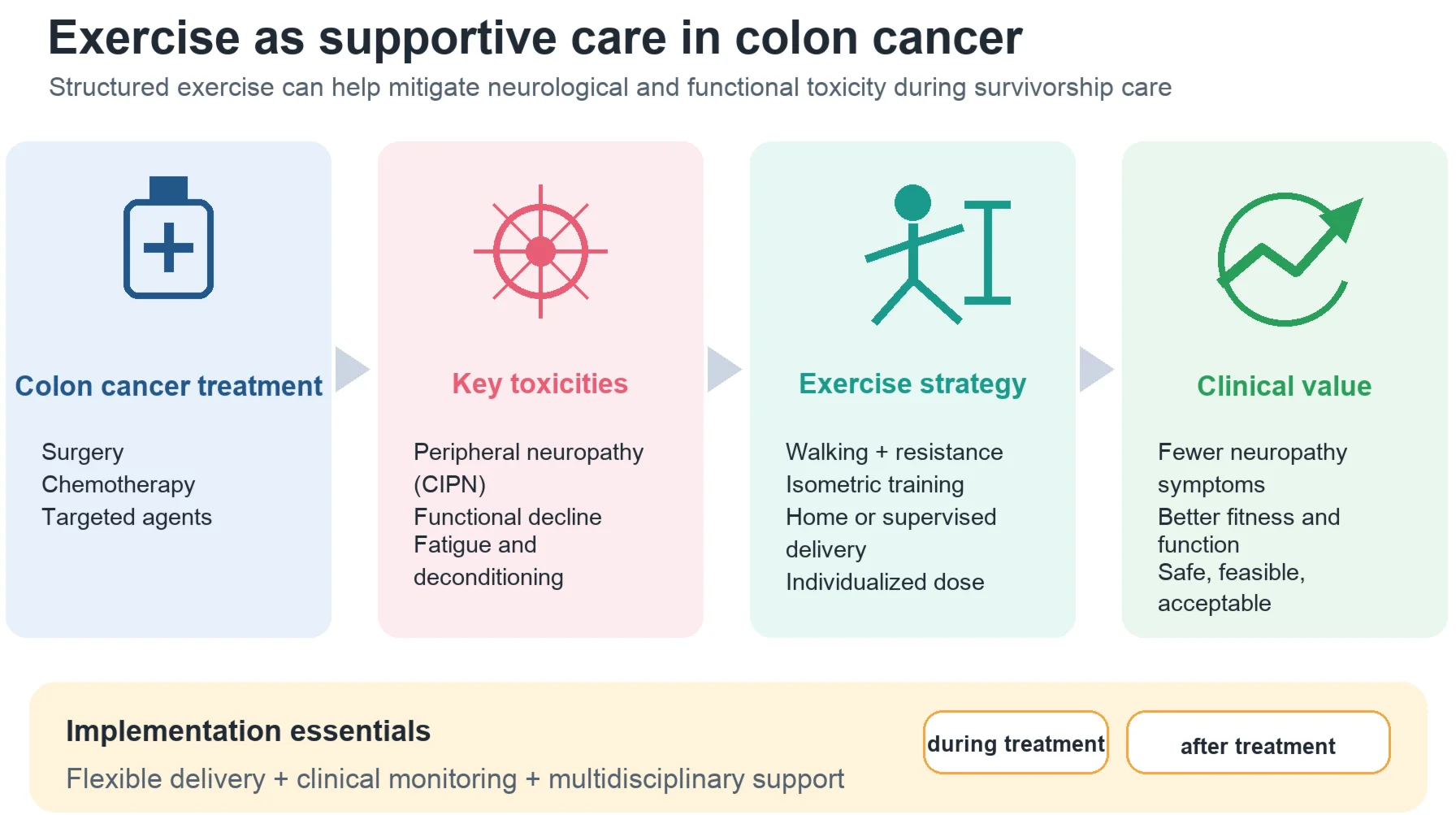
- Structured exercise may help mitigate colon cancer treatment-related toxicity, especially chemotherapy-induced peripheral neuropathy and postoperative functional decline.
- Walking, resistance, isometric, and home-based exercise programs were safe, feasible, and well tolerated during or after treatment.
- Individualized prescription, flexible delivery, and multidisciplinary support appear central to adherence and successful implementation.
- Larger colon-specific trials are needed to define optimal exercise type, dose, timing, and long-term effects.
1. Introduction
Colorectal cancer is among the most common malignancies worldwide and consistently ranks as one of the leading causes of cancer-related mortality [1]. Within this spectrum, colon cancer accounts for a substantial proportion of cases and deaths, contributing notably to global disease burden [1]. In many countries, including European settings, colon and colorectal cancers represent a major public health challenge due to their high incidence, frequent diagnosis at advanced stages, and the long-term sequelae of treatment [2].
Therapeutic strategies for colon cancer typically include curative-intent surgery, adjuvant or palliative chemotherapy based on fluoropyrimidines (e.g., 5-fluorouracil or capecitabine), often combined with oxaliplatin, and increasingly, targeted agents such as bevacizumab or epidermal growth factor receptor (EGFR) inhibitors in the metastatic setting [3]. While these regimens have improved disease-free and overall survival in many patients, they are associated with a broad spectrum of toxicities that may limit dose intensity, necessitate treatment delays or discontinuation, and substantially impair health-related quality of life [4, 5].
Among the most clinically relevant toxicities is chemotherapy-induced peripheral neuropathy (CIPN), particularly associated with oxaliplatin and taxanes. CIPN manifests as numbness, tingling, dysesthesia, or pain in the extremities, can persist long after treatment completion, and is a leading cause of dose reduction or early cessation of therapy [6, 7]. Fluoropyrimidines central to colon cancer chemotherapy can also cause severe adverse events, including mucositis, myelosuppression, gastrointestinal toxicity, and cardiotoxicity, especially in individuals with dihydropyrimidine dehydrogenase (DPD) deficiency [8]. The recognition of DPYD gene variants and their strong association with fluoropyrimidine-related toxicity has underscored the importance of pharmacogenetic screening in selected patients [8].
Surgery, another cornerstone of treatment, carries its own toxicity profile, particularly in older or frail patients. Postoperative complications, pain, muscle wasting, and functional decline are frequently observed and may hinder timely initiation or completion of adjuvant chemotherapy [5]. In addition, targeted therapies and biologics such as bevacizumab or cetuximab bring specific adverse events, hypertension, thromboembolic events, proteinuria, or severe cutaneous reactions that cumulatively contribute to morbidity and healthcare utilization [2].
Although the toxicity of individual agents has been extensively described in oncological trials and observational cohorts, integrative approaches that address how to mitigate these adverse effects, rather than solely describing them, remain relatively underdeveloped in clinical practice. In parallel, a growing body of evidence supports the role of physical exercise as a key component of supportive cancer care, with demonstrated benefits in fatigue, physical function, and quality of life across several tumor types [2, 5, 9, 10]. More recently, exercise has been proposed as a promising intervention to reduce CIPN symptoms and to support postoperative recovery in abdominal and colorectal cancer populations [11-14].
However, the specific intersection between (1) toxicity related to colon or colorectal cancer treatment and (2) the mitigating potential of exercise remains relatively fragmented in the literature. The present narrative review therefore aims to (a) describe the main toxicities associated with colon cancer treatment that are addressed in exercise trials and (b) synthesize clinical evidence on the role of structured physical exercise in attenuating these toxicities and improving functional outcomes.
2. Conceptual and theoretical background
2.1. Treatment-related toxicity in colon cancer
Toxicity in colon cancer treatment can be conceptualized along multiple domains:
Neurological toxicity, particularly CIPN, resulting from cumulative exposure to oxaliplatin or taxanes. This is often dose-limiting and may evolve from reversible paresthesia to persistent sensory deficits [6, 7].
Hematologic and gastrointestinal toxicity, especially with fluoropyrimidine-based regimens, leading to neutropenia, anemia, diarrhea, and mucositis [8].
Functional and physical deconditioning, commonly observed after major abdominal surgery and during chemotherapy, driven by reduced physical activity, muscle atrophy, fatigue, and systemic inflammation [5].
Psychosocial and behavioral toxicity, encompassing fatigue, mood changes, reduced self-efficacy, and fear of movement, which may further hinder physical activity and rehabilitation [9].
These domains interact. For instance, CIPN can impair balance and gait, increasing fall risk and limiting engagement in physical activity; postoperative pain and fatigue can reduce mobility, exacerbating muscle loss and functional decline.
2.2. Rationale for exercise as a supportive strategy
Exercise oncology research has consistently shown that well-designed exercise programs are safe, feasible, and beneficial across a wide range of cancer populations, including patients undergoing chemotherapy and survivors in the post-treatment phase [2, 5, 10]. Mechanistically, exercise may:
Improve cardiorespiratory fitness and muscular strength, buffering the impact of treatment-induced deconditioning [2, 13].
Modulate inflammatory and neurotrophic pathways, which could influence the development or severity of CIPN [6, 7].
Enhance self-efficacy, reduce fatigue and depressive symptoms, and provide a sense of control over the disease trajectory [9, 5].
Support impairment-driven rehabilitation, where exercise is tailored to the primary functional deficits caused by cancer and its treatments [5].
Against this backdrop, a small but growing number of studies have specifically evaluated exercise as a means to mitigate treatment-related toxicity in patients with colon or colorectal cancer.
3. Evidence from exercise-based interventions targeting toxicity
3.1. Overview of included studies
Four key studies were central to the present synthesis: a multicenter randomized controlled trial evaluating exercise during chemotherapy [12], a qualitative investigation of isometric resistance training after abdominal cancer surgery [11], a randomized trial of home-based exercise in colorectal cancer survivors [13], and a process-evaluation protocol for a home-based exercise intervention among women with taxane-induced neuropathy [14].
Collectively, these studies addressed:
– Neurological toxicity (especially CIPN).
– Postoperative and post-treatment functional outcomes.
– Feasibility, acceptability, and implementation processes of exercise programs in oncological settings.
3.2. Exercise during chemotherapy and CIPN
The randomized trial by Kleckner et al. [12] is one of the most informative studies regarding exercise and CIPN. In this multicenter study, 355 patients (predominantly women with breast cancer, but including colorectal cases) receiving neurotoxic chemotherapy were randomized to usual care or to the EXCAP program, a 6-week home-based walking and resistance exercise intervention. CIPN symptoms (numbness, tingling, and sensitivity to cold and heat) were self-reported before and after the intervention.
Kleckner et al. [12] observed that exercise significantly reduced cold and heat sensitivity ( .045) and showed a trend toward improvement in numbness and tingling ( .061). Subgroup analyses suggested stronger benefits among men, older adults, and patients with breast cancer, indicating that demographic and clinical factors may moderate the effects of exercise on CIPN [12]. Although not limited to colon cancer, these findings provide biological and clinical proof-of-concept that exercise can modulate neurotoxic symptoms emerging during chemotherapy.
These results align with broader narrative and mechanistic reviews, which suggest that exercise may influence nerve health through improved microvascular function, modulation of inflammatory mediators, and up-regulation of neurotrophic factors [6, 7]. However, most existing data are derived from heterogeneous cancer populations, and colon cancer-specific analyses are still relatively scarce.
3.3. Isometric resistance exercise after abdominal cancer surgery
In the qualitative study by Hashem et al. [11], patients undergoing abdominal cancer surgery (including colorectal procedures) participated in an isometric resistance exercise program. Through postoperative telephone interviews and thematic analysis, the authors explored perceptions of safety, feasibility, and acceptability of early isometric exercises implemented in hospital and continued at home.
Patients reported that the exercises were safe, appropriate, and adaptable to their postoperative condition [11]. They valued clear instructions and the possibility of gradual progression. Some participants reported difficulties with self-assessment tools, highlighting the need for simple, user-friendly metrics in routine clinical practice [11]. From a toxicity standpoint, these findings suggest that early low-intensity resistance exercise can be introduced without increasing complications, potentially supporting functional recovery and mitigating the decline associated with surgical trauma and bed rest, although specific quantitative toxicity metrics were not the primary outcome.
3.4. Home-based exercise in colorectal cancer survivors
Lee et al. [13] conducted a randomized controlled trial evaluating a 6-week home-based exercise program in colorectal cancer survivors who had completed primary treatment. The intervention targeted improvements in physical activity and functional fitness using simple, progressive exercises that could be performed at home without specialized equipment. Physical fitness was assessed using standardized tests such as step and push-up tasks.
The intervention group achieved significant improvements in physical activity levels and physical fitness compared with controls, with high adherence and no serious exercise-related adverse events [13]. Although CIPN and other specific toxicities were not the primary endpoints, improvements in functional capacity and the absence of safety concerns provide indirect evidence that home-based exercise is both feasible and well tolerated in colorectal cancer survivors recovering from the cumulative burden of surgery and chemotherapy.
3.5. Process evaluation of a home-based exercise program for Taxane-induced neuropathy
The process-evaluation protocol described by Ozorio Dutra et al. [14] focused on women with taxane-induced peripheral neuropathy participating in a home-based exercise intervention. The study evaluated fidelity, adaptability, acceptability, and participant engagement through qualitative interviews and structured logs.
Preliminary findings indicated high fidelity to the intervention, strong acceptability, and successful adaptation to individual needs [14]. Participants actively engaged in tailoring exercise routines to their daily lives, reinforcing the role of patient-centered design in maximizing adherence and sustained behavior change. Although this study did not report quantitative outcomes on toxicity reduction, it highlights the implementation processes that underpin effective exercise oncology programs and are directly relevant when translating protocols to colon cancer populations receiving neurotoxic chemotherapy.
4. Discussion
4.1. Consistent signals of benefit across heterogeneous designs
Despite methodological heterogeneity, the four core studies converge on several key points:
Safety and feasibility: Across randomized trials and qualitative investigations, exercise interventions were consistently safe, with no serious adverse events reported [11-14]. This is in line with broader exercise oncology literature demonstrating that structured exercise, when appropriately prescribed, has a favorable safety profile during and after cancer treatment [2, 5].
Adherence and acceptability: High adherence and positive patient perceptions were repeatedly documented, particularly when interventions were simple, flexible, and home-based [11-14]. These findings mirror previous reports in other cancer and non-cancer populations, showing that home-based and behaviorally supported exercise programs can achieve robust uptake [9, 15].
Potential for toxicity mitigation: Kleckner et al. [12] provided direct evidence that exercise can attenuate specific CIPN symptoms during chemotherapy, while the other studies documented improvements in physical function and postoperative recovery potential without exacerbating complications [11, 13]. These outcomes support the conceptual model in which exercise serves both as a protective and rehabilitative modality in the context of treatment-related toxicity.
Taken together, these data suggest that exercise can be integrated as an adjunct to standard treatment to mitigate selected toxicities, particularly neurological and functional impairments. However, the colon cancer-specific evidence base remains modest, as many trials involve mixed tumor cohorts.
4.2. Mechanistic considerations
While direct mechanistic data in colon cancer are limited, several plausible pathways have been proposed to explain the beneficial effects of exercise on chemotherapy-related toxicity:
Neurovascular and neurotrophic effects: Aerobic and resistance exercise may enhance peripheral nerve blood flow and up-regulate neurotrophic factors (e.g., brain-derived neurotrophic factor), potentially supporting nerve repair and dampening neurotoxic damage [6, 7].
Anti-inflammatory and metabolic modulation: Exercise can reduce systemic inflammation and improve glucose and lipid metabolism, which may influence drug metabolism, microvascular function, and pain processing [2, 10].
Muscle preservation and functional reserve: By attenuating sarcopenia and improving strength, exercise increases functional reserve, enabling patients to better tolerate treatment-induced fatigue and deconditioning [13, 5].
Psychological and behavioral mechanisms: Exercise can reduce anxiety, depressive symptoms, and cancer-related fatigue and enhance self-efficacy, which may indirectly support adherence to oncological treatments and self-management of toxicity [9, 5].
Although these mechanisms are biologically plausible and supported by indirect evidence, direct mechanistic trials in colon cancer populations are still scarce. This information is not present in the provided text at the level of specific biomarkers or detailed mechanistic pathways.
4.3. Clinical and practical implications
The findings of the reviewed studies have several practical implications for clinicians involved in the care of patients with colon or colorectal cancer:
Early integration of exercise: Exercise can be introduced during chemotherapy or in the immediate postoperative period, provided that programs are individualized and supervised or monitored appropriately [11-13].
Home-based and hybrid models: Simple, home-based programs with minimal equipment are feasible and can overcome logistical barriers such as travel distance, cost, and time constraints [13-15].
Personalization: Demographic and clinical characteristics (e.g., age, baseline physical capacity, comorbidities, neuropathy severity) appear to moderate exercise responses [12, 6]. Tailoring intensity, frequency, and modality to these factors is essential, in line with impairment-driven rehabilitation principles [5].
Interdisciplinary collaboration: Effective implementation requires coordination between oncologists, surgeons, physiotherapists, exercise professionals, and nursing staff to ensure that exercise prescriptions are safe, realistic, and aligned with treatment schedules [2, 5].
In summary, current evidence supports the clinical integration of exercise as part of a comprehensive strategy to manage and mitigate toxicity in colon cancer treatment, even though optimally designed colon-specific protocols are still lacking.
5. Gaps in knowledge and future research directions
Despite promising signals, several key gaps remain:
Colon-specific trials: Many existing studies include heterogeneous cancer types, and colon cancer–specific subgroup data are rarely reported separately. Future randomized controlled trials should be designed explicitly for colon or colorectal cancer populations, especially those receiving oxaliplatin-based chemotherapy.
Standardization of exercise dose: The optimal type, intensity, frequency, and timing of exercise to prevent or reduce CIPN and postoperative decline are not yet defined [2, 6]. Dose-response studies are needed.
Mechanistic endpoints: Few trials incorporate mechanistic outcomes such as nerve conduction studies, neurotrophic biomarkers, or detailed neurophysiological assessments. Such measures would strengthen causal inferences regarding exercise effects on CIPN. This information is not present in the provided text in detail.
Long-term follow-up: Most interventions are relatively short (e.g., 6-week programs). Long-term follow-up is necessary to determine whether benefits on neuropathy and function are sustained and whether exercise influences treatment adherence, hospitalization, or survival [4, 5].
Implementation research: Process evaluations such as that by Ozorio Dutra et al. [14] are still rare but crucial to understand how to scale exercise programs within real-world oncology services, especially in resource-constrained settings.
6. Conclusions
Colon cancer treatments, particularly surgery and fluoropyrimidine- and oxaliplatin-based chemotherapy, are associated with substantial toxicity that can compromise functional status, treatment adherence, and quality of life. Among these adverse effects, chemotherapy-induced peripheral neuropathy and postoperative deconditioning are particularly impactful.
The current body of evidence, although limited in size, indicates that structured physical exercise is a safe, acceptable, and potentially effective adjunctive strategy for mitigating selected toxicities, notably CIPN and functional decline, in patients undergoing or recovering from colon or colorectal cancer treatment [11-14]. Exercise interventions that are individualized, flexible (including home-based delivery), and supported by multidisciplinary teams appear most promising.
Integration of exercise into standard oncology care should therefore be encouraged, in accordance with existing international exercise guidelines for cancer survivors [2]. At the same time, larger, colon-specific randomized trials with mechanistic and long-term outcomes are urgently needed to refine exercise prescriptions and fully establish their role in reducing treatment-related toxicity in this population.
References
-
H. Sung et al., “Global cancer statistics 2020: GLOBOCAN estimates of incidence and mortality worldwide for 36 cancers in 185 countries,” CA: A Cancer Journal for Clinicians, Vol. 71, No. 3, pp. 209–249, Feb. 2021, https://doi.org/10.3322/caac.21660
-
K. L. Campbell et al., “Exercise guidelines for cancer survivors: consensus statement from international multidisciplinary roundtable,” Medicine and Science in Sports and Exercise, Vol. 51, No. 11, pp. 2375–2390, Nov. 2019, https://doi.org/10.1249/mss.0000000000002116
-
K. S. Courneya and C. M. Friedenreich, “Physical activity and cancer control,” in Seminars in Oncology Nursing, Vol. 23, No. 4, pp. 242–252, Nov. 2007, https://doi.org/10.1016/j.soncn.2007.08.002
-
J. Feliu et al., “Prediction of chemotoxicity, unplanned hospitalizations and early death in older patients with colorectal cancer treated with chemotherapy,” Cancers, Vol. 14, No. 1, p. 127, Dec. 2021, https://doi.org/10.3390/cancers14010127
-
F. Hashem et al., “Acceptability and feasibility of an isometric resistance exercise program for abdominal cancer surgery: an embedded qualitative study,” Cancer Control, Vol. 27, No. 1, Oct. 2020, https://doi.org/10.1177/1073274820950855
-
L. M. Henricks et al., “DPYD genotype-guided dose individualisation of fluoropyrimidine therapy in patients with cancer: a prospective safety analysis,” The Lancet Oncology, Vol. 19, No. 11, pp. 1459–1467, Nov. 2018, https://doi.org/10.1016/s1470-2045(18)30686-7
-
I. R. Kleckner et al., “Effects of exercise during chemotherapy on chemotherapy-induced peripheral neuropathy: a multicenter, randomized controlled trial,” Supportive Care in Cancer, Vol. 26, No. 4, pp. 1019–1028, Dec. 2017, https://doi.org/10.1007/s00520-017-4013-0
-
M. K. Lee, N. K. Kim, and J. Y. Jeon, “Effect of the 6-week home-based exercise program on physical activity level and physical fitness in colorectal cancer survivors: A randomized controlled pilot study,” PLOS ONE, Vol. 13, No. 4, p. e0196220, Apr. 2018, https://doi.org/10.1371/journal.pone.0196220
-
C. G. Maher, C. Sherrington, R. D. Herbert, A. M. Moseley, and M. Elkins, “Reliability of the PEDro scale for rating quality of randomized controlled trials,” Physical Therapy, Vol. 83, No. 8, pp. 713–721, Aug. 2003, https://doi.org/10.1093/ptj/83.8.713
-
S. Mijwel et al., “Adding high-intensity interval training to conventional training modalities: optimizing health-related outcomes during chemotherapy for breast cancer: the OptiTrain randomized controlled trial,” Breast Cancer Research and Treatment, Vol. 168, No. 1, pp. 79–93, Nov. 2017, https://doi.org/10.1007/s10549-017-4571-3
-
S. V. Ozorio Dutra, L. Schwab, J. Coury, M. Ji, and C. Visovsky, “Process evaluation protocol plan for a home-based physical activity intervention versus educational intervention for persistent taxane-induced peripheral neuropathy (B-HAPI study): a randomized controlled trial,” BMC Cancer, Vol. 24, No. 1, p. 240, Jun. 2024, https://doi.org/10.1186/s12885-024-12444-x
-
B. M. Pinto, S. I. Dunsiger, M. J. Waldemore, and B. H. Marcus, “Acceptability and feasibility of a home-based physical activity intervention for postpartum women: Project MOVE,” Maternal and Child Health Journal, Vol. 17, No. 2, pp. 346–355, 2013.
-
L. C. Schmitt, M. S. Ferrara, and G. D. Deyle, Exercise for chemotherapy-induced peripheral neuropathy: A narrative review,” PM&R, Vol. 12, No. 11, pp. 1179–1180, Nov. 2020, https://doi.org/10.1002/pmrj.12511
-
J. K. Silver, J. Baima, and R. S. Mayer, “Impairment‐driven cancer rehabilitation: An essential component of quality care and survivorship,” CA: A Cancer Journal for Clinicians, Vol. 63, No. 5, pp. 295–317, Jul. 2013, https://doi.org/10.3322/caac.21186
-
J. Taieb and C. Gallois, “Adjuvant chemotherapy for stage III colon cancer,” Cancers, Vol. 12, No. 9, p. 2679, Sep. 2020, https://doi.org/10.3390/cancers12092679
-
K. Y. Wonders and D. G. Drury, “The effects of exercise on chemotherapy-induced peripheral neuropathy,” Current Oncology Reports, Vol. 20, No. 10, p. 72, 2018.
About this article

The authors have not disclosed any funding.
The datasets generated during and/or analyzed during the current study are available from the corresponding author on reasonable request.
Rafael Peixoto was responsible for the conceptualization and design of the study, development of methodology, formal analysis, supervision, and project administration, and led the writing of the original draft as well as the review and editing of the manuscript. Tiago Rafael Moreira contributed to the methodological design, formal analysis, validation of the results, and critically reviewed and edited the manuscript. Alexandra Malheiro contributed to data collection, data curation, visualization, and participated in the review and editing of the manuscript. Cristiana Freire, Inês Teixeira, Matilde Adegas, Rafael Gomes, Ricardo Rabaçal, and Sara Silva contributed to the investigation and data curation. All authors reviewed and approved the final version of the manuscript.
The authors declare that they have no conflict of interest.

