Abstract
Traumatic peripheral facial paralysis is a disabling condition that may compromise facial expression, mastication, swallowing, speech, and quality of life. Although several rehabilitation approaches have been proposed, evidence regarding the long-term outcomes of oral proprioceptive stimulation remains limited. A 68-year-old man developed traumatic peripheral facial paralysis following surgery for a cerebellopontine angle tumor in 2003. After several unsuccessful rehabilitation attempts, a hyperboloid-based oral proprioceptive rehabilitation protocol was initiated in 2010. The patient performed intraoral exercises three times daily and underwent clinical follow-up for 12 years. Clinical improvement was first documented approximately 45 days after treatment initiation, with restoration of lip competence. Subsequent improvements included reduced drooling and liquid leakage, better mastication and oral bolus control, improved speech intelligibility and facial symmetry, and increased social participation. Functional gains were maintained throughout the long-term follow-up period with individualized maintenance exercises. This case describes sustained functional improvements observed during long-term follow-up after rehabilitation using a hyperboloid-based oral proprioceptive protocol. Although stimulation of the stomatognathic system may have contributed to the observed functional recovery, treatment effectiveness cannot be established from a single case. Further prospective studies using standardized outcome measures are needed to investigate the potential role of this therapeutic approach.
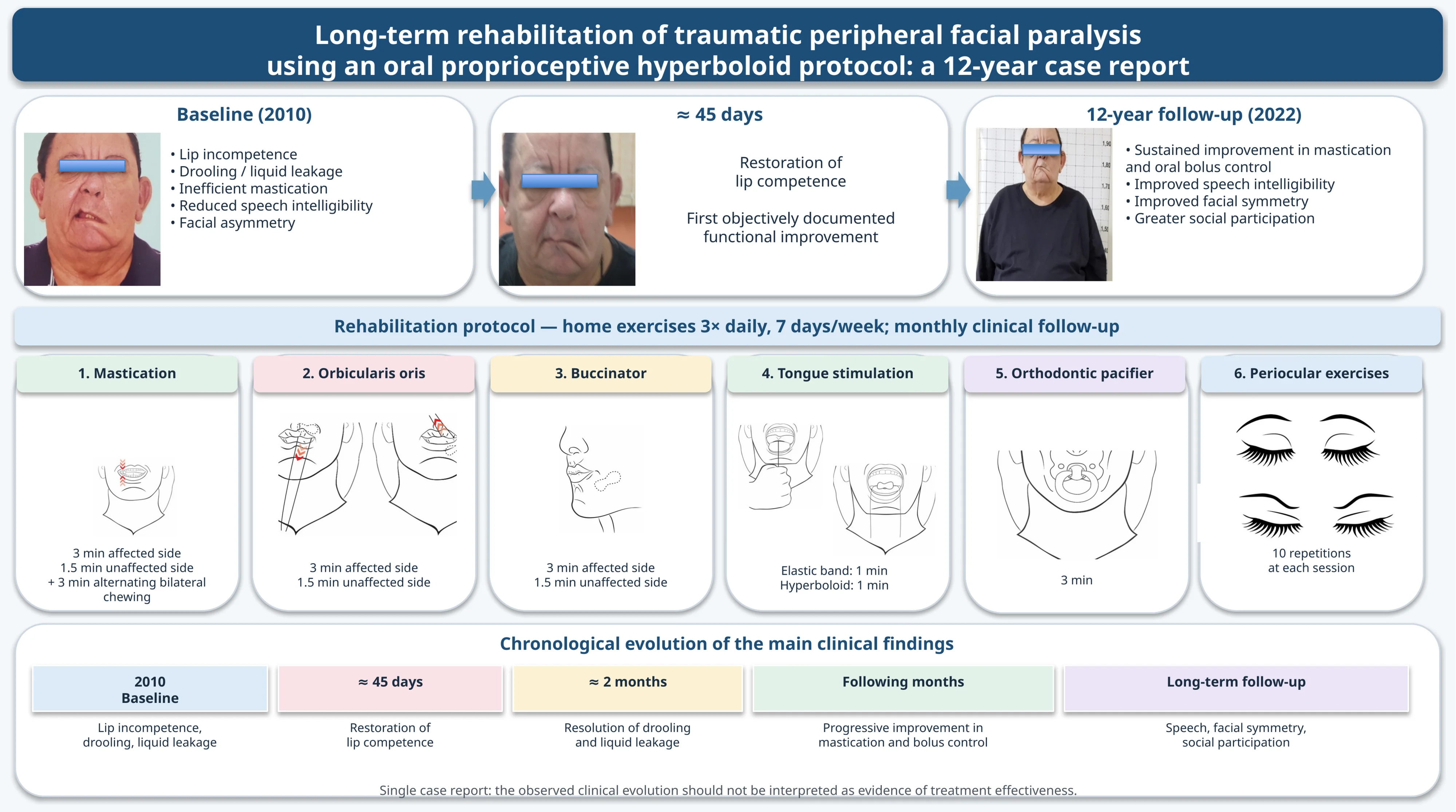
Highlights
- A 12-year follow-up documented the clinical evolution of traumatic peripheral facial paralysis during structured oral proprioceptive rehabilitation.
- Lip competence was restored approximately 45 days after rehabilitation initiation, representing the first objectively documented functional improvement.
- Progressive improvements were observed in mastication, oral bolus control, speech intelligibility, facial symmetry, and social participation.
- This single case provides long-term clinical documentation and supports further investigation of oral proprioceptive rehabilitation using standardized outcome measures.
1. Introduction
Traumatic peripheral facial paralysis is a disabling neurological condition that frequently results in persistent impairment of facial motor function and essential oral activities, including lip competence, mastication, swallowing, speech intelligibility, eye closure, and facial expression [1-3]. Beyond these functional deficits, facial paralysis may substantially affect emotional well-being, social participation, occupational performance, and overall quality of life. Several rehabilitation strategies have been proposed, including facial neuromuscular re-education, proprioceptive stimulation, and multidisciplinary rehabilitation programs. However, the available evidence remains heterogeneous regarding treatment protocols and clinical outcomes. Furthermore, most published studies focus on short-term interventions, whereas detailed longitudinal descriptions of functional recovery following rehabilitation remain scarce. In particular, few reports have documented the chronological sequence of recovery across different oral functions over extended follow-up periods [4]. Oral proprioceptive rehabilitation aims to improve neuromuscular control through repetitive, task-oriented stimulation of the stomatognathic system. From a biological perspective, repeated proprioceptive stimulation may promote sensorimotor integration and activity-dependent neuroplasticity, mechanisms associated with functional recovery following peripheral nerve injury. Although the precise mechanisms remain incompletely understood, these concepts provide a plausible biological rationale for structured rehabilitation programs in patients with peripheral facial paralysis [5]. Therefore, the purpose of this case report was to document the long-term clinical evolution of a patient with chronic traumatic peripheral facial paralysis who underwent a structured oral proprioceptive rehabilitation program over a 12-year follow-up period. Rather than demonstrating treatment efficacy, this report aims to describe the chronological pattern of functional recovery observed during rehabilitation and to provide clinically relevant longitudinal observations that may support future prospective studies using standardized outcome measures.
2. Case presentation
A 68-year-old male patient presented with chronic left-sided partial traumatic peripheral facial paralysis following facial nerve injury secondary to vestibular schwannoma resection performed in 2003. Structured oral proprioceptive rehabilitation was initiated in 2010, seven years after the neurological injury. Despite being retired, the patient remained professionally active as an ISO 9000 quality management consultant, a position that required frequent verbal communication during meetings, technical consultations, and presentations. Throughout the 12-year follow-up period, the patient demonstrated excellent adherence to the rehabilitation protocol, attending monthly clinical appointments and regularly performing the prescribed home exercises. Between 2003 and 2010, the patient underwent multiple rehabilitation interventions in an attempt to improve facial function. Despite these interventions, satisfactory and sustained functional recovery was not achieved. Because significant functional impairment persisted, a structured oral proprioceptive rehabilitation program based on Cheida’s protocol was initiated in 2010. At the initial clinical evaluation, the patient presented with marked impairment of lip competence, mastication, oral bolus control, speech intelligibility, facial expression, and facial symmetry. Following the onset of facial paralysis, he developed a habitual preference for chewing on the right (unaffected) side. During meals, food frequently accumulated within the left buccal vestibule because of reduced buccinator muscle function, requiring repeated external manual compression of the left cheek to reposition the food bolus for chewing and swallowing. When this maneuver was insufficient, retained food was manually removed from the oral cavity. Incomplete lip competence resulted in spontaneous drooling and frequent leakage of liquids during drinking. Speech impairment significantly affected daily communication, particularly during telephone conversations, during which listeners frequently asked him to repeat himself. Owing to these functional limitations and the evident facial asymmetry, the patient progressively withdrew from social situations and professional activities requiring prolonged interpersonal communication. The patient was edentulous in the maxillary arch and rehabilitated with a complete maxillary denture. The mandibular arch was rehabilitated with a removable partial overdenture retained by two O-ring attachments. Masticatory training was performed while wearing both prostheses to reproduce functional chewing. All subsequent oral proprioceptive exercises using the hyperboloid and the orthodontic pacifier were performed without the prostheses to allow direct stimulation of the oral soft tissues and perioral musculature. Baseline clinical documentation consisted of routine clinical examination and serial photographic records obtained throughout the follow-up period. The initial photograph was obtained at a radiology center before treatment. A second photograph, taken approximately 45 days after treatment initiation during a routine clinical visit, was not standardized because the unexpectedly favorable clinical evolution had not yet suggested the future scientific relevance of the case. As rehabilitation progressed, subsequent photographs were prospectively obtained under standardized conditions in the same clinical setting, using a tripod and the same mobile device whenever possible, allowing consistent longitudinal documentation throughout the 12-year follow-up period.
3. Rehabilitation protocol – exercises
The rehabilitation program was based on the structured oral proprioceptive rehabilitation protocol described by Cheida and was individually adapted according to the patient’s functional limitations [9]. The primary therapeutic goals were to restore lip competence, improve oral bolus control, enhance masticatory function, optimize facial muscle coordination, and progressively improve speech intelligibility through repeated functional stimulation of the stomatognathic system. The patient attended monthly clinical follow-up appointments throughout the rehabilitation period, except for an approximately two-month interruption during the COVID-19 pandemic. At each visit, exercise performance was reviewed, technique was corrected whenever necessary, and the rehabilitation program was adjusted according to the patient's clinical evolution. The patient demonstrated excellent adherence to treatment. Home-based exercises were performed three times daily, seven days per week, throughout the rehabilitation period. Masticatory training was performed while wearing both the maxillary complete denture and the mandibular removable partial overdenture. The patient chewed the hyperboloid for 3 minutes on the affected (left) side, followed by 1.5 minutes on the unaffected (right) side. The exercise concluded with 3 minutes of alternating bilateral chewing to promote coordinated functional activity on both sides of the stomatognathic system.
For reproducibility, the complete rehabilitation protocol is summarized in Table 1.
Table 1Rehabilitation protocol
Component | Description |
Home exercise frequency | Three sessions per day, performed every day of the week |
Clinical follow-up | Monthly clinical reassessment throughout rehabilitation. Follow-up was interrupted for approximately two months during the COVID-19 pandemic because of public health restrictions |
Chewing exercise | Performed while wearing the maxillary complete denture and mandibular removable partial overdenture. The patient chewed the hyperboloid for 3 min on the affected side, 1.5 min on the unaffected side, followed by 3 min of alternating bilateral chewing |
Orbicularis oris | Performed without prostheses for 3 min on the affected side and 1.5 min on the unaffected side |
Buccinator | Performed without prostheses for 3 min on the affected side and 1.5 min on the unaffected side |
Tongue stimulation | Performed without prostheses using an elastic band (1 min) followed by the hyperboloid (1 min) |
Orthodontic pacifier | Performed without prostheses for 3 min |
Periocular exercises | Ten repetitions at each rehabilitation session |
4. Results
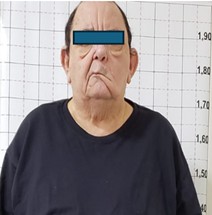
Progressive functional recovery was documented throughout the 12-year follow-up period based on serial clinical examinations, photographic records, and patient-reported functional outcomes. The earliest clinically documented improvement was restoration of lip competence, observed approximately 45 days after initiation of the rehabilitation program (Figs. 1 and 2). This represented the first objectively documented clinical sign of recovery and marked the beginning of progressive restoration of oral function. Approximately two months after treatment initiation, spontaneous drooling resolved, and leakage of liquids during drinking was no longer observed. These findings reflected recovery of oral competence under both resting and functional conditions and represented meaningful functional gains in the patient's daily life. During the following months, mastication and oral bolus control progressively improved. Food retention within the left buccal vestibule gradually decreased, resulting in a reduced need for manual compression of the left cheek to reposition the food bolus during chewing. These functional gains developed gradually throughout rehabilitation rather than occurring simultaneously. Speech intelligibility also improved progressively during follow-up. According to the patient’s reports, telephone conversations became easier. One particularly meaningful milestone occurred when he was able to place a pizza order by telephone without repeatedly being asked to repeat himself. Although this observation represents a patient-reported functional outcome rather than a standardized clinical measure, it illustrates how improved speech intelligibility translated into a meaningful benefit in everyday communication. Progressive improvements in facial symmetry and oral motor control were also observed throughout long-term follow-up. As functional recovery advanced, the patient gradually resumed social interactions and professional activities that he had previously avoided because of the functional limitations associated with facial paralysis. Overall, functional recovery followed a sequential pattern rather than occurring simultaneously across all functional domains. Restoration of lip competence preceded the resolution of drooling and liquid leakage, followed by gradual improvements in mastication, oral bolus control, speech intelligibility, facial symmetry, and social participation (Figs. 3 and 4). The chronological progression of the main clinical findings is summarized in Table 2.
Fig. 1Baseline (2010)
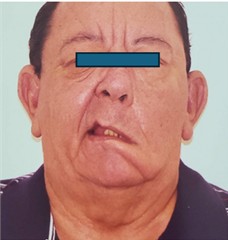
Fig. 2Approximately 45 days after treatment initiation
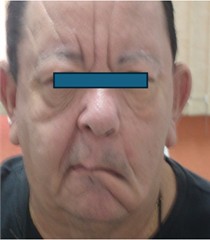
Fig. 3Follow-up in 2017
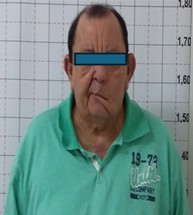
Fig. 4Follow-up in 2022
5. Discussion
The present case report describes the long-term clinical evolution of a patient with traumatic peripheral facial paralysis who underwent a structured oral proprioceptive rehabilitation protocol over a 12-year follow-up period. Because this report describes the clinical course of a single patient, the observations presented should not be interpreted as evidence of treatment effectiveness. Instead, they provide a carefully documented description of functional changes observed during long-term rehabilitation and may contribute to the generation of hypotheses for future clinical investigations. The progressive functional changes observed throughout follow-up are biologically compatible with current concepts of neuroplasticity and sensorimotor rehabilitation. Repeated activation of oral sensory receptors through structured functional exercises may stimulate adaptive neural reorganization within the sensorimotor system [5, 6].
Table 2Chronological summary of the main clinical findings and their functional significance during the 12-year follow-up period
Follow-up period | Main clinical findings | Functional significance |
Baseline (2010), Fig. 1 | Lip incompetence, drooling, liquid leakage, right-sided chewing preference, food retention requiring external cheek compression and manual removal, reduced speech intelligibility, and facial asymmetry | Severe impairment of oral function and social communication |
≈ 45 days, Fig. 2 | Restoration of lip competence | First objectively documented functional improvement |
≈ 2 months | Resolution of drooling and liquid leakage | Recovery of oral competence during rest and drinking |
Following months | Progressive improvement in mastication and oral bolus control; reduced need for cheek compression | Improved chewing efficiency and oral function |
Long-term follow-up, Figs. 3 and 4 | Progressive improvement in speech intelligibility, facial symmetry, social participation, and return to professional activities | Sustained functional improvements documented over the 12-year follow-up period |
Although the present report cannot establish a causal relationship, the observed clinical evolution is consistent with the current understanding of the nervous system's capacity to adapt to repeated sensory and motor stimulation following neurological injury. The rehabilitation protocol employed in this case emphasized repeated functional activation of the stomatognathic system through chewing exercises and oral motor stimulation. The trigeminal sensory system plays a central role in processing proprioceptive information arising from the masticatory muscles, oral mucosa, tongue, and temporomandibular joints. Experimental and clinical studies suggest that mastication contributes not only to oral function but also to broader sensorimotor integration. Within this context, the structured rehabilitation protocol described by Cheida provides a biologically plausible approach for continuous proprioceptive stimulation during oral rehabilitation [7-9]. An important aspect of the present case was the patient's sustained adherence to the rehabilitation program. Home exercises were reportedly performed three times daily, seven days per week, and were reinforced during monthly clinical follow-up visits. Such adherence allowed continuous adjustment of the rehabilitation program and consistent longitudinal observation of the patient's functional evolution. Nevertheless, because this is a single case report, it is not possible to determine the relative contribution of patient adherence, professional follow-up, or any individual component of the rehabilitation protocol to the observed clinical changes. The present report has important limitations. Functional assessment was based primarily on serial clinical examinations and photographic documentation rather than on validated facial grading systems. Because rehabilitation was initiated as part of routine clinical practice, standardized outcome measures such as the House–Brackmann scale were not available. In addition, early photographic records were not initially obtained under standardized research conditions. These limitations should be considered when interpreting the present findings. Nevertheless, the prolonged follow-up period, detailed description of the rehabilitation protocol, and continuous clinical documentation represent important strengths of this report. Although the present observations cannot establish treatment effectiveness, they document the long-term clinical evolution of a patient undergoing a structured oral proprioceptive rehabilitation program. Carefully documented case reports remain valuable for generating clinically relevant hypotheses and guiding future prospective studies using standardized outcome measures [10-12].
6. Conclusions
This case report documents the progressive functional improvements observed over a 12-year follow-up period in a patient with chronic traumatic peripheral facial paralysis who underwent a structured oral proprioceptive rehabilitation program. The observed functional changes followed a sequential pattern, beginning with restoration of lip competence and progressing to improvements in oral competence, mastication, oral bolus control, speech intelligibility, facial symmetry, and social participation. Although causality cannot be established from a single clinical observation, the chronological documentation of these functional changes provides a clinically relevant description of long-term rehabilitation. This report highlights the importance of systematic longitudinal clinical documentation for understanding functional changes in patients with traumatic peripheral facial paralysis and may contribute to the design of future prospective studies using standardized outcome measures to investigate oral proprioceptive rehabilitation.
References
-
L. A. L. Resende and S. Weber, “Peripheral facial palsy in the past: Contributions from Avicenna, Nicolaus Friedreich and Charles Bell,” Arquivos De Neuro-Psiquiatria, Vol. 66, No. 3b, pp. 765–769, Oct. 2008, https://doi.org/10.1590/s0004-282x2008000500035
-
J. H. de Lacerda Furtado, R. M. Da Silva Pires Barbosa, M. C. Conceição Da Silva, A. Gonçalves Ferreira, M. C. de Oliveira Ferreira Cardoso Pereira, and C. R. Queiroz, “Proprioceptive neuromuscular facilitation in the treatment of peripheral facial paralysis: A bibliographic review,” (in Portuguese), Revista Saúde E Desenvolvimento, Vol. 15, No. 23, pp. 21–33, 2021.
-
M. P. Dias, M. F. Ferreira Silva, and S. D. S. Barreto, “Rehabilitation of speech-language pathology in peripheral facial paralysis: integrative review,” (in Portuguese), Audiology – Communication Research, Vol. 26, p. e2478, 2021, https://doi.org/10.1590/2317-6431-2021-2478
-
M. F. F. Silva, S. V. Peres, A. Tessitore, J. R. Paschoal, and M. C. Cunha, “Application of the psychosocial facial appearance scale in the evaluation of peripheral facial paralysis: pilot study,” (in Portuguese), Audiology – Communication Research, Vol. 21, p. e1618, 2016, https://doi.org/10.1590/2317-6431-2015-1618
-
N. Dominguez-Defez, J. Lopez-Barreiro, P. Hernandez-Lucas, and A. González-Castro, “Proprioceptive neuromuscular facilitation and/or electrical stimulation in patients with peripheral facial paralysis: A systematic review,” Neurology International, Vol. 17, No. 2, p. 17, Jan. 2025, https://doi.org/10.3390/neurolint17020017
-
A. Vaughan, D. Gardner, A. Miles, A. Copley, R. Wenke, and S. Coulson, “A systematic review of physical rehabilitation of facial palsy,” Frontiers in Neurology, Vol. 11, Mar. 2020, https://doi.org/10.3389/fneur.2020.00222
-
M. G. Piancino and S. Kyrkanides, Understanding Masticatory Function in Unilateral Crossbites. Wiley, 2016, https://doi.org/10.1002/9781118971901
-
M. G. Piancino, A. Tortarolo, A. Polimeni, E. Bramanti, and P. Bramanti, “Altered mastication adversely impacts morpho-functional features of the hippocampus: A systematic review on animal studies in three different experimental conditions involving the masticatory function,” PLOS ONE, Vol. 15, No. 8, p. e0237872, 2020, https://doi.org/10.1371/journal.pone.0237872
-
A. Cheida, Hyperboloid Mastication Instrument. (in Portuguese), São Paulo, Brazil: Editora Ícone, 2004.
-
F. A. N. Borghi, “Use of hyperboloid as an adjunct in functional jaw orthopedics – Case report,” Journal of Complexity in Health Sciences, Vol. 7, No. 2, pp. 134–140, Dec. 2024, https://doi.org/10.21595/chs.2024.24352
-
F. Augusto Novo Borghi, R. Queiroz, and J. R. Gurgel Testa, “Treatment of traumatic facial paralysis with mechanical stimulus – hyperboloid: Case report,” Jaw Functional Orthopedics and Craniofacial Growth, Vol. 1, No. 2, pp. 31–35, Dec. 2021, https://doi.org/10.21595/jfocg.2021.22027
-
J. de Oliveira Farias, A. B. Moreira, L. M. Pereira, and S. B. S. Maciel, “Neurorrehabilitation with the Padovan method in newborns with congenital facial palsy: Report of 2 cases,” Amadeus International Multidisciplinary Journal, Vol. 6, No. 12, pp. 1–21, 2022.
About this article

The authors have not disclosed any funding.
The datasets generated during and/or analyzed during the current study are available from the corresponding author on reasonable request.
The authors declare that they have no conflict of interest.
This study has the approval of the relatives of the patient who died in 2022.

