Abstract
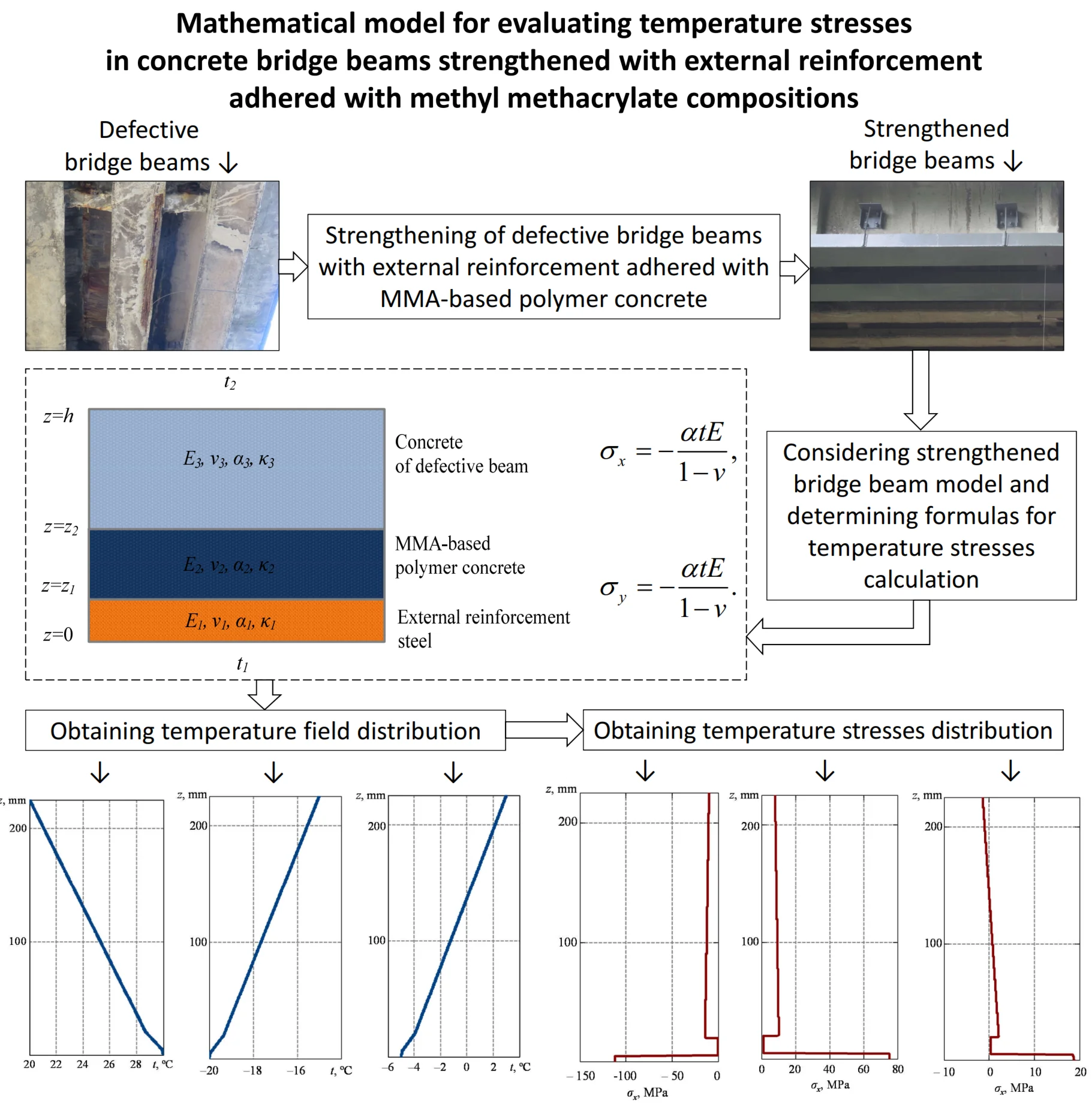
The object of the study is concrete bridge beams strengthened with external reinforcement adhered with methyl methacrylate compositions. A method for strengthening defective concrete bridge beams using methyl methacrylate based compositions is presented. A mathematical model has been improved for evaluating the temperature field and temperature stresses in a multilayer structure formed during the strengthening of defective beams with external reinforcement adhered with methyl methacrylate compositions. The distribution of temperatures and stresses in a strengthened concrete bridge beam under the influence of climatic temperature changes in the environment was investigated. A temperature gradient was found to occur at the interfaces between structural layers. At the same time, thermal stresses are also distributed unevenly in the vertical direction of the strengthened bridge beam: a discontinuity in thermal stresses occurs at the boundaries of contact between the structural layers. It has been established that under positive ambient temperatures, the magnitude of the temperature stress discontinuity in the vicinity of the contact plane between the upper edge of the polymer concrete layer and the lower edge of the reinforced concrete beam was 14.64 MPa, under the influence of negative temperatures it was 9.09 MPa, and under the influence of positive and negative temperatures on different surfaces of the beam, the maximum value of the discontinuity in thermal stresses was 1.74 MPa.
Highlights
- Temperature stress levels in the composite structure are found to be significantly higher under positive ambient temperature conditions compared to negative or alternating regimes
- Mathematical modeling validates the thermal performance of concrete bridge beams strengthened with external reinforcement adhered with methyl methacrylate compositions
- Significant temperature stress discontinuities occur at the steel-polymer interface, reaching –111.3 MPa under positive temperatures, far exceeding those at the concrete beam interface
- Analysis reveals a temperature gradient of up to 1.42°C under positive temperatures at the boundary between the MMA-based polymer concrete layer and the concrete beam
1. Introduction
Bridge structures suffer various defects and damage throughout their life cycle, and not only from natural or operational factors – military operations in Ukraine have led to significant destruction and damage to transport infrastructure, including road and railway bridges. [1]. Due to the significant number of damaged and defective bridges, it is urgent to develop new methods and technologies to restore their technical condition and load-bearing capacity. A promising repair method is the use of polymer compositions based on methyl methacrylate, which are characterized by good adhesive and cohesive properties. [2]. Methyl methacrylate (MMA) is simple and reliable to prepare, has low viscosity that does not depend on the ambient temperature, which allows it to be used outdoors at any time of the year.
The method of strengthening defective or damaged concrete bridge beams using MMA-based compositions consists of adding external reinforcement (steel sheets forming a U-shaped box [3]), which is adhered to the strengthened element using polymer concrete formed from sand impregnated with an MMA-based polymer composition [3], [4]. Fig. 1 shows typical defects in bridge span structures and the appearance of repaired outer beams using MMA-based compositions and external reinforcement.
Fig. 1Concrete beams of the bridge span structure: a), b) defects in concrete bridge beams in the form of exposure, active corrosion, and broken wire strands; c) view of the outer beams of the bridge, reinforced with MMA-adhered external reinforcement
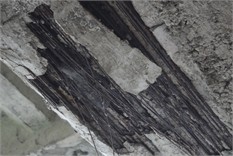
a)
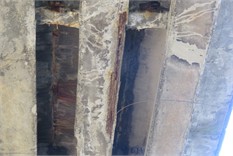
b)
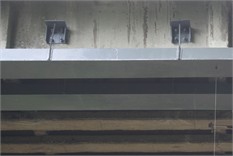
c)
The use of external reinforcement of structures with metal sheet elements has its advantages over bar reinforcement. In [5], it was established that external reinforcement of concrete structures reduces the weight of structures, which allows for steel savings of up to 12-16 % at the same height compared to reinforced concrete structures with bar reinforcement. The effectiveness of concrete elements reinforced with sheet reinforcement has also been proven experimentally in [6]. However, an important aspect of external reinforcement is ensuring reliable inclusion of external reinforcement across the entire area in conjunction with the structure as a whole [7]. This is difficult to achieve when using conventional heavy concrete without additional anchoring devices [8].
To substantiate the effectiveness of using MMA-based compositions to strengthen defective concrete bridge beams, it is necessary to conduct comprehensive studies of their stress-strain state, in particular using mathematical modeling that takes into account the influence of external factors. One such factor is climatic temperature fluctuations in the environment.
2. Literature review and problem statement
The use of acrylate compositions for repairing and strengthening building structures is a promising area: there are a number of scientific studies on the performance of adhesive joints. The polymer concrete considered in this study primarily consists of an acrylate compound. It is a subset of the general category known in Ukraine as “acrylic adhesives” – various adhesive materials based on acrylate monomers, and these materials have been widely studied.
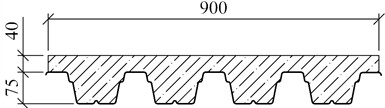
Works [9], [10] present the results of studies on the characteristics of the joint operation of steel and concrete bonded with acrylic adhesive at the manufacturing stage. To obtain experimental research results, monolithic slabs reinforced with steel profiled decking were designed, with and without a “concrete-decking” adhesive joint. The experimental samples of monolithic slabs with profiled decking had a rectangular shape with dimensions of 900×1200 mm (Fig. 2). They were formed by steel profiled decking, on top of which a 40 mm thick monolithic concrete slab was formed (excluding the filling of the corrugations). On some of the samples, acrylic adhesive was applied to the surface of the profiled decking that was in contact with the concrete before concreting.
Fig. 2Cross-section of test samples of concrete slabs with steel profiled decking
During the study of the stress-strain state of steel-reinforced concrete slabs under static load, characteristic features of their behavior were visually observed. As a result of deflection measurements, it was established that the maximum deflection in samples without adhesive bonding was 45.8 mm at a load of 17.5 kN, and in samples with adhesive bonding – 40.2 mm at a load of 30 kN. The detachment of concrete from the decking in the limit state of the samples in the absence of bonding occurred earlier than in samples with adhesive joints. The decking bonded with acrylic adhesive worked together with the concrete until the samples lost their load-bearing capacity.
The results of the studies showed that the load-bearing capacity of the tested elements, in which an adhesive bond between metal and concrete was used, was 42 % higher than that of elements without such a bond. The nature of the deflections indicates a sharp increase in deformability after the steel profiled decking detached from the concrete block in samples without bonding, but in the initial stages of loading, the deflections increased proportionally to the load. The bonding of concrete to steel using acrylic adhesive ensures the joint operation of both components of the composite structure throughout the loading process, as confirmed by the smooth increase in deflection values.
The issue of durability of steel-concrete adhesive joints was studied in [2]. Statistical processing of experimental data showed that the dependence of the time τ to joint failure on the stress in it is described by the expression:
where is the long-term strength of the adhesive joint.
The results of the studies suggest that acrylic adhesive strengthens concrete. This provides additional strength to the adhesive bond, ensuring its high reliability [2].
Research on the thermal stress state of reinforced concrete beams of highway bridge spans that were repaired with MMA-based compositions is presented in [3], [4]. In [11], the authors studied the effectiveness of using MMA-based epoxy resins to restore the mechanical properties of damaged concrete. They also did a quantitative assessment of concrete restored by injecting high molecular weight methacrylate (HMWM). The simulation results showed that HMWM can penetrate cracks with a width of 0.01 mm or more under the action of gravity. It was also found that restoring concrete with HMWM increases its stiffness and strength if the width of cracks in concrete elements exceeds 0.1 mm. Based on the results of the research, the authors found that the load-bearing capacity of repaired reinforced concrete beams is 30–40% higher than that of the original (unrepaired) beams.
In works [12-14], it has been proven that the use of MMA-based resin in the repair of concrete structures has good adhesion properties, which allows for high-quality repair of concrete structures. In addition, in works [15], [16], MMA-based resins are used to fill joints in bridge slabs. MMA-based compositions are also widely used for waterproofing transport structures [17], [18].
In works [19-21], the method of strengthening defective reinforced concrete culverts by installing a non-removable sleeve is used. The space between the defective culvert and the metal sleeve is filled with concrete mortar. At the same time, in [22], transverse stiffening ribs are used to increase the load-bearing capacity of transport structures made of corrugated metal structures. One of the disadvantages of these methods of strengthening structures is the difficulty of ensuring the joint integration of additional elements with defective structures.
The above gives grounds to assert that strengthening defective concrete bridge beams using MMA-based compositions is optimal and reliable. This is because the permanent formwork made of steel sheets will act as external reinforcement for the beams, being connected to the concrete beams by a polymer concrete matrix with high adhesive properties. Therefore, this method of strengthening concrete bridge beams is promising and requires further thorough and comprehensive research. Mathematical modeling of the operation of such reinforcement of defective bridge beams under the action of variable climatic temperature changes in the environment will allow assessing the level of thermal stresses at the boundaries of structural materials.
3. Research objectives and tasks
The aim of the work is to mathematically model the temperature field and stresses in a reinforced concrete bridge beam reinforced with MMA-based compositions under the influence of various temperature effects. To achieve this goal, the following tasks were performed:
– The mathematical model for determining the temperature field and stresses in concrete bridge beams strengthened with external reinforcement adhered with MMA-based compositions was improved.
– Patterns of temperature field distribution in a strengthened concrete bridge beam were established.
– Patterns of temperature stress changes in a strengthened concrete bridge beam at the boundaries of structural layers were established.
4. Research methodology
Thermal conductivity model of a concrete beam reinforced with MMA-adhered external reinforcement in this paper is based on certain assumptions. Firstly, in the absence of local temperature influences (e.g., from electrical networks or heating systems which are sometimes laid under span structures), it can be assumed that the temperature fields across the surfaces of bridge beams are distributed evenly. Accordingly, it can be assumed that the temperature varies only along the thickness of the beam. Secondly, the contact surfaces of the different layers of the reinforced beam – concrete of defective beam and external reinforcement steel – have low roughness. Due to the low viscosity of methyl methacrylate, the MMA-based polymer concrete effectively fills all irregularities on the structural surfaces. Therefore, it can be assumed that the thermal contact between the layers of the beam is close to ideal.
Consider the lower zone of a concrete bridge beam: it contains concrete and external reinforcement steel, which are bonded together with MMA-based polymer concrete.
Fig. 3Geometric diagram of a bridge beam model with external reinforcement adhered with MMA-based composition
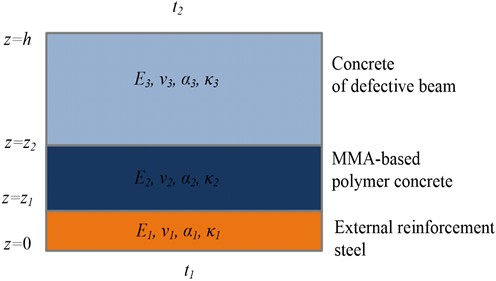
Let the reinforced beam in the rectangular Cartesian coordinate system , , occupy the area:
According to the model shown in Fig. 3, the thermal conductivity coefficient of a strengthened beam is determined by the formula:
Let us assume that the temperature in the beam does not depend on time and coordinates , . Then the heat conduction equation for the beam under consideration will take the following form:
Let us assume that on the surface of the external steel reinforcement 0 and on the upper edge of the beam’s lower belt , the temperature is equal to:
Let us assume that on surfaces and , the conditions for ideal thermal contact between the structural layers of the strengthened beam are met. As was mentioned, the assumption of ideal thermal contact is justified by the low viscosity of MMA, which ensures full contact between layers, and the relatively uniform temperature distribution across beam surfaces under typical environmental conditions. Therefore, it can be assumed that the thermal contact between the layers of the beam is close to ideal:
Solving Eq. (4), we obtain a formula for calculating the values of the temperature field:
Here, , , …, are constants whose values are found from conditions Eqs. (5) and (6):
This method is subsequently used to determine the distribution of the temperature field across the height of the strengthened reinforced concrete bridge beam.
Mathematical model of the thermally stressed state of a concrete beam strengthened with external reinforcement bonded with MMA-based composition. As a result of beam strengthening, a piecewise-homogeneous three-layer structure is formed. In the model, we assume that the modulus of elasticity , Poisson’s ratio , and linear thermal expansion coefficient are determined by the following formulas:
Let us assume that the temperature field of the beam is determined by Eq. (7), the surfaces with coordinates 0 and are free from loads, and the other surfaces are rigidly fixed.
To determine the stress-strain state of the reinforced bridge beam, we will use the equations of thermoelasticity theory. In this case, the displacements , , components , , , , of the deformation tensor, components , , of the stress tensor are equal to zero.
The equilibrium equation of the beam is as follows:
where – component of the stress tensor. From Eq. (12), taking into account the boundary conditions , we obtain 0.
Since 0, 0, 0, the first and second Duhamel relations take the form:
where , – are components of the stress tensor.
Solving the system of Eq. (13), we find:
Eqs (14) will be used below to calculate temperature stresses in a concrete bridge beam strengthened with external reinforcement adhered with MMA-based composition.
5. Research results
5.1. Results of temperature field calculation
Using the mathematical model provided, we will study the patterns of temperature field distribution across the height of strengthened reinforced concrete bridge beams. When evaluating the temperature field, we assume a total structure height of 225 mm. This height includes the thickness of the external reinforcement steel 5 mm, MMA-based polymer concrete 25 mm, and the height of the lower belt of the concrete bridge beam 200 mm. Accordingly, for each structural layer, the thermal conductivity coefficients are: 45 W/(m·°С); 12 W/(m·°С) and 23 W/(m·°С).
To take into account the multiple factors affecting the distribution of the temperature field in the lower zone of the strengthened beam, let us consider the patterns of temperature field distribution for positive, negative, and alternating temperature differences. For this purpose, the temperature value on the lower surface of the external reinforcement steel (at 0 mm) is set to and the temperature value on the upper edge of the concrete beam belt (at mm) is set to .
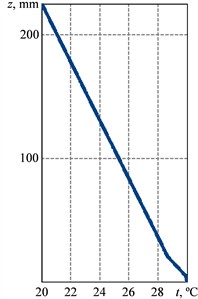
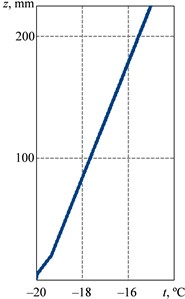
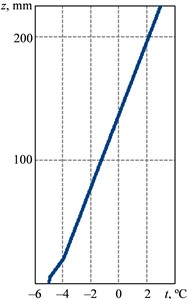
The results of the temperature field distribution by height at positive temperatures on the surfaces of the structural layers of the strengthened beam are shown in Fig. 4(a), at negative temperatures – in Fig. 4(b), and at alternating temperatures – in Fig. 4(c).
Fig. 4Results of temperature field distribution by height at a) positive, b) negative, and c) alternating temperature values on the surfaces of structural layers of a strengthened beam
a)
b)
c)
Fig. 4 shows that at given positive temperatures on the surfaces of the structural layers of the strengthened beam ( 30 °C, 20 °C,) the temperature at the contact plane between the steel external reinforcement and the MMA-based polymer concrete (at 5 mm) was 29.89 °С, and at the contact plane between the upper edge of the polymer concrete layer and the lower edge of the reinforced beam concrete (at 25 mm) was 28.46 °С. When negative temperatures ( –20 °C, –15 °C) were set on the lower and upper layers of the reinforced concrete beam, it was found that at z= 5 mm the temperature was –19.95 °С, and at 25 mm the temperature was –19.23 °С. When positive and negative temperatures were set on the beam surfaces ( –5 °C, 3 °C) at the boundaries of the structural layers, at 5 mm the temperature was –4.91 °С, and at 25 mm the temperature was –3.77 °С.
The calculation results showed that a temperature gradient occurs at the boundaries of the structural layers. When exposed to positive temperatures, the temperature gradient at the contact point between the external reinforcement steel and the MMA-based polymer concrete is 0.1 °C, and between the upper edge of the polymer concrete layer and the lower edge of the strengthened beam concrete, the temperature gradient is 1.42 °C. Accordingly, when exposed to negative temperatures, the temperature gradient was 0.05 °C and 0.7 °C, and when exposed to alternating temperatures (positive and negative), the temperature gradient was 0.09 °C and 1.14 °C.
5.2. Study of temperatures in concrete bridge beams strengthened with MMA-adhered external reinforcement
We will conduct numerical stress calculations using the temperatures and , given above and the following geometric and physical-mechanical parameters of the strengthened beam: 225 mm; 5 mm; 25 mm; 45 W/(m·°С); 2.1×10⁵ MPa; 0,3; 1.25×10⁻⁵ 1/°С; 12 W/(m·°С); 3.0×10³ MPa; 0.25; 1.0·10-5 1/°С; 23 W/(m·°С); 3.6·104 MPa; 0.3; 1.0·10-5 1/°С.
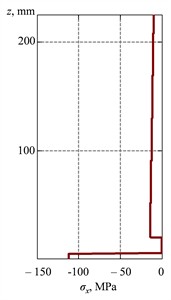
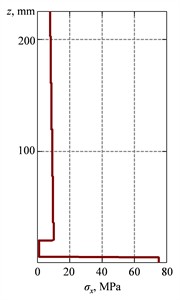
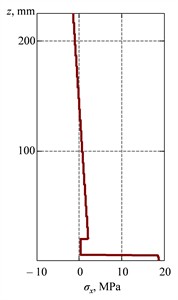
The thermal stress distributions under positive temperatures applied to the surfaces of the structural layers are shown in Fig. 5(a), at negative temperatures – in Fig. 5(b), and at alternating temperatures – in Fig. 5(c).
Fig. 5 shows that a sharp change in temperature stresses occurs at the contact plane between the external steel reinforcement and the MMA-based polymer concrete ( 5 mm). A smaller change in stresses is observed at the contact plane between the upper edge of the polymer concrete layer and the lower edge of the strengthened beam concrete ( 25 mm). At 5 mm, the stress difference was –111.3 MPa, and at 25 mm, the stress difference was –14.64 MPa. When negative temperatures are set on the beam surfaces 0 and the discontinuity in stress at 5 mm is 74.2 MPa, and at 25 mm it is 9.09 MPa. When positive and negative temperatures are set on different surfaces of the structural layers of the strengthened beam ( –5 °C, 3 °C, the stress discontinuity at 5 mm is 18.55 MPa, and at 25 mm, the stress discontinuity is –1.74 MPa.
Fig. 5Distribution of thermal stresses on the surfaces of structural layers of a strengthened beam under the influence of a) positive, b) negative, and c) alternating temperatures
a)
b)
c)
The results of the calculation of thermal stresses show that the stress level is higher when exposed to positive temperatures.
Significant differences in temperature stresses between different layers of the beam are caused by large differences in the physical and mechanical characteristics of the layers. The closest analogy is the noticeable difference between the relative deformations of concrete and external steel reinforcement at nearby points, which is explained by the different elastic moduli of concrete and steel.
6. Discussion of the obtained results
The results of the study showed that a temperature gradient occurs at the interfaces between the structural materials of the strengthened reinforced concrete bridge beam. At the same time, thermal stresses are also distributed unevenly along the vertical direction of the strengthened bridge beam. A discontinuity in thermal stresses is observed at the contact boundaries of the structural materials. These findings are consistent with the results obtained in study [3].
The appearance of a gradient at the contact zones between structural materials and the discontinuity in thermal stresses can be explained by the differences in the physical and mechanical properties of the reinforced concrete beam, the methyl methacrylate composite, and the permanent metal formwork.
In study [3], the authors demonstrated that an increase in the elastic modulus of the methyl methacrylate strengthening layer leads to higher thermal stresses in the beam-strengthening interface zone. It was established that the thermoelastic state of a beam strengthened with a 20 mm thick methyl methacrylate layer with an elastic modulus of 5000 MPa and 15000 MPa, under both positive and negative ambient temperatures, results in a threefold increase in stresses. This factor must be taken into account when strengthening defective reinforced concrete bridge beams.
The practical significance of the research lies in obtaining objective scientific data on the behavior of reinforced concrete bridge structures strengthened using MMA-based composites under the influence of environmental temperature variations.
This research direction is promising and requires further scientific investigation. Future studies are planned to develop mathematical models for analyzing the stress-strain state of strengthened reinforced concrete bridge beams under static and dynamic loads from vehicles.
The continuation of research work in this area will be the development of a spatial (3D) non-stationary thermomechanical model of reinforced concrete beam reinforcement with MMA-based compositions, based on the finite element method. This will allow modeling the effect of daily and seasonal temperature fluctuations to determine the maximum ranges of stresses and displacements that are critical for assessing the fatigue strength of reinforced concrete bridge beams with MMA-based compositions.
Experimental studies of the physical and mechanical parameters of MMA-based compositions will also be conducted. This will allow determining the creep of polymer concrete and implementing a viscoelastic model in non-stationary analysis to predict long-term stress redistribution.
For final verification and improvement of the developed mathematical model, it is planned to conduct long-term monitoring of temperature fields on the bridge with strengthened concrete beams.
7. Conclusions
Based on the analysis of literary sources, as well as mathematical modeling of temperature field distributions and temperature stresses in a strengthened reinforced concrete bridge beam, the following conclusions were made:
1) One promising design solution for repairing concrete bridge beams in service conditions is the use of MMA-based compositions with high adhesive properties, which can be used to strengthen bridge beams.
2) To assess the level of thermal stresses in reinforced concrete bridge beams, a mathematical model has been improved that allows for the geometric and physical-mechanical parameters of the structural materials of the beams to be taken into account.
3) A temperature gradient was found to occur at the interfaces between structural layers of the strengthened beam. At positive temperatures of the reinforced beam surfaces ( 30 °C, 20 °C), the temperature gradient at the contact plane between the external steel reinforcement and the MMA-based polymer concrete is 0.1 °C, and on the contact plane between the upper edge of the polymer concrete layer and the lower edge of the reinforced beam concrete, it is 1.42 °C. Accordingly, under the influence of negative temperatures ( –20 °C, –15 °C) the temperature gradient was 0.05 °C and 0.7 °C, and when exposed to positive and negative temperatures on different surfaces ( –5 °C, 3 °C), the temperature gradient was 0.09 °C and 1.14 °C.
4) The mathematical modeling results indicated that a sharp change in thermal stresses occurs at the contact between the steel external reinforcement and MMA-based polymer concrete. A smaller change in stresses is observed at the contact between polymer concrete and concrete of the strengthened beam. At the same time, higher stress levels are observed at positive temperatures applied to the beam surfaces.
5) At positive temperatures of the strengthened beam surfaces ( 30 °C, 20 °C), the discontinuity in temperature stresses on the contact plane between the external steel reinforcement and the MMA-based polymer concrete was –111.3 MPa, and on the contact plane between the upper edge of the polymer concrete layer and the lower edge of the strengthened beam concrete, the stress discontinuity was –14.64 MPa. Accordingly, at negative beam surface temperatures ( –20 °C, –15 °C), the stress discontinuity at the contact surfaces was 74.2 MPa and 9.09 MPa, and at positive and negative temperatures of the beam surfaces ( –5 °C, 3 °C), the stress discontinuity was 18.55 MPa and 1.74 MPa.
6) The proposed model provides a basis for preliminary thermal stress assessment in bridge beams, reinforced with steel external reinforcement and MMA-based polymer concrete. It allows temperature stresses to be taken into account during verification calculations of reinforced beams, thereby increasing the reliability of the reinforced structure. However, since the mathematical model is based on certain initial assumptions about the uniformity of temperature field distribution, it cannot be applied in the presence of local temperature effects on reinforced structures.
7) Further experimental validation and 3D transient analysis are recommended for fatigue and long-term performance evaluation. Among the primary areas of practical research on real objects, the following can be highlighted: comprehensive verification of the initial assumption about the uniformity of temperature field distribution, as well as studying the effect of the degree of contact between structural layers on the distribution of temperature fields.
References
-
S. V. Kliuchnyk and Y. M. Gorbatyuk, “Experience in restoring destroyed automobile artificial structures,” (in Ukrainian), Bridges and tunnels: Theory, Research, Practice, No. 22, pp. 49–54, Dec. 2022, https://doi.org/10.15802/bttrp2022/268222
-
V. H. Sydorenko, “Short-term, long-term, and fatigue strength of steel-concrete bonds with acrylic adhesives,” (in Ukrainian), Poltava, Ukraine, 1996.
-
V. Kovalchuk et al., “Procedure for determining the thermoelastic state of a reinforced concrete bridge beam strengthened with methyl methacrylate,” Eastern-European Journal of Enterprise Technologies, Vol. 4, No. 7(112), pp. 26–33, Aug. 2021, https://doi.org/10.15587/1729-4061.2021.238440
-
O. I. Rykovtsev and V. V. Kovalchuk, “Thermal stress state of reinforced concrete bridge beams strengthened with methyl methacrylate compositions,” (in Ukrainian), in 16th International Scientific and Practical Conference of Students and Young Scientists named after Georgy Kirpa, 2024.
-
F. Y. Klymenko, Development, Research, and Application in the Construction of Steel-Concrete Structures. (in Ukrainian), Lviv, Ukraine: Lviv Polytechnic National University, 2001.
-
A. I. Havrylyak, F. Y. Klymenko, and P. P. Kramarchuk, “Field tests of bendable elements with external smooth sheet reinforcement under prolonged constant loads,” (in Russian), Reserves for Progress in Architecture and Construction: Bulletin of the Lviv Polytechnic Institute, Vol. 173, pp. 20–21, 1983.
-
F. Y. Klymenko and R. I. Kinash, “Bonding of external strip reinforcement to concrete of steel-concrete beams under cyclic loads,” (in Ukrainian), Reserves for Progress in Architecture and Construction: Bulletin of Lviv Polytechnic National University, Vol. 271, pp. 55–59, 1993.
-
S. Y. Belyayeva, “Strength and deformability of concrete slabs reinforced with steel profiled decking and transverse anchors,” (in Ukrainian), Kyiv, Ukraine, 2006.
-
O. I. Lapenko, Reinforced Concrete Structures Reinforced with Permanent Formwork. (in Ukrainian), Poltava, Ukraine: TOV “ASMI”, 2009.
-
L. V. Saliichuk, “Experimental studies and theoretical justification of the strength and anchoring in concrete of glued rod anchors during shear,” (in Ukrainian) in Building Structures: Interdepartmental Scientific and Technical Collection of Scientific Works (Construction), Vol. 74, 2011, pp. 494–506.
-
L. T. Ahmed and A. Braimah, “Shear behaviour of adhesive anchors under different strain rates,” Engineering Structures, Vol. 244, p. 112763, Oct. 2021, https://doi.org/10.1016/j.engstruct.2021.112763
-
V. Pachade. “MMA resins: versatile solutions for concrete repair and coating.” Duraamen, https://duraamen.com/blog/mma-resins-versatile-solutions-for-concrete-repair-and-coating/?srsltid=afmbooqokgsxqr_x53ap1a9sp0es2k7hto8bix32fpar6g3l5mawd2r_&utm_source=chatgpt.com
-
L. V. Trykoz and O. S. Zinchenko, “Study of strength and strains of composite materials based on filled polymers,” (in Ukrainian), Bridges and tunnels: Theory, Research, Practice, No. 27, pp. 53–61, Jun. 2025, https://doi.org/10.15802/bttrp2025/333792
-
L. V. Trykoz, O. S. Zinchenko, and A. V. Nykytynskyi, “Determination of strength and structural characteristics of cement-sand mortars using recycled fillers,” (in Ukrainian), Scientific Bulletin of Construction, Vol. 111, pp. 72–79, 2024.
-
M. Abokifa and M. A. Moustafa, “Experimental behavior of poly methyl methacrylate polymer concrete for bridge deck bulb tee girders longitudinal field joints,” Construction and Building Materials, Vol. 270, p. 121840, Feb. 2021, https://doi.org/10.1016/j.conbuildmat.2020.121840
-
I. Mantawy, R. Chennareddy, M. Genedy, and M. R. Taha, “Polymer concrete for bridge deck closure joints in accelerated bridge construction,” Infrastructures, Vol. 4, No. 2, p. 31, Jun. 2019, https://doi.org/10.3390/infrastructures4020031
-
A. M. Onyshchenko, M. V. Harkusha, O. V. Fedorenko, and I. Y. Harkusha, “Application of waterproofing systems based on methyl methacrylate resin on transport structures,” (in Ukrainian), Bridges and tunnels: Theory, Research, Practice, Vol. 25, No. 25, pp. 74–86, May 2024, https://doi.org/10.15802/bttrp2024/303313
-
“Recommendations for applying waterproofing systems based on methyl methacrylate resin on transport structures,” (in Ukrainian), National Institute for Development Infrastructure, Kyiv, Ukraine, 2023.
-
R. Rybak, V. Kovalchuk, B. Parneta, and I. Karnakov, “Investigation of reinforced concrete pipe deformability by reinforcement frame under static loads,” in Lecture Notes in Civil Engineering, Cham: Springer Nature Switzerland, 2023, pp. 351–361, https://doi.org/10.1007/978-3-031-44955-0_35
-
V. Kovalchuk, B. Parneta, and R. Rybak, “Methodology of experimental studies of the deformed state of a concrete pipe restored polymer repair mix,” Procedia Structural Integrity, Vol. 59, pp. 360–366, Jan. 2024, https://doi.org/10.1016/j.prostr.2024.04.051
-
B. Parneta, V. Kovalchuk, and R. Rybak, “Methodology for evaluating the stress-strain state of strengthened concrete pipe using the finite element method with FEMAP with NX Nastran,” in EcoComfort, pp. 415–425, Aug. 2024, https://doi.org/10.1007/978-3-031-67576-8_37
-
V. Kovalchuk, M. Sysyn, M. Movahedi Rad, and S. Fischer, “Investigation of the bearing capacity of transport constructions made of corrugated metal structures reinforced with transversal stiffening ribs,” Infrastructures, Vol. 8, No. 9, p. 131, Sep. 2023, https://doi.org/10.3390/infrastructures8090131
About this article

The authors have not disclosed any funding.
The datasets generated during and/or analyzed during the current study are available from the corresponding author on reasonable request.
Kovalchuk Vitalii: concept development, goal formulation, and research task setting. Formulation of conclusions for the work. Hnativ Yuriy: improvement of a mathematical model for determining the temperature field and temperature stresses in a reinforced concrete bridge beam. Rykovtsev Oleksii: critical analysis of research works on the assessment of thermal stresses in bridge structures. Koval Maksym: review of literary sources, processing of obtained data, and formatting of the work in accordance with publication requirements. Onyshchenko Artur: calculation and analysis of thermal stresses when different temperatures are applied to the surfaces of reinforced concrete bridge beams.
The authors declare that they have no conflict of interest.

