Abstract
The article examines and presents the results of the analysis of road repair processes in the Republic. Foreign experiences in improving the technology of repairing asphalt concrete paved roads were also reviewed. Specifically, the service life of roads with asphalt concrete pavements, the requirements for repair materials, and the impact of weather and climate factors were studied. Based on this research, recommendations were developed, and their economic efficiency was calculated and scientifically substantiated through experiments.
1. Introduction
Longitudinal and transverse cracks formed on the road surface due to the weight forces falling from vehicles on highways in our republic, due to seasonal rainfall, the failure of water drainage networks on the road surface and other factors, Small-scale defects on the surface of the coating and unevenness on the surface of asphalt concrete require the following technological processes to increase the service life of asphalt concrete [1].
The implementation of modern technologies suitable for hot climates in improving existing asphalt concrete pavement repair technologies for roads in our republic, as well as increasing the efficiency of road repair while extending the service life of transportation, is considered an urgent process today. It should be emphasized that currently, technologies for improving road repair occupy a primary stage. One of the most important directions in the current conditions, socio-economic and political development, as well as transport infrastructure in our republic, is the development of a network of highways, through which domestic and transit connections with neighboring countries are carried out [2].
Automobile roads are an important asset of the country and are one of the main factors in economic growth. In 2020, international cargo transportation totaled 32.2 million tons, and by 2024, this figure reached 47.1 million tons, including a 167 % increase in the volume of international cargo transportation in 2024 compared to 2020. To improve the efficiency of vehicles, the speed of cargo delivery and passenger transportation, safety and comfort of traffic, as well as reduce the cost of cargo transportation, it is necessary, first and foremost, to improve the transport and operational performance of roads, and to radically improve road repair and maintenance work. A key feature of the road industry is its high social and economic significance. Modern highways are complex engineering structures. Moreover, highways are considered the blood vessels of the country. They must ensure the ability of vehicles to move traffic flows at high speeds [3].
2. Literature review
The causes and types of damage, including cracks, occurring on roads with asphalt concrete pavements, have been studied. Damage to asphalt concrete pavements. Technologies for repairing cracks on the surface of existing asphalt-concrete roads. They were familiarized with the study of existing cracks on roads with asphalt concrete pavements with cracks on their surface, taking samples from them, and testing them in laboratory conditions [4].
Factors influencing damage processes have been identified with non-rigid road surfaces. An analysis of the technology for repairing cracks in coatings revealed the influence of air temperature on thermal processes during the laying of hot mixed coatings in the road opening.
Methods of regeneration for the repair and restoration of asphalt concrete pavements have been introduced. The service life of the coating has been studied. Production efficiency has been studied from foreign experience [5].
An analysis of foreign experience using bitumen emulsions was conducted, the physical properties of the coating at high temperatures were studied, and the effectiveness of emulsion repair technologies was demonstrated [4].
The issue of developing new, efficient technologies for the opening of roads due to low-cost financing of road construction and extensive road construction requires time to analyze the necessary amount of capital investments required in new technologies and pay for it. By comparing the cost of these works with the costs associated with the classical method, economic efficiency was achieved through the use of coating technology using composite technologies based on cation-active bitumen emulsions for the production of road work [6].
The operational condition of roads with asphalt concrete pavement has been studied, various characteristics of the geographical location, relief and natural and climatic conditions of the republic have been studied, the need to adapt the structure of road operation with asphalt concrete pavement to regional conditions has been identified, as a result of the influence of air and climate factors on roads with asphalt concrete pavement, it is possible to observe the complication of road conditions, that is, it has been studied that the appearance of various displacements and deformations on the[5].Detailed information is provided on the organization of road construction and the fundamentals of its technology, the quality of the technological process, the reliability of road structures with asphalt concrete pavements, the selection of asphalt concrete compositions, the construction of road pavements, technological methods for performing road pavement construction, leveling and compaction work in various natural conditions [4, 6].
3. Materials and methods
Currently, in the conditions of Uzbekistan, asphalt-concrete roads are in need of early repair before the projected service deadline. The main reasons for this are high temperatures, heavy trucks, shortcomings in the construction process, a lack of repair technologies and poor quality materials used, violations of the water heating regime, and various other factors. Today, attention to highways has become a priority of our country. In particular, the use of foreign technologies in the repair of roads will not only create sufficient amenities, but also increase the service life of roads. We can see the indicators of construction and repair of roads in Surkhondaryo Region (Fig. 1).
Fig. 1Indicators of construction and repair of roads in Surkhandarya region

The emerging disruptions require the improvement of road repair technologies. In fact, the allocated funds do not correspond to actual expenses. The climatic conditions of Uzbekistan require an approach to the construction and operation of asphalt concrete pavements on roads in accordance with the requirements of SHNQ-2.05.02-23, QR 06.03-22, MQN 10-2008 [7-9].
This is due to the fact that sunlight, high temperatures, wind, rain, snow, and days of temperature passing through 0 °C (sharp temperature fluctuations) negatively affect the asphalt concrete cover. This primarily leads to a change in the chemical composition of the organic binder under the influence of oxygen, which manifests itself on the surface of the asphalt concrete coating. Long-term experience in using such coatings shows that in Surkhondaryo Region, in some cases, they do not reach the projected service life, as changes under the influence of deformation in dry hot climates are not fully studied and local climatic conditions are not taken into account. Furthermore, the linear temperature expansion coefficient of organic binders and mineral fillers in asphalt concrete is a factor leading to coating destruction [10-11].
Based on the natural and climatic conditions of Surkhondaryo Region, it is necessary to monitor the operation of the coating, study the defects that arise in it, and develop measures to eliminate them. Furthermore, it requires the involvement of a number of technologies in the repair of roads. If we consider the current state of existing asphalt-concrete roads in our country during their operation, for example, on the 4P-23h highway “M-39 from the Termez River Port” in the Surkhandarya region, we can see the following shortcomings (Fig. 2).
Fig. 2Existing trenches on the 4P-23h “Termez River Port from the M-39 highway. Photographer Amanova N, Termez city 2022


The durability of the coating under the influence of the mechanical properties of asphalt concrete is characterized by the service life of trucks and vehicles. Under operating conditions, the coatings are subject to compressive, tensile, and shear stresses. In this regard, the compressive, bending, tensile, and shear strength of asphalt concrete is determined (Fig. 3). These results are presented in Table 1.
Fig. 3Excerpts from the experiment. Photographer Rakhmatov S., laboratory in Termez city, 2022
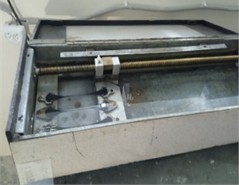
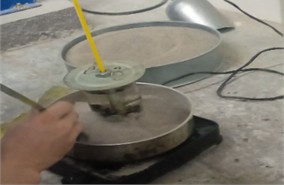
Table 1Calculation of experimental results
No | Indicator names | Unit of measurement | Indicator values | |
Quantity | Actual bitumen value | |||
1 | 2 | 3 | 4 | 5 |
1 | Needle penetration depth at 25 °C | 0.1 mm | 61-90 | 72 |
2 | Softening temperature (by ring and ball) | °C | Not less than 47 | 50 |
3 | Extensibility, At 25°C | sm | Not less than 55 | Over 70 |
These experiments have improved the composition and properties of materials used in the repair of asphalt-concrete roads.
When considering the requirements for the quality of road repair materials with asphalt concrete pavements, first and foremost, it is necessary to study the requirements for asphalt concrete mixtures and materials contained in them. At the same time, we will need to study the requirements for bitumen and bitumen emulsion used in the repair process for repairing cracks and grooves, as well as for stamping.
On the site where the 4R-23h “Termez River Port” highway with asphalt concrete pavement is located, current repair work was carried out, and experiments and observations were carried out.
Samples were taken and tested in the Laboratory of Highway Engineering and in the accredited track testing laboratory of LLC “ASFALTOBETON”.
Before entering the facility in the laboratory, the order of work was checked for the correctness of the special laboratory machine and the availability of all necessary equipment.
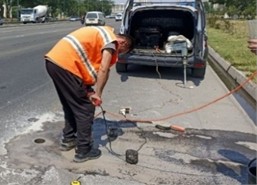
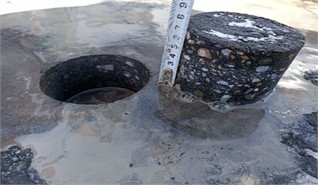
From the selected objects, 3 core samples were taken from each point, and 6 points were taken from one object.
Based on the results obtained, we determined the following indicators of asphalt concrete pavements.
Fig. 4Kern extraction process. Photographer Amanova N., Termez city 2022
Preparation of control samples of asphalt concrete mixture. Technical specifications – GOST 9128-2013. Test methods – GOST 12801-98.
Samples are prepared during the composition selection process or for the purpose of checking the quality of the coated coatings (Fig. 4). During the composition selection process, the physical and mechanical properties of the prepared samples are determined, and the selected composition is specified by comparing them with the requirements of GOST. The quality of the coating is evaluated by comparing the identified physical and mechanical properties of the prepared samples with the actual properties of the cores obtained from the coating. These test experiments are presented in Table 2.
Table 2Size and quantity of samples taken
Test type | The largest particle size in the mineral part of the mixture, mm | Sample size, mm | The approximate amount of the mixture in the sample G | |
Diameter | Elevation | |||
Determining compressive strength, water absorption (dry and water-absorbed) | 5 10, 15, 20 40 | 50.5 71.4 101.0 | 50.5 ±1.0 71.4 ±1.5 101.0 ±2.0 | 220-240 640-670 1900-2000 |
Compression test for cold mixtures | 5, 10, 15 | 71.4 | 60 ±1.0 | 440-460 |
Samples are prepared 30 minutes after the mixture is prepared. The mold and its inserts are heated to 90-100 °C and oiled. Next, a lower vkladish is installed on the special substrate of the hydraulic press, and a mold is installed on it, into which a pre-prepared mixture is added.
The mass of the additional mixture added to the sample is determined by the following formula:
where: – the mass of the sample (gr.); – the height of the sample's base (equivalent to its diameter) (mm); – existing sample height.
Fig. 5Obtained kernel samples. Photographer Rakhmatov S., laboratory in Termez city, 2022
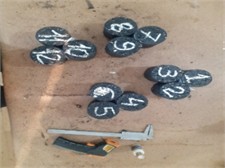
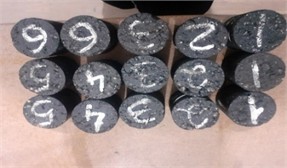
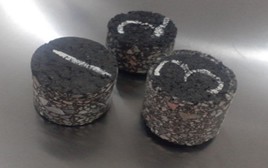
Samples from selected objects were tested using the above-mentioned methods of conducting laboratory tests, and the results are presented in Tables 3 and 4.
Table 3Average density of the preheated sample (core)
No | Layer | Thickness | |||||||
1 | Upper layer | 5.3 | 804.63 | 805.43 | 455.25 | 350.19 | 820.39 | 2.30 | 4.50 |
2 | =//= | 4.9 | 770.04 | 770.81 | 437.13 | 333.68 | 784.32 | 2.31 | 4.28 |
3 | =//= | 5.1 | 780.71 | 781.49 | 441.71 | 379.38 | 795.49 | 2.30 | 4.35 |
4 | =//= | 5.0 | 770.52 | 771.29 | 438.84 | 332.45 | 783.98 | 2.32 | 4.05 |
5 | =//= | 5.5 | 850.45 | 851.30 | 485.94 | 365.36 | 864.95 | 2.33 | 3.97 |
6 | =//= | 5.8 | 910.03 | 910.94 | 519.98 | 390.96 | 925.28 | 2.33 | 3.90 |
Table 4Average density of the heat-treated sample (virubka)
No | |||||||
1 | 660.70 | 661.36 | 379.93 | 281.43 | 669.85 | 2.35 | 3.25 |
2 | 660.89 | 661.55 | 378.84 | 282.71 | 670.50 | 2.34 | 3.40 |
3 | 660.43 | 661.09 | 379.78 | 281.31 | 669.66 | 2.35 | 3.28 |
Initially, before laying asphalt on the road, it was cleaned of dust and emulsified. Then the asphalt laying process was carried out. Class B asphalt was used. Hot asphalt was laid using a milling cutter. The fine-grained, dense hot asphalt concrete mixture of type B, used by us, meets the requirements of GOST, therefore, this type of mixture can be effectively used in the repair of asphalt concrete pavements.
The granular composition of the selected mixture is based on the requirements of GOST 9128-13 and the selected composition of mineral materials for the preparation of hot fine-grained, dense asphalt concrete mixture of type B. A comparative indicator of the selected mineral portion of the coating with the current regulatory requirements is presented. As can be seen from the graph, the composition of the selected mixtures is within the normative requirements.
Hot-temperature strength and cold-temperature elasticity (elasticity) of the coating are ensured only when the bitumen material on it possesses viscoelastic properties in a certain range of operating temperatures. The lack of such properties in bitumens leads to the appearance of displacements and displacements in the coating during the summer months, and to the appearance and displacement of cracks during the winter period. Experiments conducted by a number of researchers show that the most common damage to road pavements is fractures. Cracks cause other types of damage (crushing, forming pits, etc.). In certain seasons of the year, under the influence of sharp changes in temperature and loads from vehicles, tensile stresses arising in the coating layers lead to the formation of cracks.
4. Results and discussion
The values of the maximum and minimum temperature of the asphalt concrete coating are typically used when selecting a brand and justifying the temperature of the binding test. Conditionally, the indicator of the thermal resistance of the binder should correspond to the maximum temperature of the asphalt concrete coating. Nevertheless, the parameters of the formula vary widely depending on the actual weather and climate, with attention being paid to landscape, thermal, structural, and other factors, observations conducted during the summer months of 2024.
Table 5Results of asphalt concrete mixture deposition at a temperature [12-14]
Parameters | The results of laying an asphalt concrete mixture at a temperature of 90-100 °C | The results of laying an asphalt concrete mixture at a temperature of 110-120 °C | The results of laying an asphalt concrete mixture at a temperature of 130-140 °C | ||||||
Maximum compressive strength at 50 °C, MPa | 1.29 | 1.27 | 1.26 | 1.35 | 1.34 | 1.30 | 1.40 | 1.39 | 1.37 |
Maximum compressive strength at 20 °C, MPa | 2.40 | 2.38 | 2.27 | 2.60 | 2.55 | 2.50 | 2.70 | 2.65 | 2.60 |
Maximum compressive strength at 0 °C, MPa | 12.50 | 12.00 | 11.90 | 13.30 | 13.10 | 13.00 | 14.00 | 13.80 | 13.60 |
Water absorption W, % | 5.50 | 5.80 | 6.00 | 4.00 | 4.50 | 4.60 | 3.00 | 3.30 | 3.50 |
Density, gr/sm3 | 2.36 | 2.35 | 2.34 | 2.37 | 2.37 | 2.36 | 2.39 | 2.38 | 2.37 |
Compaction coefficient | 0.98 | 0.98 | 0.98 | 0.99 | 0.99 | 0.98 | 0.99 | 0.99 | 0.99 |
Fig. 6Air temperature and coating surface temperature for 1 month change schedule (June)
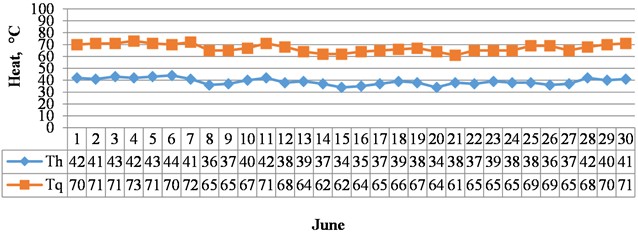
Fig. 7Air temperature and coating surface temperature for 1 month change schedule (July)
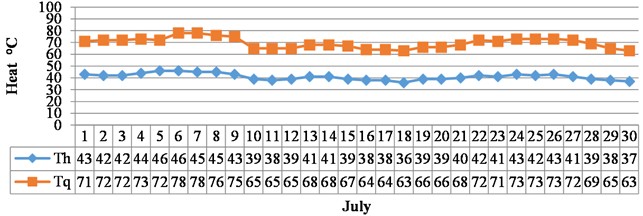
On the studied roads with asphalt concrete pavements, the surface of the pavement and the air temperature are measured at a height of 1 meter from the surface of the road surface. Based on the main research results, changes in air temperature were studied in each month (Figs. 6, 7). The difference in air temperature and coating temperature affects the thermophysical properties of the coating materials. Sunlight affects the layers of air and asphalt concrete coatings.
5. Conclusions
In recent years, in our modernizing country, great importance has been attached to the further development of the transport system, as well as the ongoing and complete repair of roads. Today, we can confidently say that asphalt concrete pavement is constantly being improved, productivity, quality, and automation of road construction are increasing. Currently, various materials and technologies are used in the maintenance and repair of road pavements. The main task of such work is to ensure the safe movement of motor vehicles at a given speed. The effectiveness of the country's socio-economic development largely depends on the quality of roads. The use of new technologies not only restores the efficiency of roads, but also significantly reduces energy and material costs. Technologies based on the renewal of existing coatings in the next decade will allow for the development of thin-film asphalt concrete coatings.
References
-
M. Kholmirzaev, “Increasing the service life of asphalt concretecoatingswith surface processing,” Iqro Journal, Vol. 3, No. 1, pp. 412–414, 2023.
-
H. Kamal, P. Das, and A. Karakas, “Effect of ultraviolet aging on rheological properties of asphalt cement,” in 63rd Canadian Technical Asphalt Association (CTAA) Conference, Nov. 2018.
-
S. Sreedhar and E. Coleri, “The effect of long-term aging on fatigue cracking resistance of asphalt mixtures,” International Journal of Pavement Engineering, Vol. 23, No. 2, pp. 308–320, Jan. 2022, https://doi.org/10.1080/10298436.2020.1745206
-
A. Abouelsaad and G. White, “Fretting and ravelling of asphalt surfaces for airport pavements: A load or environmental distress,” in 19th Annual International Conference on Highways and Airport Pavement Engineering, Asphalt Technology and Infrastructure, 2020.
-
L. M. Makaya, K. Andrianov, A. F. Zubkov, and Y. I. Kalgin, “Development of a technology for application of structural layers of road pavements using asphalt granular concrete mixtures,” Russian Journal of Building Construction and Architecture, No. 3(67), pp. 51–60, Jul. 2025, https://doi.org/10.36622/2542-0526.2025.67.3.005
-
Mamatmuminov Alisher Turakulovich, Tursunboyeva Nilufar Ikrom Kizi, and Mamatmuminov Dilshod Turakulovich, “Study of the disadvantages of asphalt concrete pavements in hot climates,” Zenodo, Apr. 2024, https://doi.org/10.5281/zenodo.11090161
-
“SHNQ-2.05.02-23 Urban planning norms and rules,” Tashkent, 2023.
-
“Construction regulations Highways,” QR 06.03-23.
-
“Road to action security importance of conditions,” MQN 10-2008, 2008.
-
V. Ushakov, M. Goryachev, S. Lugov, A. Kudryavtcev, and S. Yarkin, “Development of typical flexible road pavement catalog for regional and intermunicipal highways in Russian Federation (using the example of the Republic of Bashkortostan),” in E3S Web of Conferences, Vol. 274, p. 02010, Jun. 2021, https://doi.org/10.1051/e3sconf/202127402010
-
A. Zubkov, “Methodology for developing technological processes for constructing road pavements from hot asphalt concrete mixtures,” Moscow, 2007.
-
“Bitumen oil road viscous Technical conditions,” Moscow, GOST 22245-90, 1990.
-
“Asphalt concrete road, aerodrome and asphalt concrete mixtures. Technical specifications,” GOST 9128-2013, 2013.
-
“Interstate scientific and technical commission for standardization, technical normation and certification in construction,” Moscow, GOST 12801-98, 1998
About this article

The authors have not disclosed any funding.
The datasets generated during and/or analyzed during the current study are available from the corresponding author on reasonable request.
The authors declare that they have no conflict of interest.

