Abstract
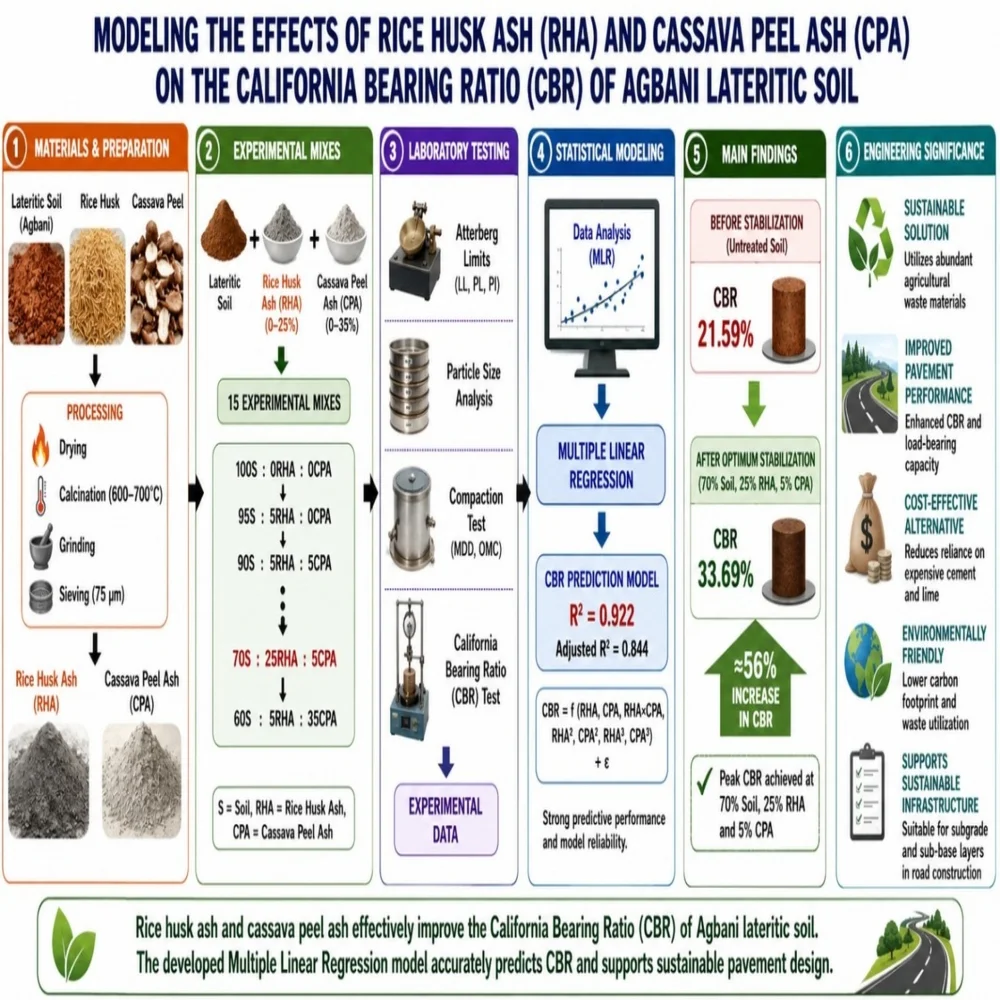
Lateritic soils commonly used for road construction in southeastern Nigeria often exhibit low bearing capacity and high plasticity, necessitating stabilization before use as pavement subgrade or sub-base materials. The use of conventional stabilizers such as cement and lime is associated with high cost and environmental concerns, motivating the exploration of sustainable alternatives. This study investigates the effects of rice husk ash (RHA) and cassava peel ash (CPA), individually and in combination, on the California Bearing Ratio (CBR) of lateritic soil obtained from Agbani, Enugu State, Nigeria. Soil samples collected from fifteen locations were blended with varying proportions of RHA (0-25 %) and CPA (0-35 %), producing fifteen representative mix designs. Laboratory testing included index properties, compaction characteristics, and CBR determination. Multiple linear regression (MLR) modeling was employed to develop predictive relationships between CBR and RHA-CPA contents. Results show that the untreated soil exhibited a low CBR of 21.59 %, while stabilization with agro-waste ashes significantly improved bearing capacity, with a peak CBR of 33.69 % achieved at a mix ratio of 70 % soil, 25 % RHA, and 5 % CPA. The developed regression model demonstrated strong predictive performance ( 0.92), with CPA exhibiting a more statistically significant influence on CBR than RHA. The findings confirm the technical viability of RHA-CPA blends as sustainable stabilizers for lateritic soils and provide a quantitative tool for preliminary pavement design.
Highlights
- Rice Husk Ash and Cassava Peel Ash significantly improved the engineering properties of Agbani lateritic soil.
- The California Bearing Ratio (CBR) increased with the addition of optimal percentages of RHA and CPA.
- Regression models were successfully developed to predict CBR values from RHA and CPA contents.
- The developed models showed strong agreement between predicted and experimental CBR values.
- Utilization of agricultural waste materials provides a sustainable and cost-effective soil stabilization method.
1. Introduction
Lateritic soils are widely distributed across tropical regions and constitute a major construction material for road pavements in Nigeria. Despite their abundance, many lateritic soils possess unfavorable engineering properties such as low bearing capacity, high plasticity, and moisture sensitivity, which limit their direct application as pavement subgrade or sub-base materials. In Agbani, Enugu State, lateritic soils commonly encountered in road construction often fail to meet minimum strength requirements, thereby necessitating stabilization.
Traditional stabilizing agents such as cement and lime are effective but present economic and environmental challenges, particularly in developing countries. The production of cement is energy-intensive and contributes significantly to greenhouse gas emissions. Consequently, there has been growing interest in the utilization of agricultural waste by-products as alternative soil stabilizers. Rice husk ash (RHA) and cassava peel ash (CPA) are two agro-waste materials abundantly generated in Nigeria. When properly processed, these ashes contain reactive silica and alumina capable of participating in pozzolanic reactions that enhance soil strength.
The California Bearing Ratio (CBR) test remains a standard index for evaluating the load-bearing capacity of subgrade and sub-base materials. While numerous studies have examined the experimental effects of RHA or CPA on soil strength, fewer studies have developed robust predictive models capable of estimating CBR as a function of agro-waste content. Moreover, limited research has focused on the combined effects of RHA and CPA on Agbani lateritic soil.
This study addresses this gap by experimentally evaluating the influence of RHA and CPA on the CBR of Agbani lateritic soil and by developing multiple linear regression models to predict CBR based on stabilizer content. The outcomes are intended to support sustainable pavement construction and reduce reliance on conventional stabilizers.
2. Literature review
Previous research has demonstrated that soil strength parameters such as CBR are strongly correlated with index properties including plasticity index, maximum dry density, and moisture content. Several authors have successfully employed regression techniques to estimate CBR from basic soil properties, thereby reducing the need for extensive laboratory testing.
In the context of soil stabilization, RHA has been widely reported as an effective pozzolanic material capable of improving strength and reducing plasticity in lateritic and expansive soils. Optimal RHA contents reported in the literature typically range between 6 % and 25 %, beyond which strength gains diminish due to excess ash content. Similarly, CPA has been shown to improve soil strength through cementitious bonding and particle aggregation, although its combined use with RHA has received limited attention.
Despite these advances, most published studies emphasize experimental observations, with relatively few providing validated mathematical models for predicting CBR of soils treated with agro-waste ashes. The interaction effects between different ashes and their nonlinear influence on strength parameters are also not sufficiently addressed. This study contributes by developing and evaluating regression-based predictive models for CBR of Agbani lateritic soil stabilized with RHA and CPA.
The potential of many materials, especially agricultural wastes, for soil stabilization is highlighted in existing research. A number of studies have concentrated on creating predictive models for soil parameters in order to offer a less expensive and time-consuming substitute for conventional laboratory testing. Additionally, prior research has demonstrated that RHA and CPA can improve a soil's CBR, a gauge of its ability to sustain large loads.
2.1. Soil index property prediction
Research has investigated the relationship between CBR and soil index characteristics. In their investigation of this relationship for Ethiopian subgrade soils, Abdella, Abebe, and Quezon [1] discovered strong relationships between CBR and characteristics such as maximum dry density (MDD) and plasticity index (PI). They created regression models, one of which was a multiple linear regression model that showed noticeably better predictive power:
CBR = 5.34MDD + 0.026F − 0.069PI, ( 0.973).
Using multiple linear regression models, Nwaogazie and Irokwe [2] also concentrated on creating models to estimate the CBR of soil from its index parameters along the Ogbia-Nembe road in Nigeria. The following were determined to be statistically significant using linear, quadratic, and multiple linear regression models:
– CBR = −69.89 + 54.944MDD, (0.82).
– CBR = 38.676 − 1.386OMC, ( 0.93).
– CBR = −820.11 + 926.06MDD − 252.49MDD2, ( 0.89).
2.2. Stabilization with Rice Husk Ash (RHA) and Cassava Peel Ash (CPA)
Ishola et al. [3] and Diugwu and Ike [4] particularly concentrated on using RHA to stabilize lateritic soil in order to enhance its engineering qualities. Their research showed that adding RHA raised the CBR of Agbani soil up to an ideal mix ratio. RHA's ability to alter the engineering characteristics of expansive soils (black cotton soil) was examined by Jain et al. [5]. According to the study, CBR dramatically rose as RHA content increased, reaching a peak at 20 % RHA with a 6.19-fold improvement over untreated soil. A regression model was also developed by Ike and Ike [6] to forecast the CBR of lateritic soil stabilized with RHA. In order to forecast the California bearing ratio (CBR) of lateritic soil stabilized with rice husk ash, he developed an equation using Scheffe's simplex lattice design or the regression model, which is written as a second-degree polynomial:
where 21, 19, 30, –8, –30, –18. So:
where , , are the proportions of the lateritic soil, rice husk ash and water respectively.
, , are interaction coefficients between the components.
: This is the CBR value of the mixture when component 1 () is used at 100 % (i.e., it is the only material in the mix) in this study.
: This is the CBR value of the mixture when component 2 () is used at 100 %.
: These values are used as the linear blending coefficients in Scheffe’s quadratic model and are also part of the interaction term calculations ().
These figures represent the contributions of water, rice husk ash (RHA), and soil, in that order. The CBR value is predicted by equation number 94 using the mix proportions of water, RHA, and soil. The changes in CBR, MDD, and OMC as a percentage are: Bearing Ratio for California (CBR): In comparison to the control mix without RHA, which had a CBR of 21 %, the ideal mix (1:1.70:0.25 for soil, RHA, and water) attained a CBR of 30 %, a 42.86 % increase. Additionally, Alhassan [7] assessed the stabilization of A-7-6 lateritic soil with RHA and found that while high RHA content decreased unconfined compressive strength (UCS), optimal RHA amount (6-8 %) enhanced CBR. For improved stabilization, the study suggested mixing RHA with lime or cement. There is little thorough study that focuses especially on the combined or comparative impacts of RHA and CPA on Agbani soil, despite the fact that data on their separate application for soil stabilization is already available. When it comes to predictive modeling for important geotechnical factors like CBR, this disparity is very noticeable. Fewer research have developed and validated reliable mathematical models for predicting these soil qualities when treated with agro-waste ashes, while the majority of the literature currently in publication focuses on experimental investigations. By creating and verifying predicting models for CBR of Agbani soil stabilized using different ratios of RHA and CPA, this study seeks to close this gap.
2.3. Research gaps and novelty
There is a dearth of comprehensive numerical models that can predict the California bearing ratio (CBR) of Agbani lateritic soil when treated with the combined effects of RHA and CPA, despite existing research on the individual use of RHA and CPA for soil stabilization. The majority of existing literature focuses on experimental investigations, with fewer studies developing and validating robust mathematical models, particularly for the combined RHA and CPA mixture. Several research gaps were identified based on the reviewed literature, including a limited focus on Agbani soil and insufficient investigation of the interaction effects between RHA and CPA.
By offering a thorough analysis and creating reliable predictive models utilizing Multiple Linear Regression for the CBR of Agbani soil stabilized with different fractions of RHA and CPA, this work seeks to close these gaps. Despite earlier studies on soil stabilization, nothing is known about the precise impacts of RHA and CPA on Agbani lateritic soil, and there are no predictive models for its essential characteristics. In particular, there is a dearth of thorough numerical models that can forecast the CBR of Agbani lateritic soil treated with RHA and CPA, as well as little thorough study focusing on their combined or compared impacts on Agbani soil. This study tackles this issue by examining and simulating these impacts in order to offer alternatives for economical and sustainable road building in the area.
This study aims to model how the California Bearing Ratio (CBR) of Agbani lateritic soils is affected by rice husk ash and cassava peel ash. The precise goals of this study are as follows: 1) To evaluate the effects of cassava peel ash and rice husk ash on the California Bearing Ratio (CBR) values of Agbani soil using laboratory tests. 2) To create a mathematical model that uses multiple linear regression (MLR) techniques to forecast the CBR of Agbani lateritic soil treated with rice husk ash and cassava peel ash.
3. Materials and methods
3.1. Materials
Lateritic soil samples were collected from Agbani, Enugu State, Nigeria, at fifteen different locations within the study area. Cassava peels and rice husks were obtained from agricultural processing sites in Abakaliki, Ebonyi State.
3.2. Production of rice husk ash and cassava peel ash
Rice husks and cassava peels were first air-dried to remove moisture. The dried materials were then calcined in a controlled open furnace at temperatures ranging between 600 °C and 700 °C to obtain ash with sufficient pozzolanic reactivity. After cooling, the ashes were sieved through a 75 µm sieve to remove unburnt particles and ensure uniform fineness suitable for soil stabilization.
3.3. Sampling strategy and mix design
From the fifteen sampling locations, three soil samples were obtained at each location, giving a total of forty-five samples. Laboratory test results from each location were averaged to yield fifteen representative data points used for analysis. The soil was blended with RHA (0-25 %) and CPA (0-35 %) by dry weight of soil. Fifteen mix proportions were designed to examine both individual and combined effects of RHA and CPA. An experimental design along with a thorough statistical and data analysis methodology were used in the study. The USCS and AASHTO methods were used to classify the soil. An experimental design along with a thorough statistical and data analysis methodology were used in the study. The USCS and AASHTO methods were used to classify the soil. Atterberg limits, particle size distribution, compaction, and CBR values were among the characteristics of both treated and untreated soil samples that were tested in the lab. A total of fifteen samples were made with different ratios of CPA (0 % to 35 %) and RHA (0 % to 25 %). The mix ratios taken into account during the investigation were: 100S:0RHA:0CPA; 95S:5RHA:0CPA; 90S:5RHA:5CPA; 85S:10RHA:5CPA; 80S:15RHA:5CPA; 75S:20RHA:5CPA; 70S:25RHA:5CPA; 95S:0RHA:5CPA; 90S:0RHA:10CPA; 85S:5RHA:10CPA; 80S:5RHA:15CPA; 75S:5RHA:20CPA; 70S:5RHA:25CPA; 65S:5RHA:30CPA; 60S:5RHA:35CPA.
3.4. Laboratory testing
Laboratory tests conducted included particle size distribution, Atterberg limits, compaction characteristics, and soaked CBR tests. Testing procedures followed relevant standard specifications. All tests on treated soils were conducted after adequate mixing and curing to ensure uniformity.
3.5. Statistical modeling
Multiple linear regression (MLR) analysis was employed to model the relationship between CBR and stabilizer contents. The general polynomial form included linear, interaction, quadratic, and cubic terms for RHA and CPA. Higher-order terms were introduced to capture observed nonlinear trends in CBR response. Model performance was evaluated using the coefficient of determination (), adjusted , and analysis of variance (ANOVA). Given the relatively small dataset ( 15), model complexity and potential overfitting were critically assessed. Multiple Linear Regression was the main statistical method used in the study to create mathematical models. Multiple Linear Regression Calculator-Statistics Kingdom, Multiple Linear Regression-Stats Blue, and Microsoft Excel 2013 were the tools utilized. Because of its capacity to model a dependent variable (CBR) as a linear function of several independent variables (RHA and CPA contents, including their higher-order and interaction terms), the MLR technique was chosen. Up to the third degree, the polynomial MLR model used has the following general form:
The dependent variable is the California Bearing Ratio (CBR); the independent variables are the percentages of Rice Husk Ash and Cassava Peel Ash, respectively; the intercept is ; the regression coefficients are to ; and the error term is epsilon. The Fisher’s F-statistic and Analysis of Variance (ANOVA) were used to verify the model’s overall reliability and significance, while the Student's t-test was used to evaluate the significance of individual coefficients. The explanatory power of the model was assessed using both the coefficient of determination () and the adjusted coefficient of determination ().
4. Results and discussion
The natural soil was classified as A-2-6 under AASHTO and SC under the Unified Soil Classification System, indicating a clayey sand with moderate plasticity. The untreated soil exhibited a low CBR value of 21.59 %, confirming its inadequate bearing capacity for direct pavement application. The basic physical properties of the soil samples are summarized in Table 1.
4.1. Basic properties of Agbani lateritic soil
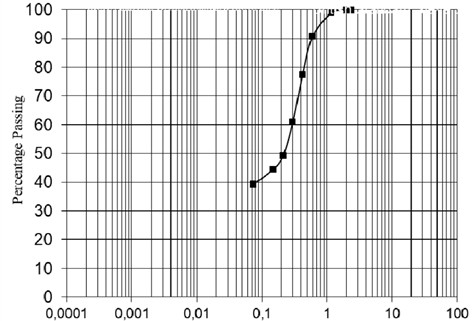
According to Table 1, the basic physical characteristics of the soil samples under investigation were fine-grained, plastic, reddish brown in color, and had 1.15 % passing sieve No. 200. The soil samples were classified as A-2-6 by AASHTO [8] and as SC by UCSC. The mean particle size distribution graph of the soil samples is shown in Fig. 1.
Table 1Basic physical properties of agbani soil
S/N | Property | Data |
1 | Texture | Fine-grained |
2 | Plasticity | Plastic |
3 | Colour | Reddish brown |
4 | Percentage Passing Sieve No. 200 | 1.15 |
5 | AASHTO Classification | A-2-6 |
6 | UCSC Classification | SC |
Fig. 1Mean particle size distribution of Agbani soil
4.2. Effect of RHA and CPA on CBR
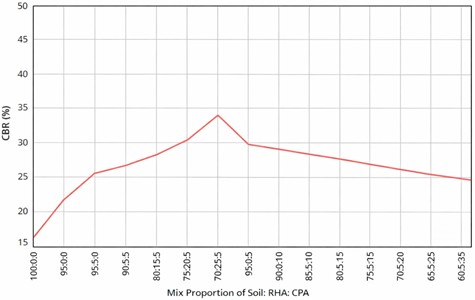
The addition of RHA and CPA resulted in a consistent improvement in CBR up to an optimum stabilizer content. Initial strength gains are attributed to improved particle packing and the onset of pozzolanic reactions between ash constituents and soil minerals. The maximum CBR value of 33.69 % was obtained at a mix proportion of 70 % soil, 25 % RHA, and 5 % CPA. Beyond this optimum, CBR values decreased, likely due to excess ash particles disrupting soil matrix continuity.
The Grande Mean findings of laboratory tests on the characteristics of Agbani Soil treated with Cassava Peel Ash and Rice Husk Ash from Stations 1 through 15 are displayed in Table 2. The various stations’ results are also displayed. Fig. 2 also displays the correlations between the California Bearing Ratio (CBR) in accordance with ASTM [9], Maximum Dry Density (MDD), Optimum Moisture Content (OMC) values of Agbani soil, and the different mix proportions of Laterite, Rice Husk Ash, and Cassava Peel Ash. The results are presented in Table 2 and illustrated in Fig. 2.
Table 2Mean values of geotechnical properties of Agbani soil blended with RHA and CPA for stations 1-15
S/N | Mix proportion | PI | C | CBR | |
1 | 100S:0RHA:0CPA | 16.183 | 17.248 | 22.515 | 21.5909 |
2 | 95S:5RHA:0CPA | 15.435 | 16.485 | 23.217 | 22.9233 |
3 | 90S:5RHA:5CPA | 14.773 | 15.863 | 23.983 | 24.4367 |
4 | 85S:10RHA:5CPA | 14.080 | 15.304 | 24.775 | 25.9827 |
5 | 80S:15RHA:5CPA | 13.457 | 14.742 | 25.542 | 27.3967 |
6 | 75S:20RHA:5CPA | 12.493 | 13.970 | 26.031 | 28.5929 |
7 | 70S:25RHA:5CPA | 11.471 | 13.219 | 26.811 | 33.6880 |
8 | 95S:0RHA:5CPA | 12.893 | 14.027 | 25.385 | 28.9189 |
9 | 90S:0RHA:10CPA | 13.369 | 14.649 | 24.680 | 28.0593 |
10 | 85S:5RHA:10CPA | 13.977 | 25.142 | 24.004 | 27.3071 |
11 | 80S:5RHA:15CPA | 14.651 | 15.640 | 23.644 | 26.5760 |
12 | 75S:5RHA:20CPA | 15.201 | 16.249 | 22.222 | 25.7787 |
13 | 70S:5RHA:25CPA | 15.638 | 16.765 | 21.465 | 24.8296 |
14 | 65S:5RHA:30CPA | 16.102 | 17.253 | 20.701 | 24.1091 |
15 | 60S:5RHA:35CPA | 16.453 | 17.961 | 20.149 | 22.2096 |
The range of CBR values for the different mix proportions was 21.5909 % to 33.6880 %. The control (natural soil without any additives) had the lowest CBR value (21.5909 %), demonstrating the soil’s inherent low bearing potential and the necessity of modification.
The addition of RHA and CPA raised the CBR values. The CBR increased by 6.18 % to 22.9233 % with just 5 % RHA (95S:5RHA:0CPA). 70S:25RHA:5CPA was the ideal mix proportion, with an average CBR of 33.6880 %. The high silica levels of RHA and CPA, which cause cementitious compounds to gradually develop in the soil, are responsible for this notable improvement. The observed decrease in plasticity indices and rise in the angle of internal friction and cohesion provide more evidence for this chemical process. The CBR values significantly decreased beyond the ideal range, indicating that too many additives took up space in the soil matrix and weakened the connection.
Fig. 2Correlation between CBR, MDD, OMC and mix proportions
4.3. Regression model interpretation
The developed MLR model exhibited strong predictive capability, with values of approximately 0.92 and adjusted of about 0.84. Statistical significance testing revealed that CPA and its quadratic term were more influential predictors of CBR than RHA. This suggests that CPA contributes more effectively to cementitious bonding in the studied soil. Although cubic terms improved model fit, their inclusion increases the risk of overfitting; hence, the model is best suited for preliminary estimation rather than definitive design.
Multiple Linear Regression was used in the statistical analysis to determine how RHA and CPA affected the CBR of Agbani soil. The input data required to create the model, including the higher-order and interaction terms, is displayed in Table 3.
Table 3Input data for model generation of RHA and CPA effects on CBR
RHA | CPA | RHA. CPA | RHA2 | CPA2 | RHA3 | CPA3 | CBR |
0 | 0 | 0 | 0 | 0 | 0 | 0 | 21.5909 |
5 | 0 | 0 | 25 | 0 | 125 | 0 | 22.9233 |
5 | 5 | 25 | 25 | 25 | 125 | 125 | 24.4367 |
10 | 5 | 50 | 100 | 25 | 1000 | 125 | 24.9827 |
15 | 5 | 75 | 225 | 25 | 3375 | 125 | 27.3967 |
20 | 5 | 100 | 400 | 25 | 8000 | 125 | 28.5929 |
25 | 5 | 125 | 625 | 25 | 15625 | 125 | 33.6880 |
0 | 5 | 0 | 0 | 25 | 0 | 125 | 28.9189 |
0 | 10 | 0 | 0 | 100 | 0 | 1000 | 28.0593 |
5 | 10 | 50 | 25 | 100 | 125 | 1000 | 27.3071 |
5 | 15 | 75 | 25 | 225 | 125 | 3375 | 26.5760 |
5 | 20 | 100 | 25 | 400 | 125 | 8000 | 25.7787 |
5 | 25 | 125 | 25 | 625 | 125 | 15625 | 24.8296 |
5 | 30 | 150 | 25 | 900 | 125 | 27000 | 24.1091 |
5 | 35 | 175 | 25 | 1225 | 125 | 42875 | 23.2096 |
The Multiple Linear Regression study performed with Microsoft Excel 2013 is summarized in Tables 4, 5.
Table 4Summary output 1 of multiple linear regression (Microsoft Excel 2013)
Regression statistics | ||||||||
Multiple R | 0.960149 | |||||||
R Square | 0.921886 | |||||||
Adjusted R Square | 0.843772 | |||||||
Standard Error | 1.192162 | |||||||
Observations | 15 | |||||||
ANOVA | ||||||||
df | SS | MS | F | Significance F | ||||
Regression | 7 | 117.4133 | 16.77333 | 11.80181 | 0.002122 | |||
Residual | 7 | 9.948756 | 1.421251 | |||||
Total | 14 | 127.3621 | ||||||
Coefficients | Standard Error | t Stat | P-value | Lower 95 % | Upper 95 % | Lower 95.0 % | Upper 95.0 % | |
Intercept | 22.62764 | 1.089168 | 20.77516 | 1.5E-07 | 20.05216 | 25.20311 | 20.05216 | 25.20311 |
RHA | –0.17275 | 0.386452 | –0.44701 | 0.66837 | –1.08656 | 0.741066 | –1.08656 | 0.741066 |
CPA | 1.054015 | 0.234239 | 4.499748 | 0.002799 | 0.500129 | 1.607901 | 0.500129 | 1.607901 |
RHA . CPA | –0.0392 | 0.043751 | –0.89588 | 0.400076 | –0.14265 | 0.064259 | –0.14265 | 0.064259 |
RHA2 | 0.020654 | 0.032972 | 0.62641 | 0.550919 | –0.05731 | 0.09862 | –0.05731 | 0.09862 |
CPA2 | –0.04757 | 0.019912 | –2.38883 | 0.048252 | –0.09465 | –0.00048 | –0.09465 | –0.00048 |
RHA3 | 0.000194 | 0.000925 | 0.20977 | 0.839822 | –0.00199 | 0.00238 | –0.00199 | 0.00238 |
CPA3 | 0.000685 | 0.000373 | 1.836774 | 0.108859 | –0.0002 | 0.001567 | –0.0002 | 0.001567 |
Table 5Summary output 2 of multiple linear regression (Microsoft Excel 2013)
Residual output | Probability output | ||||
Observation | Predicted CBR | Residuals | Standard residuals | Percentile | CBR |
1 | 22.62764 | –1.03674 | –1.22984 | 3.333333 | 21.5909 |
2 | 22.30448 | 0.618817 | 0.734077 | 10 | 22.9233 |
3 | 25.49112 | –1.05442 | –1.25082 | 16.66667 | 23.2096 |
4 | 25.36625 | –0.38355 | –0.45499 | 23.33333 | 24.1091 |
5 | 26.565 | 0.831702 | 0.986614 | 30 | 24.4367 |
6 | 29.23283 | –0.63993 | –0.75912 | 36.66667 | 24.8296 |
7 | 33.5152 | 0.172801 | 0.204986 | 43.33333 | 24.9827 |
8 | 26.79415 | 2.124747 | 2.520501 | 50 | 25.7787 |
9 | 29.09604 | –1.03674 | –1.22984 | 56.66667 | 26.576 |
10 | 26.81313 | 0.493975 | 0.585982 | 63.33333 | 27.3071 |
11 | 26.78421 | –0.20821 | –0.24699 | 70 | 27.3967 |
12 | 25.9181 | –0.1394 | –0.16536 | 76.66667 | 28.0593 |
13 | 24.7285 | 0.101101 | 0.119932 | 83.33333 | 28.5929 |
14 | 23.72914 | 0.379963 | 0.450735 | 90 | 28.9189 |
15 | 23.43373 | –0.22413 | –0.26587 | 96.66667 | 33.688 |
The effects of rice husk ash and cassava peel ash on the California Bearing Ratio (CBR) of Agbani soils were modeled using three predictive models: Multiple Linear Regression Stats Blue, Multiple Linear Regression Calculator Statistics Kingdom, and Microsoft Excel 2013.
Multiple Linear Regression (Stats Blue): CBR = 22.6276 − 0.1727RHA + 1.054CPA − 0.0392(RHA·CPA) + 0.0207RHA2 − 0.0476CPA2 + 0.0002RHA3 + 0.0007CPA3, 0.9219, 0.8438.
Multiple Linear Regression Calculator – Statistics Kingdom: CBR = 22.722708 + 0.769023CPA − 0.0786941(RHA·CPA) + 0.027286RHA2 − 0.0114589CPA2, 0.940197, 0.88397, 0.837558.
Microsoft Excel 2013: CBR = 22.63 − 0.173RHA + 1.054CPA − 0.039(RHA·CPA) + 0.021RHA2 − 0.048CPA2 + 0.00019RHA3 + 0.00069CPA3, 0.921886, 0.843772, 0.960149.
The anticipated and actual CBR values show a strong linear relationship according to the MLR models. for both the Excel and Stats Blue models, the multiple correlation coefficient () was consistently strong at roughly 0.96. At roughly 0.92, the coefficient of determination () values were likewise high. This shows that a significant portion of the variability in CBR roughly 92.2 % is explained by the models. The robustness of the MLR models was confirmed by the modified values, which take into consideration the number of predictors and were roughly 0.8438. With a high F-value of 11.80181 and a low p-value of 0.002122, the Excel ANOVA results validated the regression model’s statistical significance. This demonstrates how well the model explains the variance in CBR dependent on additions of RHA and CPA. The relative impact of the additives is highlighted by the individual coefficient analysis. the control CBR value (21.5909 %), which is the CBR when both RHA = 0 and CPA = 0, is quite near to the intercept coefficient (22.62764). the in the Excel model, it was determined that the CPA term (1.054) and the CPA2 term (0.04757) were statistically significant (p values are roughly 0.003 and 0.048, respectively). This implies that, in comparison to RHA, CPA has a more noticeable and reliable impact on CBR. in the Excel model, the RHA coefficient (–0.17275) was not statistically significant ( value of 0.668). the relative impact of the additives is highlighted by the individual coefficient analysis. the control CBR value (21.5909 %), which is the CBR when both RHA = 0 and CPA = 0, is quite near to the intercept coefficient (22.62764). in the Excel model, it was determined that the CPA term (1.054) and the CPA2 term (–0.04757) were statistically significant (p values are roughly 0.003 and 0.048, respectively). This implies that, in comparison to RHA, CPA has a more noticeable and reliable impact on CBR. in the Excel model, the RHA coefficient (–0.17275) was not statistically significant (p value of 0.668). in contrast to CPA, RHA’s lack of statistical significance in some models indicates that RHA’s impact on CBR is more strongly associated with its interaction with CPA and the higher-order polynomial variables [10] than with its straightforward linear contribution. Mathematical methods are useful for evaluating the CBR of Agbani soil stabilized by agro-waste ashes, as demonstrated by the MLR models, especially the Excel and Stats Blue versions, which successfully established a predictive link.
5. Conclusions
This study evaluated and modeled the effects of rice husk ash and cassava peel ash on the California Bearing Ratio of Agbani lateritic soil. the untreated soil exhibited poor bearing capacity, confirming the need for stabilization. Incorporation of RHA and CPA significantly improved CBR, with an optimum value of 33.69 % achieved at 70 % soil, 25% RHA, and 5 % CPA. Multiple linear regression modeling successfully captured the relationship between stabilizer content and CBR, with CPA exerting a more pronounced influence than RHA. The findings demonstrate the potential of agro-waste ashes as sustainable stabilizers for lateritic soils. the Multiple Linear Regression (MLR) models produced were robust and highly accurate, with the top models (Excel and Stats Blue) producing a high coefficient of determination ( 0.92) and an adjusted 0.84. The F-statistic’s low -value (about 0.002) validated the models' statistical significance.
References
-
D. Abdella, T. Abebe, and E. T. Quezon, “Regression analysis of index properties of soil as strength determinant for California Bearing Ratio (CBR),” Global Scientific Journals, Vol. 5, No. 6, pp. 1–12, 2017.
-
J. O. Irokwe, I. L. Nwaogazie, and S. Sule, “Development of empirical models for the estimation of CBR value of soil from their index properties: a case study of the Ogbia-Nembe Road in Niger Delta region of Nigeria,” Open Journal of Civil Engineering, Vol. 12, No. 4, pp. 648–664, 2022, https://doi.org/10.4236/ojce.2022.124036
-
K. Ishola, O. A. Olawuyi, A. A. Bello, R. K. Etim, P. Yohanna, and J. E. Sani, “Agricultural waste utilization as improvement additives for residual tropical soils: a review,” Arid Zone Journal of Engineering, Technology and Environment (AZOJETE), Vol. 15, No. 3, pp. 733–749, 2019.
-
C. A. Diugwu and C. C. Ike, “Modelling and optimization of the effect of rice husk ash on the California bearing ratio of Agbani soil using Scheffe’s method,” Material Science, Engineering and Applications, Vol. 4, No. 1, pp. 1–15, Dec. 2024, https://doi.org/10.21595/msea.2024.24638
-
A. Jain, A. K. Choudhary, and J. N. Jha, “Influence of rice husk ash on the swelling and strength characteristics of expansive soil,” Geotechnical and Geological Engineering, Vol. 38, No. 2, pp. 2293–2302, 2019, https://doi.org/10.1007/s10706-019-01087-6
-
E. U. Ike and C. C. Ike, “Optimization of the California Bearing Ratio of Lateritic Soil Stabilized with Rice Husk Ash using Scheffe’s Method,” Jurnal Kejuruteraan, Vol. 35, No. 3, pp. 705–715, 2023, https://doi.org/10.17576/jkukm-2023-35(3)-19
-
M. Alhassan, “Potentials of rice husk ash for soil stabilization,” Asian University Journal of Technology, Vol. 11, No. 4, pp. 246–250, 2008.
-
“Standard specification for classification of soils and soil aggregate mixtures for highway construction purposes,” American Association of State Highway and Transportation Officials, Washington, DC, 2020.
-
“Standard test method for California bearing ratio (CBR) of laboratory-compacted soils,” ASTM International, West Conshohocken, PA, 2024, https://doi.org/10.1520/d1883-05
-
E. C. Ukeje, N. C. H. Okeke, and C. C. Ikpa, “Application of polynomial regression analysis in modeling of the coefficient of consolidation of Awka soil,” Nnamdi Azikiwe University Journal of Civil Engineering (NAUJCVE), Vol. 1, No. 2, pp. 63–70, 2023.
About this article

The authors have not disclosed any funding.
The datasets generated during and/or analyzed during the current study are available from the corresponding author on reasonable request.
Engr. Uhuo Chinedu: conceptualization, fieldwork, laboratory testing, data analysis, and manuscript preparation. Engr. Dr. Prof. Ike: supervision, technical guidance, manuscript review, and overall editorial oversight. Engr. Dr. Mrs Ugwu Juliet Nneka: guidance and proofreading of the manuscript.
The authors declare that they have no conflict of interest.

