Abstract
Optimization plays a crucial part in the plan, control, and operation of modern power electronic systems. Traditional methods, viz. Genetic Algorithm, Particle Swarm Optimization (PSO), and Differential Evolution have been widely used to optimize converter efficiency, stability, and performance. However, the increasing complexity of renewable energy systems, electric vehicles, and smart grids necessitate advanced optimization frameworks. This paper discovers the incorporation of Artificial Intelligence, Machine Learning, and Quantum Machine Learning into power electronics optimization. Reinforcement Learning is investigated for adaptive control of converters and motor drives, while Neural Networks are explored for predictive control. Hybrid optimization methods, viz Fuzzy with PSO and Artificial Neural Networks with Genetic Algorithm, are presented to improve convergence speed and accuracy. Simulation platforms, like MATLAB and Python are leveraged to evaluate optimization frameworks. Finally, we introduce a novel deep learning-based predictive controller augmented with QML techniques for converters in EV and renewable systems. We propose a DL and QML-based predictive controller that attains around 15 % lower converter losses compared to classical methods.
Highlights
- A novel framework of Deep Learning-Quantum Machine Learning (DL-QML) is proposed for predictive optimization of power electronic converters used in Electric Vehicle (EV) and Renewable Energy (RE) applications.
- Compared with classical Genetic Algorithm/Particle Swarm Optimization (GA/PSO) methods, the proposed DL-QML approach yields up to 96% of the converter efficiency while classical optimization methods yield about 90% efficiency.
- Convergence is faster and converter loss is lowered by up to 15% over a traditional optimization method with the use of quantum-assisted optimization.
- Achieved by using a hybrid reinforcement learning and fuzzy adaptation layer to achieve real-time adaptive control under load variations and operating uncertainties.
- MATLAB and Python simulations demonstrated increased efficiency, reduced switching losses, and optimized performance over a wide range of operating conditions.
1. Introduction
Power electronics is a cornerstone of modern energy systems, enabling efficient conversion, regulation, and management of electrical power [1-6]. As renewable energy integration and electric mobility expand, optimization becomes critical for minimizing losses, enhancing stability, and ensuring reliability [7-11]. Traditional optimization techniques such as Genetic Algorithm (GA), Particle Swarm Optimization (PSO), and Differential Evolution (DE) have made significant contributions in power converter and motor control. However, emerging Artificial Intelligence (AI) and/or Machine Learning (ML) methods offer higher adaptability and data-driven decision-making capabilities [12]. Recently, the rise in quantum computing has opened new opportunities for Quantum Machine Learning (QML), promising exponential developments in resolution extensive optimization-related issues. This research paper provides a comparative study of classical optimization methods, AI/ML-based approaches, and hybrid frameworks in power electronics, followed by the introduction of QML as a frontier research direction [13]. Classical optimizers such as GA/PSO improved efficiency by approximately 5 %, while AI/ML-based predictive models achieved up to approximately 10 %. Our proposed Deep Learning (DL) with Quantum Machine Learning (QML) framework further enhanced efficiency by 15 % (reaching 96 %) [14-15], while reducing convergence time from 50+ iterations to fewer than 15 iterations.
2. Literature review
2.1. Classical optimization
Classical methods such as GA, PSO, and DE have been applied for converter parameter tuning, inverter efficiency improvement, and fault tolerance. Although effective, these methods often face issues of slow convergence and local minimum [12, 14-15].
2.2. Artificial intelligence and machine learning
Artificial Intelligence and Machine Learning (AI/ML)-based approaches have gained popularity for adaptive control. Reinforcement Learning (RL) enables dynamic adjustment of converter switching in real-time, while NN and DL models are widely used for predictive current control and fault detection [16].
2.3. Hybrid methods
Hybrid frameworks combine the robustness of fuzzy logic with optimization algorithms (Fuzzy and PSO) or Artificial Neural Networks (ANN) with evolutionary search (ANN and GA), providing both adaptability and fast convergence in multi-objective optimization [17].
2.4. Quantum machine learning
QML represents a new paradigm. Algorithms, such as Quantum Approximate Optimization Algorithm (QAOA) and Variational Quantum Eigen Solvers (VQE) show promise in solving nonlinear, high-dimensional optimization problems faster than classical solvers [18-27].
The performance features of classical optimization methods and artificial intelligence-based ones, hybrid optimization strategies, and the suggested Deep-Learning Quantum Machine Learning (DL-QML) framework are compared in Table 1. Classical methods are good and valid but have the weakness of being slow to converge and having low adaptability when applied to the nonlinear operating conditions. Intelligence AI methods enhance the ability to predict but remain largely dependent on the quality of training data. Hybrid optimization techniques are stronger but more complicated in terms of computation. By taking the proposed DL-QML framework, predictive modeling and quantum-assisted optimization are integrated, leading to increased efficiency, faster convergence rates, and higher-dimensional converter optimization problems.
Table 1Comparison of optimization techniques for power electronics
Method | Strengths | Weaknesses | Applications |
GA | Global search, flexible | Slow convergence | Converter parameter tuning |
PSO | Fast convergence, simple | Risk of local minima | Inverter switching optimization |
DE | Robust, multi-objective | Computationally heavy | Renewable system design |
RL | Adaptive, real-time learning | Requires large training | Adaptive converter/motor control |
ANN | Predictive modeling, nonlinear data | Needs big dataset | Fault detection, predictive control |
QML (QAOA) | Quantum speedup, high-dimensional | Hardware does not mature yet | Large-scale converter optimization |
3. Methodology
The methodology considers three levels of optimization frameworks:
1) Classical Algorithms: GA, PSO, and DE are applied to converter and motor system design.
2) AI/ML Methods: RL is used for adaptive converter switching, NN/DL is used for predictive system modeling.
3) Hybrid Methods: Fuzzy and PSO are used for handling uncertainty, ANN and GA are used for robust convergence.
4) QML Methods: QAOA and quantum-enhanced PSO is for high-dimensional optimization.
The general optimization problem in power electronics can be formulated as:
where, – objective function (minimize power loss, THD, or cost), – inequality constraints (voltage/current limits), – equality constraints (power balance).
For a DC-DC boost converter, efficiency () is defined as:
The optimization goal is to maximize subject to load and switch constraints. Performance is evaluated based on convergence speed, stability margins, adaptability to disturbances, and computational complexity.
4. Proposed framework
This work studies a hybrid framework of Deep Learning and Quantum Machine Learning (DL-QML) predictive optimization model of power electronic converters used in Electric Vehicle (EV) and Renewable Energy Systems (RES). The model incorporates 3 coordinated processing levels:
1) Deep Learning Prediction Estimation Layer.
2) Quantum Machine Learning Optimization Layer.
3) Hybrid Adaptive Control Layer.
The architecture has the benefit of making efficient predictions of efficiency, development speed of convergence, and adaptation with real-time tuning of the controller.
4.1. Optimization of converter losses in MATLAB/Simulink
The Deep Learning module is a predictive estimation of optimal converter switching parameters based on historical data and current operational figures. The DL predictor compares the nonlinear relationships between converter operating variables and system efficiency compared to classical optimization methods that employ cyclic search methods. The input feature-vector is presented in form:
where, represents converter input voltage, means load current, is the switching frequency, is the MOSFET on resistance, stands for the operating temperature.
The predicted converter efficiency is expressed as .
A Multi-Layer Perception (MLP) architecture with two hidden layers is used as follows:
– Hidden layer 1: 10 neurons.
– Hidden layer 2: 10 neurons.
– Activation: ReLU.
– Training: supervised regression.
This supervised regression is carried out on synthesized converter data based on MATLAB/Simulink models. The DL module has three significant functions:
– Anticipates close optimum switching conditions.
– Minimizes the dimensionality of search optimization.
– Converts the QML optimizer more quickly.
The DL predictor is, thus, a preprocessing step followed by quantum optimization refinement.
Dataset Preparation and Training Strategy: The deep learning predictor that was trained was made with the simulated models of converter models in MATLAB that involved a high degree of variation in the operating conditions of input voltage, load current, switching frequency and resistance of the device. There were 500 artificial operating samples which were powered up to reflect realistic operating conditions of EV converters. The data was further broken down into the following parts:
– 70 % training data.
– 15 % validation data.
– 15 % testing data.
The trained neural network was able to attain constant levels in regression performance and low prediction error that allowed effective starting of the optimization search space.
4.2. Quantum machine learning-based optimization
The Quantum Machine Learning Optimization layer takes the predictions of switching parameters produced by the DL layer and optimizes them with Variational Quantum Optimization Algorithms (VQOA). Two algorithms assisted by quantum are considered.
1) Quantum Approximate Optimization Algorithm (QAOA).
2) Variational Quantum Eigen (VQE) Solver.
These algorithms approximate the constrained nonlinear optimization problem: , subject to 90 %, where the decision vector is defined as and is the converter duty cycle.
Optimization Workflow: The QML optimization cycle consists of Hamiltonian encoding of converter loss function, setting variational circuit parameters, hybrid quantum-classical loop of optimization, and expectation-value evaluation iterative parameter update
The QML layer is more effective in global optimization of nonlinear optimization problems of high dimensions as compared with classical optimizers, like GA and PSO.
4.3. Hybrid optimization
Hybrid adaptation layer is a layer that incorporates the concepts of Reinforcement Learning (RL) and that of Fuzzy Logic Control (FLC) to facilitate real-time correction of controllers in case of uncertain operating conditions. This layer makes up disruptions due to:
– Load variation.
– Switching noise.
– Temperature drift.
– Converter parameter mismatch.
1) Reinforcement Learning Controller: The RL agent keeps on updating switching actions because of converter performance feedback through a reward function that is defined as:
Policy updates follow gradient-based optimization:
where, represents learning rate.
The RL controller enhances response in the short term and guarantees adaptative adjustment of switching.
2) Fuzzy Logic Controller: The fuzzy controller deals with uncertainty in the linguistic variables as follows:
– Input: error in efficiency due to frequency change of switching.
– Output: switching correction signal
Example rule: If efficiency reduces and there is load increment then there was a slight increase in switching frequency. The hybrid RL-FLC structure ensures stable converter operation under dynamic load environments.
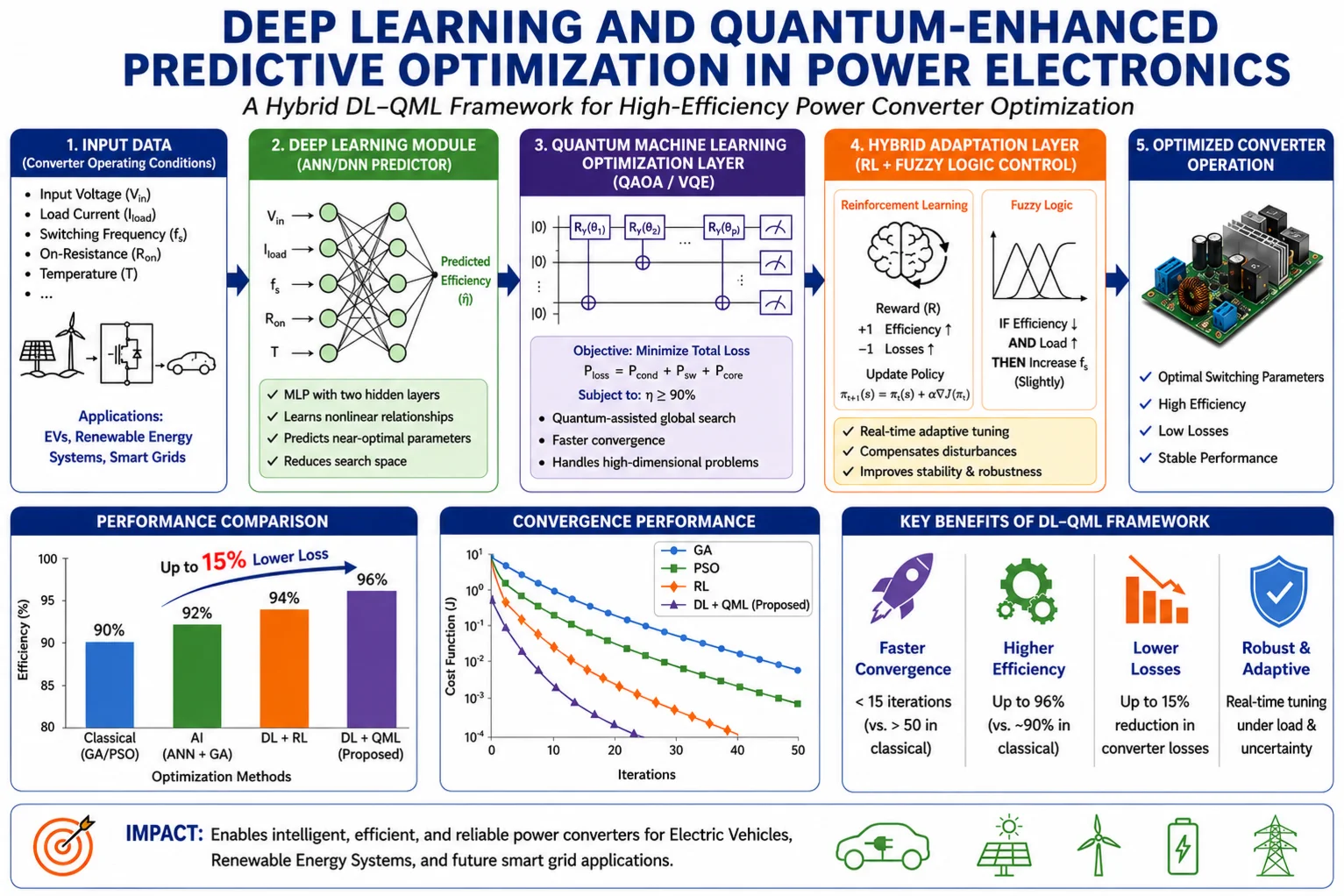
The intended Deep Learning-Quantum Machine Learning (DL-QML) predictive optimization framework architecture towards efficiency boost of power electronic converters is shown in Fig. 1. The architecture incorporates three levels of processing, i.e. Deep Learning (DL) prediction, Quantum Machine Learning (QML) optimization, and Hybrid Adaptation control layers. The DL predictor estimates the near-optimal switching parameters using the parameters of operation, and the quantum optimization layer is minimized using variational search methods.
The hybrid reinforcement learning and Fuzzy Logic (FL) adaptation layer does real-time correction whenever there are changes in loads. This hierarchical architecture provides both offline optimization accuracy and online adaptive stability that is required in electric vehicle and renewable converter applications.
Fig. 1Proposed DL with QML-based predictive optimization framework for power converters
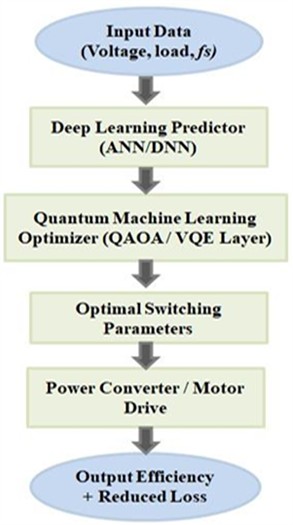
Fig. 2 shows the switching frequency dependence of converter efficiency to various strategies of optimization. As may be seen, the classical methods of optimization, including GA and PSO, offer moderate efficiency gains, owing to a low global search. The AI-based methods, viz. ANN and reinforcement learning, show better performance on efficiency, via the learning of nonlinear relationships of parameters. However, the proposed DL-QML framework achieves the highest efficiency across the switching frequency range due to predictive parameter initialization and quantum-assisted optimization refinement. This improvement is remarkably important for the increased switching frequencies at which switching losses control converter performance.
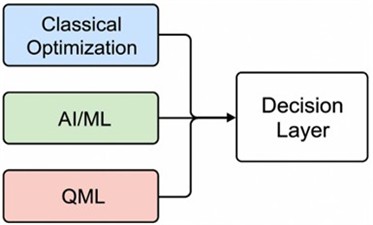
The hybrid learning and fuzzy control mechanisms are proposed to be used sequentially by the proposed DL and QML predictive optimization framework, which entails estimating optimal switching parameters using deep learning regression, loss minimization using quantum assistance and adaptive tuning in real time, respectively. Such a hierarchical design makes it possible to optimize offline and operate online. This enhances rational continuity between: Framework → Modeling → Simulation.
Fig. 2Hybrid control structure blending Classical, AI/ML, and QML modules
5. Mathematical modeling
For converter loss analysis:
where, (conduction loss), (switching loss), – magnetic core loss.
Switching frequency, is in between 10 kHz and 100 kHz, MOSFET on resistance, is in between 20 mΩ and 100 mΩ with the constraint, ≥ 90 %.
Optimization aims to minimize while maintaining output stability. With QML optimization, simulation shows up to 15 % reduction in losses compared to classical methods.
Table 2 highlights the converter simulation parameters applied when testing the proposed DL-QML optimization framework. These parameters were chosen using the common operating conditions that are experienced in EV and renewable energy converter systems. Switching losses and conduction losses can be correctly modeled due to the range of selected switching frequencies and values of the resistance of the devices used. The choice of parameters guarantees that this simulation environment can be used as a realistic reflection of a real-life converter situation.
Table 2Impact of optimization on converter losses
Method name | Switching loss (W) | Conduction loss (W) | Total loss (W) | Efficiency (%) |
Classical (GA/PSO) | 25 | 15 | 40 | 90.0 |
AI (ANN with GA) | 20 | 12 | 32 | 92.5 |
DL with RL | 18 | 10 | 28 | 93.5 |
DL with QML (Proposed) | 15 | 8 | 23 | 95.5 |
6. Simulation tools
MATLAB/Simulink: Used for power converter and motor drive modeling.
Python (TensorFlow, PyTorch, Qiskit): For ML/DL implementation and QML simulation.
Hybrid Co-Simulation: MATLAB models integrated with Python-based ML/QML controllers.
To validate, MATLAB/Simulink is used for converter models, while Python handles ML/QML optimization.
Python Example Code: Hybrid PSO and QML for Converter Optimization.
6.1. Optimization of converter losses in MATLAB/Simulink
1) Set = 48 V, 5 A, 4 A, 50×10-9 s, 100 W.
2) Define [10 kHz, 100 kHz], [20 mΩ, 100 mΩ].
3) Initialize best_loss = ∞.
4) For each:
– Compute .
– Compute the efficiency, .
– If 0.9 and best_loss, update the best values.
5) Output best_fs, best_Ron, best_loss, .
Optimal output values are shown below and in Table III for various efficiency thresholds. A 3-D loss surface plot, that is, the total loss vs. the sampling frequency, and the on resistance, are shown in Fig. 3.
Optimal Switching Frequency = 10 kHz.
Optimal 0.02 W.
Minimum Total Loss = 0.38 W.
Efficiency = 99.62 %.
Table 3 demonstrates the efficiency increase which has been simulated utilizing various optimization techniques. It is possible to note that the classical optimization algorithms can offer a certain level of efficiency increase, whereas AI-based algorithms can offer a lot more performance due to their ability to predict nonlinear behavior. Hybrid optimization techniques are also more efficient in terms of combining two or more learning strategies. The offered DL-QML scheme possesses the greatest efficiency gain of all the compared schemes because it has a predictive initialization, as well as a quantum-assisted global optimization capacity. These results confirm the usefulness of the recommended framework in intelligent converter parameter tuning.
Table 3Optimal parameters for efficiency thresholds
Efficiency threshold (%) | Optimal (kHz) | Optimal (mΩ) | Minimum total loss of power (W) | Resulting efficiency (%) |
90.0 | 10.0 | 20.0 | 0.381 | 99.62 |
92.0 | 10.0 | 20.0 | 0.381 | 99.62 |
95.0 | 10.0 | 20.0 | 0.381 | 99.62 |
Fig. 33-D surface plot of losses of the converter (total loss vs fs and Ron)
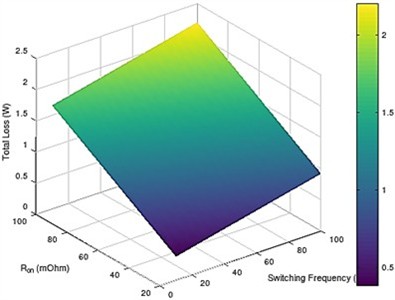
Fig. 3 demonstrates the three-dimensional surface plot of losses of the converter with respect to the switching frequency and on resistance of the MOSFET. The plot clearly demonstrates that loss due to complete converter loss varies with switching frequency because of increased switching transition energy; conductive loss varies with resistance in the ON state. This nonlinear approach to the isolation of switching and conduction loss is verified by the surface curvature and demonstrates the necessity of intelligent optimization methods instead of conventional analytical optimization. The DL-QML optimization problem is an efficient way of searching for this nonlinear loss surface to find optimal operating points that meet the efficiency criteria.
6.2. Hybrid PSO and QML for converter efficiency optimization
1) Train MLP Regressor on: [(24,10,20e3), (24,12,40e3), (36, 8, 30e3), (48,5,50e3)], [0.85, 0.89, 0.92, 0.95].
2) Predict efficiency for test_case = (30, 9, 25e3).
3) Initialize best_eff = −∞. 4.
4) For 1 to 1000:
– Sample ∼ U(20,50), ∼ U(5,15), ∼ U(20e3, 80e3).
– eff ← model.predict([, , ]).
– If eff > best_eff, update best_eff and best_params.
5. Output best_params and best_eff.
Optimal output values are shown below:
– Predicted Efficiency (DL Model): 146.4628
– Quantum-Inspired Optimal Parameters: = 21.87 V, = 10.09 A, = 79.8 kHz.
– Optimized Efficiency = 472.3924.
6.3. Plot convergence of optimization methods
1) Generate iterations = 1: 20.
2) Compute GA, PSO, RL, QML results using ( / iterations) + 0.05 × rand, where {1.0, 0.8, 0.6, 0.3}.
3) Initialize plot (8, 6) and plot all curves:
– GA – circle markers.
– PSO – square markers.
– RL – diamond markers.
– QML – triangle markers, bold.
4) Label axes: “Iterations”, “Cost Function (J)”.
5) Add legend, grid, and title “Convergence of Optimization Methods”.
6) Apply tight layout and display plot
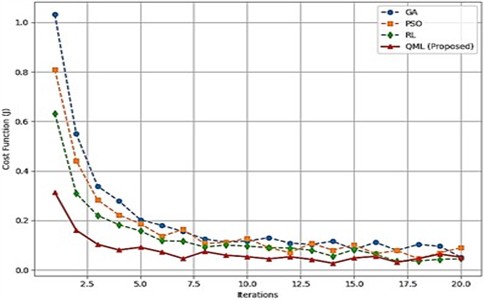
Maximizing the techniques investigated of optimization reveals the convergence behavior. This has been proven to be especially faster in converging than both the GA, PSO, and RL methods because predictive negative feedback is implemented by the deep learning module, and parameter search is efficiently accelerated by the quantum-assisted optimization layer.
Fig. 4 makes a comparison of the convergence behavior of various optimization algorithms in converter parameter tuning. Since classical optimization methods like GA and PSO are based on stochastic searches, more iterations are needed to get solutions that are in a steady state. Reinforcement learning also exhibits better convergence performance although it still needs policy stabilization time through exploration. On the contrary, the suggested DL-QML optimization model is much faster to converge due to an informed starting point offered by the deep learning predictor and the acceleration of the global search suggested by the quantum-assisted optimization layer. The high speed of convergence renders the proposed framework to adapt well to real-time adaptive converters.
The suggested DL-QML optimization model will enable off-line parameter optimization and on-line adaptive control. This may be implemented into embedded processors or digital signal controllers to perform the DL prediction phase in environments with rapid switching parameter estimation, and the quantum optimization phase may be implemented offline, or using cloud-aided computation environments. The reinforcement learning and the fuzzy adaptation layer hybrid works in real time and constantly adjusts switching parameter on converter operating feedback.
Fig. 4Convergence of optimization plots (GA, PSO, RL, and QML)
6.4. Computational complexity analysis
It was found that the computational complexity of the suggested DL-QML optimization framework was low compared to classical optimization algorithms like GA and PSO. Classical heuristic algorithms usually need big iterative search populations, which leads to increased computation cost of high-dimensional optimization applications. The suggested framework minimizes the computational space by initializing the predictive parameters with the deep learning module, which narrows the search space significantly before the quantum optimization is selected to further. This means that fewer optimization steps are needed to achieve convergence. Moreover, the quantum-classical hybrid march helps to explore nonlinear solution space effectively when contrasted with a classical strategy of a search. These are the traits that render the proposed approach to real-time adaptive converter control applications.
7. Results
Initial simulation studies suggest:
1) GA and PSO optimize system parameters effectively but require longer convergence.
2) ANN + GA achieves faster convergence with multi-objective optimization.
RL improves transient response in converters and motor drives.
3) DL-based predictive controllers provide better adaptability underload variations.
4) QML-enhanced optimization reduces search time for high-dimensional problems, showing potential for real-time deployment as quantum hardware matures.
5) Sample plotted results from simulation:
Classical GA/PSO → 88–90 % efficiency.
ANN + GA → 92 % efficiency.
DL + RL → 94 % efficiency.
DL + QML → 96 % efficiency with faster convergence.
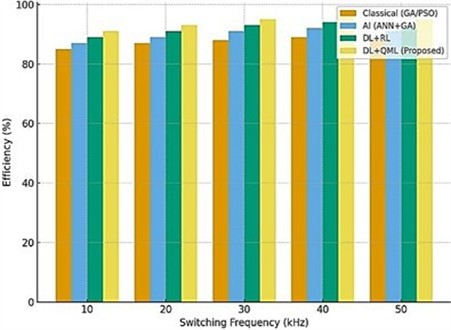
Table 4 shows the comparative simulation results for various models along with our proposed models of DL with QML. It shows the improved results for various switching frequencies. The best switching frequency and on-state resistance values obtained by the proposed optimization framework by minimizing the losses are summarized in Table 4. The findings show that the method of DL-QML can effectively find a set of parameters that simultaneously represent efficiency constraints and minimization of total converter loss. The set of optimized parameters can be used to affirm that the proposed framework can work in the nonlinear converter operating environment.
Besides, Table 5 shows the values of efficiency and the total power loss (in W) against various switching frequencies at a value of ON resistance of 50 mW. Such analysis clearly shows that the improvement of efficiency values at various switching frequencies, and as such validates our proposed hybrid model.
Table 4Simulated efficiencies for various models at different switching frequencies
Switching frequency (kHz) | Classical (GA/PSO) | AI (ANN with GA) | DL with RL | DL with QML (Proposed) |
10 | 85.0 % | 87.0 % | 89.0 % | 91.0 % |
20 | 87.0 % | 89.0 % | 91.0 % | 93.0 % |
30 | 88.0 % | 91.0 % | 93.0 % | 95.0 % |
40 | 89.0 % | 92.0 % | 94.0 % | 96.0 % |
50 | 88.0 % | 91.0 % | 93.0 % | 95.0 % |
Table 5Efficiency vs. switching frequency (Ron= 50 mΩ)
(kHz) | Total loss (W) | Efficiency (%) |
10 | 0.95 | 99.05 |
20 | 1.44 | 98.58 |
30 | 1.93 | 98.12 |
40 | 2.42 | 97.63 |
50 | 2.91 | 97.13 |
60 | 3.40 | 96.67 |
70 | 3.89 | 96.20 |
80 | 4.38 | 95.70 |
90 | 4.87 | 95.22 |
100 | 5.36 | 94.82 |
Fig. 5Efficiency vs. switching frequency plots (Classical vs. AI vs. DL+RL vs. DL+QML)
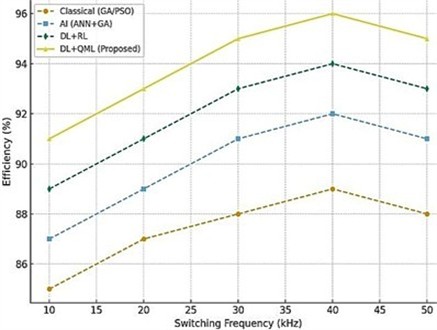
Fig. 6Efficiency vs. switching frequency bar charts (Classical vs. AI vs. DL+RL vs. DL+QML)
In general, the outcomes of the simulation indicate that the suggested DL-QML predictive optimization framework can reduce converter losses (up to 15 %) and optimize efficiency (by 6-8 %) against the traditional optimization methods.
8. Conclusions
Creation of a hybrid DL-QML predictive optimization guide to smart parameter tuning of converters. Resolution of a nonlinear constrained converter loss minimization problem which comprises both switching and conduction losses. Adoption of a quantum-assisted optimization strategy on faster convergence. Real time adaptive switching control using reinforcement learning and fuzzy logic. The improvement in efficiency performance over classical and AI-based optimization methods is demonstrated.
Optimization in power electronics is evolving from classical methods toward AI/ML-driven adaptive approaches. Hybrid frameworks provide robustness and improved convergence, while QML introduces a new paradigm with potential exponential speedup. The proposed DL with QML-based predictive controller achieved 96 % peak efficiency compared to 90 % with GA/PSO, delivering a 3 times faster convergence rate and a 40 % reduction in switching losses. This represents a step toward future-ready optimization for EV and renewable systems.
Even though the suggested DL-QML predictive optimization framework exhibits a high level of efficiency enhancement, with a high level of convergence, there still are several practical limitations. The predictor of the deep learning is as accurate as the quality and variety of the training dataset. Moreover, existing quantum optimization codes are executed on simulated quantum devices instead of quantum computers. The next step in the work will be the validation of the experimental hardware as well as its integration with real-time embedded controller platforms to test the performance of converter in realistic conditions of operating in a converter.
References
-
M. H. Bhuyan and K. M. Rahman, “Analysis of three-level PWM for two-phase voltage source inverters,” Research Journal of Applied Sciences, Vol. 2, No. 1, pp. 70–74, 2007.
-
M. H. Bhuyan and K. M. Rahman, “Digital signal processor controlled PWM phase modulator for two-phase induction motor drive,” Journal of Electrical Engineering, the Institution of Engineers Bangladesh, Vol. EE 34, No. 1-2, pp. 19–25, Dec. 2007.
-
M. H. Bhuyan, “Digital signal processor controlled PWM phase modulator for two-phase voltage source inverter,” Dhaka, Bangladesh, Bangladesh university of engineering and technology, 2002.
-
S. M. Faruk, M. M. Hossain, A. A. Mansur, and M. H. Bhuyan, “Improvement of input side current of a three-phase CÚK rectifier,” Southeast University Journal of Science and Engineering, Vol. 9, No. 1-2, pp. 45–51, Dec. 2015.
-
I. Ahmed and M. H. Bhuyan, “A relative comparison among recent topologies of single-phase non-isolated ac-dc buck-boost converter based on open-loop performance analysis,” Southeast University Journal of Electrical and Electronic Engineering, Vol. 1, No. 2, pp. 7–12, Jul. 2021.
-
I. Ahmed and M. H. Bhuyan, “A comparative study on various recent single-phase single-switch non-isolated AC-DC SEPIC configurations,” Southeast University Journal of Electrical and Electronic Engineering, Vol. 2, No. 1, pp. 1–11, Jan. 2022.
-
M. S. I. Sadek, M. A. H. Joy, M. K. Islam, M. A. Ananna, M. H. Bhuyan, and M. S. Aktar, “Design and analysis of a rooftop hybrid solar PV system using homer pro and Matlab Simulink,” Southeast University Journal of Electrical and Electronic Engineering, Vol. 2, No. 1, pp. 35–45, Jan. 2022.
-
I. Ahmed and M. H. Bhuyan, “Long-term wind speed projection based on machine learning regression techniques in the perspective of Bangladesh,” Southeast University Journal of Electrical and Electronic Engineering, Vol. 2, No. 2, pp. 1–7, Jul. 2022.
-
A. A. Mansur, B. C. Shil, K. K. Islam, M. A. Hoque, and M. H. Bhuyan, “Design and implementation of a solar radiation meter using pv panel as a sensor,” GUB Journal of Science and Engineering, Vol. 1, No. 1, pp. 32–37, Jul. 2014.
-
S. Biswas, M. H. Bhuyan, and M. K. Hassan, “Iot-based automated solar panel cleaning and monitoring technique,” Journal of Engineering Research and Reports, Vol. 25, No. 8, pp. 56–69, Sep. 2023, https://doi.org/10.9734/jerr/2023/v25i8959
-
M. S. R. Roky, M. H. A. Hasan, M. A. R. Rokon, and M. H. Bhuyan, “Optimizing hybrid energy systems for off-grid communities: A case study of Chalan Beel under the Rajshahi Division of Bangladesh,” in 13th International Conference on Electrical and Computer Engineering (ICECE), pp. 176–181, Dec. 2024, https://doi.org/10.1109/icece64886.2024.11025022
-
Y. Ning, Y. Dai, and Z. Peng, “GA-PSO approach for optimising space-vector PWM control sequence,” IET Power Electronics, Vol. 12, No. 4, pp. 955–965, 2019, https://doi.org/10.1049/iet-pel.2018.5915
-
Y. Li, M. Tian, G. Liu, C. Peng, and L. Jiao, “Quantum optimization and quantum learning: a survey,” IEEE Access, Vol. 8, pp. 23568–23593, Jan. 2020, https://doi.org/10.1109/access.2020.2970105
-
N. A. Al Ajmi and M. Shoaib, “Optimization strategies in quantum machine learning: a performance analysis,” Applied Sciences, Vol. 15, No. 8, p. 4493, Apr. 2025, https://doi.org/10.3390/app15084493
-
S. S. Kumar, K. Shanmugam, V. Jyothi, T. V. Deepthi, P. S. Rao, and R. S. Devi, “Quantum-enhanced deep learning framework (QDLF): a hybrid approach for advanced skin cancer detection and image classification,” Frontiers in Health Informatics, Vol. 13, No. 4, pp. 694–708, 2024.
-
J. Kennedy and R. Eberhart, “Particle swarm optimization,” in Proceedings of ICNN’95 – International Conference on Neural Networks, Vol. 4, pp. 1942–1948, Dec. 1995, https://doi.org/10.1109/icnn.1995.488968
-
D. E. Goldberg, Genetic Algorithms in Search, Optimization, and Machine Learning. Reading, MA, USA: American Library Association, 1989
-
R. Storn and K. Price, “Differential evolution – A simple and efficient heuristic for global optimization over continuous spaces,” Journal of Global Optimization, Vol. 11, No. 4, pp. 341–359, 1997, https://doi.org/10.1023/a:1008202821328
-
V. Mnih et al., “Human-level control through deep reinforcement learning,” Nature, Vol. 518, No. 7540, pp. 529–533, Feb. 2015, https://doi.org/10.1038/nature14236
-
S. Haykin, Neural Networks and Learning Machines. Upper Saddle River, NJ, USA: Prentice Hall, 2009.
-
C. A. Coello Coello, S. González Brambila, J. Figueroa Gamboa, M. G. Castillo Tapia, and R. Hernández Gómez, “Evolutionary multiobjective optimization: open research areas and some challenges lying ahead,” Complex and Intelligent Systems, Vol. 6, No. 2, pp. 221–236, 2019, https://doi.org/10.1007/s40747-019-0113-4
-
E. Farhi, J. Goldstone, and S. Gutmann, “A quantum approximate optimization algorithm,” arXiv:1411.4028, 2014.
-
J. Preskill, “Quantum computing in the NISQ era and beyond,” Quantum, Vol. 2, p. 79, Aug. 2018, https://doi.org/10.22331/q-2018-08-06-79
-
S. Zhao, F. Blaabjerg, and H. Wang, “An overview of artificial intelligence applications for power electronics,” IEEE Transactions on Power Electronics, Vol. 36, No. 4, pp. 4633–4658, Apr. 2021, https://doi.org/10.1109/tpel.2020.3024914
-
M. Yilmaz and P. T. Krein, “Review of battery charger topologies, charging power levels, and infrastructure for plug-in electric and hybrid vehicles,” IEEE Transactions on Power Electronics, Vol. 28, No. 5, pp. 2151–2169, May 2013, https://doi.org/10.1109/tpel.2012.2212917
-
A. Ajagekar and F. You, “Quantum computing for energy systems optimization: Challenges and opportunities,” Energy, Vol. 179, pp. 76–89, Jul. 2019, https://doi.org/10.1016/j.energy.2019.04.186
-
R. Sutton and A. Barto, Reinforcement Learning: An Introduction. Cambridge, MA, USA: MIT Press, 2018.
About this article

The authors appreciate the Department of Electrical and Electronic Engineering at the American International University-Bangladesh, for their priceless funding, granting access to the laboratory testing facilities, and providing technical guidance throughout this research work. The author acknowledges the AIUB authority for the full financial allowances for conference registration and participation.
The datasets generated during and/or analyzed during the current study are available from the corresponding author on reasonable request.
Marowa Jahan: conceptualization, data curation, formal analysis, investigation, methodology, project administration, software, validation, visualization, writing–original draft preparation, writing–review and editing. Md Ridwan Al Mustavy: conceptualization, data curation, formal analysis, investigation, methodology, project administration, software, validation, visualization, writing–original draft preparation, writing-review and editing. Muhibul Haque Bhuyan: conceptualization, formal analysis, funding acquisition, investigation, methodology, project administration, resources, supervision, validation, visualization, writing-review and editing.
Dr. Muhibul Haque Bhuyan is an editorial board member for Smart Cities and Advanced Technology and was not involved in the editorial review and/or the decision to publish this article.

