Abstract
This is an authorial synthesis article, reflecting my personal opinion and critical interpretation as the sole author, built upon and supported by the body of literature cited throughout the text. It is not a systematic review, nor a meta-analysis, nor a primary research report. It is an integrative essay that articulates evidence streams from evolutionary anthropology, sleep medicine, functional orthodontics, nutrition, neurophysiology, and the Ibero-American tradition of jaw functional orthopedics, with the aim of offering a coherent reading of the historical moment the profession is going through. The article argues that the dominant orthodontic “wait-and-see” doctrine is no longer scientifically sustainable, and that the contemporary literature – from Kevin Boyd’s evolutionary anthropology and the Mews’ orthotropics to Christian Guilleminault’s sleep medicine, the 2024 Chinese Expert Consensus on pediatric orthodontics, and Paul Henny's recent philosophical-structural critique – converges on the need for timely, interdisciplinary, airway- and function-centered care. The article also seeks to position the Ibero-American tradition of neuro-occlusal rehabilitation (Pedro Planas) and jaw functional orthopedics (Wilma Alexandre Simões) as the historical and conceptual bedrock of much of what the Anglophone literature is now rediscovering, and to articulate the recently proposed neurostomatological framework as the unifying biological foundation of the new paradigm.
Highlights
- The paradigm shift in contemporary orthodontics: why waiting to treat malocclusion is no longer a scientifically defensible position.
- Independent evidence streams converge on timely, function- and airway-centered care.
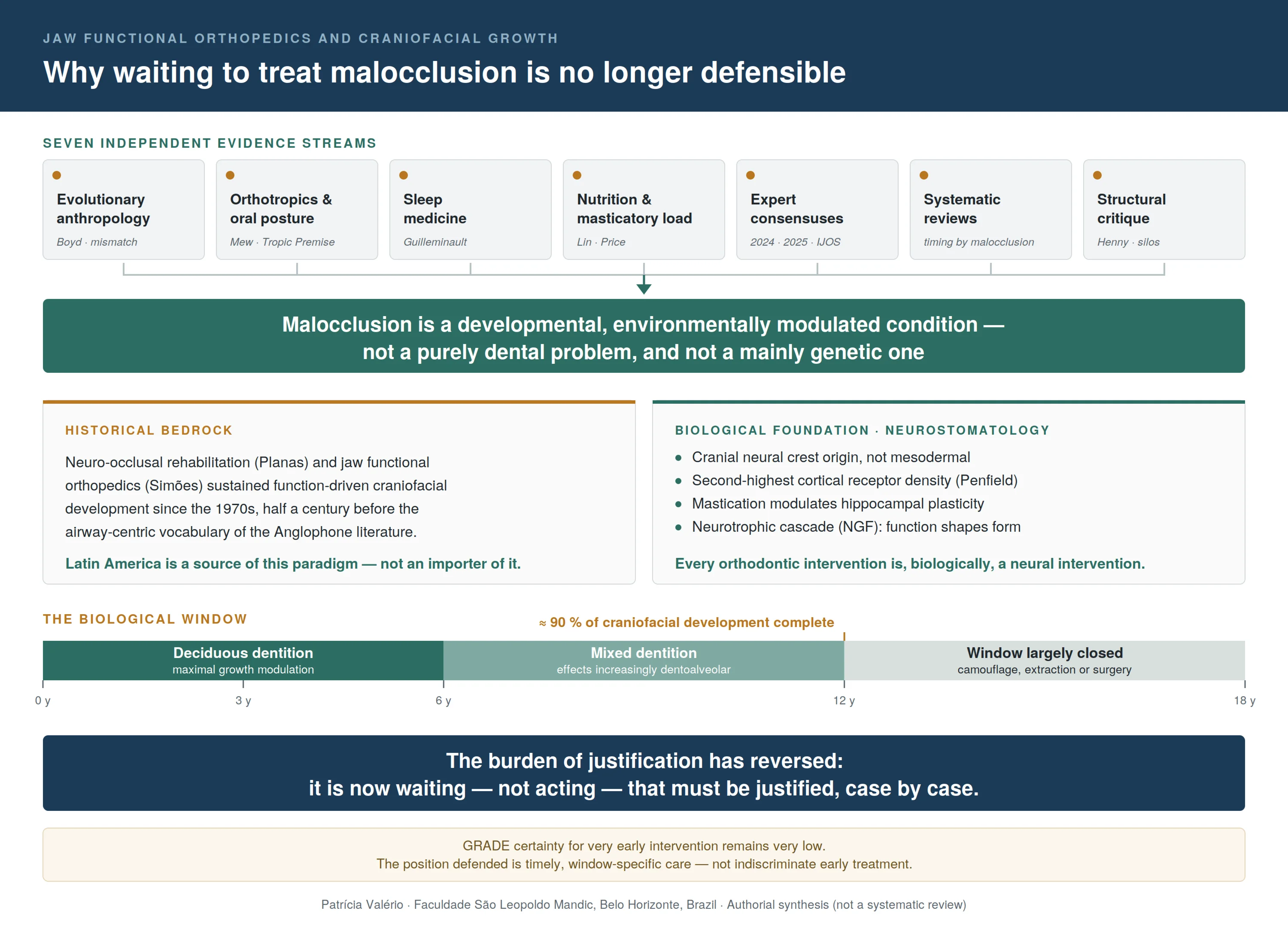
- Nearly 90% of craniofacial development is complete by the age of twelve.
- Ibero-American jaw functional orthopedics anticipated this paradigm by decades.
- Neurostomatology reframes the stomatognathic system as neural, not dental.
1. Introduction
For decades, the dominant orthodontic model has operated under two premises that are now being systematically challenged by the literature: first, that malocclusion is an essentially dental problem, to be corrected after the complete eruption of the permanent teeth; second, that its etiology is largely genetic. The first premise gave rise to the “wait-and-see” doctrine. The second turned the orthodontist into an alignment technician rather than a clinician of craniofacial development. Recent literature dismantles both premises, articulating a paradigm that integrates orthodontics, sleep medicine, evolutionary anthropology, nutrition, myofunctional therapy, neurophysiology, and otolaryngology.
2. Reframing timing as a philosophy of care
An article published in Dental Tribune in November 2025 captures the philosophical core of the shift, proposing that the goal is not merely to treat earlier but to redefine what “appropriate timing” means [1]. “Timely treatment” represents a philosophy of care: reaching the right patients at the right time and in the right way [1]. Children gain confidence and oral function early, families avoid prolonged and stressful treatments, and the clinician achieves more robust outcomes. The leadership of this transition cannot come solely from innovation in clinical tools – such as aligners and expanders – but rather, primarily, from how professionals communicate their use. The foundation of health is established in the earliest years of life, and that is why early intervention, at the first sign of a problem, is necessary to optimize malocclusion, oral function, maxillary and mandibular development, airway, breathing, sleep, and children’s psychological well-being [1]. This reframing is not cosmetic: it repositions the orthodontist as an agent of development, not as a late corrector of already-established deformities.
3. Evolutionary anthropology: malocclusion as a mismatch disease
Dr. Kevin Boyd is perhaps the most radical and scientifically anchored figure in this new orthodontics. A pediatric dentist in Chicago, instructor in the Pediatric Dentistry residency program at Lurie Children's Hospital, adjunct professor in the Anthropology Department of the University of Arkansas, and Visiting Scholar at the Penn Museum (University of Pennsylvania), Boyd argues – first formalized in (R)evolutionary Health Care [2] – that the highly prevalent malocclusion and impacted third molars seen today practically did not exist in humans until the onset of the Industrial Revolution, in the mid-eighteenth century. For Boyd, this is an “evolutionary mismatch disease”: the human genome evolved to develop under environmental conditions — diet, prolonged breastfeeding, respiratory function, chewing patterns – that have largely disappeared in the last 250 years [2].
In collaboration with curator-anthropologist Janet Monge, Boyd conducts a systematic analysis – via direct and 3D radiographic measurements – of pre-industrial skulls (infants and adults) from the Penn Museum collections, aiming to identify which skeletal structures of modern late-20th and early-21st century skulls show alterations compared to pre-industrial specimens. Preliminary findings confirm that maxillary narrowing, mandibular shortening, reduced tongue space, high-arched palate, and vertical patterns of facial growth are modern phenomena, not ancestral human traits. Boyd argues that this evolutionary perspective demands intervention before 72 months of age (six years old), precisely when the developmental window of the craniofacial-respiratory complex still allows modulation [2]. Waiting for the permanent dentition would mean, by this logic, missing the relevant biological window.
4. Orthotropics and the primacy of oral posture
British orthodontist John Mew (1928-2025) formulated, in 1981, the “Tropic Premise”: that almost all malocclusion is caused not by genetics but by the environmental factor of inadequate oral posture, and can be treated by imposing good oral posture, defined as “tongue resting on the palate, lips sealed, and teeth in contact or close to it” [3]. Encouraged by research on identical twins – which showed that mandibles varied more than any other part of the body – Mew built his hypothesis on a simple anatomical observation: malocclusion would be present mostly in individuals with a vertical pattern of facial growth, also affecting facial form, cervical posture, and airways [3]. His Tropic Premise may be understood as an application of Wolff's Law to the face, and found confirmation in Egil Peter Harvold's experiments with monkeys in the 1960s, in which blocking the nasal airways induced mouth breathing, which in turn generated low oral posture of the mandible and tongue, leading to vertical facial growth and malocclusion.
To correct this posture, Mew developed the Biobloc system, a set of simple appliances designed to bring the maxilla forward and to train the patient to maintain adequate oral posture and muscular tone, so that teeth align spontaneously [3]. He founded the London School of Facial Orthotropics. Mainstream orthodontics was skeptical: critics pointed out that Mew restricted his publications in peer-reviewed journals to “philosophical views” without subjecting his methods to rigorous randomized clinical trials, and the British Dental Association removed his license in 2017 over public criticism of colleagues. Despite this, the conceptual influence of orthotropics is now undeniable: the ideas of oral posture, nasal breathing, early maxillary expansion, and horizontal versus vertical growth permeate contemporary orthodontic discourse. His son, Mike Mew, popularized the concept globally (including via “mewing” on social media), and The Cause and Cure of Malocclusion remains a reference [3].
5. A hidden epidemic: jaws, airway, and evolution
Published by Stanford University Press in 2018, Jaws: The Story of a Hidden Epidemic [4] is probably the work that most contributed to bringing this discussion to the lay public and to the scientific community beyond dentistry. The co-authorship is symbolic: Sandra Kahn, an orthodontist trained in physical anthropology at UC Berkeley and the only Diplomate of the American Board of Orthodontics practicing exclusively Biobloc Orthotropics; and Paul R. Ehrlich, Bing Professor of Population Studies Emeritus at Stanford, author of The Population Bomb and one of the great authorities in evolutionary ecology of the twentieth century. The book's thesis is that there is a silent epidemic in Western civilization: jaws are shrinking and teeth becoming crooked and crowded, creating not only esthetic challenges but also respiratory difficulties [4]. Modern orthodontics has convinced us that appliances and oral devices can correct these problems, but although teeth can indeed be aligned, this does not address the underlying causes of this rapid change in oral evolution nor the health risks posed by obstructed airways [4].
Kahn and Ehrlich propose simple adjustments to alleviate this developing crisis, as well as a significant alternative to orthodontics that promises more consistent long-term relief [4]. As Robert Sapolsky notes in the foreword, and Jared Diamond reinforces in reviews, the book demonstrates how mundane acts – breathing, chewing, sleeping, breastfeeding – have broad systemic consequences. Among the key concepts introduced are Forwardontics, Kahn’s term for an orthodontics oriented toward horizontal (forward) growth of the face, as opposed to pathological vertical growth; GOPex (Good Oral Posture Exercises), an exercise program developed by Kahn; and the Zeroto15 project, an initiative co-founded by Kahn that proposes to address airway growth from preconception to age 15 through transdisciplinary teams [4]. The book is endorsed by Barry Raphael (Raphael Center for Integrative Orthodontics), German Ramirez-Yañez (DDS, MDSc, MSc, PhD), and John Peterson Myers (Chief Scientist, Environmental Health Sciences), among others – a coalition that crosses orthodontics, environmental science, and evolutionary medicine.
6. Sleep medicine and orofacial growth
Prof. Christian Guilleminault (1938-2019), of the Stanford Sleep Disorders Clinic, is one of the most cited researchers in the history of sleep medicine (more than 83,000 citations). It was he who, together with William Dement, first described obstructive sleep apnea syndrome in children, and his later production was central in definitively connecting orthodontics and breathing. In a seminal article published in Frontiers in Neurology in 2012, Guilleminault argues that pediatric obstructive sleep apnea in non-obese children is a disorder of orofacial growth [5]. The article presents evidence that orofacial hypotonia is a primary element in the development of anatomical abnormalities leading to abnormal breathing during sleep; that there is continuous interaction between orofacial muscle tone, maxillo-mandibular growth, and the development of sleep-disordered breathing (SDB); and that myofunctional re-education combined with orthodontics and the elimination of soft tissue from the upper airway is the rational treatment for non-obese children with SDB [5].
In Critical role of myofascial reeducation in pediatric sleep-disordered breathing [6], the group demonstrated that even after successful adenotonsillectomy, recurrence of apnea during puberty is frequent when orofacial function is not rehabilitated – the empirical foundation for the mandatory integration of surgery, orthodontics, and myofunctional therapy. The interview Obstructive sleep-disordered breathing and orthodontics (Guilleminault, Hervy-Auboiron, Huang, Li), originally published in L'Orthodontie Française and translated by Philippe Amat, consolidates the argument that the restoration of nasal breathing must be the ultimate goal to ensure adequate craniofacial and airway development in children.
In the 2017 article From oral facial dysfunction to dysmorphism and the onset of pediatric OSA [7], Guilleminault and Huang formalize what may be the most important contribution: treatment of the small oral cavity during early childhood using orthodontic techniques improves breathing during sleep and normalizes oral cavity size; however, the absence of orofacial muscular re-education via myofunctional therapy and the absence of nasal breathing re-education are associated with persistence of mouth breathing – and therefore with apnea recurrence [7]. In other words: orthodontics without functional re-education is not enough; but functional re-education without an early orthodontic window is not enough either.
7. The nutritional dimension
Dr. Steven Lin, an Australian board-accredited dentist, TEDx speaker, and author of the bestseller The Dental Diet: The Surprising Link between Your Teeth, Real Food, and Life-Changing Natural Health [8], brings the nutritional dimension into the equation. As Lin synthesizes from his reading of Weston A. Price and contemporary science, the health of the jaw, facial structure, and airway begins with what we eat [8]. The argument unfolds in four planes: dentofacial growth and masticatory stimulus, by which ancestral diets – rich in whole, fibrous foods – generated mechanical stimulus for maxillary and mandibular development, while modern ultra-processed and soft diets do not; fat-soluble vitamins (A, D, K2), where Weston Price’s “Activator X” (today identified as K2/MK-4) is central to mineralization and facial bone growth; the oral-systemic microbiome, modulated by diet, which affects inflammation, caries, periodontal disease, and development; and the integration with function, combining nutrition, breathing, airway, functional orthodontics, and sleep health [8].
The endorsement of Derek Mahony (orthodontic specialist, Full Face Orthodontics) is particularly important: he describes having witnessed, over the last decades, a paradigm shift in the focus of the dental industry toward airway-functional dentistry, and identifies in Lin the next step: integration of nutritional prevention to address the malocclusion epidemic. Lin's framework is in continuity with two foundational works: Daniel Lieberman’s The Evolution of the Human Head [9], which provides the evolutionary anthropological basis for understanding why the modern human face is so dysfunctional; and Weston A. Price’s Nutrition and Physical Degeneration [10], the historical anthropological foundation that documented, in the 1930s, the dental and facial degeneration associated with industrialized diets.
8. Institutional consolidation: consensuses and systematic reviews
Published in International Journal of Oral Science (Nature Publishing Group) in April 2024, the Expert Consensus on Pediatric Orthodontic Therapies of Malocclusions in Children [11] is probably the most robust institutional document to officially codify the paradigm shift. The consensus argues that timely intervention in malocclusion can promote an environment favorable to dentomaxillofacial development and substantially decrease the incidence or reduce the severity and complexity of malocclusion in the permanent dentition, mitigating the negative impact of abnormal environmental influences on growth [11]. Early orthodontic treatment encompasses the accurate identification and treatment of dental and maxillofacial morphological and functional abnormalities at various stages of development – from the fetal stage to the early permanent dentition phase [11]. From an economic and social standpoint, the urgency for effective early orthodontic treatments for childhood malocclusion cannot be overstated: the document highlights that malocclusion is among the three main oral diseases identified by the WHO, profoundly affecting dentomaxillofacial functions, facial esthetics, and the development of approximately 260 million children in China alone [11].
The consensus identifies several parafunctional habits as preventable causes [11]: unilateral chewing, which may result in posterior crossbite on the chewing side, midline deviation, and ultimately facial asymmetry; non-nutritive sucking (thumb sucking, pacifier), which leads to anterior open bite and arch narrowing; tongue thrust and interposition, which contributes to localized anterior open bite; and upper lip sucking and biting, which causes mandibular protrusion and anterior crossbite. The clinical message is direct: malocclusion is not classified as a disease, but as a developmental condition — and development can be modulated [11]. A second consensus, specifically on Class III, was published in 2025 [12]. Since anterior crossbite tends to worsen with growth, early orthodontic treatment can harness the growth potential to normalize maxillofacial development or reduce the severity of skeletal malformation, decreasing the difficulty and shortening the cycle of subsequent treatment, and benefits the physical and mental growth of children [12].
Published in November 2025, the systematic review Timing of Orthodontic Intervention for Pediatric Class II Malocclusion: A Systematic Review on Early vs. Late Treatment Outcomes [13] provides the most up-to-date evidence base. Of the eleven studies analyzed, eight reported statistically significant improvements favoring early orthodontic intervention. Early treatment was associated with greater improvement of maxillary and mandibular arch development, better intermaxillary relationships, and expanded airway dimensions; studies using headgear or other growth-modifying appliances showed more favorable eruptive and alignment patterns, underscoring the clinical relevance of early-phase management [13]. The same review maintains epistemological honesty: early treatment frequently results primarily in dentoalveolar rather than true skeletal changes, and skeletal effects may relapse unless reinforced during the adolescent growth phase; for Class II, functional appliance therapy in the prepubertal stage yields modest benefits and frequently requires a second phase during puberty, while treatment initiated during the pubertal growth spurt results in greater and more stable mandibular advancement [13]. The window matters, and it is specific by type of malocclusion: the issue is not to treat everything as early as possible, but to identify the optimal biological moment for each type of discrepancy.
9. From teeth to soft tissues to airway
It is worth registering the theoretical foundation that preceded and prepared this movement. William Proffit, author of the most influential textbook in world orthodontics [14], articulated already in the 1990s another dimension of the paradigm shift: the shift of treatment goals toward soft tissues and away from dental and skeletal relationships [14]. Edward H. Angle, the founder of modern orthodontics, emphasized the preservation of all dental elements in favor of facial symmetry; for him, extraction of a tooth eliminated the possibility of ideal occlusion or esthetics. However, by correcting malocclusion orthodontically, facial balance may worsen – due to soft tissue relationships ignored in diagnosis or lack of attention to esthetic goals [14]. Hence the current tendency toward soft tissue relationships. The airway-centric paradigm can be understood as a natural extension of this movement: from teeth to soft tissues, and from soft tissues to respiratory function and global development.
In 2019, Stanford Medicine created the section of Craniofacial Airway Orthodontics, signaling that the approach had left marginal territory and entered mainstream academia. Early evaluation allows orthodontists to guide facial and mandibular growth during critical developmental stages; growth-modification appliances can improve airway function, reduce future surgical needs, and alleviate maxillo-mandibular discrepancies. The review by Kalha and Aziz, Airway-centric orthodontics: a review on oral appliance therapy as a simplified solution to obstructive sleep apnea [15], offers the most compelling chronobiological rationale: an essential amount of craniofacial growth is complete by 4 years of age, and nearly 90 % of the development of the craniofacial complex is concluded by age 12 [15]. Therefore, the aberrant growth and morphological characteristics of sleep-disordered breathing in adults may be a legacy of untreated childhood problems – due both to the lack of attention from treating dentists and to the cognitive bias, in much of the lay public and the profession, of only treating after the eruption of all permanent teeth [15].
Other names structuring the field include Barry Raphael (NJ), articulator between different philosophies and head of the Raphael Center for Integrative Orthodontics; Michael Gelb, author of GASP: Airway Health, the Hidden Path to Wellness [16], with more than 40 years treating TMD; Kasey Li (Stanford), maxillofacial surgeon and pioneer in DOME and EASE, surgical alternatives for adult cases with a missed growth window; Audrey Yoon, pediatric dentist and orthodontist with influential myofunctional demonstrations; Derek Mahony (Australia), specialist in functional orthodontics and international trainer; German Ramirez-Yañez (DDS, MDSc, MSc, PhD), researcher on the diet-malocclusion relationship; and Yu-Shu Huang (Chang Gung University, Taiwan), trained by Guilleminault and author of more than 100 articles on pediatric apnea and development.
10. The structural critique: Henny and the silo problem
In May 2026, Dr. Paul A. Henny – a restorative-esthetic dentist in Roanoke, Virginia, former visiting faculty at the Pankey Institute, co-founder of the Bob Barkley Study Club, author of CoDiscovery: Exploring the Legacy of Robert F. Barkley, DDS [18], and self-described practitioner of comprehensive restorative, esthetic, and airway dentistry – published The Silo Problem – And Why Orthodontics Is at a Crossroads [17]. The text, concise and incisive, is perhaps the most lucid piece ever written on why resistance to the airway-centric paradigm persists despite the growing weight of evidence: Henny is not arguing against orthodontists, but about the business model, professional confirmation bias, and the siloed structure of the healthcare system as a whole [17].
Henny opens by identifying what he calls a profound structural problem in modern healthcare that few patients fully understand but many professionals recognize and rarely discuss: medicine and dentistry historically evolved in separate silos, and because of that separation, some of the most important connections in human health often fall through the cracks [17]. The example he uses is clinical and everyday: a child can see a pediatrician, an ENT, a general dentist, an orthodontist, a speech therapist, a sleep physician, and a myofunctional therapist – and no meaningful collaboration will occur. Each professional looks at their own piece of the puzzle, but few are willing to step back and examine the whole child and the long-term implications [17]. This fragmentation becomes especially problematic when discussing breathing, sleep-disordered breathing, craniofacial development, airway health, oral posture, tongue function, and long-term systemic health: these issues do not fit neatly into a single specialty box, and that is exactly why there is so much discomfort today within the orthodontic community [17].
Henny's reading of the current state of the profession is direct. Historically, orthodontics evolved as a profession focused on occlusion, alignment, esthetics, mechanics, and efficiency of tooth movement; concurrently, the industrialized model of orthodontics that has emerged over several decades rewards high patient volume, delegation, standardized workflows, rapid treatment delivery, and production efficiency [17]. In many practices, the orthodontist has become less of a thinker-planner and more of a systems manager overseeing production: large numbers of patients can be managed simultaneously because much of the clinical workflow is heavily delegated – assistants changing wires, scanning, placing aligners, handling patient flow – and increasingly standardized treatment protocols [17]. Henny does not deny that this model can be extraordinarily profitable, but he identifies a hidden cost: the more industrialized a system becomes, the less compatible it is with patients possessing nuanced, complex, interdisciplinary needs, and airway-aware dentistry is inherently nuanced because it requires more thorough diagnosis, individualized planning, interdisciplinary coordination, developmental understanding, and intellectual involvement [17].
It is at this point that Henny's argument becomes most incisive. Once orthodontists begin acknowledging that breathing, sleep, tongue posture, nasal function, craniofacial growth, inflammation, neurocognitive development, and systemic health are interconnected, the profession can no longer comfortably operate primarily as a tooth-moving business model [17]. Henny explicitly invokes the concept of confirmation bias: human beings rarely interpret information neutrally, but rather through the lens of what protects their identity, training, income, status, and existing worldview, and every profession suffers from this [17]. The orthodontic community – at least on the level the AAO expressed in its recent White Paper on sleep-disordered breathing and orthodontics – dismisses or minimizes emerging evidence on pediatric sleep-disordered breathing, chronic mouth breathing, nasal breathing, tongue posture, craniofacial development, and the need for interdisciplinary care [17]. The critical point is that many of these concepts are no longer fringe ideas: they are increasingly supported by sleep medicine, otolaryngology, pediatric medicine, neuroscience, microbiome research, and developmental physiology. Yet resistance persists, because accepting these concepts requires many orthodontists to rethink their fundamental practice model – and that is physically, financially, and psychologically threatening [17].
Henny formulates the conflict crystal-clearly: a high-volume, industrialized orthodontic business model relies upon reductionism and simplification, whereas airway-centered care requires close attention to the possibility of complexity, and these two approaches are naturally in conflict [17]. If the orthodontist is expected to evaluate sleep quality, breathing patterns, tongue posture, oral habits, facial growth, ENT findings, CBCT imaging, nasal obstruction, myofunctional dysfunction, and interdisciplinary medical considerations, then they must become far more intellectually involved in each case – which in turn has the undesirable effect of slowing down production, reducing delegation, increasing diagnostic time, and possibly reducing profitability [17]. Moreover, it requires planning time, and in many cases planning time is the enemy of optimal production efficiency because it is uncompensated time [17]. For Henny, this might explain why certain segments of the orthodontic community appear more comfortable minimizing these issues than fully exploring them: because if the profession fully embraces the whole-health implications of craniofacial growth and associated airway function, it can no longer remain focused only on straight teeth and attractive smiles [17].
The most philosophically important passage of Henny’s article exposes the fundamental contradiction of the system: we tend to divide the human body into specialty areas, yet biology and physiology are systemic and fully integrated; the airway – functionally and psychologically speaking – does not care whether the patient is seeing an orthodontist, an ENT, a pediatrician, or a sleep physician; the nervous system does not recognize professional silos, inflammation does not recognize insurance coding or coverage, and sleep quality does not care about specialty boundaries [17]. Henny closes the argument with the clinical portrait that many professionals who work with children immediately recognize: a chronically mouth-breathing child with poor sleep, narrow arches, altered tongue posture, ADHD-like symptoms, recurrent inflammation, and abnormal craniofacial development is not experiencing separate problems – they are experiencing an interconnected physiologic pattern of dysregulation and dysfunction [17].
For Henny, the debate at its core is not really about the airway: it is about philosophy. Two very different visions of dentistry and orthodontics are emerging – one industrialized, transactional, production-centered, efficiency-driven, and reductionistic; the other person-centered, interdisciplinary, developmental, physiologic, relationship-based, and whole-health oriented. The two philosophies produce different questions: the industrial model asks how efficiently teeth can be moved or fixed, while the whole-health model asks how this person is developing, whether in a healthy direction, and if not, how it can be improved [17]. Henny then makes an intellectually honest move: he refuses Manichaeism, noting that none of this means that orthodontists are wrong, nor that every airway diagnosis is automatically correct; healthcare requires humility, and humility cuts both ways, but true science does not fear inquiry, does not try to silence uncomfortable questions, and remains open to emerging evidence, interdisciplinary dialogue, and evolving understanding [17].
Henny's article does, in a few pages, what dozens of systematic reviews cannot: it identifies that the paradigm will only advance when the profession has the courage to confront not only the evidence, but the business model that makes the evidence uncomfortable [17]. The earlier authors – Boyd, Mew, Kahn, Ehrlich, Guilleminault, Lin – produced the scientific ballast; Henny points to the sociological and economic barrier that causes this ballast to be ignored by much of the profession. As he concludes, the future of dentistry and medicine will require far greater collaboration than we have historically embraced, if we want to continue our pursuit of truth and optimal health: the era of isolated silos should be ending, and perhaps that is a good thing, because human beings were never designed to be understood or treated in that manner [17].
11. The Ibero-American foundation: neuro-occlusal rehabilitation and JFO
The entire discussion built up to this point – from Boyd’s evolutionary anthropology to the Mews' orthotropics, from Guilleminault’s sleep medicine findings to the institutional Chinese consensus, from Henny’s philosophical-structural critique to the airway-centric paradigm at Stanford – converges on a question that the Anglophone paradigm rarely formulates with adequate clarity: if the stomatognathic system is not merely a dental apparatus, what is it, from a biological and neurophysiological standpoint? The answer to this question is perhaps the most original contribution that the Ibero-American tradition of jaw functional orthopedics (JFO) has to offer to the contemporary debate. The Anglophone airway-centric paradigm often treats ideas of function, posture, and neurophysiology as recent discoveries, but historiographically this is imprecise. Pedro Planas, a Catalan orthodontist, proposed more than half a century ago the discipline of neuro-occlusal rehabilitation (NOR) [19], centered on the premise that craniofacial form is sculpted by function – and that the mouth-brain interface is the axis from which orthodontic treatment should depart. Wilma Alexandre Simões, a Brazilian functional orthopedist, systematized and expanded this tradition in Latin America over decades [20], formulating what is perhaps the most lucid epistemological aphorism on the state of orthodontics: “monotony is not a characteristic of science; time is responsible for transforming current certainties into truths or fallacies”.
For reasons that combine linguistic barriers, the editorial hierarchy of scientific publications, and the professional silo Henny describes [17], this tradition has been treated for decades as peripheral. The recent literature, in rediscovering concepts such as tongue posture, respiratory function, epigenetic modulation of facial growth, and neural plasticity, is largely re-encountering – in different vocabulary – what NOR [19] and Ibero-American JFO [20] had been sustaining since the 1970s. In this sense, the “new paradigm” is not as new as it appears: what has changed is the experimental ballast available to support it.
12. The Latin American context
A full appreciation of the paradigm shift described here requires situating it within the Latin American context, where the intellectual foundations of function-centered orthodontics were laid long before the current Anglophone revival. The discipline of neuro-occlusal rehabilitation proposed by Pedro Planas [19] and the tradition of jaw functional orthopedics systematized by Wilma Alexandre Simões [20] took root in Latin America – and particularly in Brazil, Argentina, and Colombia – through decades of postgraduate specialization courses, clinical societies, and a continuous line of teaching that predates, by half a century, the airway-centric vocabulary now emerging in the English-language literature. In much of the region, the notions that craniofacial form is sculpted by function, that oral posture and breathing modulate growth, and that intervention should begin in the deciduous dentition have long belonged to mainstream functional and orthopedic teaching, rather than standing as frontier ideas.
Yet the Latin American situation is far from homogeneous. Alongside this strong functional tradition coexists a conventional, predominantly fixed-appliance orthodontics aligned with the North American model, and the two currents are interpreted, taught, and applied unevenly across countries and even across institutions within the same country. Postgraduate education ranges from programs deeply rooted in Planas and Simões to those in which jaw functional orthopedics appears only marginally. Access to care compounds this heterogeneity: in large parts of the region, early, interdisciplinary, airway- and function-centered treatment remains concentrated in private practice and specialized centers, while public systems – despite initiatives such as Brazil's mandatory neonatal lingual-frenulum evaluation – still struggle to deliver timely developmental care to the broader pediatric population. The integration of interdisciplinary teams (orthodontists, speech-language pathologists, pediatricians, otolaryngologists, and sleep physicians), which the present argument holds to be indispensable, is likewise unevenly realized.
This context carries a specific implication. If, as argued throughout this text, the contemporary international paradigm is in large measure rediscovering – in a different vocabulary and with new experimental ballast – what neuro-occlusal rehabilitation [19] and Ibero-American jaw functional orthopedics [20] had been sustaining since the 1970s, then Latin America is not a peripheral consumer of this paradigm but one of its historical sources. Recognizing this has practical consequences for how the region teaches, researches, and delivers orthodontic care: it invites Latin American programs to reclaim and update their own functional heritage in the light of current evidence – sleep medicine, evolutionary anthropology, and the neurostomatological framework [22], [23] – rather than importing the paradigm as if it were foreign. The region’s greatest contribution may well be to demonstrate, in both teaching and public health, that timely, function-centered care is not a boutique alternative but a scalable model of developmental care.
13. Empirical evidence: the 2021 systematic review
In 2021, in collaboration with researchers from the University of Split (Croatia), Università Cattolica del Sacro Cuore (Rome), and the Federal University of Minas Gerais, this author published the systematic review The effectiveness of early intervention on malocclusion and its impact on craniofacial growth [21]. The work followed PRISMA methodological rigor, was registered in PROSPERO (CRD42021226182), and applied ROBINS-I bias assessment and GRADE certainty rating to seven primary studies encompassing 783 pediatric patients under 6 years of age [21]. The age cutoff is decisive: while predominant orthodontic literature examines interventions in children over 7, this was the first systematic body of evidence on intervention in the deciduous dentition, in the biological window where growth modulation is still maximal [21].
The findings can be synthesized in three planes [21]. First, craniofacial morphology and bone structure: early treatment produced statistically significant improvement of facial symmetry, especially in the lower third of the face, increased palatal surface and volume, and – in Class III cases treated before age 6 – anterior morphogenetic rotation of the mandible, reduction of mandibular protrusion and length, and favorable sagittal growth of the maxilla. Importantly, skeletal effects were significantly greater in deciduous dentition than in mixed dentition, direct evidence that the window matters [21]. Second, masticatory system and functional traits: average bite force increased from 318.20 N to 382.79 N after early intervention, with concomitant increase in the thickness of the temporalis muscle at rest and in maximum intercuspation – early intervention not only corrects form, it modifies function [21]. Third, breastfeeding and feeding habits: exclusively breastfed children presented 69.1 % normal occlusion, against a markedly higher incidence of malocclusion among those artificially fed; cup-fed children (rather than bottle-fed) presented better tongue posture (73 % with tongue resting in the maxillary arch), predominant nasal breathing (69 %), and lower incidence of maxillary atresia (10 % vs 22 %) [21]. These data connect, with empirical evidence, what Boyd [2], Kahn and Ehrlich [4], Lin [8], and Guilleminault [5-7] discuss theoretically: the feeding environment shapes function, and function shapes form.
The review maintained explicit epistemological honesty: GRADE certainty was very low for all outcomes, mainly due to methodological limitations of primary studies and insufficient patient numbers given the prevalence of malocclusion [21]. But critically, it offered the first systematic mapping of the evidence available on intervention before the window traditionally accepted by the AAO – and the directional signal across all studies was convergent: early treatment produces benefits in morphology, function, and symmetry [21]. The review also anticipated an argument that would become central in the subsequent literature: genetic predisposition to malocclusion can be altered by epigenetic factors, which modify not only the phenotype but also the genotype of bone cells subjected to specific stimulus [21]. This formulation articulates precisely what JFO [19], [20] had been defending for decades in pre-molecular vocabulary.
14. The biological foundation: neurostomatology
In 2025, in the article Neurostomatology: neologism or a paradigm change? A perspective evaluation, published in the Journal of Neurophysiology (American Physiological Society) – a neurophysiology journal, not a dental one, which in itself is an indicator of the argument's relevance – this author proposed, with collaborators, the theoretical foundation of what she considers the conceptual piece missing from the airway-centric paradigm: the taxonomic reclassification of the stomatognathic system [22]. The central thesis is direct: the stomatognathic system (SS) cannot be understood nor treated as a conventional dental or orthopedic apparatus, because its embryological origin, innervation, cortical representation, density of proprioceptive receptors, and bidirectional relationship with the central nervous system demand that it be understood as part of the neural system itself [22], [23].
Several arguments support this reclassification [22]. Unlike all bodily musculoskeletal structures (of mesodermal origin), the SS derives from cranial neural crest cells – except for enamel, of ectodermal origin; this origin confers on the SS properties of stimulus response, epigenetic modulation, and plasticity that cannot be generalized from conventional orthopedic models, and treating the maxilla and mandible as ordinary bones is a categorical error [22]. All twelve cranial nerve pairs have direct or indirect relation to the SS, with the trigeminal system and the upper cervical nerves sharing convergence mechanisms in the brainstem and cervical spinal cord, generating crossed inputs that give the SS functional relevance far beyond what its anatomical representation suggests [22], [23]. In Penfield’s sensory homunculus, the SS (including teeth) is the second region of the body with the highest density of receptors, surpassed only by the hands, and its cortical representation is prominent and located anteriorly to that of the hand: stimuli in the SS reach the cortex in proportion disproportionate to its anatomical area [22].
Mastication is a documented hippocampal stimulator: under conditions of chronic stress, chewing suppresses hippocampal hyperactivity and mitigates cognitive deficits, while reduced mastication impairs memory and cognitive function [22], [23]. The mouth does not merely serve the brain – it regulates it. The periodontal ligament contains receptors that send spontaneous discharges to the CNS 24 hours a day, informing the mandible’s spatial position; it possesses encapsulated receptors that regulate masticatory force, spiral receptors that relax elevator musculature in response to excessive load, and afferent fibers that allow the patient to localize mechanical stimuli applied to the enamel with precision – even without nerve endings in the enamel itself, while ankylosed teeth or implants function through osteoperception, infinitely less discriminative [22]. This has profound clinical implications: preserving the periodontal ligament means preserving a neurosensory, not merely mechanical, structure.
The discovery by Rita Levi-Montalcini and Viktor Hamburger of nerve growth factor (NGF) underpins the mechanism by which JFO actually operates [22]: by inducing postural changes that activate muscle groups, neurotrophins are released that improve innervation and function, which in turn increase muscle tone, which stimulates tendons, fascia, periodontal ligament, and leads to bone growth. Function does not merely shape form – it does so via a documented neurotrophic cascade [22]. Bone formation depends entirely on mechanical stimulus from embryonic cell differentiation onward, which is why muscles precede bones in embryogenesis: osteocytes perceive minimal mechanical disturbances that generate intracellular calcium waves, modifying gene transcription; the bone cellular connection network (CCN), mediated by connexin 43 and glutamate (the same neurotransmitter as the CNS), operates with a logic analogous to a neural network – hence the expression “dendritic network of bone tissue” [22]. Intermittent stimuli generate osteogenesis; constant stimuli inhibit it via desensitization, exactly as with glutamatergic CNS signals [22], [23].
The Anglophone literature of the paradigm shift frequently treats breathing, posture, and function as clinical variables to be managed. The neurostomatological proposition offers the scientific basis of why these variables are determinant: because the stomatognathic system is, in its fundamental biological structure, a plastic, mechanotransduced, neurotrophically regulated neural system in bidirectional dialogue with the CNS, from embryogenesis to old age [22], [23]. There is no “isolated mouth” upon which to operate: every orthodontic intervention is, biologically, a neural intervention — even when the orthodontist is not aware of it. This formulation resolves a weakness of the current debate: the airway-centric paradigm, despite being clinically robust, often lacks a unified taxonomic foundation explaining why so many different systems – sleep, cognition, posture, mastication, immune function, behavior – converge on the same anatomical structure. The neurostomatological answer is simple: because that structure was never peripheral, it was always neural [22].
Together, the 2021 systematic review [21] and the 2025 neurostomatology article [22] offered two complementary movements: empirical evidence that early intervention modifies form, function, and symmetry, and conceptual foundation for why such modifications operate at a biological level that exceeds the dental and even the skeletal – reaching the neurophysiological. JFO [19], [20], heir to Planas and Simões, finds in this synthesis its contemporary scientific justification; and the international paradigm shift its anchoring in a unified theory of the mouth as a neural system.
Henny argues that the silos are structural – produced by business model, professional identity, and institutional fragmentation [17]. The neurostomatological proposition adds a complementary layer: the silos are also epistemological [22]. Studying the mouth as a dental apparatus, separated from the CNS, is a categorical error – not merely an unfortunate organizational choice. The biology of the neural crest, of mechanotransduction, of mastication-modulated hippocampal plasticity, of neurotrophins released by muscular function, simply does not permit the separation that the professional structure imposes [22], [23]. When Henny says that inflammation does not recognize insurance coding and the nervous system does not recognize professional silos [17], neurostomatology offers the explicit scientific grounding of that intuition.
15. Synthesis: eight propositions of the new paradigm
When all this literature is integrated, the new paradigm can be formulated in eight propositions. First, modern malocclusion is mostly an environmental disease – industrialized diet, loss of prolonged breastfeeding, mouth breathing, inadequate postural habits – and not a genetic one [2], [4], [8], [10], which makes it preventable and modulable. Second, craniofacial development reaches 90 % of its maturation by age 12 [15]; waiting for the permanent dentition means intervening after the primary window has closed. Third, malocclusion is a marker, not an isolated problem: crooked teeth are frequently the visible sign of a larger problem – inadequate airways, compromised respiratory function, fragmented sleep, altered cervical posture [4], [5], [15] – and treating only the teeth is treating the symptom. Fourth, isolated orthodontics is not enough; intervention must combine skeletal growth modulation, myofunctional re-education, restoration of nasal breathing, adequate nutrition, and treatment of respiratory obstacles such as tonsils, adenoids, and restrictive frenula [5-8], [15]. Fifth, untreated pediatric obstructive sleep apnea is associated with cognitive impairment, attention deficit, behavioral problems, and – in adulthood – cardiovascular and metabolic outcomes and increased mortality [5], [7]. Sixth, from an economic and social standpoint, the urgency for effective early treatment cannot be overstated [11], [12]: late treatment frequently means treatment with extractions, orthognathic surgery, or relapse. Seventh, as Henny demonstrates, the barrier is not only scientific, it is structural: resistance to the airway-centric paradigm does not come mainly from the absence of evidence but from the conflict between the industrialized practice model and the complexity demanded by airway-centered care, and advancing requires confronting confirmation bias, professional identity, and business model [17]. Eighth, the silo is also epistemological, and the mouth is a neural system: the reclassification of the stomatognathic system as a neural system – origin in the neural crest, second-highest density of cortical receptors, hippocampal modulation via mastication, glutamatergic mechanotransduction, neurotrophic regulation of facial growth – makes it scientifically unsustainable to treat orthodontics as an isolated orthopedic or dental discipline [22], [23]. The maxilla and mandible are not ordinary bones and the mouth is not a dental apparatus: they are part of a plastic neural system in bidirectional dialogue with the CNS from embryogenesis onward, and accepting this formulation is accepting that orthodontic treatment is, biologically, always a neural intervention.
The paradigm shift in orthodontics is neither a fad nor a marginal movement. It is the convergence of independent evidence streams coming from evolutionary anthropology [2], sleep medicine [5-7], functional orthodontics [3], nutrition [8], evolutionary ecology [4], [9], mainstream academic orthodontics [11-15], philosophical-structural reflection on the practice model itself [17], and – perhaps the most foundational piece for a coherent synthesis – the neurophysiology of the stomatognathic system and the Ibero-American tradition of neuro-occlusal rehabilitation and jaw functional orthopedics [19-23]. What unites all these authors, despite their methodological and even philosophical differences, is a common conclusion: waiting to treat malocclusion until the permanent dentition means, in most cases, missing the biological window in which intervention is most effective, least invasive, and capable of impacting not only occlusion but the systemic – and neural – development of the child.
Discussion: strengths, limitations, and counterarguments
As stated at the outset, this is an authorial synthesis rather than a systematic review, and its argument should be weighed as such. Its principal strength lies in convergence: independent bodies of evidence – evolutionary anthropology [2], sleep medicine [5-7], functional orthodontics [3], nutrition [8], evolutionary ecology [4], mainstream academic orthodontics [11-15], and the neurophysiology of the stomatognathic system [22], [23] – arrive, from different premises and by different methods, at a coincident conclusion regarding the value of timely, function- and airway-centered care. The recent institutional consolidation of these ideas – the 2024 and 2025 expert consensuses [11], [12], the creation of a Craniofacial Airway Orthodontics section at Stanford, and the publication of the neurostomatological framework in a neurophysiology journal [22] – indicates that the position defended here is no longer confined to the margins of the field.
Intellectual honesty requires acknowledging the counterarguments. The evidence base for very early intervention remains methodologically fragile: the 2021 systematic review that underpins part of this argument rated the certainty of its outcomes as very low under GRADE [21], and the systematic review on Class II malocclusion cautions that many early effects are dentoalveolar rather than truly skeletal and may relapse without a later reinforcing phase [13]. Orthotropics, whose conceptual influence is undeniable, has not been validated through rigorous randomized clinical trials, and some of its proponents have been the object of professional controversy [3]. Major bodies – including the American Association of Orthodontists in its White Paper on sleep-disordered breathing – have expressed caution regarding some of the clinical claims linking orthodontics and the airway [17]. And there is a genuine risk that a simplistic reading of “treat early” could encourage overtreatment rather than the individualized, window-specific approach that the evidence actually supports.
Why, then, do I reach the conclusion defended here? Because the pertinent question is not whether any single stream provides definitive proof, but whether their convergence, combined with the asymmetry of the risks involved, justifies abandoning “wait-and-see” as the default posture. The cost of acting is a more thorough, individualized diagnosis; the cost of failing to act, when intervention was indicated, is a biological window – largely closed by the age of twelve [15] – that does not reopen. The paradigm advocated here is not indiscriminate early treatment: it is timely treatment, matched to the optimal biological moment for each type of discrepancy [13], integrated with myofunctional re-education and the restoration of nasal breathing, and grounded in the recognition that the stomatognathic system is neural in nature [22], [23]. Understood in these terms, the balance of evidence and of risk favors a decisive move away from the wait-and-see default – while leaving every specific window, protocol, and technique open to continued scientific scrutiny.
16. Conclusions
The wait-and-see doctrine, as a default clinical posture, is no longer scientifically defensible. This does not mean that every early intervention is warranted, nor that every airway diagnosis is correct; it means that the burden of justification has shifted. Where once inaction was the prudent default and early intervention the exception requiring proof, the convergence of evolutionary anthropology, sleep medicine, functional orthodontics, nutrition, contemporary academic consensus, and the neurophysiology of the stomatognathic system has reversed that logic: it is now waiting – not acting – that must be justified case by case. My position, as the sole author of this synthesis, is that twenty-first-century orthodontics will be integrated, neurophysiologically grounded, interdisciplinary, and timely, or it will remain a late engineering of alignment imposed upon structures whose development has already been lost. The Ibero-American tradition of neuro-occlusal rehabilitation and jaw functional orthopedics [19], [20] offers this transition its conceptual bedrock, and the neurostomatological framework [22], [23] its unifying biological foundation. The decisive obstacle, as argued throughout, is no longer scientific but professional – a matter of business model, institutional structure, and the categorical separation between dentistry and neurology that biology never authorized. The silos will fall not through technical argument alone, but when the profession accepts that straight teeth are not a sufficient goal of care, and that every orthodontic intervention is, biologically, a neural intervention upon a developing child. That, in my view, is the choice this historical moment demands.
References
-
G. Yücel, “A paradigm shift in orthodontics: reframing early treatment as timely treatment,” Dental tribune, 2025, https://www.dental-tribune.com/news/a-paradigm-shift-in-orthodontics-reframing-early-treatment-as-timely-treatment-for-growing-patients.
-
K. Boyd, “(R)evolutionary health care,” ICAN: Infant, Child and Adolescent Nutrition, Vol. 4, No. 6, pp. 331–339, 2012, https://doi.org/10.1177/1941406412466837
-
J. Mew, The Cause and Cure of Malocclusion. Heathfield, East Sussex, UK: John Mew Orthotropics, 2013.
-
S. Kahn and P. R. Ehrlich, Jaws: the Story of a Hidden Epidemic. Stanford, CA: Stanford University Press, 2018.
-
Y.-S. Huang and C. Guilleminault, “Pediatric obstructive sleep apnea and the critical role of oral-facial growth: evidences,” Frontiers in Neurology, Vol. 3, Jan. 2013, https://doi.org/10.3389/fneur.2012.00184
-
C. Guilleminault, Y. S. Huang, P. J. Monteyrol, R. Sato, S. Quo, and C. H. Lin, “Critical role of myofascial reeducation in pediatric sleep-disordered breathing,” Sleep Medicine, Vol. 14, No. 6, pp. 518–525, Mar. 2013, https://doi.org/10.1016/j.sleep.2013.01.013
-
C. Guilleminault and Y.-S. Huang, “From oral facial dysfunction to dysmorphism and the onset of pediatric OSA,” Sleep Medicine Reviews, Vol. 40, pp. 203–214, Jul. 2017, https://doi.org/10.1016/j.smrv.2017.06.008
-
S. Lin, The Dental Diet: the Surprising Link Between Your Teeth, Real Food, and Life-Changing Natural Health. Carlsbad, CA: Hay House, 2018.
-
D. E. Lieberman, The Evolution of the Human Head. Cambridge, MA: Harvard University Press, 2011, https://doi.org/10.4159/9780674059443
-
W. A. Price, Nutrition and Physical Degeneration. New York, NY: Hoeber, 1939.
-
C. Zhou et al., “Expert consensus on pediatric orthodontic therapies of malocclusions in children,” International Journal of Oral Science, Vol. 16, No. 1, pp. 1–17, Apr. 2024, https://doi.org/10.1038/s41368-024-00299-8
-
X. Zhou et al., “Expert consensus on early orthodontic treatment of Class III malocclusion,” International Journal of Oral Science, Vol. 17, No. 1, Apr. 2025, https://doi.org/10.1038/s41368-025-00357-9
-
S. Dinu et al., “Timing of orthodontic intervention for pediatric Class II malocclusion: a systematic review on early vs. late treatment outcomes,” Children, Vol. 12, No. 11, p. 1533, Nov. 2025, https://doi.org/10.3390/children12111533
-
W. R. Proffit, H. W. Fields, B. E. Larson, and D. M. Sarver, Contemporary Orthodontics. Philadelphia, PA: Elsevier, 2019.
-
A. S. Kalha and S. Raju, “Airway-centric orthodontics: a review on oral appliance therapy as a simplified solution to obstructive sleep apnea,” Frontiers of Oral and Maxillofacial Medicine, Vol. 6, pp. 25–25, Jun. 2024, https://doi.org/10.21037/fomm-23-1
-
M. Gelb and H. Hindin, GASP! Airway Health – the Hidden Path to Wellness. North Charleston, SC: CreateSpace Independent Publishing Platform, 2016.
-
P. A. Henny, “The silo problem – and why orthodontics is at a crossroads,” Paul’s Substack, 2026, https://paulhennydds.substack.com/p/the-silo-problem-and-why-orthodontics.
-
P. A. Henny, CoDiscovery: Exploring the Legacy of Robert F. Barkley, DDS. Roanoke, VA: CoDiscovery Press, 2023.
-
P. Planas, Neuro-Occlusal Rehabilitation. São Paulo, Brazil: Medsi Editora Médica e Científica, 1997.
-
W. A. Simões and E. Bartolucci, Functional Orthopedics of the Jaws. Padova, Italy: Nike, 2010.
-
P. Valério, T. Poklepović Peričić, A. Rossi, C. Grippaudo, J. D. S. Tavares Campos, and I. J. Borges Do Nascimento, “The effectiveness of early intervention on malocclusion and its impact on craniofacial growth: a systematic review,” Contemporary Pediatric Dentistry, Vol. 2, No. 2, pp. 1–18, 2021, https://doi.org/10.51463/cpd.2021.61
-
R. Valério, I. J. Borges Do Nascimento, and P. Valério, “Neurostomatology: neologism or a paradigm change? a perspective evaluation,” Journal of Neurophysiology, Vol. 134, No. 2, pp. 486–492, Aug. 2025, https://doi.org/10.1152/jn.00149.2025
-
Y. Wu, Y. Lan, J. Mao, J. Shen, T. Kang, and Z. Xie, “The interaction between the nervous system and the stomatognathic system: from development to diseases,” International Journal of Oral Science, Vol. 15, No. 1, Aug. 2023, https://doi.org/10.1038/s41368-023-00241-4
About this article

The authors have not disclosed any funding.
The datasets generated during and/or analyzed during the current study are available from the corresponding author on reasonable request.
The authors declare that they have no conflict of interest.
There is no need for an ethics approval of the research.
I declare no potential conflict of interests that could interfere with the objectivity or integrity of a publication.

