Abstract
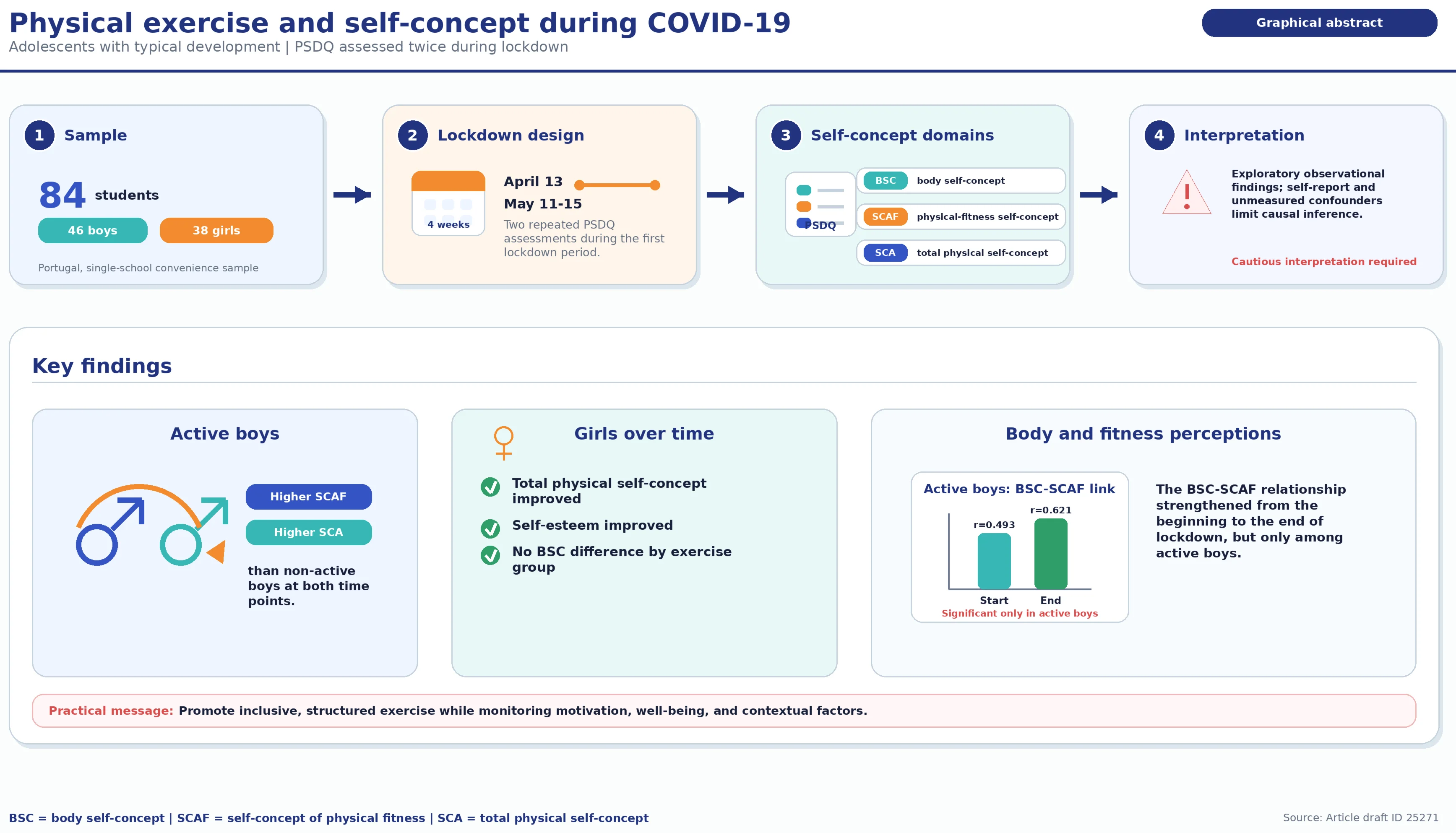
This study analyzed the evolution of physical self-concept (SCA), body self-concept (BCA), and perceived physical fitness (PFA) in elementary school adolescents at two different times during the COVID-19 pandemic. The sample consisted of 84 participants, divided by gender and whether or not they practiced physical exercise (PE). The Physical Self-Description Questionnaire (PSDQ), a validated questionnaire, was used to assess the variables under study, and the data was analyzed using descriptive and inferential statistical methods. The results showed that physically active boys had higher levels of SCA, mainly influenced by the SCAF, with significant differences compared to sedentary boys. In girls, there were improvements in various dimensions of BSC and SCAF, regardless of whether they practiced PE. There was also a positive association between BSC and SCAF only among active boys, especially towards the end of the pandemic period. The findings may indicate that PE is associated with more favorable perceptions of physical fitness among boys, although causal relationships cannot be inferred from the present data.
1. Introduction
Over time, society has undergone profound transformations motivated by the advance of technology and science, which is reflected in significant changes in social values, behaviors and attitudes. One of the aspects where these changes are particularly visible is in the perception and appreciation of the body [1]. The growing concern with body image and socially idealized aesthetic standards has led to the body assuming a central role in the construction of individual identity [2]. However, this excessive valorization can have negative consequences, especially for those who do not correspond to the prevailing aesthetic models. The discrepancy between a person's real and idealized body image can generate feelings of sadness and inferiority, thereby compromising their self-concept [3]. In many cases, this discrepancy affects emotional balance, particularly in vulnerable stages of human development, such as adolescence [3-4]. This stage is especially sensitive and plays a crucial role in the formation of self-concept, directly influencing young people's social [5] and behavioral adaptation processes [6].
Self-concept refers to the perception that individuals have of themselves, including their beliefs, feelings, and interpretations about their identity, abilities, limitations, and social roles [2, 7-8]. In children and adolescents, a weakened self-concept is associated with a greater propensity to develop mental health problems, such as anxiety and depression [1, 9]. In addition, external factors, such as physical appearance, significantly influence self-concept. Among the beneficial social behaviors is regular physical exercise (PE) [10], which contributes to greater satisfaction with body image [11] and strengthens adolescents' self-concept, promoting self-confidence, social skills, and general well-being [12]. PE can be defined as any structured, planned, and repeated bodily activity to maintain or improve components of physical fitness [13-14]. Research shows that adolescents' self-concept significantly influences their motivation to practice PE [15], and that higher levels of physical activity are associated with greater adherence to regular PE, which in turn favors a positive self-perception [16] and strengthens self-concept [17].
The COVID-19 pandemic, however, has negatively impacted adolescents' self-concept, causing changes in psychological, social, and physical dimensions, as well as fostering adverse emotional states, weakening their sense of identity [18-19]. The practice of PE also declined during this period, with many adolescents reporting a decrease in sports and recreational activities [20]. At the same time, there was an increase in the use of digital platforms for social and educational purposes, which had various effects on self-concept [21-22]. If, on the one hand, technology has made it possible to maintain social contact, on the other hand, excessive screen time and growing dependence on social networks may have contributed to an increase in sedentary lifestyles and, consequently, a weakening of self-concept among adolescents [21-22]. In this sense, could PE have influenced the self-concept of adolescents during the COVID-19 pandemic? Based on previous literature, three exploratory hypotheses were examined: (H1) Adolescents who practiced physical exercise would present higher levels of physical self-concept at both time points compared with non-practitioners; (H2) Boys would exhibit higher levels of Self-Concept of Physical Fitness (SCAF) than girls, whereas girls would exhibit comparable or higher Body Self-Concept (BSC); (H3) Both boys and girls would show improvements over time, with greater gains expected among those who practiced physical exercise.
2. Methodology
2.1. Sample
The initial pool consisted of 89 adolescents enrolled in secondary education within a public school in northern Portugal. Participants were distributed across four secondary school classes. Data screening consisted of verifying the completeness of questionnaire responses, resulting in the exclusion of five students due to missing data and a final sample of 84 participants. The sample was obtained using a non-probabilistic convenience sampling strategy, restricted to a single public secondary school, which limits generalizability to broader adolescent populations. In terms of gender distribution, there were 46 males (54.8 %) and 38 females (45.2 %). The average age was 17.13 years (±0.89), with ages ranging from 15 to 18 (see Table 1).
Table 1Distribution of sample members by gender, age, and physical exercise practice
Physical Exercise/Age | Mean | N | Dp | Minimum | Maximum | |
No | Male | 17.10 | 21 | 0.89 | 15 | 18 |
Female | 16.92 | 24 | 0.93 | 15 | 18 | |
Total | 17.00 | 45 | 0.90 | 15 | 18 | |
Yes | Male | 17.16 | 25 | 0.94 | 15 | 18 |
Female | 17.50 | 14 | 0.65 | 16 | 18 | |
Total | 17.28 | 39 | 0.86 | 15 | 18 | |
Total | Male | 17.13 | 46 | 0.91 | 15 | 18 |
Female | 17.13 | 38 | 0.88 | 15 | 18 | |
Total | 17.13 | 84 | 0.89 | 15 | 18 | |
Note: – number of cases; SD – standard deviation | ||||||
As for practicing PE, 39 students (46.4 %) said they did it regularly, 25 of whom were male and 14 female. The remaining 45 students (53.6 %) said they didn't exercise regularly (21 males and 24 females). Only students who attended formal (with or without a competitive nature) or non-formal (without competition, but with professional guidance in the area) sports institutions were considered eligible to practice physical exercise.
2.2. Instrument
The Physical Self-Description Questionnaire (PSDQ), developed by Marsh [23], was used to assess physical self-concept. The PSDQ items are rated on a 6-point Likert-type scale ranging from 1 (“False”) to 6 (“True”), with higher scores indicating higher perceived physical self-concept. This instrument is suitable for adolescents aged 12 and over, as well as young adults of both sexes. The PSDQ is made up of 70 items that assess 11 sub-scales related to SCA, some of which are worded positively and others negatively. Of the 11 subscales, four relate to Body Self-Concept (BSC) - Body Fat, Appearance, Overall Physique, and Self-Esteem, while seven are associated with Self-Concept of Physical Fitness (SCAF) – Strength, Physical Activity, Endurance, Sports Competence, Coordination, Health, and Flexibility.
Confirmatory factor analysis revealed a robust structure of the SCA subscales, proving the instrument's validity. The questionnaire has good psychometric properties, showing consistency over age and applicability to both sexes [24]. In addition, studies carried out by Almeida et al. [25] and Maia et al. [26] support the robustness of the PSDQ's construct validity, also confirming its suitability for application in cross-cultural contexts.
In the present study, the PSDQ showed very good internal consistency, with Cronbach’s Alpha values ranging from 0.808 to 0.850 across subscales (BSC and SCAF) before and after the pandemic, indicating satisfactory reliability for all dimensions assessed.
Table 2BSC and SCAF subscales (Marsh, 1993)
SCA Subscales | Items |
Health (BSC) | 1*, 12*, 23*, 34, 45*, 56*, 67*, 69 |
Coordination (SCAF) | 2, 13, 24, 35, 46, 57 |
Physical Activity (SCAF) | 3, 14, 25, 36, 47, 58 |
Body Fat (BSC) | 4*, 15*, 26*, 37*, 48*, 59* |
Sports Competence (SCAF) | 5,16, 27, 38, 49, 60 |
Overall Physical Fitness (SCAF) | 6, 17, 28, 39, 50, 61 |
Appearance (BSC) | 7, 18, 29, 40*, 51, 62* |
Stength (SCAF) | 8, 19, 30, 41*, 52, 63 |
Flexibility (SCAF) | 9, 20, 31*, 42, 53, 64 |
Resistance/Endurance (SCAF) | 10, 21, 32, 43, 54, 65 |
Self-Esteem (BSC) | 11, 22*, 33*, 44*, 55, 66, 68*, 70* |
Total Self-Concept (TSC) = means BSC and SCAF | |
Note: SCA – physical self-concept; BSC – body self-concept; SCAF – self-concept of physical fitness; * – items in the negative | |
2.3. Methodological procedures
During the first wave of the COVID-19 pandemic in Portugal, the government ordered the closure of schools from March 16, 2020, a measure that lasted until April 13 of the same year. This period corresponded to 29 consecutive days without classroom or distance learning activities (synchronous or asynchronous). On April 13, distance learning began, both synchronously and asynchronously, with secondary education resuming face-to-face activities on May 18. In total, secondary education remained in lockdown for 92 days. In the first week of distance learning (starting on April 13), the physical education teacher asked the students to answer the questionnaire on the ACF in digital format (Google Forms). The time interval between the first and second assessments was approximately four weeks (from April 13 to May 11-15, 2020). During the period between April 13 and May 18, the students took part in synchronous (twice a week) and asynchronous (student self-management) PE classes.
For the purposes of this study, Physical Exercise (PE) was operationally defined as any structured, planned, and repeated bodily activity performed to maintain or improve physical fitness, following the definition proposed by Alsolami et al. [13] and Hansen et al. [14]. Participants were classified into two groups, practicing PE and not practicing PE, based on their self-reported regular participation in formal or non-formal physical activity programs. Practicing PE referred to adolescents who engaged in organized sports or structured exercise sessions at least twice per week under the supervision of a qualified instructor (e.g., physical education teacher, coach, or fitness professional) for a minimum of three consecutive months prior to data collection. Non-practicing PE referred to adolescents who did not engage in any structured or supervised physical activity outside of mandatory school physical education classes during the same period.
The students' physical fitness was monitored using the FITescola battery of tests, a structured set of physical assessments aimed at children and adolescents between the ages of 10 and 18, integrated into the FITescola platform. The aim of this tool is to promote active lifestyles, with pedagogical feedback geared towards health. The results obtained are compared with specific reference tables by age and gender, classifying students into zones such as: Healthy Zone, Needs Improvement and Athletic Profile (Direção-Geral da Educação, Ministério da Educação de Portugal) [27].
2.4. Statistical procedures
Frequencies were used to describe the number of cases. The mean was used as a measure of central tendency and the standard deviation as a measure of dispersion. Since most of the variables had a non-normal distribution according to the Kolmogorov-Smirnov test, we used non-parametric inferential statistics. The Mann-Whitney (U) test was used to compare the independent variables at the same time and the Wilcoxon (W) test was used to compare the dependent variables at different times. Spearman’s test (rs) was used to correlate the variables. The following classification of correlation values was used: < 0.19 very weak; 0.20-0.39 weak; 0.40-0.59 moderate; 0.60-0.79 strong; > 0.80 very strong [28]. The Mann-Whitney U test was used for comparisons between independent groups (e.g., practitioners vs. non-practitioners; boys vs. girls), whereas the Wilcoxon signed-rank test was used for within-group comparisons across time (beginning vs. end of the pandemic).
A significance level of 0.05 was set for a 95 % confidence level. The Cronbach’s Alpha test () was used to observe the internal consistency of the SCA sub-scales. Considering the values presented by George & Mallery, P. [29], an instrument or test has appropriate reliability when is at least 0.70 ( 0.90 excellent; between 0.80-0.89 very good; between 0.70-0.79 acceptable; between 0.60-0.69 questionable).
3. Results
3.1. Body, physical fitness, and total self-concept by gender according to physical exercise at the beginning and end of the pandemic
Table 3 shows the results of the analysis of SCA, BSC, and SCAF as a function of the practice of PE, considering the sex of the participants and the moments at the beginning and end of the pandemic. The statistical tests used were the Wilcoxon test (W) for inter-group comparisons (start vs. end) and the Mann-Whitney test (U) for comparisons between groups (with vs. without exercise). Descriptively, boys presented higher mean values in SCAF and SCA than girls at both time points, while girls presented slightly higher mean values in BSC (see Table 3). On average, adolescents who practiced physical exercise presented higher SCAF values than non-practitioners.
In the male group, there were no statistically significant differences in ACC over time, either for those who practiced PE or for those who did not. In addition, there was no significant difference between the two groups at any of the times analyzed. Among boys who did not practice physical exercise, SCAF increased significantly from the beginning to the end of the pandemic ( 0.011; Wilcoxon test; Table 3). However, when comparing the groups, there was a highly significant difference at both times ( 0.001), indicating that physically active boys had higher levels of SCAF throughout the pandemic. About SCA, non-active boys showed no significant variations over time, while active boys also showed no statistically significant changes. However, there were significant differences between the two groups, both at the beginning ( 0.001) and at the end of the pandemic ( 0.008), which is consistent with higher perceived physical fitness among active boys; however, this pattern should be interpreted cautiously given the observational design.
In the female group, there was a significant improvement in the BSC between the beginning and end of the pandemic only among those who did not practice PE ( 0.018), while those who did practice showed no significant changes. Despite this, there was no significant difference between the groups at any of the times analyzed. Among girls, both practitioners and non-practitioners showed significant improvements in SCA over time ( 0.004 and 0.019, respectively; Wilcoxon test; Table 3). However, as with BSC, no significant differences were found between the groups, either at the beginning or at the end of the pandemic. Finally, in the SCA, both girls who practiced and those who did not practice PE showed a significant improvement between the beginning and the end of the pandemic ( 0.004 and 0.019, respectively). However, comparisons between the two groups revealed no statistically significant differences.
In general, the results suggest that the practice of PE is associated with higher levels of SCA in males, which is justified by SCAF, even though these levels have remained stable over time. Among female adolescents, the benefits of practicing PE were not as evident when compared to inactive adolescents, but there was a significant improvement in the indicators throughout the pandemic, regardless of the practice of PE.
Table 3Body, physical fitness, and total self-concept by gender according to physical exercise at the beginning and end of the pandemic
Sex | Physical Exercise | BSC | SCAF | SCA | ||||||
Begining | End | W | Begining | End | W | Begining | End | W | ||
Male | No (21) | 4.59±0.64 | 4.67±0.58 | 0.217 | 3.56±0.71 | 3.85±0.66 | 0.011* | 4.07±0.59 | 4.26±0.54 | 0.054 |
Yes (25) | 4.76±0.61 | 4.82±0.63 | 0.689 | 4.81±0.47 | 4.85±0.42 | 0.696 | 4.78±0.46 | 4.84±0.44 | 0.493 | |
P | 0.290 | 0.447 | 0.000** | 0.000** | 0.000** | 0.008* | ||||
Female | No (24) | 4.05±0.72 | 4.23±0.69 | 0.018* | 3.40±0.62 | 3.57±0.59 | 0.003* | 3.72±0.56 | 3.90±0.55 | 0.004* |
Yes (14) | 4.13±0.65 | 4.33±0.58 | 0.294 | 3.53±0.66 | 3.81±0.64 | 0.028* | 3.83±0.60 | 4.07±0.52 | 0.019* | |
U | 0.832 | 0.650 | 0.525 | 0.238 | 0.892 ± | 0.545 | ||||
Note: SCA – Physical Self-Concept; BSC – Body Self-Concept; SCAF - Self-Concept of Physical Fitness; Values are expressed as mean ± standard deviation. U = Mann–Whitney test; W = Wilcoxon signed-rank test; * 0.05; ** 0.001 | ||||||||||
When comparing sexes within each physical exercise condition, no significant differences were observed among adolescents who did not practice physical exercise in any of the self-concept dimensions (BSC, SCAF, or SCA; 0.05). However, among those who practiced physical exercise, boys exhibited significantly higher scores in the Self-Concept of Physical Fitness (SCAF) both at the beginning and at the end of the pandemic ( 0.001). They also showed higher Total Physical Self-Concept (SCA) scores compared with girls ( 0.01), whereas no significant differences were found for Body Self-Concept (BSC; 0.10). These findings indicate that the main sex-related differences were driven by perceived physical fitness rather than by body image components.
Taken together, these results highlight the influence of gender and physical exercise on adolescents’ self-perceptions, particularly in domains related to perceived physical fitness. To gain a more detailed understanding of these patterns, the following section explores the evolution of specific subscales of body self-concept (BSC) and self-concept of physical fitness (SCAF) across the study period.
Given the number of statistical comparisons performed, the risk of Type I error is increased. Because the study had an exploratory purpose and the original database is no longer available for reanalysis with alternative modelling approaches, no formal correction for multiple comparisons (e.g., Bonferroni or FDR) was applied. Therefore, the results should be interpreted with appropriate caution.
3.2. Body self-concept and physical fitness subscales according to gender and physical activity at the beginning and end of the pandemic
Table 4 summarizes the significant changes observed in the subscales of Body Self-Concept (BSC) and Self-Concept of Physical Fitness (SCAF), according to sex and physical exercise practice during the pandemic.
Regarding the BSC, the self-esteem subscale showed statistically significant improvements among girls, both in those who practiced PE ( 0.011) and in those who were sedentary ( 0.022). No significant changes were found for boys or for the other BSC subscales (appearance, body fat, and overall physique), indicating general stability in body-image perceptions throughout the study period.
Within the SCAF dimension, several subscales exhibited significant improvements over time. Coordination ( 0.012), strength ( 0.003), and endurance ( 0.001) increased among sedentary boys, while physical activity ( 0.001) and endurance ( 0.021) improved among sedentary girls. Active girls also demonstrated significant gains in physical activity ( 0.025) and endurance ( 0.046).
Overall, the most pronounced positive changes during the pandemic occurred in self-esteem, physical activity, endurance, and, to a lesser extent, coordination and strength dimensions. These results suggest that improvements were more evident among participants who were initially less active, possibly reflecting adaptive responses to the constraints imposed by the lockdown period.
Table 4BSC and SCAF subscales according to gender and PE practice at the beginning and end of the pandemic
Subscale | Sex | PE practice | Significant change (Begin → End) | Direction of change | p-value |
Self-Esteem (BSC) | Female | Both (Yes & No) | Significant | Increase | 0.011-0.022* |
Coordination (SCAF) | Male | No | Significant | Increase | 0.012* |
Physical Activity (SCAF) | Male No/ Female Yes & No | Significant | Increase | < 0.001-0.025* | |
Strength (SCAF) | Male | No | Significant | Increase | 0.003* |
Endurance (SCAF) | Male No/ Female Yes & No | Significant | Increase | 0.000-0.046* | |
Note: TSC – total self-concept; BSC – body self-concept; SCAF – self-concept of physical fitness. * 0.05; ** 0.001 | |||||
Analysis at the subscale level (Table 5) showed that Self-Esteem (BSC) improved significantly among girls in both exercise conditions ( 0.022 for non-practitioners; 0.011 for practitioners). Within the SCAF dimension, sedentary boys improved in Coordination ( 0.012), Strength ( 0.003), and Endurance ( 0.001), whereas sedentary girls improved in Physical Activity ( 0.001) and Endurance ( 0.021). Active girls also improved in Physical Activity ( 0.025) and Endurance ( 0.046). No significant changes were observed in Appearance, Body Fat, Overall Physique, or Flexibility for either sex or condition.
Table 5Analysis at the subscale level
TSC | Subscales of self-concept | Sex | Male | Female | ||||
Exercise | No | Yes | p | No | Yes | p | ||
BSC | Body Fat | Beginning | 5.071 | 4.880 | 0.824 | 4.431 | 4.583 | 0.660 |
End | 5.008 | 5.020 | 0.664 | 4.382 | 4.643 | 0.370 | ||
P | 0.600 | 0.418 | 0.774 | 0.636 | ||||
Appearance | Beginning | 4.262 | 4.427 | 0.353 | 3.840 | 3.843 | 0.976 | |
End | 4.449 | 4.445 | 0.782 | 4.125 | 3.881 | 0.820 | ||
P | 0.190 | 0.671 | 0.144 | 0.964 | ||||
Overall Physique | Beginning | 4.214 | 4.687 | 0.177 | 3.625 | 3.774 | 0.649 | |
End | 4.354 | 4.700 | 0.288 | 3.882 | 4.048 | 0.832 | ||
P | 0.407 | 0.952 | 0.056 | 0.330 | ||||
Self-Esteem | Beginning | 4.792 | 5.030 | 0.293 | 4.302 | 4.313 | 0.844 | |
End | 4.884 | 5.123 | 0.336 | 4.521 | 4.729 | 0.671 | ||
P | 0.616 | 0.465 | 0.022* | 0.011* | ||||
SCAF | Health | Beginning | 5.036 | 5.450 | 0.085 | 5.063 | 4.509 | 0.122 |
End | 5.219 | 5.500 | 0.156 | 5.214 | 4.606 | 0.150 | ||
P | 0.457 | 0.568 | 0.149 | 0.286 | ||||
Coordination | Beginning | 4.095 | 4.733 | 0.012* | 4.229 | 3.905 | 0.288 | |
End | 4.162 | 4.860 | 0.007* | 4.160 | 4.188 | 0.638 | ||
P | 0.776 | 0.511 | 0.419 | 0.270 | ||||
Physical Activity | Beginning | 2.238 | 4.793 | 0.000** | 1.938 | 3.452 | 0.000** | |
End | 3.171 | 4.893 | 0.000** | 2.701 | 3.662 | 0.025* | ||
P | 0.001 | 0.727 | 0.001 | 0.600 | ||||
Sports Competence | Beginning | 3.365 | 4.967 | 0.000** | 3.188 | 3.398 | 0.705 | |
End | 3.394 | 4.960 | 0.000** | 3.229 | 3.821 | 0.225 | ||
P | 0.807 | 1.000 | 0.385 | 0.044 | ||||
Strength | Beginning | 3.627 | 4.800 | 0.001* | 2.854 | 3.226 | 0.302 | |
End | 3.764 | 4.787 | 0.003* | 3.028 | 3.214 | 0.564 | ||
P | 0.107 | 0.729 | 0.117 | 0.928 | ||||
Flexibility | Beginning | 3.698 | 4.420 | 0.057 | 4.146 | 3.607 | 0.182 | |
End | 4.000 | 4.312 | 0.407 | 4.104 | 3.988 | 0.976 | ||
P | 0.087 | 0.364 | 0.871 | 0.156 | ||||
Resistance/Endurance | Beginning | 2.889 | 4.480 | 0.000** | 2.375 | 2.595 | 0.514 | |
End | 3.260 | 4.631 | 0.000** | 2.563 | 3.214 | 0.046* | ||
P | 0.005 | 0.392 | 0.126 | 0.021* | ||||
3.3. Association between the BSC and SCAF scales according to gender and physical activity at the beginning and end of the pandemic
Table 6 shows the Spearman correlation coefficients () to analyze the association between the BSC and SCAF, according to gender and physical activity, both at the beginning and end of the pandemic.
Among young men who practiced PE, a positive and significant association was observed between BSC and SCAF at the beginning of the pandemic ( 0.493; 0.012), and this correlation became even stronger and highly significant at the end of the period analyzed ( 0.621; 0.001). These results indicate that, among physically active boys, the higher the BSC, the higher the perception of SCAF and vice versa.
However, among girls who practiced PE, no significant association was identified between BSC and SCAF, either at the beginning ( –0.167; 0.568) or at the end of the pandemic ( 0.143; 0.626). This suggests that, for this group, the perception of BSC and SCAF were not significantly correlated.
Among sedentary boys, the correlations were also not significant, although they were positive: 0.204 at the start ( 0.375) and 0.305 at the end ( 0.179). The same pattern was observed in sedentary girls, with values of 0.300 at the start ( 0.154) and 0.395 at the end ( 0.056), the latter close to the significance level.
These data suggest that the significant association between BSC and SCAF was only present in active boys, becoming more robust over time. In contrast, no significant correlations were identified in the other groups, although the positive trends among the sedentary, especially among females at the end of the pandemic, indicate possible latent or progressive effects not statistically captured at this point in the analysis.
Table 6Association between the BSC and SCAF scales according to gender and physical activity at the beginning and end of the pandemic
Exercise | BSC – SCAF | ||
Beginning () | End () | ||
Yes | Male | 0.493* | 0.621** |
p | 0.012 | 0.001 | |
Female | –0.167 | 0.143 | |
p | 0.568 | 0.626 | |
No | Male | 0.204 | 0.305 |
p | 0.375 | 0.179 | |
Female | 0.300 | 0.395 | |
p | 0.154 | 0.056 | |
Note: BSC-SCAF – Association between body self-concept and self-concept of physical fitness; – Spearman correlation; * 0.05; ** 0.001 | |||
4. Discussion
The results obtained in this study revealed significant variations in the perception of physical self-concept (SCA), body self-concept (BSC), and perceived physical fitness (PFA) according to gender, PE practice, and the pandemic context. Regarding BSC, boys – regardless of PE practice – did not show statistically significant changes over time, suggesting a relative stability in body self-image during adolescence. This pattern may reflect developmental or contextual stability rather than external sociocultural influences. In contrast, sedentary girls demonstrated a significant improvement in BSC, with no comparable change among those who practiced PE. These differences indicate that girls’ body perception may have been more sensitive to contextual changes during confinement, such as alterations in daily routines or reduced social comparison, although these factors were not directly measured in the present study.
For SCA, active boys consistently showed significantly higher levels at both time points, largely explained by the significant increase in SCAF. Although these levels remained stable overall, sedentary boys showed improvements in SCAF from the beginning to the end of the pandemic. This may suggest that some adolescents adopted more active behaviors during the confinement period, even without participation in formal PE programs – a possibility supported by previous studies on adolescent activity patterns during lockdown [30]. Among girls, both active and inactive participants displayed significant improvements in SCA and SCAF, with no differences between groups. While unstructured or home-based physical activities could have contributed to these outcomes, such behaviors were not formally assessed and should therefore be interpreted cautiously.
Gender differences were most pronounced among active participants, with boys showing higher SCA scores, driven by significantly greater SCAF values. This finding aligns with previous research reporting a stronger association between perceived physical performance and body identity in males [31]. Among sedentary adolescents, however, no gender differences emerged, suggesting that structured PE participation may amplify, rather than mitigate, gender differences in perceived physical fitness and self-concept.
Analysis of the BSC and SCAF subscales identified specific dimensions of change. Self-esteem increased significantly among girls, regardless of PE practice, which may indicate adaptive psychological responses during confinement, although emotional or motivational variables were not directly assessed. The SCAF subscales – physical activity, coordination, strength, and endurance—showed significant improvements, particularly among sedentary boys, and to a lesser extent among girls. These results suggest that even minimal or self-directed activity during lockdown may have positively influenced adolescents’ perceptions of physical competence.
The associations between BSC and SCAF were significant only among physically active boys, and became stronger over time. This pattern supports prior evidence that structured physical practice enhances the coherence between perceived body image and perceived physical ability [32]. Among girls, no significant correlations were observed, possibly reflecting the influence of unmeasured variables such as general self-esteem or sociocultural norms related to appearance – factors that future studies should address directly.
The interpretation of results related to physical exercise should be considered with caution, given that exercise participation was operationalized dichotomously (practitioner vs. non-practitioner). This approach does not capture relevant dimensions such as exercise frequency, intensity, volume, or type, all of which may differentially influence physical self-concept. Future studies should utilize validated instruments, such as the International Physical Activity Questionnaire (IPAQ), to quantify physical activity levels more precisely and to better characterize the dose-response relationships involved.
In summary, the findings highlight the influence of PE practice on adolescents’ perceived fitness and body self-concept, particularly among boys. At the same time, improvements observed among sedentary adolescents suggest that contextual factors during the pandemic may have fostered positive self-perceptions even without formal exercise. These interpretations should, however, be viewed with caution, as several potentially confounding variables, including pubertal stage, socioeconomic context, and unreported informal physical activity, were not controlled. Future studies should integrate measures of biological maturation and psychosocial context to better isolate the effects of structured PE on adolescent self-concept development.
Finally, while some interpretations offered in this section may suggest potential psychosocial or contextual mechanisms, these should be considered speculative because relevant variables (e.g., socioeconomic status, pubertal stage, social media use, and psychological adjustment) were not assessed. As a result, the extent to which physical exercise itself, rather than unmeasured contextual factors, accounts for the observed differences cannot be determined.
It should be noted that important confounding variables, such as socioeconomic status, pubertal stage, psychological well-being, and social media use, were not measured in the present study. These factors have been shown to influence adolescents’ body image and self-concept and therefore may partly account for the observed patterns. As such, the interpretation that physical exercise directly influenced self-concept should be viewed with caution, as the associations identified may reflect the combined effect of multiple unmeasured contextual and psychosocial determinants.
5. Conclusions
The results suggest that adolescents who report practicing PE also report higher perceived physical fitness and body self-concept, especially among active boys. In girls, the gains were more evident in emotional dimensions, such as self-esteem, regardless of practice. The pandemic context seems to have favored improvements in both sexes, even among initially sedentary adolescents, suggesting that psychosocial factors and behavioral adaptations play a relevant role in the development of self-image and physical perception during adolescence.
This study highlights the importance of considering gender differences and the psychosocial context in the impact of physical exercise on self-concept and perceived physical fitness. This reinforces the need for differentiated and inclusive strategies to promote PE among adolescents, with special attention to intrinsic motivation, emotional well-being, and the role of social and cultural influences.
In summary, physical exercise proves to be a fundamental ally in the positive development of adolescents’ self-concept and perception of physical competence, and is even more relevant in challenging contexts such as that experienced during the COVID-19 pandemic.
6. Limitations of the study
Despite the relevant contributions of this study, it is important to recognize a number of limitations that may have conditioned the results obtained and their generalization.
Firstly, we would highlight the exclusive use of subjective measures, based on self-reporting, which can introduce biases associated with individual perception. Associated with this, the lack of control over the frequency, intensity, duration, and type of physical exercise practiced is an important limitation, since the simple categorization between practitioners and non-practitioners may not reflect the real diversity of physical involvement among the participants.
Additionally, because data collected from a single school using convenience sampling, extrapolation of results to other contexts or populations should be made cautiously.
In addition, the study did not consider relevant psychosocial variables, such as global self-esteem, social pressure, use of social networks, mental health, or family support, which the literature points to as determinants in the construction of body self-concept, especially among girls. Another limiting aspect is the lack of information collected on specific behavioral changes during the pandemic, such as changes in eating habits, sleep patterns, or new forms of informal physical activity (e.g., online training, dancing, or active games). These factors could have influenced adolescents’ physical perceptions and mediated some of the changes observed. Furthermore, the binary categorization of physical exercise did not consider the frequency, intensity, or type of activity performed, which may have introduced classification imprecision. Future studies are encouraged to employ standardized physical activity assessment tools such as the International Physical Activity Questionnaire (IPAQ) to improve measurement accuracy.
The sample used was non-probabilistic and restricted to a specific geographical region, which limits the generalization of the results to other socio-cultural contexts. In addition, the distribution of participants between the groups (practitioners vs. non-practitioners) was unequal, which may have affected the statistical robustness of some comparisons, especially when analyzing by gender.
Given the exploratory nature of the study, no formal correction for multiple comparisons was applied, which may have increased the likelihood of Type I error; therefore, results should be interpreted with appropriate caution. Additionally, potentially relevant confounding variables, including socioeconomic status, pubertal stage, and social media use, were not assessed. These factors may influence self-concept independently of physical exercise, thereby limiting causal inference and making it difficult to isolate the specific contribution of exercise practice.
Finally, although the longitudinal design made it possible to compare two distinct moments (beginning and end of the pandemic), the lack of intermediate points of evaluation made it impossible to analyze the temporal evolution of the variables studied throughout the pandemic process in greater detail.
Given these limitations, caution is advised when interpreting the results, and the need for future research that considers mixed methodologies, mediating psychosocial variables, and more diverse and representative samples is reinforced.
References
-
J. S. Pepper, V. B. van Hasselt, R. A. Black, and B. A. Schneider, “Assessment of psychological functioning in retired firefighters,” Psychological Services, Vol. 21, No. 1, pp. 120–129, 2024, https://doi.org/10.1037/ser0000703
-
C. Nang, D. Hersh, K. Milton, and S. R. Lau, “The impact of stuttering on development of self-identity, relationships, and quality of life in women who stutter,” American Journal of Speech-language Pathology, Vol. 27, No. 3S, pp. 1244–1258, Oct. 2018, https://doi.org/10.1044/2018_ajslp-odc11-17-0201
-
Y. You, D. Wang, Y. Wang, Z. Li, and X. Ma, “A bird’s-eye view of exercise intervention in treating depression among teenagers in the last 20 years: a bibliometric study and visualization analysis,” Frontiers in Psychiatry, Vol. 12, 2021, https://doi.org/10.3389/fpsyt.2021.661108
-
E. Melguizo-Ibáñez, G. González-Valero, P. Puertas-Molero, and J. M. Alonso-Vargas, “Emotional intelligence, physical activity practice and Mediterranean diet adherence-an explanatory model in elementary education school students,” Children, Vol. 9, No. 11, p. 1770, Nov. 2022, https://doi.org/10.3390/children9111770
-
H. W. Marsh et al., “The big-fish-little-pond effect: generalizability of social comparison processes over two age cohorts from Western, Asian, and Middle Eastern Islamic countries,” Journal of Educational Psychology, Vol. 107, No. 1, pp. 258–271, 2015, https://doi.org/10.1037/a0037485
-
S. Zhao, X. Chen, H. Park, D. Li, J. Liu, and L. Cui, “The development of self – and group orientations among Chinese young adolescents: implications for social and behavioral adjustment,” Developmental Psychology, Vol. 60, No. 5, pp. 942–953, 2024, https://doi.org/10.1037/dev0001719
-
Y. Omodaka and T. Sato, “The quality of life of students with difficulties accessing support,” INQUIRY: the Journal of Health Care Organization, Provision, and Financing, Vol. 60, 2023, https://doi.org/10.1177/00469580231159728
-
V. Rotondi and L. Stanca, “The effect of particularism on corruption: theory and empirical evidence,” Journal of Economic Psychology, Vol. 51, pp. 219–235, Dec. 2015, https://doi.org/10.1016/j.joep.2015.09.008
-
F. M. Ssewamala et al., “Applying a family-level economic strengthening intervention to improve education and health-related outcomes of school-going AIDS-orphaned children: lessons from a randomized experiment in Southern Uganda,” Prevention Science, Vol. 17, No. 1, pp. 134–143, Aug. 2015, https://doi.org/10.1007/s11121-015-0580-9
-
A. Bednarek, A. Bodajko-Grochowska, D. Zarzycka, A. Emeryk, and E. Cichosz, “Physical activity of adolescents in the prevention of lifestyle diseases,” Pielegniarstwo XXI Wieku / Nursing in the 21st Century, Vol. 17, No. 3, pp. 32–37, Sep. 2018, https://doi.org/10.2478/pielxxiw-2018-0025
-
P. M. Flores et al., “Influence of physical activity on body image perception,” Motricidade, Vol. 16, No. 3, pp. 265–273, 2020.
-
A. Wattanapisit et al., “The clusters of health-risk behaviours and mental wellbeing and their sociodemographic correlates: a study of 15,366 ASEAN university students,” BMC Public Health, Vol. 22, No. 1, Oct. 2022, https://doi.org/10.1186/s12889-022-14233-2
-
F. J. Alsolami et al., “Determinants of breast cancer in Saudi women from Makkah region: a case-control study (breast cancer risk factors among Saudi women),” BMC Public Health, Vol. 19, No. 1, Nov. 2019, https://doi.org/10.1186/s12889-019-7942-3
-
A. L. Hansen, G. Ambroziak, D. Thornton, L. Dahl, and B. Grung, “The effects of diet on levels of physical activity during winter in forensic inpatients – a randomized controlled trial,” Food and Nutrition Research, Vol. 64, 2020, https://doi.org/10.29219/fnr.v64.3610
-
T. Tubic and V. Djordjic, “Age and gender effects on global self-worth and domain-specific self-perceptions in youth,” Zbornik Instituta Za Pedagoska Istrazivanja, Vol. 47, No. 1, pp. 41–61, Jan. 2015, https://doi.org/10.2298/zipi1501041t
-
A. Huang et al., “Self-concept in primary school student with dyslexia: the relationship to parental rearing styles,” International Journal of Environmental Research and Public Health, Vol. 18, No. 18, p. 9718, Sep. 2021, https://doi.org/10.3390/ijerph18189718
-
T. Shao and X. Zhou, “Correlates of physical activity habits in adolescents: a systematic review,” Frontiers in Physiology, Vol. 14, Apr. 2023, https://doi.org/10.3389/fphys.2023.1131195
-
Q. Li, R. Luo, X. Zhang, G. Meng, B. Dai, and X. Liu, “Intolerance of covid-19-related uncertainty and negative emotions among chinese adolescents: a moderated mediation model of risk perception, social exclusion and perceived efficacy,” International Journal of Environmental Research and Public Health, Vol. 18, No. 6, p. 2864, Mar. 2021, https://doi.org/10.3390/ijerph18062864
-
A. D. Kurnia, “Self-efficacy and COVID-19 prevention behaviour among adolescents: a cross-sectional study,” Gaceta Médica De Caracas, Vol. 130, No. Supl. 5, pp. S882–S889, 2022, https://doi.org/10.47307/gmc.2022.130.s5.4
-
A. R. Lopes and O. K. Nihei, “Preditores de impactos negativos da pandemia de COVID-19 em universitários brasileiros,” Arquivos De Ciências Da Saúde Da UNIPAR, Vol. 27, No. 4, pp. 1552–1568, Apr. 2023, https://doi.org/10.25110/arqsaude.v27i4.2023-001
-
R. Ciacchini et al., “Social media in adolescents: a retrospective correlational study on addiction,” Children, Vol. 10, No. 2, p. 278, Jan. 2023, https://doi.org/10.3390/children10020278
-
S. Lesinskienė et al., “Lifestyle habits related to internet use in adolescents: relationships between wellness, happiness, and mental health,” Children, Vol. 11, No. 6, p. 726, Jun. 2024, https://doi.org/10.3390/children11060726
-
H. W. Marsh, “The multidimensional structure of physical fitness: invariance over gender and age,” Research Quarterly for Exercise and Sport, Vol. 64, No. 3, pp. 256–273, 2013, https://doi.org/10.1080/02701367.1993.10608810
-
H. W. Marsh, “The importance of being important: theoretical models of relations between specific and global components of physical self-concept,” Journal of Sport and Exercise Psychology, Vol. 16, No. 3, pp. 306–325, 1994, https://doi.org/10.1123/jsep.16.3.306
-
A. P. Almeida, J. A. Maia, and J. M. Fontoura, “Physical self-concept: study of its differential expression in athletes and non-athletes,” in Avaliação Psicológica: Formas E Contextos, Vol. IV, pp. 425–435, 1996.
-
J. A. R. Maia, A. P. Almeida, and J. M. Fontoura, “Portuguese adaptation of the physical self-concept scale (PSDQ). A confirmatory factor analysis study,” (in Portuguese) in Avaliação psicológica: formas e contextos, Vol. IV, Braga: APPORT, 1996, pp. 443–450.
-
“Manual of the FITescola test battery.” FITescola. https://recursos.fitescola.dge.mec.pt
-
M. M. Mukaka, “A guide to appropriate use of correlation coefficient in medical research,” Malawi Medical Journal, Vol. 24, No. 3, pp. 69–71, 2012.
-
D. George and P. Mallery, SPSS for Windows step by step: a simple guide and reference. Boston: Allyn & Bacon, 2003.
-
J. F. López-Gil, M. S. Tremblay, and A. García-Hermoso, “Influence of lockdown on physical fitness and self-perception among adolescents,” Children, Vol. 10, No. 1, pp. 105–105, 2023.
-
P. Júdice, R. Santos, and L. Lopes, “Changes in physical activity patterns during COVID-19 lockdown and their association with mental health in adolescents,” European Journal of Pediatrics, Vol. 182, No. 4, pp. 1763–1772, 2023.
-
J. Gruno and D. Serafim, “Gender differences in body image and physical self-concept among physically active adolescents,” International Journal of Adolescence and Youth, Vol. 27, No. 1, pp. 131–144, 2022.
About this article

The authors have not disclosed any funding.
The datasets generated during and/or analyzed during the current study are available from the corresponding author on reasonable request.
Pedro Flores: conceptualization, methodology, supervision, validation, writing-review and editing. Carlos Miguel Teixeira: investigation, data curation, writing-review and editing. Alexandra Malheiro: conceptualization, methodology, formal analysis, data curation, visualization, writing-original draft preparation. Emília Alves: methodology, supervision, validation, writing-review and editing. Luís Ferreira: formal analysis, software, visualization, writing-review and editing. Joana Ribeiro: supervision, project administration, funding acquisition, writing-review and editing.
Dr. Pedro Forte is an editor in chief; Dr. Joana Ribeiro is an editorial board member for Sports, Performance and Wellbeing and were not involved in the editorial review and/or the decision to publish this article.

