Abstract
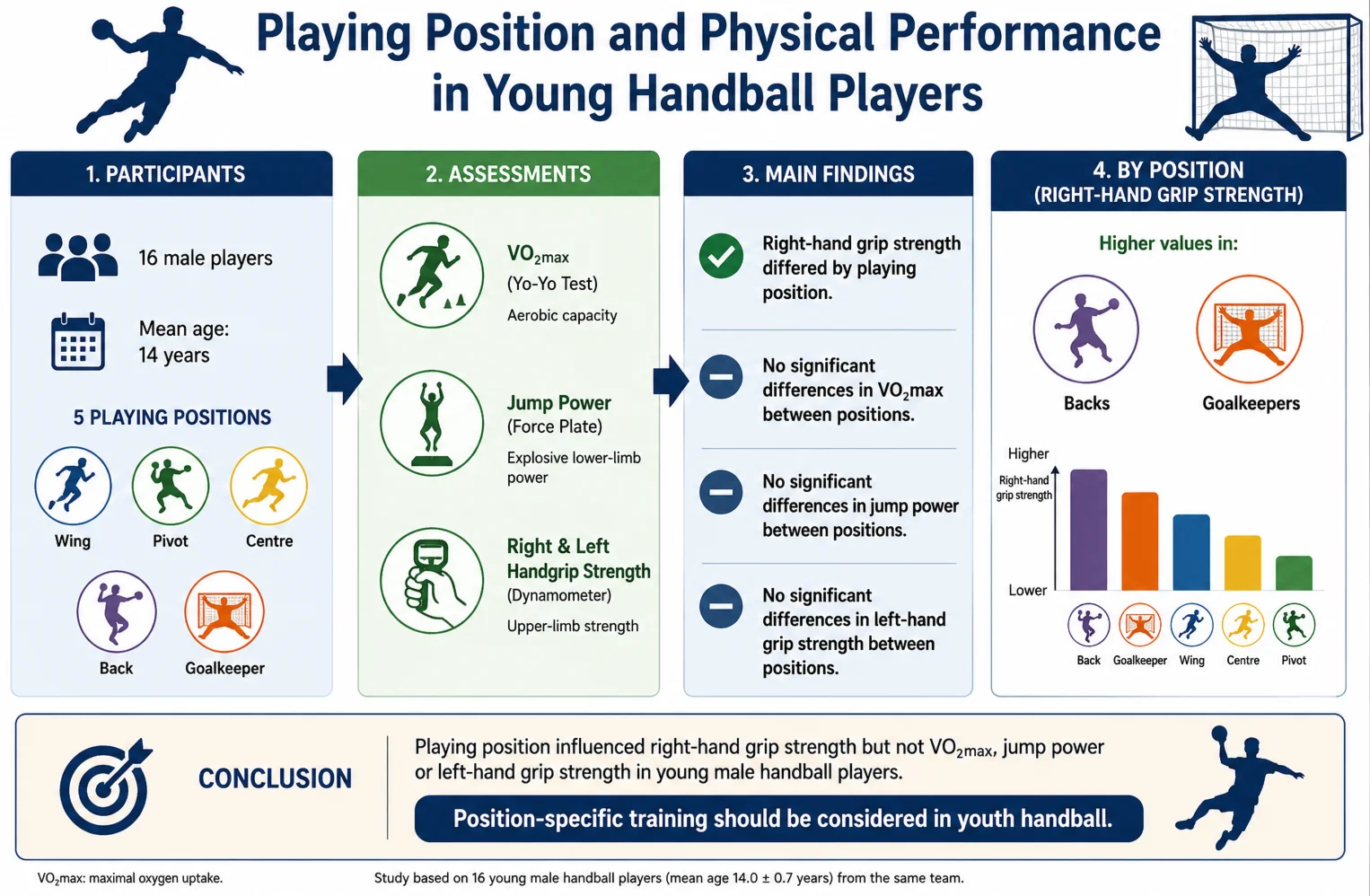
2. This study aimed to analyse the influence of playing position on selected physical performance variables in young male handball players. It was hypothesised that playing position would influence physical performance variables in young handball players, namely VO2max, jump power and handgrip strength, particularly right-hand grip strength, due to the different physical, technical and tactical demands associated with each playing position. The sample consisted of 16 athletes from the same team, with a mean age of 14.0±0.7 years, distributed across five playing positions: wing, pivot, centre, goalkeeper and back. Aerobic capacity was assessed through the Yo-Yo Test, from which VO₂max was estimated. Jump power was measured using a force plate, while handgrip strength was assessed with a hand dynamometer for both right and left hands. Descriptive statistics were used to characterise the sample, and the Kruskal-Wallis test was applied to compare performance variables between playing positions. The results showed no statistically significant differences between positions for VO₂max, jump power or left-hand grip strength. However, a significant difference was found for right-hand grip strength, with higher values observed in backs and goalkeepers. Therefore, the results partially confirmed the hypothesis, as playing position appeared to influence right-hand grip strength, but not all the physical performance variables analysed. Although some positional trends were identified, the small sample size requires cautious interpretation. These findings suggest that playing position may influence specific physical performance characteristics in youth handball, supporting the importance of individualised and position-specific training programmes.
Highlights
- Playing position significantly influenced right-hand grip strength in young male handball players.
- No significant positional differences were found for VO₂max, jump power or left-hand grip strength.
- The findings support individualized, position-specific training programmes for youth handball players.
1. Introduction
Handball is an intermittent team sport of high intensity [1] and strong neuromuscular demand [2], characterised by alternation between offensive and defensive actions, multidirectional movements [3], accelerations and decelerations [4], jumps [5], throws/shots [6], rapid changes of direction [4], physical contacts and short recovery periods [1]. As the technical and tactical tasks differ between wings, backs/centres, pivots and goalkeepers, playing position may influence the external load profile, physiological intensity, strength and power of young handball players [7].
Goalkeepers have a highly specific role, associated with reaction speed [8], defensive positioning [9], mobility and the rapid execution of specific movements [10], and the ability to anticipate shooting situations [11]. Wings tend to stand out for their speed, acceleration, agility, jumping ability and capacity to perform fast breaks [7]. Backs require greater power, strength, stature and throwing velocity due to the frequency of long-distance shots and physical contact [12]. The centre player presents a more balanced profile, combining endurance, coordination, agility and rapid changes of direction [13]. Finally, the pivot is characterised by greater body mass, strength, balance and stability, due to the need to operate in areas of high physical contact near the six-metre line [14]. These differences justify the need for position-specific physical preparation, especially in young players, whose maturation and physical development may still influence performance [15].
In young players, this analysis should consider growth, biological maturation and progressive specialisation, as these factors influence indicators of aerobic fitness, strength, speed, power and overall performance [16]. VO2, expressed as VO₂max or VO₂peak, represents the athlete’s cardiorespiratory capacity and is relevant in handball because it facilitates recovery between intense efforts, helps maintain intensity throughout the match and improves fatigue tolerance, particularly in positions with a greater volume of movement and transitions [7], [16]. Therefore, positional differences in VO₂ may reflect not only general fitness, but also the specific demands of each playing role.
Jump power is determinant for explosive lower-limb actions, including jump shots, blocks, jumps, accelerations and changes of direction. The countermovement jump and other jump tests are useful for assessing explosive capacity in handball players, and plyometric interventions have been shown to improve jumping ability, speed and change-of-direction performance [2], [5]. Furthermore, jumping ability is related to throwing velocity and accuracy, reinforcing its importance for offensive performance [6].
Handgrip strength is a simple and functional measure of upper-limb strength, relevant for gripping, controlling, protecting and throwing the ball. The assessment of handgrip strength, including the right hand, allows differences associated with laterality, hand dominance and positional specialisation to be observed, and may also reveal useful asymmetries for training planning [2], [5]. Thus, the present study aims to analyse the influence of playing position on VO2, jump power and handgrip strength, with particular attention to the right hand, in young handball players, contributing to a more individualised training prescription adjusted to the real demands of each position.
This study aims to determine whether playing position influences the physical performance of young handball players through the analysis of VO₂, jump power and handgrip strength, particularly of the right hand, in order to better understand the specific physical demands of each position. Playing position is expected to influence physical performance variables in young handball players, namely VO₂, jump power and handgrip strength, particularly right-hand grip strength, due to the different physical, technical and tactical demands associated with each playing position
2. Methodology
2.1. Study design
This study employs an observational, cross-sectional, descriptive and comparative design, with the aim of analysing physical performance variables in young handball players, as well as comparing these variables according to playing position.
2.2. Sample
The sample consisted of 16 young male handball players from the same team, with an average age of 14.0±0.7 years. The following playing positions were considered: wing, pivot, centre, goalkeeper and wing-back. The general characteristics of the sample were analysed using descriptive statistics, including age, years of experience, VO2max, jump power and right and left hand grip strength.
2.3. Procedures
Data were collected individually for each athlete and subsequently organised into a database for statistical analysis. All tests were applied under standardised conditions, with the same procedures used for all participants, in order to improve the reliability of the measurements.
Aerobic capacity was assessed using the Yo-Yo Intermittent Recovery Test, from which VO2max was estimated according to the distance achieved. This field test was selected because it is specifically designed to assess the ability to perform repeated high-intensity intermittent exercise, which is consistent with the physiological demands of handball. Previous research has shown that the Yo-Yo intermittent tests are valid tools for evaluating intermittent endurance capacity and aerobic fitness in team-sport contexts, and a systematic review reported good-to-excellent test-retest reliability across Yo-Yo test variants [17-19]. Therefore, the estimated VO2max values were considered appropriate for comparing cardiorespiratory performance between playing positions.
Fig. 1Study flowchart
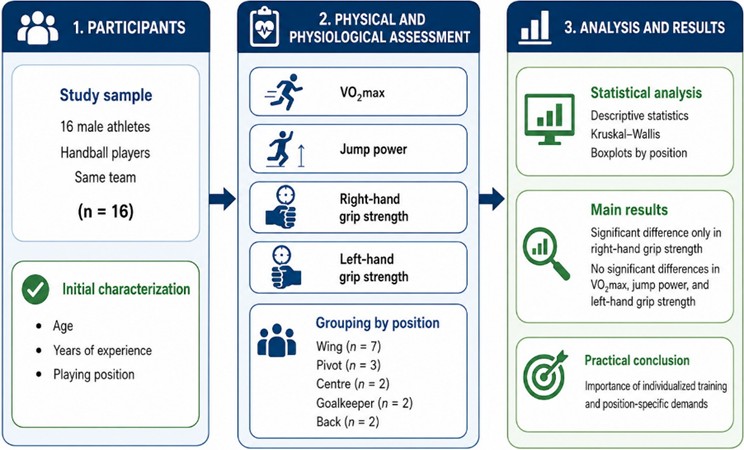
Jumping power was assessed using a force plate through a vertical jump protocol. The force plate records force-time data and allows the objective calculation of jump-related variables, such as jump height, force production and power output. Countermovement jump assessments performed on force plates have been widely used to evaluate lower-limb neuromuscular performance, and previous studies have reported acceptable reliability of force-time variables when the testing protocol is standardised [20], [21]. For this reason, the force plate was considered a suitable and reliable instrument for assessing explosive lower-limb performance in young handball players.
Handgrip strength was assessed using a hand dynamometer, with values for the right and left hands recorded separately. Hand dynamometry is a practical, valid and reliable method for assessing maximal isometric grip strength and is commonly used in sport performance assessment. Previous studies have demonstrated high test-retest reliability for handgrip strength measurements in children, adolescents and athletes, including both preferred and non-preferred hands [22], [23]. Recording both hands separately also allowed the analysis of lateral differences, hand dominance and possible asymmetries relevant to ball control, gripping and throwing actions in handball.
2.4. Statistical analysis
Statistical analysis was performed using JASP software. Initially, a descriptive analysis of the variables was carried out, using the mean, standard deviation, median, interquartile range, minimum value and maximum value. To compare the physical variables between playing positions, the Kruskal-Wallis test was used, with a significance level of 0.05. Effect sizes were also analysed, namely epsilon squared () and the correlation coefficient (), to complement the interpretation of the results.
3. Results
The main findings obtained from the descriptive and comparative analysis of the variables assessed. First, a general characterisation of the sample is provided, taking into account age, years of experience, VO2max, jump power, and right and left hand grip strength (Table 1).
Table 1Descriptive analysis of the study variables
Variable | Mean ± SD | Median [Q1-Q3] | Min-Max |
Age (years) | 14.0±0.7 | 14.0 [14.0-14.0] | 12.0-15.0 |
Years of experience | 2.9±1.7 | 2.0 [2.0-3.2] | 1.0-7.0 |
VO2max | 49.2±7.4 | 45.7 [43.8-54.3] | 40.2-63.6 |
Jump power | 758.2±146.8 | 737.7 [686.5-817.8] | 560.9-1099.0 |
Handgrip strength – right hand | 36.6±5.9 | 36.7 [32.5-40.2] | 26.8-48.4 |
Handgrip strength – left hand | 34.6±4.9 | 34.2 [30.5-38.0] | 27.2-44.4 |
Note. SD = standard deviation; Q1 = first quartile; Q3 = third quartile. Units for VO2max, jump power, and handgrip strength should be reported according to the protocol and instruments used. | |||
The sample had a mean age of 14.0±0.7 years and an average of 2.9±1.7 years’ experience. With regard to physical variables, VO2max had a mean of 49.2±7.4, whilst jump power recorded a mean of 758.2±146.8. With regard to handgrip strength, the mean was 36.6±5.9 for the right hand and 34.6±4.9 for the left hand. These results provide an overall characterisation of the sample in terms of age, sporting experience and physical performance.
Table 2Comparison of physical performance variables according to playing position
Variable | Wing ( 7) | Pivot ( 3) | Centre ( 2) | Goalkeeper ( 2) | Back ( 2) | H(4) | |||
VO2max | 47.3±5.5 | 51.5±11.7 | 60.2±0.0 | 44.4±1.3 | 45.8±0.0 | 4.87 | 0.301 | 0.08 | 0.66 |
Jump power | 677.2±87.1 | 736.4±181.7 | 768.0±53.3 | 799.7±77.2 | 1023.1±107.4 | 7.30 | 0.121 | 0.30 | 0.77 |
Handgrip strength – right hand | 34.5±3.3 | 39.7±2.5 | 27.0±0.3 | 41.8±2.8 | 43.6±6.7 | 10.37 | 0.035 | 0.58 | 0.87 |
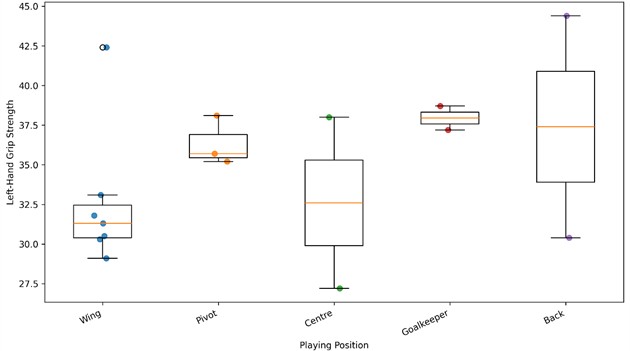
Handgrip strength – left hand | 32.6±4.5 | 36.3±1.6 | 32.6±7.6 | 38.0±1.1 | 37.4±9.9 | 3.73 | 0.443 | 0.00 | 0.47 |
Note. Values by position are presented as mean ± standard deviation. = Kruskal-Wallis test statistic; = effect size based on the Kruskal-Wallis test; correlation ratio, used as a descriptive measure of the association between a nominal variable and a continuous variable. Because some groups included only two athletes, the results should be interpreted as exploratory. | |||||||||
Table 2 presents a comparison of physical variables according to playing position. It was found that VO2max did not show any statistically significant differences between positions, although central players had higher mean values. No significant differences were observed in jump power either, although full-backs had the highest mean values for this variable. With regard to right-hand grip strength, a statistically significant difference was observed between positions, with 0.035, with the highest values recorded for full-backs and goalkeepers and the lowest for centre-backs. On the other hand, left-hand grip strength showed no statistically significant differences between positions.
The VO2max graph (Fig. 2) indicates that central midfielders had the highest values, whilst goalkeepers and full-backs showed lower and more homogeneous values. The wingers showed some variation, with intermediate values and one player recording a higher value. These results suggest that aerobic capacity may differ between positions, although the small size of the groups limits definitive conclusions.
Fig. 2VO2max by position
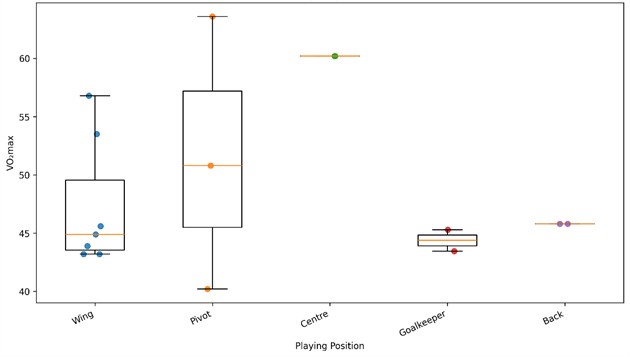
Fig. 3Jump power by position
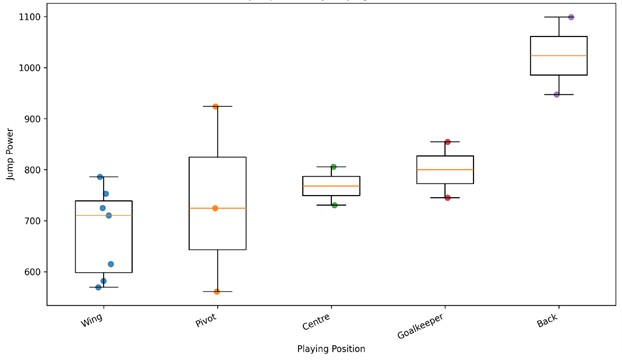
In the jump power graph (Fig. 3), the full-backs stood out with the highest values, followed by the goalkeepers and centre-backs. The wingers showed lower values and some variability, whilst the centre-forwards displayed a wider distribution. Overall, the graph suggests that jump power may be associated with the specific demands of each position, but the results should be interpreted as exploratory.
The graph of right-hand grip strength (Fig. 4) shows visual differences between the positions. Players in the wing and goalkeeper positions tended to have higher values, whilst centre-backs recorded the lowest values. This trend suggests that right-hand grip strength may vary depending on playing position, although interpretation should be cautious due to the small number of players in some groups.
In the graph showing left-hand grip strength (Fig. 5), the differences between positions appear less pronounced than for the right hand. Nevertheless, goalkeepers, full-backs and pivots recorded slightly higher values, whilst wingers and centre-backs showed lower values or greater variability. These results suggest a positional trend, but without visual evidence as clear as that seen for the right hand.
Fig. 4Right-hand grip strength by position
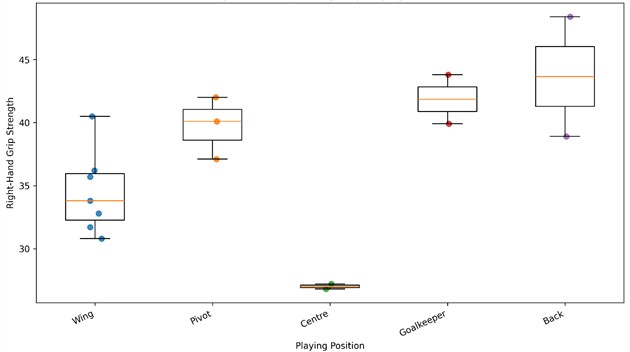
Fig. 5Left-hand grip strength by position
4. Discussion
The present study analysed selected physical performance variables according to playing position in youth male handball players. In the current sample, no statistically significant differences were observed between playing positions for VO2max, jump power, or left-hand grip strength, whereas right-hand grip strength showed a significant positional difference (present study). The descriptive results also suggested that centre players presented higher VO2max values, backs showed higher jump power values, and backs and goalkeepers tended to present higher right-hand grip strength values (present study). These results should be interpreted with caution due to the small sample size and the unequal number of players across positions (present study).
It was hypothesised that playing position would influence physical performance variables in young handball players, namely VO2, jump power and handgrip strength, particularly right-hand grip strength, due to the different physical, technical and tactical demands associated with each playing position. The results partially confirmed this hypothesis, as a statistically significant difference was found only for right-hand grip strength, while VO₂, jump power and left-hand grip strength did not show statistically significant differences between playing positions. Therefore, the hypothesis was partially supported, suggesting that playing position may influence specific physical characteristics, especially upper-limb strength, but not all the physical performance variables analysed.
These findings are consistent with previous research showing that physical fitness attributes in handball can vary according to playing position [24]. Previous studies have shown that handball players from different positions may present distinct anthropometric, maturational, and physical performance characteristics, especially in youth athletes [25]. Research in elite handball has also demonstrated that match-play physiological demands differ between positions, supporting the idea that each playing role imposes specific physical requirements on the athlete [26].
The tendency for backs to present higher jump power in the present study may be explained by the specific offensive demands of this position, which often involve powerful jumps, long-range shots, and explosive actions [27]. The higher right-hand grip strength observed in backs and goalkeepers may also reflect the relevance of upper-limb strength in actions such as throwing, blocking, and ball control [24]. Previous research has highlighted handgrip strength, vertical jump performance, and throwing-related capacities as relevant physical indicators in handball players, reinforcing the importance of assessing these variables according to positional role [27].
Although most differences were not statistically significant, the observed trends suggest that players may present different physical profiles even within the same team and age group [25]. This reinforces the importance of individualised training prescription, since applying the same training stimulus to all players may not adequately address the specific needs of each athlete [28]. In team handball, performance depends not only on collective tactical organisation but also on the individual physical, technical, and positional characteristics of each player [28].
From a practical perspective, the present results support the need for position-specific and individualised training programmes. Coaches should consider the physical demands of each playing position when planning training, such as aerobic capacity development for players with greater movement involvement, jump power for positions requiring explosive offensive actions, and upper-limb strength for positions with greater throwing, blocking, or ball-control demands [26], [27]. Individual monitoring is particularly important in youth athletes, because maturation, training experience, and positional specialisation can influence physical development and performance outcomes [25].
In conclusion, the findings of the present study suggest that positional differences in youth handball may be more evident in right-hand grip strength, while other variables showed only descriptive trends (present study). Even when statistical significance is limited, the analysis of individual and positional profiles remains useful for guiding training decisions and improving the specificity of training prescription [24], [28]. Therefore, training programmes in youth handball should respect both the individual characteristics of each athlete and the specific demands of their playing position [26], [28].
5. Conclusions
The present study suggests that playing position may influence selected physical performance variables in young handball players. Although VO2max, jump power and left-hand grip strength did not show statistically significant differences between positions, relevant descriptive trends were observed. Centre players presented higher VO2max values, backs showed greater jump power, and backs and goalkeepers recorded higher right-hand grip strength. The only statistically significant difference was found for right-hand grip strength, indicating that upper-limb strength may be more position-dependent in this sample. These findings reinforce the importance of individualized and position-specific training in youth handball. However, due to the small and unequal sample size across positions, the results should be interpreted with caution. Future studies with larger samples are needed to confirm these positional differences.
References
-
C. García-Sánchez, R. M. Navarro, C. Karcher, and A. de La Rubia, “Physical demands during official competitions in elite handball: a systematic review,” International Journal of Environmental Research and Public Health, Vol. 20, No. 4, p. 3353, 2023, https://doi.org/10.3390/ijerph20043353
-
F. Hang, Y. Zhong, L. Zhu, and S. Feng, “Meta-analysis of the effects of plyometric training on athletic performance in handball athletes,” Scientific Reports, Vol. 15, No. 1, 2025, https://doi.org/10.1038/s41598-025-15526-3
-
M. Bassek, D. Raabe, D. Memmert, and R. Rein, “Analysis of motion characteristics and metabolic power in elite male handball players,” Journal of Sports Science and Medicine, Vol. 22, No. 2, pp. 310–316, 2023, https://doi.org/10.52082/jssm.2023.310
-
C. Saal, C. Baumgart, F. Wegener, N. Ackermann, F. Sölter, and M. W. Hoppe, “Physical match demands of four LIQUI-MOLY Handball-Bundesliga teams from 2019-2022: effects of season, team, match outcome, playing position, and halftime,” Frontiers in Sports and Active Living, Vol. 5, 2023, https://doi.org/10.3389/fspor.2023.1183881
-
K. S. Noutsos, P. G. Meletakos, M. Kepesidou, and G. C. Bogdanis, “Equal effects of low – and moderate-volume supplementary plyometric training on sprint, change of direction ability, and lower-limb power in preadolescent female handball players,” Journal of Functional Morphology and Kinesiology, Vol. 9, No. 4, p. 204, 2024, https://doi.org/10.3390/jfmk9040204
-
J. Tuquet, E. Mainer Pardos, A. Cartón-Llorente, A. Roso-Moliner, G. García-Buendía, and D. Lozano, “Importance of jumping ability in handball throwing speed and accuracy,” Journal of Visualized Experiments, No. 218, 2025, https://doi.org/10.3791/67443
-
H. Wagner, V. Radic, and M. Hinz, “Differences in game-based performance by playing position in young elite male team handball players,” Frontiers in Sports and Active Living, Vol. 7, 2025, https://doi.org/10.3389/fspor.2025.1688078
-
P. Krawczyk and S. Bodasiński, “Psychomotor abilities as predictors of actions of handball goalkeepers during saves,” Polish Journal of Sport and Tourism, Vol. 29, No. 3, pp. 15–22, 2022, https://doi.org/10.2478/pjst-2022-0016
-
J. Yang and J. Kwon, “Exploring the Handball Goalkeeper’s proper defence position and efficient movement strategy: considering the Goalkeeper’s last defence line,” IJASS (International Journal of Applied Sports Sciences), Vol. 36, No. 2, pp. 174–181, 2024, https://doi.org/10.24985/ijass.2024.36.2.174
-
P. Heuvelmans, A. Gokeler, A. Benjaminse, J. Baumeister, and D. Büchel, “Agility in handball: position – and age-specific insights in performance and kinematics using proximity and wearable inertial sensors,” Sensors, Vol. 25, No. 9, p. 2728, Apr. 2025, https://doi.org/10.3390/s25092728
-
K. Huesmann, J. Schorer, D. Büsch, J. Witt, and F. Loffing, “Expert goalkeepers’ and coaches’ views on anticipation and cue utilisation facing backcourt throws in handball goalkeeping,” Frontiers in Sports and Active Living, Vol. 5, 2023, https://doi.org/10.3389/fspor.2023.1215696
-
B. Pueo, J. Tortosa-Martínez, L. J. Chirosa-Rios, and C. Manchado, “Throwing performance by playing positions of male handball players during the European Championship 2020,” Scandinavian Journal of Medicine and Science in Sports, Vol. 32, No. 3, pp. 588–597, 2021, https://doi.org/10.1111/sms.14100
-
C. Manchado, B. Pueo, L. J. Chirosa-Rios, and J. Tortosa-Martínez, “Time-motion analysis by playing positions of male handball players during the European Championship 2020,” International Journal of Environmental Research and Public Health, Vol. 18, No. 6, p. 2787, 2021, https://doi.org/10.3390/ijerph18062787
-
A. Carton-Llorente, D. Lozano, V. Gilart Iglesias, D. Jorquera, and C. Manchado, “Worst-case scenario analysis of physical demands in elite men handball players by playing position through big data analytics,” Biology of Sport, Vol. 40, No. 4, pp. 1219–1227, 2023, https://doi.org/10.5114/biolsport.2023.126665
-
A. de La Rubia, A. L. Kelly, J. García-González, J. Lorenzo, D. Mon-López, and S. Maroto-Izquierdo, “Biological maturity vs. relative age: independent impact on physical performance in male and female youth handball players,” Biology of Sport, Vol. 41, No. 3, pp. 3–13, 2024, https://doi.org/10.5114/biolsport.2024.132999
-
C. Aouichaoui et al., “Reference values of physical performance in handball players aged 13-19 years: taking into account their biological maturity,” Clinics and Practice, Vol. 14, No. 1, pp. 305–326, 2024, https://doi.org/10.3390/clinpract14010024
-
J. Bangsbo, F. M. Iaia, and P. Krustrup, “The Yo-Yo intermittent recovery test: a useful tool for evaluation of physical performance in intermittent sports,” Sports Medicine, Vol. 38, No. 1, pp. 37–51, 2028.
-
C. Castagna, P. Krustrup, and S. Póvoas, “Yo-Yo intermittent tests are a valid tool for aerobic fitness assessment in recreational football,” European Journal of Applied Physiology, Vol. 120, No. 1, pp. 137–147, 2019, https://doi.org/10.1007/s00421-019-04258-8
-
J. Grgic, L. Oppici, P. Mikulic, J. Bangsbo, P. Krustrup, and Z. Pedisic, “Test-retest reliability of the Yo-Yo test: a systematic review,” Sports Medicine, Vol. 49, No. 10, pp. 1547–1557, 2019, https://doi.org/10.1007/s40279-019-01143-4
-
A. Heishman, B. Daub, R. Miller, B. Brown, E. Freitas, and M. Bemben, “Countermovement jump inter-limb asymmetries in collegiate basketball players,” Sports, Vol. 7, No. 5, p. 103, Apr. 2019, https://doi.org/10.3390/sports7050103
-
J. J. Merrigan, J. D. Stone, W. G. Hornsby, and J. A. Hagen, “Identifying reliable and relatable force-time metrics in athletes-considerations for the isometric mid-thigh pull and countermovement jump,” Sports, Vol. 9, No. 1, 2020, https://doi.org/10.3390/sports9010004
-
J. Cronin, T. Lawton, N. Harris, A. Kilding, and D. T. Mcmaster, “A brief review of handgrip strength and sport performance,” Journal of Strength and Conditioning Research, Vol. 31, No. 11, pp. 3187–3217, 2017, https://doi.org/10.1519/jsc.0000000000002149
-
J. Gąsior et al., “Test-retest reliability of handgrip strength measurement in children and preadolescents,” International Journal of Environmental Research and Public Health, Vol. 17, No. 21, p. 8026, 2020, https://doi.org/10.3390/ijerph17218026
-
L. Massuca, B. Branco, B. Miarka, and I. Fragoso, “Physical fitness attributes of team-handball players are related to playing position and performance level,” Asian Journal of Sports Medicine, Vol. 6, No. 1, 2015, https://doi.org/10.5812/asjsm.24712
-
S. P. J. Matthys, J. Fransen, R. Vaeyens, M. Lenoir, and R. Philippaerts, “Differences in biological maturation, anthropometry and physical performance between playing positions in youth team handball,” Journal of Sports Sciences, Vol. 31, No. 12, pp. 1344–1352, 2013, https://doi.org/10.1080/02640414.2013.781663
-
S. C. A. Póvoas et al., “Physiological demands of elite team handball with special reference to playing position,” Journal of Strength and Conditioning Research, Vol. 28, No. 2, pp. 430–442, 2014, https://doi.org/10.1519/jsc.0b013e3182a953b1
-
H. Vila, C. Manchado, N. Rodriguez, J. A. Abraldes, P. E. Alcaraz, and C. Ferragut, “Anthropometric profile, vertical jump, and throwing velocity in elite female handball players by playing positions,” Journal of Strength and Conditioning Research, Vol. 26, No. 8, pp. 2146–2155, 2012, https://doi.org/10.1519/jsc.0b013e31823b0a46
-
H. Wagner, T. Finkenzeller, S. Würth, and S. P. Von Duvillard, “Individual and team performance in team-handball: A review,” Journal of Sports Science and Medicine, Vol. 13, No. 4, pp. 808–816, 2014.
About this article

The authors have not disclosed any funding.
The datasets generated during and/or analyzed during the current study are available from the corresponding author on reasonable request.
João Ribeiro: Conceptualization, data collection, statistical analysis, data interpretation, and writing-original draft preparation. Samuel Campos: Investigation and writing-review and editing. Vitor Vinagre: investigation and writing-review and editing. Jorge Moreira: investigation and writing-review and editing. Alexandra Malheiro: supervision and writing-review and editing. Pedro Afonso: Supervision and writing-review and editing. All authors have read and approved the final version of the manuscript.
The authors declare that they have no conflict of interest.

