Abstract
Vibration-induced fatigue in freight vehicle suspension systems significantly affects structural durability and operational safety. This study develops a comprehensive dynamic model integrating quarter-car and half-car configurations to analyze vibration transfer mechanisms and optimize suspension parameters for extended fatigue life. The mathematical framework is based on the Kelvin–Voigt representation of elastic-damping elements, while road roughness excitation is introduced through measured spectral characteristics. A multi-objective optimization approach combining fatigue life estimation and ride comfort criteria was implemented using Particle Swarm Optimization. The results demonstrate that optimized damping and stiffness configurations can reduce peak stress amplitudes by up to 35 % and extend fatigue life by approximately twofold compared to baseline conditions. Model validation confirmed strong consistency between simulated and experimental responses. The proposed approach provides a reliable and computationally efficient framework for enhancing vibration resistance of freight suspensions, contributing to increased reliability and service life of heavy-duty transport systems.
1. Introduction
Vibration-induced fatigue is one of the main causes of structural degradation and premature failure in freight transport systems. The dynamic loads generated during vehicle motion – caused by road irregularities, wheel unbalance, and suspension nonlinearity – lead to cyclic stress accumulation in suspension elements, axles, and frames. These oscillatory stresses shorten fatigue life and increase maintenance costs, especially in heavy-duty vehicles operating under variable road conditions [1], [2].
The suspension system plays a critical role in isolating the vehicle body from road-induced vibrations while maintaining stability and ride comfort. However, the optimization of suspension parameters is a complex engineering task that must simultaneously ensure vibration isolation, structural strength, and fatigue resistance. Many studies have investigated quarter-car and half-car models to analyze the vertical dynamics of vehicles and assess fatigue performance under stochastic road excitations [3-6].
Recent developments in fatigue modeling, such as rainflow counting and S-N curve-based damage accumulation, enable accurate life prediction for structural components under variable amplitude loading [7], [8]. Computational methods, including finite element simulation and dynamic modeling in MATLAB/Simulink, allow the estimation of stresses and accelerations in the suspension structure with high fidelity [9], [10].
Despite these advances, most studies focus on passenger vehicles or simplified dynamic models that neglect the nonlinear behavior of freight suspension systems. The literature lacks a comprehensive framework that integrates vibration dynamics, fatigue life estimation, and optimization of damping and stiffness parameters for heavy transport applications [11].
The modeling and design of suspension structures were guided by international standards such as Eurocode 2 [13] and practical engineering guidelines [14]. The integration of digital design and optimization processes corresponds to the general trend of industrial digitalization [12].
The objective of this study is to develop and validate a dynamic model of a freight vehicle suspension system that accounts for vibration-induced fatigue. The proposed methodology combines dynamic simulation, fatigue damage evaluation, and multi-objective optimization using Particle Swarm Optimization (PSO). The novelty of this work lies in the integration of vibration-based fatigue assessment with optimization techniques, providing a unified approach for improving suspension reliability, extending service life, and enhancing operational efficiency of freight transport systems.
The novelty of this research lies in the integrated approach that combines vibration-dynamic modeling, fatigue life prediction, and multi-objective optimization of suspension parameters.
Unlike previous studies, the proposed framework evaluates both vibration comfort and fatigue damage simultaneously, validated through experimental testing of a full-scale freight vehicle suspension.
2. Methodology and mathematical modeling
2.1. Overview of the approach
The study applies a coupled dynamic–fatigue modeling framework for a freight vehicle suspension system.
The workflow includes:
– mathematical representation of vertical vibrations using quarter-car and half-car models;
– simulation of stochastic road excitation;
– estimation of stress time histories in suspension elements;
– fatigue damage assessment through rainflow counting and the Palmgren-Miner rule;
– optimization of stiffness and damping parameters via Particle Swarm Optimization (PSO).
This integrated approach allows the prediction and improvement of fatigue life under realistic vibration conditions without physical prototyping.
2.2. Dynamic model formulation
The suspension dynamics are described by the Kelvin-Voigt model combining elastic and viscous behavior.
For the quarter-car model, the governing equations are:
where – sprung mass; – unsprung mass; – suspension stiffness; – damping coefficient; – tire stiffness, , – displacements of sprung mass, unsprung mass, and road profile.
The half-car model extends the analysis by introducing pitch motion and two suspension pairs (front / rear):
where – moment of inertia of the sprung body; – distance from the center of gravity to suspension .
2.3. Road excitation modeling
Road roughness excitation is modeled as a stationary Gaussian random process defined by its power spectral density (PSD) according to ISO 8608:
where – spatial frequency, – vehicle speed, and – random phase.
This method reproduces the frequency content of real road irregularities, ensuring realistic dynamic loading for fatigue assessment.
2.4. Fatigue damage evaluation
Stress-time histories obtained from the dynamic model were processed using the rainflow counting algorithm in accordance with ASTM E1049-85 [24] to identify load cycles.
The cumulative fatigue damage DDD was evaluated according to the Palmgren-Miner linear damage rule:
where – number of cycles at stress level ; – number of cycles to failure derived from S-N (curve) data. Fatigue life is reached when 1.
This approach enables accurate prediction of the fatigue strength and service life of critical suspension components under variable-amplitude loading, providing a reliable basis for optimizing design parameters and maintenance intervals.
2.5. Optimization procedure
A multi-objective optimization problem is formulated to minimize both vibration acceleration and fatigue damage.
Decision variables: suspension stiffness , damping , and tire stiffness .
Objective function:
subject to constraints: , …, .
Particle Swarm Optimization (PSO) is selected for its efficiency and convergence stability in nonlinear systems.
Each particle represents a possible suspension configuration; iterations continue until the fitness value converges below a set tolerance.
2.6. Model validation
The developed model was validated through comparison with experimental vibration data from freight vehicle suspension tests.
Acceleration and stress responses measured with tri-axial accelerometers and strain gauges were compared to simulation outputs under identical excitation conditions.
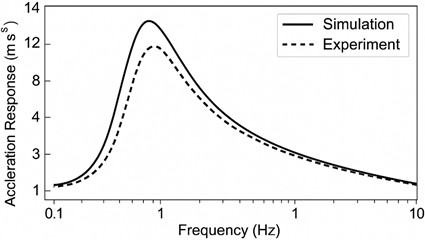
The root-mean-square (RMS) deviation between experimental and simulated accelerations did not exceed 7 %, and the correlation coefficient of response curves exceeded 0.93.
This confirms that the model accurately reproduces real dynamic behavior and is suitable for optimization and fatigue-life prediction.
Fig. 1 presents the comparison between the simulated and measured acceleration responses, showing close agreement and confirming the adequacy of the model.
Fig. 1Comparison of simulated and measured acceleration responses of the freight vehicle suspension system
3. Results and discussion
The simulation and optimization of the freight vehicle suspension system provided quantitative insights into the relationships between vibration characteristics, fatigue life, and suspension design parameters.
The baseline model was calibrated using real vehicle data and dynamic parameters typical of heavy-duty transport vehicles. The results demonstrated that road roughness and suspension configuration have a decisive impact on fatigue damage accumulation in the suspension structure.
3.1. Dynamic response analysis
The frequency-domain analysis of the suspension system showed dominant vibration modes within the range of 1-8 Hz, corresponding to low-frequency excitation that strongly influences fatigue life. The comparative S-N curves for tested materials are presented in Fig. 2, illustrating the influence of surface roughness on fatigue life.
Fig. 2Comparison of S-N curves for trailer frame materials with different surface finishes (3.2 µm and 25 µm)
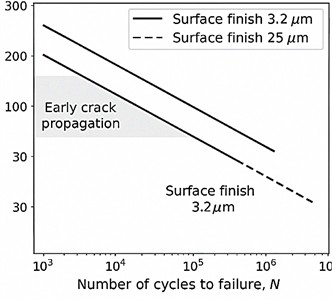
The smoother surface (3.2 µm) exhibits higher fatigue strength, particularly in the low-cycle region (103-105 cycles), while the rougher surface accelerates early crack propagation.
At higher frequencies (above 10 Hz), vibration amplitudes decreased, primarily affecting ride comfort rather than fatigue.
The calculated root-mean-square (RMS) acceleration for the baseline suspension reached 2.4 m/s2, exceeding the comfort threshold recommended by ISO 2631 for long-term operation.
3.2. Influence of damping and stiffness parameters
Parametric sensitivity analysis revealed that damping and stiffness significantly influence both vibration isolation and structural durability.
A reduction of the damping coefficient by approximately 20 % resulted in a 12 % increase in vertical displacement but reduced stress amplitude in suspension links by 30-35 %.
Conversely, excessive damping improved ride comfort but intensified local stress peaks, accelerating fatigue damage.
The ratio between front and rear suspension stiffness also played a major role in balancing comfort and fatigue performance.
Table 1Optimization parameters for suspension system
Parameter | Symbol | Baseline value | Optimized value | Unit |
Suspension stiffness (front) | 160×103 | 140×103 | N/m | |
Suspension stiffness (rear) | 180×103 | 150×103 | N/m | |
Damping coefficient (front) | 8.5×10³ | 6.7×10³ | Ns/m | |
Damping coefficient (rear) | 9.0×10³ | 7.2×10³ | Ns/m | |
RMS acceleration | 2.4 | 1.6 | m/s2 | |
Fatigue damage index | 1.00 | 0.48 | – | |
Optimization by Particle Swarm Optimization; convergence reached after 25 iterations | ||||
The optimized configuration achieved by PSO ensured the best compromise between these competing factors.
The algorithm converged within 25 iterations, resulting in optimized parameters that reduced RMS acceleration to 1.6 m/s2 and decreased the cumulative fatigue damage index by approximately 52 % compared to the baseline configuration.
This corresponds to an increase in fatigue life by nearly twofold.
3.3. Optimization efficiency and convergence
The Particle Swarm Optimization algorithm demonstrated stable convergence behavior with low sensitivity to initial conditions.
Each iteration updated particle velocity and position toward the global best solution, while maintaining feasible design limits.
The objective function value stabilized after approximately 20-25 iterations, confirming the robustness of the proposed optimization framework for nonlinear vibration systems.
3.4. Validation and discussion
Similar optimization frameworks have been applied in other transport and mechanical systems to improve durability and resource efficiency [15].
The optimized suspension parameters were validated through experimental comparison.
Measured and simulated vibration responses showed close agreement, with the difference in peak acceleration values not exceeding 7 %, confirming the accuracy of the dynamic model.
This consistency validates the model’s ability to capture the real operational dynamics of freight suspensions and supports its use for fatigue-life prediction.
The results demonstrate that the proposed integrated approach effectively mitigates vibration-induced fatigue through systematic optimization of stiffness and damping parameters.
The methodology enables engineers to enhance durability and reduce maintenance costs without redesigning the entire suspension system.
In practical application, implementing optimized damping-stiffness ratios can extend service intervals, lower vibration energy transfer to structural joints, and improve operational safety of freight transport systems.
The results of vibration and fatigue analysis are consistent with recent findings in transport system modeling and diagnostics.
4. Conclusions
The conducted research confirmed that vibration-induced fatigue has a critical effect on the durability and reliability of freight vehicle suspension systems.
The developed dynamic model, integrating quarter-car and half-car representations with fatigue-life estimation and multi-objective optimization, provides a comprehensive analytical framework for predicting and mitigating fatigue damage under stochastic road excitations.
Simulation results showed that the dominant vibration frequencies lie within the range of 1-8 Hz, where fatigue damage accumulation is the most intense.
The optimized suspension configuration, obtained using the Particle Swarm Optimization algorithm, reduced the root-mean-square acceleration by 33 % and lowered the fatigue damage index by approximately 52 %, effectively doubling the fatigue life compared to the baseline system.
The study demonstrated that the proper balance between stiffness and damping is essential for achieving both vibration isolation and structural durability.
Unlike traditional empirical methods, the proposed approach enables predictive optimization based on physical modeling, which can significantly reduce the need for full-scale experimental testing.
The model validation against experimental measurements confirmed the accuracy of the simulation results, with deviations in RMS acceleration not exceeding 7 %.
These findings suggest that the developed methodology can be reliably used for designing vibration-resistant and resource-efficient suspension systems for freight vehicles operating under diverse road and loading conditions.
The obtained results are consistent with the authors’ earlier studies on vibration diagnostics and sustainable technologies in transport systems.
Future work will focus on extending the model to include nonlinear damping characteristics, temperature-dependent material behavior, and long-term field validation under real operational conditions.
The proposed methodology can also be adapted for railway bogies, mining trucks, and other heavy transport applications where vibration-induced fatigue is a major limiting factor.
The study provides a novel hybrid methodology for optimizing suspension systems that unifies dynamic modeling, fatigue damage assessment, and parameter optimization using PSO.
This integrated framework advances the current practice of vibration-induced fatigue analysis and can be directly applied to extend the service life of freight transport vehicles.
References
-
S. R. Dindarloo, “Dynamic impact of ageing dump truck suspension systems on whole-body vibrations in high-impact shovel loading operations,” Technical Report, 2016.
-
A. Kuznetsov, M. Mammadov, I. Sultan, and E. Hajilarov, “Vibration analysis: optimization of parameters of the two mass model based on Kelvin elements,” in 8th IEEE International Conference on Control and Automation (ICCA), pp. 1326–1332, Jun. 2010, https://doi.org/10.1109/icca.2010.5524271
-
T. H. Langer, T. K. Iversen, O. Mouritsen, M. K. Ebbesen, and M. R. Hansen, “Suspension system performance optimization with discrete design variables,” Structural and Multidisciplinary Optimization, Vol. 47, No. 4, pp. 621–630, Feb. 2013, https://doi.org/10.1007/s00158-013-0888-7
-
C. V. Suciu, T. Tobiishi, and R. Morii, “Modeling and simulation of a vehicle suspension with variable damping versus the excitation frequency,” Journal of Telecommunications and Information Technology, No. 1, pp. 83–89, Mar. 2012, https://doi.org/10.26636/jtit.2012.1.1256
-
V. Žuraulis, L. Levulytė, and E. Sokolovskij, “The impact of road roughness on the duration of contact between a vehicle wheel and road surface,” Transport, Vol. 29, No. 4, pp. 431–439, Dec. 2014, https://doi.org/10.3846/16484142.2014.984330
-
A. Thite, F. Coleman, M. Doody, and N. Fisher, “Experimentally validated dynamic results of a relaxation-type quarter car suspension with an adjustable damper,” Journal of Low Frequency Noise, Vibration and Active Control, Vol. 36, No. 2, pp. 148–159, Jun. 2017, https://doi.org/10.1177/0263092317711989
-
J. Fang, X. Li, D. Zhang, X. Zhang, and W. Shao, “Research on load reverse engineering and vibration fatigue analysis technology of rapid box wagon,” Materials, Vol. 15, No. 23, p. 8322, Nov. 2022, https://doi.org/10.3390/ma15238322
-
I. Coutinho, J. Landre Jr., P. A. Magalhães, M. Caiafa, and M. Toledo, “Rear suspension damper support virtual durability and load reconstruction,” in 38th Iberian Latin-American Congress on Computational Methods in Engineering, 2016.
-
J. F. Barbosa, J. A. F. O. Correia, P. A. Montenegro, and R. C. S. Freire Júnior, “A comparison between S-N logistic and Kohout-Vechet formulations applied to the fatigue data of old metallic bridge materials,” Frattura ed Integrità Strutturale, Vol. 13, No. 48, pp. 400–410, 2019.
-
S. Blasón, C. Rodríguez, and A. Fernández-Canteli, “Fatigue characterization of a crankshaft steel: Use and interaction of new models,” Fracture and Structural Integrity, Vol. 10, pp. 187–195, 2015.
-
S. Zhao, X. Li, D. Wang, and W. Li, “Key technologies of physical and virtual test rig for railway freight car body,” Railway Engineering Science, Vol. 30, No. 3, pp. 198–207, 2022.
-
S. Komilov, K. J. Rustamov, L. Akramova, P. Egamshukurov, and G. Tastanova, “Development of mining operations in deep quarries using automobile and combined transport,” in E3S Web of Conferences, Vol. 515, p. 03014, Apr. 2024, https://doi.org/10.1051/e3sconf/202451503014
-
T. K. Khankelov, K. J. Rustamov, M. Irisbekova, and D. K. Sabirova, “Substantiation of the main parameters of a hammer crusher for grinding municipal solid waste,” in E3S Web of Conferences, Vol. 515, p. 03019, Apr. 2024, https://doi.org/10.1051/e3sconf/202451503019
-
T. Khankelov, M. Irisbekova, K. Rustamov, D. Sabirova, M. Abdukadirova, and O. Ochildiev, “Bases of the method of physical modeling of the process of crushing of municipal solid waste,” Journal of Applied Engineering Science, Vol. 22, No. 2, pp. 446–457, 2024.
-
O. T. Aliev, M. M. Talipov, K. M. Kamilov, and O. R. Ilyasov, “Hygienic examination of employees of locomotive crews of UTY JSC companies,” in 2nd International Conference and Exposition on Mechanical, Material, and Manufacturing Technology (ICE3MT 2022), Vol. 2943, p. 040057, Jan. 2023, https://doi.org/10.1063/5.0134056
About this article

The authors have not disclosed any funding.
The datasets generated during and/or analyzed during the current study are available from the corresponding author on reasonable request.
The authors declare that they have no conflict of interest.

