Abstract
This paper presents a systematic review of research advancements in both powertrain configurations and optimization algorithm-based Energy Management Strategies (EMS) for Fuel Cell Hybrid Electric Vehicles (FCHEVs). Firstly, based on the types of auxiliary energy sources (power batteries, supercapacitors, and their combinations), it analyzes and compares the operating principles, topological characteristics, and performance merits and demerits of mainstream FCHEV powertrain configurations, namely FC+B, FC+SC, and FC+B+SC. Building upon this foundation, this review focuses specifically on optimization-based Energy Management Strategies (EMS). A clear algorithmic taxonomy is established, categorizing optimization strategies into global optimization algorithms and real-time optimization algorithms. The strengths and limitations of representative algorithms within each category are scrutinized in terms of optimality, real-time capability, computational burden, and practical applicability. The review indicates that while global optimization algorithms can provide theoretical benchmarks for system performance, their application is constrained by computational complexity and dependence on a priori driving cycle knowledge. Conversely, real-time optimization algorithms offer potential for online implementation but face challenges regarding guaranteed global optimality, model dependency, and parameter sensitivity. This comprehensive analysis not only synthesizes the state-of-the-art but also clearly delineates the persistent gap between theoretical optimality and practical implementability – a central challenge in the field. By mapping this landscape, the review provides a valuable reference for researchers and engineers, guiding the selection and development of EMS that align with specific application priorities, whether they be benchmark validation, real-time control, or low-cost deployment. Ultimately, this work contributes to the advancement of efficient, durable, and economically viable FCHEVs, supporting the broader transition to low-carbon transportation.
Highlights
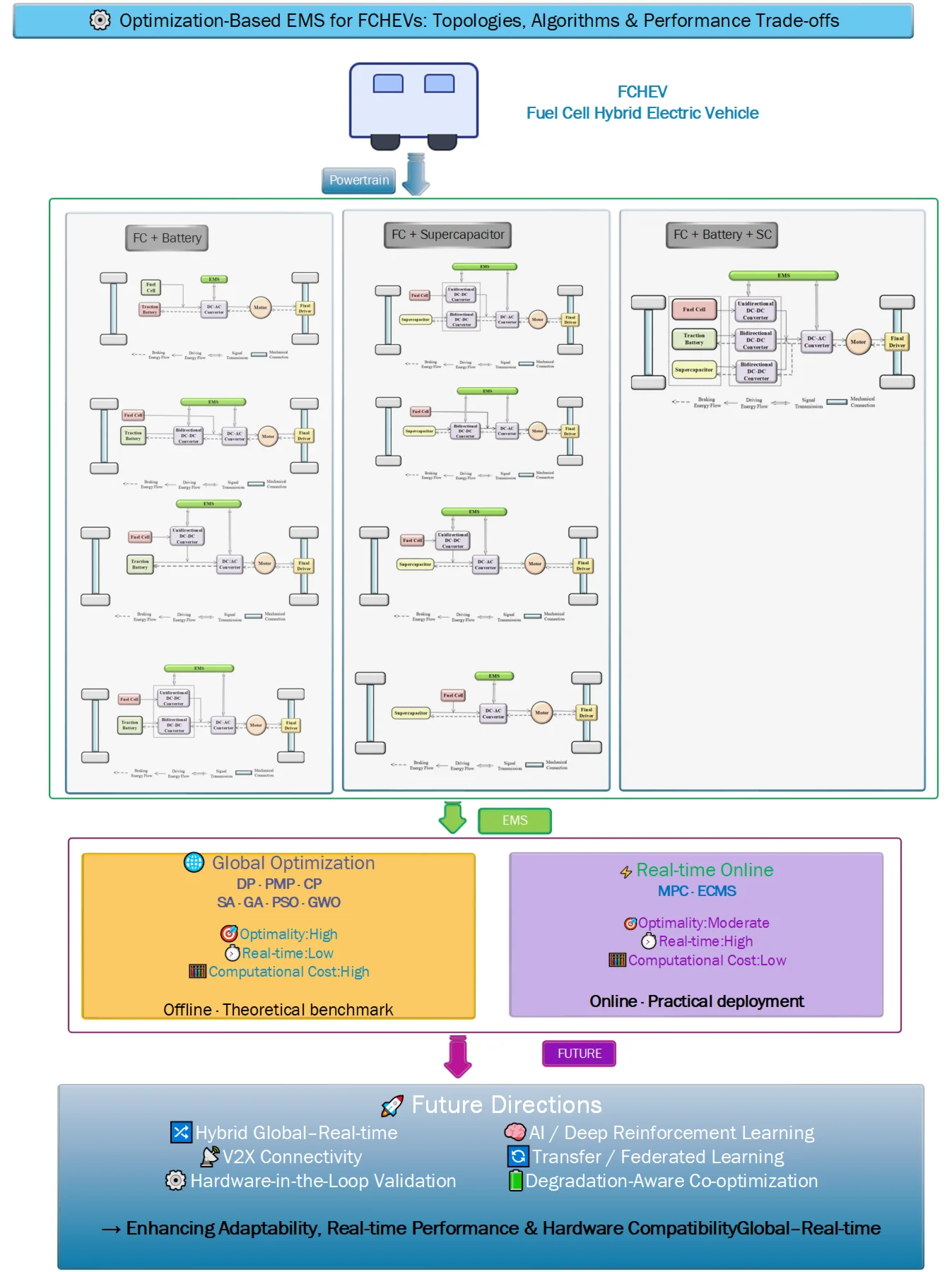
- Future EMS development necessitates hybrid architectures integrating global and real-time methods, enhanced by AI, V2X, and hardware-in-the-loop validation to improve adaptability, real-time performance, and hardware compatibility.
- A systematic review of optimization algorithm-based energy management strategies for FCHEVs is presented, covering global optimization and real-time online paradigms with comparative analysis of optimality and real-time performance.
- Three mainstream FCHEV powertrain configurations (FC+B, FC+SC, FC+B+SC) are critically analyzed in terms of topology characteristics and their influence on EMS design and control flexibility.
- Global optimization algorithms (DP, PMP, CP, SA, GA, PSO, GWO) achieve theoretical optimality but suffer from high computational costs and dependence on prior driving-cycle information.
- Real-time online algorithms (MPC, ECMS) enable instantaneous optimization with reduced computational burden, yet face challenges in maintaining global optimality and adaptability to dynamic driving conditions.
1. Introduction
As a clean energy technology, fuel cells exhibit prominent advantages including long lifespan, high energy conversion efficiency, and superior power density, demonstrating promising application potential across multiple sectors [1]. Fuel cell vehicles (FCVs), a pivotal branch of new energy vehicles, exhibit distinctive advantages including zero-emission characteristics, extended driving range, rapid refueling capability, and exceptional ride comfort [2]. These vehicles not only offer a viable technological pathway for low-carbon transformation in the automotive industry but also present innovative solutions to address global energy crises and environmental pollution challenges [3]. Nevertheless, inherent limitations such as sluggish dynamic response and inability to recover braking energy in fuel cell systems necessitate the integration of auxiliary energy sources (e.g., power batteries or supercapacitors) to establish hybrid power systems. In fuel cell hybrid electric vehicles (FCHEVs), the dynamic coupling characteristics and operational condition dependency of multi-energy sources (fuel cells, power batteries/supercapacitors) demand robust energy management strategies (EMS) to achieve coordinated power distribution under complex driving conditions, thereby attaining globally optimized objectives across multi-dimensional constraints such as power output performance, hydrogen consumption economy, and energy source durability. Driven by the escalating complexity of hybrid powertrain architectures and breakthroughs in intelligent control technologies, EMS research over the past decade has evolved from heuristic rule-based approaches to multi-objective co-optimization frameworks, positioning it as one of the most cutting-edge and engineering-critical research frontiers in this domain [4].
Energy management strategies (EMS) can be categorized into three methodologies based on theoretical frameworks: rule-based, optimization-based, and learning-based strategies [5]. Rule-based strategies (e.g., deterministic rules, fuzzy logic control) rely on expert knowledge for design, offering real-time implementability but being prone to local optima. This review specifically focuses on optimization-based strategies. We adopt and consistently apply a standardized taxonomy that divides these algorithms into two distinct classes: global (offline) optimization algorithms and real-time (online) optimization algorithms. While learning-based strategies (e.g., reinforcement learning) are acknowledged as a growing paradigm, they fall outside the scope of this review, which is dedicated to conventional optimization frameworks [5].
Focusing on energy management strategies (EMS) for fuel cell hybrid electric vehicles (FCHEVs), a systematic review of advancements and persistent challenges in optimization algorithm-driven EMS is conducted through an in-depth analysis of powertrain configuration characteristics and their coupled influences on tractive performance and hydrogen economy. The findings aim to provide theoretical insights and methodological guidance for developing next-generation EMS tailored to high-dimensional nonlinear hybrid systems with strong dynamic coupling.
This review is based on a systematic search of recent literature (primarily from 2018-2024) in major databases such as IEEE Xplore, Science Direct, and Web of Science, using keywords related to “fuel cell hybrid electric vehicle”, “energy management strategy”, and “optimization algorithm”. The selection focused on peer-reviewed articles that present novel optimization frameworks or comparative analyses for FCHEV EMS. The literature screening adhered to the following criteria: (1) the research object is the EMS for FCHEVs; (2) the core methodology involves optimization algorithms (e.g., DP, MPC); (3) the research presents algorithm design, simulation, or experimental validation; (4) the publication type is peer-reviewed journal/conference articles or theses. Surveys focusing solely on learning-based strategies (e.g., reinforcement learning) were excluded from the core discussion of this review.
2. Energy source configurations of FCHEV hybrid power systems
As auxiliary energy sources for fuel cells, supercapacitors and power batteries demonstrate notable advantages including low cost, high power density, convenient energy storage, and efficient energy utilization [6]. Their compact size and lightweight characteristics further enhance suitability for automotive integration. Current FCHEV hybrid power systems primarily adopt three energy source configurations: 1) Fuel Cell + Battery (FC+B), 2) Fuel Cell + Supercapacitor (FC+SC), and 3) Fuel Cell + Battery + Supercapacitor (FC+B+SC). The FC+B configuration remains the most widely implemented, while the other two configurations exhibit promising application potential. This section provides a comparative analysis of operating principles, advantages, and limitations across these configurations, establishing a foundation for EMS optimization and decision-making in hybrid electric vehicle (HEV) applications.
2.1. Fuel cell + battery configuration
This configuration represents the most prevalent FCHEV architecture, benefiting from mature industrial chains and low production costs [7]. It addresses critical limitations of standalone fuel cell systems – such as insufficient output characteristics and inability to recover braking energy – significantly enhancing system reliability, efficiency [8], and energy utilization [9]. Based on the impact of connection topologies on EMS performance, this configuration can be further classified into three subtypes: directly connected, semi-connected, and fully connected architectures.
2.1.1. Directly connected configuration
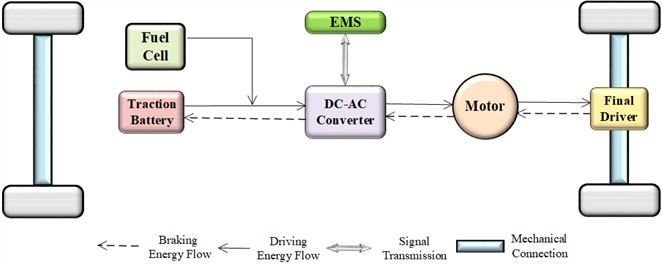
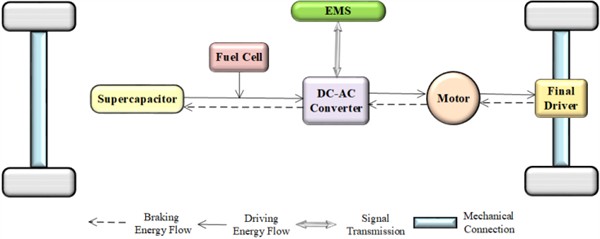
As illustrated in Fig. 1, the directly connected configuration links the fuel cell and battery directly to the DC bus. The EMS regulates energy transfer through DC/AC converter control, enabling both power delivery and braking energy storage. While this topology offers structural simplicity, low cost, compact size, and high energy transfer efficiency, it introduces critical limitations. The slow dynamic response of the fuel cell adversely impacts power performance. Additionally, increased output voltage fluctuations accelerate degradation of both fuel cells and batteries, while complicating vehicle control. Furthermore, the fuel cell and battery voltages in this configuration are constrained by the load’s rated voltage. Consequently, optimal economic performance is achievable only when the DC bus voltage aligns precisely with load requirements [10].
Fig. 1Directly connected configuration (FC+B)
2.1.2. Semi-connected configurations
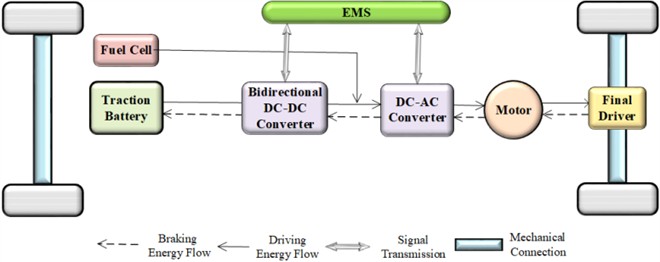
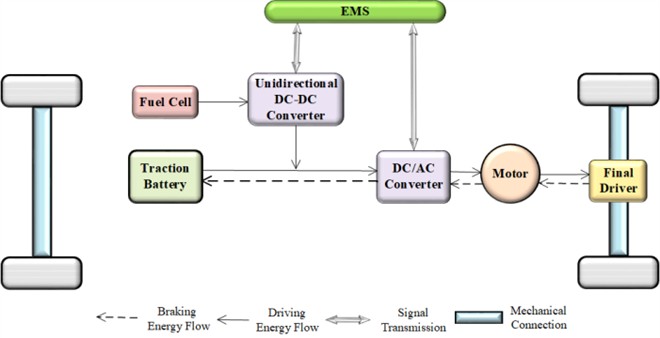
A semi-connected configuration refers to a system where the fuel cell and traction battery are connected to the DC bus via unidirectional or bidirectional DC/DC converters. Based on the converter’s connection target, this configuration is further divided into two types: traction battery semi-connected (FC+BDC) and fuel cell semi-connected (FCDC+B), as illustrated in Fig. 2.
In the FC+BDC configuration (Fig. 2(a)), the fuel cell is directly connected to the DC bus, while the traction battery is connected to the DC bus via a bidirectional DC/DC converter. The bidirectional DC/DC converter stabilizes the output voltage for the load, maintains the traction battery at a lower voltage level, and extends its service life. However, in this configuration, the direct connection of the fuel cell to the bus imposes more stringent requirements on their dynamic characteristics and response capabilities. This topological connection adversely affects the fuel cell lifespan while compromising the vehicle’s comprehensive performance in terms of economic efficiency and power characteristics. Furthermore, the implementation of bidirectional DC/DC converters for traction battery interface introduces additional energy conversion losses, ultimately degrading the overall vehicular energy efficiency and operational performance.
In the FCDC+B architecture (Fig. 2(b)), the fuel cell is interfaced with the DC bus via a unidirectional DC/DC converter, while the traction battery is directly connected to the bus. Although this topology mitigates DC bus voltage fluctuations induced by variations in fuel cell output power, the direct battery-bus connection necessitates continuous high-performance operation of the battery to maintain the bus voltage within prescribed thresholds. More critically, the energy management system in this configuration exhibits three fundamental limitations: insufficient precision in power distribution control and voltage regulation, particularly under high-current demand conditions such as cold starts; inability to prevent the fuel cell from operating in low-efficiency regions [7]; and suboptimal power transfer efficiency during transient operating conditions [11]. These systemic shortcomings collectively degrade overall energy utilization efficiency, ultimately adversely affecting the economic performance of the system.
Fig. 2Semi-connected configuration
a) Semi-connected configuration of power batteries (FC+BDC)
b) Semi-connected configuration of fuel cells (FCDC+B)
2.1.3. Fully-connected configuration
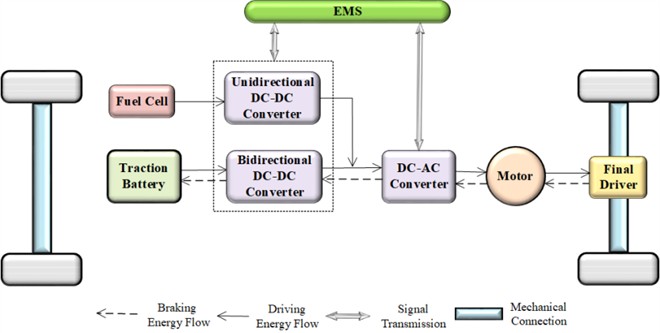
As illustrated in Fig. 3, the fully-connected configuration involves connecting the fuel cell system (FCS) to the DC bus via a unidirectional DC/DC converter and the traction battery to the DC bus via another unidirectional DC/DC converter. This configuration eliminates adverse effects on the DC bus, improves vehicle dynamics and control performance, extends the lifespan of both the fuel cell and traction battery, and reduces the risk of the fuel cell entering low-efficiency regions. It also enables optimal power transfer from the fuel cell, thereby enhancing overall vehicle economy. However, this configuration requires large-capacity capacitors to mitigate high voltage ripples generated by the DC/DC converters. The increased number of converters raises structural complexity and manufacturing costs while reducing system efficiency [12].
Fig. 3Fully connected configuration
2.2. Fuel cell + supercapacitor configuration
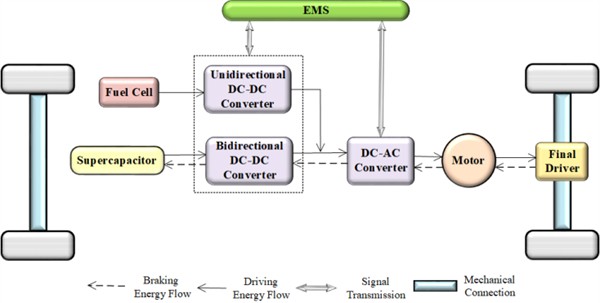
As illustrated in Fig. 4, the fuel cell plus supercapacitor (FC+UC) configuration demonstrates remarkable similarity to the fuel cell plus battery (FC+B) configuration. The fundamental distinction between these two hybrid architectures stems from the inherent differences between batteries and supercapacitors. The superior characteristics of supercapacitors are primarily manifested in their rapid charge/discharge capabilities, high power density, extended cycle life, exceptional operational efficiency, and reliable performance across broad temperature ranges [13], [17]. Furthermore, supercapacitors exhibit exceptional compatibility with high-current charge/discharge requirements, making them particularly suitable for braking energy recovery in electric vehicles [18]. However, the relatively low energy density of supercapacitors limits their capacity to sustain prolonged charge/discharge cycles, which has significantly hindered the widespread adoption of FC+UC configurations in practical applications.
2.3. Fuel cell + traction battery + supercapacitor hybrid configuration
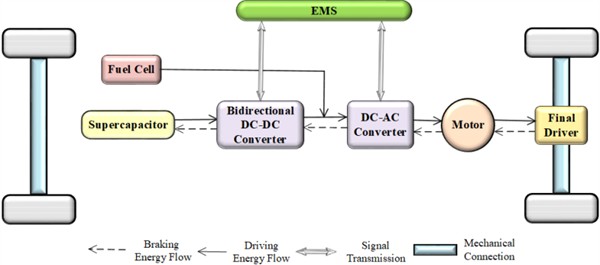
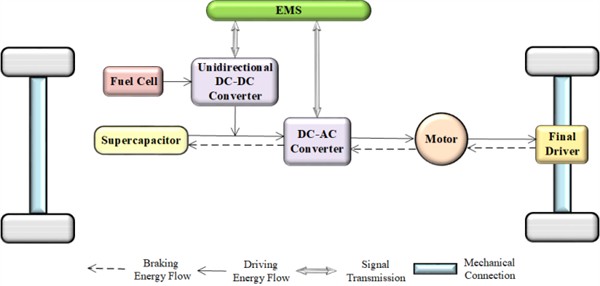
In the fuel cell + traction battery + supercapacitor (FC+B+UC) hybrid configuration, the complementary advantages of multiple energy sources significantly enhance overall vehicle performance. The battery provides high energy density to ensure driving range, while the supercapacitor improves dynamic response through its high power density characteristics. Specifically, the supercapacitor instantaneously delivers high power output during acceleration to enhance driving performance and efficiently absorbs regenerative braking energy. This configuration prevents the battery from sustaining high-current impacts, thereby extending its cycle life [19]. In urban driving scenarios with frequent start-stop operations and drastic power demand fluctuations, this cooperative operation mode demonstrates remarkable advantages. Through optimized control by EMS, dynamic power distribution can be achieved based on the characteristics of each power source, simultaneously improving vehicle economy and reducing operational stress on fuel cells.
Experimental results from constant-current charge/discharge experiments demonstrate that the integration of supercapacitors as auxiliary power sources effectively prevents high-power charge/discharge operations from damaging the service life of lithium-ion traction batteries. The FC+B+UC architecture exhibits multiple topological variants depending on whether the fuel cell is connected to a unidirectional DC/DC converter, and whether the traction battery and supercapacitor are interfaced with bidirectional DC/DC converters.
Fig. 4FC+UC
a) Fully connected configuration
b) Supercapacitor-based semi-connected configuration
c) Fuel cell-based semi-connected configuration
d) Directly connected configuration
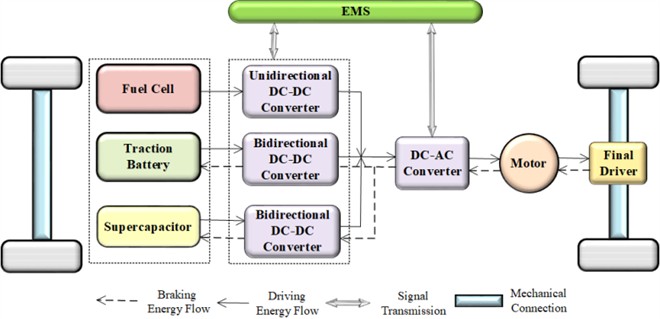
Fig. 5 illustrates the fully connected topology incorporating all converters. In a case study targeting fuel cell electric buses, reference [20] conducted comparative analyses of four potential configurations across five criteria: safety, voltage compatibility, controllability, cost, and structural complexity. Simulations under China Typical City Driving Cycle and Changchun City Bus Cycle demonstrated that the topology shown in Fig. 5 outperformed other configurations in safety, voltage matching, and control performance. However, the inclusion of additional DC/DC converters increases manufacturing costs and spatial requirements.
However, the inherent structural complexity of this configuration introduces technical challenges in vehicle control and parameter matching for FCVs, leading to limited practical applicability [21]. The progressive development of energy management systems (EMS) and the maturation of hierarchical energy management strategies are expected to address these limitations. For example, Ruan, Y. et al. [22] proposed a hierarchical energy management strategy for FCVs that combines adaptive moving average filtering, equivalent cost minimization, and nonlinear control of supercapacitor energy states. While this strategy effectively maintains hydrogen consumption, fuel cell durability, and bus voltage within optimal ranges, it predominantly emphasizes fuel cell durability and inadequately addresses battery longevity considerations. Based on the aforementioned configuration characteristics, the following sections will systematically explore the application of optimization algorithms in EMS.
Fig. 5Fully connected configuration (FC+B+UC)
3. Optimization-based energy management strategies for FCHEVs
This section reviews optimization-based EMS, which are classified into two primary categories according to their operational paradigm: Global Optimization Algorithms and Real-time Optimization Algorithms. This taxonomy is consistently applied throughout the following discussion to provide a clear analytical framework [2].
The primary representative global optimization algorithms include Dynamic Programming (DP) [23], Pontryagin’s Minimum Principle (PMP) [24], Convex Optimization (CP) [25], Simulated Annealing (SA) [26], Genetic Algorithm (GA) [27], Particle Swarm Optimization (PSO) [28], and Grey Wolf Optimization (GWO) [29]. Real-time optimization algorithms are primarily represented by Model Predictive Control (MPC) [30] and Equivalent Consumption Minimization Strategy (ECMS) [31].
3.1. Global optimization algorithms
Global optimization algorithms, also termed offline optimization algorithms, inherently lack online optimization capability and require predefined driving cycle information. These algorithms can be classified into four categories: direct optimization, indirect optimization, gradient-based optimization, and gradient-free optimization [32].
1) Direct Optimization: Direct optimization methods utilizing the DP algorithm decompose complex problems into subproblems and solve overlapping subproblems recursively through solution reuse. This approach is characterized by two key features: first, the optimal solution to a complex problem consists of the optimal solutions to its subproblems; second, these subproblems overlap and may be computed multiple times during the process [33]. The DP algorithm is grounded in Bellman’s principle of optimality, which states that regardless of historical states and decisions, subsequent decisions must form an optimal strategy based on the states resulting from prior decisions [34].
Owing to its three operational advantages, the DP algorithm has been widely adopted in fuel cell hybrid electric vehicle energy management systems: it optimizes energy flow allocation among powertrain components, extends the lifespan of fuel cells, traction batteries, and supercapacitors by mitigating load stress, and enhances system cost-effectiveness. As a globally optimal solver, DP is uniquely capable of addressing dynamic optimization problems with nonlinear constraints, making it a benchmark for comparative algorithm evaluation [35-38]. However, the method inherently requires complete prior knowledge of driving cycles, precluding real-time optimization. Moreover, its full-width backward induction mechanism for state-value updates leads to exponentially increasing computational time and memory demands when the state-space dimension exceeds millions – a phenomenon known as the “curse of dimensionality”.
To overcome the real-time implementation limitations of DP in energy management systems, current research primarily proposes two types of solutions:
– The first integrates DP with complementary algorithms, exemplified by Xi et al. [38], who employed DP to optimize target parameters and subsequently trained a Back propagation (BP) neural network using these optimized results. This hybrid approach aims to develop a real-time Back propagation (BP) neural network controller to compensate for DP’s inability to operate online, yet suffers from high computational costs and failure to maintain traction battery SOC equilibrium, ultimately impairing battery longevity and systemic economic efficiency.
– The second solution adopts Stochastic Dynamic Programming, as demonstrated by Ding [39] through a four-stage methodology: statistical analysis of driving cycles using driver demand torque modeling for future load prediction, construction of a first-order Markov chain model, iterative derivation of expected torque profiles, and DP-based global optimization. This method can achieve real-time optimization while maintaining the SOC of the traction battery between 0.9-0.8988, which can extend the traction battery's lifespan and improve economic efficiency. However, the precision of Stochastic DP in handling large-scale problems may still be impacted by the “curse of dimensionality”.
To address the curse of dimensionality in energy management optimization, multi-dimensional DP algorithms offer a viable alternative. For instance, Li Zhenye [9] demonstrated that a multi-dimensional DP framework achieves dual benefits: prolonging the service life of fuel cells and traction batteries while reducing system manufacturing costs. Crucially, this methodology effectively circumvents dimensionality-related computational divergence despite operating within an expanded state space.
When addressing multi-objective energy management problems, DP’s computational intensity and mediocre convergence persist. Zhao et al. [40] proposed a Non-dominated Sorting Dynamic Programming (NSDP) algorithm by integrating non-dominated sorting mechanisms with conventional DP, which retains DP’s inherent advantages while enabling stable acquisition of uniformly distributed non-dominated solution sets. This methodology significantly reduces computational costs and mitigates the curse of dimensionality through problem-scale and dimensionality reduction, while simultaneously extending traction battery service life and improving system-level economic performance.
2) Indirect Optimization: Within indirect optimization methodologies, the PMP algorithm introduces co-state variables to transform global optimization problems into instantaneous optimal control formulations, thereby enabling online implementation [41]. Although PMP requires shorter computational time than DP, it demonstrates comparatively inferior performance in vehicular energy flow allocation, component lifespan extension (fuel cells, traction batteries, and supercapacitors), and economic optimization, achieving near-optimal solutions rather than true global optima. Song et al. [24] implemented an adaptive PMP framework coupled with an enhanced Markov model for driving cycle prediction, realizing real-time optimization with a 4 % reduction in hydrogen consumption compared to rule-based strategies. This hybrid methodology not only enhances fuel cell durability and economic performance but also rigorously maintains the SOC at 0.6 throughout operational cycles, thereby extending its service life. Nevertheless, the optimization efficacy remains critically dependent on the prediction accuracy of driving conditions.
Three primary methods determine PMP’s co-state variables: battery SOC feedback, driving cycle prediction, and driving mode recognition. These provide diverse strategies for FCV energy management, yet each carries inherent limitations. Practical implementation requires careful algorithm selection or hybridization.
3) Gradient-Based Optimization: CP, a quintessential gradient-based optimization approach, encompasses methodologies such as Linear Programming (LP), Mixed-Integer Linear Programming (MILP), Quadratic Programming (QP), and Semidefinite Programming (SDP) [42]. Leveraging the inherent convexity of problem formulations, CP guarantees globally optimal solutions while maintaining computational efficiency. Similar to DP, CP requires prior knowledge of driving cycles; however, its model simplification and convex relaxation processes marginally compromise solution optimality compared to DP [43]. Yu et al. [44] achieved near-global optimality using CP, demonstrating remarkable computational acceleration under the China City Bus Cycle (CCBC)-with CP requiring merely 4.7 seconds versus DP’s 18,000+ seconds- while maintaining competitive performance in economic efficiency and component durability. Nevertheless, this performance remains contingent upon accurate driving cycle prediction. Furthermore, although CP enables polynomial-time computation of global optima for continuous-variable control problems, the introduction of integer decision variables transforms the formulation into Mixed-Integer Convex Programming (MICP), demanding prohibitive computational resources [45]. Addressing these limitations, Hao et al. [46] integrated quadratic programming with the Alternating Direction Method of Multipliers (ADMM), achieving real-time optimization with enhanced computational efficiency and reduced operational costs.
4) Gradient-Free Optimization: Typical methods include SA, GA, PSO, and GWO.
SA is a stochastic optimization algorithm that employs iterative solving. Inspired by the physical annealing process, it mimics the phase transition behavior of metals during heating and cooling cycles to identify optimal solutions. The SA algorithm demonstrates global search capability, enabling it to escape local optima and achieve global optimality. Although computationally straightforward and easily implementable, this algorithm faces practical limitations due to its incapability of online real-time optimization, thereby necessitating hybrid approaches with other algorithms to enhance automotive power systems energy management performance. As demonstrated in the work of Li et al. [26], the SA algorithm was effectively integrated to optimize fuzzy control strategies. Through iterative refinement of fuzzy control rules and membership functions, their methodology successfully improved the fuel economy and emission performance of parallel hybrid electric vehicles while maintaining the SOC within 0.3-0.9. However, this approach did not address the implications for traction battery lifespan.
Genetic Algorithm (GA) is an optimization methodology developed based on the mechanisms of biological genetic inheritance and mutation, incorporating principles from Darwinian evolutionary theory. The fundamental implementation process includes: defining objective functions, encoding optimization parameters through binary representation, generating initial populations via random sampling, designing fitness evaluation functions, ranking individuals according to fitness values, eliminating inferior solutions through selection pressure, employing an elitism preservation strategy, performing crossover and mutation operations to update the population, and achieving predefined termination criteria through iterative evolution [47]. The primary advantages of this algorithm are as follows: Firstly, it exhibits strong compatibility, enabling effective integration with various algorithms to flexibly address diverse optimization problems. Secondly, the search process is adaptive, with parameters having minimal impact on search speed, allowing for rapid convergence to near-optimal solutions. Thirdly, it offers high computational efficiency, as it directly utilizes objective functions to guide the search without requiring auxiliary information transformation, thereby optimizing computational resource allocation. Fourthly, it employs a probabilistic exploration mechanism, enabling global search of the solution space through stochastic operators and avoiding limitations associated with deterministic rule-based approaches. Fifthly, it supports parallel computing, with its population-based architecture facilitating efficient utilization of high-performance computing clusters, significantly reducing computational latency while enhancing optimization throughput [48-49].
For instance, Bai et al. [50] addressed the inherent limitations of Back propagation (BP) neural network – specifically slow convergence rates and poor generalization capabilities – through hybrid integration with Genetic Algorithms (GA). By implementing GA-optimized network parameters, their methodology achieved a recognition accuracy of 99.9 % for BP neural networks while enabling optimal operating mode allocation, thereby significantly enhancing vehicular energy efficiency. In complementary research, Zhao et al. [51] employed Support Vector Machine (SVM) algorithms for vehicle driving cycle identification and utilized Genetic Algorithm (GA) for optimization. Through this optimization approach, real-time optimization can be achieved, thereby reducing hydrogen consumption while prolonging the lifespan of both fuel cells and traction batteries.
The particle swarm optimization (PSO) algorithm simulates bird flock predation behavior, demonstrating advantages in high-dimensional search spaces and minimal parameter configuration requirements [42]. However, its global search capability remains limited with susceptibility to local optima. This deficiency can be effectively mitigated through the implementation of a PSO variant incorporating inertia weight adjustment [52]. Li et al. [53] developed a rule-based energy management control strategy for parallel hybrid electric vehicles, optimizing threshold parameters via PSO to maintain both engine and battery operations within their respective optimal efficiency ranges. Experimental results revealed a 14.9 % average reduction in fuel consumption compared to conventional rule-based strategies.
The grey wolf optimizer (GWO) algorithm, as a global optimization strategy, features structural simplicity and minimal parameter dependence. Nevertheless, it exhibits inherent limitations including insufficient solution accuracy and premature convergence. Zhou et al. [54] proposed an enhanced GWO algorithm integrated with fuzzy control strategy, incorporating dynamic population concepts. Validation through FTP72 and NEDC driving cycles confirmed improved vehicle economy, though energy source lifespan considerations were not incorporated in their investigation.
3.2. Real-time optimization algorithms
Real-time optimization can achieve instantaneous economic optimality but cannot guarantee global optimality.
MPC, as a quintessential real-time optimization methodology, exhibits broad applicability to both linear and nonlinear systems. Its core mechanism relies on a finite-horizon receding optimization framework, which achieves dynamic regulation by periodically solving localized optimization problems while ensuring computationally tractable workloads. However, the control performance of MPC is intrinsically dependent on the predictive model’s accuracy. Notably, MPC demonstrates superior predictive capability and inherent robustness. It iteratively solves an optimization problem at each discrete time step. However, the computational burden inherent in solving such optimization problems may lead to insufficient real-time performance of the controller, thereby degrading the overall closed-loop control effectiveness. The performance of MPC is highly sensitive to parameter selection; improper tuning of penalty weights or constraint relaxation factors may result in system instability or suboptimal control behavior. Furthermore, the implementation of MPC entails significant complexity, necessitating experienced engineers for system design and commissioning, along with iterative parameter tuning to achieve optimal performance. In practice, MPC is rarely deployed in isolation but rather synergistically integrated with complementary algorithms. As demonstrated by Chai et al. [57], the hybridization of MPC with an ECMS in hybrid electric vehicles (HEVs) substantially enhanced energy efficiency and fuel economy through coordinated energy management.
ECMS is also a representative real-time optimization algorithm. By dynamically adjusting the energy distribution between the battery and fuel in hybrid powertrain systems, this algorithm minimizes overall energy consumption. It is designed to extend battery lifespan to the greatest extent, thereby reducing maintenance costs and the frequency of battery replacements. ECMS is relatively simple, computationally efficient, and facilitates straightforward implementation in both hardware and software for electric vehicles. However, the ECMS algorithm necessitates high-fidelity models to characterize vehicle powertrain dynamics and energy conversion processes. Insufficient model fidelity consequently leads to suboptimal algorithmic performance. Furthermore, while ECMS typically operates within a global optimization framework for energy management, it often inadequately incorporates driver behavior patterns and real-time road condition data, thus failing to achieve personalized energy management strategies. Additionally, the effectiveness of ECMS is heavily contingent upon specific driving scenarios, demonstrating limited adaptive capability across heterogeneous operating conditions.
The determination of the Equivalent Factor (EF) in the Equivalent Consumption Minimization Strategy (ECMS) employs two distinct approaches. The first method derives fixed EFs through global optimization, which enhances fuel economy under predetermined driving cycles but fails to maintain SOC balance or achieve expected control performance under dynamic operating conditions due to its inherent rigidity. The second method dynamically adjusts EFs via SOC feedback regulation controllers, designed based on deviations between the real-time SOC and its predefined bounds or target values. This adaptive variant (termed A-ECMS) demonstrates improved adaptability to varying driving scenarios and robust SOC maintenance compared to fixed-EF implementations. However, both methodologies share a critical theoretical limitation: their real-time control processes solely rely on instantaneous state-space information, inherently precluding guaranteed global optimality in fuel economy [58]-[61].
The integration of global optimization with real-time optimization algorithms has emerged as a promising paradigm for holistic vehicle energy management. As demonstrated by Zhang et al. [62], this hybrid architecture employs DP to derive stage-wise optimal solutions through backward recursion, subsequently embedding MPC to construct a hierarchical energy management framework. Such a synergistic approach leverages DP’s global optimality characteristics for baseline strategy generation while utilizing MPC’s receding horizon optimization to compensate for real-time disturbances and model uncertainties.
The adaptability and global optimization capability of real-time optimization systems are closely related to the updates of internal system parameters. However, existing real-time optimization algorithms often employ pre-trained mapping models to update these parameters, which constrain the algorithms’ global optimization performance and adaptive capacity [63].
3.3. Structured comparative analysis and trade-offs
The preceding analysis reveals fundamental trade-offs among optimization-based EMS paradigms, primarily centered on the tension between optimality, real-time capability, and practical applicability. A structured comparison highlights these relationships.
Global optimization algorithms, such as DP and CP, are designed to achieve theoretically global or near-global optimality, serving as indispensable benchmarks. However, this pursuit of optimality comes at a significant cost: they exhibit high computational burden (notably the ‘curse of dimensionality’ for DP) and are fundamentally non-causal, requiring complete a priori driving cycle information. This renders them unsuitable for direct real-time implementation. PMP offers a bridge, achieving near-optimality with moderate computational cost, but its effectiveness in real-time hinges on accurate driving condition prediction to adapt the co-state variable. Gradient-free metaheuristics (e.g., GA, PSO) are powerful for solving complex, non-linear offline optimization problems, such as parameter tuning for rule-based strategies, but they themselves are not real-time strategies and share the dependency on predefined cycles.
In contrast, real-time optimization algorithms prioritize causality and implementability. MPC achieves local optimality over a receding horizon and can explicitly handle constraints, making it robust. Yet, its performance is critically dependent on high-fidelity prediction models and incurs a moderate to high online computational burden. The Equivalent Consumption Minimization Strategy (ECMS) and A-ECMS are highly computationally efficient and easily implementable, optimizing instantaneous fuel consumption. However, they only guarantee instantaneous optimality, not global optimality, and their performance is sensitive to the tuning (or adaptive estimation) of the crucial Equivalent Factor parameter.
This comparative landscape underscores a core challenge: no single algorithm excels simultaneously in global optimality, low computational cost, and strong real-time capability without dependencies. The choice inherently involves a compromise, guiding researchers and engineers to select algorithms based on whether the priority is offline benchmark analysis, real-time control with predictive capability, or low-complexity online implementation.
4. Conclusions
This study has systematically reviewed two interconnected domains for FCHEVs: the hybrid powertrain configurations and, with a focused scope, the optimization-based Energy Management Strategies (EMS). Within the EMS review, we established and consistently applied a taxonomy that categorizes these strategies into global optimization algorithms and real-time optimization algorithms. The review elucidates a fundamental trade-off between optimality and practicality. Global optimization algorithms (e.g., Dynamic Programming) provide a theoretical performance benchmark, but their application is fundamentally limited by high computational demand and the non-causal requirement of a priori driving cycle knowledge. In contrast, real-time optimization algorithms (e.g., Model Predictive Control, Equivalent Consumption Minimization Strategy) are designed for causal, online operation. However, they cannot guarantee global optimality, and their performance is often sensitive to model accuracy or parameter tuning. The core challenge in the field, therefore, lies in bridging the gap between the optimality of global optimization algorithms and the implementability of real-time optimization algorithms, while mitigating their respective dependencies on perfect foresight and precise modeling.
In recent years, fueled by advancements in artificial intelligence algorithms, the energy management strategies for FCHEVs have evolved from single-algorithm optimization to multidisciplinary intelligent systems, with intelligent strategies gaining significant attention. Under stochastic driving conditions, these intelligent strategies can emulate the human learning mechanism to enhance the global optimization capability and adaptive capacity of energy management systems, thereby achieving superior compatibility with FCHEV energy management requirements. The convergence of optimization theory, data-driven machine learning, and connectivity is poised to unlock the next generation of high-performance, robust, and truly intelligent EMS for FCHEV.
Future research should pivot towards constructing hybrid intelligent EMS architectures that integrate the rigor of optimization theory with the adaptability of learning algorithms. Promising technical pathways include:
1) Deep Integration of Optimization and Learning: Leveraging Deep Reinforcement Learning (DRL) to learn near-optimal policies directly from data in a model-free or semi-model-free manner, or employing Deep Neural Networks (DNNs) to approximate the policy maps generated by offline optimizers like DP, enabling fast online solutions to complex optimization problems.
2) Enhanced Prediction and Personalized Management: Deep integration of Vehicle-to-Everything (V2X) communication, cloud-based big data, and onboard sensor information to improve the accuracy of short-term velocity and power demand predictions. This will enhance the performance of predictive controllers (e.g., MPC, PMP) and enable personalized EMS tailored to driver style and real-time traffic conditions.
3) Multi-objective Co-design and Lifecycle Optimization: Developing co-optimization frameworks that jointly design EMS parameters and component sizing (e.g., battery/capacitor capacity). The objective should shift towards minimizing total lifecycle cost, encompassing hydrogen consumption, component degradation, and replacement expenses.
4) Algorithm Light weighting and Embedded Deployment: Research on efficient algorithm simplification, fixed-point compilation, and hardware acceleration techniques for automotive edge computing platforms. This is crucial to ensure the reliable real-time execution of advanced algorithms on resource-constrained vehicle control units (VCUs).
5) Cross-Disciplinary Integration for System Robustness: Future EMS development would benefit significantly from deeper integration with advances in adjacent fields. For instance, incorporating physics-informed or data-driven models of battery degradation directly into the optimization cost function could enable more accurate lifecycle management. Similarly, leveraging advanced time-series forecasting techniques for short-term velocity and power demand prediction would improve the accuracy and robustness of predictive controllers like MPC and adaptive PMP, moving beyond simple Markov chain models.
The development of advanced EMS for FCHEVs has significant implications beyond the automotive sector, contributing to broader sustainable development goals. Efficient energy management directly reduces hydrogen consumption, enhancing the environmental benefits of fuel cell technology. Furthermore, strategies that prolong the lifespan of critical components like fuel cells and batteries reduce resource consumption and waste associated with premature replacements, supporting a circular economy. The system-level optimization principles and intelligent control architectures reviewed here are also transferable to other complex hybrid energy systems, such as renewable microgrids, marine propulsion, and aerospace applications. By improving the efficiency, durability, and cost-effectiveness of multi-source power systems, this field of research actively contributes to the global transition towards cleaner, more resilient and sustainable energy infrastructures.
References
-
Z. Wang, Z. Zheng, and C. Li, “A high-step-up low-ripple and high-efficiency DC-DC converter for fuel-cell vehicles,” IEEE Transactions on Power Electronics, Vol. 37, No. 3, pp. 3555–3569, 2022, https://doi.org/10.1109/tpel.2021.3112072
-
C. Liu, “Latest research trends of foreign hydrogen fuel cell vehicles,” Journal of Power Sources, Vol. 37, No. 4, pp. 534–535, 2013.
-
R. Huang, H. He, X. Zhao, and M. Gao, “Longevity-aware energy management for fuel cell hybrid electric bus based on a novel proximal policy optimization deep reinforcement learning framework,” Journal of Power Sources, Vol. 561, p. 232717, Mar. 2023, https://doi.org/10.1016/j.jpowsour.2023.232717
-
H. He and X. Meng, “A review of energy management technologies for hybrid electric vehicles,” (in Chinese), Transactions of Beijing Institute of Technology, Vol. 42, No. 8, pp. 773–783, 2022.
-
J. Han, H. Shu, X. Tang, X. Lin, C. Liu, and X. Hu, “Predictive energy management for plug-in hybrid electric vehicles considering electric motor thermal dynamics,” Energy Conversion and Management, Vol. 251, p. 115022, Jan. 2022, https://doi.org/10.1016/j.enconman.2021.115022
-
B. Amrouche, T. Otmane Cherif, M. Ghanes, and K. Iffouzar, “A passivity-based controller for coordination of converters in a fuel cell system used in hybrid electric vehicle propelled by two seven phase induction motor,” International Journal of Hydrogen Energy, Vol. 42, No. 42, pp. 26362–26376, Oct. 2017, https://doi.org/10.1016/j.ijhydene.2017.08.099
-
J. Y. Chen et al., “Research progress on fuel cell vehicle power system and energy management strategies,” (in Chinese), Journal of Central South University (Science and Technology), Vol. 55, No. 1, pp. 80–92, 2024.
-
S. Yu, “Modeling and energy management of fuel cell hybrid system for locomotive,” (in Chinese), Southwest Jiaotong University, Chengdu, China, 2018.
-
Z. Li, “Research on energy management strategy of fuel cell vehicles based on multi-dimensional DP algorithm,” (in Chinese), Guangdong University of Technology, Guangzhou, China, 2022.
-
Z. You, L. Wang, Y. Han, and F. Zare, “System design and energy management for a fuel cell/battery hybrid forklift,” Energies, Vol. 11, No. 12, p. 3440, Dec. 2018, https://doi.org/10.3390/en11123440
-
Y. Liu, Z. Li, Z. Lin, K. Zhao, and Y. Zhu, “Multi-objective optimization of energy management strategy on hybrid energy storage system based on Radau pseudospectral method,” IEEE Access, Vol. 7, pp. 112483–112493, Jan. 2019, https://doi.org/10.1109/access.2019.2935188
-
J.-I. Corcau and L. Dinca, “Experimental tests regarding the functionality of a DC to DC boost converter,” in International Symposium on Power Electronics, Electrical Drives, Automation and Motion, pp. 579–582, 2014, https://doi.org/10.1109/speedam.2014.6872042
-
B. Li, “Research on energy management strategy of fuel cell vehicle based on driving condition prediction,” (in Chinese), Jilin University, Changchun, China, 2022.
-
X. Li, “Research on intelligent energy management strategies of hybrid electric vehicles,” (in Chinese), North University of China, Taiyuan, China, 2020.
-
T. Haarnoja et al., “Soft actor-critic algorithms and applications,” arXiv:1812.05905, 2019.
-
Z. Fu, H. Wang, F. Tao, B. Ji, Y. Dong, and S. Song, “Energy management strategy for fuel cell/battery/ultracapacitor hybrid electric vehicles using deep reinforcement learning with action trimming,” IEEE Transactions on Vehicular Technology, Vol. 71, No. 7, pp. 7171–7185, Jul. 2022, https://doi.org/10.1109/tvt.2022.3168870
-
A. Liu, “Research on regenerative braking energy recovery system for subway,” (in Chinese), Hunan University of Technology, Zhuzhou, China, 2022.
-
Z. Zhang, J. Tang, and T. Zhang, “Experimental validation of hydrogen fuel-cell and battery-based hybrid drive without dc-dc for light scooter under two typical driving cycles,” Energies, Vol. 15, No. 1, p. 69, 2021, https://doi.org/10.3390/en15010069
-
M. A. Hannan, F. A. Azidin, and A. Mohamed, “Hybrid electric vehicles and their challenges: a review,” Renewable and Sustainable Energy Reviews, Vol. 29, pp. 135–150, Jan. 2014, https://doi.org/10.1016/j.rser.2013.08.097
-
K. Yang et al., “Parameter matching and control strategy for multi-energy source fuel cell electric bus,” (in Chinese), Journal of Automobile Safety and Energy, Vol. 11, No. 3, pp. 362–370, 2020.
-
Z. Chen, R. Zhang, and L. Xu, “Simulation analysis of parameter matching and energy management strategy for fuel cell heavy-duty truck power system,” (in Chinese), in Machinery Design and Manufacture, No. 1, pp. 14–19, 2024, https://doi.org/10.1109/vppc66000.2025.11392997
-
Y. Ruan and Y. Zhan, “Research on hierarchical energy management strategy optimization for fuel cell vehicles,” (in Chinese), Electronic Measurement Technology, Vol. 44, No. 19, pp. 1–7, 2021.
-
B. Wu and S. Zhang, “Energy management strategy for dual-motor two-speed transmission electric vehicles based on dynamic programming algorithm optimization,” Journal of Electrified Vehicles, Vol. 10, No. 1, pp. 19–31, 2020, https://doi.org/10.4271/14-10-01-0002
-
K. Song, X. Wang, F. Li, M. Sorrentino, and B. Zheng, “Pontryagin’s minimum principle-based real-time energy management strategy for fuel cell hybrid electric vehicle considering both fuel economy and power source durability,” Energy, Vol. 205, p. 118064, 2020, https://doi.org/10.1016/j.energy.2020.118064
-
S. Xie, X. Hu, Q. Zhang, X. Lin, B. Mu, and H. Ji, “Aging-aware co-optimization of battery size, depth of discharge, and energy management for plug-in hybrid electric vehicles,” Journal of Power Sources, Vol. 450, p. 227638, 2020, https://doi.org/10.1016/j.jpowsour.2019.227638
-
W. Li, G. Feng, and J. Ma, “Optimization of HEV energy management based on adaptive simulated annealing algorithm,” (in Chinese), Agricultural Equipment and Vehicle Engineering, Vol. 59, No. 4, pp. 31–35, 2021.
-
X. Liu et al., “Energy management strategy for fuel cell vehicles based on multi-objective optimization,” (in Chinese), Electronic Measurement Technology, Vol. 44, No. 6, pp. 81–89, 2021, https://doi.org/10.1016/j.energy.2020.118212
-
A. Zhang, L. Fang, and H. Hu, “Energy management strategy for plug-in fuel cell tram based on speed optimization and particle swarm optimization algorithm,” (in Chinese), Urban Mass Transit Research, Vol. 25, No. 10, pp. 249–254, 2022.
-
Z. Guo, “Research on adaptive optimization energy management strategy for four-wheel drive PHEV based on driving condition perception,” (in Chinese), Jilin University, Changchun, China, 2023.
-
Y. Zhou, A. Ravey, and M.-C. Péra, “Real-time cost-minimization power-allocating strategy via model predictive control for fuel cell hybrid electric vehicles,” Energy Conversion and Management, Vol. 229, p. 113721, Feb. 2021, https://doi.org/10.1016/j.enconman.2020.113721
-
J. Liu et al., “Research on energy management strategy for TTR vehicles with minimum equivalent fuel consumption,” (in Chinese), Automotive Engineering, Vol. 45, No. 2, pp. 285–292+340, 2023.
-
M. Inci, M. Büyük, M. H. Demir, and G. Ilbey, “A review and research on fuel cell electric vehicles: topologies, power electronic converters, energy management methods, technical challenges, marketing and future aspects,” Renewable and Sustainable Energy Reviews, Vol. 137, p. 110648, Mar. 2021, https://doi.org/10.1016/j.rser.2020.110648
-
Q. Ye, Introduction to reinforcement learning: From principles to practice. (in Chinese), Beijing: China Machine Press, 2020.
-
M. Chen, “Research on real-time and intelligent energy management strategies for hybrid electric vehicles,” (in Chinese), Chongqing University of Technology, Chongqing, China, 2023.
-
H. He, Y. Wang, R. Han, M. Han, Y. Bai, and Q. Liu, “An improved MPC-based energy management strategy for hybrid vehicles using V2V and V2I communications,” Energy, Vol. 225, p. 120273, Jun. 2021, https://doi.org/10.1016/j.energy.2021.120273
-
B. Liu, L. Li, X. Wang, and S. Cheng, “Hybrid electric vehicle downshifting strategy based on stochastic dynamic programming during regenerative braking process,” IEEE Transactions on Vehicular Technology, Vol. 67, No. 6, pp. 4716–4727, Jun. 2018, https://doi.org/10.1109/tvt.2018.2815518
-
Y. Yang, H. Pei, X. Hu, Y. Liu, C. Hou, and D. Cao, “Fuel economy optimization of power split hybrid vehicles: a rapid dynamic programming approach,” Energy, Vol. 166, pp. 929–938, Jan. 2019, https://doi.org/10.1016/j.energy.2018.10.149
-
L. Xi, X. Zhang, C. Sun, Z. Wang, X. Hou, and J. Zhang, “Research on energy management strategy for extended-range electric vehicles based on dynamic programming and neural network,” (in Chinese), Journal of Highway and Transportation Research and Development, Vol. 35, No. 9, pp. 128–136, 2018, https://doi.org/10.3390/en10111871
-
S. Ding, “Research on energy management control strategy of pure electric vehicle based on stochastic dynamic programming,” (in Chinese), Hunan University, Changsha, China, 2020.
-
K. Zhao et al., “Multi-objective energy management strategy for HEV based on improved dynamic programming method,” (in Chinese), Journal of South China University of Technology (Natural Science Edition), Vol. 50, No. 9, pp. 138–148, 2022.
-
Y. Wang et al., “Adaptive optimal energy management strategy of fuel cell vehicle by considering fuel cell performance degradation,” (in Chinese), Journal of Traffic and Transportation Engineering, Vol. 22, No. 1, pp. 190–204, 2022, https://doi.org/10.21203/rs.3.rs-2240618/v1
-
H. Zhou, “Research on multi-objective energy management strategy for fuel cell vehicles based on deep reinforcement learning,” (in Chinese), Chongqing University, Chongqing, China, 2022.
-
X. Hu, C. Zou, X. Tang, T. Liu, and L. Hu, “Cost-optimal energy management of hybrid electric vehicles using fuel cell/battery health-aware predictive control,” IEEE Transactions on Power Electronics, Vol. 35, No. 1, pp. 382–392, Jan. 2020, https://doi.org/10.1109/tpel.2019.2915675
-
Z. Yu and T. Zhang, “Energy management strategy for fuel cell buses based on convex optimization algorithm,” (in Chinese), Journal of Jiamusi University (Natural Science Edition), Vol. 41, No. 1, pp. 68–73, 2023.
-
N. Robuschi, M. Salazar, N. Viscera, F. Braghin, and C. H. Onder, “Minimum-fuel energy management of a hybrid electric vehicle via iterative linear programming,” IEEE Transactions on Vehicular Technology, Vol. 69, No. 12, pp. 14575–14587, Dec. 2020, https://doi.org/10.1109/tvt.2020.3030088
-
H. Chen, J. Chen, Z. Liu, and H. Lu, “Real-time optimal energy management for a fuel cell/battery hybrid system,” Asian Journal of Control, Vol. 21, No. 4, pp. 1847–1856, 2019, https://doi.org/10.1002/asjc.2065
-
C. Wang, “Research on energy management strategy of hybrid electric buses based on genetic algorithm,” (in Chinese), Shandong University, Jinan, China, 2020.
-
D. Li and B. Zhang, “Research on parameter optimization of control strategy for a series-parallel hybrid electric bus,” (in Chinese), Journal of Hefei University of Technology (Natural Science Edition), Vol. 42, No. 6, pp. 741–745+762, 2019.
-
C. Ren, “Research on PHEV energy management and optimization based on full path driving cycle prediction,” (in Chinese), Nanjing University of Aeronautics and Astronautics, Nanjing, China, 2021.
-
S. Bai et al., “Optimization of energy management strategy for extended-range electric vehicles based on GA-BP working condition recognition,” (in Chinese), Mechanical Science and Technology for Aerospace Engineering, Vol. 41, No. 7, pp. 1112–1120, 2022.
-
Y. Zhao et al., “Energy management strategy for fuel cell hybrid electric vehicles based on genetic algorithm optimization of support vector machine working condition recognition,” (in Chinese), Science Technology and Engineering, Vol. 20, No. 14, pp. 5820–5827, 2020.
-
C. Ji, “Research on energy management strategy of plug-in hybrid electric vehicle based on multi-objective particle swarm optimization,” (in Chinese), Xinjiang University, Urumqi, China, 2020.
-
P. Li, X. Zhu, and X. Jiao, “Energy management strategy for parallel hybrid electric vehicles based on intelligent optimization rules,” (in Chinese), Journal of Yanshan University, Vol. 43, No. 6, pp. 546–553, 2019.
-
J. Zhou et al., “Fuzzy control energy management strategy for fuel cell vehicles based on IGWO,” (in Chinese), Journal of Chongqing University of Technology (Natural Science), Vol. 35, No. 5, pp. 33–41, 2021.
-
Y. Huang, H. Hu, J. Tan, C. Lu, and D. Xuan, “Deep reinforcement learning based energy management strategy for range extend fuel cell hybrid electric vehicle,” Energy Conversion and Management, Vol. 277, p. 116678, Feb. 2023, https://doi.org/10.1016/j.enconman.2023.116678
-
J. Guo, H. He, J. Peng, and N. Zhou, “A novel MPC-based adaptive energy management strategy in plug-in hybrid electric vehicles,” Energy, Vol. 175, pp. 378–392, May 2019, https://doi.org/10.1016/j.energy.2019.03.083
-
H. Chai, X. Zhao, P. Shi, Q. Yu, Q. Han, and Z. Zheng, “MPC-based energy management with short-term driving condition prediction for a plug-in hybrid electric truck,” Sustainable Energy and Fuels, Vol. 7, No. 14, pp. 3432–3446, 2023, https://doi.org/10.1039/d3se00479a
-
Z. Fu, X. Liu, H. Li, and Z. Li, “Equivalent consumption minimization strategy based on a variable equivalent factor,” in Chinese Automation Congress (CAC), pp. 4215–4219, Oct. 2017, https://doi.org/10.1109/cac.2017.8243519
-
T. Deng, H. Han, and J. Luo, “Research on improved ECMS energy management control for hybrid electric vehicles based on dynamic programming algorithm,” (in Chinese), China Mechanical Engineering, Vol. 29, No. 3, pp. 326–332, 2018.
-
T. Deng et al., “Research on adaptive rule energy management control for HEV based on approximate ECMS strategy,” (in Chinese), Automotive Engineering, Vol. 39, No. 6, pp. 607–614, 2017.
-
M. Yao, X. Zhang, and D. Qin, “Real-time optimization of equivalent factor for plug-in hybrid electric vehicles,” (in Chinese), Journal of South China University of Technology (Natural Science Edition), Vol. 47, No. 11, pp. 44–53, 2019.
-
B. Zhang et al., “Research on PHEV model predictive control strategy based on real-time traffic information,” (in Chinese), Automotive Technology, No. 9, pp. 1–8, 2023.
-
H. Hu, W.-W. Yuan, M. Su, and K. Ou, “Optimizing fuel economy and durability of hybrid fuel cell electric vehicles using deep reinforcement learning-based energy management systems,” Energy Conversion and Management, Vol. 291, p. 117288, Sep. 2023, https://doi.org/10.1016/j.enconman.2023.117288
About this article

The authors have not disclosed any funding.
The datasets generated during and/or analyzed during the current study are available from the corresponding author on reasonable request.
Mingyu Chen was responsible for drafting the manuscript, and Jiyan Qi contributed to the overall conceptualization and language polishing.
The authors declare that they have no conflict of interest.

