Abstract
The performance and durability of cutting and technological tools are largely determined by the condition of their surface layer. Titanium carbide-based ion-plasma coatings are of particular interest because of their high hardness, thermal stability, and compatibility with carbide substrates. This study investigates the phase composition and structural features of ion-plasma TiC-based coatings formed under different deposition conditions. A combined thermodynamic and experimental approach was applied, including refinement of p-T-x diagrams for the Ti-C system, X-ray diffraction analysis, Auger electron spectroscopy, and photoelectron spectroscopy. The results showed that the coatings contain both stoichiometric and non-stoichiometric TiCₓ phases together with free and diamond-like carbon, and that their formation strongly depends on acetylene pressure and substrate temperature. At an acetylene pressure of 1.1 Pa, the coating contained about 33 at.% TiC and 67 at.% free carbon, whereas at 0.004 Pa the composition shifted to about 50 at.% TiC and 50 at.% free carbon. The refined p-T-x diagrams were consistent with the experimental observations and proved useful for predicting phase formation and selecting deposition regimes. The study demonstrates that controlled non-stoichiometry can be used to tailor the structure and expected functional performance of TiC-based coatings for cutting and technological applications.
1. Introduction
The condition of the surface layer is a key factor determining the performance, wear resistance, and service life of cutting and technological tools. For this reason, surface engineering methods are widely used to improve the functional reliability of tools operating under friction, elevated temperatures, and aggressive media [1], [2].
Among advanced surface modification techniques, physical vapor deposition (PVD), including ion-plasma deposition, is widely applied because it enables relatively low-temperature processing and allows control over coating composition, structure, and thickness [2], [3], [7]. Titanium-based coatings such as TiN, Ti(C,N), and TiC are among the most important protective coatings for engineering applications. In particular, titanium carbide-based coatings are attractive due to their high hardness, thermal stability, chemical resistance, and compatibility with cemented carbide substrates [5], [8], [21].
Previous studies have shown that the structure and performance of carbide-based coatings strongly depend on deposition conditions, phase composition, and coating architecture [4], [6], [23]. Recent studies have also confirmed that deposition conditions strongly influence the structural evolution and phase formation of TiC thin films prepared by sputtering-based techniques [23], [24]. Titanium carbide is characterized by a relatively wide homogeneity range, and therefore deviations from stoichiometry during ion-plasma deposition may lead to the formation of carbon-deficient or carbon-enriched TiCₓ phases, as well as free carbon components, which substantially affect coating structure and expected functional behavior [6], [9], [15], [21].
Despite extensive studies of titanium carbide coatings, the relationship between thermodynamic phase formation conditions and experimentally observed phase composition in ion-plasma TiC-based coatings remains insufficiently clarified. In particular, the role of reactive gas pressure and substrate temperature in controlling the formation of stoichiometric and non-stoichiometric TiCₓ phases requires further analysis.
The novelty of this study lies in the combined use of refined p-T-x thermodynamic diagrams and experimental X-ray diffraction, Auger electron spectroscopy, and photoelectron spectroscopy to determine how deposition conditions influence phase formation and structural features of ion-plasma titanium carbide-based coatings. The aim of this work is to investigate the phase composition and structural features of TiC-based ion-plasma coatings and to assess the effect of deposition parameters on the formation of stoichiometric and non-stoichiometric phases relevant to cutting and technological applications.
2. Methodology
The study combined thermodynamic modeling and experimental characterization to determine the phase composition, chemical composition, and structural features of ion-plasma titanium carbide-based coatings.
Thermodynamic calculations were performed using the phase equilibrium approach based on the principle of maximum entropy for an isolated thermodynamic system [10], [15]. The main technological parameters considered in the analysis were the reactive gas (acetylene) pressure, , and the substrate temperature, . In addition, the mass flow rates of the metallic and gaseous components were taken into account, since they are governed by the operating parameters of the ion-plasma deposition system, including reactive gas pressure and coating deposition rate [11-14].
The mass flow rate of acetylene, (kg·m−2·s−1), was determined as [11-13]: 1.27×10⁻³, where is the acetylene pressure in the vacuum chamber.
The mass flow rate of metal, (kg·m−2·s−1), was calculated as [13], [14]: , where is the coating deposition rate, is the carbide density, and K is a coefficient depending on the molecular weight of the metal. For titanium, 0.8 [13], [14].
Thermodynamic data for titanium carbides over a wide temperature range were used to calculate phase equilibria in the Ti-C system and to predict phase formation as a function of deposition conditions [15]. The calculated phase relations were then compared with the experimentally observed coating composition.
The refined p-T-x diagram presented in Fig. 1 was constructed on the basis of thermodynamic phase-equilibrium calculations for the Ti-C system using the maximum-entropy approach for an isolated thermodynamic system. The diagram was generated using acetylene pressure, substrate temperature, and the calculated mass flow rates of gaseous and metallic components as the main input parameters. This thermodynamic framework was used to predict the phase stability ranges of stoichiometric and non-stoichiometric titanium carbide phases under different ion-plasma deposition conditions. The calculated phase relations were subsequently compared with the experimentally measured coating composition and structure obtained by X-ray diffraction, Auger electron spectroscopy, and photoelectron spectroscopy.
Construction of Fig. 1. Fig. 1 was constructed from thermodynamic phase-equilibrium calculations for the Ti-C system using the maximum-entropy approach for an isolated thermodynamic system. The main input parameters were the acetylene pressure , substrate temperature , acetylene mass flow rate , and titanium-containing flux . The acetylene mass flow rate was calculated according to Eq. (1), whereas the metallic flux was estimated using Eq. (2). Based on these parameters, phase stability regions in the -- space were calculated and plotted as the refined phase diagram shown in Fig. 1. The calculated phase fields were then validated by X-ray diffraction, Auger electron spectroscopy, and photoelectron spectroscopy.
Experimental characterization of the coatings was carried out using X-ray diffraction analysis, Auger electron spectroscopy, and photoelectron spectroscopy [16-18]. Surface-sensitive measurements were performed using an ESCALAB MK-2 electron spectrometer (VG, United Kingdom) equipped with a hemispherical capacitor-type energy analyzer and a LEG 200 electron gun. Quantitative elemental analysis was conducted according to standard procedures for surface analysis [16-18].
The sensitivity of Auger electron spectroscopy for point surface measurements reached approximately 0.001 monolayer [18-20]. The accuracy of elemental concentration determination in the present study was about 0.05 relative atomic percent, corresponding to approximately 5 % of the measured concentration.
To assess trends in coating adhesion-related behavior, a thermodynamic criterion based on the free energy of carbide formation was additionally considered [15]. The analyzed coating compositions were compared in terms of the magnitude of the free energy of formation in order to evaluate their relative thermodynamic stability and expected interfacial behavior.
3. Results
Fig. 1 presents the refined p-T-x diagram for the Ti-C system obtained from thermodynamic phase-equilibrium calculations. The calculated phase fields reflect the influence of acetylene pressure and substrate temperature on the stability of titanium carbide-based phases under ion-plasma deposition conditions. To validate the thermodynamic predictions, the calculated phase relations were compared with the experimentally determined coating composition and structure obtained by X-ray diffraction, Auger electron spectroscopy, and photoelectron spectroscopy. The phase and chemical composition of the ion-plasma titanium carbide-based coatings was then evaluated by combining these thermodynamic predictions with experimental characterization.
Fig. 1Refined p-T-x diagram for the Ti-C system obtained from thermodynamic phase-equilibrium calculations under ion-plasma deposition conditions
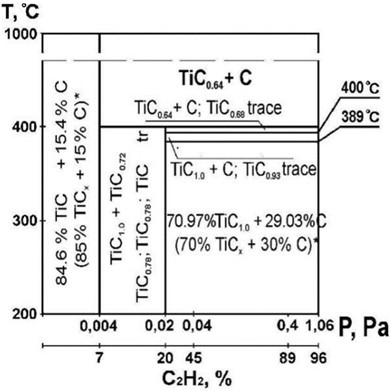
Fig. 1 shows the calculated phase stability regions of TiC-based coatings as a function of acetylene pressure and substrate temperature under ion-plasma deposition conditions. The diagram was used as a predictive map for identifying the deposition regimes corresponding to stoichiometric and non-stoichiometric titanium carbide phases, as well as to free-carbon-containing regions. Therefore, the figure serves as the basis for interpreting the experimentally measured coating compositions discussed below.
To verify the predictive capability of the diagram, the calculated phase relations were compared with experimentally measured coating compositions obtained under two representative deposition conditions. For coatings deposited on R6M5K5 steel substrates at an acetylene pressure of 1.1 Pa, Auger electron spectroscopy indicated approximately 33 at.% TiC and 67 at.% free carbon, which corresponds to about 70 wt.% TiC and 30 wt.% carbon. These values are consistent with the calculated phase equilibria for the given deposition conditions [15].
At a lower acetylene pressure of 0.004 Pa, the coating composition changed to approximately 50 at.% TiC and 50 at.% free carbon, corresponding to about 83 wt.% TiC and 17 wt.% carbon. This result also showed good agreement with the calculated p-T-x diagram and confirms the sensitivity of phase formation to the acetylene pressure.
Auger electron spectroscopy revealed substantial variations in the carbon-to-titanium atomic ratio depending on the deposition regime, indicating the formation of non-stoichiometric titanium carbide phases TiCx. Both titanium-rich and carbon-rich TiCx compositions were identified under different reactive gas pressures, confirming that the coatings do not remain strictly stoichiometric over the investigated technological range.
Photoelectron spectroscopy showed systematic changes in the relative intensity of titanium carbide- and carbon-related spectral features with changing acetylene pressure. At lower pressure, carbon-related peaks were less pronounced, indicating preferential formation of titanium-rich TiCx phases. At higher acetylene pressure, the contribution of carbon-related features increased, which indicates enhanced incorporation of free carbon and carbon-rich structural components.
Ion etching experiments additionally revealed depth-dependent changes in spectral characteristics. The near-surface region exhibited a stronger contribution from carbon-related features, whereas deeper layers showed more pronounced TiC-related peaks. This behavior confirms that the coating structure is compositionally non-uniform through the thickness and contains both carbide-rich and carbon-rich regions.
Thermodynamic analysis of the free energy of formation of titanium, zirconium, and hafnium carbides showed that increasing the stoichiometric coefficient from 0.6 to 1.0 leads to a substantial increase in the magnitude of the free energy of formation. For titanium carbide, the free energy of formation increased from approximately 165.351 to 211.229 kJ/mol. This result indicates higher thermodynamic stability of stoichiometric TiC and supports the conclusion that deviations from stoichiometry play an important role in determining coating structure and expected functional behavior.
4. Discussion
The good agreement between the thermodynamically constructed refined p-T-x diagram and the experimentally determined phase composition confirms that the proposed approach is suitable for predicting phase formation in ion-plasma titanium carbide-based coatings. This result is important because it shows that thermodynamic modeling can be used not only for interpretation of experimental observations, but also for the selection of deposition conditions that provide the required coating composition [10], [15].
The observed dependence of phase composition on acetylene pressure reflects the balance between titanium flux and carbon supply during deposition. At lower acetylene pressure, the reduced carbon activity favors the formation of titanium-rich and carbon-deficient TiCx phases. In contrast, higher acetylene pressure promotes additional carbon incorporation, which leads to the appearance of free carbon and carbon-rich structural components in the coating. This trend is consistent with the experimentally observed change in the carbon-to-titanium ratio and confirms the strong effect of deposition conditions on coating formation.
The results also indicate that the coating structure is not strictly uniform. The photoelectron spectra and ion-etching data suggest that carbon-related features are more pronounced in the near-surface region, whereas deeper layers contain a stronger TiC-related contribution. Such structural non-uniformity is characteristic of non-equilibrium ion-plasma deposition processes and should be taken into account when selecting technological regimes for practical applications.
From the viewpoint of materials engineering, controlled non-stoichiometry is an important factor for tailoring coating performance. The wide homogeneity range of titanium carbide makes it possible to obtain coatings with different phase compositions depending on the required application. Carbon-deficient TiCx phases may improve compatibility with metallic substrates, whereas compositions closer to stoichiometric TiC are associated with higher thermodynamic stability and are expected to provide better hardness and load-bearing capability [8], [9], [15]. This interpretation is also consistent with previous observations that the phase composition of carbide-based coatings has a direct influence on their physical and mechanical behavior [22].
The presence of carbon-rich components is also important from a tribological viewpoint, since TiC/a-C type coatings may exhibit different wear behavior depending on the carbide-to-carbon balance [25]. The practical relevance of such control is supported by previous studies showing that titanium carbide coatings can provide significant anti-wear benefits in engineering applications [26].
The increase in the magnitude of the free energy of formation with increasing stoichiometric coefficient additionally supports the conclusion that stoichiometric titanium carbide is thermodynamically more stable than carbon-deficient compositions. Therefore, the combination of thermodynamic calculations with X-ray and electron-spectroscopic analysis provides a useful basis for optimizing deposition parameters and designing TiC-based coatings for cutting and technological tools.
Overall, the present results demonstrate that the phase composition and structural features of ion-plasma titanium carbide-based coatings can be purposefully controlled by adjusting the reactive gas pressure and substrate temperature. This provides a practical route for selecting deposition regimes that balance carbide formation, carbon incorporation, and expected coating performance in engineering applications.
5. Conclusions
The combined thermodynamic and experimental analysis showed that the phase composition of ion-plasma TiC-based coatings is strongly controlled by deposition conditions. At an acetylene pressure of 1.1 Pa, the coating contained about 33 at.% TiC and 67 at.% free carbon, whereas at 0.004 Pa the composition shifted to about 50 at.% TiC and 50 at.% free carbon. AES and photoelectron spectroscopy confirmed the formation of both stoichiometric and non-stoichiometric TiCₓ phases together with free and diamond-like carbon.
The refined p-T-x diagram for the Ti-C system was consistent with the experimental observations and can therefore be used for selecting deposition regimes that provide the required TiCx composition. Thermodynamic calculations also showed that increasing the stoichiometric coefficient from 0.6 to 1.0 increases the magnitude of the free energy of formation of titanium carbide from about 165.351 to 211.229 kJ/mol, indicating higher stability of stoichiometric TiC.
These results demonstrate that controlled adjustment of acetylene pressure and substrate temperature can be used to tailor the structure and expected functional performance of TiC-based wear-resistant coatings for cutting and technological tools.
References
-
D. K. Devarajan, B. Rangasamy, and K. K. Amirtharaj Mosas, “State-of-the-art developments in advanced hard ceramic coatings using pvd techniques for high-temperature tribological applications,” Ceramics, Vol. 6, No. 1, pp. 301–329, Jan. 2023, https://doi.org/10.3390/ceramics6010019
-
Y. Deng, W. Chen, B. Li, C. Wang, T. Kuang, and Y. Li, “Physical vapor deposition technology for coated cutting tools: A review,” Ceramics International, Vol. 46, No. 11, pp. 18373–18390, Aug. 2020, https://doi.org/10.1016/j.ceramint.2020.04.168
-
N. Ariharan, C. G. Sriram, N. Radhika, S. Aswin, and S. Haridas, “A comprehensive review of vapour deposited coatings for cutting tools: properties and recent advances,” Transactions of the IMF, Vol. 100, No. 5, pp. 262–275, Sep. 2022, https://doi.org/10.1080/00202967.2022.2037343
-
K. P. Shaha, Y. T. Pei, D. Martinez-Martinez, J. C. Sanchez-Lopez, and J. T. M. de Hosson, “Effect of process parameters on mechanical and tribological performance of pulsed-DC sputtered TiC/a-C:H nanocomposite films,” Surface and Coatings Technology, Vol. 205, No. 7, pp. 2633–2642, Dec. 2010, https://doi.org/10.1016/j.surfcoat.2010.10.020
-
S. Zhang, “Titanium carbonitride-based cermets: processes and properties,” Materials Science and Engineering A, Vol. 163, No. 1, pp. 141–148, 1993, https://doi.org/10.1016/0921-5093(93)90588-6
-
N. Kumar et al., “Microstructure and phase composition dependent tribological properties of TiC/a-C nanocomposite thin films,” Surface and Coatings Technology, Vol. 258, pp. 557–565, Nov. 2014, https://doi.org/10.1016/j.surfcoat.2014.08.038
-
N. Schalk, M. Tkadletz, and C. Mitterer, “Hard coatings for cutting applications: Physical vs. chemical vapor deposition and future challenges for the coatings community,” Surface and Coatings Technology, Vol. 429, p. 127949, Jan. 2022, https://doi.org/10.1016/j.surfcoat.2021.127949
-
N. Oláh, Z. Fogarassy, A. Sulyok, J. Szívós, T. Csanádi, and K. Balázsi, “Ceramic TiC/a:C protective nanocomposite coatings: Structure and composition versus mechanical properties and tribology,” Ceramics International, Vol. 42, No. 10, pp. 12215–12220, Aug. 2016, https://doi.org/10.1016/j.ceramint.2016.04.164
-
K. Frisk, “A revised thermodynamic description of the Ti-C system,” Calphad, Vol. 27, No. 4, pp. 367–373, Dec. 2003, https://doi.org/10.1016/j.calphad.2004.01.004
-
G. B. Sinyarev, N. A. Vatolin, B. G. Trusov, and G. K. Moiseev, Use of computers for thermodynamic calculations of metallurgical processes. (in Russian), Moscow, Russia: Nauka, 1982.
-
L. N. Rozanov, Vacuum Technique. (in Russian), Moscow, Russia: Vysshaya Shkola, 1990.
-
R. K. Saidakhmedov, Ion-plasma coatings based on transition metal nitrides and carbides with controlled stoichiometry. (in Russian), Tashkent, Uzbekistan: Fan, 2005.
-
G. P. Fetisov, M. G. Karpman, and R. K. Saidakhmedov, Ion-plasma non-stoichiometric coatings based on transition metal nitrides and carbides. (in Russian), Moscow, Russia: MAI-PRINT, 2011.
-
L. Holland, Vacuum deposition of thin films. (in Russian), Moscow-Leningrad: Gosenergoizdat, 1963.
-
A. G. Turchanin and M. A. Turchanin, Thermodynamics of Refractory Carbides and Carbonitrides. (in Russian), Moscow, Russia: Metallurgiya, 1991.
-
J. F. Watts and J. Wolstenholme, An Introduction to Surface Analysis by XPS and AES. Chichester, UK: Wiley, 2019, https://doi.org/10.1002/9781119417651
-
D. P. Woodruff, Modern Techniques of Surface Science. Cambridge, UK: Cambridge University Press, 2016, https://doi.org/10.1017/cbo9781139149716
-
J. C. Vickerman, Surface Analysis: the Principal Techniques. Chichester, UK: John Wiley & Sons, 1997.
-
R. K. Saidakhmedov, K. K. Kadirbekova, and G. R. Saidakhmedova, “Composition and structure of the ion-plasma coating obtained based on titanium carbide,” (in Russian), in 23th International Conference Ion – Surface Interactions, pp. 128–131, Aug. 2017.
-
R. K. Saidakhmedov, K. K. Kadirbekova, and G. R. Saidakhmedova, “Composition and properties of ion-plasma coatings based on titanium carbide,” (in Russian), in Republican Scientific and Technical Conference Modern Technologies for the Production and Processing of Composite and Nanocomposite Materials, May 2017.
-
H. Larhlimi, A. Ghailane, M. Makha, and J. Alami, “Magnetron sputtered titanium carbide-based coatings: A review of science and technology,” Vacuum, Vol. 197, p. 110853, Mar. 2022, https://doi.org/10.1016/j.vacuum.2021.110853
-
Y. Hu, L. Li, X. Cai, Q. Chen, and P. K. Chu, “Mechanical and tribological properties of TiC/amorphous hydrogenated carbon composite coatings fabricated by DC magnetron sputtering with and without sample bias,” Diamond and Related Materials, Vol. 16, No. 1, pp. 181–186, Jan. 2007, https://doi.org/10.1016/j.diamond.2006.05.010
-
A. Z. Ait Djafer, N. Saoula, N. Madaoui, and A. Zerizer, “Deposition and characterization of titanium carbide thin films by magnetron sputtering using Ti and TiC targets,” Applied Surface Science, Vol. 312, pp. 57–62, Sep. 2014, https://doi.org/10.1016/j.apsusc.2014.05.084
-
Y.-S. Fang, T. H. Do, K.-A. Chiu, W.-C. Chen, and L. Chang, “Reactive sputtering deposition of epitaxial tic film on si(100) substrate,” Coatings, Vol. 10, No. 7, p. 647, Jul. 2020, https://doi.org/10.3390/coatings10070647
-
J. Schneider, S. Ulrich, J. Patscheider, and M. Stueber, “Wear study of a magnetron-sputtered tic/a-c nanocomposite coating under media-lubricated oscillating sliding conditions,” Coatings, Vol. 12, No. 4, p. 446, Mar. 2022, https://doi.org/10.3390/coatings12040446
-
J. Zhang et al., “Anti-wear titanium carbide coating on low-carbon steel by thermo-reactive diffusion,” Surface and Coatings Technology, Vol. 364, pp. 265–272, Apr. 2019, https://doi.org/10.1016/j.surfcoat.2019.02.085
About this article

The authors have not disclosed any funding.
The datasets generated during and/or analyzed during the current study are available from the corresponding author on reasonable request.
The authors declare that they have no conflict of interest.

