Abstract
Optimization of technological processes through mathematical modeling reduces the number of experimental studies and leads to improved technological efficiency. In this paper, based on the results of modifying aluminum-silicon system alloys with tantalum oxide, the effect on one of their mechanical properties – impact toughness – was optimized using mathematical modeling. The samples were cast in foundry furnaces, and experimental investigations were carried out under laboratory conditions. The impact toughness of the samples was determined using a JBW-300 pendulum impact testing machine. Based on the obtained results, a relationship graph was developed showing the dependence between the amount of tantalum oxide used for modification and the impact toughness of the aluminum-silicon alloy under study. Using this experimentally obtained graph, the results were mathematically modeled. It was found that the presence of tantalum particles in the range of 0.3-0.5 % in the aluminum-silicon alloy composition has a positive effect on its impact toughness. At the end of the paper, the authors’ conclusions are presented based on the conducted experiments and the results obtained.
Highlights
- The effect of nickel content on hardness of malleable cast iron was investigated.
- A mathematical model describing hardness variation was developed.
- A correlation between nickel concentration and hardness was established.
- Optimal nickel content for maximum hardness was determined.
- The model shows good agreement with experimental results.
1. Introduction
The development of the mechanical engineering industry requires machine components to have a long service life and to be manufactured in an economically efficient manner. For this purpose, optimizing technological processes through mathematical modeling is considered one of the most effective approaches in component manufacturing. The production of machine-building components by casting plays an important role in the mechanical engineering industry. In recent years, the manufacture of machine components from aluminum alloys has been increasing year by year. This is due to the favorable mechanical and service properties of aluminum alloys, as well as their good castability [1-2]. In addition, the distinctive characteristics of these alloys, such as light weight combined with high strength, further increase their demand [3-5]. One of the methods for improving the mechanical properties of aluminum alloys is the technological process of modification using various modifiers [6]. At present, scientific research aimed at improving the properties of aluminum alloys – particularly cast aluminum alloys – and extending the service life of manufactured components is being actively conducted by researchers worldwide [7-10]. In addition, experimental studies have been carried out by researchers to investigate the effect of tantalum on aluminum alloys.
In particular, Maria Elizabetta Pammer and co-authors, in their scientific work entitled “The Effect of Tantalum on the Processing of Al10SiMg Alloys”, investigated the influence of Ta on Al10SiMg alloys based on the results of laboratory experiments. In these experiments, tantalum was added as a modifying element to Al10SiMg alloys at temperatures ranging from 660 °C to 700 °C [11]. At the conclusion of the experiments, it was observed that the addition of tantalum to Al10SiMg alloys at a temperature of 668 °C with a holding time of 60 minutes provided the most effective results.
Yu. K. Yezhovskiy and A. I. Klusevich, in their scientific work entitled “Dielectric Multilayer Nanostructures Based on Tantalum and Aluminum Oxides”, examined the formation process and certain dielectric properties of multilayer nanostructures obtained on the basis of tantalum and aluminum oxides. Their experimental results showed that the dielectric permittivity of such structures is almost linearly dependent on the indicated composition, and that their conductivity depends on the ratio of the thicknesses of each layer, which was experimentally confirmed [12].
Sam McCartney and co-authors conducted a scientific study entitled “Formation of Ta3N5 Films by Reactive Sputtering of Aluminum with Tantalum Oxide”. In their research, aluminum was alloyed with tantalum oxide using a reactive sputtering method. However, they noted that increasing the aluminum ratio in the deposited thin Ta-N-Al layer leads to positive reactions in the thin film at high values of the Ta2Al intermetallic compound, resulting in a decrease in electrical resistance. From the researchers’ work, it can be concluded that the developed Ta-N-Al thin films have shown effective performance when applied in resistor devices [13].
However, despite the studies discussed above, the effect of tantalum on other mechanical properties of aluminum alloys – particularly impact toughness – has not been sufficiently investigated. In this paper, the influence of tantalum oxide on the impact toughness of an aluminum-silicon alloy is analyzed and optimized through mathematical modeling.
2. Materials and methods
Impact toughness is the ability of a metal or alloy to absorb mechanical energy during deformation and fracture under impact loading. It is usually evaluated by the work required to deform and fracture a prismatic specimen with a unilateral transverse notch during an impact bending test, which is denoted by Impact toughness is one of the most important strength properties of a metal. A sharp decrease in impact toughness with decreasing test temperature defines the material’s cold brittleness (ductile-brittle transition) limit; reliable operation of the material is possible only at temperatures above this limit [14].
A widely used method for determining impact toughness is testing specimens with a small fatigue crack (approximately 1.5 mm in length) extending from the notch root. In this case, the specific fracture energy, usually denoted by , is evaluated. Compared with , is a more sensitive parameter for assessing the brittleness of high-strength materials. The test determines the material’s resistance to impact, which is defined as the work expended to fracture the specimen under impact divided by the cross-sectional area at the notch.
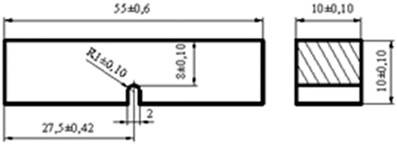
Aluminum-silicon system specimens with various compositions cast in a foundry furnace were prepared in accordance with the state standard, and U-notched specimens were selected for impact toughness testing. The specimens were manufactured by machining in accordance with the drawing (Fig. 1).
Fig. 1Schematic drawing of the specimens
The experiments were carried out at room temperature using a JBW-300 pendulum impact testing machine, which provides a nominal pendulum energy of up to 300 J. The specimens were placed on the supports of the impact testing device with the notch oriented in the opposite direction to the impact. Using a template, the specimens were positioned asymmetrically relative to the supports.
The impact work was determined automatically, and the results were displayed on the monitor after each test. The main measured parameter was the absorbed energy (), which represents the energy of the impact required to fracture the specimens, adjusted to account for frictional losses.
3. Results and discussion
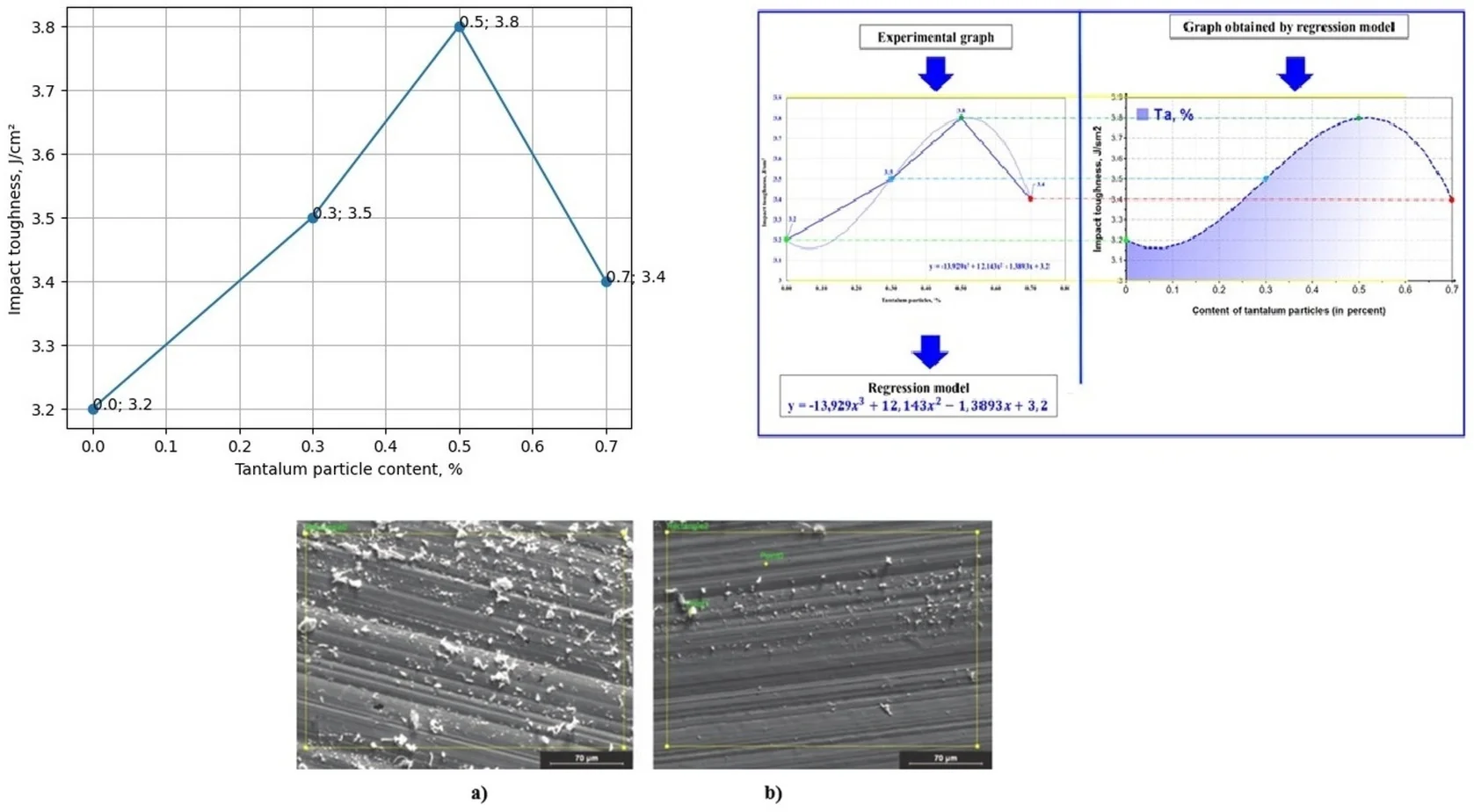
The obtained results are presented in Table 1. Based on the data in Table 1, a relationship graph showing the effect of tantalum content in the alloy on impact toughness was developed (Fig. 2). The results confirm that the investigated aluminum alloys possess sufficient plasticity and impact toughness, which makes them suitable for application in components operating under dynamic loads. Increasing the tantalum content in the alloy beyond a certain level does not lead to a further increase in impact toughness; on the contrary, it results in a decrease.
Table 1Impact toughness results
No. | Type of specimen | Test temperature | Impact toughness, J/cm2 |
1 | U-notched specimen, 2 mm | 20±3 | 3.2 |
2 | U-notched specimen, 2 mm | 20±3 | 3.5 |
3 | U-notched specimen, 2 mm | 20±3 | 3.8 |
4 | U-notched specimen, 2 mm | 20±3 | 3.4 |
Fig. 2Relationship graph
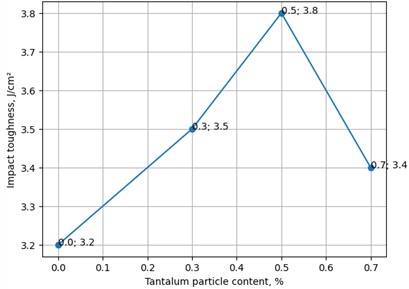
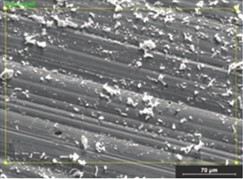
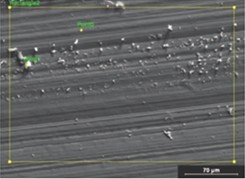
Fig. 3Changes in the microstructure of the samples: a) sample without tantalum oxide addition; b) sample with tantalum oxide addition
a)
b)
Fig. 3(a) shows the microstructure of the aluminum alloy without the addition of tantalum oxide, where a non-uniform distribution of phases and relatively coarse particles can be observed. In some regions, agglomeration of intermetallic or silicon phases is present, which may lead to the formation of local stress concentrations within the structure. In contrast, Fig. 3(b) presents the microstructure of the sample with tantalum oxide addition, where the particles are significantly finer and more uniformly distributed. The introduction of tantalum oxide increases the number of crystallization centers, resulting in grain refinement and improved structural uniformity, which positively affects the mechanical properties of the alloy, particularly its impact toughness.
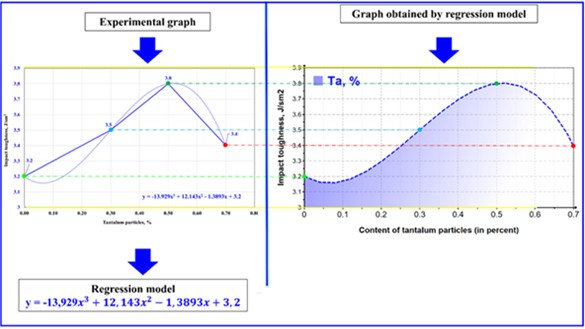
In the next stage, a mathematical model is developed to describe the dependence of the impact toughness of the Al-Si alloy on the percentage content of tantalum as a result of modification with tantalum oxide. For this purpose, the experimental results obtained are used (Fig. 2). Four experimental data points, namely (0, 3.2), (0.3, 3.5), (0.5, 3.8), and (0.7, 3.4), are taken as input values, and based on these points, the initial form of a cubic polynomial function is constructed as shown in Eq. (1) [15]:
where – denotes the basic Lagrange polynomials, and – represents the -coordinates of the data points.
At the initial stage of the calculation, the polynomials are determined. Each is defined by the following formula:
To construct a mathematical model of this graph obtained from the experimental studies, the initial form of the cubic polynomial function for the four measured data points is given as in Eq. (1). Each is defined by the following Eq. (2) [17]. In the present case, for the experimentally determined points 0, 0.3, 0.5, 0.7, the following expressions are obtained:
Using the expressions obtained above, we can write the function , which can be expressed as follows. Thus, the following data points have been obtained based on the experimental studies: 3.2; 3.5; 3.8; 3.4.
In this case, we obtain the following expression .
Now, all terms are combined as follows, and using the obtained results, a mathematical model of the dependence of the impact toughness of the aluminum-silicon alloy on the percentage content of the tantalum oxide modifier during modification is developed:
The graph of the developed function was also generated using the PTC Mathcad software. To verify the reliability of the obtained mathematical model, the values of the points determined from the experimental studies were entered into the program and tested. By comparing the graph obtained from the experimental data with the graph generated using the developed mathematical model, it was found that the similarity of the mathematical model is 96 % (Fig. 4).
Fig. 4Cast samples. Scheme for developing the mathematical model based on experimental results and the corresponding graphs
4. Conclusions
Based on the conducted research, the following conclusions can be drawn:
1) Modification of the aluminum-silicon alloy with tantalum oxide made it possible to increase its impact toughness by 10-12 %. In this process, tantalum should be introduced into the molten aluminum-silicon alloy in such a way that its content in the alloy composition remains within the range of 0.3-0.5 %.
2) Using the Eq. (3) developed through mathematical modeling, the effect of tantalum on the impact toughness of the aluminum–silicon alloy can be determined by calculation, without the need for additional experimental studies.
3) The differences between the graphs obtained from laboratory experiments and those developed through mathematical modeling were found to be within the range of 4-5 %, which confirms the reliability of the conducted research.
References
-
J. Aljashaami, F. Husham, S. W. Khafaji, M. S. Ahmed, and M. A. Al-Shujairi, “The effect of silver on the Orowan strengthening of Al-Mg-Ag alloys after thermo-mechanical processing,” International Journal of Mechatronics and Applied Mechanics, Vol. 1, No. 21, pp. 239–249, Sep. 2025, https://doi.org/10.17683/ijomam/issue21.23
-
H. Bo-Qing, W. Xiao-Ming, Z. Tang, Z. Zong-Yuan, W. Xing, and C. Xiao-Long, “Transmittance and refractive index of the lanthanum strontium aluminium tantalum oxide crystal,” Chinese Physics Letters, Vol. 18, No. 2, pp. 278–279, Feb. 2001, https://doi.org/10.1088/0256-307x/18/2/342
-
H. Liu et al., “Effects of la addition on the microstructure, thermal conductivity and mechanical properties of Mg-3Al-0.3Mn alloys,” Materials, Vol. 15, No. 3, p. 1078, Jan. 2022, https://doi.org/10.3390/ma15031078
-
S. Macartney, R. Wuhrer, L. George, and L. R. Sheppard, “Preparation of aluminium doped Ta3N5 films via nitridation of sputtered tantalum oxide films,” Materials Chemistry and Physics, Vol. 287, p. 126110, Aug. 2022, https://doi.org/10.1016/j.matchemphys.2022.126110
-
I. N. Matsyuk, E. Shlyakhov, and N. V. Zyma, “Study of planar mechanisms kinetostatics using the theory of complex numbers with MathCAD PTC,” Mechanics, Materials Science and Engineering, Vol. 8, 2017.
-
M. Pammer, J. Pölzl, and J. Li, “Silicon poisoning and effects of tantalum on AlSi alloys,” Metals, Vol. 13, No. 12, p. 1917, Nov. 2023, https://doi.org/10.3390/met13121917
-
T. Sarvar, T. Nodir, U. Mardonov, B. Saydumarov, D. Kulmuradov, and M. Boltaeva, “Effects of germanium (Ge) on hardness and microstructure of Al-Mg, Al-Cu, Al-Mn system alloys,” International Journal of Mechatronics and Applied Mechanics, Vol. 2024, No. 16, pp. 179–184, Jun. 2024, https://doi.org/10.17683/ijomam/issue16.21
-
C. Song, D. Hou, J. Wang, and J. Zhu, “Current situation and development trend of die casting aluminum alloy industry,” Special Casting and Nonferrous Alloys, Vol. 44, No. 6, 2024, https://doi.org/10.15980/j.tzzz.2024.06.021
-
S. Tursunbaev, N. Turakhodjaev, L. Zhang, Z. Wang, U. Mardonov, and M. Saidova, “Mechanical properties and evolution of the microstructure of Al-Cu-Mg system alloys under the influence of alloying elements (GE AND SI),” International Journal of Mechatronics and Applied Mechanics, Vol. 2024, No. 18, pp. 164–169, Dec. 2024, https://doi.org/10.17683/ijomam/issue18.19
-
S. Tursunbaev, N. Turakhodjaev, S. Mardonakulov, and S. Toshmatova, “Effect of germanium oxide on the properties of aluminum casting details in agricultural machinery,” in BIO Web of Conferences, Vol. 85, p. 01024, Jan. 2024, https://doi.org/10.1051/bioconf/20248501024
-
S. Tursunbaev et al., “Comparison of the effect of germanium (Ge) and germanium-silicon (Ge-Si) combinations on the hardness of aluminum alloy through mathematical modeling,” in International Conference on Optical and Computational Technologies for Measurements and Industrial Applications (OptiComp 2025), p. 34, Sep. 2025, https://doi.org/10.1117/12.3077575
-
A. Turakhujaeva et al., “Mathematical modeling of the effect of the lithium element on the fluidity of Al-Si and Al-Cu alloys,” in International Conference on Reliable Systems Engineering (ICoRSE), Sep. 2025, https://doi.org/10.1007/978-3-032-02508-1_6
-
D. H. Xiao, J. N. Wang, D. Y. Ding, and H. L. Yang, “Effect of rare earth Ce addition on the microstructure and mechanical properties of an Al-Cu-Mg-Ag alloy,” Journal of Alloys and Compounds, Vol. 352, No. 1-2, pp. 84–88, Mar. 2003, https://doi.org/10.1016/s0925-8388(02)01162-3
-
Z. Xu, S. Wang, H. Wang, H. Song, S. Li, and X. Chen, “Effect of cooling rate on microstructure and properties of twin-roll casting 6061 aluminum alloy sheet,” Metals, Vol. 10, No. 9, p. 1168, Aug. 2020, https://doi.org/10.3390/met10091168
-
J. Yang, B. Liu, D. Shu, Q. Yang, and T. Hu, “Vehicle giga-casting Al alloys technologies, applications, and beyond,” Journal of Alloys and Compounds, Vol. 1013, p. 178552, Jan. 2025, https://doi.org/10.1016/j.jallcom.2025.178552
-
L. J. Yang, “The effect of casting temperature on the properties of squeeze cast aluminium and zinc alloys,” Journal of Materials Processing Technology, Vol. 140, No. 1-3, pp. 391–396, Sep. 2003, https://doi.org/10.1016/s0924-0136(03)00763-5
-
Y. K. Ezhovskii and A. I. Klusevich, “Dielectric multilayer nanostructures of tantalum and aluminum oxides,” Physics of the Solid State, Vol. 45, No. 11, pp. 2203–2208, Nov. 2003, https://doi.org/10.1134/1.1626763
About this article

The authors have not disclosed any funding.
The datasets generated during and/or analyzed during the current study are available from the corresponding author on reasonable request.
The authors declare that they have no conflict of interest.

