Abstract
This article presents the results of experimental studies aimed at determining the laws of structure formation of a composite binder for self-compacting basalt fiber concrete. The conducted scientific research revealed that after mixing the composite binder – consisting of Portland cement, zeolitic rock, and quartz sand – with water, the process of structure formation slightly slows down at the initial stage; however, subsequently, the formation of new hydration products accelerates sharply. In addition, it was shown that the induction period of setting of the cement–composite mixture increases with a decrease in the clinker component content in the composite binder. At the same time, it was established that the activity of the cement-composite stone and the basalt fiber concrete based on it persists for a long time at various ages, including early ages, and that their structure intensively gains strength.
Highlights
- The study develops an optimized composite binder composition for self-compacting basalt fiber concrete using local raw materials, including Portland cement, Beltau zeolitic rock, and Maisky quartz sand.
- Physicochemical analyses (XRD, DTA, and SEM) reveal that while the composite binder slightly delays initial structure formation due to clinker dilution, it subsequently accelerates the formation of new hydration products.
- The active silica- and alumina-containing microfillers undergo pozzolanic reactions, successfully binding weak portlandite (Ca(OH)_2) into stable, strength-providing, low-basic calcium hydrosilicates (C-S-H) and calcium hydroaluminates (CAH) phases.
- Microstructural examinations confirm that the modified cement stone achieves a highly dense matrix featuring a well-defined system of needle- and plate-like crystallohydrates that effectively fill the pore structure.
- Consequently, the optimized self-compacting concrete demonstrates intensive strength gain, reaching a compressive strength of 67.4 MPa at 28 days, which exceeds the plain cement control composition by approximately 18%
1. Introduction
In recent years, the rapid development of science and technology has significantly influenced modern construction practices, requiring the creation of new types of concrete with enhanced performance characteristics capable of meeting high operational demands. As a result of extensive research worldwide, various composite materials known as new-generation concretes (NGC) have been developed [1-6].
One of the key modern requirements for concrete is the reduction of construction time while ensuring rapid achievement of design strength. In 1990, Hajime Okamura proposed a solution based on advanced polyacrylate- and polycarboxylate-based superplasticizers, enabling the production of concrete with low water demand and high flowability. This material became known as Self-Compacting Concrete (SCC) [7], [8].
The main feature of SCC is its ability to compact under its own weight without mechanical vibration. Due to these advantages, SCC has been widely adopted, first in precast concrete production and later in cast-in-place construction.
Research on the structure and properties of SCC continues to develop intensively. Notable contributions include studies conducted at the Faculty of Civil Engineering of the Berlin University of Technology [9, 10]. The growing number of publications in European journals confirms the sustained scientific interest in SCC [11-15].
In the Republic of Uzbekistan, SCC has also begun to be implemented; however, its application remains limited due to insufficient investigation of technologies based on local raw materials and the lack of appropriate regulatory documentation.
To determine the laws of structure formation of the newly developed self-compacting basalt fiber concrete composition, the authors of the composite carried out a comprehensive and detailed investigation of the characteristics of the modified cement stone forming its microstructure.
Unlike our previous publications devoted mainly to the mechanical performance of basalt fiber reinforced concretes, the present research focuses on the physicochemical laws of structure formation in a self-compacting basalt fiber concrete based on a composite binder containing zeolitic rock and finely ground quartz sand.
The scientific novelty of the work consists in:
– Establishing the kinetic features of hydration and structure formation of a clinker-reduced composite binder.
– Identifying the transformation mechanism from primary high-basic CSH and Ca(OH)2 to secondary low-basic CSH(I) and CAH phases.
– Correlating XRD, DTA, and SEM results with strength development mechanisms.
– Determining the optimal volumetric concentration of silica- and alumina-containing microfillers considering their pozzolanic activity.
This approach allows a deeper understanding of hydration mechanisms in self-compacting basalt fiber concrete produced using local raw materials.
2. Research methods
To study the structure of the modified cement stone, a number of physicochemical analysis methods were employed. In particular, X-ray phase analysis, differential thermal analysis, and electron microscopic analysis methods were used.
In the experimental studies, the following initial materials were adopted: Portland cement CEM I 32.5 N produced by the Akhangaron Cement Plant as the cement binder; zeolitic rock from the Beltau deposit (Navoi region) as a mineral microfiller included in the composite cementitious binder; quartz sand from the Maisky deposit (Tashkent region) as another mineral microfiller included in the composite cementitious binder; a polycarboxylate-based superplasticizer Master Glenium 27 produced by BASF (Germany) as a chemical admixture; and basalt fiber produced by LLC “MEGA INVEST INDUSTRIAL” (Jizzakh region), with a diameter of 13-17 µcm and a length of 6-12 mm, used as a dispersed fibrous microfiller.
The self-compacting basalt fiber concrete mixture was prepared using the developed composite binder. The mixture proportions per cubic meter were as follows:
1) Composite binder – 480 kg/m3.
2) Fine aggregate – 820 kg/m3.
3) Coarse aggregate – 780 kg/m3.
4) Water-to-binder ratio (W/B) – 0.34.
5) Superplasticizer Master Glenium 27 – 0.95 % by weight of binder.
6) Basalt fiber – 1.2 % by volume.
Cube specimens of 100×100×100 mm were cast for compressive strength testing. For each test age, at least three specimens were prepared, and the average value was reported. Standard deviation did not exceed 5 %.
Specimens were cured under standard conditions at a temperature of 20±2 °C and relative humidity of 95 % until the testing age (7, 28, and 90 days).
Compressive strength tests were performed in accordance with standard procedures. Microstructural analysis was carried out at 28 days of curing.
3. Research results
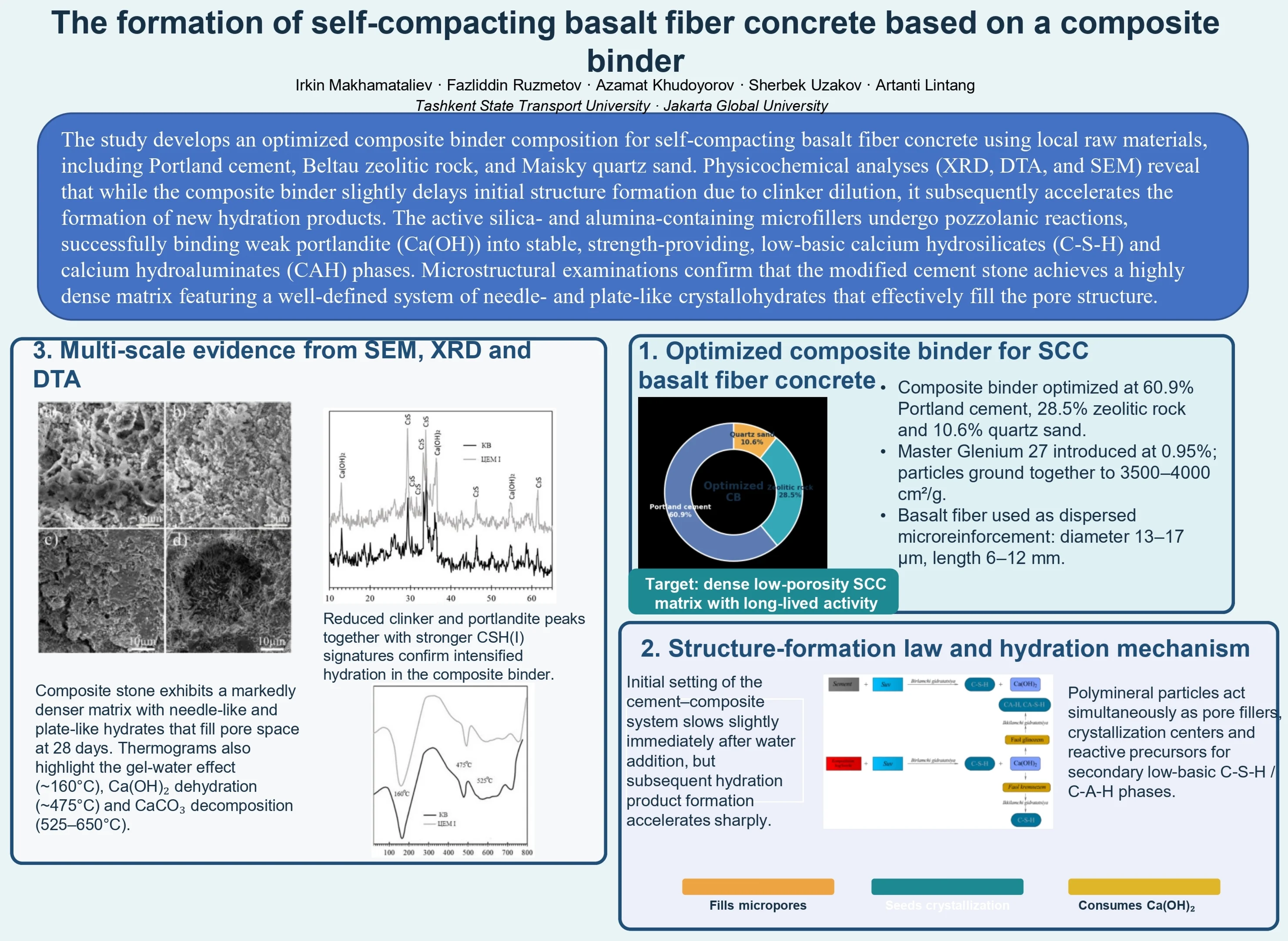
The microstructural analysis showed that the structure of the cement stone obtained from a cement binder without additives is characterized by a loosely crystallized matrix composed mainly of X-ray amorphous newly formed products (Fig. 1(a)). Against this background, hexagonal plate-like crystals of portlandite are clearly observed.
In contrast, the structure of the stone produced on the basis of the developed composite binder is distinguished by a denser and more compact arrangement, in which a well-defined system of needle-shaped and plate-like newly formed products is formed (Fig. 2(b)).
Fig. 1Microstructure of newly formed products (28 days): a), c) plain cement stone; b), d) cement stone based on the composite binder (CB). Original micrographs obtained by the authors at the Tashkent State Transport University laboratory, 2025
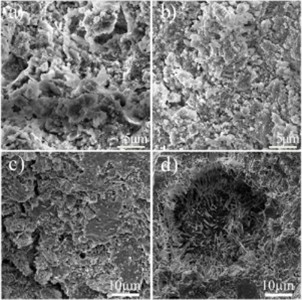
Particles of the polymineral binder perform multiple functions in the formation of the cement-composite stone structure. They fill micropores and voids, thereby densifying the matrix and increasing strength; act as nucleation centers for crystallization; and participate in pozzolanic reactions leading to the formation of secondary low-basic calcium hydrosilicates instead of primary high-basic hydrosilicates and portlandite. These transformations are confirmed by the X-ray phase analysis results presented in Fig. 2.
Fig. 2Diffractograms of plain cement stone and cement stone based on the composite binder (CB). Original micrographs obtained by the authors at the Tashkent State Transport University laboratory, 2025
A decrease in the intensity of peaks corresponding to clinker minerals is observed in these diffractograms, in particular: for alite at / = 3.04, 2.97, 2.78, 2.74, 2.61, 2.18, 1.77 Å, and for belite at / = 2.89, 2.67, 2.72, 2.76, 2.75, 2.78, 1.77 Å. This indicates that the use of the composite binder (CB) leads to an intensification of the hydration processes. In addition, the CB also causes a decrease in the intensity of peaks corresponding to portlandite at / = 4.93, 2.63, 1.93 Å. Here, d is the interplanar spacing in Å (10⁻10 m), and n is the order of reflection (integer numbers 1, 2, 3, …, ). For both compositions, the presence of residual quartz is characteristic (almost identical), as well as the formation of calcium hydrosilicates; however, in the developed composition, the peaks of CSH(I) are more pronounced, whereas in the control composition, the peaks of CSH(II) are more distinct.
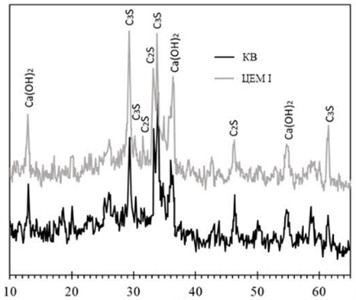
The differential thermal analysis (DTA) of plain cement stone and cement stone based on the composite binder revealed the presence of three main endothermic effects on the thermograms (Fig. 3).
Fig. 3Thermograms of plain cement stone and cement stone based on the composite binder (CB)
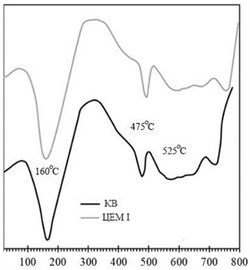
The first effect (at a temperature of approximately 160 °C) is associated with the loss of adsorbed water from gel-like hydration products. In the thermogram of cement stone based on the composite binder, the reduction in the area under this effect is explained by a decrease in the amount of gel-like newly formed products due to their transition to a more crystalline state. The second effect (at a temperature of approximately 475 °C) corresponds to the dehydration of calcium hydroxide. An increase in the area under this peak in the thermogram of plain cement stone indicates a higher content of portlandite in its composition. The third effect (at a temperature range of 525-650 °C) is associated with the decomposition of CaCO3.
The comparative analysis provided by Fig. 1 and Fig. 2 serves as a multi-scale validation of the composite binder’s effectiveness. While Fig. 1 (SEM) visually demonstrates a denser microstructure where hydration products effectively fill the capillary pores, Fig. 2 (XRD) provides quantitative evidence of the pozzolanic reaction. The reduction in portlandite peaks confirms that the active mineral additives transform weak calcium hydroxide into stable, strength-providing C-S-H phases. This structural transformation is the fundamental reason why the developed basalt fiber concrete exhibits superior durability compared to the control group.
4. Discussion of research results
At the initial stage of setting of the composite cement binder, when the crystallohydrates occupy a small volume, the chemical-mineralogical characteristics and activity of the additives have almost no noticeable effect on the main properties of the binder. However, an acceleration of the hydration processes becomes apparent.
At the second stage of setting, chemical processes become dominant, leading to a modification of the phase composition. The system shifts from primary high-basic CSH and Ca(OH)2 toward more stable secondary low-basic CSH and CAH phases. This transformation depends on the chemical composition and activity of the finely dispersed additives. Densification and strengthening of the cement stone occur when the balance shifts toward increased formation of low-basic CSH(I) and CAH. However, excessive amounts of reactive silica- and alumina-containing microfillers may hinder crystal intergrowth by covering newly formed phases. These results confirm the existence of an optimal volumetric concentration of pozzolanic microfillers in the composite cement binder.
The studies demonstrated that the active silica- and alumina-containing additives in the composite binder (CB) bind portlandite (Ca(OH)2) into secondary low-basic CSH and CAH phases (Fig. 4).
The newly formed products of the hydrated composite binder can be conditionally divided into two groups: primary and secondary. The structure of the primary hydration products exhibits an amorphous phase, i.e., it forms according to a solution-based mechanism within the interstitial pores. In this case, the chemical composition of the hydration products in the pore space depends on the chemical composition of the larger particles of the surrounding binder.
Fig. 4Comparison of the hydration mechanisms of plain cement and the composite binder (CB)
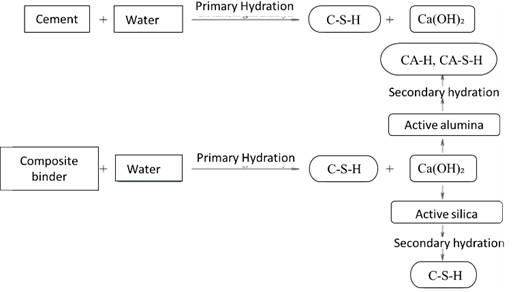
The surface of finely ground quartz microfillers acquires positively charged active centers during mechano-chemical activation, which facilitates the deagglomeration of cement particles in the mixture. This, in turn, enhances the effect of the polycarboxylate superplasticizer on the cement system and reduces particle sedimentation. Studies of the hydration processes in composites containing finely ground quartz sand showed that an increase in the fineness and relative amount of quartz accelerates the formation of calcium hydroxide. This occurs because the highly dispersed quartz particles act as nucleation centers for the crystallization of calcium hydroxide. Finely ground zeolitic rock also belongs to the class of pozzolanic materials, as the reactive silica (SiO2) and alumina (Al2O3) it contains react with portlandite (Ca(OH)2), transforming it into low-basic C-S-H, C-A-H, and C-A-S-H phases. As a result, the microstructure of the hardened cement concrete is improved, becoming denser and exhibiting higher impermeability [10].
When analyzing the morphology of the newly formed products (Fig. 1), the synergistic effect of the mineral composition of the hydration products of the composite binder constituents and the interaction rate of clinker minerals with the aqueous phase becomes clearly apparent. The use of a composite binder with a relatively larger specific surface area intensifies the hydration processes, leading to the formation of new products that further densify the hardened composite, thereby increasing its strength and reducing its permeability.
Analysis of the morphology of the newly formed products in the optimized composite binder reveals that its structure is characterized by high density and a system of needle-like newly formed products that effectively fill the pore structure.
The compressive strength of the composite binder concrete reached:
1) 7 days – 48.6 MPa.
2) 28 days – 67.4 MPa.
3) 90 days – 74.2 MPa.
Compared with plain cement concrete, the 28-day compressive strength increased by approximately 18 %.
XRD analysis indicated a reduction in portlandite peak intensity by approximately 22 % in the composite binder system compared to the control sample, confirming active pozzolanic interaction.
Thermal analysis showed a lower endothermic peak area at 475 °C in the composite binder stone, indicating reduced Ca(OH)2 content and formation of secondary hydration products.
These quantitative results confirm the intensification of secondary structure formation processes.
Despite the positive results, this study has certain limitations. The high concentration of fine mineral additives requires precise superplasticizer dosage, which is sensitive to ambient temperature changes. Furthermore, the long-term durability of this concrete (exceeding 180 days) and its behavior under high-frequency dynamic loads remain to be investigated in future research. Finally, the results are specific to the chemical properties of the local raw materials used (Beltau zeolite).
5. Conclusions
An optimized composite binder composition based on Portland cement was developed with the following proportions: Portland cement – 60.9 %, zeolitic rock – 28.5 %, quartz sand – 10.6 %, and superplasticizer – 0.95 %.
The conducted physicochemical studies allowed establishing the laws of structure formation in self-compacting basalt fiber concrete:
1) At the initial stage of hydration, a slight delay in structure formation occurs due to clinker dilution; however, subsequent pozzolanic reactions significantly accelerate the formation of secondary hydration products.
2) XRD analysis demonstrated a 22 % reduction in portlandite peak intensity, confirming active binding of Ca(OH)2 into low-basic CSH(I) and CAH phases.
3) The microstructure of the composite binder stone is characterized by a dense system of needle-like and plate-like crystallohydrates that effectively fill pore space and reduce porosity.
4) The optimized concrete exhibited compressive strengths of 48.6 MPa (7 days), 67.4 MPa (28 days), and 74.2 MPa (90 days), exceeding the control composition by approximately 18 % at 28 days.
5) The induction period increases with decreasing clinker content, confirming the kinetic influence of mineral additives.
The developed composite binder ensures prolonged activity, intensive strength gain, and improved structural densification. The results confirm the efficiency of using locally available zeolitic rock and quartz sand for producing high-performance self-compacting basalt fiber concrete.
References
-
A. I. Adylkhodzhaeva, I. M. Makhamataliev, U. Z. Turgunbaev, and V. M. Tsoy, Intensive Construction Technologies. (in Russian), Tashkent: Fan va Tekhnologiya, 2016.
-
A. I. Adylkhodzhaev, I. M. Makhamataliev, and V. M. Tsoy, Composite Building Materials. (in Russian), LAMBERT Academic Publishing, 2018.
-
A. I. Adylkhodzhaev, I. M. Makhamataliev, V. M. Tsoy, and K. S. Umarov, Complex-Modified Concretes with Organomineral Additives. (in Russian), Innovatsion Rivozhlanish Nashriyot-Manbaa Uyi, 2020.
-
A. I. Adylkhodzhaev, I. M. Makhamataliev, F. F. Karimova, and I. A. Kadirov, Modern Methods for Studying Building Materials. (in Russian), Tashkent: TSTU, 2023.
-
P. Zhang, K. Wang, Q. Li, and J. Wang, “Fabrication and properties of basalt fiber reinforced self-compacting concrete: A review,” Construction and Building Materials, Vol. 266, p. 120944, 2021.
-
M. Khan, M. Cao, and M. Ali, “Effect of basalt fiber length and content on mechanical properties of high-strength self-compacting concrete.,” Journal of Building Engineering, Vol. 45, p. 103550, 2022.
-
K. K. Kamilov, S. I. Turakhanov, and S. K. Kamilov, “History of self-compacting expanded clay concrete.,” (in Russian), in Proceedings of the International Scientific-Practical Conference on Production of Innovative Building Materials based on Local Raw Materials, pp. 283–290, 2024.
-
Y. Wang and S. Singh, “Development of self-compacting concrete using sustainable composite binders: A state-of-the-art review.,” Sustainability, Vol. 16, No. 2, p. 842, 2024.
-
I. M. Makhamataliev, “Modern trends in improving reinforced concrete structures.,” (in Russian), Vestnik TashIIT, No. 2, pp. 16–18, 2012.
-
I. M. Makhamataliev, “On new generation concretes based on effective mineral additives, fine-grained sands, and hyperplasticizers.,” (in Russian), Vestnik TashIIT, No. 1/2, pp. 24–27, 2013.
-
I. M. Makhamataliev, “Technical and economic efficiency of using high-strength concretes,” (in Russian), Arkhitektura. Gradostroitelstvo. Dizayn, No. 2, pp. 17–21, 2013.
-
I. M. Makhamataliev, “Improving methodological aspects of polystructural theory of composite building materials,” (in Russian), Vestnik TashIIT, No. 2, pp. 106–110, 2015.
-
Ahmed and S. A. R., “Review article on Self-Compacting Concrete,” Civil Engineering Department, Altahadi University, 2003.
-
N.M. Mukhammadiev and G. Malikov, “Use of basalt fiber in concrete mixture for manufacture of prefabricated concrete and reinforced concrete structures,” in The 3rd International Symposium on Civil, Environmental, and Infrastructure Engineering (ISCEIE) 2024, Vol. 3317, No. 1, p. 030043, Jan. 2025, https://doi.org/10.1063/5.0266812
-
J. Liu et al., “Synergistic effect of zeolite and nano-silica on hydration kinetics and microstructure of composite binders,” Cement and Concrete Research, Vol. 165, p. 107082, 2023.
About this article

The authors have not disclosed any funding.
The datasets generated during and/or analyzed during the current study are available from the corresponding author on reasonable request.
The authors declare that they have no conflict of interest.

