Abstract
Industry 5.0 marks a transformative shift in manufacturing by placing humans at the center of advanced, intelligent production systems. Human-machine collaboration emerges as a cornerstone of this paradigm, yet existing scholarship remains fragmented across technologies, collaboration models, and application domains. This study systematically reviews and synthesizes literature on human–machine collaboration in Industry 5.0 manufacturing, with a focus on key technological enablers, prevailing collaboration paradigms, and implementation challenges. Following PRISMA 2020 guidelines, a comprehensive search across seven major databases, supplemented by manual reference screening, identified sixty peer-reviewed studies published between 2017 and 2025. Using qualitative thematic synthesis, the analysis highlights that human-centric manufacturing is driven by the integration of artificial intelligence, digital and human digital twins, collaborative robotics, cyber-physical systems, and advanced sensing and interface technologies. Dominant collaboration paradigms, such as human-machine interaction, human-robot collaboration, human-machine cooperation, and human–cyber-physical systems, are applied across manufacturing, improving productivity, safety, ergonomics, trust, and worker well-being. However, adoption faces challenges like integration complexity, skill gaps, ethical and privacy issues, safety risks, and limited empirical validation, especially in developing economies. This review provides a novel structured synthesis by categorizing technological enablers into five integrative clusters, mapping collaboration paradigms to applications and measurable human-centric outcomes, and synthesizing multi-dimensional implementation challenges with associated research gaps, thereby offering an integrated framework that advances beyond prior fragmented or technology-isolated reviews and supports framework development for sustainable human-centric manufacturing. It further informs policy and managerial decision-making, guiding future empirical research toward sustainable, human-centric manufacturing systems.
Highlights
- A key finding is that Industry 5.0 research is biased toward high-income, Western contexts, with developing economies (particularly in Africa) underrepresented, limiting the scalability and inclusivity of human-centric manufacturing frameworks.
- The study categorizes key enablers of human-machine collaboration (AI, digital/human digital twins, collaborative robotics, cyber-physical systems, advanced sensing/interface technologies) into a framework supporting human-centric manufacturing in Industry 5.0.
- Synthesizing 60 peer-reviewed studies (2017–2025), the review maps five collaboration paradigms (HMI, HRC, HMC, HCPS, human-machine co-evolution) to manufacturing applications and human-centric outcomes (trust, ergonomics, safety, worker well-being).
- The study synthesizes six adoption barriers (integration complexity, workforce skill gaps, ethical/privacy concerns, safety risks, data scarcity, cost constraints) and links them to research gaps, providing a roadmap for practitioners and policymakers.
1. Introduction
The rapid advancement of manufacturing technologies has significantly reshaped industrial production systems over the past decade, giving rise to Industry 5.0 as an evolutionary paradigm that moves beyond automation-centric efficiency toward human-centric, sustainable, and resilient manufacturing models. In contrast to Industry 4.0, which predominantly focused on digitalization, interconnectivity, and autonomous operations, Industry 5.0 explicitly reasserts the human role as a core contributor to value creation, emphasizing close collaboration between workers and intelligent machines, robots, and cyber-physical systems [1]. This paradigm shift reflects an increasing awareness that technological sophistication alone is insufficient to resolve modern manufacturing challenges, particularly those associated with workforce well-being, system adaptability, and broader socio-ethical responsibilities [2, 4].
Emerging collaboration paradigms, human-machine interaction (HMI), human-robot collaboration (HRC), human-machine collaboration (HMC), and human-cyber-physical systems (HCPS), are systematically applied across specific manufacturing applications and operational environments to support varying levels of task complexity, autonomy, and human involvement. Their deployment enables seamless coordination between human expertise and intelligent systems in activities such as assembly, inspection, maintenance, and decision support. These paradigms enhance adaptability, safety, and operational efficiency while allowing manufacturing systems to respond dynamically to changing production demands and human-centered performance requirements.
Human-machine collaboration has therefore become a defining element of Industry 5.0 manufacturing systems [5]. Recent research emphasizes the significance of enabling technologies, such as artificial intelligence (AI), collaborative robots (Cobots), digital and human digital twins, and advanced sensing and interface systems, in facilitating closer and safer human–machine interactions. These technologies support real-time communication, decision-making assistance, ergonomic safety, and adaptive role allocation in production settings [6][7]. Moreover, they create new collaboration paradigms where humans act not merely as passive operators but as active decision-makers, co-creators, and supervisors of intelligent systems across tasks, including assembly, inspection, additive manufacturing, and safety management. Although significant progress has been made in smart manufacturing research, studies on Human-Centric Smart Manufacturing (HSM) remain relatively limited and dispersed [6], with most contributions focusing on isolated technological enablers or specific application domains rather than providing a comprehensive and integrated framework for practical implementation.
Furthermore, literature reveals persistent challenges that hinder the widespread adoption of Industry 5.0 principles, including system integration complexity, workforce skill gaps, ethical and privacy concerns, safety risks, and limited empirical validation in real industrial environments. Notably, there is a lack of standardized frameworks linking collaboration paradigms to measurable human-centric outcomes, as well as insufficient attention to longitudinal implementation and contexts in developing economies. These gaps limit the practical applicability of current research and create uncertainty for practitioners and policymakers seeking to implement human-centric manufacturing strategies.
In response to these limitations, this study conducts a comprehensive review of human-machine collaboration in Industry 5.0 manufacturing. By systematically analyzing existing literature, the study aims to identify key technological enablers, examine dominant collaboration paradigms and their applications, and synthesize critical implementation challenges and research gaps. The significance of this study lies in its ability to consolidate fragmented knowledge, provide structured insights for researchers and industry stakeholders, and establish a foundation for future empirical research and framework development to advance sustainable and human-centric manufacturing systems.
1.1. Research aim
This study aims to systematically review and synthesize existing scholarly literature on human-machine collaboration in Industry 5.0, with a focus on identifying key enabling technologies, collaboration paradigms, and implementation challenges that shape the transition toward human-centric manufacturing systems.
1.2. Research objectives, formulated research questions, and identified gaps in literature
Table 1 presents a structured alignment between the study’s research objectives, corresponding research questions, and the key research gaps identified from the reviewed literature. By explicitly linking each aim of a specific research question, the table clarifies the study’s analytical focus and ensures methodological coherence. Additionally, the identified research gaps highlight critical limitations in existing Industry 5.0 research, thereby justifying the need for this review and guiding future investigations toward advancing human-centric manufacturing.
This study makes a distinct contribution to the field of human-machine collaboration in Industry 5.0 by addressing three interrelated objectives that collectively advance knowledge and practice. First, by identifying and categorizing key technological enablers, it provides a systematic framework that integrates AI, digital twins, cobots, and other technologies, moving beyond fragmented analyses to reveal how these tools collectively support human-centric manufacturing. Second, by analyzing dominant collaboration paradigms and their applications, the study links theoretical models, such as HMI, HRC, HMC, and HCPS, to practical manufacturing contexts, highlighting measurable outcomes related to trust, ergonomics, and worker well-being. Third, by synthesizing implementation challenges, including technological, organizational, and socio-ethical barriers, the research exposes critical gaps in empirical and longitudinal validation, especially in real industrial settings and developing economies. Together, these objectives offer a comprehensive, evidence-based roadmap for advancing human-centric Industry 5.0 adoption, bridging theory, practice, and policy considerations.
Table 1Alignment of research objectives, research questions, and identified research gaps
S/no. | Research objectives | Formulated research questions | Identified research gaps |
1. | To identify and categorize the key technological enablers supporting human–machine collaboration in Industry 5.0 manufacturing systems. | What are the key technological enablers that support human–machine collaboration in Industry 5.0 manufacturing systems, and how can they be systematically categorized? | Existing studies largely examine enabling technologies (e.g., AI, digital twins, cobots) in isolation, with limited integrative frameworks that explain how these technologies collectively enable human-centric manufacturing systems |
2. | To analyze the dominant human–machine collaboration paradigms and their manufacturing applications in enabling human-centric production. | What dominant human-machine collaboration paradigms are evident in Industry 5.0, and how are these paradigms applied across different manufacturing contexts to support human-centric production? | There is a lack of standardized models or taxonomies that consistently link collaboration paradigms (HMI, HRC, HMC, HCPS) to specific manufacturing applications and measurable human-centric outcomes such as trust, ergonomics, and well-being |
3. | To synthesize the major implementation challenges and research gaps affecting the adoption of human-centric manufacturing in Industry 5.0. | What are the major technological, organizational, and socio-ethical challenges hindering the adoption of human-centric manufacturing in Industry 5.0, and what critical research gaps remain? | Current literature shows limited empirical and longitudinal validation of human-centric Industry 5.0 solutions, particularly in real industrial environments and in developing economies, resulting in insufficient evidence to guide scalable and context-sensitive adoption |
1.3. Literature review
1.3.1. Evolution from Industry 4.0 to Industry 5.0
According to [8, 9], Industry 4.0 largely focused on automation, cyber-physical systems, and data-driven optimization as means of improving manufacturing efficiency and productivity. Although these technological advancements generated substantial operational benefits, they have been criticized for downplaying the human role by positioning operators mainly as system overseers rather than key contributors to value creation. In response, Industry 5.0 has emerged as a complementary paradigm that places humans back at the core of advanced manufacturing, with a strong emphasis on human-centricity, sustainability, and resilience [10, 11]. This transition reconceptualizes technology not as a substitute for human labor, but as a facilitator of human creativity, informed decision-making, and worker well-being through effective human-machine collaboration.
1.3.2. Human-machine collaboration in Industry 5.0
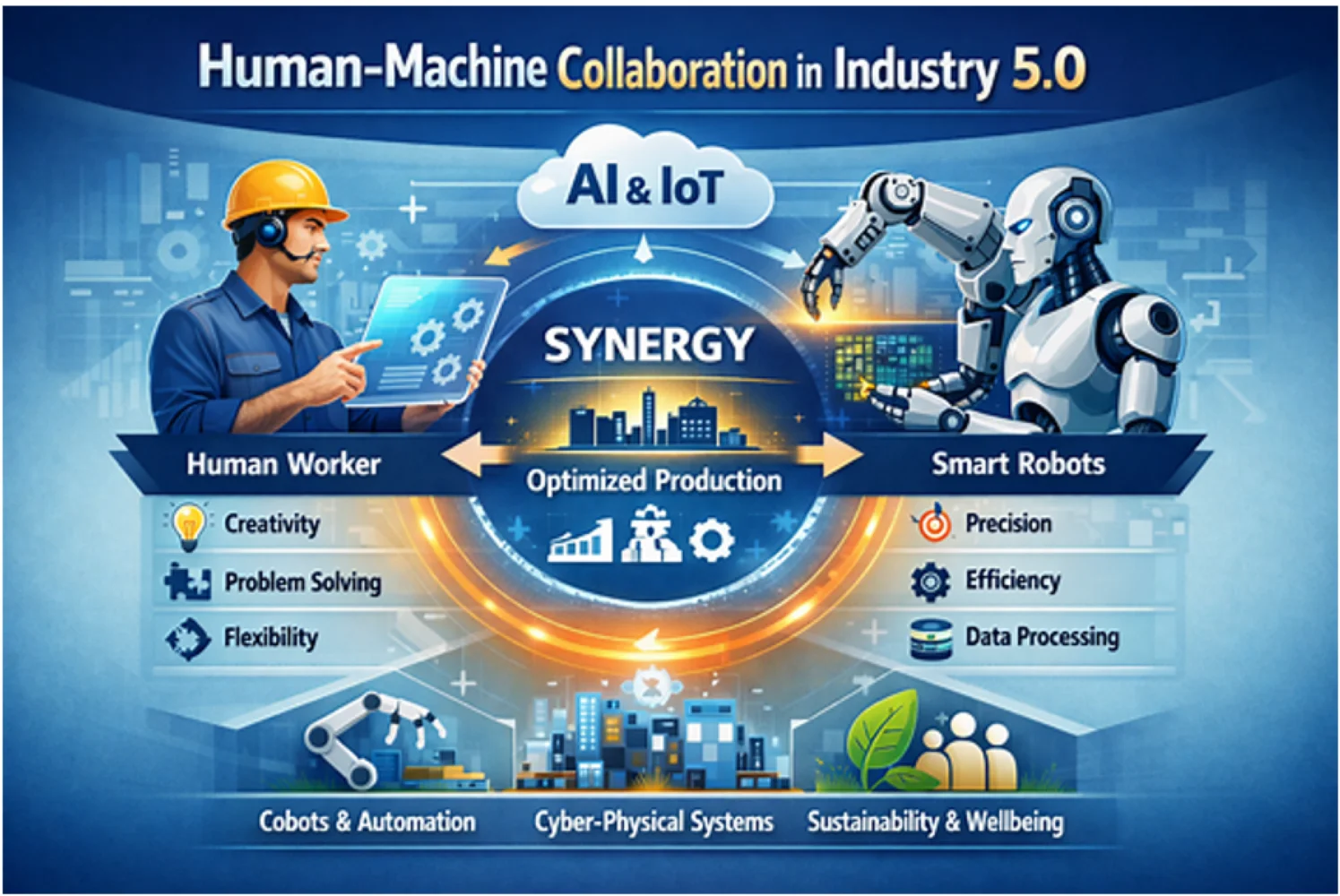
In their study, [12] argue that HMC represents a core principle of Industry 5.0, characterized by synergistic interactions in which humans and intelligent machines work jointly by capitalizing on their complementary strengths. In this context, humans offer cognitive adaptability, contextual awareness, and ethical reasoning, while machines contribute precision, speed, and advanced computational capabilities. The existing literature frames HMC as a continuum spanning from basic HMI to more HCPS. Nevertheless, much of the research examines these collaboration forms in isolation, thereby constraining a comprehensive understanding of how they collectively enable human-centric manufacturing objectives.
1.3.3. Technological enablers of human-machine collaboration
A broad range of enabling technologies underpins effective human-machine collaboration within the Industry 5.0 framework. AI and ML support adaptive decision-making processes and provide personalized assistance to human operators, while cobots enable safe, efficient, and flexible physical interaction between humans and machines, as demonstrated in [13, 14]. The same study further explains that DTs facilitate real-time system visualization, simulation, thereby enhancing shared situational awareness and informed decision-making across manufacturing operations. Complementary technologies such as augmented and virtual reality, advanced sensing systems, edge computing infrastructures, and IIoT platforms further strengthen data acquisition, communication, and human-machine integration. In addition, predictive maintenance, which combines real-time sensor data monitoring, machine learning techniques, and advanced data analytics, significantly improves equipment health management by anticipating failures before they occur and enabling timely, targeted interventions that optimize operational performance [15]. Despite the extensive discussion of these technologies in the literature, most existing studies examine them independently, with limited integrative frameworks explaining how their combined deployment enables truly human-centric manufacturing systems.
1.3.4. Collaboration paradigms and manufacturing applications
Reports by [16] and [17] show that dominant human–machine collaboration paradigms, HMI, HRC, HMC, and HCPS, are applied across diverse manufacturing activities such as assembly, maintenance, quality inspection, and production planning, yielding benefits like improved productivity, reduced ergonomic risks, enhanced safety, and greater worker satisfaction. However, literature consistently highlights a persistent gap: the absence of standardized taxonomies and evaluation frameworks that systematically link collaboration paradigms to application domains and measurable human-centric outcomes such as trust, cognitive workload, and well-being. This lack of consistency results in fragmented and non-comparable findings, undermining cross-study validation and limiting the generalizability of reported results, thereby underscoring the urgent need for integrative and comparative analyses that bridge conceptual and empirical perspectives.
1.3.5. Implementation challenges and research gaps
Despite increasing interest in Industry 5.0, several challenges continue to impede the large-scale adoption of human-centric manufacturing. From a technological perspective, key issues include system interoperability, data security, and the development of reliable human-aware AI models [18, 19]. According to these studies, organizational challenges further complicate implementation, particularly skills shortages, resistance to change, and the absence of robust training and reskilling frameworks. In addition, socio-ethical concerns, such as worker autonomy, data privacy, and trust in intelligent systems, remain prominent. The authors also note that much of the existing literature is predominantly conceptual or based on laboratory-scale studies, with relatively few empirical and longitudinal investigations conducted in real industrial settings, especially within developing economies. These limitations highlight the need for systematic reviews that consolidate existing evidence and offer practical, evidence-based guidance for scalable and context-sensitive implementation.
1.3.6. Summary of literature review and positioning of this study
The reviewed literature collectively positions HMC as a foundational pillar of Industry 5.0, marking a deliberate shift from the automation-dominant, efficiency-oriented focus of Industry 4.0 toward synergistic, value-driven interactions that leverage complementary human and machine strengths (Section 1.3.2-1.3.5).
While the literature robustly establishes HMC as central to Industry 5.0, it exhibits clear fragmentation: isolated examinations of technologies, paradigms, and challenges; descriptive rather than integrative analyses; and insufficient standardized models linking theoretical constructs to practical, human-centric outcomes. Prior reviews have advanced understanding in narrower scopes, e.g., assessing human-centered claims [8], scoping human-robot interaction toward Industry 5.0 workplaces [16], or synthesizing human-cyber-physical perspectives [12], yet they rarely integrate across enabling technologies, collaboration paradigms, applications, and multi-dimensional barriers within a single systematic framework.
Unlike prior reviews that focus predominantly on conceptual pillars [8,9], human-robot interaction scoping [13], or tensions/resolution strategies [19], this SLR uniquely provides an integrated synthesis across enabling technologies, paradigms, applications, and multi-faceted challenges, with explicit taxonomies (Tables 3-5) to guide framework development and context-sensitive adoption. By consolidating fragmented scholarship through thematic synthesis of sixty peer-reviewed studies (2017-2025), this study clarifies how human-centric manufacturing is technologically enabled, paradigmatically applied, and practically constrained, thereby advancing a more coherent, actionable understanding of Industry 5.0 manufacturing systems and laying a foundation for future empirical validation, standardized metrics, and inclusive implementation, particularly in underrepresented industrial contexts.
2. Methodology
2.1. Review design and PRISMA framework
This study employed a systematic literature review (SLR) explicitly guided by the PRISMA 2020 (Preferred Reporting Items for Systematic Reviews and Meta-Analyses) framework to ensure methodological transparency, reproducibility, and completeness. PRISMA principles informed all stages of the review process, including literature identification, screening, eligibility assessment, inclusion, and synthesis.
The review was designed to address three predefined research objectives focused on identifying technological enablers, analyzing human-machine collaboration paradigms and applications, and synthesizing implementation challenges and research gaps in Industry 5.0 human-centric manufacturing. A structured review protocol was developed before data collection to minimize selection bias and ensure consistency in study identification and analysis.
2.2. Information sources and literature search strategy
Consistent with PRISMA recommendations for comprehensive coverage, a systematic search was conducted across multiple high-quality bibliographic databases to capture interdisciplinary research spanning manufacturing systems, robotics, AI, cyber–physical systems, and socio-technical studies relevant to Industry 5.0. The search strategy employed predefined keywords combined using Boolean operators, limited to peer-reviewed publications in English from 2017 to 2025, to reflect the emergence and maturation of Industry 5.0 research. In addition, reference lists of key review articles were screened to identify further relevant studies, in line with PRISMA guidance on supplementary search strategies. Table 2 summarizes the specific search strings applied across databases.
Table 2Search strings used across databases
Database | Search string |
Scopus | (“Industry 5.0” OR “human-centric manufacturing”) AND (“human-machine collaboration” OR “human-robot collaboration” OR “human-machine interaction” OR “human-cyber-physical systems”) AND (manufacturing OR production OR “smart factory”) AND (“artificial intelligence” OR “digital twins” OR “collaborative robots” OR “cyber-physical systems”) |
Web of Science | TS=(“Industry 5.0” AND “human-machine collaboration”) OR TS=(“human-centric manufacturing” AND (“collaborative robots” OR “digital twins” OR “cyber-physical systems”)) OR TS=(“human-robot collaboration” AND “Industry 5.0” AND manufacturing) |
IEEE Xplore | (“Industry 5.0” AND “human-machine interaction”) AND (“artificial intelligence” OR “cyber-physical systems” OR “collaborative robots” OR “digital twin” OR “machine learning”) AND (manufacturing OR assembly OR automation) |
Science Direct | (“Industry 5.0” OR “human-centric manufacturing”) AND (“human-machine collaboration” OR “human-robot collaboration” OR “collaborative robots”) AND (“digital twin” OR “artificial intelligence” OR “cyber-physical systems”) AND manufacturing |
SpringerLink | (“Industry 5.0”) AND (“human-machine collaboration” OR “human-robot collaboration” OR “human-cyber-physical systems”) AND (“digital twins” OR “cobots” OR “artificial intelligence”) AND (manufacturing OR production) |
MDPI Open Access | (“Industry 5.0” OR “human-centric manufacturing”) AND (“human-machine interaction” OR “human-robot collaboration” OR “collaborative robots” OR “cyber-physical systems”) AND (manufacturing OR “smart manufacturing” OR “Industry 5.0”) |
Google Scholar | “Industry 5.0” “human-machine collaboration” manufacturing | “human-centric manufacturing” “collaborative robots” “digital twins” | “human-robot collaboration” “Industry 5.0” “cyber-physical systems” |
Note: Search strings were adapted to the syntax and field-tag conventions of each database. All searches were restricted to peer-reviewed English-language publications. Google Scholar and reference screening served supplementary roles consistent with PRISMA 2020 guidance. Boolean operators AND / OR / NOT were applied throughout; phrase searches used double quotation marks. Field tags: TS = Topic (Web of Science); no field restriction applied in Scopus (all fields default); IEEE Xplore Full Text and Metadata | |
2.3. Eligibility criteria
Clear inclusion and exclusion criteria were established a priori in accordance with PRISMA. Studies were included if they explicitly addressed human-machine, human-robot, or human-cyber-physical collaboration, were situated within manufacturing or closely related industrial contexts, and examined enabling technologies, collaboration paradigms, applications, or implementation challenges aligned with Industry 5.0 human-centric principles. Conversely, studies were excluded if they focused solely on Industry 4.0 automation without human-centric considerations, addressed non-industrial domains exclusively, or lacked sufficient conceptual or methodological clarity relevant to the study objectives.
2.4. Study selection and screening process
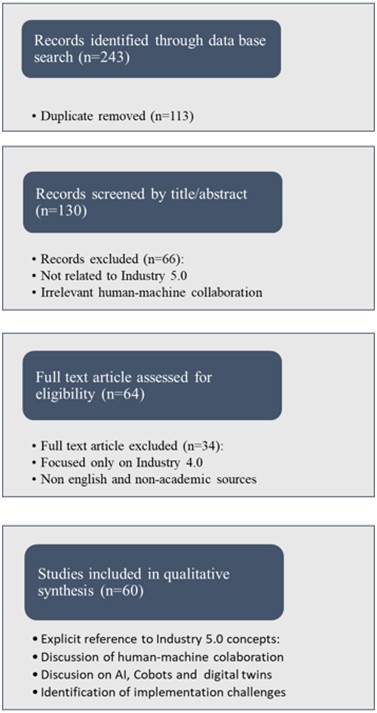
The study selection process adhered to the PRISMA four-phase flow, comprising identification, screening, eligibility, and inclusion. In the identification phase, all records retrieved from the database searches were aggregated, and duplicate entries were removed to ensure accuracy. During the screening phase, titles and abstracts were examined to exclude studies that were clearly irrelevant. This initial screening was conducted by the first author, with cross-checks performed by co-authors to minimize bias.
In the eligibility phase, full-text articles of potentially relevant studies were assessed against the predefined inclusion and exclusion criteria. This step ensured that only studies directly addressing human–machine collaboration in Industry 5.0 manufacturing were considered. Finally, in the inclusion phase, sixty studies met the eligibility criteria and were incorporated into the final synthesis. These studies are comprehensively documented in Appendix A, providing traceability and transparency of inclusion decisions. The overall selection process is visually summarized in Fig. 1, which presents the PRISMA flow diagram.
Fig. 1PRISMA 2020
2.5. Quality appraisal of included studies
The credibility of the included evidence was evaluated in accordance with PRISMA recommendations through a qualitative quality appraisal of all selected studies. Unlike numerical scoring systems, this appraisal employed qualitative criteria, which are more appropriate for an interpretive systematic literature review. Each study was assessed based on its relevance to the research objectives, the clarity of its aims, the coherence of its methodology, and its contribution to theory or practice in human-centric manufacturing.
Given the exploratory and interdisciplinary nature of Industry 5.0 research, both empirical and conceptual studies were retained, provided they demonstrated analytical rigor and relevance. This inclusive approach ensured comprehensive coverage of the field while maintaining quality standards appropriate for a systematic review.
To enhance transparency, the quality appraisal was guided by four explicit criteria: (1) Relevance to Industry 5.0 human-machine collaboration, (2) Methodological rigor, including clarity of research design and data analysis, (3) Theoretical or practical contribution, particularly in advancing human-centric manufacturing, and (4) Clarity and coherence of reported findings.
Studies meeting these criteria were retained to ensure analytical robustness and alignment with the study objectives.
2.6. Data collection and extraction
A standardized data extraction form was developed before analysis, consistent with PRISMA. For each included study, the following data were systematically extracted: author(s) and year, study focus, enabling technologies discussed, type of human-machine collaboration, manufacturing application domain, key findings, and identified implementation challenges.
The extracted data formed the basis of Appendix A, which serves as the primary evidence table linking individual studies to the synthesized results presented in the main text.
2.7. Data organization, coding, and analysis
Extracted data were organized thematically and analyzed using a qualitative thematic synthesis approach. An inductive-deductive coding strategy was adopted, in which initial codes were derived from the research objectives, while additional themes emerged iteratively from the data. Studies were systematically coded and clustered into thematic categories covering technological enablers of human-machine collaboration, collaboration paradigms and manufacturing applications, as well as implementation challenges and research gaps. This structured coding process facilitated cross-study comparison and supported the development of integrative summary tables (Tables 2-4), in line with PRISMA guidance on transparent and reproducible data synthesis.
2.8. Synthesis of results
In accordance with PRISMA, a narrative synthesis was employed to integrate findings across heterogeneous study designs. This approach facilitated the identification of recurring patterns, convergent evidence, and unresolved issues in human-centric manufacturing for Industry 5.0.
The synthesis emphasized qualitative human-centric outcomes, such as trust, safety, ergonomics, cognitive workload, and well-being, alongside technological and operational considerations, reflecting the core principles of Industry 5.0.
2.9. Methodological rigor and transparency
Methodological rigor was reinforced through adherence to PRISMA guidelines, explicit documentation of search and screening procedures, and transparent reporting of inclusion decisions. The use of structured extraction templates, thematic coding, and cross-referencing between Appendix A and synthesized tables enhanced reliability and reproducibility.
Although this review did not involve quantitative meta-analysis due to heterogeneity in study designs and outcome measures, the systematic and transparent approach ensures robustness appropriate for a PRISMA-compliant qualitative SLR.
2.10. Tools and software used
Reference management was conducted using Mendeley, facilitating citation tracking and duplicate removal. Data extraction, coding, and synthesis were performed using Microsoft Excel and Microsoft Word to support structured qualitative analysis.
No bibliometric or automated text-mining tools were used, as the study prioritized interpretive depth and contextual understanding consistent with the human-centric orientation of Industry 5.0 research.
3. Results and discussion
3.1. Identification and categorization of technological enablers of human-machine collaboration
The reviewed studies (Appendix A) reveal that human-centric manufacturing in Industry 5.0 is underpinned by a convergence of advanced digital, cognitive, and physical technologies rather than isolated automation tools. Analysis of the “technology/tools discussed” field across the dataset indicates five dominant technological clusters.
Table 3 summarizes key technological clusters supporting human-machine collaboration, detailing the enabling technologies, their roles in facilitating interaction, and the human-centric contributions they provide, including enhanced decision-making, safety, productivity, situational awareness, and adaptive, intuitive collaboration.
Table 3Technological enablers of human-machine collaboration in Industry 5.0
Technological cluster | Key technologies | Role in human-machine collaboration | Human-centric contributions |
Artificial intelligence and intelligent algorithms | ML, deep learning, large language models (LLMs), vision-language models (VLMs) | Enable adaptive decision-making, natural language interaction, emotion recognition, and intelligent task allocation | Augments human capabilities by interpreting intent, workload, and emotional states; supports intuitive human-robot communication and real-time collaboration |
Digital twin and human digital twin technologies | Digital twins, human digital twins (HDTs), simulation and modeling tools | Replicate machines, processes, and human physical and cognitive characteristics | Support ergonomic assessment, cognitive workload monitoring, safety simulation, and training; enable system designs centered on human needs |
Collaborative robotics | Collaborative robots with force sensing, vision systems, and safety mechanisms | Enable safe physical interaction and shared workspaces between humans and robots | Enhance productivity while preserving human control; reduce physical strain and repetitive tasks; support task co-execution rather than replacement |
Cyber-physical and human-cyber-physical systems | CPS architectures, HCPS frameworks, embedded control systems | Integrate sensing, computation, connectivity, and human-in-the-loop control | Position humans as active decision-makers rather than supervisory agents, reinforcing human-centric system design |
Sensing, interface, and connectivity technologies | Wearable sensors, EEG systems, AR/VR interfaces, IoT/IIoT platforms, wireless communication | Enable real-time perception, feedback, and interaction between humans and machines | Facilitate context-aware collaboration, adaptive task scheduling, continuous monitoring, and enhanced situational awareness |
The analysis demonstrates that human-centric manufacturing emerges from the coordinated integration of intelligent cognition, digital representation, physical collaboration, and systemic orchestration rather than from isolated technological deployment. Artificial intelligence enables adaptive decision-making and contextual awareness; digital twins provide virtual representations of both human and machine states; collaborative robots support safe physical interaction; and human-cyber-physical systems orchestrate these elements in real time. Together, these technologies create synergistic, adaptive manufacturing environments that enhance productivity, safety, trust, and worker well-being while reinforcing the central role of humans in Industry 5.0 systems.
A critical observation emerging from the cluster analysis is the contrast between studies that treat AI capabilities and digital twin technologies as standalone performance enhancers versus those that examine their integrative potential. While studies such as [14] and [16] demonstrate discrete benefits of cobots and predictive maintenance, respectively, studies employing HCPS frameworks [13, 63] reveal distinctly superior human-centric outcomes when these clusters are combined, particularly in relation to adaptive task allocation and cognitive workload reduction. This divergence suggests that fragmented technology adoption, though common in practice, may systematically underperform compared to architecturally integrated deployments, a finding with direct implications for investment prioritization in SMEs.
3.2. Analysis of human-machine collaboration paradigms and manufacturing applications
Table 4 provides a comprehensive overview of human-machine collaboration paradigms in Industry 5.0 manufacturing, mapping each paradigm to its primary applications, associated human roles, and key human-centric outcomes. It highlights the progression from basic interface-level interactions to fully integrated, adaptive, and co-learning systems, demonstrating the expanding cognitive and creative involvement of humans. The framework emphasizes qualitative dimensions, such as trust, well-being, and skill development, alongside productivity, underscoring the shift toward human-centered, intelligent production ecosystems in modern manufacturing.
Table 4Collaboration paradigms, manufacturing applications, and human-centric outcomes in Industry 5.0
Collaboration paradigm | Primary manufacturing applications | Human roles | Key human-centric outcomes |
Human-machine interaction | Assembly systems, control rooms, inspection dashboards | Operator, system monitor | Improved situational awareness, reduced error rates, enhanced usability |
Human-robot collaboration | Assembly, inspection, material handling, maintenance | Co-worker, task executor | Reduced physical workload, improved safety, increased productivity |
Human-machine collaboration | Production planning, logistics, quality control, decision support | Decision maker, cognitive partner | Enhanced decision quality, trust in AI systems, balanced cognitive workload |
Human-cyber-physical systems | Smart factories, adaptive production lines, predictive maintenance | Active system agent, supervisor of intelligent agents | System resilience, transparency, improved worker well-being |
Human-machine co-evolution and reciprocal learning | Personalized manufacturing, skill-intensive production, continuous improvement systems | Learner, innovator, co-evolving partner | Skill development, reskilling, long-term human-machine trust and adaptability |
The matrix illustrates a clear evolution from basic interface-level interaction to advanced, adaptive, and co-learning collaboration models, reflecting Industry 5.0’s transition from purely efficiency-focused automation to human-centered value creation. Higher collaboration stages correspond to wider application areas, enriched cognitive roles for humans, and qualitative outcomes such as trust, well-being, and skill enhancement, factors often overlooked in conventional manufacturing metrics. The reviewed literature indicates that Industry 5.0 does not replace human workers but rather positions them at the heart of intelligent production systems, promoting cooperation, empathy, and adaptability as core characteristics of human-centric manufacturing.
The reviewed literature reveals an asymmetry in paradigm maturity: while HMI and HRC are comparatively well-documented with empirical validation, HMC and HCPS frameworks remain largely conceptual or confined to laboratory demonstrations. This gap is significant because these latter paradigms, those involving the highest degree of human cognitive involvement, are precisely the ones most central to Industry 5.0’s human-centric ambitions. The paradox thus exposed highlights a systemic research priority misalignment that future studies must urgently address. Moreover, the evolution of collaboration paradigms is not merely technological but fundamentally socio-technical, reflecting a shift toward systems that emphasize adaptability, trust, and human agency over pure automation efficiency. Yet, inconsistencies across studies in measuring these outcomes underscore the need for standardized evaluation metrics to ensure comparability and practical implementation.
3.3. Synthesis of implementation challenges and research gaps
Table 5 presents a synthesized overview of the key implementation challenges and associated research gaps affecting the adoption of human-machine collaboration in Industry 5.0 manufacturing systems. The table consolidates findings from the thematic analysis by categorizing recurring technological, organizational, ethical, and economic barriers and linking them to their implications for human-centric manufacturing. By explicitly mapping these challenges to unresolved research gaps.
Table 5Synthesis of implementation challenges and research gaps in human-machine collaboration for Industry 5.0
Category | Key challenges/barriers | Implications for human-centric manufacturing | Identified research gaps |
Integration complexity | Difficulty integrating AI, cobots, digital twins, and legacy systems | Limits seamless collaboration and system interoperability | Need for integrative frameworks and modular architectures for HMC |
Workforce skills and adaptation | Skills gaps, resistance to change, high training demands | Slows adoption and reduces human–machine synergy | Lack of longitudinal studies on workforce adaptation and upskilling strategies |
Ethical, privacy, and trust issues | Concerns about AI transparency, data privacy, and algorithmic bias | Reduces human trust and acceptance of intelligent systems | Limited exploration of socio-ethical frameworks for HMC evaluation |
Safety and human–robot interaction risks | Collision avoidance, system reliability, certification challenges | Affects worker safety and limits co-working in shared spaces | Understudied real-world safety validation, especially in developing economies |
Data scarcity and model reliability | Limited availability of high-quality, human-centric datasets | Impairs AI performance and adaptive collaboration | Early-stage application of LLMs and cognitive adaptation lacks industrial validation |
Cost and infrastructure constraints | High implementation costs and uneven technological readiness | Restricts adoption, particularly in resource-limited contexts | Underrepresentation of Global South manufacturing contexts in empirical studies |
The table demonstrates that realizing human-centric manufacturing extends beyond mere technological maturity. Effective implementation requires the simultaneous consideration of organizational structures, ethical concerns, socio-technical interactions, and economic factors. Addressing these dimensions in isolation limits scalability and practical impact. Consequently, structured implementation frameworks, comprehensive evaluation metrics, and strategies aligned with regulatory and policy objectives are essential. These coordinated approaches help bridge existing gaps, support context-sensitive deployment, and ensure that Industry 5.0 human-machine collaboration delivers sustainable, inclusive, and scalable value across diverse manufacturing environments.
3.4. Implication of the study
This systematic review presents several key implications that transform the synthesized evidence from Tables 2-4 into actionable and theoretical advancements for human-centric manufacturing in Industry 5.0. The implications outlined below emphasize the study’s contributions to bridging research fragmentation and facilitating real-world transitions.
1) Theoretical implication (Advancement of human-centric Industry 5.0 frameworks): By integrating sixty peer-reviewed studies into comprehensive taxonomies (Tables 2-4), this review moves beyond previous fragmented analyses to propose a cohesive theoretical framework. The classification of technological enablers into five clusters clarifies their collective roles and supports the development of dynamic models that capture human-machine synergies. This enriches the conceptual foundations of Industry 5.0 literature and enables future hypothesis-driven investigations into co-evolutionary human-system interactions.
2) Practical/managerial implications (Guidance for industrial implementation): Practitioners and manufacturing managers receive evidence-based directives for designing and implementing human-machine collaboration systems. The mapping of technological clusters to paradigms (discussed further in Section 3.5) provides decision-makers with the tools to select context-appropriate integrations, such as combining collaborative robotics with advanced sensing for human-robot collaboration in assembly lines. These integrations enhance productivity, reduce ergonomic risks, and improve worker well-being. This structured guidance minimizes implementation uncertainties, encourages informed investment in enabling technologies, and supports the scalable adoption of smart manufacturing practices tailored to operational needs.
3) Policy implication (Support for workforce development and governance strategies): The synthesized challenges and gaps identified in Table 4 offer policymakers critical insights for developing supportive frameworks. The review emphasizes the need for targeted workforce upskilling programs, ethical AI governance protocols, and inclusive technology diffusion policies, particularly to address disparities in developing economies. By underscoring the importance of aligning regulations with human-centric outcomes (e.g., trust and safety), this study informs national and international strategies for sustainable and resilient deployment of Industry 5.0 while mitigating socio-ethical risks.
3.5. Interconnections and practical insights
The interaction among technological clusters creates a progressive chain that supports the evolution of collaboration paradigms. Notably, the synergy between the Artificial Intelligence and intelligent algorithms cluster and Digital Twin and Human Digital Twin technologies drives a transition from basic HMI paradigms, which focus on simple monitoring in control rooms, to advanced HMC and HCPS. AI-driven emotion recognition and adaptive task allocation, enhanced by HDTs for real-time cognitive workload simulation, improve transparency and trust. This shift elevates human roles from passive operators to active decision-makers and collaborative partners. This progression is particularly evident in applications like predictive maintenance and adaptive production lines, where these integrations lead to measurable human-centric improvements in decision quality and worker well-being, while fostering reciprocal learning that is often lacking in isolated technology deployments.
Additionally, collaborative robotics combined with sensing, interface, and connectivity technologies (such as AR/VR and wearable sensors) accelerates the development of HRC paradigms. Force-sensing mechanisms and context-aware interfaces facilitate safe co-execution in shared workspaces for assembly and maintenance tasks, resulting in reduced physical workload and improved safety outcomes. The architectures of cyber-physical and human-cyber-physical systems orchestrate these elements in a holistic manner, ensuring systemic resilience across paradigms.
However, these interconnections are not without practical implementation challenges, which reveal deeper insights into adoption barriers. While theoretical synergies suggest seamless progression, real-world constraints, such as the complexity of integrating with legacy systems and the scarcity of data for training reliable human-aware models, often hinder translation, particularly in small and medium enterprises (SMEs) and developing economies. Limited empirical and longitudinal validation, as highlighted in Table 4, presents a significant critique: many documented benefits (e.g., enhanced trust through AI and Digital Twins in HMC/HCPS) arise from controlled laboratory settings, with little evidence of scalability in resource-constrained environments where infrastructure deficits and skill gaps amplify ethical concerns like algorithmic bias and privacy erosion. Therefore, without modular architectures and targeted upskilling, these technological enablers risk exacerbating rather than alleviating human-centric disparities.
4. Future research direction
Building on the synthesized evidence and identified gaps (see Tables 2-4 and Section 3.5), the following prioritized directions provide a clearer roadmap for advancing human-centric Industry 5.0 manufacturing. These directions focus on transitioning from conceptual integration to rigorous, context-sensitive implementation.
Empirical and longitudinal validation of human-centric industry 5.0 models: Future research should prioritize large-scale, longitudinal case studies and field experiments that monitor socio-technical performance over extended periods (e.g., 2-5 years). This approach will validate the proposed synergies among technological clusters (e.g., AI and digital/human digital twins enhancing trust in HMC/HCPS) and measure outcomes such as worker well-being, cognitive workload, and system resilience. Special emphasis should be placed on moving beyond laboratory evidence to include diverse operational environments, particularly in high-variability production lines.
1) Development and validation of standardized, multi-dimensional evaluation metrics and frameworks: There is a pressing need for consensus-based, quantifiable metrics that systematically link collaboration paradigms (HMI, HRC, HMC, HCPS) to human-centric outcomes (trust, ergonomics, skill development, emotional states) alongside operational KPIs (productivity, safety incidents). Future efforts should focus on creating and empirically testing hybrid frameworks that integrate qualitative (e.g., perceived trust scales) and quantitative (e.g., physiological monitoring via wearables) indicators, allowing for consistent benchmarking and maturity assessments across organizations.
2) Context-sensitive implementation strategies for SMEs and developing economies: Given the significant underrepresentation of resource-constrained contexts in current empirical research, dedicated studies should explore low-cost, modular, and incremental adoption pathways tailored to SMEs and manufacturing ecosystems in the Global South. This research should investigate barriers such as infrastructure deficits, financial constraints, skill gaps, and cultural resistance while testing context-adapted interventions (e.g., hybrid human-AI training programs or affordable cobot integrations). Comparative studies between developed and developing regions would reveal transferable versus localized enablers, facilitating inclusive and equitable diffusion of Industry 5.0.
3) Integration of human-centricity with sustainability, resilience, and ethical governance: Emerging research emphasizes the importance of intertwining human-centric collaboration with Industry 5.0's other pillars (sustainability and resilience) through ethical, transparent AI systems. Future studies should investigate hybrid human-AI decision architectures (e.g., explainable LLMs in HMC) that maintain human agency while addressing algorithmic bias, data privacy, and long-term societal impacts. This direction could also explore reciprocal learning models and connections to Society 5.0, where consumers and communities co-create resilient, circular manufacturing ecosystems.
5. Limitations of the study
Several limitations should be considered when interpreting the results:
1) Reliance on secondary literature: This review synthesizes existing research rather than generating new primary data through industrial experiments, case studies, or longitudinal observations. Consequently, it limits the ability to establish causal relationships or validate proposed synergies (e.g., enhancing trust in HMC/HCPS through AI and digital twins) in real-world contexts. This may lead to an overemphasis on conceptual or lab-derived benefits versus practical implementation challenges.
2) Heterogeneity of studies: The reviewed studies exhibit significant methodological diversity, including conceptual frameworks, simulations, small-scale experiments, and qualitative analyses, along with varying outcome measures and levels of empirical rigor. This diversity precludes meta-analysis or statistical aggregation, restricting the review to qualitative thematic synthesis and narrative integration. As a result, precise quantification of effect sizes for human-centric outcomes (e.g., trust, ergonomics, well-being) is not possible.
3) Narrow scope of sources: The search was limited to English-language, peer-reviewed articles from seven major academic databases, potentially excluding relevant non-English publications, regional journals, conference proceedings, industry reports, and grey literature. This may introduce a bias towards Western or high-income contexts, underrepresenting perspectives from developing economies and manufacturing environments in the Global South-contexts identified as lacking representation in the literature (see Table 4 and Section 3.5). Additionally, excluding non-peer-reviewed sources may overlook emerging insights from practitioners or policy documents that influence Industry 5.0 adoption.
4) Subjectivity in thematic synthesis: Despite employing structured inductive-deductive coding and cross-author validation, the thematic analysis and categorization of technological clusters, paradigms, and challenges involve interpretive judgment. While this approach is suitable for an exploratory systematic literature review in a developing field, it introduces a degree of subjectivity that could affect the definition of themes or their emphasis, particularly when integrating fragmented research on rapidly evolving topics like large language models in HMC or human digital twins.
6. Conclusions
This study systematically reviewed sixty peer-reviewed contributions on human-machine collaboration in Industry 5.0, employing a PRISMA-compliant methodology to clarify how human-centric manufacturing is enabled, applied, and constrained. The review establishes a structured taxonomy of five enabling technology clusters, artificial intelligence, digital and human digital twins, collaborative robotics, cyber-physical systems, and advanced sensing/interface technologies, that collectively enhance human-machine collaboration. It further maps dominant paradigms (HMI, HRC, HMC, HCPS) to concrete manufacturing applications and measurable human-centric outcomes, including trust, ergonomics, safety, and worker well-being.
By synthesizing implementation challenges such as integration complexity, workforce skill gaps, socio-ethical concerns, and limited empirical validation, the study identifies critical research gaps and outlines a roadmap for future investigations. Its core contribution lies in consolidating fragmented scholarship into a coherent, taxonomy-driven framework that bridges theory and practice. Unlike prior reviews that focused narrowly on isolated technologies or conceptual pillars, this work provides a comprehensive, evidence-based foundation for advancing sustainable, human-centric manufacturing systems. In doing so, it strengthens academic understanding while equipping practitioners and policymakers with actionable insights for context-sensitive adoption, particularly in underrepresented industrial environments and developing economies.
References
-
M. T. Islam, K. Sepanloo, S. Woo, S. H. Woo, and Y.-J. Son, “A review of the Industry 4.0 to 5.0 transition: exploring the intersection, challenges, and opportunities of technology and human-machine collaboration,” Machines, Vol. 13, No. 4, p. 267, Mar. 2025, https://doi.org/10.3390/machines13040267
-
A. J. Okirie, “Examining the effect of maintenance work on employees’ physical and mental health, as well as their overall well-being, in industrial settings,” Global Journal of Engineering and Technology Advances, Vol. 19, No. 3, pp. 131–142, Jun. 2024, https://doi.org/10.30574/gjeta.2024.19.3.0108
-
E. D. ’Antoine, J. Jansz, A. Barifcani, S. Shaw-Mills, M. Harris, and C. Lagat, “Psychosocial safety and health hazards and their impacts on offshore oil and gas workers,” Safety, Vol. 9, No. 3, p. 56, Aug. 2023, https://doi.org/10.3390/safety9030056
-
S. Davila-Gonzalez and S. Martin, “Human digital twin in Industry 5.0: A holistic approach to worker safety and well-being through advanced AI and emotional analytics,” Sensors, Vol. 24, No. 2, p. 655, 2024, https://doi.org/10.3390/s24020655
-
T. C. Callari, Y. Curzi, and N. Lohse, “Realising human-robot collaboration in manufacturing? A journey towards industry 5.0 amid organisational paradoxical tensions,” Technological Forecasting and Social Change, Vol. 219, p. 124249, 2025, https://doi.org/10.1016/j.techfore.2025.124249
-
M. Peruzzini, E. Prati, and M. Pellicciari, “A framework to design smart manufacturing systems for Industry 5.0 based on the human-automation symbiosis,” International Journal of Computer Integrated Manufacturing, Vol. 37, No. 10-11, pp. 1426–1443, Sep. 2023, https://doi.org/10.1080/0951192x.2023.2257634
-
A. J. Okirie, M. Barnabas, and J. E. Adagbon, “Maintenance management optimization: evaluating manual and automated methods of tracking uptime hours for offshore equipment,” American Journal of IR 4.0 and Beyond, Vol. 3, No. 1, pp. 15–27, Oct. 2024, https://doi.org/10.54536/ajirb.v3i1.3516
-
A. Ninan, N. Le Gouhinec, J. J. Scott, F. Y. M. Salameh, M. N. Elouri, and H. M. H. Alqahtani, “AI/ML-based safety monitoring system for offshore drilling rigs: enhancing safety, compliance and operational efficiency,” in SPE/IADC Middle East Drilling Technology Conference and Exhibition, May 2025, https://doi.org/10.2118/225680-ms
-
C. Zhang et al., “Towards new-generation human-centric smart manufacturing in Industry 5.0: a systematic review,” Advanced Engineering Informatics, Vol. 57, p. 102121, Aug. 2023, https://doi.org/10.1016/j.aei.2023.102121
-
J. Alves, T. M. Lima, and P. D. Gaspar, “Is Industry 5.0 a human-centred approach? a systematic review,” Processes, Vol. 11, No. 1, p. 193, Jan. 2023, https://doi.org/10.3390/pr11010193
-
A. Tóth, L. Nagy, R. Kennedy, B. Bohuš, J. Abonyi, and T. Ruppert, “The human-centric Industry 5.0 collaboration architecture,” MethodsX, Vol. 11, p. 102260, Dec. 2023, https://doi.org/10.1016/j.mex.2023.102260
-
A. J. Okirie, E. F. Lawson, and N. O. Ozuru, “Integrating Industry 4.0 and 5.0 technologies for sustainable, resilient oil and gas production operations,” Advanced Manufacturing Research, Vol. 4, No. 1, p. 23, Feb. 2026, https://doi.org/10.21595/amr.2026.25525
-
L. Bukowski and S. Werbinska-Wojciechowska, “Towards maintenance 5.0: resilience-based maintenance in AI-driven sustainable and human-centric industrial systems,” Sensors, Vol. 25, No. 16, p. 5100, Aug. 2025, https://doi.org/10.3390/s25165100
-
S. Lou, Z. Hu, Y. Zhang, Y. Feng, M. Zhou, and C. Lv, “Human-cyber-physical system for Industry 5.0: a review from a human-centric perspective,” IEEE Transactions on Automation Science and Engineering, Vol. 22, No. 1, pp. 494–511, Jan. 2025, https://doi.org/10.1109/tase.2024.3360476
-
A. Rejeb, K. Rejeb, I. Zrelli, Y. Kayikci, and A. Hassoun, “The research landscape of Industry 5.0: a scientific mapping based on bibliometric and topic modeling techniques,” Flexible Services and Manufacturing Journal, Vol. 37, No. 4, pp. 1203–1250, Nov. 2024, https://doi.org/10.1007/s10696-024-09584-4
-
A. J. Okirie, B. Mack, and N. Obinichi, “Comparative study of sensor-generated operational data, equational calculation, and temporal data acquisition for optimal predictive maintenance decisions,” Global Journal of Engineering and Technology Advances, Vol. 20, No. 2, pp. 061–73, Aug. 2024, https://doi.org/10.30574/gjeta.2024.20.2.0143
-
H. Abouloifa and M. Bahaj, “Comparing deep learning and Fourier series models for equipment failure prediction in predictive industrial maintenance 4.0,” Scientific Reports, Vol. 15, No. 1, p. 40717, Nov. 2025, https://doi.org/10.1038/s41598-025-24497-4
-
S. Panagou, W. P. Neumann, and F. Fruggiero, “A scoping review of human robot interaction research towards Industry 5.0 human-centric workplaces,” International Journal of Production Research, Vol. 62, No. 3, pp. 974–990, 2023, https://doi.org/10.1080/00207543.2023.2172473
-
T. Stipancic and D. Rosenberg, “From human-machine interaction to human-machine cooperation: Status and progress,” Applied Sciences, Vol. 15, No. 17, p. 9475, Aug. 2025, https://doi.org/10.3390/app15179475
-
R. Kour, R. Karim, P. Dersin, and N. Venkatesh, “Cybersecurity for Industry 5.0: trends and gaps,” Frontiers in Computer Science, Vol. 6, p. 1434436, Jul. 2024, https://doi.org/10.3389/fcomp.2024.1434436
-
D. A. J. Pacheco and B. Iwaszczenko, “Unravelling human-centric tensions towards Industry 5.0: literature review, resolution strategies and research agenda,” Digital Business, Vol. 4, No. 2, p. 100090, Dec. 2024, https://doi.org/10.1016/j.digbus.2024.100090
-
E. F. Langås, M. H. Zafar, and F. Sanfilippo, “Exploring the synergy of human-robot teaming, digital twins, and machine learning in Industry 5.0: a step towards sustainable manufacturing,” Journal of Intelligent Manufacturing, Vol. 37, No. 3, pp. 999–1022, Feb. 2025, https://doi.org/10.1007/s10845-025-02580-x
-
U. Asad, M. Khan, A. Khalid, and W. A. Lughmani, “Human-centric digital twins in industry: a comprehensive review of enabling technologies and implementation strategies,” Sensors, Vol. 23, No. 8, p. 3938, Apr. 2023, https://doi.org/10.3390/s23083938
-
I. Maurtua, A. Ibarguren, J. Kildal, L. Susperregi, and B. Sierra, “Human-robot collaboration in industrial applications,” International Journal of Advanced Robotic Systems, Vol. 14, No. 4, p. 172988141771601, Jul. 2017, https://doi.org/10.1177/1729881417716010
-
I. Bucci, V. Fani, and R. Bandinelli, “Towards human-centric manufacturing: exploring the role of human digital twins in Industry 5.0,” Sustainability, Vol. 17, No. 1, p. 129, Dec. 2024, https://doi.org/10.3390/su17010129
-
S. S. Kumar, S. R. Kumar, and G. Ramesh, “From Industry 4.0 to 5.0: enriching manufacturing excellence through human-robot interaction and technological empowerment,” in Intelligent Systems and Industrial Internet of Things for Sustainable Development, Chapman and Hall/CRC, 2024, pp. 24–51.
-
K. A. Demir, G. Döven, and B. Sezen, “Industry 5.0 and human-robot co-working,” Procedia Computer Science, Vol. 158, pp. 688–695, Jan. 2019, https://doi.org/10.1016/j.procs.2019.09.104
-
Y. Lu et al., “Outlook on human-centric manufacturing towards Industry 5.0,” Journal of Manufacturing Systems, Vol. 62, pp. 612–627, Jan. 2022, https://doi.org/10.1016/j.jmsy.2022.02.001
-
M. Dhanda, B. A. Rogers, S. Hall, E. Dekoninck, and V. Dhokia, “Reviewing human-robot collaboration in manufacturing: Opportunities and challenges in the context of Industry 5.0,” Robotics and Computer-Integrated Manufacturing, Vol. 93, p. 102937, Jun. 2025, https://doi.org/10.1016/j.rcim.2024.102937
-
J. Yang, Y. Liu, and P. L. Morgan, “Human-machine interaction towards Industry 5.0: Human-centric smart manufacturing,” Digital Engineering, Vol. 2, p. 100013, Sep. 2024, https://doi.org/10.1016/j.dte.2024.100013
-
Y. Wang et al., “How do we research human-robot interaction in the age of large language models? A systematic review,” in Proceedings of the 2026 CHI Conference on Human Factors in Computing Systems, pp. 1–28, Apr. 2026, https://doi.org/10.1145/3772318.3790920
-
S. Huang, M. Huang, Q. Zhu, G. Wang, and Y. Yan, “Operation tasks assignment optimization of human-robot collaboration manufacturing system based on NSGA-II,” in Human-Centric Smart Manufacturing Towards Industry 5.0, Cham: Springer Nature Switzerland, 2025, pp. 211–228, https://doi.org/10.1007/978-3-031-82170-7_9
-
I. Yitmen and A. Almusaed, “Synopsis of Industry 5.0 paradigm for human-robot collaboration,” in Artificial Intelligence, IntechOpen, 2024, https://doi.org/10.5772/intechopen.1005583
-
S. Singh, M. Rai, J. K. Pandey, and A. K. Saxena, “Emotional intelligence and collaborative dynamics in Industry 5.0 for human-machine interactions,” in Advances in Computational Intelligence and Robotics, IGI Global, 2024, pp. 190–204, https://doi.org/10.4018/979-8-3693-6806-0.ch010
-
N. Knežević, A. Savić, Z. Gordić, A. Ajoudani, and K. Jovanović, “Toward Industry 5.0: A neuroergonomic workstation for a human-centered, collaborative robot-supported manual assembly process,” IEEE Robotics and Automation Magazine, Vol. 32, No. 3, pp. 103–113, 2025, https://doi.org/10.1109/mra.2024.3487323
-
M. A. Younas, A. H. Abdullah, G. M. Din, M. Faisal, M. Mudassar, and A. B. Yasir, “Smart manufacturing system using LLM for human-robot collaboration: applications and challenges,” European Journal of Theoretical and Applied Sciences, Vol. 3, No. 1, pp. 215–226, Jan. 2025, https://doi.org/10.59324/ejtas.2025.3(1).21
-
J. Lim, S. Patel, A. Evans, J. Pimley, Y. Li, and I. Kovalenko, “Enhancing human-robot collaborative assembly in manufacturing systems using large language models,” in 2024 IEEE 20th International Conference on Automation Science and Engineering (CASE), pp. 2581–2587, 2024, https://doi.org/10.1109/case59546.2024.10711843
-
B. Wang, P. Zheng, L. Wang, and D. Mourtzis, Human-Centric Smart Manufacturing Towards Industry 5.0. Cham: Springer Nature Switzerland, 2025, https://doi.org/10.1007/978-3-031-82170-7
-
L. Panter, R. Leder, D. Keiser, and M. Freitag, “Requirements for human-machine-interaction applications in production and logistics within Industry 5.0 – a case study approach,” Procedia Computer Science, Vol. 232, pp. 1164–1171, Jan. 2024, https://doi.org/10.1016/j.procs.2024.01.114
-
C. Cimini, A. Lagorio, S. Cavalieri, O. Riedel, C. E. Pereira, and J. Wang, “Human-technology integration in smart manufacturing and logistics: Current trends and future research directions,” Computers and Industrial Engineering, Vol. 169, p. 108261, 2022, https://doi.org/10.1016/j.cie.2022.108261
-
H. Wang et al., “A safety management approach for Industry 5.0’s human-centered manufacturing based on digital twin,” Journal of Manufacturing Systems, Vol. 66, pp. 1–12, 2023, https://doi.org/10.1016/j.jmsy.2022.11.013
-
Y. Xiong, Y. Tang, S. Kim, and D. W. Rosen, “Human-machine collaborative additive manufacturing,” Journal of Manufacturing Systems, Vol. 66, pp. 82–91, Feb. 2023, https://doi.org/10.1016/j.jmsy.2022.12.004
-
M. A. Shabur, A. Shahriar, and M. A. Ara, “From automation to collaboration: exploring the impact of industry 5.0 on sustainable manufacturing,” Discover Sustainability, Vol. 6, No. 1, p. 341, Apr. 2025, https://doi.org/10.1007/s43621-025-01201-0
-
F. Zhang, Y. Zhang, and S. Xu, “Collaboration effectiveness-based complex operations allocation strategy towards human-robot interaction,” Autonomous Intelligent Systems, Vol. 2, No. 1, p. 20, 2022, https://doi.org/10.1007/s43684-022-00039-x
-
A. K. Inkulu and M. V. A. R. Bahubalendruni, “Human-robot collaborative task planning for assembly system productivity enhancement,” Robotic Intelligence and Automation, Vol. 44, No. 1, pp. 120–130, Mar. 2024, https://doi.org/10.1108/ria-05-2023-0067
-
P. Segura Parra, O. Lobato Calleros, and A. Ramirez-Serrano, “Human-robot collaboration systems: components and applications,” in International Conference of Control, Dynamic Systems, and Robotics, pp. 1–9, Nov. 2020, https://doi.org/10.11159/cdsr20.150
-
M. M. Rahman, F. Khatun, I. Jahan, R. Devnath, and M. A.-A. Bhuiyan, “Cobotics: The evolving roles and prospects of next-generation collaborative robots in Industry 5.0,” Journal of Robotics, Vol. 2024, No. 1, p. 2918089, 2024, https://doi.org/10.1155/2024/2918089
-
L. Liu et al., “Human robot collaboration for enhancing work activities,” Human Factors: The Journal of the Human Factors and Ergonomics Society, Vol. 66, No. 1, pp. 158–179, Jan. 2022, https://doi.org/10.1177/00187208221077722
-
A. Adel and N. Hs Alani, “Human-centric collaboration and Industry 5.0 framework in smart cities and communities: fostering sustainable development goals 3, 4, 9, and 11 in Society 5.0,” Smart Cities, Vol. 7, No. 4, pp. 1723–1775, Jul. 2024, https://doi.org/10.3390/smartcities7040068
-
J. Pizoń and A. Gola, “Human-machine relationship-perspective and future roadmap for Industry 5.0 solutions,” Machines, Vol. 11, No. 2, p. 203, 2023, https://doi.org/10.3390/machines11020203
-
S. Rani, D. Jining, K. Shoukat, M. U. Shoukat, and S. A. Nawaz, “A human-machine interaction mechanism: Additive manufacturing for Industry 5.0-Design and management,” Sustainability, Vol. 16, No. 10, p. 4158, 2024, https://doi.org/10.3390/su16104158
-
S. Nahavandi, “Industry 5.0-a human-centric solution,” Sustainability, Vol. 11, No. 16, p. 4371, 2019, https://doi.org/10.3390/su11164371
-
E. Kaasinen, A.-H. Anttila, P. Heikkilä, J. Laarni, H. Koskinen, and A. Väätänen, “Smooth and resilient human-machine teamwork as an Industry 5.0 design challenge,” Sustainability, Vol. 14, No. 5, p. 2773, Feb. 2022, https://doi.org/10.3390/su14052773
-
G. Pang, W. Liu, D. Niyato, D. E. Quevedo, B. Vucetic, and Y. Li, “Wireless human-machine collaboration in Industry 5.0,” IEEE Transactions on Wireless Communications, Vol. 25, pp. 8546–8563, 2026, https://doi.org/10.1109/twc.2025.3638753
-
V. Priya, C. Vipin, Z. M. Zubair, and S. Pranav, “Enhancing human-machine collaboration for value creation in automotive manufacturing in Industry 5.0,” in Aspects of Quality Management in Value Creating in the Industry 5.0 Way, Boca Raton: CRC Press, 2024, pp. 137–151, https://doi.org/10.1201/9781032677040-8
-
S. K. Srivastava, “Green supply-chain management: A state-of-the-art literature review,” International Journal of Management Reviews, Vol. 9, No. 1, pp. 53–80, Mar. 2007, https://doi.org/10.1111/j.1468-2370.2007.00202.x
-
U. Ghugar, R. Nayak, and J. B. Awotunde, “Enabling technologies for seamless human-machine interaction in Industry 5.0,” in Computational Intelligence for Analysis of Trends in Industry 4.0 and 5.0, Boca Raton: Auerbach Publications, 2025, pp. 215–240, https://doi.org/10.1201/9781003533023-9
-
N. L. Rane, Kaya, and J. Rane, “Human-centric artificial intelligence in Industry 5.0: Enhancing human interaction and collaborative applications,” in Artificial Intelligence, Machine Learning, and Deep Learning for Sustainable Industry 5.0, Vol. 5, Deep Science Publishing, 2024, pp. 2–95, https://doi.org/10.70593/978-81-981271-8-1_5
-
M. Katariya, A. Mathur, and S. Singh, “Human-robot/machine interaction for sustainable manufacturing: Industry 5.0 perspectives,” in Handbook of Intelligent and Sustainable Manufacturing, Boca Raton: CRC Press, 2024, pp. 18–41, https://doi.org/10.1201/9781003405870-2
-
A. Hassan, P. K. Dutta, S. Gupta, E. Mattar, and S. Singh, Human-Centered Approaches in Industry 5.0: Human-Machine Interaction, Virtual Reality Training, and Customer Sentiment Analysis. IGI Global, 2024.
-
X. Li, A. Nassehi, B. Wang, S. J. Hu, and B. I. Epureanu, “Human-centric manufacturing for human-system coevolution in Industry 5.0,” CIRP Annals, Vol. 72, No. 1, pp. 393–396, Jan. 2023, https://doi.org/10.1016/j.cirp.2023.04.039
-
S. Ling, B. Wang, Y. Rong, and G. Q. Huang, “Human-machine synchronization for smart manufacturing towards Industry 5.0,” in Human-Centric Smart Manufacturing Towards Industry 5.0, Cham: Springer Nature Switzerland, 2025, pp. 341–357, https://doi.org/10.1007/978-3-031-82170-7_15
-
J. Xu, Q. Sun, Q.-L. Han, and Y. Tang, “When embodied AI meets Industry 5.0: human-centered smart manufacturing,” IEEE/CAA Journal of Automatica Sinica, Vol. 12, No. 3, pp. 485–501, Mar. 2025, https://doi.org/10.1109/jas.2025.125327
-
J. Fan, Y. Yin, T. Wang, W. Dong, P. Zheng, and L. Wang, “Vision-language model-based human-robot collaboration for smart manufacturing: a state-of-the-art survey,” Frontiers of Engineering Management, Vol. 12, No. 1, pp. 177–200, Jan. 2025, https://doi.org/10.1007/s42524-025-4136-9
-
S. Saniuk, S. Grabowska, and A. Thibbotuwawa, “Challenges of industrial systems in terms of the crucial role of humans in the Industry 5.0 environment,” Production Engineering Archives, Vol. 30, No. 1, pp. 94–104, 2024, https://doi.org/10.30657/pea.2024.30.9
-
C. Aceta, I. Fernández, and A. Soroa, “KIDE4I: A generic semantics-based task-oriented dialogue system for human-machine interaction in Industry 5.0,” Applied Sciences, Vol. 12, No. 3, p. 1192, 2022, https://doi.org/10.3390/app12031192
-
I. Kardush, S. Kim, and E. Wong, “A techno-economic study of Industry 5.0 enterprise deployments for human-to-machine communications,” IEEE Communications Magazine, Vol. 60, No. 12, pp. 74–80, Dec. 2022, https://doi.org/10.1109/mcom.001.2101068
-
D. Ivanov, “The Industry 5.0 Framework: viability-based integration of the resilience, sustainability, and human-centricity perspectives,” International Journal of Production Research, Vol. 61, No. 5, pp. 1683–1695, Mar. 2023, https://doi.org/10.1080/00207543.2022.2118892
-
R. A. Sheikh, I. Ahmed, A. Y. A. Faqihi, and Y. M. Shehawy, “Global perspectives on navigating Industry 5.0 knowledge: achieving resilience, sustainability, and human-centric innovation in manufacturing,” Journal of the Knowledge Economy, Vol. 16, No. 5, pp. 15997–16032, Dec. 2024, https://doi.org/10.1007/s13132-024-02498-4
-
P. Johri, J. N. Singh, A. Sharma, and D. Rastogi, “Sustainability of coexistence of humans and machines: An evolution of Industry 5.0 from Industry 4.0,” in 2021 10th International Conference on System Modeling and Advancement in Research Trends (SMART), pp. 410–414, Dec. 2021, https://doi.org/10.1109/smart52563.2021.9676275
-
A. N. Anang, P. O. Obidi, A. O. Mesogboriwon, J. O. Obidi, M. Kuubata, and D. Ogunbiyi, “The role of artificial intelligence in Industry 5.0: Enhancing human-machine collaboration,” World Journal of Advanced Research and Reviews, Vol. 24, No. 2, pp. 380–400, 2024, https://doi.org/10.30574/wjarr.2024.24.2.3369
-
T. Hoch et al., “Multi-stakeholder perspective on human-AI collaboration in Industry 5.0,” in Artificial Intelligence in Manufacturing, Cham: Springer Nature Switzerland, 2023, pp. 407–421, https://doi.org/10.1007/978-3-031-46452-2_23
-
K. Briken, J. Moore, D. Scholarios, E. Rose, and A. Sherlock, “Industry 5 and the human in human-centric manufacturing,” Sensors, Vol. 23, No. 14, p. 6416, Jul. 2023, https://doi.org/10.3390/s23146416
-
Y. Palazhchenko, V. Shendryk, V. Ivanov, and M. Hatala, “Industry 5.0: Aspects of collaboration technologies,” in Lecture Notes in Mechanical Engineering, Cham: Springer Nature Switzerland, 2023, pp. 609–617, https://doi.org/10.1007/978-3-031-38165-2_71
-
L. Nagy, J. Abonyi, and T. Ruppert, “Knowledge graph-based framework to support human-centered collaborative manufacturing in Industry 5.0,” Applied Sciences, Vol. 14, No. 8, p. 3398, Apr. 2024, https://doi.org/10.3390/app14083398
-
S. Nixdorf, F. Ansari, and S. Schlund, “Reciprocal learning in human-machine collaboration: a multi-agent system framework in Industry 5.0,” in Digitization of the Work Environment for Sustainable Production, GITO Verlag, 2022, pp. 207–225, https://doi.org/10.30844/wgab_2022_11
-
H. Oliff, Y. Liu, M. Kumar, and M. Williams, “Improving human-robot interaction utilizing learning and intelligence: A human factors-based approach,” IEEE Transactions on Automation Science and Engineering, Vol. 17, No. 3, pp. 1–14, 2020, https://doi.org/10.1109/tase.2020.2967093
-
A. Gill and A. Mathur, “Emotional intelligence in the age of AI,” in Advances in Business Information Systems and Analytics, IGI Global, 2024, pp. 271–294, https://doi.org/10.4018/979-8-3693-3140-8.ch014
-
J. Coetzer, R. B. Kuriakose, and H. J. Vermaak, “Using the OEE score to enable collaborative decision-making for human-machine interaction in an Industry 5.0 setting,” in World Conference on Information Systems for Business Management, Singapore: Springer Nature Singapore, 2024, pp. 279–292, https://doi.org/10.1007/978-981-99-8349-0_22
About this article

The authors have not disclosed any funding.
The datasets generated during and/or analyzed during the current study are available from the corresponding author on reasonable request.
Ahiamadu Jonathan Okirie: conceptualization, data collection, investigation, original draft preparation, methodology, data analysis. Nyekachi Olumati Ozuru: validation, review and editing, methodology. Azibopuru Churchill Onyasi: data analysis, review and editing.
The authors declare that they have no conflict of interest.

