Abstract
This paper investigates the effect of gossypol resin, rubber crumb, and regenerated waste oil on the properties and ageing behavior of natural liquid bitumen from Tajikistan. FTIR spectroscopy was used to analyze structural changes before and after heating at 160 °C. The results show that the additives influence bitumen structure and oxidation resistance. Complex-modified systems exhibited improved stability and slower ageing compared to pure bitumen, while some single-additive compositions showed higher degradation. The findings confirm that combined modifiers can enhance bitumen performance and promote the use of local materials in road construction.
Highlights
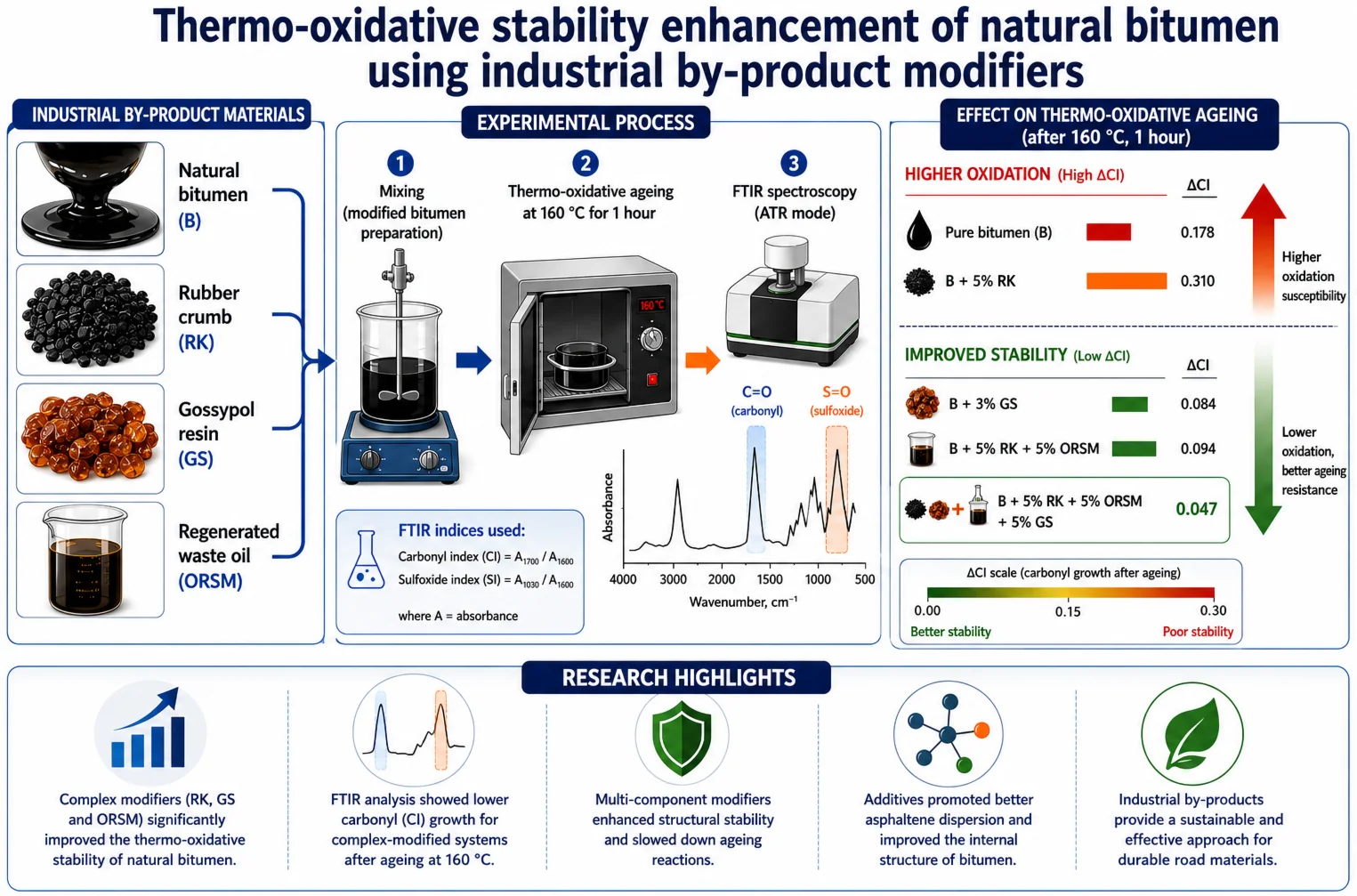
- Complex modifiers containing rubber crumb, gossypol resin, and regenerated waste oil improved the thermo-oxidative stability of natural bitumen.
- FTIR analysis revealed that multi-component modified binders showed lower carbonyl growth after ageing at 160 °C.
- Rubber-only modified bitumen exhibited the highest oxidation susceptibility with ΔCI ≈ 0.31 after thermal exposure.
- Combined additives promoted better asphaltene dispersion and improved structural stability of bitumen systems.
- The study demonstrates the potential of local industrial by-products for sustainable road material development.
1. Introduction
In the Republic of Tajikistan, the shortage of high-quality bitumen necessitates the efficient use of local raw materials, including heavy oils, industrial waste, and by-products, to reduce resource consumption and improve sustainability in road construction. The development of complex binders based on local materials is considered a promising approach; however, many aspects of their performance remain insufficiently studied [1-5]. Natural liquid bitumen often exhibits limited thermal stability and resistance to ageing under modern traffic and climatic conditions, which affects pavement durability. Thermo-oxidative processes during heating lead to the formation of carbonyl and sulfoxide functional groups, resulting in increased stiffness and brittleness of the binder. Therefore, the use of modifying additives is widely explored to enhance bitumen performance.
Numerous studies have demonstrated that Fourier transform infrared (FTIR) spectroscopy is an effective tool for investigating chemical composition and ageing of bituminous binders. Ageing is associated with the growth of oxidation products and structural changes that can be quantified using spectral indices [7-12]. Research on modified binders shows that additives such as polymers and rubber significantly influence oxidation resistance and improve durability by altering the internal structure of bitumen [13-15]. In addition, microstructural processes, including asphaltene interactions, play an important role in ageing mechanisms [16-19]. Nevertheless, limited information is available on natural liquid bitumen from regional sources modified with locally available industrial by-products, which highlights the relevance of this study.
In addition, while short-term thermo-oxidative ageing can be simulated under laboratory conditions, long-term field ageing involves more complex processes including prolonged oxidation, UV exposure, and environmental effects. Standard ageing procedures such as Rolling Thin Film Oven Test (RTFOT) and Pressure Aging Vessel (PAV) are commonly used to simulate these conditions. Therefore, the present study focuses primarily on short-term ageing behavior, while long-term performance requires further investigation.
2. Research objects and methods
2.1. Research objects
Road Bitumen and Compounds with Rubber and Petrochemical Additives. Method: Reflectance FTIR (ATR).
Eight samples of bitumen binders and their modified composites were studied. RP – rubber powder; ORSM – residue from the regeneration of lubricating oils; GS – gossypol resin
Table 1Composition of liquid bitumen with additives
Sample No. | Description of composition |
1 | B – original bitumen (pure) |
2 | B + 5 % RK – bitumen with the addition of 5 wt.% rubber crumb |
3 | B + 3 % GS – bitumen with the addition of 3 wt.% gossypol resin |
4 | B + 10 % rubber + 3 % GS – bitumen with the addition of 10 wt.% rubber component and 3 wt.% gossypol resin |
5 | B + 10 % RK + 3 % GS + 5 % ORSM – bitumen with a complex additive of rubber crumb, gossypol resin and ORSM |
6 | B + 3 % GS + 5 % RP – bitumen with the addition of 3 % gossypol resin and 5 % rubber powder |
7 | B + 5 % RK + 5 % ORSM – bitumen with the addition of 5 % rubber crumb and 5 % ORSM |
8 | B + 5 % RK + 5 % ORSM + 5 % GS – bitumen with the addition of 5 % rubber crumb, 5 % ORSM and 5 % gossypol resin |
2.2. IR analysis and index calculation methodology
IR spectra were recorded on a Spectrum 65 FT-IR instrument with an ATR (ZnSe) attachment in the 4000-400 cm⁻1 range, at a resolution of 4 cm⁻1 and an accumulation of 16-32 scans. The analysis was performed on the original samples and after incubation at 160 °C for 1 hour. For quantitative processing, the AI, PI, CI and SI indices were used, calculated from the ratios of band intensities at 1600, 1450, 720, 1700 and 1030 cm⁻1.
3. Results and discussion
3.1. IR spectra of bitumen before and after heating
To evaluate the structural changes and ageing behavior of the studied binders, IR spectral analysis was performed. Figs. 1 and 2 present the combined IR spectra of all samples before heating and after thermal exposure at 160 °C.
The PI and AI indices characterize the structural composition of bitumen, reflecting the relative proportions of paraffinic and aromatic components, while the CI and SI indices describe the degree of oxidation and ageing. An increase in the CI value indicates a higher level of ageing, whereas smaller changes in CI suggest greater resistance of the bitumen to thermo-oxidative stress.
The original bitumen (sample 1) has the highest index of paraffin chains PI ≈ 1.50, which indicates a pronounced paraffin structure. The introduction of modifying additives in most cases leads to a decrease in PI to the range of 0.94-1.20, i.e., a reduction in the relative proportion of long-chain –(CH2)n– fragments. The minimum PI value was observed for composition 8, indicating a more balanced structural composition.
Fig. 1FTIR spectra of bitumen samples before and after thermo-oxidative ageing at 160 °C for 1 hour (ATR mode, 4000-400 cm⁻1). All spectra correspond to compositions listed in Table 1 and are presented for comparative structural analysis
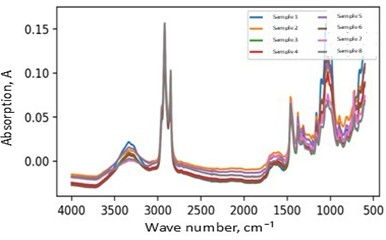
a) IR spectra of the original samples (before heating)
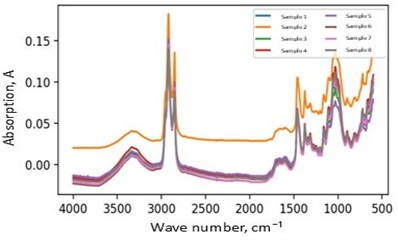
b) IR spectra of the samples after heating 160 °C, 1 hour
Fig. 2FTIR spectra of samples 1 (base bitumen) and 2 (bitumen with 5 % rubber crumb) before and after ageing at 160 °C for 1 hour, showing the evolution of carbonyl (C = O) and sulfoxide (S = O) functional groups
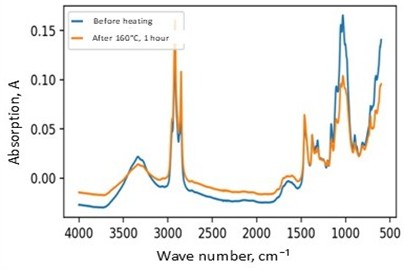
a) Sample 1. B (pure bitumen)
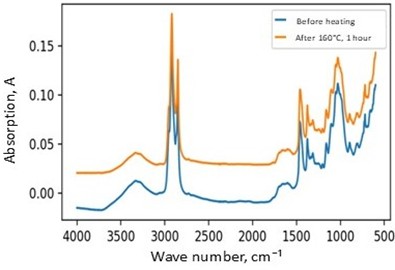
b) Sample 2. B + 5 % RK
Table 2AI and PI index values for the original samples
Sample | AI (before heating) | PI (before heating) |
1 | –0.106 | 1.503 |
2 | 0.157 | 1.192 |
3 | –0.084 | 1.142 |
4 | –0.008 | 1.147 |
5 | 0.113 | 1.171 |
6 | –0.061 | 1.418 |
7 | 0.094 | 0.999 |
8 | 0.047 | 0.935 |
3.2. Aging indices at 160 °C, 1 hour
The carbonyl index (CI) shows that, when held at 160 °C for 1 hour, most systems experience an increase in the content of C = O carbonyl structures. The largest increase in CI (≈ 0.31) is characteristic of composition 2 (B + 5 % RK); elevated ΔCI values are also noted for samples 3 and 6. The smallest increase in CI was recorded for compositions 5 and 8, which indicates their higher resistance to thermal-oxidative aging.
Samples 1 and 2 exhibited high paraffin content and pronounced susceptibility to thermo-oxidative ageing. Sample 1 (pure bitumen) showed significant growth of carbonyl groups after thermal exposure, confirming intensive ageing processes and indicating that, although it serves as a reference material, its resistance to oxidation is limited. Sample 2 (B + 5 % RK) demonstrated the largest increase in oxidation indices, reflecting a high tendency toward degradation and confirming that this composition is the most sensitive to ageing among the studied systems.
Table 3The CI and SI index values before and after heating
Sample | CI up to | CI after | ΔCI | SI up to | SI after | ΔSI |
1 | –0.178 | –0.003 | 0.175 | 3.470 | 1.960 | –1.510 |
2 | 0.101 | 0.410 | 0.309 | 1.733 | 1.377 | –0.356 |
3 | –0.138 | 0.060 | 0.198 | 2.122 | 1.697 | –0.425 |
4 | –0.070 | 0.063 | 0.133 | 1.950 | 2.039 | 0.089 |
5 | 0.045 | 0.112 | 0.067 | 1.945 | 1.287 | –0.658 |
6 | –0.150 | 0.045 | 0.195 | 2.665 | 1.961 | –0.704 |
7 | 0.097 | –0.034 | –0.131 | 1.316 | 1.998 | 0.682 |
8 | –0.020 | 0.032 | 0.052 | 1.305 | 1.920 | 0.615 |
Fig. 3FTIR spectra of samples 3 and 4 containing gossypol resin and combined modifiers, illustrating moderate structural changes and oxidation behavior after thermo-oxidative ageing
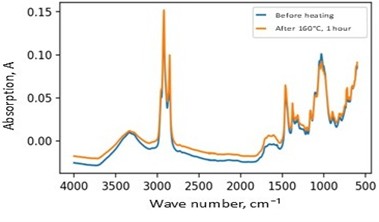
a) Sample 3. B + 3 % GS
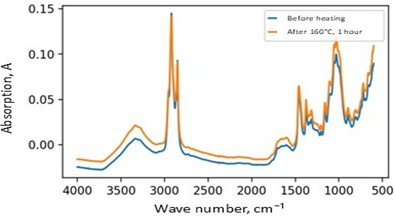
b) Sample 4. B + 10 % rubber + 3 % GS
Samples 3 and 4 exhibited moderate paraffin content and noticeable thermo-oxidative ageing after thermal exposure. Sample 3 showed a clear increase in carbonyl groups, indicating that the addition of gossypol resin alone does not provide sufficient protection against oxidation and results in intermediate durability between pure bitumen and more stable formulations. Sample 4 demonstrated similar oxidation behavior with moderate changes in ageing indices, allowing it to be classified as having average resistance to thermo-oxidative ageing.
Fig. 4FTIR spectra of samples 5 and 6 with complex additive systems, highlighting differences in oxidation resistance and structural stability after thermal exposure at 160 °C
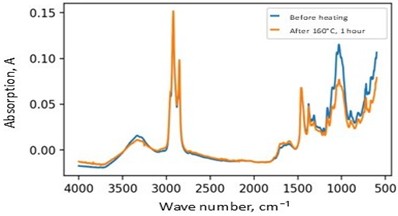
a) Sample 5. B + 10 % RK + 3 % GS + 5 % ORSM
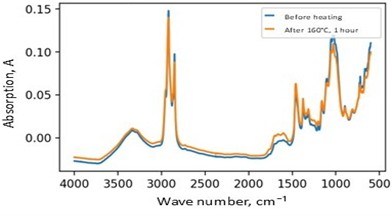
b) Sample 6. B + 3 % GS + 5 % RP
Samples 5 and 6 showed contrasting ageing behavior under thermal exposure. Sample 5 exhibited only moderate growth of oxidation indices, indicating relatively stable performance and suggesting that this composition can be considered a promising system in terms of durability. In contrast, sample 6 demonstrated significant accumulation of carbonyl groups and pronounced thermo-oxidative ageing, confirming that the combination of gossypol resin and rubber powder does not provide sufficient protection and places this formulation among the less stable systems.
Fig. 5FTIR spectra of samples 7 and 8, demonstrating reduced paraffin content and improved resistance to thermo-oxidative ageing in multi-component modified systems
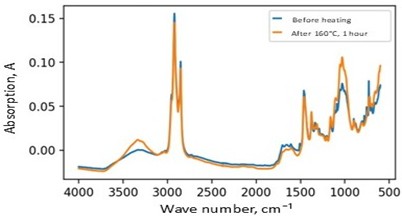
a) Sample 7. B + 5 % RK + 5 % ORSM
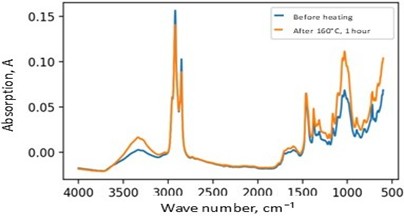
b) Sample 8. B + 5 % RK + 3 % GS + 5 % ORSM
Samples 7 and 8 exhibited reduced paraffin content and relatively stable structural characteristics. For sample 7, only minor changes in the carbonyl index after thermal exposure indicate relatively high resistance to thermo-oxidative ageing and a more favorable structure compared to pure bitumen, although its overall performance is slightly inferior to the most stable systems. Sample 8 demonstrated a balanced structural composition and moderate growth of oxidation indices, confirming improved resistance to ageing. Overall, composition 8 shows a favorable combination of structural stability and durability and can be considered one of the most promising formulations among the studied systems.
From a microstructural perspective, changes in FTIR indices reflect alterations in the colloidal structure of bitumen, particularly asphaltene-maltene interactions. Reduced paraffin bands and lower carbonyl growth in complex-modified systems indicate better asphaltene dispersion and structural stability, leading to decreased phase separation and improved resistance to oxidative ageing.
4. Conclusions
This study showed that modification of natural liquid bitumen with industrial by-products significantly affects its structure and ageing behavior. The base bitumen exhibited a high paraffin content, while modified systems demonstrated a more balanced composition. The highest increase in carbonyl index (CI ≈ 0.31) was observed for the rubber-modified sample, indicating its lower resistance to oxidation. In contrast, complex-modified systems exhibited minimal changes, confirming their improved ageing resistance. These results can be explained by improved asphaltene dispersion and stabilization of the colloidal structure in complex systems, which reduces oxidative degradation.
Although FTIR provides insight into chemical changes, physical performance was not evaluated and should be addressed in future studies.
The use of local by-products represents a promising approach for sustainable bitumen modification; however, further research is required to assess large-scale applicability.
References
-
M. Y. Yunusov, A. Toshmakhmadzoda, S. S. Umarov, and R. K. Sairahmanov, “Theoretical aspects of an experimental study of the influence of a complex additive of various functional purposes on the properties of road bitumen,” Polytechnic Bulletin. Engineering Research Series, Vol. 49, No. 1(49), pp. 123–125, 2020.
-
R. K. Sairahmanov and A. Toshmakhmadzoda, “Theoretical aspects and efficiency of using secondary raw materials and by-products of organic industry in road construction,” Polytechnic Bulletin. Engineering Research Series, No. 3(59), pp. 132–137, 2022.
-
R. K. Sairahmanov, N. S. Arabzoda, S. S. Umarov, and A. Toshmakhmadzoda, “Modified asphalt binder with additives of various functional purposes for stone mastic asphalt concrete,” Polytechnic Bulletin. Engineering Research Series, No. 4(60), pp. 157–163, 2022.
-
R. K. Sairahmanov, A. Toshmakhmadzoda, and S. Umarov, “Asphalt concrete with additives based on industrial waste and secondary raw materials,” Polytechnic Bulletin. Engineering Research Series, No. 1(61), pp. 237–241, 2023.
-
A. Toshmakhmadzoda, R. K. Sairahmanov, and D. K. Khudoykulov, “Use of some resinous waste from the processing of local coals in the composition of road bitumen,” in Science is the Basis of Innovative Development, 2019.
-
A. Toshmakhmadzoda, R. K. Sairahmanov, and H. A. Sharipov, “Efficient use of industrial waste in road materials,” in Science is the Basis of Innovative Development, 2019.
-
J. G. Speight, The Chemistry and Technology of Petroleum. Boca Raton, FL, USA: CRC Press, 2014, https://doi.org/10.1201/b16559
-
D. Lesueur, “The colloidal structure of bitumen: Consequences on the rheology and on the mechanisms of bitumen modification,” Advances in Colloid and Interface Science, Vol. 145, No. 1-2, pp. 42–82, Jan. 2009, https://doi.org/10.1016/j.cis.2008.08.011
-
X. Lu and U. Isacsson, “Effect of ageing on bitumen chemistry and rheology,” Construction and Building Materials, Vol. 16, No. 1, pp. 15–22, Feb. 2002, https://doi.org/10.1016/s0950-0618(01)00033-2
-
G. Airey, “Rheological properties of styrene butadiene styrene polymer modified road bitumens,” Fuel, Vol. 82, No. 14, pp. 1709–1719, 2003, https://doi.org/10.1016/s0016-2361(03)00146-7
-
J. Petersen, Transportation Research Board. Washington, D.C.: Transportation Research Board, 2009, pp. 1–56, https://doi.org/10.17226/23002
-
M. N. Siddiqui and M. F. Ali, “Studies on the aging behavior of asphalt using FTIR spectroscopy,” Fuel, Vol. 78, No. 9, pp. 1005–1012, 1999.
-
I. Yut and A. Zofka, “Correlation between rheology and chemical composition of aged polymer-modified asphalts,” Construction and Building Materials, Vol. 62, pp. 109–117, 2014, https://doi.org/10.1016/j.conbuildmat.2014.03.043
-
J. Zhu, B. Birgisson, and N. Kringos, “Polymer modification of bitumen: Advances and challenges,” European Polymer Journal, Vol. 54, pp. 18–38, May 2014, https://doi.org/10.1016/j.eurpolymj.2014.02.005
-
A. Behnood, “Performance of asphalt mixtures modified with crumb rubber: A review,” Construction and Building Materials, Vol. 111, pp. 384–408, 2016.
-
R. Karlsson and U. Isacsson, “Material-related aspects of asphalt recycling-state-of-the-art,” Journal of Materials in Civil Engineering, Vol. 18, No. 1, pp. 81–92, 2006, https://doi.org/10.1061/(asce)0899-1561(2006)18:1(81)
-
L. Ding et al., “Evaluation of oxidative aging in asphalt binder using FTIR and rheological tests,” Materials, Vol. 11, No. 12, 2018.
-
N. Kringos, M. N. Partl, and A. Scarpas, “Multi-scale investigation of bitumen ageing,” Road Materials and Pavement Design, Vol. 9, No. sup1, pp. 83–109, 2008.
-
S. Djabbarov, K. Abdullaev, and S. Shayakhmetov, “Modeling the trajectory of wind-sand flow over a highway,” in AIP Conference Proceedings, Vol. 3390, No. 1, p. 050021, Mar. 2026, https://doi.org/10.1063/5.0321772
About this article

The authors have not disclosed any funding.
The datasets generated during and/or analyzed during the current study are available from the corresponding author on reasonable request.
The authors declare that they have no conflict of interest.

