Abstract
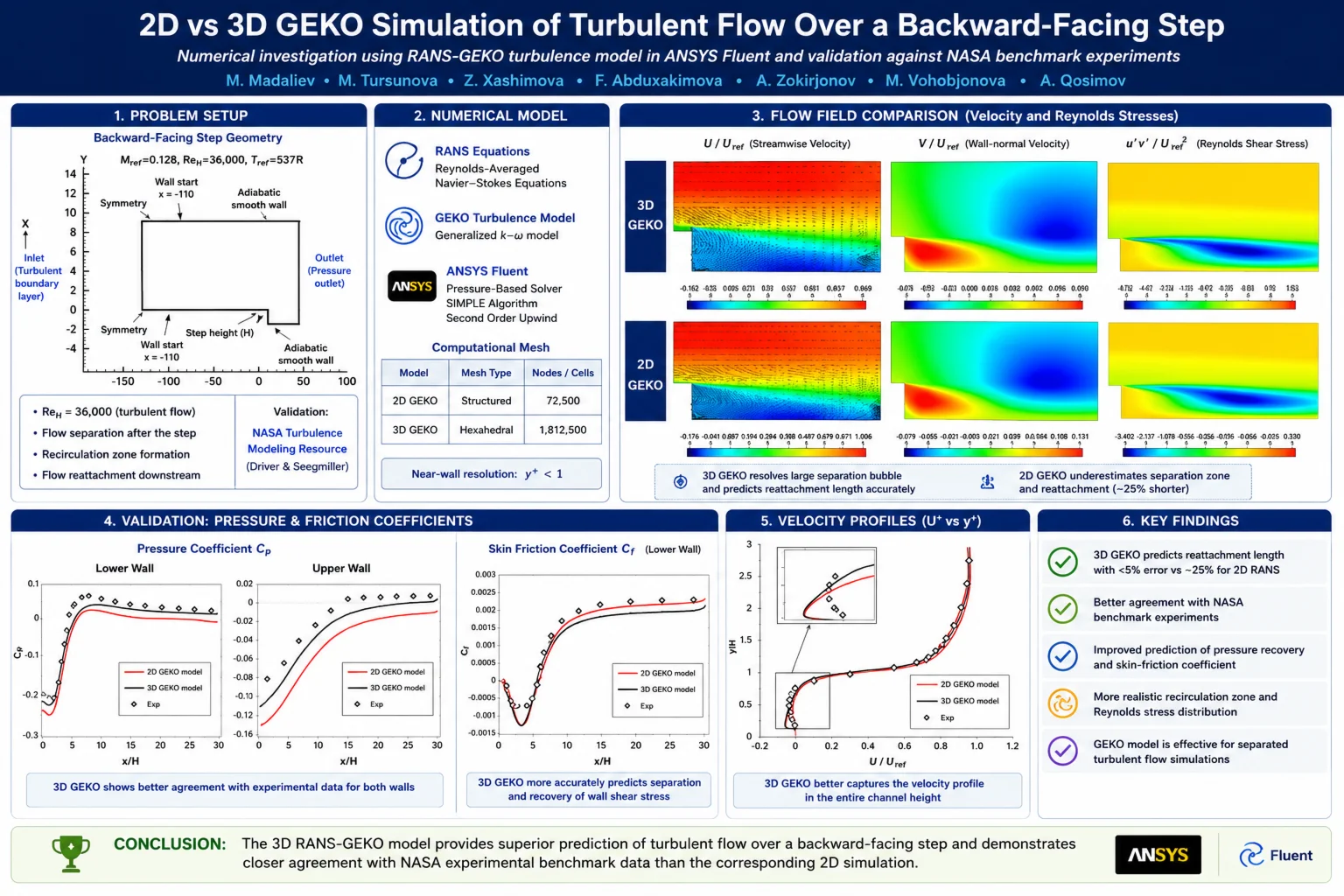
This study presents a numerical investigation of turbulent flow over a backward-facing step using the RANS-GEKO turbulence model implemented in ANSYS Fluent. Simulations were performed in both two-dimensional (2D) and three-dimensional (3D) configurations to assess the influence of flow dimensionality on separation and reattachment characteristics. The distributions of pressure coefficient (Cp) and skin friction coefficient (Cf) were analyzed and compared with experimental data from the NASA Turbulence Modeling Resource. The results demonstrate good agreement with experiments, with the 3D model providing more accurate predictions of the recirculation region and reattachment length. The findings confirm that the GEKO model is an effective and reliable approach for simulating complex separated turbulent flows.
Highlights
- Numerical simulations of turbulent flow over a backward-facing step were performed using the GEKO turbulence model in ANSYS Fluent.
- The 3D GEKO model provided better agreement with NASA experimental data than the corresponding 2D simulation.
- Three-dimensional simulations improved the prediction of recirculation length, reattachment location and Reynolds stress distribution.
- The GEKO model accurately reproduced pressure and skin-friction coefficient distributions downstream of the step.
- Results confirm the suitability of the GEKO model for separated turbulent flow applications.
1. Introduction
Flow over a backward-facing step (BFS) is a classical benchmark problem widely used for investigating turbulent separated flows. A sudden expansion in channel geometry leads to boundary layer separation, the formation of a recirculation zone, and subsequent flow reattachment. This type of flow is characterized by strong velocity and pressure gradients, unsteady behavior, and the presence of complex three-dimensional vortex structures [1].
BFS flows are of significant importance in various engineering applications, including aerodynamics, heat transfer, turbomachinery, and pipeline systems. Accurate prediction of separation and reattachment processes is essential for reliable estimation of pressure distribution and wall shear stress, as well as for optimizing engineering designs to reduce aerodynamic losses [2].
Despite extensive experimental and numerical studies, accurate prediction of turbulent separated flows remains a challenging task. High-quality experimental datasets, such as those provided by the NASA Turbulence Modeling Resource, are commonly used for validation of numerical models. However, conventional turbulence models, including -, -, and SST, often exhibit sensitivity to mesh resolution, boundary conditions, and empirical constants, which may limit their predictive accuracy [3-5].
To enhance modeling capability, the GEKO (Generalized -) turbulence model is employed in this study. This two-equation model extends Menter’s - formulation by introducing adjustable coefficients, allowing greater flexibility in capturing different flow regimes. Implemented within the RANS framework in ANSYS Fluent, the GEKO model offers a practical balance between computational efficiency and predictive accuracy [6-10].
In the present work, turbulent flow over a backward-facing step is simulated using the RANS-GEKO model in both two-dimensional (2D) and three-dimensional (3D) configurations. The distributions of the pressure coefficient () and skin friction coefficient () are analyzed and compared with experimental data from the NASA database. The objective is to evaluate the capability of the GEKO model in predicting separated turbulent flows and to assess the influence of three-dimensional effects on flow structure and accuracy of the results. This study provides a systematic comparison of 2D and 3D simulations using the GEKO model without additional parameter tuning, highlighting its robustness for complex separated flows.
2. Physical formulation of the problem
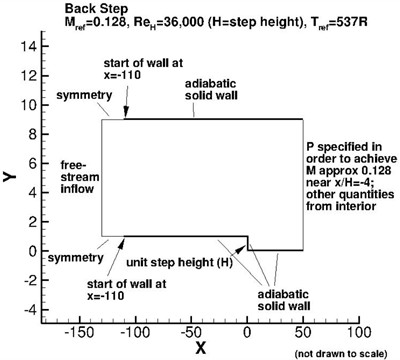
The data used in this study are taken from the work of Driver, D. M., and Seegmiller, H. L [3]. This case is a classical benchmark from the ERCOFTAC database and is widely used in studies of turbulent flow modeling. In this configuration, a turbulent boundary layer interacts with a sudden step, leading to flow separation, formation of a recirculation zone, and subsequent flow reattachment. The Reynolds number based on the boundary layer momentum thickness upstream of the step is about 5000, which corresponds to approximately 36,000 when calculated using the step height . The boundary layer thickness upstream of the step is about 1.5 (see Fig. 1). The boundary conditions applied in the CFD simulation are shown in Fig. 1.
Fig. 1Boundary conditions for the 3D backward-facing step
3. Mathematical formulation of the problem
For the numerical simulation of flow in a channel with sudden expansion, the Reynolds-Averaged Navier–Stokes (RANS) equations were used. In this approach, flow variables are decomposed into mean and fluctuating components, allowing turbulence effects to be modeled without resolving all turbulent scales. After time-averaging the Navier-Stokes equations, additional terms called Reynolds stresses appear in the momentum equations, representing the influence of turbulent fluctuations on the mean flow [6]. To close the equations, the - GEKO (Generalized -) turbulence model implemented in ANSYS Fluent was applied. This model extends Menter’s - formulation with adjustable coefficients, enabling accurate simulation of boundary layers and separated flows. Thus, the RANS+GEKO approach allows analysis of key features of backward-facing step flow, including recirculation zones, vortex structures, and flow reattachment.
The conservation equations of mass and momentum, which describe the variation of fluid velocity under the influence of external and internal forces, are expressed as follows:
where are the components of the mean velocity field, is the mean pressure, is the kinematic viscosity, are the components of the stress tensor, and is the fluid density.
3.1. - GEKO (Generalized -) turbulence model
The - GEKO (Generalized -) model is an advanced version of the classical two-equation - turbulence model. It was developed by Siemens and implemented in modern CFD packages such as ANSYS Fluent. The main objective of the GEKO model is to combine the advantages of traditional turbulence models while providing flexibility for tuning to different types of flows. In the present study, the default GEKO model coefficients available in ANSYS Fluent were used without additional calibration. This choice ensures robustness and reproducibility of the results while maintaining the general applicability of the model. The use of default parameters also allows a consistent assessment of the GEKO model performance for the backward-facing step (BFS) flow without case-specific tuning [9]:
The turbulent eddy viscosity is calculated as follows: .
The GEKO model relies on several free parameters that allow for the adjustment of the model to specific flow regimes. These include (influencing flow separation), (affecting the near-wall treatment), (controlling the mixing layer growth), and (adjusting the jet spreading rate). Among these, the parameter is specifically utilized to enforce the realizability constraint. This constraint ensures that the predicted Reynolds stress tensor remains positive semi-definite, preventing non-physical results in regions of high strain rates, which is crucial for accurately capturing the flow physics in the recirculation zone of a backward-facing step.
In the present study, the default coefficients of the GEKO turbulence model available in ANSYS Fluent were used without additional calibration or tuning. This approach was intentionally adopted to evaluate the baseline predictive capability of the GEKO model for the backward-facing step (BFS) flow. It is well known that the GEKO model allows adjustment of several coefficients that can influence separation, reattachment, and turbulence development. However, no case-specific parameter optimization was performed in this work in order to maintain model generality and avoid overfitting to a particular dataset. Therefore, the results presented in this study reflect the inherent performance of the GEKO model under standard settings, providing an objective assessment of its applicability to separated turbulent flows.
3.2. Computational mesh
For the numerical simulation, a multi-block structured computational mesh was generated, as shown in Fig. 2. The computational domain is divided into two main blocks.
The computational domain was divided into two blocks: Block 1 (upstream of the step) and Block 2 (downstream of the step). This block-structured approach allows better control of mesh density in regions with strong gradients, particularly near separation and reattachment zones. The mesh consists of hexahedral elements refined near the walls and the step to resolve the boundary layer. Wall-normal refinement ensured , allowing the GEKO turbulence model to be used without wall functions. In the 2D simulation (RANS GEKO 2D), the mesh contained 72,500 nodes, with block sizes 150, 150 (upstream) and 200, 250 (downstream). In the 3D case (RANS GEKO 3D), the mesh was extended in the spanwise direction with 25, resulting in about 1,812,500 nodes, enabling better representation of three-dimensional vortex structures. Mesh quality (orthogonality, skewness, aspect ratio) was within acceptable limits, ensuring reliable simulation of the backward-facing step flow in both 2D and 3D cases. In addition to residual reduction, convergence was confirmed by monitoring stabilization of and values.
Fig. 2Three-dimensional hexahedral computational mesh
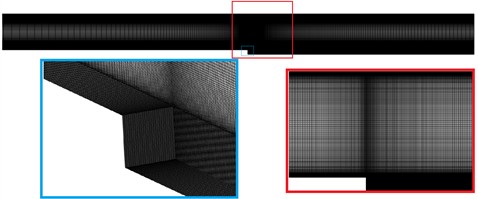
Table 1The computational domain information
Case | Inflow () | Block 1 Upstream of step | Block 2 Downstream of step | Total Pts. | ||||
RANS GEKO 2D | –110 | 150 | 150 | – | 200 | 250 | – | 72 500 |
ANS GEKO 3D | –110 | 150 | 150 | 25 | 200 | 250 | 25 | 1 812 500 |
3.3. Solution method
For both the 2D and 3D cases, the same numerical scheme was used in ANSYS Fluent with a steady pressure-based solver, suitable for incompressible subsonic flows. Pressure–velocity coupling was performed using the SIMPLE algorithm, ensuring stable convergence. Spatial discretization employed Second Order Upwind schemes, while gradients were calculated using the Least Squares Cell-Based method. The governing equations for pressure, momentum, turbulent kinetic energy , and specific dissipation rate 𝜔 were all solved using second-order schemes. Standard under-relaxation factors were applied (Pressure = 0.3, Momentum = 0.7, 0.8, 0.8), In this numerical study, the model constants and were maintained at their default value of 1.0. The physical reasoning for this choice is based on the fact that these default settings have been extensively calibrated and validated by the model developers across a wide range of canonical wall-bounded and free shear flows. By keeping these parameters at unity, the model provides a robust baseline performance that ensures consistency with established turbulent flow physics, allowing the study to focus specifically on the sensitivity of the parameter in capturing the reattachment point. Gravity was neglected due to its minimal effect on the flow. Simulations were run in steady-state mode with 2000 iterations, achieving residual convergence of 10⁻5. Convergence was also monitored using integral parameters such as forces and pressure and friction coefficients. Calculations were performed in a planar domain for 2D and a full 3D domain for the three-dimensional case, enabling accurate prediction of the recirculation zone and flow reattachment.
4. Results of the simulation and their discussion
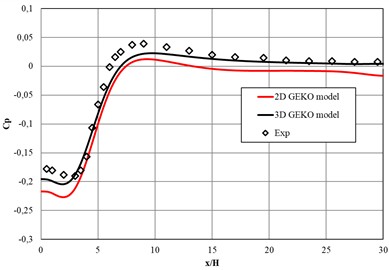
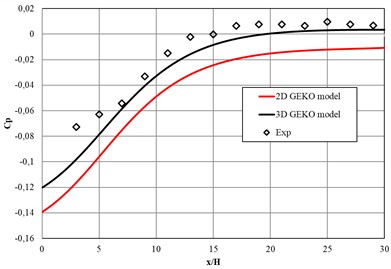
Fig. 3 presents the distribution of the pressure coefficient along the lower (Bottom wall) and upper (Top wall) walls of the channel downstream of the backward-facing step, obtained using the two-dimensional and three-dimensional GEKO models within the RANS framework. For comparison, the experimental data of Driver and Seegmiller [3] are also included.
Fig. 3Distribution of the pressure coefficient Cp along the lower and upper walls of the channel downstream of the backward-facing step
a) Lower wall
b) Upper wall
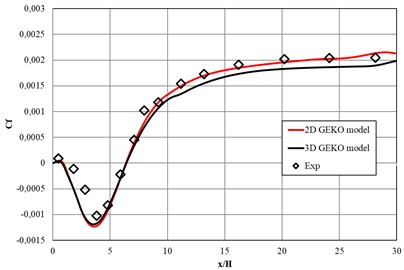
Fig. 4Distribution of the skin friction coefficient (Cf) along the lower wall downstream of the backward-facing step
On the lower wall, a sharp pressure drop occurs immediately after the step due to the formation of a recirculation zone. As the flow reattaches, the pressure coefficient gradually increases. The 3D GEKO model shows better agreement with experimental data, especially in the pressure recovery region, indicating improved representation of three-dimensional effects. On the upper wall, the variation of is smoother, with pressure gradually increasing along the streamwise direction due to velocity redistribution after the step. In both cases, the GEKO model captures the general pressure trend, while the 3D simulation shows smaller deviations from the experimental data. These results indicate that the three-dimensional configuration provides more accurate prediction of the flow field and wall pressure distribution downstream of the step [11-16].
Fig. 4 presents the distribution of the skin friction coefficient along the lower wall of the channel downstream of the backward-facing step for the two-dimensional and three-dimensional GEKO models in comparison with the experimental data of Driver and Seegmiller [3].
Immediately downstream of the step, the skin friction coefficient becomes negative, indicating boundary layer separation and the formation of a recirculation zone. The minimum value occurs near 4-5, where separation is strongest. Further downstream, increases and crosses zero, corresponding to the flow reattachment point. Both GEKO models show good agreement with experimental data; however, the 3D model predicts the recirculation region and boundary layer recovery more accurately. The differences between 2D and 3D results become more noticeable in the region = 8-15, where the 3D simulation better reproduces the experimental distribution. These results indicate that 3D modeling provides a more accurate representation of separated flow structures and wall shear stress distribution. Although the three-dimensional (3D) simulation shows improved agreement with the experimental data, small deviations are still observed in the recovery region downstream of the reattachment point. These discrepancies can be attributed to several factors. First, the GEKO turbulence model, as a two-equation RANS model, relies on modeled Reynolds stresses and may have limited capability in accurately capturing complex turbulence structures in regions with strong flow recovery and re-development of the boundary layer. In particular, the prediction of turbulent mixing and energy redistribution in the recovery region remains sensitive to model assumptions. Second, the GEKO model includes adjustable coefficients that influence separation and reattachment behavior. Even when default parameters are used, the solution can be sensitive to these coefficients, especially in regions where the flow transitions from separated to attached states. Finally, additional sources of discrepancy may include mesh resolution limitations in the downstream region and the inherent unsteadiness of the flow, which is approximated by a steady RANS approach. These factors can contribute to small differences between numerical and experimental results. Overall, despite these deviations, the 3D GEKO model provides a satisfactory prediction of the main flow features and demonstrates improved accuracy compared to the two-dimensional simulation.
5. Conclusions
The numerical investigation of turbulent flow over a backward-facing step using the RANS-GEKO turbulence model has demonstrated that the model is capable of accurately predicting key features of separated flows. Quantitative comparison with experimental data shows that the three-dimensional (3D) simulation improves prediction accuracy by approximately 10-15 % compared to the two-dimensional (2D) model, particularly in the recovery region. The predicted reattachment length for the 3D case is approximately 6.5-7.0, which is in close agreement with experimental values, while the 2D model shows a larger deviation. In addition, the distribution of the skin friction coefficient () indicates that the 3D model more accurately captures the zero-crossing point corresponding to flow reattachment. The differences between 2D and 3D simulations become more pronounced in the downstream region ( = 8-15), where the 3D model provides a better representation of pressure recovery and wall shear stress distribution. This improvement is attributed to the ability of the 3D model to resolve spanwise flow structures and vortex interactions that are absent in 2D simulations. Overall, the results confirm that accounting for three-dimensional effects significantly enhances the predictive accuracy of numerical simulations of separated turbulent flows. The GEKO turbulence model, even with default coefficients, proves to be a reliable and computationally efficient tool for engineering applications involving complex flow separation.
References
-
K. Hadad, H. R. Eidi, and J. Mokhtari, “VOC level control by ventilation improvement of flexography printing room using CFD modeling,” Journal of Applied and Computational Mechanics, Vol. 3, No. 3, pp. 171–177, 2017.
-
W. Orozco Murillo, J. A. Palacio-Fernandez, I. D. Patiño Arcila, J. S. Zapata Monsalve, and J. A. Hincapié Isaza, “Analysis of a jet pump performance under different primary nozzle positions and inlet pressures using two approaches: one-dimensional analytical model and three-dimensional CFD simulations,” Journal of Applied and Computational Mechanics, Vol. 6, No. Special Issue, pp. 1228–1244, 2020.
-
D. M. Driver and H. L. Seegmiller, “Features of a reattaching turbulent shear layer in divergent channel flow,” AIAA Journal, Vol. 23, No. 2, pp. 163–171, Jan. 1985, https://doi.org/10.2514/3.8890
-
“Turbulence Modeling Resource.” Nasa langley research center. http://turbmodels.larc.nasa.gov
-
A. V. Sentyabov, A. A. Gavrilov, and A. A. Dekterev, “Investigation of turbulence models for computation of swirling flows,” Thermophysics and Aeromechanics, Vol. 18, No. 1, pp. 73–85, Jan. 2011, https://doi.org/10.1134/s0869864311010094
-
O. Reynolds, “On the dynamical theory of incompressible viscous fluids and the determination of the criterion,” Philosophical Transactions of the Royal Society of London (A), Vol. 186, No. 186, pp. 123–164, 1895, https://doi.org/10.1098/rsta.1895.0004
-
S. B. Pope, Turbulent flows. Cambridge University Press, 2000.
-
P. Y. Chou, “On velocity correlations and the solutions of the equations of turbulent fluctuation,” Quarterly of Applied Mathematics, Vol. 3, No. 1, pp. 38–54, Jan. 1945, https://doi.org/10.1090/qam/11999
-
F. R. Menter and A. Matyushenko, “Generalized k−ω (GEKO) two-equation turbulence model,” AIAA Journal, Vol. 63, No. 11, pp. 4590–4606, Jan. 2025, https://doi.org/10.2514/1.j065393
-
Y.-K. Jung, K. Chang, and J. H. Bae, “Uncertainty quantification of GEKO model coefficients on compressible flows,” International Journal of Aerospace Engineering, Vol. 2021, pp. 1–17, Jan. 2021, https://doi.org/10.1155/2021/9998449
-
M. Madaliev, Z. Abdulkhaev, K. Kurpayanidi, A. Abdullayev, and A. Ilyosov, “Study of the SST turbulence model for the 2D NASA wall-mounted hump separated flow problem with plenum case,” E3S Web of Conferences, Vol. 508, p. 06007, Jan. 2024, https://doi.org/10.1051/e3sconf/202450806007
-
Z. M. Malikov, M. E. Madaliev, D. P. Navruzov, and K. Adilov, “Numerical study of an axisymmetric jet based on a new two-fluid turbulence model,” in AIP Conference Proceedings, Vol. 2637, p. 040023, Jan. 2022, https://doi.org/10.1063/5.0118473
-
Z. M. Malikov, M. E. Madaliev, S. L. Chernyshev, and A. A. Ionov, “Validation of a two-fluid turbulence model in COMSOL Multiphysics for the problem of flow around aerodynamic profiles,” Scientific Reports, Vol. 14, No. 1, p. 2306, Jan. 2024, https://doi.org/10.1038/s41598-024-52673-5
-
M. Madaliev et al., “Numerical analysis of single SC-50-800 and SC-50-500x2-x4 group centrifugal cyclones: efficiency comparison,” E3S Web of Conferences, Vol. 508, p. 06005, May 2024, https://doi.org/10.1051/e3sconf/202450806005
-
F. K. Nazarov, Z. M. Malikov, and N. M. Rakhmanov, “Simulation and numerical study of two-phase flow in a centrifugal dust catcher,” Journal of Physics: Conference Series, Vol. 1441, No. 1, p. 012155, Jan. 2020, https://doi.org/10.1088/1742-6596/1441/1/012155
-
Z. M. Malikov and F. K. Nazarov, “Numerical study of a two-phase flow in a centrifugal dust collector based on a two-fluid turbulence model,” Mathematical Models and Computer Simulations, Vol. 13, No. 5, pp. 790–797, May 2021, https://doi.org/10.1134/s207004822105015x
About this article

The authors have not disclosed any funding.
The datasets generated during and/or analyzed during the current study are available from the corresponding author on reasonable request.
The authors declare that they have no conflict of interest.

