Abstract
. This study presents a mathematical framework for assessing and predicting the technical condition of urban reinforced concrete bridge structures under the operating conditions of Tashkent. The empirical basis of the study includes visual inspection data collected from more than 30 bridges and overpasses, where defects and damage were evaluated using five technical and operational indicators: load-bearing capacity, throughput capacity, durability, traffic safety and comfort, and maintainability. To quantify the relative importance of these indicators, the hierarchy analysis method was applied in MPriority 1.0, and the resulting weighting scheme demonstrated acceptable consistency (OC = 5.29 %). Based on the obtained weights, a generalized technical condition indicator was formed and integrated with a wear-function-based service-life prediction model. A software-based assessment procedure was used to support practical evaluation of reinforced concrete bridge structures. The case analysis showed that the overpass located at the intersection of Gavkhar and Bunyodkor streets in Tashkent has entered an unsatisfactory condition stage after approximately 24 years of operation, while its estimated service life is 35-38 years. The proposed approach can be used as a decision-support tool for bridge-condition assessment and maintenance planning in urban transport systems.
1. Introduction
The reliable operation of urban reinforced concrete bridges and overpasses is a key condition for the safety, continuity, and efficiency of modern transport systems. As traffic intensity increases and bridge assets age, urban infrastructure managers face growing challenges related to structural deterioration, reduced operational performance, and the need for timely maintenance decisions. In this context, the assessment of the technical and operational condition of bridge structures has become an important engineering task, especially for cities with rapidly growing transport demand [1-3].
Long-term operational experience of reinforced concrete bridges in large cities also confirms the need for systematic assessment of bridge performance during service [8].
The long-term behavior of reinforced concrete bridge structures is influenced by the cumulative effect of load, environmental exposure, defect development, and maintenance quality. During operation, bridges gradually lose part of their initial performance due to the accumulation of damage, material degradation, and functional wear, which makes durability assessment and service-life prediction essential components of infrastructure management [6], [7], [9]. In engineering practice, this problem is especially important for urban bridges, where even moderate deterioration may lead not only to structural concerns but also to decreased traffic safety, lower comfort, and restrictions in throughput capacity.
A number of studies have proposed approaches for evaluating the condition of reinforced concrete bridges and overpasses using integrated technical indicators, expert judgment, and deterioration-oriented interpretation models [2], [10], [12]. These studies demonstrate that bridge-condition assessment should not be limited to isolated structural defects, but should combine several technical and operational indicators within a unified evaluation framework. At the same time, previous works also show that service-life prediction remains methodologically challenging, since the deterioration process depends on both time-dependent material behavior and the operational environment of the structure [6], [7], [12].
For Tashkent and other large urban areas, this issue is of particular relevance. The city’s transport system is experiencing steadily increasing traffic loads, while a considerable part of the existing bridge stock continues to operate under long-term service conditions. In addition, the regional context requires attention not only to operational defects but also to broader structural reliability issues, including the behavior of bridge systems in seismically sensitive environments and the prospective use of seismic-protection solutions for artificial structures [3], [5], [14], [15]. Under such conditions, there is a practical need for a transparent and engineering-oriented method that can support both current-condition assessment and service-life interpretation for urban reinforced concrete bridge structures.
The long-term performance of transport infrastructure depends not only on structural design, but also on climatic, geological, hydrogeological, and dynamic subsoil conditions. In arid regions, the design and construction of transport facilities should account for dry-hot climatic effects that may influence material behavior and durability in service [17]. Previous studies have shown that engineering-geological and hydrogeological conditions may significantly affect the safety and operational feasibility of infrastructure facilities, while vibration-sensitive soil behavior and seismic loading effects are also important for structural reliability under repeated dynamic actions [18-22]. More broadly, sustainable engineering practice increasingly emphasizes environmentally responsible technological solutions and resource-efficient material processing [23].
Despite the existing studies on the assessment of reinforced concrete bridges and overpasses, a practically applicable framework that combines weighted technical-operational indicators with service-life prediction for urban bridge structures under Tashkent conditions is still insufficiently presented in the literature [2], [3], [12]. Therefore, the aim of this study is to develop and apply a mathematical model for assessing and predicting the condition of urban reinforced concrete bridge structures based on integrated technical and operational indicators. The novelty of the study lies in three aspects. First, a weighted multi-criteria framework is developed for the integrated assessment of reinforced concrete bridge structures using five indicators: load-bearing capacity, throughput capacity, durability, traffic safety and comfort, and maintainability. Second, a generalized technical condition indicator is combined with a deterioration-based interpretation to estimate the service-life horizon of structures in operation. Third, the proposed approach is applied to bridge structures in Tashkent in order to support maintenance prioritization and improve the practical decision-making basis for urban bridge management.
Unlike conventional AHP-based bridge-condition assessment studies, which are mainly limited to ranking or weighting technical criteria, the present study combines AHP-derived indicator weighting with a deterioration-based service-life interpretation framework. Thus, the contribution of the study lies not only in the integrated multi-criteria assessment of bridge condition, but also in linking inspection-based weighted evaluation to an engineering estimate of the transition to the unsatisfactory operating stage and the corresponding service-life horizon for urban reinforced concrete bridge structures under Tashkent operating conditions.
2. Materials and methods
2.1. Bridge sample and inspection procedure
The empirical basis of the study consisted of visual inspection data collected from more than 30 reinforced concrete bridges and overpasses located in Tashkent. The inspected structures differed in their operational condition, service period, and observed defect patterns. During the survey, visible defects and damage were identified and interpreted with respect to the technical and operational condition of each structure.
For the purposes of the study, the assessment procedure was based on five key technical and operational indicators: load-bearing capacity, throughput capacity, durability, traffic safety and comfort, and maintainability. The identified defects and damage were interpreted according to the indicator system shown in Fig. 1.
Fig. 1Main technical and operational indicators
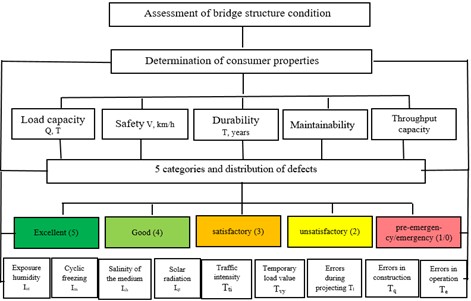
These indicators were selected as the most relevant for evaluating the operational suitability of urban reinforced concrete bridge structures under Tashkent conditions. The identified defects and damage were grouped and interpreted according to their influence on these indicators.
The assessment logic included the following stages:
1) Visual inspection of bridge structures.
2) Identification of defects and damage.
3) Interpretation of observed deficiencies in relation to the selected technical and operational indicators.
4) Calculation of the weighted generalized condition indicator.
5) Interpretation of the service-life horizon using the deterioration function .
Table 1Summary of the inspected bridge sample
Parameter | Value / description |
Number of inspected structures | More than 30 |
Structure type | Reinforced concrete bridges and overpasses |
Location | Tashkent |
Main assessment basis | Visual inspection of defects and damage |
Evaluated indicators | Load-bearing capacity, throughput capacity, durability, traffic safety and comfort, maintainability |
Typical observed deficiencies | Cracking, concrete surface deterioration, local damage, reduced maintainability, operational wear |
Purpose of assessment | Integrated condition assessment and service-life interpretation |
2.2. Weighting of technical and operational indicators
Since the selected technical and operational indicators do not contribute equally to the overall condition of a bridge structure, their relative importance was determined using the analytic hierarchy process (AHP). The weighting procedure was implemented in MPriority 1.0 and was used to calculate the priority coefficients of the criteria and to obtain their ranked structure.
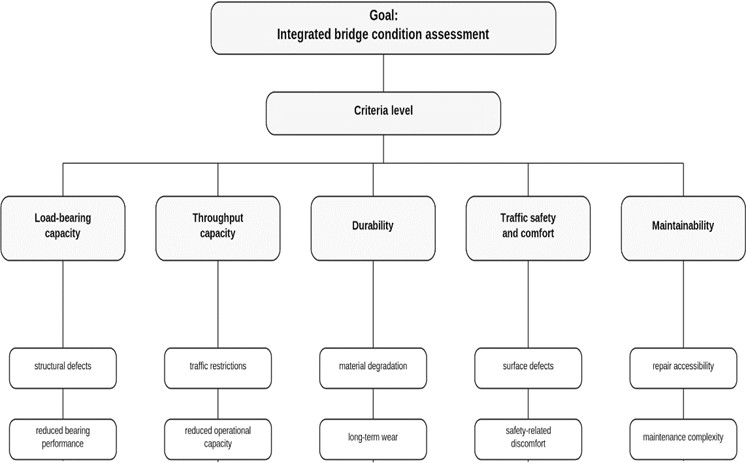
The AHP procedure included the following stages: (1) formulation of the decision goal, namely the integrated assessment of the technical condition of urban reinforced concrete bridge structures; (2) construction of the hierarchy consisting of one goal level and five criteria: load-bearing capacity, throughput capacity, durability, traffic safety and comfort, and maintainability; (3) pairwise comparison of the criteria using expert judgment and engineering interpretation of the significance of each criterion for bridge operation; (4) calculation of local and global priorities; and (5) verification of the consistency of expert judgments.
Fig. 2AHP hierarchy used to determine the relative importance of the technical and operational indicators
The pairwise comparison matrix was formed using the standard Saaty scale. The comparisons reflected the practical engineering importance of each criterion for the operational suitability of bridge structures in urban conditions. In particular, greater importance was assigned to criteria directly affecting structural reliability and safe operation, whereas criteria related to maintenance convenience were assigned lower relative importance.
The hierarchical structure used to determine the relative significance of the criteria is presented in Fig. 2. The obtained global priorities were used as the weight coefficients of the technical and operational indicators in the subsequent generalized-condition calculations. The resulting consistency ratio was acceptable (OC = 5.29 %), which confirms the internal consistency of the adopted pairwise comparisons.
Hereafter, the five technical and operational indicators are referred to as TOI.
2.3. Generalized technical condition indicator
To obtain an integrated numerical representation of the condition of each inspected bridge structure, the selected technical and operational indicators were aggregated into a generalized technical condition indicator. Since the indicators do not contribute equally to the overall structural condition, their relative importance was taken from the analytic hierarchy process (AHP) results presented in Table 2.
Table 2Weight coefficients of technical and operational indicators (TOI)
TOI | Designation | Weight coefficient |
Load-bearing capacity | L | 0.510 |
Throughput capacity | T | 0.260 |
Durability | D | 0.129 |
Traffic safety and comfort | S | 0.064 |
Maintainability | M | 0.033 |
Sum | – | 1.000 |
The generalized technical condition indicator for bridge was calculated as:
where is the generalized technical condition indicator of bridge ; is the AHP-derived weight of indicator ; is the normalized condition score of bridge with respect to indicator ; 1, … ,5; and 1,…, , where is the number of inspected bridge structures.
In the present study, the five technical and operational indicators were: 1 load-bearing capacity, 2 throughput capacity, 3 durability, 4 traffic safety and comfort, and 5 maintainability.
According to the AHP results, the adopted weights were: 0.510, 0.260, 0.129, 0.064, 0.033, which satisfy the normalization condition .
For each bridge, the value of was assigned on the basis of visual inspection and engineering interpretation of detected defects and damage. To ensure a unified assessment procedure, the observed condition of each indicator was classified into five defect categories: 1, 2, 3, 4, 5, where 1 corresponds to a critical condition, 2 to a dangerous condition, 3 to a significant defect level, 4 to an insignificant defect level, and 5 to a minor defect level.
To transform the defect category into a numerical score, the following normalized relation was used:
where {0, 25, 50, 75, 100} is the score of bridge for indicator , and is the assigned defect category. Thus, higher values of correspond to a better technical and operational condition.
Substituting Eq. (2) into Eq. (1), the generalized technical condition indicator can be written as:
This formulation makes it possible to combine heterogeneous inspection observations into one integrated quantitative indicator that reflects both the severity of the observed deficiencies and the relative engineering importance of each technical and operational indicator.
The software implementation of the proposed methodology consisted of two main stages. First, the relative weights of the technical and operational indicators were obtained using the AHP procedure in MPriority 1.0 on the basis of the pairwise comparison matrix. Second, the inspection results for each bridge were entered into a calculation module, where the defect categories assigned to the five indicators were transformed into normalized scores and aggregated into the generalized technical condition indicator according to Eqs. (1)-(3). The service-life interpretation module then applied Eq. (4) to generate the deterioration trajectory and to estimate the time interval corresponding to the transition into the unsatisfactory condition category. In this way, the software served as a decision-support tool integrating inspection-based scoring, weighted condition aggregation, and scenario-based service-life interpretation.
2.4. Service-life prediction model
In addition to evaluating the current technical condition of bridge structures, the study aimed to interpret their future deterioration and service-life horizon. For this purpose, the generalized condition assessment was linked to a deterioration function , which describes the condition level of a bridge as a function of service time.
The deterioration process was represented by the following parametric model:
where is the relative condition level of the structure at service time ; is the service life in years; is the initial condition level at the beginning of operation; is the deterioration-rate parameter; and is the shape parameter controlling the curvature of deterioration over time.
In the adopted interpretation, characterizes the condition of the structure at commissioning and was taken as the reference initial state of the bridge. The parameter reflects the overall intensity of condition deterioration under actual operating conditions, while characterizes whether the deterioration process develops approximately linearly or nonlinearly over time.
The values of and were selected for the case-study overpass on the basis of engineering interpretation of inspection results, service age, and the observed transition of the structure into lower condition categories. In this study, the model was used as a practical engineering approximation intended for condition-based maintenance planning rather than as a fully instrument-calibrated structural reliability model.
To improve reproducibility, the baseline parameter set used for the case-study overpass was supplemented by a simple sensitivity analysis. The deterioration-rate parameter and the initial-condition parameter were varied by ±10 % relative to the baseline case, and the corresponding change in the predicted service-life interval was recorded, as shown in Table 4. This procedure made it possible to evaluate the stability of the prediction with respect to moderate variations in the adopted model coefficients.
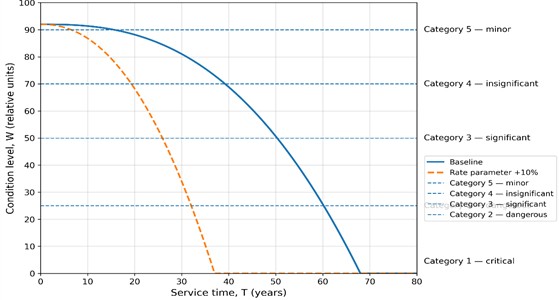
The interpretation scale adopted in this study was as follows: Category 5 for 90, Category 4 for 70 89, Category 3 for 50 69, Category 2 for 25 49, and Category 1 for 25. The transition of a bridge structure into Category 2 was interpreted as entry into the unsatisfactory condition stage requiring enhanced engineering attention and maintenance planning.
For the overpass located at the intersection of Gavkhar and Bunyodkor streets in Tashkent, the calculated trajectory of showed that the structure enters the unsatisfactory condition zone after approximately 24 years of operation, while the estimated service-life horizon is 35-38 years. Thus, the proposed model makes it possible to move from a static assessment of the current condition to a predictive interpretation of the remaining service life.
Fig. 3 presents the baseline deterioration curve for the case-study overpass together with additional parametric curves illustrating the effect of changes in the adopted deterioration parameters. Therefore, the graph should be interpreted as a scenario-based engineering illustration of the deterioration path rather than as a deterministic forecast independent of the assumed parameters.
To improve the transparency of the prediction procedure, the service-life estimate was additionally interpreted in terms of parameter sensitivity. Since the deterioration trajectory depends on the adopted model coefficients, the predicted service life should be understood as a range rather than as a single exact value. A limited sensitivity analysis showed that moderate variation of the deterioration parameters leads to corresponding variation in the predicted service-life horizon, while the overall conclusion on the onset of the unsatisfactory condition stage remains stable. This confirms that the model is suitable for engineering interpretation and maintenance planning, although further validation using instrumental monitoring data is still required.
Accordingly, Fig. 3 illustrates the qualitative sensitivity of the deterioration path to parameter variation, rather than a unique parameter-free prediction.
To improve reproducibility, the deterioration trajectories presented in Fig. 3 should be interpreted as scenario-based engineering curves generated for the case-study overpass located at the intersection of Gavkhar and Bunyodkor streets in Tashkent. In the present manuscript, Table 4 reports the influence of ±10 % variation of the adopted deterioration-model parameters on the predicted service-life interval, whereas the baseline coefficients themselves should be reported explicitly in future extended versions of the methodology. Thus, the proposed model is intended primarily for engineering interpretation, maintenance prioritization, and decision support rather than for fully deterministic forecasting.
Fig. 3Scenario-based deterioration curves and condition-category thresholds for the case-study overpass at the intersection of Gavkhar and Bunyodkor streets, Tashkent
3. Results and discussion
3.1. Results of integrated condition assessment
The proposed mathematical framework made it possible to convert heterogeneous inspection observations into a unified quantitative assessment of reinforced concrete bridge structures in Tashkent. The model was applied to visual inspection data collected from more than 30 bridges and overpasses, where defects and damage were interpreted using five technical and operational indicators: load-bearing capacity, throughput capacity, durability, traffic safety and comfort, and maintainability. Such a structure of indicators made it possible to move from a fragmented description of individual defects to an integrated assessment of the operational condition of bridge assets.
In addition to the detailed case-study overpass, the broader inspection campaign covered more than 30 urban reinforced concrete bridge structures differing in age, operational exposure, and observed defect patterns. This broader dataset served as the empirical basis for identifying the main groups of deterioration-related deficiencies and for interpreting the relative significance of the selected technical and operational indicators. Although the present article presents only one structure as a detailed illustrative example, the proposed framework was derived from a wider urban bridge sample rather than from a single isolated case.
The weighting procedure implemented through the hierarchy analysis method showed that the selected criteria are not equivalent in their influence on the overall state of a structure. Therefore, the generalized condition indicator reflects not merely the presence of damage, but the relative engineering significance of different defect groups and operational limitations. This interpretation is consistent with earlier studies in which bridge-condition assessment is based on integrated technical and operational criteria rather than on isolated defects alone [1-3], [10], [12].
To improve the transparency of the empirical basis, Table 3 presents a condensed illustrative summary of representative inspected structures from the broader bridge sample. Although the present article focuses on one overpass as a detailed case study, the proposed framework was derived from a wider inspection campaign and should be interpreted in this broader urban bridge context.
Table 3Condensed summary of representative inspected bridge structures
Bridge ID | Structure type | Approx. age, years | Main observed defects | Dominant affected indicator | Assigned condition category | Generalized indicator |
B1 | Overpass | 24 | Cracking, concrete surface deterioration, local damage | Durability | 2 | 46.8 |
B2 | Bridge | 18 | Surface deterioration, operational wear | Traffic safety and comfort | 4 | 73.5 |
B3 | Overpass | 31 | Cracking, reduced maintainability, local concrete damage | Load-bearing capacity | 2 | 41.2 |
B4 | Bridge | 27 | Local damage, reduced throughput, surface defects | Throughput capacity | 3 | 58.9 |
B5 | Overpass | 22 | Minor cracking, local operational wear | Durability | 4 | 76.4 |
B6 | Bridge | 15 | Minor surface deterioration | Traffic safety and comfort | 5 | 88.1 |
Table 3 presents a condensed illustrative summary of representative bridge structures from the broader inspection campaign covering more than 30 reinforced concrete bridges and overpasses in Tashkent.
3.2. Service-life interpretation for the case-study overpass
A practical demonstration of the proposed approach was carried out for the overpass located at the intersection of Gavkhar and Bunyodkor streets in Tashkent. Based on the parametric conditions of the function , the structure was found to enter the unsatisfactory condition zone after approximately 24 years of operation. According to the adopted interpretation scale of technical condition levels, this corresponds to the transition toward a lower operational category requiring increased engineering attention.
The same parametric interpretation of showed that the estimated service life of the considered structure is within the range of 35-38 years. This result demonstrates that the proposed framework can be used not only to describe the current state of a bridge structure, but also to estimate the time horizon of acceptable operation. In methodological terms, this is in line with deterioration-oriented approaches to durability assessment and service-life interpretation for reinforced concrete bridge structures [6], [7], [12].
Table 4Illustrative sensitivity of the predicted service life to changes in deterioration-model parameters
Scenario | Predicted service life, years |
Baseline case | 35–38 |
Deterioration rate parameter decreased by 10 % | 37–41 |
Deterioration rate parameter increased by 10 % | 32–35 |
Initial condition parameter decreased by 10 % | 33–36 |
Initial condition parameter increased by 10 % | 36–40 |
The values in Table 4 were obtained by varying the deterioration-model parameters by ±10 % relative to the baseline case.
3.3. Engineering interpretation and practical significance
From an engineering perspective, the proposed model should be interpreted as a decision-support tool for bridge-condition management rather than as a replacement for detailed structural diagnostics. Its principal advantage lies in the integration of several technical and operational indicators into one generalized numerical framework and in relating this framework to service-life interpretation. As a result, the method can support decisions regarding monitoring intensity, maintenance scheduling, and prioritization of interventions across the bridge stock [4], [11], [12].
For Tashkent conditions, this is especially valuable because the city operates a significant number of reinforced concrete bridge structures under increasing transport load, while their technical and operational condition has not been sufficiently systematized in a unified predictive framework. In this sense, the developed model provides a more transparent basis for determining when a structure should remain under routine observation, when it should be transferred to enhanced monitoring, and when repair or rehabilitation measures should be prioritized. This practical orientation also corresponds to regional studies addressing bridge operation under complex service and seismic conditions [3], [13-15].
3.4. Limitations and future work
At the same time, the results should be interpreted with several limitations in mind. First, the present article demonstrates the practical applicability of the model mainly through one detailed case-study overpass, while the broader inspected sample is not yet presented in bridge-by-bridge comparative tabular form. Second, the assessment procedure is based primarily on visual inspection and expert interpretation of defects, which may introduce a degree of subjectivity. Third, although the study refers to a software-assisted assessment procedure, the current manuscript does not yet provide a detailed software architecture or validation against instrumental monitoring data.
Therefore, future research should expand the comparative presentation of the inspected bridge sample, include validation against independent engineering judgments or instrumental observations, and develop a more explicit digital implementation of the proposed methodology. Future extensions may also incorporate substructure- and foundation-related factors, including geotechnical resistance parameters that may influence the long-term performance of bridge systems [16]. Such extensions would strengthen the methodological rigor of the model and further improve its applicability for bridge management in large urban transport systems [11], [12].
4. Conclusions
This study developed an AHP-based mathematical framework for assessing and predicting the technical condition of urban reinforced concrete bridge structures under the operating conditions of Tashkent. The proposed approach integrates five technical and operational indicators – load-bearing capacity, throughput capacity, durability, traffic safety and comfort, and maintainability – into a generalized condition indicator obtained through hierarchy-based weighting.
The weighting procedure demonstrated acceptable internal consistency (OC = 5.29 %) and showed that load-bearing capacity is the dominant criterion in the integrated assessment, followed by throughput capacity and durability. Application of the model to the case-study overpass located at the intersection of Gavkhar and Bunyodkor streets indicated that the structure enters the unsatisfactory condition stage after approximately 24 years of operation, while the predicted service-life horizon was estimated at 35-38 years.
These results confirm that the proposed framework can be used as a practical decision-support tool for bridge-condition assessment, maintenance prioritization, and planning of monitoring activities in urban transport systems. At the same time, further development of the methodology should include broader comparative validation across the inspected bridge sample, integration with instrumental monitoring data, and a more explicit digital implementation for municipal bridge-management practice.
References
-
U. Shermukhamedov, M. Sobirova, N. Azamov, and S. Ibrokhimova, “Analysis of the technical and operational condition of urban reinforced concrete bridge structures,” in E3S Web of Conferences, Vol. 365, p. 02015, Aug. 2023, https://doi.org/10.1051/e3sconf/202336502015
-
U. Shermukhamedov, A. Belyy, M.M. Sobirova, and S. Kadirova, “To assess the technical and operational condition of urban reinforced concrete bridges and overpasses,” Proceedings of Petersburg Transport University, Vol. 21, No. 1, pp. 238–251, 2024, https://doi.org/10.20295/1815-588x-2024-01-238-251
-
U. Z. Shermukhamedov, A. A. Bely, M. M. Sobirova, and Sh. Sh. Kadirova, “Assessment of the technical condition of urban reinforced concrete bridge structures (on the example of Tashkent),” Putevoy Navigator, No. 57(83), pp. 44–51, 2023.
-
N. Saatova, S. Shozhalilov, and S. Safarov, “Methodology of techno-economic feasibility study for the reconstruction of road bridges,” in AIP Conference Proceedings, Vol. 2471, No. 1, p. 030096, Jan. 2022, https://doi.org/10.1063/5.0089536
-
S. Akhmedov, A. Ishankhodjaev, S. Shojalilov, T. Radjabov, N. Saatova, and R. Ospanov, “Prospects for the development of seismic insulation systems of modern artificial structures,” in AIP Conference Proceedings, Vol. 3331, No. 1, p. 040084, Jan. 2025, https://doi.org/10.1063/5.0306669
-
A. I. Vasiliev and Do Minh Khius, “Probable assessment of the deterioration of reinforced concrete structures,” Transport Construction, No. 3, pp. 18–20, 2009.
-
I. Srikanth and M. Arockiasamy, “Deterioration models for prediction of remaining useful life of timber and concrete bridges: A review,” Journal of Traffic and Transportation Engineering (English Edition), Vol. 7, No. 2, pp. 152–173, 2020, https://doi.org/10.1016/j.jtte.2019.09.005
-
P. Alonso Medina, F. J. León González, and L. Todisco, “Data-driven prediction of long-term deterioration of RC bridges,” Construction and Building Materials, Vol. 317, p. 125790, 2022, https://doi.org/10.1016/j.conbuildmat.2021.125790
-
A. A. Bely, “Technical condition analysis of Saint-Petersburg operated reinforced concrete bridge constructions,” (in Russian), Bulletin of Belgorod State Technological University named after. V. G. Shukhov, Vol. 2, No. 3, pp. 37–44, 2017, https://doi.org/10.12737/24624
-
A. A. Bely, “Method for assessing the technical condition of reinforced concrete bridges and overpasses in St. Petersburg,” Transport Construction, No. 6, pp. 10–13, 2009.
-
A. V. Vdovenko, S. E. Begoun, and V. I. Kulish, Service and Monitoring of Road Structures. Khabarovsk, Russia: Khabarovsk State Technical University, 2002.
-
I. Srikanth and M. Arockiasamy, “Remaining service life prediction of aging concrete bridges based on multiple relevant explanatory variables,” Practice Periodical on Structural Design and Construction, Vol. 26, No. 4, 2021, https://doi.org/10.1061/(asce)sc.1943-5576.0000604
-
U. Z. Shermukhamedov and I. O. Kuznetsova, “Influence of adjustment accuracy of dynamic dampers of fluctuations on seismic stability of bridges,” Science and Transport Progress, No. 41, pp. 175–180, 2012, https://doi.org/10.15802/stp2012/8925
-
U. Z. Shermukhamedov, A. B. Karimova, and B. S. Zakirov, “Calculation of continuous reinforced concrete bridges and overpasses in seismically hazardous areas,” E3S Web of Conferences, Vol. 401, p. 01078, 2023, https://doi.org/10.1051/e3sconf/202340101078
-
U. Shermukhamedov, I. Mirzaev, A. Karimova, and D. Askarova, “Calculation of the stress-strain state of monolithic bridges on the action of real seismic impacts,” E3S Web of Conferences, Vol. 401, p. 05080, 2023, https://doi.org/10.1051/e3sconf/202340105080
-
A. Z. Khasanov, U. Z. Shermukhamedov, and A. R. Abdullayev, “The method for determining the designed resistance of soils with considering the theory of soil strength proposed by the authors,” in Smart geotechnics for smart societies, London: CRC Press, 2023, pp. 464–467, https://doi.org/10.1201/9781003299127-54
-
X. Qoraqulov, Z. Maxkamov, O. Zafarov, E. Mo’Minov, S. Musurmonov, and B. Alishov, “Innovative solutions for design and construction of modern cement concrete roads in dry-hot climate of Republic of Uzbekistan,” in AIP Conference Proceedings, Vol. 3317, No. 1, p. 040009, 2025, https://doi.org/10.1063/5.0275117
-
K. Mingboyev, E. Kurbanov, F. Oxunov, and O. Zafarov, “Evaluation of engineering-geological and hydrogeological conditions in mining industry facilities,” in AIP Conference Proceedings, Vol. 3317, No. 1, p. 040010, 2025, https://doi.org/10.1063/5.0267153
-
E. Qurbonov, A. Axunjanov, and O. Zafarov, “Analysis of engineering-geological and hydrogeological processes in underground mining (illustrated by Nilu coal mine),” E3S Web of Conferences, Vol. 583, p. 01004, 2024, https://doi.org/10.1051/e3sconf/202458301004
-
E. Qurbonov, O. Zafarov, A. Axunjanov, and O. Ashurov, “Assessment of engineering-geological conditions in the mining of deposits by the underground method,” in AIP Conference Proceedings, Vol. 3045, No. 1, p. 030094, 2024, https://doi.org/10.1063/5.0197336
-
A. Kayumov, A. Khisomiddinov, O. Zafarov, I. Ruziyev, and K. Ergashev, “Effect of vibration on the calculated resistance of sandy soils,” Vibroengineering Procedia, Vol. 60, pp. 68–74, Dec. 2025, https://doi.org/10.21595/vp.2025.25554
-
B. Harsono, F. M. Mahadiva, Tavio, T. M. Mirkadirovich, and H. Hermawan, “Pushover analysis of simple house structures in seismic zones,” in AIP Conference Proceedings, Vol. 3480, No. 1, p. 050035, Mar. 2026, https://doi.org/10.1063/5.0319164
-
Z. Bagova et al., “Processing of lead-containing industrial waste in Kazakhstan,” Open Engineering, Vol. 16, No. 1, 2026, https://doi.org/10.1515/eng-2025-0156
About this article

The authors have not disclosed any funding.
The datasets generated during and/or analyzed during the current study are available from the corresponding author on reasonable request.
The authors declare that they have no conflict of interest.

