Abstract
This paper examines the dynamic behavior of a structurally inhomogeneous cylindrical shell with various types of structural reinforcement. Natural vibrations of shells reinforced with transverse frames and longitudinal discrete stringers are considered. Using ANSYS Workbench 2023R, eigenfrequencies and vibration modes were determined under various boundary conditions, and the influence of reinforcement parameters on the system's dynamic characteristics was numerically analyzed. The validity of the results was confirmed by comparison with known theoretical and experimental data. The results obtained can be used in the design and dynamic analysis of thin-walled shell structures.
1. Introduction
Structurally inhomogeneous shells are commonly used in various fields, including aerospace and mechanical engineering, power engineering, and construction. The presence of features such as variable thickness, stiffeners, stringers, layered structures, or functionally graded materials significantly influences the dynamic characteristics of these structures. As a result, modal analysis – focused on determining natural frequencies and vibration modes – serves as a crucial tool for examining the dynamic behavior of shell systems. Conducting modal analysis of structurally inhomogeneous shells is vital for enhancing vibration reliability, preventing resonance phenomena, and optimizing design parameters during the early stages of development.
Structurally inhomogeneous shells refer to shell structures whose mechanical properties vary across their surface area or thickness. The main types of these shells include shells with variable thickness, shells with ribs, stringers, or frames, layered and composite shells, shells featuring localized inclusions and cutouts, and shells made from functionally graded materials. This inhomogeneity introduces complexities into mathematical models and gives rise to local vibration modes.
Research has focused on the nonlinear elastic and post-critical behavior of cylindrical composite shells reinforced with carbon nanotubes and strengthened with ring and stringer stiffeners, as discussed in reference [1]. Utilizing Donnell's theory, which incorporates von Karman geometric nonlinearity and the Galerkin method, the research demonstrated that the inclusion of laminated composite ribs significantly enhances critical loads and the overall load-bearing capacity, with ring stiffening proving more effective. The research established a strong dependence of strength characteristics on factors such as the distribution of nanofillers, parameters of the elastic foundation, geometric configurations, and temperature effects.
In reference [2], the free vibrations of functionally graded cylindrical shells on a Winkler-Pasternak elastic foundation were analyzed, accounting for temperature variations and various boundary conditions. It was shown that increasing temperature reduces natural frequencies, while increasing foundation stiffness results in higher natural frequencies. At high length-to-radius (/) ratios, the influence of boundary conditions becomes negligible.
In reference [3] analytically investigate the nonlinear torsional bending and post-critical behavior of functionally graded cylindrical shells with different types of reinforcement. The findings indicate that thermal effects and reinforcement parameters have a significant impact on critical loads, with spiral stiffeners providing the highest load-bearing capacity.
In reference [4], the nonlinear resonance of cylindrical shells with spiral functionally graded hardening is examined, considering a nonlinear elastic foundation and damping. The results show that the hardening parameters, the nonlinearity of the foundation, and the variation in material properties significantly affect the amplitude of the resonant response.
The free vibrations of composite cylindrical shells using a layer-by-layer differential-quadrature method, which demonstrated high accuracy and rapid convergence, were studied in reference [5]. It was found that stiffeners increase natural frequencies, and the influence of stringers becomes more pronounced with their relative height.
Free vibrations of reinforced cylindrical shells were analyzed in [6], considering inertial effects and rib eccentricity. It was shown that discrete rib modeling provides higher accuracy compared to averaging methods.
In reference [7], the dynamic behavior of circular thin-walled A36 steel pipes with cracks was analyzed using the finite element method. The study focused on impact resistance, deformation modes, and the force-displacement relationship for various geometric configurations. A comparison was made with defect-free pipes. The results indicated that cracks significantly reduced both energy capacity and average breaking force, while the numerical models provided reliable predictions for the dynamic behavior of defective pipes.
In references [8] to [9] introduced a mathematical model and methodology for estimating the damping capacity of structurally inhomogeneous systems, which consist of multilayer cylinders and a viscoelastic shell. The study determined complex natural frequencies and amplitudes of forced vibrations, revealing that maximum damping occurs when the real parts of two closely spaced natural frequencies approach each other.
In reference [10], LS-DYNA was employed to examine the impact resistance of axisymmetric thin-walled square tubes with various geometries and cross-sections under oblique impact. The findings revealed that multi-cell conical tubes exhibited the highest specific absorption energy and failure peak force. It was found that geometric parameters, cross-section, and load angle uncertainty significantly affect impact resistance and should be considered in multi-objective optimization efforts.
In [11], LS-DYNA numerical modeling was used to study the behavior of a water-filled tank under explosive impact. It was found that the presence of water reduces the structure’s response by reducing external work, slightly increasing the maximum response, and that axial fastening provides higher explosion resistance than hinged fastening.
In references [12] to [13], the dynamics of multiconnected axisymmetric shell structures made from thin-walled viscoelastic elements were investigated. The research demonstrated that the natural vibration problem could be effectively addressed using approximate engineering methods and numerical analysis. The developed software package enables the determination of amplitude-frequency responses and helps identify conditions for maximum damping capacity. It was established that the interaction between axisymmetric and non-axisymmetric vibrations results in only a slight difference in amplitude (12-16 %), confirming the synergistic effect of viscoelastic properties.
Studies conducted in reference [14] have focused on optimizing cylindrical shells with ring reinforcements subjected to both axial and radial bending, considering constraints related to mass, frequency, and load. The findings indicate that an optimal distribution of stiffener parameters can lead to a reduction in structural weight while enhancing stiffness and strength.
The dynamics and strength of cylindrical shells depend significantly on the type and parameters of the reinforcement, material properties, and support conditions. The use of modern materials and various stiffening rib configurations increases the load-bearing capacity, natural frequencies, and stability of structures.
The aim of this study is to analyze the dynamic behavior of a heterogeneous shell structure reinforced with frames and stringers and to determine the influence of their parameters on the natural vibration modes and frequencies. The objectives of the study include developing a computational model of the structure, determining the natural vibration modes and frequencies, and analyzing their changes for various frame and stringer combinations. The scientific significance of this work lies in developing theoretical concepts regarding the dynamics of reinforced shell structures and establishing patterns of influence of design parameters on their frequency characteristics.
2. Research methods and materials used.
The natural vibrations of cylindrical shells reinforced with transverse frames and longitudinal discrete stringers were studied using the ANSYS Workbench 2023R software package. The eigenfrequencies and vibration modes were determined, and the impact of the reinforcing element parameters on the dynamic characteristics of the shell structure was analyzed.
ANSYS Workbench is an integrated computational environment designed for interdisciplinary engineering calculations. It combines modules for mechanics of rigid bodies, heat transfer, fluid dynamics, electromagnetics, and other processes, allowing for effective numerical modeling of structural behavior under operational conditions.
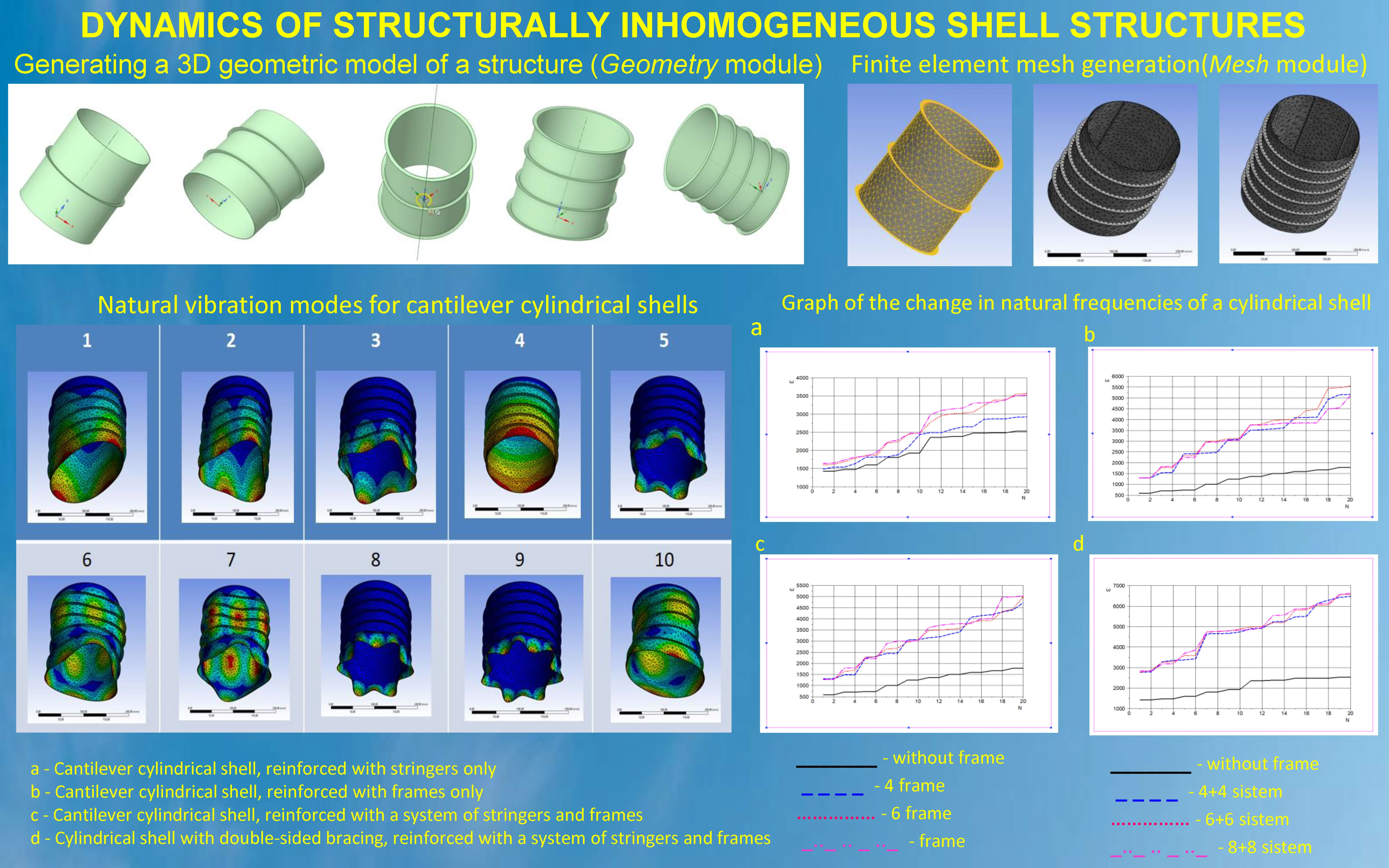
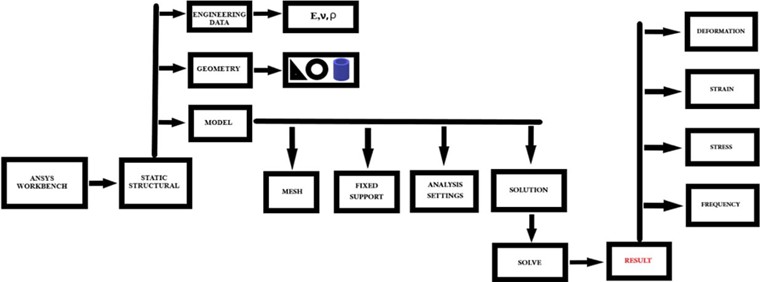
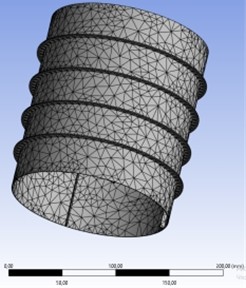
The numerical modeling process was conducted in several stages. In the preliminary preparation phase, the physical and mechanical properties of the material were defined using the Engineering Data module. Following this, a three-dimensional geometric model of the structure was created according to actual dimensions using the Geometry module (see Fig. 2). The Static Structural and Modal calculation modules were then linked. After generating the finite element mesh in the Mesh module (see Fig. 3), boundary conditions and calculation parameters were established in the Setup module. The calculation was executed in the Solution module, and the results were analyzed in the Results module.
Fig. 1Computational model for modal analysis in ANSYS WORKBENCH
The initial data were the actual geometric characteristics of a thin-walled, structurally inhomogeneous cylindrical shell [22-23]: / = 2.3; / = 115; = 75 mm, 0.65 mm, 172.5 mm, 2×10¹¹ N/m2, 7,850 kg/m3. Here: , , are the radius, length, and thickness of the cylindrical shell, respectively.
The computational studies were performed for cylindrical shells installed under various boundary conditions. The following shell contour restraint schemes were considered: C-C – rigid two-sided restraint; C-F – cantilever restraint.
Fig. 2Generating a 3D geometric model of a structure (Geometry module)
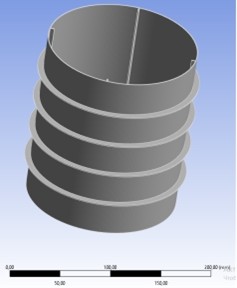
Fig. 3Finite element mesh generation (Mesh module)
3. Results and discussion
At the first stage of the study, the natural vibrations of a thin-walled, structurally heterogeneous cylindrical shell with symmetrically located 4, 6 and 8 uniformly spaced transverse rectangular frames with a cross-section of 6×1 mm were analyzed, and then the natural vibrations of a thin-walled, structurally heterogeneous cylindrical shell with uniformly spaced stringers of a rectangular cross-section of 4×1 mm were analyzed (Table 1).
Table 1Eigenfrequencies of a cylindrical shell with different frames
No. | C-F | C-C | C-F | ||||||
Number of frames | Number of frames | Number of stringers | |||||||
4 | 6 | 8 | 4 | 6 | 8 | 4 | 6 | 8 | |
1. | 1295 | 1305 | 1291 | 2850 | 2910 | 2889 | 623 | 573 | 577 |
2. | 1296 | 1307 | 1291 | 2856 | 2919 | 2894 | 633 | 580 | 611 |
3. | 1537 | 1763 | 1823 | 3419 | 3355 | 3247 | 730 | 689 | 716 |
4. | 1543 | 1768 | 1825 | 3424 | 3364 | 3248 | 730 | 723 | 716 |
5. | 2410 | 2330 | 2242 | 3563 | 3804 | 3852 | 808 | 750 | 788 |
6. | 2412 | 2333 | 2243 | 3574 | 3826 | 3858 | 811 | 761 | 798 |
In the second stage of the study, the dynamic behavior of the symmetrical installation of a combination of frames and stringers in cylindrical shell structures was assessed (Table 2).
Table 2Eigenfrequencies of a cylindrical shell for symmetrical installations of a frame and stringer combination
No. | C-F | C-C | C-F | ||||||
Frame and stringer combination | Frame and stringer combination | Simple shell | Number of stringers | Number of frames | |||||
4+4 | 6+6 | 8+8 | 4+4 | 6+6 | 8+8 | 0 | 6 | 6 | |
1. | 1302 | 1276 | 1272 | 2783 | 2773 | 2837 | 584 | 573 | 1305 |
2. | 1311 | 1278 | 1273 | 2791 | 2871 | 2840 | 584 | 580 | 1307 |
3. | 1477 | 1634 | 1785 | 3285 | 3280 | 3181 | 702 | 689 | 1763 |
4. | 1482 | 1685 | 1786 | 3357 | 3284 | 3193 | 702 | 723 | 1768 |
5. | 2241 | 2289 | 2209 | 3380 | 3593 | 3699 | 728 | 750 | 2330 |
6. | 2305 | 2293 | 2211 | 3435 | 3595 | 3859 | 728 | 761 | 2333 |
An analysis of the obtained results shows that strengthening shell structures with frames and stringers significantly changes the dynamic behavior of the shell structures. This effect is multifaceted, as they simultaneously act as stiffeners, masses, and sources of structural heterogeneity, increasing the flexural and membrane stiffness of the shell.
When six frames are installed on shell structures, the vibration frequencies reach maximum values, while when eight frames are installed, they decrease. Therefore, the six-frame option can be considered optimal.
An analysis of cases with stringers installed showed that increasing their number does not significantly affect the vibration frequencies. Even doubling the number of stringers results in a change in their numerical values of only 7.38 %.
An analysis of the use of systems consisting of a combination of frames and stringers (presented in Table 2) shows that this solution is significantly more effective. For each structure, the above-described methodology allows for the selection of a specific design solution, taking into account its actual geometric dimensions and the physical and mechanical properties of the material.
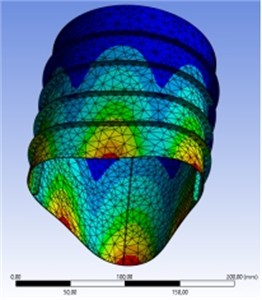
During the study, ANSYS Workbench 2023R software was used to generate natural vibration modes for all computational models of slender cylindrical structures. The generated natural vibration modes were compared with each other, and each computational model was analyzed separately for cases in which frames and stringers were installed. The article provides the first and second natural vibration modes as an example (Figs. 4-5). The generated vibration modes revealed that stringers have a greater influence on longitudinal deformations, while frames have a greater influence on hoop and local deformations. At high structural densities, the shell begins to behave like an orthotropic medium.
Fig. 4First mode of vibration of a structurally inhomogeneous cantilever shell
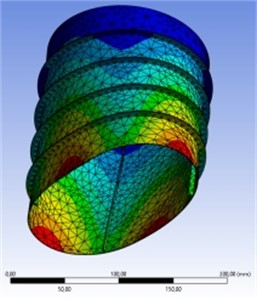
Fig. 5Second mode of vibration of a structurally inhomogeneous cantilever shell
To verify the reliability of the numerical results, they were compared with experimental data from reference [15]. The results showed satisfactory agreement, confirming the validity of the computational model and numerical algorithm used. The smallest discrepancies were observed for the cantilever fastening scheme and the case of rigid shell restraints on both sides, where the experimental and calculated data aligned most closely. In the case of hinged fastenings on both sides, a comparison was made with findings from reference [16]. It was noted that discrepancies were somewhat larger, possibly due to the increased sensitivity of the dynamic characteristics related to the modeling of the hinged connections.
The study yielded reliable results with practical application in the design of shell structures. By applying the results, the vibration amplitude is halved, and the structure is protected from various hazardous effects (such as resonance) by monitoring its dynamic state. The results can be directly applied in the aviation, shipbuilding, and mechanical engineering industries to develop and improve design solutions for thin-walled shell structures. The application of the results covers the calculation, analysis, and optimization of thin-walled structures, taking into account their dynamic characteristics, including assessing their dynamic strength, stability, and durability under variable loads. The use of modern structural materials, as well as various reinforcement schemes (ring, stringer, spiral) for the design of shell structures helps to increase the load-bearing capacity of structures, regulate their dynamic characteristics and ensure stability when exposed to various dynamic loads.
4. Conclusions
1) It has been established that reinforcing shell structures with stiffening ribs leads to a significant transformation of their natural vibration modes, which is caused by the redistribution of the system’s stiffness and inertial characteristics.
2) It was observed that incorporating frames in thin cylindrical structures results in a significant change in the natural vibration frequencies. However, further increasing the number of frames does not yield the expected improvements. Therefore, determining the optimal number of frames for each specific structure is a critical task.
3) The use of stringers leads to a change in the natural oscillation frequencies; however, this effect is insignificant. Even when their quantity is doubled, the difference in frequencies does not exceed 7.38 %.
4) The study concluded that using a combination of frames and stringers in thin cylindrical structures positively influences the natural vibration frequencies, allowing for effective control or adjustment of these frequencies.
5) The developed methodology and the obtained results can be used in the design of shell structures operating under complex dynamic influences.
References
-
N. van Tien et al., “Nonlinear thermo-mechanical buckling of torsion-loaded cylindrical shells with eccentric stiffeners made from CNT-reinforced composite,” Iranian Journal of Science and Technology, Transactions of Mechanical Engineering, Vol. 46, No. 4, pp. 1107–1119, Apr. 2022, https://doi.org/10.1007/s40997-021-00482-w
-
M.-T. Tran, V.-L. Nguyen, S.-D. Pham, and J. Rungamornrat, “Free vibration of stiffened functionally graded circular cylindrical shell resting on Winkler-Pasternak foundation with different boundary conditions under thermal environment,” Acta Mechanica, Vol. 231, No. 6, pp. 2545–2564, Jun. 2020, https://doi.org/10.1007/s00707-020-02658-y
-
V. H. Nam, N. T. Phuong, and N. T. Trung, “Nonlinear buckling and postbuckling of sandwich FGM cylindrical shells reinforced by spiral stiffeners under torsion loads in thermal environment,” Acta Mechanica, Vol. 230, No. 9, pp. 3183–3204, Sep. 2019, https://doi.org/10.1007/s00707-019-02452-5
-
A. Shaterzadeh and K. Foroutan, “Post-buckling of cylindrical shells with spiral stiffeners under elastic foundation,” (in Korean), Structural Engineering and Mechanics, Vol. 60, No. 4, pp. 615–631, Apr. 2016, https://doi.org/10.12989/sem.2016.60.4.615
-
K. Daneshjou and M. Talebitooti, “Free vibration analysis of rotating stiffened composite cylindrical shells by using the layerwise-differential quadrature (LW-DQ) method,” Mechanics of Composite Materials, Vol. 50, No. 1, pp. 21–38, Jan. 2014, https://doi.org/10.1007/s11029-014-9390-6
-
X. Zhao, K. M. Liew, and T. Y. Ng, “Vibrations of rotating cross-ply laminated circular cylindrical shells with stringer and ring stiffeners,” International Journal of Solids and Structures, Vol. 39, No. 2, pp. 529–545, Jan. 2002, https://doi.org/10.1016/s0020-7683(01)00194-9
-
C. W. Isaac and O. Oluwole, “Numerical modelling of the effect of non-propagating crack in circular thin-walled tubes under dynamic axial crushing,” Thin-Walled Structures, Vol. 115, pp. 119–128, Mar. 2017, https://doi.org/10.1016/j.tws.2017.02.012
-
M. M. Mirsaidov, I. I. Safarov, M. K. Teshaev, and Z. I. Boltayev, “Dynamics of structural – Inhomogeneous coaxial-multi-layered systems "cylinder-shells",” Journal of Physics: Conference Series, Vol. 1706, No. 1, p. 012033, Dec. 2020, https://doi.org/10.1088/1742-6596/1706/1/012033
-
D. Khodzhaev, N. Vatin, R. Abdikarimov, B. Normuminov, and B. Mirzaev, “Dynamic stability of viscoelastic orthotropic shells with concentrated mass,” IOP Conference Series: Materials Science and Engineering, Vol. 890, No. 1, p. 012042, Jun. 2020, https://doi.org/10.1088/1757-899x/890/1/012042
-
C. Qi, S. Yang, and F. Dong, “Crushing analysis and multiobjective crashworthiness optimization of tapered square tubes under oblique impact loading,” Thin-Walled Structures, Vol. 59, pp. 103–119, Oct. 2012, https://doi.org/10.1016/j.tws.2012.05.008
-
Y. Wang and H. Zhou, “Numerical study of water tank under blast loading,” Thin-Walled Structures, Vol. 90, pp. 42–48, May 2015, https://doi.org/10.1016/j.tws.2015.01.012
-
S. Khudainazarov, T. Mavlanov, S. Salimov, M. Ulugova, and T. Sabirjanov, “Simulation of dynamic processes of shell structures with viscoelastic elements,” E3S Web of Conferences, Vol. 365, p. 03040, Jan. 2023, https://doi.org/10.1051/e3sconf/202336503040
-
S. Khudainazarov, T. Mavlanov, F. Umarova, T. Sabirjanov, and M. Ulugova, “Evaluation of the dynamic characteristics of complex multiply connected, structurally inhomogeneous systems,” E3S Web of Conferences, Vol. 365, p. 03035, Jan. 2023, https://doi.org/10.1051/e3sconf/202336503035
-
M. Sadeghifar, M. Bagheri, and A. A. Jafari, “Buckling analysis of stringer-stiffened laminated cylindrical shells with nonuniform eccentricity,” Archive of Applied Mechanics, Vol. 81, No. 7, pp. 875–886, Oct. 2010, https://doi.org/10.1007/s00419-010-0457-0
-
V. Shevchenko, O. Vlasov, and V. Kairov, “Experimental research of constructional non-homogeneous cylindrical shells free oscillations,” (in Russian), Bulletin of the National Technical University of Ukraine "KPI," Machine Equipment Series, Vol. 68, No. 2, pp. 122–127, 2013.
-
S. Khudainazarov, T. Mavlanov, F. Umarova, K. Turajonov, K. Rustamov, and T. Sabirjanov, “The natural vibrations of a structurally inhomogeneous cylindrical shell,” in AIP Conference Proceedings, Vol. 3286, p. 030006, Feb. 2025, https://doi.org/10.1063/5.0279741
About this article

The authors have not disclosed any funding.
The datasets generated during and/or analyzed during the current study are available from the corresponding author on reasonable request.
The authors declare that they have no conflict of interest.

