Abstract
This article discusses the seismic resistance of the two-story structure constructed from wooden SIP panels, which are commonly used in low-rise structures. In the research process, the behavior of the building under seismic influences was comprehensively analyzed based on theoretical calculations and digital modeling performed using the ETABS software package. In particular, the values of horizontal displacements along the floors of the building were determined, and the results of theoretical calculations were compared with the results obtained in the ETABS program. In addition, the stress–strain state of the building structures was determined, and deformations arising under seismic loads, internal forces, and the laws of their distribution were assessed. The obtained results show that wooden buildings with SIP panels are sufficiently deformable and energy-absorbing in relation to seismic impacts. The convergence of the results of theoretical and numerical calculations confirms the reliability of the chosen computational models and accepted assumptions.
Highlights
- Seismic behavior of a two-story low-rise timber building constructed from SIP panels was investigated.
- The stress–strain state and horizontal displacements were determined using theoretical calculations and ETABS modeling.
- Natural vibration periods of the building were found within 0.017–0.088 s, indicating high structural stiffness.
- Good agreement between theoretical and numerical results (difference within 10–15 %) confirms model reliability.
- SIP panel timber buildings demonstrated sufficient stiffness, strength, and seismic resistance for low-rise construction.
1. Introduction
Over the recent years, the construction sector has been fast changing in the wake of two key problems in the world, namely, the sustainable development requirement and the necessity to provide structural integrity under severe loading conditions, particularly the occurrence of earthquakes [1]. These issues are especially applicable in low-rise buildings, which comprise a large part of residential and public buildings in a number of nations [2]. The low-rise buildings are very popular because they are economical, fast to construct, flexible in their architecture, and even adapted to single-family dwellings [3]. Nevertheless, within the seismic areas, the design of such buildings should be approved in terms of strength, stability, ductility, and reliability. The issue of earthquake-resistant design does not merely lie in the choice of strong materials but also in rational structuring systems and adequate calculations that are conducted with the help of seismic load models [4]. The precise identification of the seismic forces, their distribution along the length of the structure's height, and the assessment of the structure's behavior during dynamic forces are the major factors in the consideration of safety. In this regard, lightweight structural materials come in as a great benefit [5]. Lightweight structures tend to have fewer inertial forces during seismic events, and this has the potential of minimizing damages and enhancing performance [6]. Thus, the increasing popularity of other structural materials such as wood is a rational reaction to the contemporary demands of engineering.
Wooden structures have taken a new interest in contemporary civil engineering because of their environmental benefits and good mechanical characteristics [7]. Simultaneously, the analysis of wooden constructions in the condition of seismic activity is still a complicated engineering task due to the anisotropy of wood, the properties of strength and rigidity being directional, and the moisture content, as well as the quality of connections. In low-rise wooden buildings, the performance of joints, bracing systems, shear walls, and diaphragms is active in the seismic resistance [8]. Therefore, to allow safe expansion of wooden structures in earthquake-prone areas, there is a need to develop and implement proper calculation techniques for such structures.
Processing wood into the building structure materials and their elimination results in insignificant environmental impact, i.e., the wood structures possess their distinctive characteristics that meet the requirements of the so-called green construction [9]. The current interest presently is the building of earthquake-resistant buildings and environmentally friendly buildings [10]. Wood is one of the materials that are eco-friendly. Wood is regarded as one of the initial construction materials mankind took on on the way to civilizational progress [11]. The construction industry is one of the industries that consume a lot of wood because it is easy to process, durable, and user-friendly [12]. The use of wood as a building material makes it lightweight, and its usage results in the expedited and gained efficiency of the construction production that is the most crucial direction of construction. Synthetic adhesives that are waterproof are dependable in gluing wood. Through this, glued wooden structures of large cross-sections, large lengths, bending in different forms, and other forms are produced [13].
The article is dedicated to the calculation of seismic forces on the wooden structures of low rises. The central consideration is put on finding seismic loads, calculation models, and the structural reaction of the wooden systems to the effects of an earthquake.
2. Method
The studies on assessing the strength and seismic resistance of low-rise timber-frame buildings were conducted based on SIP panels, which are considered a modern construction technology. Two-story residential buildings consisting of exterior walls, inter-floor slabs, and floor elements were adopted as the research object. To determine the stress-strain state under seismic action, theoretical calculation methods, regulatory requirements, and numerical modeling approaches were applied, and the calculations were performed in accordance with the requirements of QMQ 2.01.03-19. The RST Uz 836-97 scale was adopted as the methodological basis for evaluating seismic intensity, and the results made it possible to comprehensively assess the seismic performance of low-rise timber buildings made of SIP panels.
3. Results and discussion
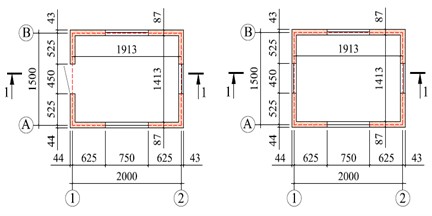
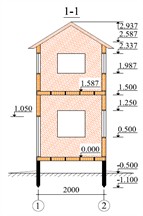
The research object was a two-story wooden structural SIP-panel building constructed at a scale of 1:2, with plan dimensions of 1500×2000 mm. The story heights were 1500 mm and 1350 mm, respectively, and the walls were made of SIP panels; the loads were 1.72 kN and 0.736 kN, the modulus of elasticity was 105 MPa, and the design compressive resistance was 13 MPa. On the façade of the first floor, there are two windows measuring 750×750 mm, one window measuring 600×750 mm, and a door measuring 450×1050 mm; on the second floor, there are two windows measuring 400×750 mm and two windows measuring 450×500 mm (Fig. 1).
Based on QMQ 2.01.03-19, the seismic resistance of low-rise SIP panel buildings was carried out in the following sequence [13]:
1) Determination of the seismic calculation scheme.
2) Collection of permanent and temporary loads, the values of which are multiplied by the combination coefficient (0.9 – for permanent loads, 0.5 – for short-term and 0.8 – for long-term temporary loads).
3) Determining the stiffness of structural elements in the longitudinal and transverse directions of the building.
4) Determination of potential and kinetic energies by the formula:
where is – potential energy; – kinetic energy; – amplitude of mass displacement; – mass at the same -th point.
Fig. 1Wall plan and section of a two-story SIP panel building
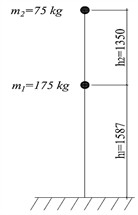
Determination of the period of natural oscillations-T according to the following formula:
Calculation of the calculated seismic load according to clause 2.13 of QMQ 2.01.03-19 [13, p. 19] in the selected direction at point “” and corresponding to the -th form of the building’s natural oscillations according to the formula:
where – responsibility coefficient (1); – earthquake frequency coefficient (7-8 points: 1.2; 9 points: 1.25); – floor number coefficient (1); – regularity coefficient (per item 2.25); – seismicity coefficient (Table 2.7); – building weight at point (per clause 2.1, design loads); – spectral coefficient (item 2.14); – dissipation coefficient (item 2.16); – coefficient depending on -th natural mode and load location (items 2.18-2.19).
The dissipation coefficient – should be determined by the formula:
where 0.3 is the oscillation decrement, determined by natural tests at the elastic stage of buildings similar to those being designed, and if experimental determination is not possible, it is taken according to Table 2.9 [13; p. 22]; – period of natural vibrations according to the fundamental tone of building vibrations.
For buildings with a number of floors up to 5, including for the masses and rigidity of floors with minimal height variation, at 0.4 sec, it is allowed to determine the coefficient according to the following simplified formula [13, p. 21]:
where and are the displacement of the building or structure at the point under consideration and the locations of the accumulation of the mass of the natural oscillation in the points , which is calculated in accordance with the requirements of clause 2.1.
4. Seismic force is distributed along the axes (longitudinal and transverse).
Calculations were also performed based on the ETABS software package, which is one of the most important characteristics of the dynamic state of buildings, to determine the theoretical forms of oscillations. They are used to calculate the response to seismic impacts using linear approximation. The physical properties of the structural materials used in the construction of the building model are as follows: The OSB boards were simulated as orthotropic material that had the following parameters: 3500 MPa, 1500 MPa, 690 MPa, 0.3. Polystyrene foam: density-25 kg/m3; modulus of elasticity-200 MPa; Poisson’s ratio-0.2; Wooden base: density-600 kg/m3; modulus of elasticity-10000 MPa; Poisson’s ratio-0.5. The model adopted a Cartesian coordinate system that facilitated the description and simplification of the computation process, and -axis is used to represent the vertical direction and and -axes to represent the longitudinal and transversal direction of the building plan respectively. A three-dimensional coordinate grid was used to form the structural model and the horizontal spacings were 2 m (-axis) and 1.5 m (-axis). The vertical levels were –1.1 m and –0.5 m at the foundation, 0-1.5 m at the first floor, and 1.587-2.937 m at the second floor. The structure of the building provides SIP panel walls comprising of a total thickness of 87 mm, which is reinforced by timber studs (30×75 mm). In the finite model element, the studs and the panel sheathing were classified as an integrated ribbed structural system. In the study, calculations were performed for 4 forms of building vibrations due to the use of building models. Deformations in buildings corresponding to the vibrations of these shapes are shown in Fig. 2.
Fig. 2Shapes of vibrations of the building model under the influence of seismic force
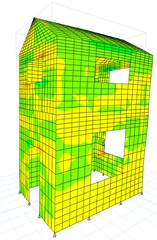
a) View of the first shape, period of oscillation 0.088 sec
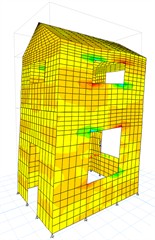
b) View of the second shape, period of oscillation 0.07 sec
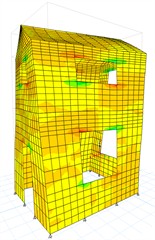
c) View of the third shape, period of oscillation 0.04 sec
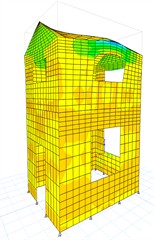
d) View of the fourth shape, period of oscillation 0.017 sec
All vibration periods have absolute values less than 0.1 seconds, which indicates the high stiffness of the structure. In experimental studies, it is usually possible to determine only the first mode shape, and even this is recorded using specialized seismic measurement instruments, whereas identifying the 2nd-4th modes in low-rise buildings is considerably more difficult. In multi-story buildings, however, higher modes can be recorded relatively easily using specialized equipment. In theoretical analyses, vibration mode shapes can be determined for all cases, which computational software performs efficiently.
Displacement results under seismic loading for the timber-structured SIP-panel building modeled in ETABS were obtained, and their graphs are presented in Fig. 3.
The values of the greatest displacements in a building with SIP panels under the influence of seismic forces are given in Table 1.
Fig. 3Graphs of displacements on the first floor of a SIP panel building under the influence of an earthquake accelerogram
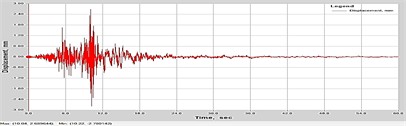
a) Along the axis
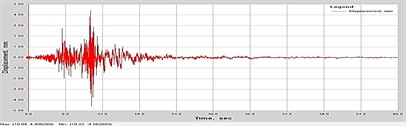
b) Along the axis
Table 1Results of building displacements obtained using the ETABS program
Along the building axes | Effects of earthquake on first floor of building | Effects of earthquake on second floor of building |
Along the -axis | 2.69 | 3.08 |
Along the -axis | 4.41 | 5.03 |
In the program, various seismic impacts were applied at the same time interval (i.e., 35 sec), and based on the obtained results, the values of displacements of a wooden SIP panel building were analyzed.
Using the complex calculation and design program ETABS, the stresses and strains arising in the structures of a low-rise wooden building were calculated. Fig. 4 shows the stresses and strains arising in the elements of wooden buildings with SIP panels under the action of seismic forces along the and axes.
Fig. 4Normal stresses arising from seismic forces
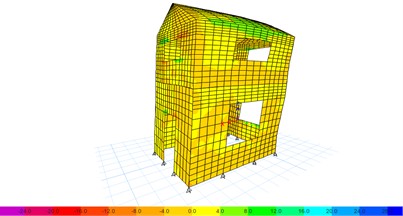
a) Stress along the axis (28 MPa);
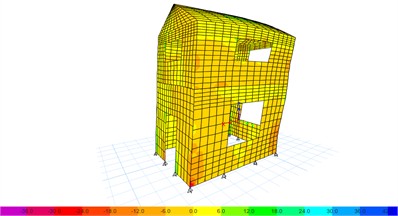
b) Stress along the axis (42 MPa)
The values of relative displacements between floors, determined using the theoretical calculations and the complex calculation and design program ETABS, were compared. The comparison results are presented graphically and are shown in Fig. 5.
Fig. 5Results of theoretical calculations and relative displacements of the building floors obtained in the ETABS program
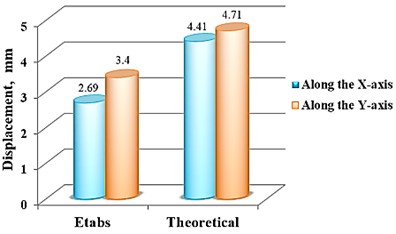
a) First floor
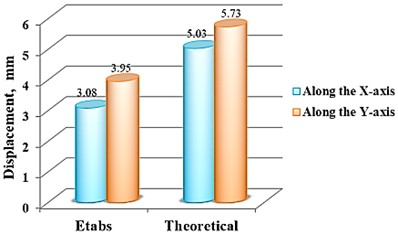
b) Second floor
Table 2Stress-strain state of building structures under the influence of seismic forces based on the finite element method
Building characteristics | Normal stresses, MPa | Tangential stress | Stresses in building structures | ||
Along the -axis | Along the -axis | Cutting force, (kN) | Bending moment, (kN∙m) | ||
Low-rise wooden building with SIP panels | 28 | 42 | 3.6 | 45 | 14 |
5. Conclusions
Based on experimental investigations, theoretical calculations, and numerical simulations, it can be concluded that low-rise timber buildings using SIP panels exhibit sufficient strength, stiffness, and seismic resilience. Maximum horizontal displacements ranged between 4.71-5.73 mm, while interstory drift ratios were within 1/420-1/460 of the story height, which is below the permissible limit of 1.0 % h according to Eurocode 8 (EN 1998-1, Section 4.2.3). The comparison between experimental and numerical results revealed a high degree of correlation, with differences not exceeding 10-15 %, confirming the adequacy of the adopted calculation approach [14]. These findings demonstrate that SIP panel-based structural systems effectively control horizontal displacements and interstory drifts, ensuring structural stability and seismic performance for low-rise timber buildings in seismic regions.
References
-
P. Heresi and E. Miranda, “Intensity measures for regional seismic risk assessment of low-rise wood-frame residential construction,” Journal of Structural Engineering, Vol. 147, No. 1, p. 04020, Jan. 2021, https://doi.org/10.1061/(asce)st.1943-541x.0002859
-
S. Hu, W. Wang, and B. Qu, “Seismic evaluation of low-rise steel building frames with self-centering energy-absorbing rigid cores designed using a force-based approach,” Engineering Structures, Vol. 204, p. 110038, Feb. 2020, https://doi.org/10.1016/j.engstruct.2019.110038
-
S. Razzakov and A. Martazaev, “Mechanical properties of concrete reinforced with basalt fibers,” in E3S Web of Conferences, Vol. 401, p. 05003, Jul. 2023, https://doi.org/10.1051/e3sconf/202340105003
-
X. Estrella, P. Guindos, J. L. Almazán, and S. Malek, “Efficient nonlinear modeling of strong wood frame shear walls for mid-rise buildings,” Engineering Structures, Vol. 215, p. 110670, Jul. 2020, https://doi.org/10.1016/j.engstruct.2020.110670
-
O. Fozilov, A. Martazaev, S. Razzakov, R. Mavlonov, and B. Maksud Ugli, “Numerical modeling of reinforced concrete structures made of lightweight concrete using ANSYS,” Vibroengineering Procedia, Vol. 60, pp. 683–689, Dec. 2025, https://doi.org/10.21595/vp.2025.25511
-
J. Carrillo and S. M. Alcocer, “Shear strength of reinforced concrete walls for seismic design of low-rise housing,” ACI Structural Journal, Vol. 110, No. 3, p. 415, May 2013, https://doi.org/10.14359/51685599
-
A. Martazaev, S. Razzakov, R. Mavlonov, O. Fozilov, and B. Maksud Ugli, “Theoretical assessment of the mechanical properties of fiber concrete using the dispersion analysis method,” Vibroengineering Procedia, Vol. 60, pp. 788–794, Dec. 2025, https://doi.org/10.21595/vp.2025.25362
-
X. Wang, P. Su, J. Liu, Z. Chen, and K. Khan, “Seismic performance of light steel-natural timber composite beam-column joint in low-rise buildings,” Engineering Structures, Vol. 256, p. 113969, Apr. 2022, https://doi.org/10.1016/j.engstruct.2022.113969
-
A. Juraeva, A. Martazaev, S. Razzakov, and A. Akmaljon, “The effect of the quantity and length of fibers on the mechanical properties of fiber-reinforced concrete based on polypropylene fibers,” Vibroengineering Procedia, Vol. 60, pp. 571–578, Dec. 2025, https://doi.org/10.21595/vp.2025.25363
-
P. Orellana, H. Santa María, J. L. Almazán, and X. Estrella, “Cyclic behavior of wood-frame shear walls with vertical load and bending moment for mid-rise timber buildings,” Engineering Structures, Vol. 240, p. 112298, Aug. 2021, https://doi.org/10.1016/j.engstruct.2021.112298
-
N. N. Kosbergenov and S. J. Razzakov, “Calculation of structural insulated panel buildings for seismic effects,” Universum: Tekhnicheskie Nauki, Vol. 139, No. 10, pp. 26–31, Oct. 2025.
-
J. He, F. Pan, C. S. Cai, F. Habte, and A. Chowdhury, “Finite-element modeling framework for predicting realistic responses of light-frame low-rise buildings under wind loads,” Engineering Structures, Vol. 164, pp. 53–69, Jun. 2018, https://doi.org/10.1016/j.engstruct.2018.01.034
-
“QMQ 2.01.03-19 Construction in Seismic Areas,” (in Uzbek), Ministry of Construction of the Republic of Uzbekistan, Tashkent, 2019.
-
“Eurocode 8. Design of structures for earthquake resistance,” BSI British Standards, London, BS EN 1998-3:2025 – TC, 2025, https://doi.org/10.3403/30094289u
About this article

The authors have not disclosed any funding.
The datasets generated during and/or analyzed during the current study are available from the corresponding author on reasonable request.
The authors declare that they have no conflict of interest.

