Abstract
This article examines the design of earthworks to improve the stability of embankment slopes in sandy soils reinforced with geosynthetic materials. Ensuring the stability and strength of the earth bed in sandy soils is particularly relevant under increasing train speeds and growing linear and axial loads on existing and newly constructed railway lines. A design solution for an embankment in sandy soils reinforced with geosynthetics is proposed based on calculations of the slope stability coefficient. Calculation schemes for determining additional restraining forces and slope stability when using volumetric geogrid and geotextile are presented. The increase in the stability coefficient is achieved through additional restraining forces provided by the geotextile and each -th cell of the volumetric geogrid. It has been established that reinforcement of sandy embankment slopes with geosynthetic materials increases the retention force T-hold by 18-25 % due to additional design parameters, while the stability coefficient rises by 14-23 %, ensuring the required condition 1.2.
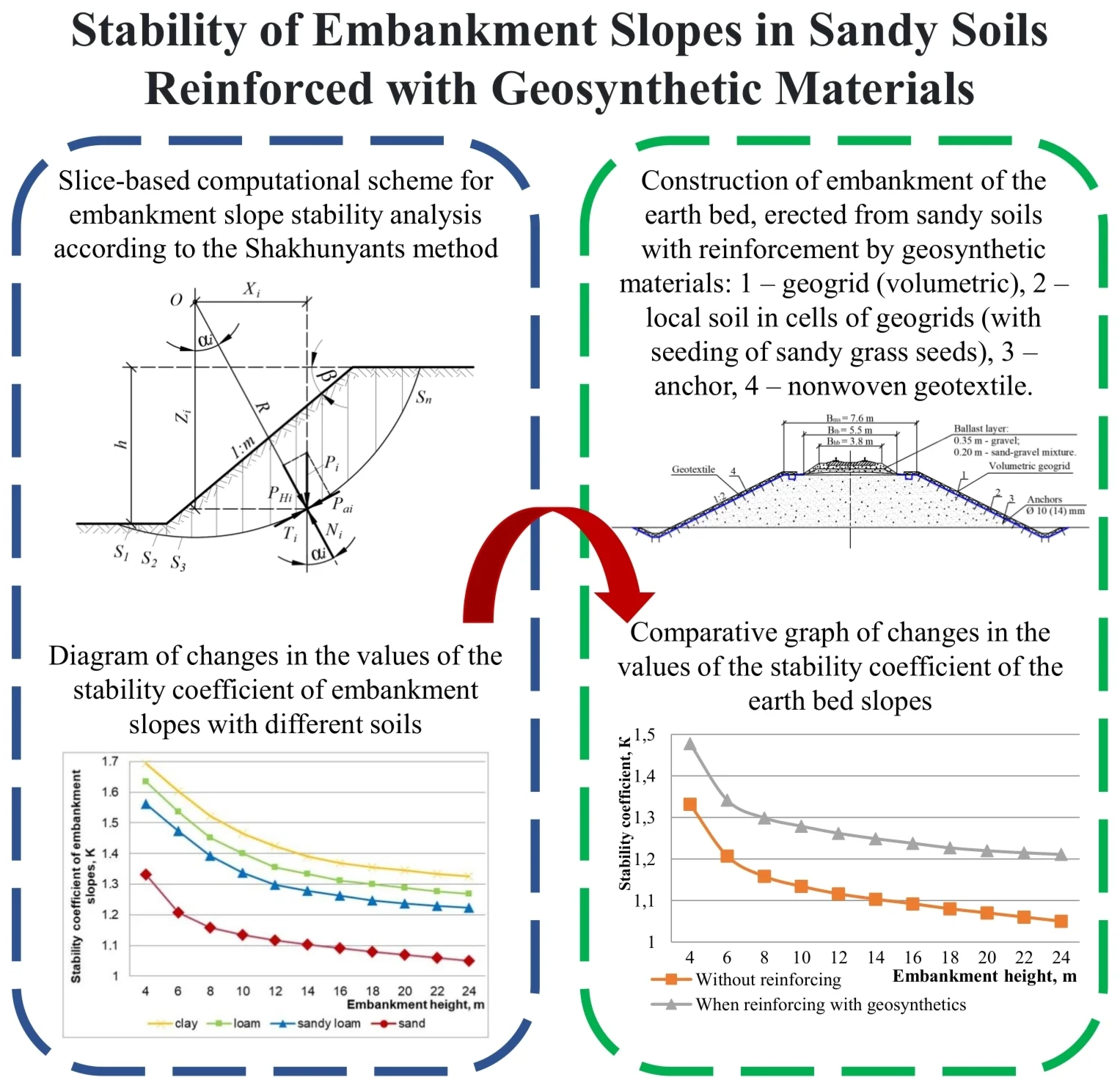
Highlights
- Slice-based computational scheme for embankment slope stability analysis according to the Shakhunyants method.
- Diagram of changes in the values of the stability coefficient of embankment slopes with different soils.
- Construction of embankment of the earth bed, erected from sandy soils with reinforcement by geosynthetic materials: 1 – geogrid (volumetric), 2 – local soil in cells of geogrids (with seeding of sandy grass seeds), 3 – anchor, 4 – nonwoven geotextile.
- Comparative graph of changes in the values of the stability coefficient of the earth bed slopes.
1. Introduction
At present, railway construction and operation in Uzbekistan are increasingly oriented toward resource-saving technologies that extend the service life of technical facilities, particularly track equipment as key elements of railway infrastructure [1]. Improving railway transport efficiency requires high reliability and operational stability of the track base – the earth bed – a complex structure mainly composed of sandy soils of complex origin. Research is focused on improving existing and developing new earth bed designs and slope strengthening technologies [2]. The study examines embankment slopes on the Kiyikli–Khizirbobo section of the Bukhara-Misken railway line. Rising train speeds, increased linear and axial loads, and the introduction of new permanent way structures impose stricter requirements on subgrade strength and stability [3, 4].
Studies on the use of geosynthetic materials in earth bed structures aim to develop solutions that enhance the stability of sandy railway embankments, reduce deflation and deformation, and improve slope reinforcement technologies [5-8]. Priority is given to constructive-technological and organizational solutions based on geosynthetics [8-10]. Key tasks include evaluating reinforced slope stability under various soil conditions and developing effective reinforcement measures.
Recent international studies have further confirmed the effectiveness of geosynthetic reinforcement for embankment and slope stabilization under complex loading conditions, including geocell-reinforced railway embankments, upper-bound stability analysis of reinforced slopes, and finite-element studies of geotextile-supported embankments under variable geometry and loading [11-13].
Experience from the construction and operation of the Tashguzar–Kumkurgan, Angren–Pap, and Bukhara–Misken railway lines highlights the need to ensure subgrade strength and stability from the construction stage [14, 15]. The study aims to determine the stability of sandy embankment slopes reinforced with geosynthetic materials. Domestic researchers focus on improving slope design and reinforcement methods [16, 17]. The research objectives are:
– Development of constructive-technological and organizational solutions using geosynthetics.
– Assessment of reinforced slope stability considering operational conditions.
– Preparation of recommendations to enhance railway subgrade slope stability.
The research included theoretical and experimental studies conducted on the Bukhara-Misken railway line. Stability was assessed using circular cylindrical sliding surface methods (“method of areas,” “method of friction circle,” etc.). Soil parameters for Plaxis 2D and GEO 5 modeling were taken from geotechnical reports of ‘BOSHTRANSLOYIHA,’ Ltd.
Geosynthetic materials improve both general and local slope stability and provide erosion protection [18-21]. Priority areas include developing new sandy embankment designs, strengthening slopes, and reducing deflation and deformation.
2. Materials and methods
2.1. Choice of the design to increase stability of embankment slopes in sandy soils
The main method for calculating the stability of earth bed slopes is the method of G. M. Shakhunyants. G. M. Shakhunyants method takes into account practically all kinds of possible impacts on the earth bed and takes into account the interaction of the compartments of massif breakdown of the possible shift. In standard documents this method is given as the basic method for calculations of slope stability by circular cylindrical shift surfaces [22].
To clarify the computational procedure, Fig. 1 shows the slice-based model used in the Shakhunyants method. The potentially unstable soil mass is divided into n vertical slices, and for each -th slice the acting forces, normal and tangential components, and the corresponding resisting and driving moments are determined with respect to the center of rotation .
Fig. 1Slice-based computational scheme for embankment slope stability analysis according to the Shakhunyants method
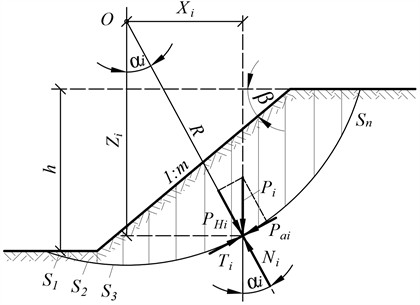
The calculations of the stability coefficient of earth bed slopes are performed using the classical formula of Prof. G.M. Shakhunyants. For clarity, the summation notation used below is interpreted slice-by-slice over the entire assumed sliding body:
where, is the slope stability coefficient. The notation and is used in condensed form and should be interpreted as Σ(1 to ) and Σ(1 to ) , respectively, where is the resisting moment of the -th slice and is the driving moment of the -th slice. Here is the total number of slices in the assumed sliding mass. In the same equation, is the cohesion of soil in the -th slice, is the base length of the -th slice, = is the friction coefficient corresponding to the internal friction angle of the -th slice, is the normal force acting on the base of the -th slice, and is the additional restraining force acting on the -th slice due to reinforcement. Thus, the index varies from 1 to .
The parameters of sandy soils (cohesion, internal friction angle, unit weight and deformation modulus) were determined based on engineering-geological investigations and standard recommendations for railway subgrade design in sandy soils (Table 1).
Table 1Main geotechnical parameters of sandy soil used in calculations
Parameter | Value |
Cohesion () | 3-8 kPa |
Friction angle () | 28-34° |
Unit weight () | 17-19 kN/m3 |
Elastic modulus () | 15-25 MPa |
The values of embankment slope stability coefficient were determined for different soils using Eq. (1). The changes in the slope stability coefficient for different soils are shown in Fig. 2. The graph was generated from analytical calculations performed by Eq. (1) for the adopted soil parameters and embankment heights considered in the study.
Fig. 2Diagram of changes in the values of the stability coefficient of embankment slopes with different soils
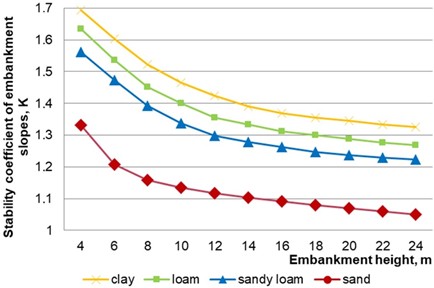
Analysis of the calculation results and the graph of change in the slope stability coefficient for different soils show, that the standard value of the embankment slope stability coefficient is provided in all, except sandy soils. In sandy soils, the embankment height exceeds 6 m. Consequently, if the embankment is more than 6 m high in sandy soils, reinforcement is required.
Stability of embankment slopes in sandy soils is increased by strengthening them with geosynthetic materials (geotextile and volumetric geogrid).
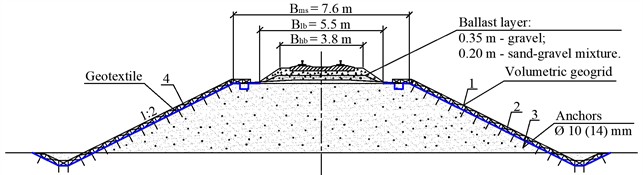
The design of the earth bed embankment constructed of sandy soils reinforced with geosynthetic materials is shown in Fig. 3.
2.2. Calculation of restraining forces when laying a volumetric geogrid
Stability of embankment slopes in sandy soils when laying a volumetric geogrid increases due to the increase in restraining force .
In each -th cell of the volumetric geogrid additional restraining forces arise, which are shown in Fig. 3. According to Newton’s third law, in the soil-filled cells of the volumetric geogrid the shift and restraining forces will be equal to zero, since they are reinforced by metal anchors. The anchors ensure stable positioning of the volumetric geogrid.
Fig. 3Construction of embankment of the earth bed, erected from sandy soils with reinforcement by geosynthetic materials: 1 – geogrid (volumetric), 2 – local soil in cells of geogrids (with seeding of sandy grass seeds), 3 – anchor, 4 – nonwoven geotextile
The restraining forces from the volumetric geogrid acting on each -th cell are determined according to the calculation scheme (see Fig. 4) by the following formula [20]:
where is specific adhesion of the soil in the cell of the volumetric geogrid, kPa; is friction coefficient of the soil of the volumetric geogrid cell; is the size of the base of the -th cell of the volumetric geogrid, m; is normal component of the weight of the -th cell of the volumetric geogrid, kN; are tangential forces of each -th cell of the volumetric geogrid, kN.
Fig. 4Calculation scheme for determining additional restraining forces in each i-th cell of the volumetric geogrid
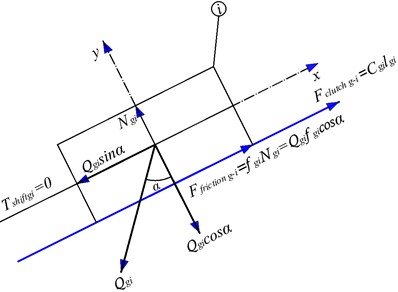
The parameters , and were determined based on engineering survey data and accepted design recommendations for reinforced sandy soils. In Eq. (2), is the total restraining force generated by the volumetric geogrid and is obtained by summing the contribution of each -th cell over the active reinforced zone; thus, is the number of geogrid cells considered in the calculation. Here, is the specific adhesion of the soil in the -th geogrid cell, is the friction coefficient of the soil in the cell, is the characteristic base size of the -th cell, is the normal component of the weight of the -th cell, and is the tangential force associated with the -th cell.
3. Results and discussion
Determination of stability coefficient of embankment slopes in sandy soils reinforced with geosynthetic materials
The calculation of embankment stability belongs to the first group of limit states. Therefore, stability is determined by the stress-strain state and strength of the embankment soils. The volumetric state of the soil mass is characterized by strength and physical and mechanical characteristics, which are as follows: deformability modulus, specific gravity, specific cohesion and angle of internal friction.
The coefficient of stability of embankment slopes in sandy soils when laying geosynthetic materials is determined by taking into account the proposed additional restraining forces from the geotextile and each -th cell of the volumetric geogrid. The geosynthetic reinforcement used in the design was characterized by standard physical and mechanical properties, including tensile strength, surface density, cell geometry and deformation resistance, which were adopted according to manufacturer specifications and design recommendations.
Taking into account additional restraining forces, Eq. (1) will get the following form:
where, the additional restraining terms correspond to the contribution of the geotextile and the restraining force generated by each -th cell of the volumetric geogrid. In condensed notation, denotes the total restraining effect of the geotextile layer, whereas denotes the total restraining effect of the volumetric geogrid obtained by summing the cell contributions over the active reinforced zone. Therefore, the modified expression accounts for both the natural soil resistance and the reinforcement effect.
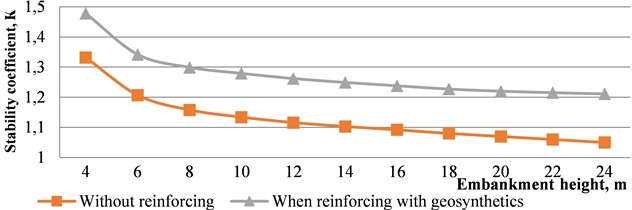
When strengthening the slopes of the earth bed constructed in sandy soils with geosynthetic materials additional restraining forces and influence the value of slope stability coefficient. Comparative results of change of values of stability coefficient of slopes without strengthening and taking into account additional restraining forces at strengthening are given in table 1. As can be seen from Table 2, the calculations showed that the use of geosynthetic materials in reinforcing the slopes of sandy soil embankments increases the stability coefficient by 14-23 % depending on the height of the embankment.
Comparison of stability coefficient values without strengthening the slopes of the earth bed, erected from sandy soils and when strengthening them with geosynthetic materials in the graphical representation are shown in Fig. 5. The graph was plotted from the analytical values listed in Table 2 for unreinforced and reinforced embankments.
Table 2Comparative results of changes in the values of slope stability coefficient without strengthening and taking into account additional restraining forces with strengthening
Stability coefficient, | At the height of the embankment, m | |||||||||
6 | 8 | 10 | 12 | 14 | 16 | 18 | 20 | 22 | 24 | |
Without reinforcing | 1.21 | 1.16 | 1.13 | 1.12 | 1.10 | 1.09 | 1.08 | 1.07 | 1.07 | 1.06 |
With a view to reinforcing | 1.49 | 1.39 | 1.34 | 1.30 | 1.27 | 1.25 | 1.23 | 1.22 | 1.21 | 1.21 |
The analysis of the results of calculation of the stability coefficient of slopes of embankment slopes in sandy soils shows that the total restraining force increases by 18-25 %, and the stability coefficient increases by 14-23 % and always provides the required condition 1.2. Numerical modeling in Plaxis 2D and GEO5 confirmed the increase in the stability coefficient obtained by analytical calculations, demonstrating consistency between analytical and numerical approaches [2, 22]. Both approaches showed the same trend: without reinforcement, the stability coefficient decreases with increasing embankment height, whereas reinforcement preserves the required stability level and increases the safety margin of the slope.
Fig. 5Comparative graph of changes in the values of the stability coefficient of the earth bed slopes
4. Conclusions
1) The application of geosynthetic materials is aimed at improving existing and developing new earth bed structures to enhance overall and local stability of embankment slopes in sandy soils. a comprehensive approach to selecting the material type and assessing slope stability is essential.
2) It is recommended to apply the method of Prof. G.M. Shakhunyants, adopted in standard documents as the main method, to determine the stability coefficient of earth bed slopes.
3) The use of geosynthetics in earth bed structures improves erosion resistance and increases the stability coefficient of embankment slopes. Long-term performance aspects such as creep and environmental effects should be considered in future studies.
4) Analysis of calculations and graphs of slope stability coefficients for different soils shows that the standard stability value is ensured for all soils except sandy ones. in sandy soils, stability is not ensured when the embankment height exceeds 6 m; therefore, slopes higher than 6 m require reinforcement.
5) The results indicate that additional restraining forces increase the total retaining force by 18-25 %, while the stability coefficient increases by 14-23 %; in the reinforced cases, increases from 1.21-1.06 to 1.49-1.21 depending on embankment height. These results, supported by the present analytical and numerical study, confirm that the reinforced sandy embankment slopes satisfy the required condition 1.2.
References
-
K. Lesov, “Effectiveness management of construction production programs with changes in the facilities saturation with means of mechanization,” in AIP Conference Proceedings, Vol. 2612, p. 040022, Jan. 2023, https://doi.org/10.1063/5.0114462
-
K. Lesov, M. Kenjaliyev, A. Mavlanov, and S. Tadjibaev, “Stability of the embankment of fine sand reinforced with geosynthetic materials,” E3S Web of Conferences, Vol. 264, p. 02011, Jun. 2021, https://doi.org/10.1051/e3sconf/202126402011
-
P. Punetha and S. Nimbalkar, “Performance improvement of ballasted railway tracks using three-dimensional cellular geoinclusions,” Geotextiles and Geomembranes, Vol. 50, No. 6, pp. 1061–1082, Dec. 2022, https://doi.org/10.1016/j.geotexmem.2022.06.007
-
A. Abdujabarov, P. Begmatov, F. Eshonov, M. Mekhmonov, and M. Khamidov, “Influence of the train load on the stability of the subgrade at the speed of movement,” E3S Web of Conferences, Vol. 264, p. 02019, Jun. 2021, https://doi.org/10.1051/e3sconf/202126402019
-
N. Begmatov, U. Ergashev, K. Lesov, and S. Shayakhmetov, “Bearing capacity of the subgrade for high-speed train traffic,” E3S Web of Conferences, Vol. 531, p. 02006, Jun. 2024, https://doi.org/10.1051/e3sconf/202453102006
-
S. Inti and V. Tandon, “Design of geocell reinforced roads through fragility modeling,” Geotextiles and Geomembranes, Vol. 49, No. 5, pp. 1085–1094, Oct. 2021, https://doi.org/10.1016/j.geotexmem.2021.03.003
-
S. R. Satyal, B. Leshchinsky, J. Han, and M. Neupane, “Use of cellular confinement for improved railway performance on soft subgrades,” Geotextiles and Geomembranes, Vol. 46, No. 2, pp. 190–205, Apr. 2018, https://doi.org/10.1016/j.geotexmem.2017.11.006
-
S. Matveev, E. Martynov, N. Litvinov, G. Kadisov, and V. Utkin, “The geogrid-reinforced gravel base pavement model,” Magazine of Civil Engineering, Vol. 94, No. 2, pp. 21–30, 2020, https://doi.org/10.18720/mce.94.3
-
B. R. Christopher, “Geotextiles used in reinforcing paved and unpaved roads and railroads,” in Geotextiles: from design to applications, Elsevier, 2016, pp. 305–335, https://doi.org/10.1016/b978-0-08-100221-6.00014-0
-
G. Lazorenko, A. Kasprzhitskii, Z. Khakiev, and V. Yavna, “Dynamic behavior and stability of soil foundation in heavy haul railway tracks: a review,” Construction and Building Materials, Vol. 205, pp. 111–136, Apr. 2019, https://doi.org/10.1016/j.conbuildmat.2019.01.184
-
P.-Y. Li, H.-Q. Dou, and W.-F. Nie, “Stability analysis of geosynthetic-reinforced slopes considering multiple potential failure mechanisms based on the upper bound theorem,” International Journal of Geomechanics, Vol. 24, No. 2, 2024, https://doi.org/10.1061/ijgnai.gmeng-8428
-
V.-N. Pham and E. Oh, “Optimisation design of geocell-reinforced high-speed railway embankments,” KSCE Journal of Civil Engineering, Vol. 30, No. 4, p. 100454, Apr. 2026, https://doi.org/10.1016/j.kscej.2025.100454
-
S. R. Sabab, H. M. Ashiq, M. U. Kabir, and S. S. Sakib, “The impact of geosynthetics on embankment performance using finite element modelling – a case study,” Results in Materials, Vol. 29, p. 100869, 2026, https://doi.org/10.1016/j.rinma.2025.100869
-
K. J. Wu and D. N. Austin, “Three-dimensional polyethylene geocells for erosion control and channel linings,” Geotextiles and Geomembranes, Vol. 11, No. 4-6, pp. 611–620, Jan. 1992, https://doi.org/10.1016/0266-1144(92)90035-9
-
K. S. Lesov and M. K. Kenjaliyev, “Organizational and technological parameters during the construction of the bukhara-misken railway line,” in AIP Conference Proceedings, Vol. 2471, p. 030026, Jan. 2022, https://doi.org/10.1063/5.0089621
-
M. Muzaffarova and M. Mirakhmedov, “Dilatation of the method of fixation moveable sands,” in AIP Conference Proceedings, Vol. 2612, p. 040007, Jan. 2023, https://doi.org/10.1063/5.0135327
-
M. Miraxmedov, A. Khudoyorov, K. Abdullaev, and M. Muzaffarova, “Negative impact of wind on the condition of roads (road and rail) in the sandy desert,” in AIP Conference Proceedings, Vol. 2471, p. 030051, Jan. 2022, https://doi.org/10.1063/5.0091022
-
Y. Xu and J. P. Wang, “Stability and performance of ground improvement using geocell mattresses under extreme weather,” in 18th International Conference on Soil Mechanics and Geotechnical Engineering: Challenges and Innovations in Geotechnics (ICSMGE), Vol. 2, pp. 985–988, 2013.
-
J. O. Avesani Neto, B. S. Bueno, and M. M. Futai, “Evaluation of a calculation method for embankments reinforced with geocells over soft soils using finite-element analysis,” Geosynthetics International, Vol. 22, No. 6, pp. 439–451, Dec. 2015, https://doi.org/10.1680/jgein.15.00024
-
G. Madhavi Latha, “Design of geocell reinforcement for supporting embankments on soft ground,” Geomechanics and Engineering, Vol. 3, No. 2, pp. 117–130, 2011, https://doi.org/10.12989/gae.2011.3.2.117
-
M. S. Khedkar and J. N. Mandal, “Behaviour of cellular reinforced sand under triaxial loading conditions,” Geotechnical and Geological Engineering, Vol. 27, No. 5, pp. 645–658, Aug. 2009, https://doi.org/10.1007/s10706-009-9264-1
-
K. S. Lesov, S. A. Tadzhibayev, and M. K. Kenzhaliyev, “Increasing the stability of the slopes of the embankment of the roadbed with the use of volumetric geogrids,” Carjis, Vol. 2, No. 10, pp. 229–236, 2022.
-
K. S. Lesov, A. K. Mavlanov, and M. K. Kenjaliyev, “Load-bearing capacity of pile foundations of contact network supports in the sandy soil subgrade,” in AIP Conference Proceedings, Vol. 2471, p. 030027, Jan. 2022, https://doi.org/10.1063/5.0089622
About this article

The authors have not disclosed any funding.
The datasets generated during and/or analyzed during the current study are available from the corresponding author on reasonable request.
The authors declare that they have no conflict of interest.

