Abstract
This article presents the results of experimental studies to investigate and evaluate, in accordance with standard requirements, the impact strength of developed self-compacting basalt fiber concrete compositions. The research demonstrated that replacing the cement binder with a composite consisting of Portland cement, zeolite-containing rock, and quartz sand can produce highly effective self-compacting basalt fiber concrete mixtures. Experimental studies have shown that even after initial cracks have formed, basalt fiber concrete samples are capable of withstanding increased impact loads. This indicates that the developed self-compacting basalt fiber concrete, as a composite material with very high impact strength, can be recommended for the construction of highly critical protective structures.
Highlights
- Optimal fiber content identified: A volumetric basalt fiber concentration of 1.4% was found to be the optimal threshold, increasing the impact crack resistance of self-compacting concrete by up to nine times compared to non-reinforced mixtures.
- Enhanced energy absorption: The study confirms that basalt fibers create a "bridging effect" that allows the composite to maintain structural integrity and withstand significantly higher dynamic impact loads even after initial cracking.
- Local mineral synergy: The use of a multi-component binder featuring local zeolite-containing rock and quartz sand optimizes the matrix-fiber interaction, resulting in a high-performance, resource-efficient, and self-compacting composite.
1. Introduction
In recent years, considerable attention has been paid in the construction sector to the development and implementation of energy- and resource-efficient materials and technologies. This focus is driven by the need to reduce construction costs, improve product quality, and significantly minimize the negative impact on the environment. Among these factors, a decisive role is often played by investors seeking greater economic benefits through reduced consumption of raw materials, energy, and time. In particular, in the modern construction of monolithic buildings and structures, concrete mixtures distinguished by their advanced technological properties are increasingly being used. Such concrete mixtures are capable of independently filling formworks, including those with dense reinforcement or complex geometric shapes, while maintaining cohesion and uniformity, without any external mechanical influence. For this reason, they have come to be known in contemporary construction practice as self-compacting concretes (SCC) [1-4].
The scientific novelty of this research lies in the development of a unique self-compacting concrete (SCC) matrix using a multi-component composite binder (zeolite-containing rock and quartz sand). Unlike previous studies that focus on general fiber-reinforced concrete, this work specifically optimizes the synergistic interaction between the local mineral additives and basalt fibers to maximize impact toughness in seismically active conditions.
2. Literature review and methods
Self-compacting concretes (SCC) simultaneously solve two problems due to the uniqueness of their properties and structure: they possess higher strength compared to conventional heavy concretes, and they reduce construction time and labor intensity. In addition, such concretes exhibit high workability and achieve strength gain at faster rates. For these reasons, SCCs are classified as “high-performance concretes”. The development of these properties in SCC is achieved through the combined use of modifiers, including efficient superplasticizers, viscosity-modifying agents, active mineral additives, and setting accelerators [5-13].
The use of self-compacting concretes (SCC) in the construction sector in the Republic of Uzbekistan still faces certain difficulties. On one hand, these challenges are associated with the complexities of organizing the production of such concretes; on the other hand, they are related to the absence of relevant regulatory documents. At present, resolving these issues largely requires the intensification of scientific research aimed at developing SCC technologies adapted to local resources and conditions.
Currently, scientists from leading higher education institutions in our country, namely Tashkent Architectural and Construction University (TACU) and Tashkent State Transport University (TSTU), are conducting research on self-compacting concretes (SCC) and working on improving these technologies, taking into account local conditions [14], [15]. In particular, studies at TSTU have demonstrated that producing SCC based on a composite cement binder can yield high efficiency. In this context, the composition of the composite binder, which forms the basis of the SCC, was optimized according to strength factors using mathematical models [16], [17], resulting in the following optimal proportions of components: zeolitic rock – 28.5 %, quartz sand – 10.6 %, and superplasticizer Master Glenium 27 – 0.95 %. It should be noted that the superplasticizer is introduced not directly into the binder but as part of the mixing water added to the composition.
It is well known that the requirements for self-compacting fiber-reinforced concretes, particularly basalt fiber-reinforced concretes, are determined based on their intended applications. In particular, the modern concept of designing special and protective structures demands a careful analysis to predict and anticipate the behavior and deformation of structural elements under impact loads. This is because the magnitude of such behavior and deformations directly depends on the type of structure under consideration, the properties of the construction materials, and the rate at which they deform.
In the design of structures using self-compacting fiber-reinforced concretes, it is crucial to understand the deformation mechanisms in terms of crack formation, brittle fracture, surface damage, and the corresponding responses under impact collisions. The physical properties of each colliding object and structural element under impact remain key factors that determine the overall result of deformation and crack formation. Other influencing factors include the velocity and angle of the impact. If the deformed shape of two arbitrary colliding bodies can be accurately predicted during the impact, the probable methods for determining the fracture mode under dynamic impact loading can be applied with a high degree of confidence.
It is known that self-compacting basalt fiber-reinforced concrete is considered a typical composite material and, based on the polystructural theory, its study involves distinguishing between micro- and macrostructures. Key structural parameters of such composites include technological cracks and residual deformations that form during the production of structural elements. Subsequently, the failure of the structure occurs due to the growth of these cracks into main (principal) cracks and their further development.
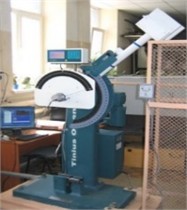
To investigate the impact toughness of the newly developed self-compacting basalt fiber-reinforced concrete, a test setup consisting of five functional blocks was used (Fig. 1) [13], [18]. The functional blocks included: 1) a force application block; 2) a piston hammer with adjustable mass; 3) a block for recording the hammer’s velocity prior to impact; 4) a block containing interchangeable impact applicators with varying configurations and rotations; and 5) a block for securing test specimens subjected to impact at different angles.
The operating principle of this device (test stand) is as follows: based on the pre-estimated strength characteristics of the construction material under study, the approximate mass of the hammer is selected, and corresponding cartridges are chosen. The test specimen is then mounted onto the ten securing blocks. Next, the sensors of the electronic stopwatch are checked to ensure correct installation. The hammer is moved to its rearmost position, the cartridge is loaded into the chamber, and the device is set to the operational mode. Once it is confirmed that no personnel are present within the safety zone, the triggering mechanism is actuated by pressing the finger lever, resulting in the release of the projectile from the piston-hammer. The time is recorded from the stopwatch, and the pre-impact velocity of the piston is determined. To repeat the impact, the hammer is returned to its initial position. The test cycle is then repeated the required number of times [19]-[21].
This test stand allows for precise determination of the impact force, adjustment of the impact angle in any desired direction, and evaluation of the fracture both qualitatively and quantitatively.
Using this test stand, the response of fine-grained concrete to single and repeated dynamic impacts was investigated under a wide range of varying impact conditions.
The impact testing procedure followed a cyclic approach, where the total energy absorption was quantified by recording the cumulative number of blows required to initiate the first visible crack () and the subsequent number of blows leading to final structural disintegration (). This method allows for a precise evaluation of the material’s post-cracking ductility.
Fig. 1General view and functional components of the experimental test stand designed for dynamic impact loading. Photo by N. Muhammadiev at TSTU laboratory, May 2025
3. Results
The impact strength of the concrete was determined according to the method described in [13]. According to this method, the impact resistance of the composite is calculated as the arithmetic mean of three specimens using the following formula:
where: – the sequence number of the impact that caused the specimen to fail; – the sequence number of the impact preceding the one that caused failure, i.e., the height from which the load was dropped, in cm; – the work expended to cause failure of the standard specimen, in J; – mass of the steel hammer, in kg; – volume of the specimen, in cm3.
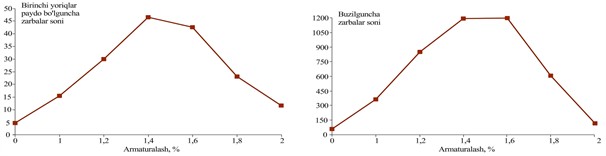
In the experimental studies, the following initial materials were used: cement binder: Portland cement CEM I 32.5 N produced by Ohangaron Cement Plant; fine aggregate: sand obtained from the “Pskent” deposit (GOST 8736-93); coarse aggregate: crushed stone produced from gravel from the “Pskent” deposit (GOST 8269.0-97); mineral micro-filler for the composite cement binder: zeolitic rock from the Beltau deposit (Navoi region); additional mineral micro-filler for the composite cement binder: quartz sand from the Maysky deposit (Tashkent region); chemical admixture: polycarboxylate-based superplasticizer Master Glenium 27 (BASF, Germany); dispersed fiber micro-filler: basalt fiber with a diameter of 13-17 μm and a length of 6-12 mm, produced by QK LLC “Mega Invest Industrial” (Jizzakh region). The results of the conducted experimental studies are presented in Fig. 2.
Fig. 2Impact toughness characteristics as a function of basalt fiber volumetric concentration, showing the optimal threshold at 1.4 %
Comparing these results with studies on conventional high-strength concrete (HSC), it is observed that the energy dissipation capacity of the developed SCC with 1.4 % basalt fiber is significantly higher. While standard HSC often exhibits brittle failure shortly after the first crack, our composite demonstrates a 'bridging effect' that maintains structural integrity under repeated dynamic loading.
The analysis of the obtained experimental results indicates that the inclusion of basalt fibers in the composition improves the impact toughness characteristics of the composite, but only up to a certain fiber content. In particular, the crack resistance of self-compacting basalt fiber-reinforced concrete can increase up to nine times compared to SCC without fibers. This improvement is achieved at a fiber volumetric concentration of 1.4 %. If the volumetric concentration of basalt fibers exceeds 1.6 %, the impact toughness characteristics of the self-compacting basalt fiber-reinforced concrete sharply decrease.
The use of fibers in composite materials is critically important. In particular, when fibers are added to concrete, they help ensure the required workability and, in turn, contribute to the absorption of a large portion of the energy until failure. The composite matrix provides crack propagation control, maintains residual strength after initial cracking, enhances impact toughness, and ensures resistance to large deformations and elongation (bending) [22].
It is well known that dynamic (impact) loading is characterized by continuously changing parameters, high intensity, and short duration. Unlike static strength, dynamic strength is more dependent on the presence of initial defects in the concrete structure. This phenomenon can be explained by the delayed development of microplastic deformations, which reduces the capacity for stress redistribution. Fibers act as “bridges,” reducing internal stresses in the composite and, consequently, preventing the further development of defects and decreasing the number (and size) of defect growth centers. This indicates that fibers actively participate in the formation of the composite’s microstructure and exhibit a positive influence on this process.
For basalt fiber-reinforced concrete, the graphical relationship between tensile stresses and deformations can be represented as consisting of two distinct zones (Fig. 3).
Fig. 3Stress-strain relationship in tension, illustrating the ductile behavior and energy absorption stages of basalt fiber-reinforced SCC
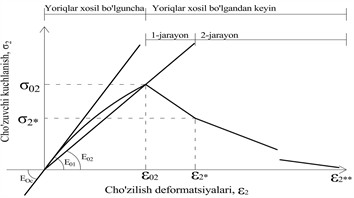
The first zone corresponds to the stage before crack formation, while the second zone represents the stage after cracks have appeared. In the first zone, the fiber-reinforced concrete matrix does not contain any cracks. The post-cracking stage is characteristic of the onset of fracture in the concrete matrix [23]. It should be noted that, for basalt fiber-reinforced concrete, the stress–strain curve appears more ductile compared to that of ordinary concrete. Nevertheless, the portion of the curve exhibiting a sharp drop is clearly visible. This behavior is attributed to the action of basalt fibers, which bridge cracks within the concrete matrix. The fractured portion of the curve can be analyzed in two distinct stages: Stage 1 and Stage 2. During Stage 1, stresses gradually increase in the composite fiber-reinforced concrete matrix, including the continuous strengthening of the fibers. In Stage 2, the residual stress is primarily associated with the elongation of the basalt fibers. At the ultimate tensile deformation, when the tensile strength approaches zero, it is assumed that all basalt fibers have been fully stretched, although fiber breakage has not yet occurred.
The subsequent experimental studies were devoted to determining the impact toughness of fiber-reinforced concretes with different compositions (Table 1).
The results of the conducted studies are presented in Table 2.
Table 1Material proportions and basic physicomechanical properties of the tested fine-grained SCC compositions
Composition number | Material consumption, kg/m3 | Strength, MPa | Elastic Modulus, GPa | |||||
CB | SP | Sand | Water | Cubic | Prismatic | |||
Cement | Binder | |||||||
1 | 702 | 452 | 11 | 1020 | 235 | 66,2 | 50,9 | 35,1 |
2 | 646 | 508 | 15 | 1020 | 223 | 68,6 | 51,0 | 36,0 |
3 | 582 | 572 | 18 | 1020 | 201 | 65,4 | 50,6 | 34,2 |
4 | 652 | 502 | 11 | 1020 | 253 | 64,8 | 49,8 | 33,4 |
5 | 606 | 548 | 15 | 1020 | 231 | 72,6 | 59,2 | 40,3 |
6 | 631 | 523 | 18 | 1020 | 203 | 63,0 | 48,9 | 32,2 |
7 | 601 | 553 | 11 | 1020 | 251 | 68,9 | 51,1 | 35,9 |
8 | 695 | 459 | 18 | 1020 | 196 | 70,3 | 52,3 | 36,3 |
9 | 631 | 523 | 15 | 1020 | 221 | 66,2 | 50,8 | 38,8 |
10* | 545 | - | - | 1634 | 218 | 42,9 | 31,8 | 25,2 |
11 | 545 | 169 | - | 1465 | 241 | 41,2 | 30,3 | 29,0 |
12 | 545 | - | 15 | 1691 | 182 | 50,3 | 33,2 | 30,5 |
Note: CB – composite binder; SP – superplasticizer; * – composition not mechanochemically activated compared to the others. | ||||||||
Table 2Comparative impact toughness parameters, including the number of blows until failure and energy coefficients
Composition (according to Table 1) | Number of blows for the first crack | Impact energy (first crack), J | Number of blows until specimen fracture | Impact energy (fracture), J | Impact toughness coefficient, | / |
2 | 30 | 1770 | 990 | 58410 | 33 | 0,15 |
5 | 45 | 2655 | 1210 | 71390 | 27 | 0,21 |
8 | 40 | 2360 | 960 | 56640 | 24 | 0,14 |
10* | 5 | 295 | 25 | 1475 | 5 | 0,09 |
11 | 5 | 295 | 75 | 4425 | 15 | 0,11 |
12 | 5 | 295 | 85 | 5016 | 17 | 0,14 |
Note: * composition is mechanically unactivated; basalt fiber content is 1.5 % by volume | ||||||
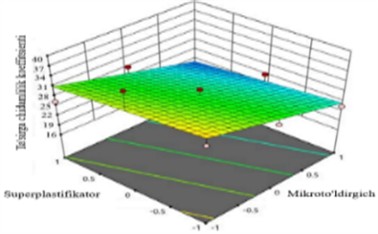
From the obtained results, it is evident that the highest number of blows was observed in the fiber concrete specimens prepared according to composition No. 5. Although the maximum value of the impact toughness coefficient () corresponds to the fiber concrete specimens of composition No. 2, it would be incorrect to consider this indicator as decisive when designing structures of critical facilities, since other parameters – such as the number of blows until the first crack and until specimen fracture – gave relatively lower results. The effect of the amounts of the incorporated microfiller and superplasticizer on the impact toughness coefficient () is shown in Fig. 4.
In basalt fiber-reinforced concrete, after the formation of fibrous “bridging” cracks, the absorption of impact load energy and, consequently, the impact ductility of the composite are determined [24], [25]. The impact toughness coefficient (), defined as the ratio of the final to initial impact energy, is considered a good indicator of the ductility of basalt fiber concrete under impact loading. Undoubtedly, the final impact energy (before fracture) and the energy expended to initiate the first crack differ significantly, with the final energy being considerably higher.
Fig. 4Influence of mineral microfiller and superplasticizer dosage on the impact toughness coefficient (μ), highlighting the efficiency of the composite binder
4. Conclusions
Experimental studies have confirmed that even after the formation of initial cracks, the specimens were able to withstand a significant amount of impact load until fracture. Interestingly, for self-compacting basalt fiber concrete, the obtained results exceed the final impact energy reported in the literature for high-strength concrete [13], [14]. This indicates that basalt fiber concretes have a very high potential as composite materials with high impact resistance, suitable for use in protective structures and critical constructions.
References
-
A. I. Adylkhodjaeva, I. M. Makhamataliev, U. Z. Turgunbaev, and V. M. Tsoy, Intensive Construction Technologies. (in Russian), Tashkent: Fan va Texnologiya Publishing House, 2016.
-
A. I. Adylkhodjaev, I. M. Makhamataliev, and V. M. Tsoy, Composite Construction Materials. Lambert Academic Publishing, 2018, pp. 978–613.
-
A. I. Adylkhodjaev, I. M. Makhamataliev, V. M. Tsoy, and K. S. Umarov, Complexly Modified Concretes with Organomineral Additives. (in Russian), Tashkent: Innovatsion Rivojlanish Nashriyot-Manbaa Uyi, 2020.
-
Y. N. Kovalev, Building Materials: Laboratory Practice. (in Russian), Minsk, Moscow: Novoe Znanie, INFRA-M, 2013.
-
Y. M. Bazhenov, “New century – new effective materials and technologies,” (in Russian), Building Materials, Equipment and Technologies of the XXI Century, Vol. 1, pp. 12–13, 2001.
-
O. N. Bolotskikh, “Self-compacting concrete and its diagnostics. Part 1: History, composition, properties, advantages and prospects,” Concrete and Reinforced Concrete in Ukraine, Vol. 6, pp. 2–6, 2006.
-
O. N. Bolotskikh, “Concrete that flows and compacts itself,” Construction Industry Journal, Vol. 9, pp. 40–42, 2015.
-
S. A. R. Ahmed and A. R. A. Sabry, “Review article on self-compacting concrete,” Altahadi University, 2003.
-
M. Shoya, S. Sugita, Y. Tsukinaga, M. Aba, and K. Tokuhasi, “Properties of self-compacting concrete with slag fine aggregates,” in International Conference on Creating with Concrete, pp. 121–130, 1999.
-
“The European Guidelines for Self-Compacting Concrete: Specification, Production and Use.” SCC European Project Group, 2005, http://www.efnarc.org
-
I. Rodríguez Viacava, A. Aguado de Cea, and G. Rodríguez de Sensale, “Self-compacting concrete of medium characteristic strength,” Construction and Building Materials, Vol. 30, pp. 776–782, May 2012, https://doi.org/10.1016/j.conbuildmat.2011.12.070
-
N.M. Mukhammadiev and G. Malikov, “Use of basalt fiber in concrete mixture for manufacture of prefabricated concrete and reinforced concrete structures,” in The 3rd International Symposium on Civil, Environmental, and Infrastructure Engineering (ISCEIE), Vol. 3317, p. 030043, Jan. 2025, https://doi.org/10.1063/5.0266812
-
V. Tsoy, D. Abdullaeva, and N.M. Mukhammadiyev, “Influence of silica-containing additives on structure formation of composite cement binder for non-autoclaved aerated concrete,” in Problems in the Textile and Light Industry in the Context of Integration of Science and Industry and Ways to Solve Them: PTLICISIWS-2, Vol. 3045, p. 060019, Jan. 2024, https://doi.org/10.1063/5.0197488
-
K. K. Kamilov, S. I. Turakhanov, and S. K. Kamilov, “History of self-compacting expanded clay concrete,” in Proceedings of the International Scientific-Practical Conference on Innovative Building Materials based on Local Raw Materials, pp. 283–290, 2024.
-
I. M. Makhamataliev, “Modern trends in improving reinforced concrete structures,” Bulletin of TashIIT, Vol. 2, pp. 16–18, 2012.
-
A. I. Adylkhodjaev, I. M. Makhamataliev, F. F. Karimova, and I. A. Kadirov, Modern Methods of Studying Building Materials (Textbook). (in Russian), Tashkent: TSTU Publishing, 2023.
-
I. M. Makhamataliev, “Improvement of methodological aspects of polystructural theory of composite building materials,” Bulletin of TashIIT, Vol. 2, pp. 106–110, 2015.
-
C. Raupov and G. Malikov, “Creep in expanded clay concrete at different levels of stress under compression and tension,” in E3S Web of Conferences, Vol. 365, p. 02008, Jan. 2023, https://doi.org/10.1051/e3sconf/202336502008
-
I. Mukhamataliyev, F. Ruzmetov, A. Khudoyorov, and S. Uzakov, “About the strength characteristics of fiber-fiber-reinforced concrete fox polfiber M12 BASF companies,” in E3S Web of Conferences, Vol. 452, p. 06026, Nov. 2023, https://doi.org/10.1051/e3sconf/202345206026
-
I. Mukhamataliyev, N. Mukhammadiev, F. Ruzmetov, A. Khudoyorov, and S. Uzakov, “Performance properties of fiber-reinforced concrete particle-fiber-reinforced fox polfiber M12 BASF companies,” in 6th International Scientific Conference Construction Mechanics, Hydraulics and Water Resources Engineering (CONMECHYDRO 2024), Vol. 3286, p. 020003, Jan. 2025, https://doi.org/10.1063/5.0281474
-
I. M. Makhamataliev, “New generation concretes based on effective mineral additives, fine sands and hyperplasticizers,” Bulletin of TashIIT, No. 1/2, pp. 24–27, 2013.
-
I. M. Makhamataliev, “Technical and economic efficiency of using high-strength concretes,” Architecture, Urban Planning and Design, No. 2, pp. 17–21, 2013.
-
C. Raupov and G. Malikov, “Comparison of microcrack formation boundaries determined by complex of physical methods with long-term strength of expanded clay concrete under different types of stress state,” in E3S Web of Conferences, Vol. 365, p. 02023, Jan. 2023, https://doi.org/10.1051/e3sconf/202336502023
-
A. Ilyasov, A. Adilkhodjaev, I. Makhamataliev, and A. Allamuratov, “Optimization of the composition of fiber foam concrete with polypropylene fiber Fox Polfiber M12 produced by basf company,” in E3S Web of Conferences, Vol. 452, p. 06011, Nov. 2023, https://doi.org/10.1051/e3sconf/202345206011
-
V. Soy, “Investigation of effect of silica-containing additives on structure of composite binders,” in The 3rd International Symposium on Civil, Environmental, and Infrastructure Engineering (ISCEIE) 2024, Vol. 3317, p. 030039, Jan. 2025, https://doi.org/10.1063/5.0267635
About this article

The authors have not disclosed any funding.
The datasets generated during and/or analyzed during the current study are available from the corresponding author on reasonable request.
The authors declare that they have no conflict of interest.

