Abstract
This study investigates the enhancement of mechanical properties of fine-grained concrete reinforced with basalt fibers for road pavement applications. Basalt fibers were incorporated into the concrete mixture at dosages of 0.5 %, 1.0 %, and 1.5 % by weight of cement to achieve micro-reinforcement of cement-concrete pavements. Experimental results were obtained by evaluating the compressive strength and flexural tensile strength of prepared specimens. The findings indicate that the inclusion of basalt fibers contributes to improved structural integrity of the cement matrix by limiting the formation and propagation of microcracks and macrocracks. Based on the experimental analysis, practical recommendations are proposed for optimizing the fiber content to ensure uniform distribution and formation of a dense and durable cementitious structure.
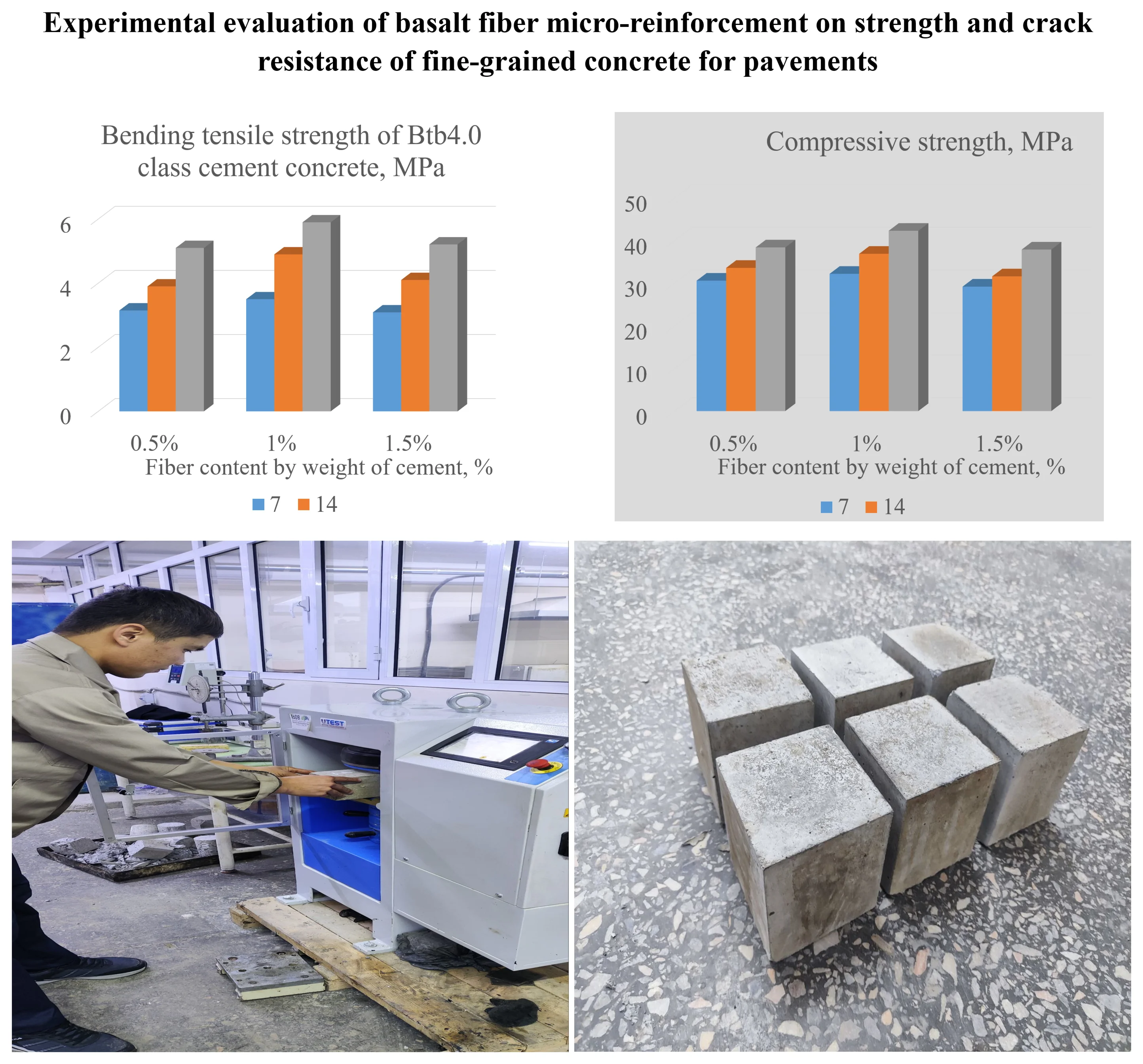
Highlights
- Bending tensile strength of Btb4.0 class cement concrete, MPa
- Compressive strength, MPa
- Testing machine
- Standart cubes
1. Introduction
The performance of cement-concrete pavements is significantly influenced by both mechanical loading and environmental conditions. An analysis of ekspluatation conditions indicates that the surface layer of the pavement is the most vulnerable to damage, as it is directly exposed to traffic loads and climatic impacts. In particular, severe climatic conditions, such as hot and dry environments, accelerate the deterioration processes and consequently reduce the service life of cement-concrete pavements.
Therefore, the consideration of climatic zone characteristics at the design and construction stages is essential for ensuring long-term pavement performance. In hot and dry climates, cement concrete requires enhanced resistance to shrinkage, cracking, and surface degradation, which necessitates the modification of its structural and mechanical properties.
One of the effective approaches to improving the durability of the pavement surface layer is the application of modern technologies aimed at controlling the internal structure of the concrete mixture. In this context, micro-reinforcement using fiber materials has gained considerable attention, as it contributes to the formation of a more uniform and crack-resistant cementitious matrix [1-8].
Furthermore, the rapid increase in traffic intensity, particularly the growth in heavy vehicles with axle loads exceeding 13 tons, imposes additional demands on pavement strength and durability. Under such conditions, the development of high-performance cement-concrete pavements with improved mechanical properties becomes a critical engineering task [1, 2, 9-12].
2. Methodology
During the operation of cement-concrete pavements, deterioration occurs due to traffic loads and environmental factors. These include mechanical damage, environmental effects, and crack development.
An experimental study was conducted to evaluate the effect of basalt fibers on fine-grained concrete. Fibers were added in proportions of 0.5 %, 1.0 %, and 1.5 % by weight of cement. Concrete specimens were prepared under laboratory conditions to ensure uniform fiber distribution.
After standard curing, the samples were tested to determine compressive strength and flexural tensile strength. The results were analyzed to identify the optimal fiber content for improving the durability and crack resistance of the concrete.
Fig. 1Failure modes in cement-concrete pavements (diagram developed by the authors using AutoCAD, 2025): a) aggregate strength (R3) exceeds cement matrix strength (Rp), resulting in failure along the mortar; b) aggregate strength is lower than cement matrix strength, leading to failure through both mortar and aggregate; c) comparable strengths of aggregate and cement matrix, resulting in mixed failure patterns
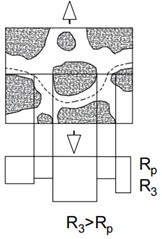
a)
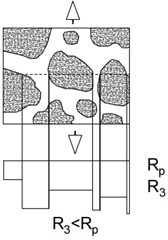
b)
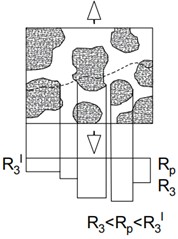
c)
2.1. Materials
Analysis of cement-concrete pavement deterioration indicates that failure predominantly occurs within the cement matrix. To mitigate this issue, various types of fibers have been incorporated into concrete mixtures as micro-reinforcing elements.
In this study, concrete specimens were prepared using different types of fibers, including polypropylene, basalt, glass, wool, steel, and amorphous fibers, added in various proportions relative to the cement mass [1, 2]. A control mixture without fibers was also prepared for comparison.
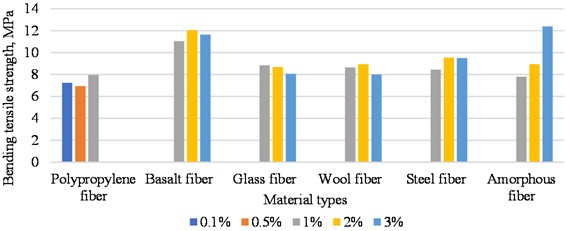
The experimental results demonstrate that the inclusion of fibers improves both compressive strength and flexural tensile strength of the concrete (Figs. 2 and 3).
Fig. 2Variation of compressive strength depending on fiber mass fraction based on experimental data obtained by the authors (2025)
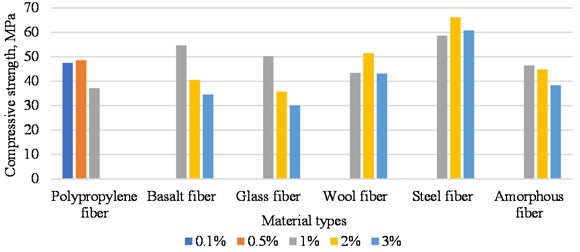
Analyses show that fiber-reinforced cement concrete (FRCC) exhibits significantly increased strength. However, under high loads and natural climatic conditions, some fibers face problems. Metal fibers, despite their high strength, are prone to corrosion, causing premature pavement failure. Natural fibers, which resist chemical reactions, environmental effects, and corrosion, are preferable. Basalt fibers are the most suitable, enhancing strength while remaining durable throughout the pavement’s service life [3, 11-15].
Fig. 3Effect of different fiber types on the tensile strength of cement-concrete mixtures based on experimental results obtained by the authors (2025)
2.2. Experimental procedure
Basalt fibers enable micro-reinforcement of cement concrete pavements, effectively preventing deterioration along the cement matrix. By inhibiting microcrack formation, they also prevent subsequent macrocracking. The fine-grained basalt fiber-reinforced concrete mix for road applications was designed based on flexural tensile strength, as shown in (Table 1).
Table 1Mix design of a concrete mixture with a flexural tensile strength of class Bt.b4.0
Selected materials for concrete composition | Materials consumed for 1 m3 | |||
Mass, kg | Density, kg/dm3 | Volume, dm3 | ||
Cement | Bekabadcement CEM I 42.5H DP | 380.93 | 3.11 | 122.51 |
Sand | Sand crushed from basalt stone 0-5 mm | 725.15 | 2.65 | 273.60 |
Gravel | Basalt Crushed Stone Ø 5-10 mm (70 %) | 719.97 | 2.74 | 262.80 |
Basalt Crushed Stone Ø 10-20 mm (30 %) | 308.55 | 2.74 | 112.60 | |
Chemical additive | Plasticizer Huaxin Cement Jizzakh | 3.80 | 1.07 | 3.56 |
Basalt fiber | BK 10 | 3.80 | 2.60 | 1.46 |
Water | 158.11 | 1.0 | 158.10 | |
One of the main challenges in producing basalt fiber-reinforced concrete is achieving uniform fiber distribution. A single basalt bundle contains hundreds of fibers, which do not fully disperse when mixed directly with cement and water. Laboratory observations indicate that basalt fibers should first be mixed with dry aggregates (crushed stone and sand) for 2-3 minutes to ensure complete dispersion, followed by the addition of cement and water. The rotational speed of the concrete mixer is critical for uniform distribution and should be maintained between 90 and 120 rpm [3, 15, 16].
3. Results and discussion
Basalt fibers of grade Bk-10 (12 mm length, 13-15 µm diameter) were incorporated into a fine-grained concrete mix (B30 compressive strength class, Bt.b4.0 flexural tensile class) at 0.5 %, 1 %, and 1.5 % by cement mass. The results were compared with control samples without fibers. The addition of 1 % basalt fibers yielded the highest flexural tensile and compressive strengths among the tested proportions (Figs. 4, 5, 6).
Fig. 4Effect of basalt fiber content (by cement mass) on flexural tensile and compressive strengths based on experimental data obtained by the authors (2025)
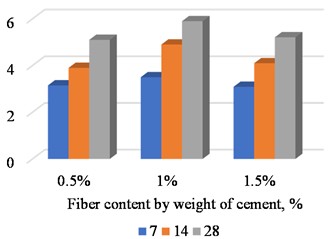
a) Bending tensile strength of Btb4.0 class cement concrete, MPa
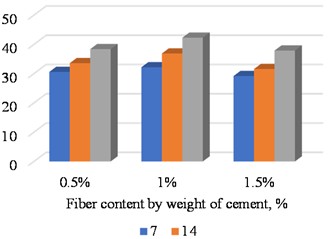
b) Compressive strength, MPa
Fig. 5Compressive strength of B30 class concrete (Bekabad cement CEM I 42.5N) with and without basalt fibers based on experimental results obtained by the authors (2025)
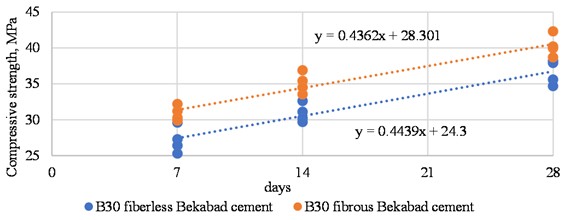
Fig. 6Flexural tensile strength of Bt.b4.0 class concrete with and without basalt fibers (Bekabad cement mix) based on experimental data obtained by the authors (2025)
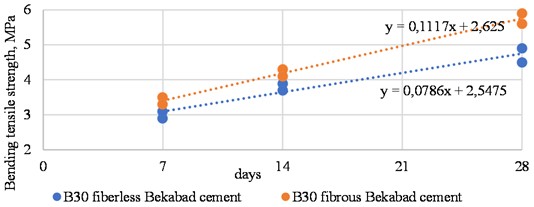
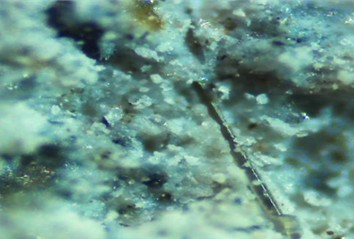
Fig. 7Formation of the contact zone between basalt fibers and cement concrete matrix. Microscopic image obtained by the authors, 2025
The results indicate that incorporating basalt fibers into cement concrete increases both compressive and flexural tensile strengths. While laboratory conditions yield higher strengths, practical production may not always achieve the same results due to challenges in replicating laboratory conditions. Therefore, each test should be validated through practical application.
4. Analysis of experimental data
Recommendations for Using Basalt Fibers to Enhance the Strength of Fine-Grained Road Concrete
1) Dry-mix the aggregates (crushed stone 5-10 mm and 10-20 mm, and sand) for 1 min in a concrete mixer.
2) Maintain the mixer rotation speed at 90-120 rpm.
3) Add cement and mix for an additional 1 min.
4) Incorporate basalt fibers at 0.5 %, 1 %, or 1.5 % by cement mass into the dry mixture and mix for 1-3 min, visually checking each minute to ensure uniform fiber distribution.
5) Dry mixing allows friction with aggregates to separate fiber bundles and achieve full dispersion.
6) Finally, add water to the dry mix and mix for 60-90 s [3, 4, 5].
5. Conclusions
Fine-grained basalt fiber-reinforced concrete exhibits higher strength than conventional road concrete. Micro-reinforcement with basalt fibers prevents cement paste degradation by forming a complex internal structure. The highest strength was achieved with 1 % basalt fibers by cement mass; lower or higher proportions reduced strength. Specifically, compressive and flexural strengths were 5-10 % higher than in concrete without fibers. Excess fiber content increases porosity and decreases strength, while insufficient fiber content fails to form an adequate reinforcing structure.
References
-
Y. Begich, S. Klyuev, V. Jos, and A. Cherkashin, “Fine-grained concrete with various types of fibers,” Magazine of Civil Engineering, p. 9, Feb. 2020, https://doi.org/10.18720/mce.97.2
-
S. V. Biradar, M. S. Dileep, and T. Vijaya Gowri, “Studies of concrete mechanical properties with basalt fibers,” IOP Conference Series: Materials Science and Engineering, Vol. 1006, No. 1, p. 012031, Jan. 2020, https://doi.org/10.1088/1757-899x/1006/1/012031
-
T. J. Amirov and M. I. Jumog’Ulov, “The use of basalt fibers to increase the strength of roads with fine-grained cement concrete pavement,” Problems of Architecture and Construction, No. 2, pp. 131–133, Jun. 2024.
-
T. J. Amirov and M. I. Jumog’Ulov, “Investigation of the microstructure of fine-grained pavement concrete,” in Prospects for the Development of Road Transport in Uzbekistan: Design, Operation, and Logistics, No. 2, pp. 490–493, Jun. 2024.
-
T. J. Amirov, B. E. Qurbonov, and M. I. Jumog’Ulov, “Analysis of the physico-mechanical properties of pressed concrete mixtures with the addition of basalt fibers,” Problems of Architecture and Construction, No. 1, pp. 232–235, Jun. 2025.
-
T. J. Amirov and M. I. Jumog’Ulov, “Increasing the strength of fine-grained concrete used in the construction of road pavements,” Science Swallows of New Uzbekistan, No. 3, pp. 56–59, Jun. 2024.
-
T. Amirov, X. Aripov, B. Qurbonov, M. Tuxtayev, and S. Rakhmatov, “Designing the composition of road concrete with chemical additives,” E3S Web of Conferences, Vol. 264, p. 02049, Dec. 2021, https://doi.org/10.1051/e3sconf/202126402049
-
T. Amirov, K. Aripov, M. Tukhtayev, and S. Rakhmatov, “Study of the influence of the share of sand in the mixture aggregates for the physical and mechanical properties of road heavy concrete mixtures,” in AIP Conference Proceedings, Vol. 3244, No. 1, p. 040005, May 2024, https://doi.org/10.1063/5.0242117
-
A. Mamatmuminov, S. Ibragim, and I. Xoshimov, “Technology for producing modified polymer sulfur bitumen and its properties,” Vibroengineering Procedia, Vol. 60, pp. 556–562, Dec. 2025, https://doi.org/10.21595/vp.2025.25364
-
A. M. Brandt, “Fibre reinforced cement-based (FRC) composites after over 40 years of development in building and civil engineering,” Composite Structures, Vol. 86, No. 1-3, pp. 3–9, Mar. 2008, https://doi.org/10.1016/j.compstruct.2008.03.006
-
V. Fiore, T. Scalici, G. Di Bella, and A. Valenza, “A review on basalt fibre and its composites,” Composites Part B: Engineering, Vol. 74, pp. 74–94, Jun. 2015, https://doi.org/10.1016/j.compositesb.2014.12.034
-
J. Branston, S. Das, S. Y. Kenno, and C. Taylor, “Mechanical behaviour of basalt fibre reinforced concrete,” Construction and Building Materials, Vol. 124, pp. 878–886, Oct. 2016, https://doi.org/10.1016/j.conbuildmat.2016.08.009
-
Y. Jiang, T. Wang, and B. Li, “Experimental study on mechanical properties and crack resistance of basalt fiber reinforced concrete,” Materials and Structures, Vol. 49, pp. 4899–4909, Jun. 2016.
-
T. Ayub, N. Shafiq, and M. F. Nuruddin, “Mechanical properties of high-performance concrete reinforced with basalt fibers,” Procedia Engineering, Vol. 77, pp. 131–139, Jul. 2014, https://doi.org/10.1016/j.proeng.2014.07.029
-
D. P. Dias and C. Thaumaturgo, “Fracture toughness of geopolymeric concretes reinforced with basalt fibers,” Cement and Concrete Composites, Vol. 27, No. 1, pp. 49–54, Jan. 2005, https://doi.org/10.1016/j.cemconcomp.2004.02.044
-
J. Sim, C. Park, and D. Y. Moon, “Characteristics of basalt fiber as a strengthening material for concrete structures,” Composites Part B: Engineering, Vol. 36, No. 6-7, pp. 504–512, Jan. 2005, https://doi.org/10.1016/j.compositesb.2005.02.002
About this article

The authors have not disclosed any funding.
The datasets generated during and/or analyzed during the current study are available from the corresponding author on reasonable request.
The authors declare that they have no conflict of interest.

