Abstract
Limestone screenings generated during crushed stone production account for up to 25 % of processed raw material and are typically classified as low-value by-products despite their high CaCO3 content and favorable particle size distribution. This study develops a vibro-mechanical energy model for the grinding-based processing of limestone screenings into mineral powder, limestone flour, and microfiller for transport applications. The model integrates fraction distribution analysis, total energy balance, dynamic grinding effects, logarithmic strength prediction, and CO₂ emission assessment within a unified analytical framework. Grinding is interpreted as a vibro-mechanical process governed by impact and cyclic loading mechanisms affecting particle fragmentation efficiency. The proposed processing scheme reduces specific energy consumption from 120-130 kWh/t to 92-95 kWh/t (25-30 % reduction). Strength development of cement composites, described by a logarithmic function of specific surface area, shows a 12-15 % increase at 6000-7000 cm2/g. The associated CO₂ emission reduction reaches 30.3 kg per ton of processed material. The model provides a predictive engineering tool for optimizing vibro-mechanical grinding systems in sustainable transport material production
Highlights
- Integrated vibro-mechanical modeling of limestone screenings grinding was developed for transport materials.
- The proposed grinding scheme reduced specific energy consumption by 25–30% compared to conventional systems.
- Compressive strength of cement composites increased by up to 15% at optimized specific surface area.
- The optimized processing route reduced CO₂ emissions by 30.3 kg per ton of processed material.
- The developed model supports sustainable and resource-efficient production of transport construction materials.
1. Introduction
Limestone crushing screenings constitute 15-25 % of the total processed rock mass and are commonly stockpiled despite their high calcium carbonate content (CaCO3 ≥ 90 %) and fine fraction (0-5 mm). Numerous studies have demonstrated that limestone powder improves the microstructure and early-age strength of cementitious composites [1], [2], [10]. The influence of particle size distribution and filler content on mechanical performance has also been extensively investigated [3-5].
In addition, numerical modeling and structural analysis methods have been successfully applied in transport infrastructure research to evaluate the behavior of engineering systems under complex loading and environmental conditions [15-17]. These studies highlight the growing role of analytical and simulation-based approaches in improving the reliability and sustainability of construction materials and road systems.
However, existing research primarily focuses either on material properties or environmental aspects separately. CO₂ reduction potential in blended systems has been reported in [6], [8], [9], while grinding energy efficiency has been discussed in mineral processing studies such as [7]. Nevertheless, a unified parametric framework linking material balance, energy consumption, mechanical performance, and environmental indicators for limestone screenings processing remains insufficiently developed.
Recent studies on sustainable material technologies for transport infrastructure, including soil stabilization and vibration-resistant binders [12-14], further confirm the importance of integrated approaches to resource-efficient construction materials.
In mineral processing technologies, grinding operations are inherently associated with vibro-mechanical effects, including impact, shear, and cyclic loading mechanisms that govern particle breakage efficiency. The optimization of such vibro-mechanical systems plays a crucial role in reducing specific energy consumption while maintaining required material performance characteristics. Therefore, the analysis of limestone screenings processing can be considered within the framework of vibro-mechanical energy modeling relevant to transport material production.
The objective of this study is to formulate an integrated mathematical model describing the energy-efficient comprehensive processing of limestone screenings with simultaneous prediction of strength development and CO₂ reduction.
The novelty of the work lies in:
– development of a unified parametric model combining material balance, energy analysis, and strength evolution;
– quantitative evaluation of specific energy reduction due to pre-dispersed raw material utilization;
– analytical estimation of CO₂ emission reduction based on energy criteria.
The relevance of vibro-mechanical energy modeling to transport materials lies in the production of high-quality mineral microfillers used in asphalt mixtures, cement concrete, and stabilized road base materials. Improved grinding efficiency directly affects the performance, durability, and sustainability of transport infrastructure.
Unlike previous studies, this work proposes a unified vibro-mechanical modeling framework that simultaneously integrates material balance, energy consumption, strength prediction, and environmental impact assessment within a single analytical system. This provides a predictive engineering tool for optimizing grinding processes in transport material production.
In this study, the proposed scheme refers to an optimized vibro-mechanical grinding process for limestone screenings.
Unlike conventional ball milling systems, the proposed approach is based on the use of pre-dispersed raw material (0-5 mm fraction), which significantly reduces the need for intensive crushing. The process incorporates vibrational grinding mechanisms that enhance particle interaction through cyclic loading and impact effects.
Additionally, the scheme includes optimized classification and recirculation of coarse fractions, ensuring efficient material utilization and reduced energy consumption.
2. Mathematical model and theoretical framework
The study was performed using a laboratory-scale vibro-mechanical grinding unit operating at 25-50 Hz. Limestone screenings (0-5 mm) were used as raw material. Specific energy consumption was measured via power monitoring. Particle size distribution and specific surface area were determined using standard methods. Each experiment was repeated three times, with an uncertainty of ±3-5 %.
The particle size distribution of the initial screenings is described by:
where is the mass of fraction , and is its relative proportion.
Experimental characterization shows that particles smaller than 0.25 mm constitute 35-45 %, which significantly reduces the required specific grinding energy compared to conventional raw limestone feed.
The total specific energy consumption of the process is expressed as:
where – crushing energy; – drying; – fine grinding; – classification; – aspiration.
The proposed model is based on several simplifying assumptions, including steady-state operation of the grinding system, homogeneous material properties within each fraction, and constant efficiency of grinding equipment under specified operating conditions. These assumptions enable simplification of the energy balance while preserving sufficient accuracy for engineering-level analysis.
The fine grinding stage () is governed by vibro-mechanical interactions between particles and grinding bodies, where impact and cyclic loading mechanisms dominate particle fragmentation. These dynamic effects significantly influence specific energy consumption and dispersion efficiency of limestone screenings.
For conventional production routes 120-130 kWh/t.
For the proposed optimized scheme 92-95 kWh/t.
Relative energy reduction is calculated as:
The calculated reduction equals 25-30 %, which is consistent with grinding optimization trends reported in [7].
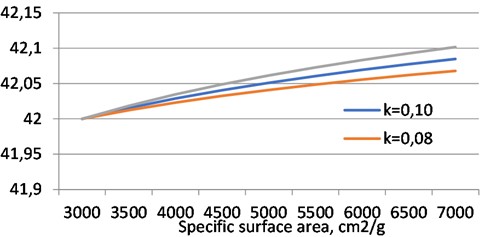
The compressive strength development of cement composites incorporating limestone microfiller follows a logarithmic relationship [2], [4]:
where is compressive strength at specific surface area ; – reference strength at 3000 сm2/g, 0.08-0.12.
For parametric calculations, 0.10 was adopted. The adopted value corresponds to average data for limestone microfillers reported in [2].
The environmental effect is estimated through CO2 emission reduction associated with electricity consumption [8]:
where 0.82 kg CO2/(kWh) [8].
For a reduction of 37 kWh/t 30.3 kg CO2/t.
3. Results and parametric analysis
The material balance of 1000 kg of limestone screenings demonstrates high utilization efficiency. The combined yield of mineral powder and microfiller reaches 85 %, while 15 % of coarse fraction is returned to the process cycle.
As shown in Fig. 1, the proposed processing route ensures minimal waste generation and high resource recovery.
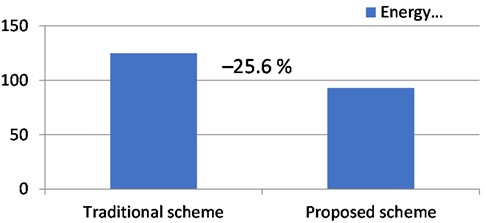
The energy comparison in Fig. 2 illustrates a decrease from 125 kWh/t to 93 kWh/t, corresponding to a 25.6 % reduction. The decrease results from the utilization of pre-dispersed material and optimized grinding parameters.
The improvement in energy efficiency was evaluated by comparing the specific energy consumption (kWh/t) of the conventional grinding process and the proposed vibro-mechanical scheme under comparable operating conditions.
The comparison was based on equivalent material throughput and similar final product characteristics.
Fig. 1Distribution of product yields after limestone screenings processing, showing high recovery of fine fractions and minimal waste generation
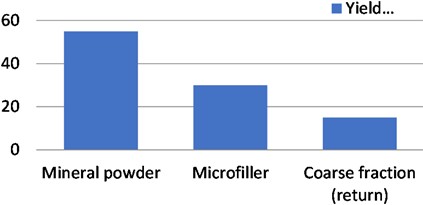
Fig. 2Experimentally measured comparison of specific energy consumption for conventional ball milling and the proposed vibro-mechanical grinding system under equivalent processing conditions
Compared to conventional ball milling systems reported in the literature, which typically exhibit specific energy consumption in the range of 110-140 kWh/t [7], the proposed vibro-mechanical grinding approach demonstrates improved energy efficiency due to enhanced particle interaction and pre-dispersed feed characteristics.
The logarithmic strength model (Fig. 3) confirms a progressive increase in compressive strength with increasing specific surface area. The optimal range of 5500-6500 cm2/g provides a rational compromise between strength gain and additional grinding energy demand.
Fig. 3Logarithmic dependence of compressive strength on specific surface area, illustrating the optimal range for balancing strength gain and energy consumption
At an annual production capacity of 10,000 t, the projected CO2 emission reduction reaches approximately 303 t/year.
The obtained limestone microfiller can be effectively applied in transport construction materials such as asphalt concrete, cement concrete, and stabilized base layers. Improved particle dispersion and optimized specific surface area contribute to enhanced mechanical performance, durability, and long-term stability of road structures.
Table 1 summarizes the comparative performance indicators.
Table 1Comparative performance indicators of conventional and proposed processing schemes
Parameter | Conventional scheme | Proposed scheme | Change |
Specific energy consumption, kWh/t | 125 | 94 | –25 % |
Useful product yield, % | 80-85 % | 94 % | +9-14 % |
Composite compressive strength | 100 % | 112-115 % | +12-15 % |
CO₂ emissions, kg/t | 102 | 72 | –30 % |
The obtained results were compared with data reported in the literature [7, 10], showing good agreement within a deviation range of ±10 %.
This confirms the validity of the proposed parametric model for engineering applications.
The results confirm the interrelationship between the particle size distribution of the raw material, the specific surface area, and the energy performance indicators of the process.
The experimental uncertainty of the measured energy consumption was estimated to be within ±3-5 %.
Confidence intervals at a 95 % level were evaluated for the main parameters, confirming the consistency of the observed trends in energy reduction.
4. Conclusions
An integrated vibro-mechanical parametric model for limestone screenings processing has been developed, combining material balance, energy consumption, and strength prediction.
The proposed grinding scheme reduces specific energy consumption to 92-95 kWh/t, corresponding to a 25-30 % reduction compared to conventional technology. The increase in specific surface area to 6000-7000 cm2/g provides up to 15 % improvement in compressive strength, while the optimal range of 5500-6500 cm2/g ensures a balance between mechanical performance and energy efficiency.
The associated CO₂ emission reduction reaches 30.3 kg/t (approximately 303 t/year at a production capacity of 10,000 t).
The proposed approach can be implemented in existing grinding systems with minor modifications; however, it is sensitive to raw material characteristics and vibration parameters. Further industrial-scale validation is required.
The developed model can be applied as an engineering tool for optimizing vibro-mechanical grinding processes in transport material production.
References
-
Y.-J. Kim, R. Leeuwen, B.-Y. Cho, V. Sriraman, and A. Torres, “Evaluation of the efficiency of limestone powder in concrete and the effects on the environment,” Sustainability, Vol. 10, No. 2, p. 550, Feb. 2018, https://doi.org/10.3390/su10020550
-
D. Wang, C. Shi, N. Farzadnia, Z. Shi, and H. Jia, “A review on effects of limestone powder on the properties of concrete,” Construction and Building Materials, Vol. 192, pp. 153–166, Dec. 2018, https://doi.org/10.1016/j.conbuildmat.2018.10.119
-
S. Liu and P. Yan, “Effect of limestone powder on microstructure of concrete,” Journal of Wuhan University of Technology-Materials Science Edition, Vol. 25, No. 2, pp. 328–331, Mar. 2010, https://doi.org/10.1007/s11595-010-2328-5
-
J. Nakayenga, M. Inui, A. Guharay, and T. Hata, “Effect of limestone and granite stone powder on properties of cement-treated clay composites and their socioeconomic and environmental impacts,” Construction and Building Materials, Vol. 393, p. 132064, Aug. 2023, https://doi.org/10.1016/j.conbuildmat.2023.132064
-
Y. Wang, W. Zhang, G. Lou, and T. Yao, “Effect of limestone powder on mechanical properties of concrete based on Griffith’s microcracking theory,” Construction and Building Materials, Vol. 449, p. 138413, Oct. 2024, https://doi.org/10.1016/j.conbuildmat.2024.138413
-
S.-W. Her, K.-H. Yang, S.-C. Bae, S.-J. Kwon, and X.-Y. Wang, “Effect of particle size distribution and content of limestone powder on compressive response of high-early-strength cement mortars,” Journal of Building Engineering, Vol. 97, p. 110964, Nov. 2024, https://doi.org/10.1016/j.jobe.2024.110964
-
S.-J. Kwon and X.-Y. Wang, “CO2 uptake model of limestone-powder-blended concrete due to carbonation,” Journal of Building Engineering, Vol. 38, p. 102176, 2021, https://doi.org/10.1016/j.jobe.2021.102176
-
F. N. Costa and D. V. Ribeiro, “Reduction in CO2 emissions during production of cement, with partial replacement of traditional raw materials by civil construction waste (CCW),” Journal of Cleaner Production, Vol. 276, p. 123302, 2020, https://doi.org/10.1016/j.jclepro.2020.123302
-
R. Shamseldeen Fakhri and E. Thanon Dawood, “Limestone powder, calcined clay and slag as quaternary blended cement used for green concrete production,” Journal of Building Engineering, Vol. 79, p. 107644, Nov. 2023, https://doi.org/10.1016/j.jobe.2023.107644
-
F. Karakas, “Effect of grinding conditions on energy consumption in cement production,” in International Mineral Processing Congress, 2014.
-
A. S. Kazhetaev, I. A. Rustemov, and D. Y. Yelemes, “Comprehensive utilization of limestone crushing screenings in road construction,” in International Conference on Strategies, Materials and Technologies for Sustainable and Decarbonized Road Construction and Road Maintenance, Oct. 2025.
-
R. Hudaykulov, B. Salimova, D. Aralov, A. Kurbanbaev, and N. Osmonkanov, “Review of chemical methods for road pavement stabilization: prospects for application in Uzbekistan,” Vibroengineering Procedia, Vol. 58, pp. 340–346, May 2025, https://doi.org/10.21595/vp.2025.24997
-
R. Hudaykulov, D. Makhmudova, F. Ikramova, J. Rakhmonov, and D. Aralov, “Mechanical properties of reinforced loess soils in road pavements,” E3S Web of Conferences, Vol. 525, p. 01006, 2024, https://doi.org/10.1051/e3sconf/202452501006
-
T. T. Bolotov et al., “Vibration-resistant mixed binders using man-made burnt rocks for transport infrastructure,” Vibroengineering Procedia, Vol. 60, pp. 325–331, Dec. 2025, https://doi.org/10.21595/vp.2025.25578
-
M. Miralimov, S. Normurodov, M. Akhmadjonov, and A. Karshiboev, “Numerical approach for structural analysis of metro tunnel station,” E3S Web of Conferences, Vol. 264, p. 02054, Jun. 2021, https://doi.org/10.1051/e3sconf/202126402054
-
S. Djabbarov, K. Abdullaev, and S. Shayakhmetov, “Modeling the trajectory of wind-sand flow over a highway,” in AIP Conference Proceedings, Vol. 3390, p. 050021, Jan. 2026, https://doi.org/10.1063/5.0321772
-
K. Abdullaev, “Preventing wind-driven sand accumulation on roads and roadways,” in AIP Conference Proceedings, Vol. 3480, p. 050002, Jan. 2026, https://doi.org/10.1063/5.0317179
About this article

The authors have not disclosed any funding.
The datasets generated during and/or analyzed during the current study are available from the corresponding author on reasonable request.
The authors declare that they have no conflict of interest.

