Abstract
This study presents the design, analysis, and structural performance assessment of precast-monolithic beam reinforced concrete floors incorporating aerated concrete blocks, developed for the hot and dry climatic conditions of Uzbekistan. The main objective is to determine the bearing capacity and deflection behavior of these composite floors using the limit equilibrium method, accounting for different span lengths and load combinations in accordance with SP 20.13330.2016 “Loads and Impacts.” Six design configurations were analyzed for spans ranging from 3 m to 6 m under twelve load combinations. The results show that the moment capacity obtained from the limit equilibrium method is 1.5-1.8 times higher than that computed by the traditional sectional method, demonstrating improved structural efficiency and material economy. Experimental verification was conducted on a prototype slab constructed at the Department of Building Structures, Fergana Polytechnic Institute. The study confirms that using aerated concrete blocks as permanent formwork and fillers not only reduces weight but also enhances construction speed and energy efficiency. The developed system is recommended for low-rise residential and public buildings requiring lightness, seismic resistance, and cost-effectiveness.
1. Introduction
Over the past two decades, many researchers worldwide have studied precast-monolithic systems as alternatives to fully monolithic structures. Vatin et al. analyzed composite beam-block floors with lightweight aggregates, demonstrating their potential for industrialized construction [6]. Paraschenko et al. and Teplova and Vinogradova discussed the structural efficiency of partial ribbed precast-monolithic floors with cellular concrete blocks [7, 8]. Shembakov emphasized the advantages of hybrid frames that combine monolithic and precast elements in mass housing construction [9]. Barguti investigated the crack resistance and deformability of prestressed beam floors [10]. However, most previous works were performed under temperate or humid climates and did not explicitly consider the behavior of composite systems under arid and hot environmental conditions, typical for Central Asia. The combined effects of temperature gradients, low humidity, and increased shrinkage demand specific structural solutions that are still insufficiently explored.
In Uzbekistan, studies on reinforced concrete floor systems with aerated or foam concrete blocks remain limited [11, 12]. Aerated concrete, due to its low density, high thermal insulation, and compatibility with reinforced concrete beams, is particularly suitable for use as permanent formwork and filler material [13]. Nevertheless, the structural performance of such composite floors – especially the interaction between beams, reinforcement, and aerated block infill – has not been systematically analyzed under local climatic loads [14].
To fill this gap, the present research focuses on the structural behavior of precast-monolithic beam reinforced concrete floors with aerated concrete blocks designed for hot-dry regions. The study applies the limit equilibrium method to evaluate the load-bearing capacity and deformation characteristics of multi-span systems [15, 16]. Six design configurations were analyzed with various load combinations and span lengths ranging from 3 m to 6 m. The results provide new insight into the redistribution of internal forces, formation of plastic hinges, and the overall bearing capacity of hybrid floor systems.
The novelty of this research lies in adapting the theoretical and computational framework of the limit equilibrium method to local climatic and construction conditions, and in validating it through experimental verification on a prototype floor constructed at Fergana Polytechnic Institute [17]. The study aims to contribute both to the scientific understanding of composite floor behavior and to the industrial application of energy-efficient, lightweight structural technologies in the context of Uzbekistan’s housing development program [18].
2. Methodology
The analysis of the precast-monolithic beam reinforced concrete floors was conducted using the limit equilibrium method, which allows for the consideration of both elastic and inelastic (plastic) behavior of reinforced concrete elements [15]. This approach was selected because traditional elastic calculations, which assume a constant relationship between load and internal forces, often underestimate the actual bearing capacity of statically indeterminate systems [16].
For analytical modeling, beams were assumed to be statically indeterminate with rigid fixations at the supports. The support conditions were verified through an experimental prototype, which included a continuous belt of reinforced concrete along the floor perimeter to prevent rotation of the end sections [17]. The following design assumptions were adopted:
1) Concrete class B25 (compressive strength = 25 MPa).
2) Reinforcement: A-III (yield strength = 390 MPa).
3) Aerated concrete block density = 700 kg/m3.
4) Effective height of floor section = 220 – 270 mm depending on configuration.
Six structural schemes were analyzed for clear spans between 3.0 m and 6.0 m, each containing different reinforcement layouts and block configurations. The calculations were performed in MATLAB using iterative plastic-analysis routines based on the limit equilibrium conditions. The results were compared to elastic-theory predictions for the same geometries.
Experimental validation was carried out at the Department of Building Structures, Fergana Polytechnic Institute. A prototype slab of Type II configuration (span = 3.6 m, depth = 240 mm) was fabricated using local materials. The aerated concrete blocks served simultaneously as permanent formwork and as lightweight filler.
The calculations showed that the ultimate moment capacity obtained by the limit equilibrium method was 1.5-1.8 times greater than that predicted by the classical section method, validating the presence of plastic reserves within the system. The effective redistribution of internal forces was confirmed by the experimental test, where the first visible cracks appeared at approximately 65 % of the theoretical ultimate load. After yielding of the tensile reinforcement, a stable plastic zone developed without sudden collapse, indicating ductile failure behavior.
3. Results and discussion
The results of the analytical and experimental investigations demonstrate the structural efficiency, ductility, and applicability of the developed precast-monolithic beam reinforced concrete floors with aerated concrete block infill under the climatic conditions of Uzbekistan. The study analyzed six design configurations differing in span, reinforcement layout, and block geometry, while considering twelve load combinations defined by SP 20.13330.2016 “Loads and Impacts.” Each configuration was evaluated using both elastic theory and the limit equilibrium method to assess the redistribution of internal forces, ultimate bending capacity, and serviceability deflection limits.
Analytical calculations revealed that the limit equilibrium method produces significantly higher and more realistic results than conventional sectional analysis. The ultimate bending moment obtained from the limit equilibrium method was 1.5-1.8 times greater, reflecting the additional plastic reserves of the reinforced concrete system (Table 1).
Table 1Results of analytical calculation of ultimate moments and deflection limits for different spans
Np/p | Name of loads | Standard load | Normative linear load | Estimated load | Estimated linear load | Note | |
,ꞏ 10 N/m2 | , 10 N/m | ,ꞏ 10 N/m2 | , 10 N/m | ||||
Constant loads | |||||||
R1 | Floor/covering weight | ||||||
R1a | Option 1 | 70 | 42 | 1.15 | 80.5 | 48.3 | Floor covering |
R1b | Option 2 | 200 | 120 | 1.15 | 230 | 138 | Warm floor covering |
R1v | Option 3 | 150 | 90 | 1,2 | 180 | 108 | Roof covering (flat roof) |
R2 | Weight of the floor | ||||||
R2a | Weight of reinforced concrete part | – | 117.8 132.8 147.8 162.8 | 1.1 1.1 1.1 1.1 | – | 129.59 146.9 162.59 179.9 | With a concrete thickness of 3 cm With a concrete thickness of 4 cm With a concrete thickness of 5 cm With a concrete thickness of 6 cm |
R2b | Weight of blocks made of foam concrete | – | 81.25 | 1.1 | – | 89.38 | – |
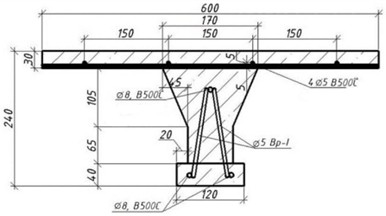
This outcome confirms that the precast-monolithic composite behavior allows redistribution of bending moments through the formation of plastic hinges without compromising structural stability (Fig. 1). The highest bearing capacity was achieved in Type V and Type VI configurations, covering spans between 5.4 and 6.0 meters, with ultimate moments ranging from 20.5 to 22.1 kNm and deflection limits corresponding to /200. These results validate the theoretical assumption that the composite slab system performs as a statically indeterminate frame where internal moments shift from mid-span to support zones upon reaching the yield limit of reinforcement.
Fig. 1Scheme of the second type of overlap
As loading increased, the stress distribution across the section evolved from elastic to partially plastic, leading to the progressive formation of cracks in the tension zone. The first visible cracks were observed at approximately 60-70 % of the calculated ultimate load, which corresponds to the onset of reinforcement yielding. The structure continued to carry additional load beyond this stage, evidencing its ductile behavior – a highly desirable characteristic in seismic-prone regions (Fig. 2). The analytical serviceability check showed that all tested configurations satisfied the deflection requirement of /200, ensuring user comfort and the absence of visible sagging in normal operation.
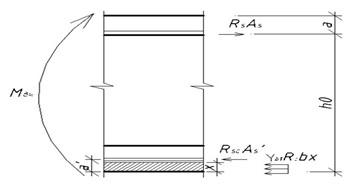
The experimental investigation, conducted at the Department of Building Structures of Fergana Polytechnic Institute, provided valuable validation of the theoretical model. A prototype slab of the Type II configuration (span = 3.6 m, total depth = 240 mm) was fabricated using local materials, where aerated concrete blocks functioned both as permanent formwork and lightweight filler between the ribs. The slab was instrumented to measure mid-span deflection and crack propagation under incremental static loading. The measured load-deflection curve exhibited an initial linear response up to approximately 4.5 kN/m2, followed by a nonlinear phase associated with crack formation, and finally a plastic plateau at around 7.3 kN/m2, corresponding to the ultimate limit state (Fig. 3). The maximum experimental deflection at mid-span was 18.4 mm, while analytical prediction yielded 17.2 mm, resulting in a deviation of only 6.5 %. This close correlation indicates that the adopted theoretical model accurately describes the real behavior of the system.
Fig. 2Compression of the upper zone of concrete and tension of the reinforcement from below in the span
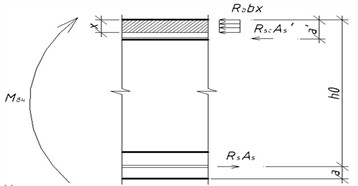
Fig. 3Compression of the lower zone of concrete and tension of the reinforcement on top of the support
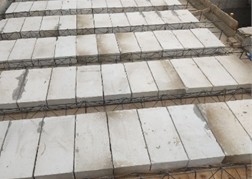
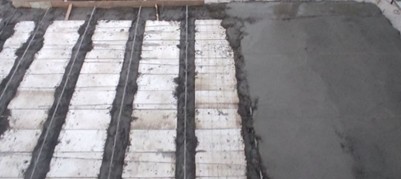
Furthermore, the mode of failure observed in the prototype slab corresponded to flexural failure rather than brittle shear, confirming adequate redistribution of internal forces and proper interaction between concrete and reinforcement (Fig. 4). The experimental cracks initiated near the mid-span and gradually propagated toward the supports, with no signs of sudden collapse or delamination between the topping and the blocks. The integrity of the concrete ribs and the aerated block infill remained intact even after the ultimate load, which further supports the efficiency of the proposed construction system.
Fig. 4Experimental precast-monolithic coating (Fergana Polytechnic Institute Laboratory, 2025)
A comparative analysis of the obtained results with previous studies confirms the global relevance of this research. Vatin et al. reported a similar 1.6-1.9× increase in moment capacity for hybrid beam-block slabs with expanded clay fillers, while Paraschenko et al. demonstrated a 25-30 % reduction in self-weight for ribbed precast-monolithic floors with cellular concrete blocks. The present study aligns with these findings but extends their scope by proving that such systems remain reliable even under hot-dry climatic conditions, where high temperature gradients and reduced humidity could otherwise affect the long-term strength and shrinkage behavior of concrete. The experimental results obtained in Fergana confirm that aerated concrete blocks with density of about 700 kg/m3 maintain structural integrity and adhesion with cast-in-place concrete even at surface temperatures exceeding +45 °C.
The inclusion of aerated concrete blocks as integral components of the floor system brings several important engineering advantages. Firstly, the overall dead load is reduced by approximately 28 % compared to traditional solid slabs, which significantly increases the seismic resistance of low- and mid-rise buildings. Secondly, the permanent block formwork eliminates the need for temporary supports and simplifies on-site assembly. Thirdly, the thermal insulation properties of aerated concrete contribute to a 20-25 % reduction in heat transfer through the floor, thereby improving energy efficiency. Lastly, the economic analysis indicates a 12-15 % reduction in total material consumption and a 20 % decrease in labor intensity due to modular installation. These findings demonstrate that the developed floor system is not only structurally reliable but also cost-effective and environmentally sustainable.
4. Conclusions
The conducted analytical and experimental investigations have demonstrated that the proposed precast-monolithic beam reinforced concrete floors with aerated concrete blocks possess a high level of structural reliability, economic efficiency, and adaptability to the hot-dry climatic conditions of Uzbekistan. The system effectively combines the advantages of precast and monolithic construction methods, resulting in improved load-bearing capacity, ductility, and energy performance.
Based on the results of six structural configurations and twelve load combinations, it was established that the ultimate moment capacity calculated by the limit equilibrium method exceeds that obtained from the classical sectional analysis by approximately 1.5-1.8 times, confirming the presence of plastic reserves within the structure. The calculated and measured deflection limits (/200) were in close agreement, differing by less than 7 %, which validates the reliability of the adopted analytical model.
The experimental testing of the prototype slab fabricated at the Department of Building Structures, Fergana Polytechnic Institute, confirmed the accuracy of the theoretical predictions. The observed ductile behavior with gradual crack development and delayed failure indicates that the floor system ensures high seismic resistance and serviceability even under dynamic loading conditions. The close correlation between analytical and experimental results demonstrates that the limit equilibrium method can be confidently used for the design of such composite floors in practical engineering applications.
In terms of construction technology, the incorporation of aerated concrete blocks as permanent formwork and lightweight filler allows for the elimination of temporary formwork, reduction in dead load by about 28 %, and savings in material consumption of up to 15 % compared to traditional solid slabs. The modularity of the system accelerates installation and minimizes the need for heavy lifting equipment, making it especially suitable for low- and mid-rise buildings in seismic zones. Additionally, the thermal insulation provided by aerated concrete improves the building’s energy efficiency by 20-25 %, contributing to the goals of sustainable and environmentally friendly construction.
The research outcomes align with and extend previous works by Vatin et al. and Paraschenko et al., but for the first time, the performance of precast-monolithic floors has been validated under hot and arid climatic conditions. This adaptation of the hybrid floor system to the local environment represents a significant scientific contribution, bridging theoretical, experimental, and practical domains of structural engineering in Uzbekistan.
References
-
N. P. Abovsky and J. V. Endzhievsky, “Some aspects of development of numerical methods of calculation of structures,” News of Universities: Construction and Architecture, No. 8, pp. 30–47, 1981.
-
A. V. Aleksandrov, B. Y. Lashchennikov, N. N. Shaposhnikov, and V. A. Smirnov, Methods of Calculating Rod Systems, Plates and Shells Using a Computer. Moscow: Stroyizdat, 1976.
-
O. O. Andreev, “Assessment of the bearing capacity of reinforced concrete sections taking into account the probabilistic nature of the strength of concrete and steel,” Structural Mechanics and Calculation of Structures, No. 6, pp. 16–19, 1984.
-
V. N. Baykov and E. E. Sigalov, “Reinforced concrete structures,” in Beyond Failure, Reston, VA: American Society of Civil Engineers, 2008, pp. 129–171, https://doi.org/10.1061/9780784409732.ch05
-
V. M. Barastov, “Some design solutions for reinforced concrete floors for reconstructed buildings,” in Proceedings of the All-Russian Scientific and Technical Conference “Current Issues of Construction”, pp. 19–23, 2002.
-
Vatin et al., “Technology of precast-monolithic beam reinforced concrete floors with expanded clay concrete blocks,” Construction of Unique Buildings and Structures, Vol. 7, No. 70, pp. 43–59, 2018.
-
N. A. Paraschenko, A. S. Gorshkov, and N. I. Vatin, “Partially ribbed precast-monolithic floors with cellular concrete blocks,” Magazine of Civil Engineering, No. 6, pp. 50–68, 2011.
-
Z. S. Teplova and N. A. Vinogradova, “Precast-monolithic floors of the “Marko” system,” Construction of Unique Buildings and Structures, Vol. 8, No. 35, pp. 48–59, 2015.
-
V. A. Shembakov, “Technology of precast-monolithic housing construction SMK in mass construction of Russia and the CIS countries,” Housing Construction, No. 3, pp. 26–29, 2013.
-
M. K. Barguti, “Strength, deformability and crack resistance of precast-monolithic beam prestressed floors,” Moscow, Russia, 1992.
-
B. A. Pushkarev and P. A. Korenkov, “Precast-monolithic reinforced concrete structures: Areas of application and calculation features,” Construction and Technological Safety, No. 46, pp. 30–35, 2013.
-
V. M. Barastov, “Analysis of design solutions for lightweight reinforced concrete floors,” in Proceedings of the 2nd International Scientific and Technical Conference “Problems of Construction and Road Complexes”, pp. 386–390, 2004.
-
S. Z. Alpirovich and I. I. Ulitsky, Treeless Pavements Using Hollow Concrete Blocks. UkrNIIS Publications, 1948.
-
R. Z. Tojiev, E. M. Yunusaliev, and I. N. Abdullaev, “The American ways to study the impact of ground vibrations from explosions on the stability of buildings and structures,” The American Journal of Interdisciplinary Innovations and Research, Vol. 2, No. 11, 2020.
About this article

The authors have not disclosed any funding.
We would like to express our gratitude to:
Teplovoy Zh. S., Nedvige E. S. and Vinogradova N. A., whose articles [19,20] formed the basis for the presentation of this material.
To the head of Kasansay Plant of Reinforced Concrete Products LLC, Ismailov T.A., for the opportunity to conduct experimental work at the enterprise.
To the director of the design institute of LLC “Kishlok Kurilish Loyikha” Khalikov M. for assistance in conducting research.
The datasets generated during and/or analyzed during the current study are available from the corresponding author on reasonable request.
The authors declare that they have no conflict of interest.

