Abstract
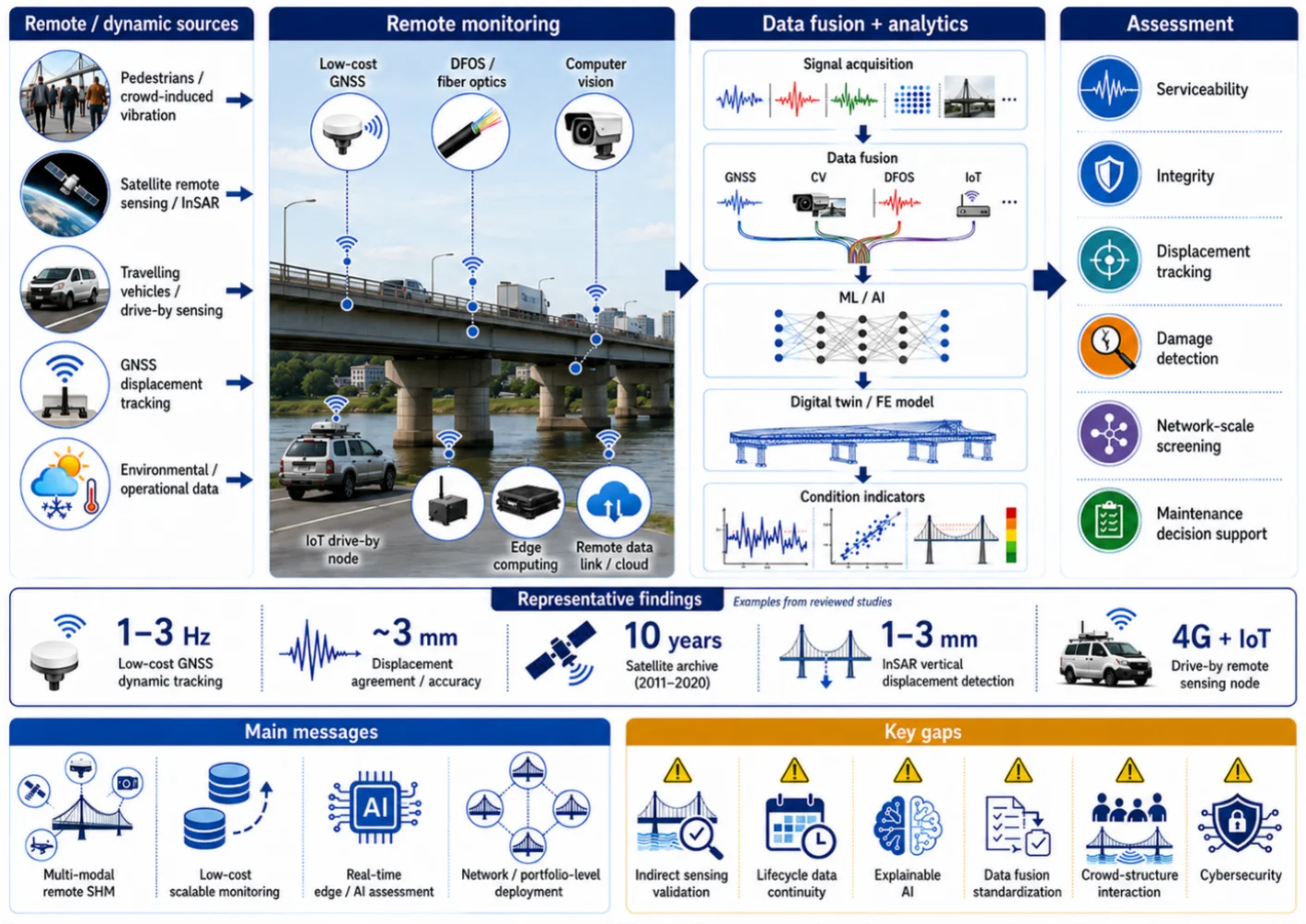
An overview of the main recent techniques of Bridge Health Monitoring (BHM) is presented, addressing the use of remote controls. The data coming from satellite measurements, together with travelling cars can be matched and elaborated with the help of machine learning strategies. The data can be interpreted with a view to obtaining information for a deeper investigation into the integrity or serviceability of the bridge. A brief discussion on key gaps and perspectives is finally presented.
Highlights
- Combines satellite data, vehicle-based sensing and remote monitoring for bridge assessment.
- Low-cost GNSS can track bridge dynamics at 1–3 Hz with about 3 mm displacement agreement.
- InSAR can reconstruct 10 years of satellite data and detect 1–3 mm vertical displacement.
- Computer vision, edge computing and drive-by IoT support near-real-time network screening.
- Main gaps include data fusion, lifecycle continuity, explainable AI, crowd–structure modelling and cybersecurity.
1. Introduction
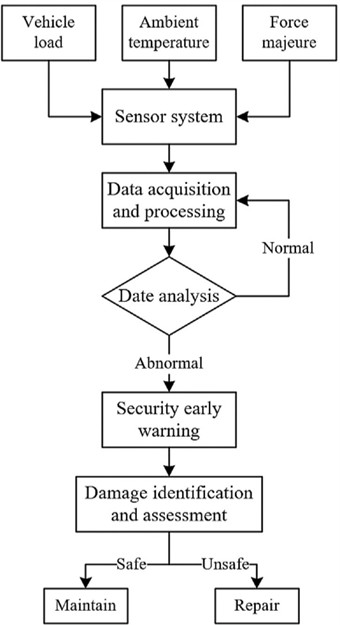
Bridge Health Monitoring (BHM) strategies have recently been modified to consider the big data coming from satellite surveys, vibration due to pedestrian activities and travelling cars, mainly from sensors dedicated to the safe conduct of driving. These can generate vibration histories and consequent movements that can be elaborated to furnish info on the mechanical and integrity conditions of the roads over bridges and viaducts. Damage identification algorithms and decision support for maintenance and resilience can be better assumed throughout the comparison over time of the dynamical response of the structures under investigation [1]. The operation process of the implemented BHM system is shown in Fig. 1 [2].
2. Pedestrian-induced vibrations and footbridge monitoring
Ingólfsson et al. in [3] provide a comprehensive literature review of pedestrian-induced lateral vibrations of footbridges, including modelling strategies, load descriptions, human-structure interaction models, and case studies. Analytical and experimental work on synchronous walking shows how crowd synchronization with low-frequency lateral modes can produce large-amplitude responses, as famously observed on the London Millennium Bridge. Lightweight footbridge design studies in your dataset discuss slender structural forms, comfort and serviceability criteria, and integration of self-powered wireless systems to enable long-term BHM. Externally, the London Millennium Bridge investigations document the onset of pedestrian-induced lateral vibration and the effectiveness of added damping as a mitigation strategy, influencing modern design guidance and serviceability criteria [4], [5]. More recent reviews focus specifically on footbridge BHM, highlighting dense sensor networks, computer vision, and ML-based classification of pedestrian events and structural responses [6].
Overall, the field is mature in terms of phenomenological understanding and modelling of pedestrian-induced vibrations, but still developing towards real-time monitoring, crowd-structure interaction modelling, and active/semiactive control strategies.
Fig. 1Flow chart of BHM system
3. Advanced sensing technologies
3.1. Low-cost global navigation satellite system (GNSS)
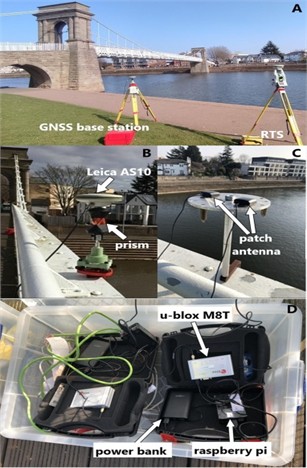
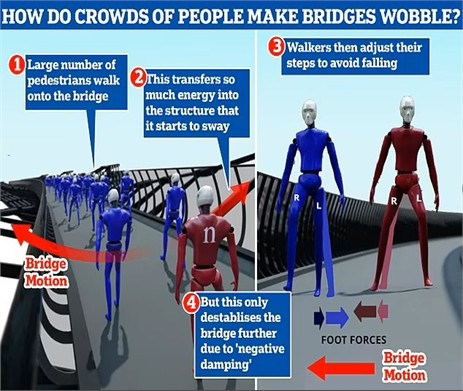
Xue and Psimoulis in [7] demonstrate that low-cost multi-GNSS receivers can track dynamic displacements of a pedestrian suspension bridge at 1-3 Hz, recovering dominant frequencies with accuracy comparable to geodetic-grade GNSS and displacement amplitudes within ~3 mm of robotic total station data. Fig. 2(a) shows Top panel (A): Wilford pedestrian bridge on River Trent and the locations of GNSS base station and receivers RTS on the riverbank; (B) Leica AS10 antenna on the midspan of the bridge (location C) with reflective prisms mounted underneath as the receivers target (C) the two patch antennas on the ground-plane at location C; (D) the two u-blox M8T receivers, with each one connected to the patch antenna and raspberry pi-3, and the latter was powered by power bank. This confirms that GNSS - traditionally constrained by cost – can support displacement-based BHM, especially when integrated with accelerometers or vision-based sensors. The effects introduced by pedestrian motions, as virtually modelled, can then be observed to determine the oscillations of the bridge (Fig. 2(b)). In [8] a practical low-cost example of r.c. bridge has been performed using COSMO-Sky med high resolution satellite data base. In the example described in [8] it has been possible to re-construct ten years of images (April 2011-June 2020) based on metallic guard rail visible emissions, acquired from Italian Space Agency (ASI) and subsequently elaborated with StaMPS PSI interferometric process. It has been possible to detect vertical displacements with an accuracy of 1-3 mm. It has been also possible to distinguish the ordinary thermal effects of deformations along the years from an ongoing settlement. The above technique is almost promising, due to the fact that the implementation of specific tetrahedral receivers is undoubtedly desirable, but the large amount of bridges to be monitored conflicts with the need of low-cost data. An alternative terrestrial approach (as in Fig. 2) should be more effective, provided that topographic measuring points are low cost and easy to install, together to the possibility to remove the GNSS base station with the data set of dynamic measurement. Further modelling with animated pedestrian or vehicle loads can be implemented to compare experimental vs numerical prediction, in view to an optimization via structural identification.
Fig. 2a) The geodetic-grade GNSS stations and b) virtual simulation of pedestrian vibrating loads generated by “FigureLab AI” software licensed by authors
a)
b)
3.2. Distributed fiber-optic sensing (DFOS)
Brillouin Optical Frequency Domain Analysis (BOFDA), compared with the Time Domain one (BOTDA), can be used to monitor internal strain along concrete slabs over their full life cycle, capturing casting, early-age behaviour, service loading, and long-term effects with high spatial resolution [9]. Focusing on concrete structures, recent typical BHM solutions utilizing DFOS are summarized in Table 1. Recent reviews identify DFOS as a key technology for distributed, embeddable sensing in bridges, tunnels, decks, and other linear infrastructures where conventional gauges would be too sparse or intrusive [2] as Optical Frequency Domain Reflectometry (OFDR).
Table 1Typical DFOS solutions applied in Structural HM of r.c. structures [9]
DFOS technologies | Publishing year | Monitoring objects | Monitoring location | Monitoring process | Monitoring environment |
OFDR | 2020 | Tunnel lining | Concrete surface | Operation stage | Construction activity |
OFDR | 2021 | Concrete beams | Concrete interior | Crack | Extreme loading |
BOTDA | 2021 | Tunnel lining | Concrete surface | Damages | Normal activity |
OFDR | 2022 | Cylinder pipe | Concrete surface | Crack | Loading |
OFDR | 2023 | RC beams | Interior and surface | Deflection crack | Loading |
BOFDA | NA | Concrete Slabs | Concrete interior | Full-life cycle | Energization saltwater corrosion |
3.3. Computer vision and edge computing
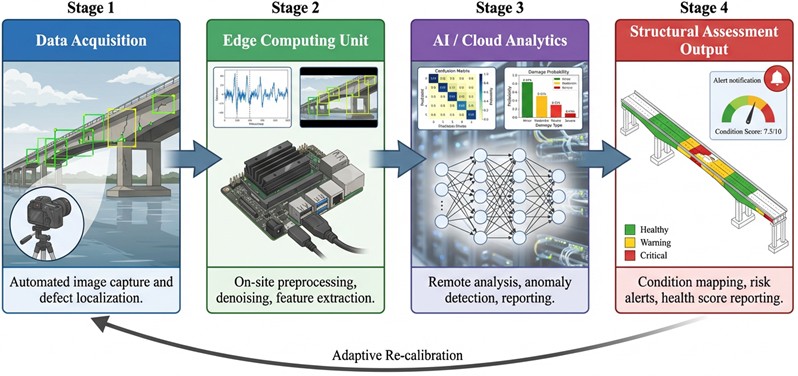
The computer-vision presents a smart BHM framework with edge computing, performing onboard processing of video data to extract displacements and damage indicators, thereby reducing data volume and latency and enabling near-real-time condition assessment [10]. This aligns with a growing body of work on non-contact optical BHM, where cameras (including smart devices) and edge AI are used to estimate deflections, mode shapes, and crack patterns [11].
3.4. IoT and drive-by monitoring
The IoT-based drive-by system demonstrates that vehicle-mounted sensors can be used for bridge health monitoring: a single-board computer (Raspberry Pi) integrates a MEMS accelerometer, temperature sensor, GPS, and 4G modem to record vehicle responses and trajectory during passage over bridges and to perform basic onboard processing [12]. The system successfully identifies the fundamental frequency of a test footbridge and shows noise performance comparable to or superior to wired systems. The scheme is in Fig. 3.
This dovetails with a wider emerging literature on indirect or “drive-by” bridge monitoring, which uses test or in-service vehicles to infer bridge properties from vehicle responses [10], [13]. Collectively, these sensing developments point towards highly distributed, low-cost, and often indirect monitoring architectures, which are critical for large bridge networks.
Fig. 3Smart SHM framework integrating computer vision and edge computing for real-time bridge assessment generated by “FigureLab AI” software licensed by authors
4. Conclusions
Across recent research papers and broader literature, the current state of the art in bridge monitoring and dynamic assessment permits the following brief discussion, in order to raise gaps and possible perspectives.
Main trends:
1) From single sensor to multi-modal SHM. Combining acceleration, displacement (GNSS/CV), strain (DFOS), acoustic emission, and environmental sensitivity and robustness [1], [2].
2) From local case studies to network/portfolio approaches. ML-based prestress prediction, drive-by and in-fleet BHM, together with low-cost IoT sensing, aim for scalable assessment of entire bridge networks [12], [13].
Key gaps:
1) Full integration of indirect sensing. Drive-by and in-fleet SHM methods show clear promise yet lack standardized calibration protocols and cross-network validation, limiting their deployment beyond controlled experimental settings [13], [14].
2) Lifecycle-level SHM and data continuity. Most DFOS and GNSS monitoring campaigns remain short-term. Decade-scale datasets are essential for reliable deterioration modelling, yet open-access repositories and systematic archiving standards are still largely absent [2], [9].
3) Explainability of AI-based diagnostics. Despite strong predictive performance, most ML and deep learning damage detection models lack interpretability. Physics-informed and explainable AI (XAI) frameworks are needed to meet engineering accountability requirements and support regulatory acceptance [1], [2].
4) Multi-modal data fusion and standardization. Heterogeneous sensor streams: GNSS, DFOS, computer vision, and IoT remain incompatible in format and sampling rate. No consensus standard exists for data fusion in BHM, impeding interoperability and scalable network-level deployment [2], [7].
5) Crowd-structure interaction modelling. Simplified pedestrian load assumptions fail under realistic crowd densities and synchronization conditions [3], [6]. Real-time FE model updating integrated with vision-based crowd tracking remains experimentally unvalidated at scale.
6) Cybersecurity of remote monitoring systems. Increasing reliance on wireless transmission and cloud infrastructure exposes BHM systems to data tampering and adversarial attacks. Fault-tolerant protocols and anomaly detection mechanisms for sensor network integrity remain critically underdeveloped [12].
The main aspects of a BHM approach driven by remote control or self-induced data (e.g. traffic info, pedestrian behavior) are the possibility of obtaining a large set of automatic information that can be managed from remote stations. The use of Artificial Intelligence for the elaboration of big data, coming from traffic or from the behavior of the users, can furnish on real time info, able to evaluate in advance the occurrence of a critical situation. The interpretation of data via AI can help, but cannot substitute the personal responsibility of the decision makers to establish the priority of interventions.
References
-
Z. He, W. Li, H. Salehi, H. Zhang, H. Zhou, and P. Jiao, “Integrated structural health monitoring in bridge engineering,” Automation in Construction, Vol. 136, p. 104168, Jan. 2022, https://doi.org/10.1016/j.autcon.2022.104168
-
Z. Deng, M. Huang, N. Wan, and J. Zhang, “The current development of structural health monitoring for bridges: A review,” Buildings, Vol. 13, No. 6, p. 1360, May 2023, https://doi.org/10.3390/buildings13061360
-
E. T. Ingólfsson, C. T. Georgakis, and J. Jönsson, “Pedestrian-induced lateral vibrations of footbridges: A literature review,” Engineering Structures, Vol. 45, pp. 21–52, Jan. 2012, https://doi.org/10.1016/j.engstruct.2012.05.038
-
P. Dallard et al., “London millennium bridge: pedestrian-induced lateral vibration,” Journal of Bridge Engineering, Vol. 6, No. 6, pp. 412–417, Dec. 2001, https://doi.org/10.1061/(asce)1084-0702(2001)6:6(412)
-
H. Qiao, H. Guan, and Y. Zhu, “Footbridge structural health monitoring: A review of current research and future directions,” Structure and Infrastructure Engineering, pp. 1–24, Jan. 2025, https://doi.org/10.1080/15732479.2025.2547349
-
Y. Fujino, B. M. Pacheco, S.I. Nakamura, and P. Warnitchai, “Synchronization of human walking observed during lateral vibration of a congested pedestrian bridge,” Earthquake Engineering and Structural Dynamics, Vol. 22, No. 9, pp. 741–758, Jan. 1993, https://doi.org/10.1002/eqe.4290220902
-
C. Xue and P. A. Psimoulis, “Monitoring the dynamic response of a pedestrian bridge by using low-cost GNSS receivers,” Engineering Structures, Vol. 284, p. 115993, Jan. 2023, https://doi.org/10.1016/j.engstruct.2023.115993
-
L. Hasa, G. Corsini, M. Diani, M. L. Battagliere, M. Sassu, and M. L. Puppio, “Territorial scale monitoring of civil infrastructures through remote sensing,” in Proc 3rd International Conference on Natural Hazards and Infrastructure, ICONHIC 2022, p. 28229, Dec. 2022.
-
S. Wang et al., “Distributed fiber optic sensing for internal strain monitoring in full life cycle of concrete slabs with BOFDA technology,” Engineering Structures, Vol. 305, p. 117798, Apr. 2024, https://doi.org/10.1016/j.engstruct.2024.117798
-
Z. Peng, J. Li, H. Hao, and Y. Zhong, “Smart structural health monitoring using computer vision and edge computing,” Engineering Structures, Vol. 319, p. 118809, Nov. 2024, https://doi.org/10.1016/j.engstruct.2024.118809
-
E. Ozer and R. Kromanis, “Smartphone prospects in bridge structural health monitoring: A literature review,” Sensors, Vol. 24, No. 11, p. 3287, Jan. 2024, https://doi.org/10.3390/s24113287
-
Z. Peng, J. Li, and H. Hao, “Development and experimental verification of an IoT sensing system for drive-by bridge health monitoring,” Engineering Structures, Vol. 293, p. 116705, Oct. 2023, https://doi.org/10.1016/j.engstruct.2023.116705
-
A. Elhattab, “Drive-by bridge damage monitoring: Concise review,” Civil Engineering Research Journal, Vol. 1, No. 1, p. 555555, Jul. 2017, https://doi.org/10.19080/cerj.2017.01.555555
-
D. Hester and A. González, “A discussion on the merits and limitations of using drive-by monitoring to detect localised damage in a bridge,” Mechanical Systems and Signal Processing, Vol. 90, pp. 234–253, Jan. 2017, https://doi.org/10.1016/j.ymssp.2016.12.012
About this article

Thanks to the research funds entitled PRIN 2022 PNRR “Rock Resilience” and FISA 2024-00140 SENSLIFE, from the Italian Ministry of University and Research, for economic support.
The datasets generated during and/or analyzed during the current study are available from the corresponding author on reasonable request.
The authors declare that they have no conflict of interest.

