Abstract
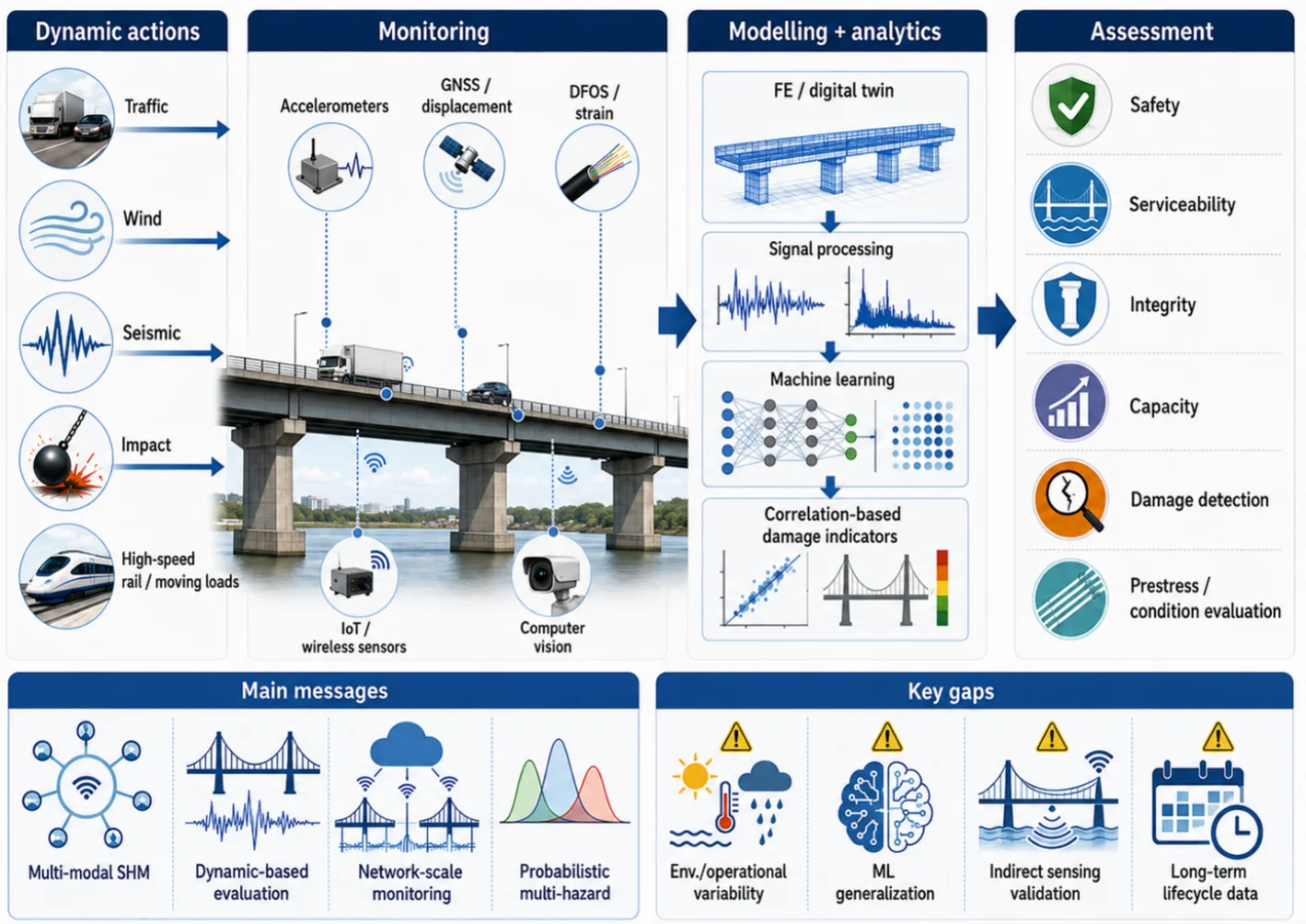
An overview of the main recent techniques of Bridge Health Monitoring (BHM) is here presented. The use of vibrations induced by artificial or natural loads is investigated in terms of review of State-of-Art, together with ordinary (i.e. traffic, wind) or extreme events (i.e. seism, impact). The data can be interpreted by direct modelling or by machine learning routines in order to obtain advertises to a deeper investigation on integrity or serviceability of the bridge. A brief discussion on key gaps and perspectives is finally presented.
Highlights
- Reviews bridge health monitoring under traffic, wind, seismic, impact and moving loads.
- Presents multi-sensor BHM using accelerometers, GNSS, DFOS, IoT and computer vision.
- Shows how FE models, digital twins, signal processing and ML support damage detection.
- Reviewed studies report key values such as ~3 % capacity-estimation difference, 100 Hz acceleration sampling, < 50 Hz railway-transition frequencies and ~275 km/h critical train speed.
- Main gaps include environmental variability, ML transferability, indirect sensing validation and long-term lifecycle data.
1. Introduction
Bridge Health Monitoring (BHM) has evolved from isolated, campaign-based tests to integrated systems that couple heterogeneous sensors, data analytics, and numerical models for continuous condition assessment over the full life cycle. Recent reviews emphasize a shift from “proof-of-concept” demonstrations to system-level, multi-hazard monitoring, highlighting sensing architectures, data management, damage identification algorithms, and decision support for maintenance and resilience. The operation process of the traditional BHM system is shown in [1] and [2].
Classic vibration-based damage detection methods rely on changes in natural frequencies, mode shapes, and derived quantities such as modal curvatures, modal strain energy, and flexibility [3], [4]. Modern trends move towards: (1) multi-feature approaches that combine modal parameters with operational or statistical features; (2) data-driven and machine-learning-based damage indicators; (3) reference-free or reference-lean methods that reduce dependence on a pristine baseline [5], [6].
2. Structural monitoring and capacity / damage assessment
2.1. Dynamic-static stiffness conversion and capacity evaluation
Tan et al. [7] propose a quick and easy evaluation method for the bearing capacity of cracked reinforced concrete bridges based on a dynamic-static stiffness conversion model. A virtual crack-based FEM links crack parameters to both dynamic and static stiffness; a surrogate model then converts measured dynamic stiffness (from vibration tests) into static stiffness and a verification factor equivalent to a static load test. Field application to a hollow slab bridge yields a bearing-capacity factor within about 3 % of a full static load test, at significantly reduced time and cost.
This work is representative of a broader trend in which measured dynamics are used as proxies for static capacity, especially where static load tests are expensive or disruptive. Similar correlations between dynamic and static stiffness have been observed in experimental and numerical studies on cracked or deteriorated members [3], [4], [8].
2.2. Data-driven capacity indicators and prestress assessment
Calò et al. [9] develop a machine-learning-based surrogate model to predict prestressing force reduction in PSC box-girder bridges with unbonded tendons, using a large FE-generated dataset calibrated against experimental tests. The framework predicts prestress loss as a function of initial prestress, concrete modulus, and strain variations at selected sections, achieving low prediction errors and interpretable patterns via SHAP analysis.
This complements dynamic–static stiffness conversion: instead of only using global dynamic stiffness, it demonstrates how monitoring data, FE modelling, and ML can infer internal, otherwise inaccessible parameters (e.g., effective prestress) at the portfolio level.
2.3. Correlation-based damage indicators
Deng et al. [10] propose a damage identification method for long-span bridges based on the correlation of monitored global dynamic responses in high-dimensional space. The method uses the ratio of mean squares between different response channels as a robust indicator that is relatively insensitive to load variability but sensitive to structural changes.
In parallel, reviews of vibration-based damage detection show a clear trend towards robust, multi-sensor features and ML-enabled indicators, including deep learning, autoencoders, and hybrid physics-ML workflows [6].
3. Dynamic responses under traffic, wind, seismic and impact loads
3.1. Operational traffic and surface roughness
Ho and Nishio [11] model dynamic responses of bridges under random traffic flow and surface roughness, validating the model against monitoring data from a steel box-girder bridge. They show that RMS accelerations depend strongly on truck ratios and speeds, while peak responses are sensitive to axle sequences and roughness patterns. Two wireless sensor nodes, namely sensors #1 and #2, were attached to the lower flanges at the mid-span of the two box-girders of the traffic lanes, as illustrated in Fig. 1(a) and (b). Synchronized three-axis accelerations were continuously acquired throughout the data acquisition period with a sampling frequency of 100 Hz. Thereafter, the vertical acceleration (-direction) was used for validation. Developments in bridge weigh-in-motion (B-WIM) that explicitly include bridge dynamics [12] improve axle-load estimation and continuous influence-line identification, especially for longer spans. Together, these works highlight that vehicle-bridge interaction and road profile must be represented, at least approximately, when interpreting vibration data under real traffic.
Fig. 1Example for target bridge span and configuration of wireless sensor nodes
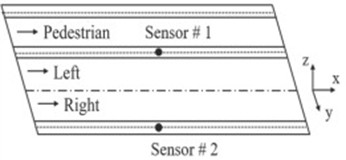
a) Target bridge spam
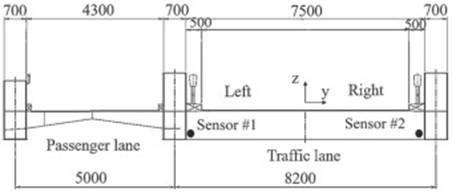
b) Cross-section (unit: mm)
3.2. Heavy vehicle impact and local failures
Heng et al. [8] analyze dynamic responses of highway bridges subjected to heavy truck impacts using detailed FE modelling and advanced concrete damage material laws, validated against crash tests. They outline typical failure modes of piers, caps, and girders and demonstrate how impact speed, mass, and angles govern the extent of local and global damage. The various failure modes of the impacted RC piers can be generated in actual vehicular collisions. These studies provide realistic envelopes for impact-induced demands and support robustness assessment, design of protective systems and calibration of intensity dynamic tests.
3.3. Transition zones and high-speed rail
Hu et al. [12] conduct extensive field tests on bridge-embankment transitions in high-speed railway lines, for train speeds from 5 to 360 km/h. Using wavelet-based and smoothing techniques, they characterize critical sections and dominant frequencies (mostly below 50 Hz), identify critical distances from abutments, and observe a critical speed at which dynamic amplification is maximized. In this case dynamic stress changes only slightly as train speed increases: the curve follows a gentle S-shape, indicating speed has little effect except at 12.27 m from the abutment, where stress is highest. The inflection occurs at roughly 275 km/h. Fig. 2(b) and 2(c) reveal that dynamic acceleration and displacement at the bed surface rise with train speed, with the greatest growth at 25.27 m from the WAT and increasing further as the measurement point moves away from the WAT. These relationships form steeper S-shaped curves, with inflection points again around 275 km/h. Thus, 275 km/h is regarded as a critical train speed. This illustrates how local stiffness transitions can be detected and studied via dynamic responses, which is relevant for monitoring strategies that use moving loads as “probes” of the structure.
Fig. 2Flow Chart of ML and damage detection strategies
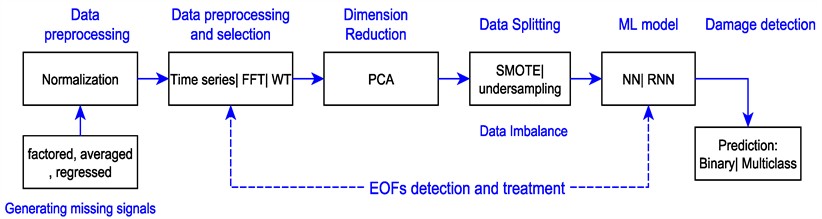
3.4. Multi-hazard and reliability-based frameworks
Chen et al. [13] investigate deep-water bridge piers under combined seismic and wave loading using a 1:30 shaking-table model with wavemaker. They report substantial shifts in natural frequencies, strong added-mass effects, and nonlinear interactions such that the combined response is not simply the sum of individual actions. Yang et al. [14] propose a unified stochastic dynamic and system reliability framework for long-span cable-stayed bridges under near-fault ground motions, using direct probability integral methods and pulse-type ground-motion models to compute time-varying response statistics and failure probabilities. More broadly, integrated BHM reviews emphasize that multi-hazard, reliability-based approaches are becoming central, moving beyond deterministic, single-hazard analyses [1].
4. Modelling, control, and data-driven methods
4.1. Dynamic modelling in BHM workflows
Several research works integrate refined numerical modelling with monitoring: dynamic B-WIM algorithms that explicitly account for bridge vibrations to estimate influence lines and axle loads [12]; shaking-table and fluid-structure interaction models for combined seismic-wave loading on deep-water piers [13] and nonlinear analysis of rocking bridge systems under 3D ground motions [15]. At a methodological level, integrated SHM frameworks increasingly adopt the “digital twin” concept: finite-element models are continuously updated using BHM data and then used for prediction, scenario analysis, and decision support [1]. Mazzeo et al. [16] propose an inerter-based dissipation system for a cable-stayed bridge, achieving improved energy dissipation and reduced seismic responses under transverse excitation compared with conventional viscous dampers. Such structural control systems are tightly linked with BHM: monitoring data can be used to tune or assess controllers, while the presence of control devices modifies the dynamic signatures that BHM algorithms must interpret.
4.2. Machine learning and intelligent damage detection
Beyond the ML-based prestressing framework of Calò et al. [9], it assisted on a rapid growth in ML and deep-learning methods for vibration-based damage detection, including convolutional neural networks, autoencoders, and hybrid physics-informed networks [6]. These methods are promising when combined with rich sensing (CV, GNSS, DFOS, IoT), but they raise challenges around generalization across structures, interpretability of learned features, and the need for large, high-quality labelled datasets.
5. Conclusions
Across recent research papers and the broader literature, the current state of the art in bridge monitoring and dynamic assessment permits the following brief discussion, in order to raise gaps and possible perspectives.
1) From single sensor to multi-modal SHM. Combining acceleration, displacement (GNSS/CV), strain (DFOS), acoustic emission, and environmental sensing improve sensitivity and robustness [1] [2].
2) From static tests to dynamic-based evaluation. Methods such as dynamic-static stiffness conversion and dynamic B-WIM use vibration data as proxies for static capacity or load effects [7], [12].
3) From local case studies to network / portfolio approaches. ML-based prestress prediction, drive-by and in-fleet BHM and low-cost IoT sensing aim for scalable assessment of entire bridge networks [9], [17], [18].
4) From deterministic models to probabilistic and multi-hazard frameworks. Reliability-based studies under near-fault seismic loading and combined hazards (seismic + wave, seismic + traffic) are becoming more common [13], [14].
The main Key Gaps can be summarized as follows
1) Environmental and operational variability. Many vibration-based methods remain sensitive to temperature, humidity, and traffic patterns; robust normalization and reference-free approaches are still being refined [5].
2) Generalization of data-driven models. ML frameworks trained on one bridge or dataset may not transfer well without physics-based constraints, careful feature design, and domain adaptation [1].
3) Full integration of indirect sensing. Drive-by and in-fleet SHM techniques are promising but need standardized procedures, calibration strategies, and validation on diverse full-scale networks [18], [19].
4) Lifecycle-level BHM. DFOS and long-term GNSS deployments show strong potential, but many studies remain short-term; there is a clear need for decade-scale datasets to characterize deterioration and support reliable forecasting [20], [21].
The main aspects of a BHM approach due to ensure assessment of safety, serviceability and integrity of bridges is devoted to engineering judgement of all the data provided. An approach similar to the validation check procedure, commonly adopted to verify correctness, readability, completeness and respect to standards should be provided. In this sense specific guidelines with flow chart of personal responsibility can be used. As final example, some precautions could be:
1) Accuracy and cost may be optimized with hybrid sensor arrays that combine FBG and piezoelectric components.
2) In multi-vehicle settings, advanced signal processing, including machine-learning classifiers, will further minimize mistakes.
3) Standardized installation procedures ensure uniform calibration across bridge networks and little disturbance.
4) Correlating weight data with fatigue and damage indicators through integration with BHM platforms. The use of mass impact instruments [22] can complete this approach.
5) Implementation of wireless energy-harvesting sensors to facilitate extensive installations on inventory of ageing bridges.
Finally, the aspect of material variability of structures should be taken into account, replying strategies already performed in constructions [23].
References
-
Z. He, W. Li, H. Salehi, H. Zhang, H. Zhou, and P. Jiao, “Integrated structural health monitoring in bridge engineering,” Automation in Construction, Vol. 136, p. 104168, Apr. 2022, https://doi.org/10.1016/j.autcon.2022.104168
-
Z. Deng, M. Huang, N. Wan, and J. Zhang, “The current development of structural health monitoring for bridges: a review,” Buildings, Vol. 13, No. 6, p. 1360, May 2023, https://doi.org/10.3390/buildings13061360
-
S. W. Doebling, C. R. Farrar, and M. B. Prime, “A summary review of vibration-based damage identification methods,” The Shock and Vibration Digest, Vol. 30, No. 2, pp. 91–105, Mar. 1998, https://doi.org/10.1177/058310249803000201
-
W. Fan and P. Qiao, “Vibration-based damage identification methods: a review and comparative study,” Structural Health Monitoring, Vol. 10, No. 1, pp. 83–111, Apr. 2010, https://doi.org/10.1177/1475921710365419
-
M. Moravvej and M. El-Badry, “Reference-free vibration-based damage identification techniques for bridge structural health monitoring-a critical review and perspective,” Sensors, Vol. 24, No. 3, p. 876, Jan. 2024, https://doi.org/10.3390/s24030876
-
O. Avci, O. Abdeljaber, S. Kiranyaz, M. Hussein, M. Gabbouj, and D. J. Inman, “A review of vibration-based damage detection in civil structures: From traditional methods to machine learning and deep Learning applications,” Mechanical Systems and Signal Processing, Vol. 147, p. 107077, Jan. 2021, https://doi.org/10.1016/j.ymssp.2020.107077
-
G. Tan, S. Lin, W. Wang, and W. Yang, “A rapid evaluation method for the bearing capacity of reinforced concrete bridges under crack damage based on dynamic-static stiffness conversion model,” Engineering Structures, Vol. 343, p. 121207, Nov. 2025, https://doi.org/10.1016/j.engstruct.2025.121207
-
K. Heng, R. Li, Z. Li, and H. Wu, “Dynamic responses of highway bridge subjected to heavy truck impact,” Engineering Structures, Vol. 232, p. 111828, Apr. 2021, https://doi.org/10.1016/j.engstruct.2020.111828
-
M. Calò, S. Ruggieri, M. Buitrago, A. Nettis, J. M. Adam, and G. Uva, “An ML-based framework for predicting prestressing force reduction in reinforced concrete box-girder bridges with unbonded tendons,” Engineering Structures, Vol. 325, p. 119400, Feb. 2025, https://doi.org/10.1016/j.engstruct.2024.119400
-
F. Deng, S. Wei, Y. Xu, and H. Li, “Damage identification of long-span bridges based on the correlation of monitored global dynamic responses in high dimensional space,” Engineering Structures, Vol. 299, p. 117134, Jan. 2024, https://doi.org/10.1016/j.engstruct.2023.117134
-
H. Ho and M. Nishio, “Evaluation of dynamic responses of bridges considering traffic flow and surface roughness,” Engineering Structures, Vol. 225, p. 111256, Dec. 2020, https://doi.org/10.1016/j.engstruct.2020.111256
-
M. S. Gonçalves, F. Carraro, and R. H. Lopez, “A B-WIM algorithm considering the modeling of the bridge dynamic response,” Engineering Structures, Vol. 228, p. 111533, Feb. 2021, https://doi.org/10.1016/j.engstruct.2020.111533
-
Y. Chen, X. Huang, K. Wu, and Z.-X. Li, “Experimental research on dynamic responses and hydrodynamic pressures of deep-water bridge piers under seismic and wave actions,” Engineering Structures, Vol. 313, p. 118276, Aug. 2024, https://doi.org/10.1016/j.engstruct.2024.118276
-
D. Yang, J. Liu, R. Yu, and G. Chen, “Unified framework for stochastic dynamic responses and system reliability analysis of long-span cable-stayed bridges under near-fault ground motions,” Engineering Structures, Vol. 322, p. 119061, Jan. 2025, https://doi.org/10.1016/j.engstruct.2024.119061
-
Z. Jia, J. Wen, M. Hu, Q. Han, and K. Bi, “Seismic response of rocking bridge systems under three-dimensional ground motions,” Engineering Structures, Vol. 322, p. 119162, Jan. 2025, https://doi.org/10.1016/j.engstruct.2024.119162
-
M. Mazzeo, R. Santoro, S. Sciutteri, and G. Ricciardi, “Inerter-based dissipation for vibration control of a cable-stayed bridge subjected to transverse seismic excitation,” Engineering Structures, Vol. 336, p. 120297, Aug. 2025, https://doi.org/10.1016/j.engstruct.2025.120297
-
Z. Peng, J. Li, and H. Hao, “Development and experimental verification of an IoT sensing system for drive-by bridge health monitoring,” Engineering Structures, Vol. 293, p. 116705, Oct. 2023, https://doi.org/10.1016/j.engstruct.2023.116705
-
A. Elhattab, “Drive-by bridge damage monitoring: concise review,” Civil Engineering Research Journal, Vol. 1, No. 1, pp. 1–7, Jul. 2017, https://doi.org/10.19080/cerj.2017.01.555555
-
D. Hester and A. González, “A discussion on the merits and limitations of using drive-by monitoring to detect localised damage in a bridge,” Mechanical Systems and Signal Processing, Vol. 90, pp. 234–253, Jun. 2017, https://doi.org/10.1016/j.ymssp.2016.12.012
-
P. Hu, C. Zhang, S. J. Chen, Y. Wang, W. Wang, and W. H. Duan, “Dynamic responses of bridge-embankment transitions in high speed railway: Field tests and data analyses,” Engineering Structures, Vol. 175, pp. 565–576, Nov. 2018, https://doi.org/10.1016/j.engstruct.2018.08.079
-
S. Wang et al., “Distributed fiber optic sensing for internal strain monitoring in full life cycle of concrete slabs with BOFDA technology,” Engineering Structures, Vol. 305, p. 117798, Apr. 2024, https://doi.org/10.1016/j.engstruct.2024.117798
-
M. Coni, F. Mistretta, F. Stochino, J. Rombi, M. Sassu, and M. L. Puppio, “Fast falling weight deflectometer method for condition assessment of RC bridges,” Applied Sciences, Vol. 11, No. 4, p. 1743, Feb. 2021, https://doi.org/10.3390/app11041743
-
M. Puppio, M. Pellegrino, L. Giresini, and M. Sassu, “Effect of material variability and mechanical eccentricity on the seismic vulnerability assessment of reinforced concrete buildings,” Buildings, Vol. 7, No. 3, p. 66, Jul. 2017, https://doi.org/10.3390/buildings7030066
About this article

This research was funded by the PRIN 2022 PNRR project “Rock Resilience” of the Italian Ministry of University and Research.
The datasets generated during and/or analyzed during the current study are available from the corresponding author on reasonable request.
The authors declare that they have no conflict of interest.

