Abstract
This paper investigates the natural vibration periods for a set of 111 historical masonry minarets from Egypt, Turkey, Jordan, and Bosnia and Herzegovina. The database is compiled from literature publications and local archives, and includes minarets characterized by various geometries, design features, architectural styles, state of preservation, age. In particular, this paper develops a bivariate empirical model to estimate the natural vibration period of historical masonry minarets using geometric parameters such as height and base width (or diameter). Through extensive log-log regression analysis, it is shown that combining the height with the base width offers good estimates of the natural period. The developed bivariate (LL-BI(H,B)) model, in particular, shows low dispersion and strong statistical reliability. As such, it represents a practical and data-efficient tool for estimating the vibration period of masonry minaret, supporting large-scale seismic risk and heritage assessment where detailed structural data are limited.
1. Introduction
Slender historical masonry structures such as minarets and bell towers are well-known vulnerable to seismic loads. The collapse of such structures during earthquakes leads to irreparable cultural loss and compounds urban disaster, as evidenced by damage patterns from recent international seismic events (Fig. 1). As such, these repeated failures underscore the urgent need for a proper understanding of these structures and their vulnerability, and to accurately evaluate seismic risk assessment and guide mitigation strategies. This need is also outlined by several literature studies, which focused on early documentation and investigation [1, 2] or experimental and or computational analyses (e.g., [3-9]), or even more detailed seismic response assessments of historic monumental buildings [10, 11] minarets (e.g., [12-14]).
Among others, the natural vibration period is known to represent a preliminary but powerful parameter for the dynamic characterization of structures, as it is a crucial step to evaluate their structural health status [15]. Experimental and analytical methods can accurately determine the natural period of structures, but these processes are often costly, time-consuming to in-situ test each minaret, or limited by modelling uncertainties. Alternatively, empirical equations offer simple and sufficiently accurate tools for estimating natural periods [16]. For example, [17, 18] obtained a predictive correlation to estimate the natural period of masonry towers as a function of height . The authors in [19] developed empirical formulations for the fundamental frequency of slender masonry structures for different typologies such as towers, minarets, and chimneys. Sallam et al. [13] represented an initial step toward developing a new empirical equation correlating the height of Carine minarets with their natural period.
In this work, natural periods from the literature are compared with the predictions from a new bivariate empirical equation that expresses the period based on the height and on the base diameter or width , combining physical reasoning with statistical regression analysis.
Fig. 1Seismic vulnerability of historic minarets (after Sallam [20])
![Seismic vulnerability of historic minarets (after Sallam [20])](https://static-01.extrica.com/articles/26249/26249-img1.jpg)
2. Database
In this study, 111 historical masonry minarets were selected from multiple regions, including Turkey, Egypt, Bosnia, and Jordan. The full database description can be found in [21]. The compiled data traces the historical and cultural development of Islamic architecture of minarets across different periods. Including the massive early and Fatimid Egyptian minarets (969-1171 CE), and the relatively slender and decorative Mamluk styles in Egypt (1250-1517 CE), as well as the extremely slender pencil-shaped Ottoman styles from different regions; Turkey (1299-1922 CE), Egypt (1517-1848 CE), Bosnia and Herzegovina (1463-1878 CE), and Jordan (1516-1918 CE) which are distinguished by their great height and elegant proportions. Fig. 2 shows the assembly of these historical minarets and their evolution in dimensions, geometries, and shapes over time, while Table 1 summarizes the key characteristics of the minarets, including sample size, natural period, and total height.
Fig. 2Examples of historic masonry minarets compiled in the database (after Sallam [20])
![Examples of historic masonry minarets compiled in the database (after Sallam [20])](https://static-01.extrica.com/articles/26249/26249-img2.jpg)
Table 1Key characteristics of the historic minarets in the database, grouped by country
Country | Sample size | Natural period [s] | Total height H [m] | Base width B [m] | |||
Min T | Max T | Min_H | Max_H | Max_B | Min_B | ||
Turkey | 83 | 0.22 | 1.78 | 12.80 | 74.4 | 4.86 | 1.20 |
Egypt | 23 | 0.30 | 2.22 | 17.50 | 84.65 | 6.20 | 2.00 |
Bosnia and Herzegovina | 4 | 0.54 | 1.03 | 23.09 | 35.80 | 1.82 | – |
Jordan | 1 | – | 0.78 | – | 45.90 | 2.69 | – |
Overall range | 111 | 0.29-2.22 | 12.80-84.65 | 1.20-6.20 | |||
3. Elaboration of the regression model
The core of this study is represented by input data from the database of Section 2, where each entry of Table 1 derives from distinct minarets and includes measurements of the fundamental vibration period either from field dynamic testing campaigns, or operational modal analyses. Alongside the dynamic response, the database systematically documents the key geometric attributes that govern the structural behaviour of slender masonry towers.
Specifically, the total height 𝐻 (in meters) and the base or diameter width 𝐵 (in meters) are used for developing the regression model. The height 𝐻 controls the global flexural deformation and the mass distribution contributing to the fundamental mode, whereas the base width 𝐵 provides a proxy for the lateral stiffness and sectional capacity of the tower. Because mechanical characterization is often unavailable for heritage structures, the availability and reliability of these geometric parameters make them particularly suited for developing empirical period–geometry relations that remain applicable even where detailed structural surveys or numerical models are not feasible.
In particular, using these geometric variables, the present analysis develops a new regression formulation, expressed in logarithmic form, to reflect the power-law behaviour that typically governs the dynamics of slender towers. This study proposes in fact a physically explicit formulation which is represented by the bivariate model LL-BI(H,B):
where is a scaling constant, and are the elastic exponents associated with each parameter, and represents the random variability of real structures
As shown in Eqs. (1-2), the proposed model separates the effect of height – which tends to increase the vibration period – from the effect of base width – which increases stiffness and therefore reduces the period. The explicit incorporation of the error term indicates that the observed periods deviate from the median prediction by a multiplicative lognormal factor and allows for a probabilistic analysis.
4. Results
The three-dimensional representation of the bivariate model for the full database is shown in Fig. 3, where observed minarets data are projected onto the surface and coloured according to standardized residuals, allowing a visual assessment of model fit and dispersion across the geometric domain. The slope in the height direction is close to unity ( 0.94), indicating that the period scales almost linearly with height when the base diameter is kept constant. The negative exponent on B ( = –0.43) captures the stiffening effect of a wider base: for two minarets of equal height, the one with a larger base diameter has a shorter fundamental period.
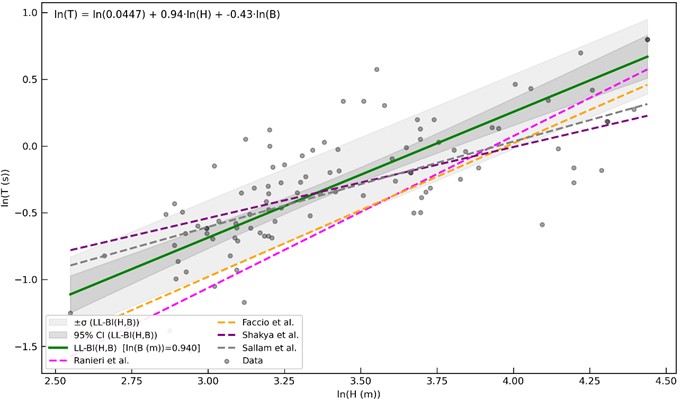
In Fig. 4, moreover, the projection of this bivariate law onto the plane, plotted for a mean base of 2.5 m, is compared with the four height-only empirical formulations from the literature. Shaded bands indicate ± and the 95 % confidence interval of the proposed model. Data points show the distribution of observed , illustrating differences in slope and scaling behaviour among the models. The green curve representing LL-BI(H,B) follows the central trend of the data, remaining largely within the ± band derived from its residuals. Literature models differ slightly from the observed data, but their predictions mainly fall between ± from the median bivariate prediction. This visual impression is consistent with the numerical metrics: the bivariate model reaches an adjusted of 0.621 and RMSE of 0.242 s, whereas the best among the four literature models attains of 0.461 and RMSE of 0.288 s. The reduction in from about 0.31-0.33 for the literature models to 0.28 for LL-BI(H,B) confirms that explicitly accounting for both height and base diameter yields a more concentrated and reliable prediction of the period.
Fig. 3Fitted surface of the LL-BI(H,B) model with data points and residuals
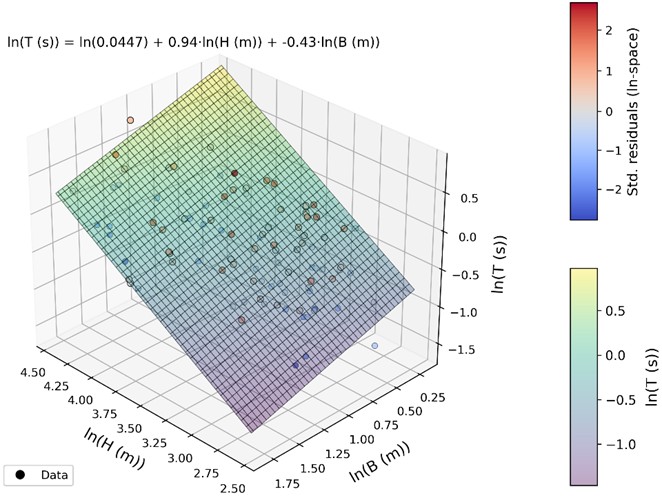
Fig. 4Comparison between the LL-BI(H,B) model and literature formulations in ln-ln space
5. Conclusions
This study proposed an empirical relationship for estimating the fundamental period of historical masonry minarets. The advantage of the present proposal, compared to literature, is represented by the use of geometric parameters that are readily obtainable from surveys, archival documentation, or even websites. More in detail, it was shown that the bivariate model LL-BI(H,B) consistently achieves the lowest dispersion, indicating that the combined effect of height and base dimension strongly governs the global stiffness of these slender masonry structures. These research activities are elaborated in the frame of the running “CoReng” project.
References
-
M. Oguzmert, “Dynamic behavior of masonry minarets,” Istanbul Technical University, Institute of Science and Technology, 2022.
-
K. M. Khallaf, “Study of treatment, restoration, and conservation of archaeological minarets in Cairo applied on one selected archaeological minaret,” Cairo University, 2024.
-
K. A. Bani-Hani, H. S. Zibdeh, and K. Hamdaoui, “Health monitoring of a historical monument in Jordan based on ambient vibration test,” Smart Structures and Systems, Vol. 4, No. 2, pp. 195–208, Mar. 2008, https://doi.org/10.12989/sss.2008.4.2.195
-
A. G. El-Attar, A. M. Saleh, and A. H. Zaghw, “Conservation of a slender historical Mamluk-style minaret by passive control techniques,” Structural Control and Health Monitoring, Vol. 12, No. 2, pp. 157–177, Jan. 2005, https://doi.org/10.1002/stc.54
-
C. S. Oliveira, E. Çaktı, D. Stengel, and M. Branco, “Minaret behavior under earthquake loading: The case of historical Istanbul,” Earthquake Engineering and Structural Dynamics, Vol. 41, No. 1, pp. 19–39, Apr. 2011, https://doi.org/10.1002/eqe.1115
-
M. I. Ismail and A. M. Essa, “Seismic behavior of heritage masonry structures,” International Journal of Structural and Civil Engineering Research, Vol. 3, No. 4, pp. 13–24, 2014.
-
R. Livaoğlu, M. H. Baştürk, A. Doğangün, and C. Serhatoğlu, “Effect of geometric properties on dynamic behavior of historic masonry minaret,” KSCE Journal of Civil Engineering, Vol. 20, No. 6, pp. 2392–2402, Sep. 2016, https://doi.org/10.1007/s12205-016-0622-2
-
A. Bayraktar, A. C. Altunişik, B. Sevim, and T. Türker, “Seismic response of a historical masonry minaret using a finite element model updated with operational modal testing,” Journal of Vibration and Control, Vol. 17, No. 1, pp. 129–149, Aug. 2010, https://doi.org/10.1177/1077546309353288
-
A. Bayraktar, I. Çalik, and T. Türker, “A simplified fundamental frequency formulation based on in-situ tests for masonry stone minarets,” Experimental Techniques, Vol. 46, No. 2, pp. 225–238, May 2021, https://doi.org/10.1007/s40799-021-00474-0
-
H. M. Hassan, H. E. Abdel Hafiez, M. A. Sallam, C. Bedon, M. Fasan, and A. Henaish, “Multidisciplinary approach of proactive preservation of the religions complex in Old Cairo-Part 1: geoscience aspects,” Heritage, Vol. 8, No. 2, p. 56, Jan. 2025, https://doi.org/10.3390/heritage8020056
-
H. M. Hassan, H. E. Abdel Hafiez, M. A. Sallam, C. Bedon, M. Fasan, and A. Henaish, “Multidisciplinary approach of proactive preservation of the religions complex in Old Cairo-Part 2: structural challenges,” Heritage, Vol. 8, No. 3, p. 89, Feb. 2025, https://doi.org/10.3390/heritage8030089
-
H. M. Hassan et al., “Seismic assessment of a cultural heritage minaret in Cairo,” Springer Geology, pp. 541–565, Feb. 2023, https://doi.org/10.1007/978-3-031-13810-2_28
-
M. A. Sallam, H. M. Hassan, M. A. Sayed, H. E. Abdel Hafiez, H. S. Zahra, and M. Salem, “Seismic vulnerability assessment of historical minarets in Cairo,” Geoenvironmental Disasters, Vol. 10, No. 1, p. 30, Dec. 2023, https://doi.org/10.1186/s40677-023-00260-7
-
A. Erkal and Z. H. I. Hilmi, “Effective expressions for the estimation of the first and third natural periods of minarets based on extensive and comprehensive parametric modal analyses,” Structures, Vol. 72, p. 108275, Feb. 2025, https://doi.org/10.1016/j.istruc.2025.108275
-
P. Clemente and G. Buffarini, “Dynamic response of buildings of the cultural heritage,” in Encyclopedia of Structural Health Monitoring, Wiley, 2008, https://doi.org/10.1002/9780470061626.shm173
-
M. M. Kose, “Parameters affecting the fundamental period of RC buildings with infill walls,” Engineering Structures, Vol. 31, No. 1, pp. 93–102, Jan. 2009, https://doi.org/10.1016/j.engstruct.2008.07.017
-
P. Faccio, S. Podestà, and A. Saetta, “Venice, bell tower of the Church of Sant’Antonin, example 5,” (in Italian) in Guidelines for the Assessment and Reduction of Seismic Risk of Cultural Heritage Aligned with the New Technical Standards for Construction (DM 14/01/2008), Rome, Italy: Italian Ministry of Cultural Heritage, 2009.
-
C. Rainieri and G. Fabbrocino, “Predictive correlations for the estimation of the elastic period of masonry towers,” in Proceedings of the Experimental Vibration Analysis for Civil Engineering Structures EVACES, pp. 3–5, 2011.
-
M. Shakya, H. Varum, R. Vicente, and A. Costa, “Empirical formulation for estimating the fundamental frequency of slender masonry structures,” International Journal of Architectural Heritage, Vol. 10, No. 1, pp. 55–66, Jan. 2016, https://doi.org/10.1080/15583058.2014.951796
-
M. A. Sallam, “Evaluation of seismic vulnerability of some historical structures in Old Cairo,” Benha University, Banha, Egypt, 2022.
-
M. A. Sallam, M. Fasan, H. M. Hassan, C. Bedon, G. Smiroldo, and H. E. Abdel Hafiez, “Dynamic characterization of masonry minarets using regression models,” Bulletin of Earthquake Engineering, 2026.
About this article

This research study is part of the “CoReng” Particular Relevance Italy-Egypt bilateral project (2024-26). The research activities are partly financially supported by the Italian Ministry of Foreign Affairs and International Cooperation (grant number EG24GR01) and by the Science, Technology and Innovation Funding Authority (STDF, grant number 47530).
The datasets generated during and/or analyzed during the current study are available from the corresponding author on reasonable request.
Prof. Marco Fasan is a scientific committee member; Prof. Chiara Bedon is a chair of the 75th International Conference on Vibroengineering and were not involved in the editorial review and/or the decision to publish this article.

