Abstract
Integrating in-situ modal testing and numerical modelling based on experimental evidence is a powerful strategy for studying the dynamic behavior of existing constructions and making decisions about their retrofitting or monitoring. This paper applies this strategy to analyze the seismic behavior of an unreinforced masonry arch bridge in Spain, investigating on two different approaches to account for the backfill material. An extensive experimental campaign was conducted to determine the bridge’s mechanical and dynamic properties. Operational modal analysis, carried out using two accelerometer setups, was used to extract frequencies and modal shapes through algorithms in both the time and frequency domains. Two finite-element models of the bridge were built and identified: one that treats the backfill between the masonry wall faces as a structural material and another that does not include the backfill, instead redistributing its mass within the masonry density. The two models’ modal behavior and dynamic responses to a real earthquake were then compared to evaluate the effect of different ways of accounting for backfill.
1. Introduction
Vibration-based identification of numerical models improves the reliability of the seismic assessment of existing constructions. Operational modal analysis (OMA) is commonly used to extract the structure’s modal properties [1], [2]. Theoretical basis and algorithms of extraction are widely investigated in the literature, cf. e.g. [3], [4]. Integrating experimental modal findings with the calibration of numerical models [5] is essential for seismic assessment through dynamic analysis [6] and for damage detection in structural health monitoring [7-9].
Due to the complex nature of masonry as a heterogeneous, non-linear composite material, modelling masonry constructions is not an easy task. Various approaches have been proposed, including homogenized continuum macro-mechanical models [10], [11], discrete micro or macro-elements [12], and multiscale models [13]. The finite element method (FEM) is a widely used approach for studying the seismic behavior of masonry constructions, particularly for non-linear dynamic analyses of complex structures [14]. The effectiveness of calibrating numerical models of masonry structures based on experimental modal data has been demonstrated in previous studies [6], [9], [11]. Another issue comes from the fact that masonry constructions often contain cavities filled with backfill material, the structural role of which is still under investigation [15].
Contributing to the debate, this paper presents the results of a study of a Spanish masonry arch bridge. An extensive experimental campaign was conducted to determine the bridge’s mechanical and dynamic parameters. Modal tests were carried out in OMA involving two accelerometer setups acquiring signals from different positions and directions. The modal parameters were extracted using time-domain and frequency-domain algorithms. To evaluate the impact of the backfill, two finite element models of the bridge were created: one that considers the backfill to be a structural component, and another that treats it as additional mass only. The results of modal identification and nonlinear dynamic analyses under a real earthquake are compared to investigate how different modelling approaches may affect the seismic assessment of this type of structure.
2. The Xirles bridge
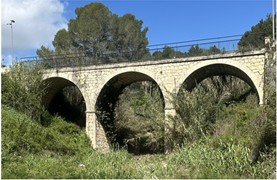
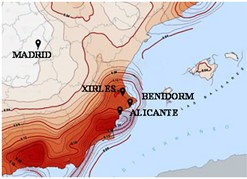
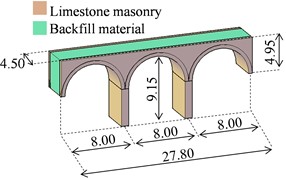
The Xirles bridge is a masonry arch road bridge that is still in use. It is located near the town of Alicante in Spain, see Fig. 1(a-b). The bridge consists of three arches, each spanning 8 meters. The height of the central arch at the keystone is 9.15 meters. Outer spandrels are made of ashlar limestone blocks, as confirmed by X-ray fluorescence analyses. Backfill material is present between the outer faces of the spandrels for a width of 4.50 m, see Fig. 1(c).
Fig. 1a) The Xirles bridge (Photo by Elisa Montis, Alicante, Spain, Apr 4, 2025); b) location in the Spanish seismic map; c) materials and geometrical details.
a)
b)
c)
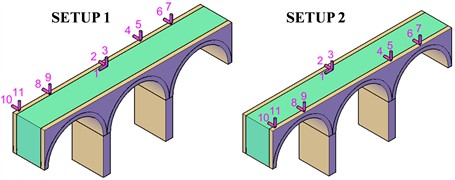
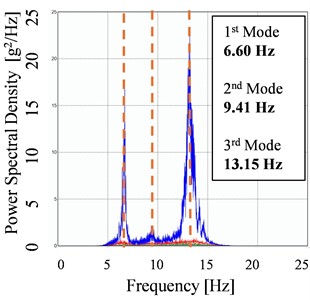
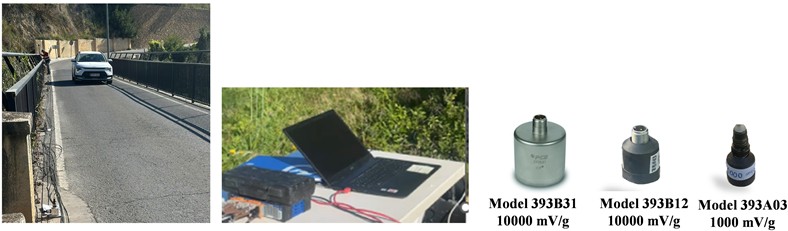
Fig. 2a) The two setups; b) power spectral density diagram; c) ambient vibration test and equipment. Photo by Elisa Montis, Alicante, Spain, Apr 4, 2025
a)
b)
c)
3. Ambient vibration tests on the bridge
OMA tests were conducted on the bridge in April 2025. Two setups comprising five locations of the accelerometers on the deck, recording signals in 11 different directions, are considered, see Figs. 2(a) and 2(b). The instrumentation layout consisted of 11 high-sensitivity uniaxial accelerometers and a multichannel data acquisition unit (QUANTUMX MX1601B), see Fig. 2(c). The mid-span left-side three-axial sensor (made of three accelerometers arranged to record signals from three orthogonal directions) is kept fixed throughout all recording sessions to ensure phase and amplitude consistency required for modal assembly. The remaining sensors, configured in biaxial arrangements, were distributed across the lateral arches and piers to capture the global modal shapes of the structure, including longitudinal, transversal, and torsional components.
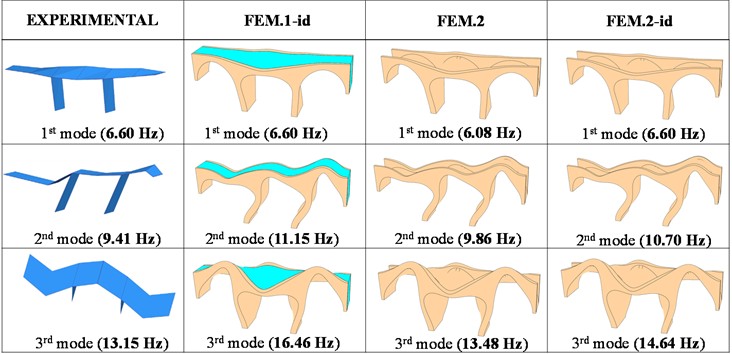
The modal parameters were extracted using Artemis [16], by means of techniques in both the frequency and time domains to ensure the reliability of the modal properties. The Curve-fit Frequency Domain Decomposition technique was used in the frequency domain. The Stochastic Subspace Identification Extended Unweighted Principal Component technique was adopted in the time domain, as it allows for the estimation of statistical uncertainties associated with each identified modal parameter. The accuracy of the modal extraction process was verified with the Modal Assurance Criterion. Fig. 2(d) shows the frequency spectrum finally obtained. The geometrical model of the bridge was implemented using both simplified representations and a detailed 3D geometry. The first three experimental frequencies are reported in the first column of Table 2, while the corresponding shapes are depicted in the first column of Fig. 4.
4. Identification of numerical models
FEM models of the bridge were implemented in Abaqus [17], considering the masonry as a homogeneous nonlinear material with different tensile and compressive behavior. The concrete damage plasticity [18] was adopted as the constitutive model by assuming that the tensile strength of the masonry is 1/30 of the compressive strength. Due to the complex geometries of arches and piers, 10-node quadratic tetrahedral elements (C3D10) were chosen.
A first model, which treats the backfill as a structural material, was built and referred to as FEM.1-id, see left Fig. 3. This approach assumes that the masonry and the backfill collaborate structurally (in the model, they are linked by tie constraints along their contact surfaces). It is to note that non-destructive tests were carried out on the bridge, which resulted in reference values for the mechanical parameters of the masonry. No such tests were conducted on the backfill material, however. Thus, literature values were initially considered for the backfill. A calibration process, based on the identification of the first three frequencies and mode shapes, eventually led to the masonry and backfill values of Young’s moduli ( and ), Poisson’s ratios ( and ) and mass density ( and ) given in the first row of Table 1.
Table 1Mechanical properties of the materials assumed in the models considered in the investigation
Model | Backfill | [MPa] | [MPa] | [-] | [-] | [kg/m3] | [kg/m3] |
FEM.1-id | YES | 4030 | 180 | 0.25 | 0.4 | 1900 | 1400 |
FEM.2 | NO | 4030 | – | 0.25 | – | 2972 | – |
FEM.2-id | NO | 4750 | – | 0.25 | – | 2972 | – |
A second model, called FEM.2, was then built, which does not include the backfill but redistributes its mass in the masonry density (see right Fig. 3). FEM.2 was assigned the same of FEM.1-id and an increased value of mass density (to account for the backfill mass), see 2nd row of Table 1. Since this model did not match the experimental frequencies, an identified model FEM.2-id was then considered, in which a higher value of was assumed (3rd row of Table 1).
Table 2 provides a comparison of the first three experimental and numerical frequencies of the considered models. It should be noted that the model without backfill required a higher value for the masonry Young’s modulus than that adopted in FEM.1-id. The first three modal shapes of the considered models are compared with the experimental shapes in Fig. 4. A good match between numerical and experimental frequencies and shapes is found for the identified models.
Table 2Experimental and numerical frequencies (Hz)
Freq. | EXP | FEM.1-id | FEM.2 | FEM.2-id |
1st | 6.60 | 6.60 | 6.08 | 6.60 |
2nd | 9.41 | 11.15 | 9.86 | 10.70 |
3rd | 13.15 | 16.46 | 13.48 | 14.64 |
Fig. 3FEM models with and without backfill
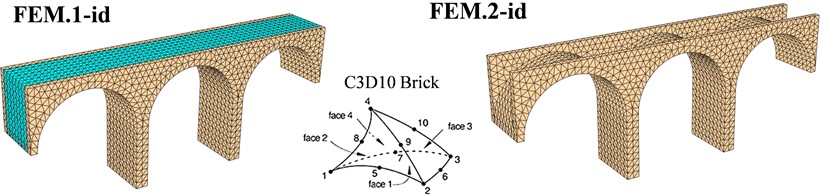
Fig. 4Comparing experimental and numerical frequencies and mode shapes
5. Non-linear dynamic analyses under a spectrum-consistent earthquake
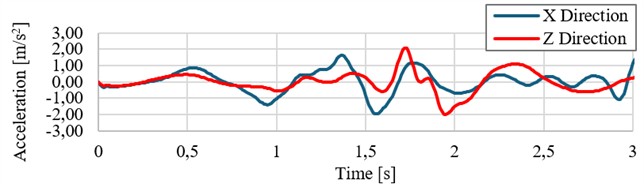
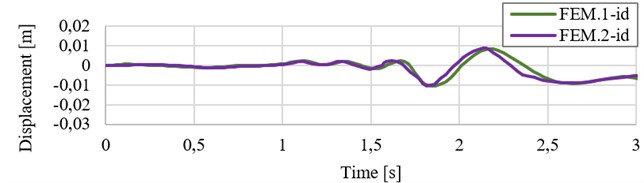
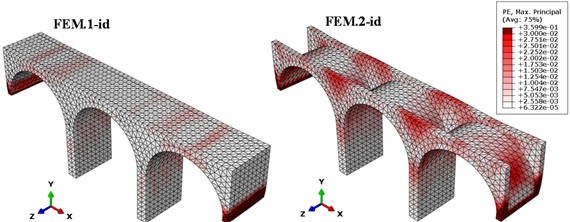
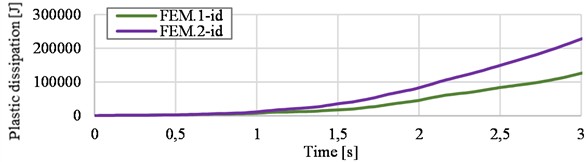
Non-linear dynamic analyses were carried out under an earthquake consistent with the Spanish design response spectrum. It was obtained from the 2015 La Mancha earthquake (Magnitude 4.5, ID EMSC-20150223_0000068). The two components of the earthquake are plotted in Fig. 5(a). The out-of-plane top displacements at the midpoint of the central arch, relevant to FEM.1-id and FEM.2-id, are plotted in Fig. 5(b). The diagrams show a very slight difference in the peak displacement response of the two models. However, Fig. 6(a) shows that the damage pattern due to tensile plastic strain is more widespread in FEM.2-id than in FEM.1-id. This is consistent with the graph presented in Fig.6(b), which shows greater plastic energy dissipation in FEM.2-id. The greater plastic involvement of FEM.2-id is due to the higher value of the elastic modulus, which reduces the elastic range while maintaining the same tensile strength as FEM.1-id.
6. Conclusions
An effective strategy for obtaining reliable structural assessments of existing constructions is to integrate the results of experimental modal tests with consistently calibrated numerical models.
Fig. 5a) Spectrum-consistent earthquake; b) out-of-plane top displacements of the two models
a)
b)
Fig. 6a) Plastic tensile strain; b) plastic energy dissipation of the two models
a)
b)
This paper applies this strategy to study the seismic behavior of a Spanish masonry arch bridge, by investigating different approaches to model the backfill between the masonry wall faces. OMA tests were carried out, while time-domain and frequency-domain techniques were employed to extract modal properties. Two finite element models were identified based on experimental findings: one that considers the backfill as a structural material, and another that accounts only for its inertial effect. Non-linear dynamic analyses under a spectrum-consistent earthquake were performed with both models. The results show that the two models exhibit similar global behavior in terms of modal shapes and displacements, although the model without backfill required a higher value of masonry Young’s modulus. Because of this, it exhibits greater involvement in the plastic range, resulting in more widespread damage due to tensile strain. As the two models represent the extremes of possible assumptions (i.e. backfill as either structural material or structural mass), any other modelling scenario is included in this range (e.g. an interface between masonry and backfill). The results show that modelling backfill as structural mass is a conservative approach that can be adopted to predict displacement demand and damage pattern in the absence of experimental data on the seismic behavior of the structure. Future studies will be devoted to comparing finite element and discrete element approaches for the seismic assessment of masonry arch bridges with backfill.
References
-
H. Hasani and F. Freddi, “Operational modal analysis on bridges: a comprehensive review,” Infrastructures, Vol. 8, No. 12, p. 172, Dec. 2023, https://doi.org/10.3390/infrastructures8120172
-
G. Loi, M. C. Porcu, F. Maltinti, M. Coni, and F. Aymerich, “Experimental in-situ characterisation of the damping properties of road pavements,” Construction and Building Materials, Vol. 489, p. 142174, Aug. 2025, https://doi.org/10.1016/j.conbuildmat.2025.142174
-
R. Brincker, L. Zhang, and P. Andersen, “Modal identification from ambient responses using frequency domain decomposition.,” in Proceedings of the International Modal Analysis Conference (IMAC), pp. 625–630, Feb. 2000.
-
B. Peeters and G. de Roeck, “Stochastic system identification for operational modal analysis: a review,” Journal of Dynamic Systems, Measurement, and Control, Vol. 123, No. 4, pp. 659–667, Dec. 2001, https://doi.org/10.1115/1.1410370
-
E. Reynders, “System identification methods for (operational) modal analysis: review and comparison,” Archives of Computational Methods in Engineering, Vol. 19, No. 1, pp. 51–124, Feb. 2012, https://doi.org/10.1007/s11831-012-9069-x
-
S. Mansour, F. Rizzo, N. I. Giannoccaro, A. La Scala, M. F. Sabbà, and D. Foti, “Essential dynamic characterization of a historical bridge: integrated experimental and numerical investigations,” Journal of Civil Structural Health Monitoring, Vol. 14, No. 1, pp. 85–102, Dec. 2023, https://doi.org/10.1007/s13349-023-00744-y
-
Z. Deng, M. Huang, N. Wan, and J. Zhang, “The current development of structural health monitoring for bridges: a review,” Buildings, Vol. 13, No. 6, p. 1360, May 2023, https://doi.org/10.3390/buildings13061360
-
M. C. Porcu, D. M. Patteri, S. Melis, and F. Aymerich, “Effectiveness of the FRF curvature technique for structural health monitoring,” Construction and Building Materials, Vol. 226, pp. 173–187, Nov. 2019, https://doi.org/10.1016/j.conbuildmat.2019.07.123
-
C. Gentile and A. Saisi, “Ambient vibration testing of historic masonry towers for structural identification and damage assessment,” Construction and Building Materials, Vol. 21, No. 6, pp. 1311–1321, Jun. 2007, https://doi.org/10.1016/j.conbuildmat.2006.01.007
-
S. Ivorra, F. J. Baeza, D. Bru, and F. B. Varona, “Seismic behavior of a masonry chimney with severe cracking condition: preliminary study,” Key Engineering Materials, Vol. 628, pp. 117–122, Aug. 2014, https://doi.org/10.4028/www.scientific.net/kem.628.117
-
M. C. Porcu, E. Montis, and M. Saba, “Role of model identification and analysis method in the seismic assessment of historical masonry towers,” Journal of Building Engineering, Vol. 43, p. 103114, Nov. 2021, https://doi.org/10.1016/j.jobe.2021.103114
-
V. Cusmano, B. Pantò, D. Rapicavoli, and I. Caliò, “A discrete‐element approach accounting for P‐Delta effects,” Earthquake Engineering and Structural Dynamics, Vol. 52, No. 7, pp. 2047–2066, Apr. 2023, https://doi.org/10.1002/eqe.3867
-
M. Pepe, M. Pingaro, P. Trovalusci, E. Reccia, and L. Leonetti, “Micromodels for the in-plane failure analysis of masonry walls: Limit Analysis, FEM and FEM/DEM approaches,” Frattura ed Integrità Strutturale, Vol. 14, No. 51, pp. 504–516, Dec. 2019, https://doi.org/10.3221/igf-esis.51.38
-
A. Gerges, M. C. Porcu, and A. Cazzani, “Numerical investigation of the post-elastic seismic response of the multi-vaulted Beit-El-Din Hammam,” International Journal of Masonry Research and Innovation, Vol. 9, No. 5/6, pp. 537–566, Jan. 2024, https://doi.org/10.1504/ijmri.2024.141652
-
V. Sarhosis, T. Forgács, and J. V. Lemos, “A discrete approach for modelling backfill material in masonry arch bridges,” Computers and Structures, Vol. 224, p. 106108, Nov. 2019, https://doi.org/10.1016/j.compstruc.2019.106108
-
“ARTeMIS Modal Pro,” Structural Vibration Solutions A/S, NOVI Science Park, 9220 Aalborg East, Denmark, 2022.
-
“ABAQUS V2025,” University of Cagliari, 2025.
-
L. S. Rainone, V. Tateo, S. Casolo, and G. Uva, “About the use of concrete damage plasticity for modeling masonry post-elastic behavior,” Buildings, Vol. 13, No. 8, p. 1915, Jul. 2023, https://doi.org/10.3390/buildings13081915
About this article

The authors have not disclosed any funding.
The doctoral school on “Defense against natural risks and ecological transition of built environment” (Universities of Catania and Cagliari) and the Doctoral School on “Materials engineering, structures and terrain” of the University of Alicante are acknowledged.
The datasets generated during and/or analyzed during the current study are available from the corresponding author on reasonable request.
The authors declare that they have no conflict of interest.

