Abstract
Traditionally, Structural Health Monitoring (SHM) relied on periodic manual inspections and visual assessments, which are inherently limited and subjective in nature, labor-intensive, and unable to detect hidden internal damage. Recently, the integration of the Internet of Things (IoT) has transformed the SHM paradigm by enabling the transition from reactive maintenance to proactive, continuous, and predictive strategies. Indeed, modern IoT systems allow for the deployment of dense, wireless, and cost-effective sensor networks that can capture real-time structural responses and transmit data directly to processing centers. In this context, the present work presents a preliminary application of integrated IoT and SHM techniques for an existing RC structure located in the Campi Flegrei area (near the city of Naples in Italy) that has recently been subjected to several earthquake swarms.
1. Introduction
Within the broader Structural Health Monitoring (SHM) framework, Internet of Things (IoT) technologies enable continuous monitoring and support structural interpretation through data-driven feature extraction and statistical analysis [1].
Complementarily, the evolution of wireless and distributed sensor networks can support the adoption of scalable, low-power sensing architectures, aligned with current IoT deployments [2].
Recent surveys on IoT-based SHM, emphasize how cloud-native infrastructures, lightweight protocols [3, 4] and MEMS-based sensing enable dense acquisition and near real-time processing across large structural assets [5].
At the same time, Operational Modal Analysis (OMA) provides the methodological backbone for interpreting ambient vibration data. Indeed, the role of OMA in identifying modal frequencies, mode shapes, and damping ratios results to be essential for structural assessment [6, 7].
Recent advances in digital monitoring technologies and AI-enhanced anomaly detection [8, 9], as well as scalable IoT-5G architectures for post-event assessment [10, 11], further demonstrate how modern platforms can support automatic detection, early warning, and lifecycle management.
In parallel, integrated experimental-numerical studies have illustrated how the identified modal parameters can be employed to calibrate and validate finite-element models, thereby improving the reliability of structural simulations under seismic or aerodynamic loads [12, 13].
The proposed IoT-based SHM system, briefly described in the present work, is designed not only to acquire continuous acceleration data but also to facilitate the extraction of modal features, providing a solid basis for data-informed decision making in the highly dynamic context of the Campi Flegrei (Southern Italy) seismic area. In the following, Section 2 summarizes the architecture of the adopted IoT system, Sections 3 and 4 summarize some preliminary results.
2. IoT system architecture and sensor network for structural monitoring
The proposed SHM system is based upon a distributed network of sensor nodes interconnected to a modular cloud infrastructure, which makes possible the transition to a continuous and predictive monitoring strategy outlined in Section 1. To capture the dynamic responses of the reinforced concrete structure in real time, with particular attention to the stresses induced by seismic swarms in the Campi Flegrei area, high-performance digital accelerometers were employed. The technical specifications of these devices have been carefully selected to adapt to the needs of micro-seismic monitoring:
– Flexible measurement range: the sensors offer user-selectable full-scale options, supporting operating ranges of ±2 g, ±4 g, and ±8 g.
– High sensitivity: to ensure maximum resolution in the detection of low-intensity vibrations, the nodes have been configured to operate within a range of ±2 g.
– Environmental reliability: the devices guarantee high stability to changing external climatic conditions, being able to operate without performance degradation in a temperature range between –40 °C and +125 °C.
2.1. Proposed system architecture and data flow
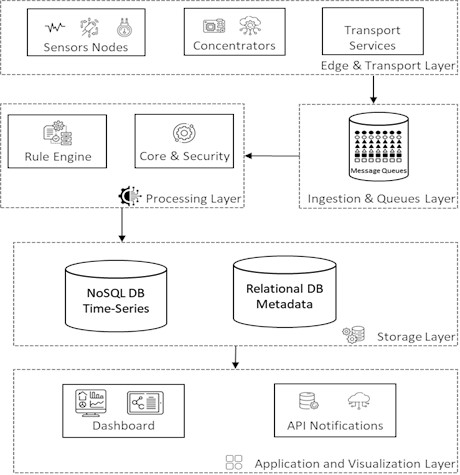
The network infrastructure has been designed according to a tiered logic architecture, optimized for scalability and handling of high-frequency data flows typical of SHM applications. The architecture, depicted in Fig. 1, can be divided into the following macro-components:
– Perception and Transport Layer (Edge & Transport): field devices capture accelerations and transmit data packets to cloud transport services. Transmission is done using lightweight, standardized IoT protocols (such as MQTT or HTTP), which ensure low network overhead. In the most complex configurations, the nodes communicate in advance with a local gateway, which acts as an aggregator and translates industrial protocols into formats suitable for cloud transmission.
– Ingestion and Decoupling Layer: once the telemetry flows reach the server, they are not directly processed in a synchronic way but are routed within a system of Message Queues. This intermediate layer is essential to ensure the resilience of the entire system: in the event of acute seismic events, where the volume of data generated by the sensor network undergoes sudden peaks, the queues absorb the abnormal load, preventing the collapse of processing services and ensuring total data integrity.
– Processing Layer and Rule Engine (Core & Rule Engine): the data extracted from the queues feeds the logical core of the platform. A central component (Core) manages security, device sessions, and fabric metadata. In parallel, the “Rule Engine” performs complex event processing in real time, evaluating incoming telemetry through configurable logic chains. If the Rule Engine detects a kinematic anomaly, it automatically triggers emergency procedures. Beyond threshold-based alerting, the modular design of the Rule Engine allows the integration of automatic modal tracking algorithms. Such capabilities pave the way for real-time detection of deviations in modal frequencies, which are typically considered precursors of structural degradation.
– Storage Layer: to ensure optimal performance, the architecture takes a hybrid approach to persisting information. A relational database (SQL) is used to store entities, sensor spatial relationships, and system configurations in a structured way. On the contrary, a non-relational database (NoSQL) is dedicated exclusively to the ingestion and massive storage of time-series generated at high frequency by accelerometers.
– Application and Visualization Layer which constitutes the access point for end users. Through dynamic graphical interfaces (Dashboards), this layer queries databases and processing services to provide a visual representation of the health of the facility. It allows the analysis of time series, real-time monitoring of accelerations and centralized management of alarms, interfacing with external information systems via API.
Fig. 1Schematic representation of the five-layer IoT architecture adopted for the structural monitoring system (SHM) involving: physical capture (layer 1), message queues (layer 2), real-time event processing (layer 3), hybrid storage (layer 4), visualization and notification to end users (layer 5)
2.2. Implementation phase
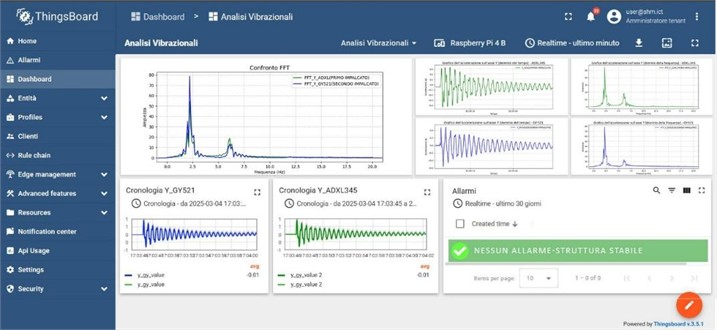
In the execution phase, the complex reference architecture was implemented using the open-source IoT platform ThingsBoard. This environment provided the modular software infrastructure needed to efficiently orchestrate transport services, messaging queues, and the complex routing logic of the rule engine. In addition, the platform has enabled the rapid prototyping of dedicated user interfaces (UI Dashboards), providing interactive graphical tools for the visualization of time series and concretely facilitating the transition from a manual inspection approach to proactive monitoring of structural health. Fig. 2 depicts the user interface dashboard implemented in ThingsBoard.
Fig. 2Schematic representation of the five-layer IoT architecture adopted for the structural monitoring system (SHM) involving: physical capture (layer 1), message queues (layer 2), real-time event processing (layer 3), hybrid storage (layer 4), visualization and notification to end users (layer 5)
3. Preliminary SHM results
3.1. The building and the monitoring system
The case study analyzed in this paper focuses on a reinforced concrete school building located in Quarto (NA, Italy), built during the 1990s. From a planimetric perspective, the footprint of the building fits within a rectangular area of approximately 36 m by 21 m. The structure reaches a height of about 7 m, with a inter-story height of approximately 3.10 m.
The floor diaphragms are composed of predalles precast slabs integrated with cast-in-place ribs, resulting in a total thickness of 25 cm. The primary load-bearing system consists of RC frames with both shallow (wide) and deep beams arranged in both directions. The lateral force-resisting system includes a core wall system at the elevator shaft and a shear wall next to the external staircase on the right side. Further details are omitted herein for the sake of brevity.
To determine the limit values of accelerations acceptable for the usability of the structure, a Finite Element (FE) model was developed thanks to the SAP2000 software [14].
The model was calibrated based on the vibration data acquired, to reproduce the main vibration modes of the structure, which cannot be reported due to space constraints. Indeed, the identified dynamic parameters can be directly employed to refine the FE model as shown in recent integrated experimental–numerical studies [12, 13].
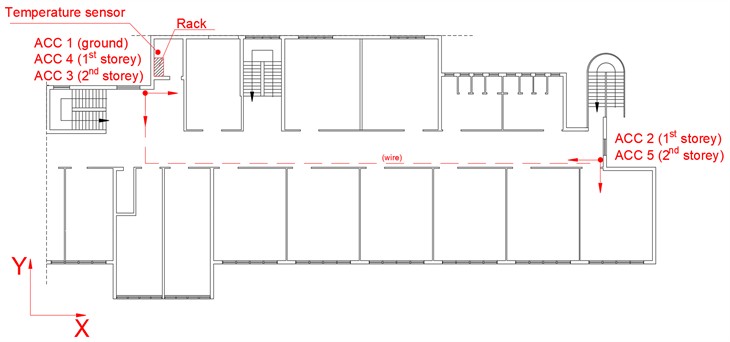
The monitoring system consists of one temperature sensor and 5 MEMS accelerometers (whose features are reported in Section 2) located inside the building as follows:
– Sensor 1, located at the bottom to record the acceleration transmitted by the ground.
– Sensors 2 and 4, recording the accelerations at the 1st storey.
– Sensors 3 and 5, recording the accelerations at the 2nd storey.
Fig. 3 depicts the plan layout of the monitoring system (in red) for the whole building, where the accelerometers are denoted with the acronym “ACC”.
Fig. 3Layout of the monitoring system (in red). MEMS sensors are mentioned with the acronym “ACC”
3.2. Preliminary time series analysis
The acquired time series (with 100 Hz sampling rate) were analyzed at the occurrence of some relevant earthquakes, reported in Table 1, based on data given by the earthquake list with real-time updates by the Italian Earthquake National Observatory [15].
Fig. 4 presents the temporal evolution of the three acceleration components ( and are depicted in Fig. 3 and represents the vertical direction) recorded by the five MEMS sensors during the seismic events listed in Table 1. For each sensor and for each component, a 20 s window centered on the peak of the detrended signal is shown.
Table 1Considered seismic events in the Campi Flegrei area [15]
Event | Date and time | Magnitude (Md) | Depth [km] | Latitude | Longitude |
1 | 2025-11-20 04:24:11 | 2.4 | 3 | 40.84 | 14.12 |
2 | 2025-11-28 16:29:41 | 2.7 | 1 | 40.83 | 14.11 |
3 | 2026-01-08 17:44:08 | 2.6 | 3 | 40.83 | 14.13 |
Fig. 4Time series recorded for the seismic event reported in Table 1
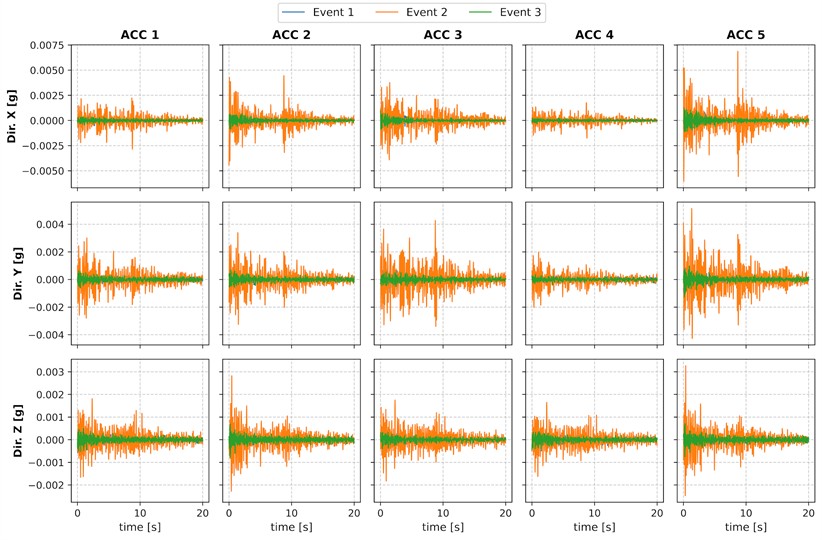
With respect to Fig. 4, it should be observed that the accelerations measured at the ground floor (ACC 1) are markedly lower than those recorded at the upper stories, confirming the dynamic amplification associated with structural height. Sensors located at the first and second floors (ACC2-ACC5) exhibit amplitude variations consistent with the predominant flexural modes, with higher values in the horizontal components compared to the vertical direction.
Furthermore, the traces related to “Event 1” are not clearly visible despite having a comparable magnitude to the other events. This difference highlights the sensitivity of local site conditions and source proximity in shaping the effective structural input.
4. Conclusions
This study presented a preliminary implementation of an IoT-based Structural Health Monitoring system applied to an existing reinforced concrete school building located in the Campi Flegrei area. The recorded acceleration time histories exhibited a good level of repeatability among different seismic events. Overall, the quality of the acquired data confirms the reliability of the sensing hardware and of the ingestion-processing pipeline built on the IoT platform.
The adopted architecture, developed around a modular cloud-native platform and a distributed network of low-cost MEMS accelerometers, demonstrated the feasibility of enabling continuous, real-time monitoring in a context characterized by recurrent micro-seismic activity.
In addition to the demonstrated feasibility, the proposed IoT infrastructure offers a concrete foundation for early warning functionalities, where deviations in modal features -tracked automatically through the Rule Engine- can be used as indicators of potential anomalies. Future developments will focus on the implementation of automated modal tracking, AI-assisted damage detection routines, and the integration of the monitoring system within a digital twin framework to enhance predictive simulations and long-term asset management.
References
-
C. R. Farrar and K. Worden, Structural Health Monitoring. Wiley, 2012, https://doi.org/10.1002/9781118443118
-
J. P. Lynch, “A summary review of wireless sensors and sensor networks for structural health monitoring,” The Shock and Vibration Digest, Vol. 38, No. 2, pp. 91–128, Mar. 2006, https://doi.org/10.1177/0583102406061499
-
C. Arcadius Tokognon, B. Gao, G. Y. Tian, and Y. Yan, “Structural health monitoring framework based on internet of things: a survey,” IEEE Internet of Things Journal, Vol. 4, No. 3, pp. 619–635, Jun. 2017, https://doi.org/10.1109/jiot.2017.2664072
-
M. S. Islam and S. C. Dutta, “Internet of Things (IoT) in structural health monitoring: a decade of research trends,” Journal of Infrastructure Management and Maintenance, Vol. 14, No. 2, pp. 45–62, 2024.
-
G. M. S. Al-Khafaji, A. J. Al-Fahdawi, and H. M. Jassim, “Design of building structure health monitoring model based on IoT and MEMS sensors,” Sustainable Buildings, Vol. 6, No. 1, pp. 1–12, 2025, https://doi.org/10.1051/sbuild/20240038
-
R. Brincker and C. E. Ventura, Introduction to Operational Modal Analysis. Wiley, 2015, https://doi.org/10.1002/9781118535141
-
C. Rainieri and G. Fabbrocino, Operational Modal Analysis of Civil Engineering Structures. New York, NY: Springer New York, 2014, https://doi.org/10.1007/978-1-4939-0767-0
-
J. C. Bormon, “AI-assisted structural health monitoring for foundations and high-rise buildings,” in International Conference on Smart Structures and Systems (ICSSS), pp. 112–119, Sep. 2025, https://doi.org/10.20944/preprints202509.1196.v1
-
C. Quinonero et al., “Improving diagnostic yield for analyzing periodic electrograms in the remote detection of pacemaker lead issues,” Sensors, Vol. 25, No. 3, p. 656, Jan. 2025, https://doi.org/10.3390/s25030656
-
A. Masood and K. Ahmad, “Assessment of municipal solid waste management in Jammu City: problems, prospects and solutions,” in Smart Cities-Opportunities and Challenges, Vol. 58, pp. 257–275, Apr. 2020, https://doi.org/10.1007/978-981-15-2545-2_23
-
V. Ergen and A. C. Zülfikar, “Scalable IoT-Based Structural Health Monitoring System for Post-Earthquake Rapid Assessment,” Buildings, Vol. 16, No. 5, p. 950, Feb. 2026, https://doi.org/10.3390/buildings16050950
-
S. Mansour, F. Rizzo, N. I. Giannoccaro, A. La Scala, M. F. Sabbà, and D. Foti, “Essential dynamic characterization of a historical bridge: integrated experimental and numerical investigations,” Journal of Civil Structural Health Monitoring, Vol. 14, No. 1, pp. 85–102, Dec. 2023, https://doi.org/10.1007/s13349-023-00744-y
-
F. Rizzo et al., “Construction and dynamic identification of aeroelastic test models for flexible roofs,” Archives of Civil and Mechanical Engineering, Vol. 23, No. 1, Oct. 2022, https://doi.org/10.1007/s43452-022-00545-y
-
“SAP2000 integrated software for structural analysis and design,” Computers and Structures, Inc., Berkeley, California, Version 25, 2000.
-
“Osservatorio Nazionale Terremoti.” INGV. https://terremoti.ingv.it/
About this article

The authors have not disclosed any funding.
The authors thank Eng. Giovanni Cutolo for the technical support provided in setting up the IoT framework and streamlining data collection.
The datasets generated during and/or analyzed during the current study are available from the corresponding author on reasonable request.
Prof. Enzo Martinelli is a scientific committee member of the 75th International Conference on Vibroengineering and was not involved in the editorial review and/or the decision to publish this article.

