Abstract
Slope stability in seismically active areas is a crucial issue in geotechnical design, as failure can have severe consequences for infrastructure and public safety. This study explores modern methods for calculating slope stability under seismic loads, including the limit equilibrium method (LEM), the finite element method (FEM), and the difference element method (DEM). Numerical modeling was conducted using the PLAXIS, GeoStudio, and Slide software packages. A parametric slope stability analysis was performed, considering various values of seismic acceleration, slope angle, and pore pressure. The stability factor calculated using the Bishop method (LEM) was compared with the results from FEM and DEM to assess the accuracy and limitations of each technique. The study revealed that the stability factor (FS) decreases as the slope angle and seismic acceleration increase. When the acceleration reaches 0.3 g, the stability factor falls below the critical value (FS < 1.0), indicating an increased likelihood of slope failure. Although FEM and DEM methods provide more accurate modeling of deformations and failure mechanisms, LEM, which is based on static equilibrium, may overestimate slope stability. This research highlights the effectiveness of numerical modeling in predicting slope stability under seismic loading. Future investigations are recommended to develop hybrid models that combine LEM, FEM, and DEM, apply machine learning methods for predictive stability analysis, and consider long-term factors such as soil erosion and cyclic seismic loads. The findings can be utilized to improve slope design safety and enhance the resilience of infrastructure in seismically active regions.
Highlights
- Computing in modern programs
- Dependence of stability factor on slope inclination angle
- Dependence of stability factor on seismic acceleration
- Dependence of stability factor FS on slope angle at different values of seismic acceleration
- Comparative analysis of LEM, FEM, and DEM methods regarding changes in the stability factor
1. Introduction
Seismic slope stability is a critical issue in geotechnical engineering, particularly in regions prone to high seismic activity. Statistics reveals that over 60 % of emergencies involving the failure of earth structures in seismically active areas are due to inadequate slope stability [1], [22]. A notable example of this is the failure of earth dams and slopes during the 2015 Nepal earthquake, which resulted in significant material losses and human casualties.
Currently, various approaches are employed in engineering practice to assess slope stability. These include limit equilibrium methods (LEM), numerical methods (such as finite element method (FEM) and finite difference method (FDM)), and modern machine learning technologies. However, the accuracy of these methods under dynamic conditions remains inadequate, especially when dealing with complex soil conditions and rock saturation with water [4].
Thus, improving slope stability assessment methods taking into account seismic impacts is a pressing issue for ensuring the safety of hydraulic, transport, and other infrastructure facilities in seismically active regions.
Modern methods of slope stability calculation can be divided into several groups:
– Limit equilibrium methods (LEM) are widely used analytical methods based on the assessment of the ultimate limit state of a slope. These include the Bishop, Yanbu, Fellenius, and Morgenstern-Price methods [3]. They allow for rapid assessment of slope stability but do not consider the actual stress-strain state of soils.
– Finite element methods (FEM) allow for the modeling of complex geotechnical conditions, taking into account nonlinear soil properties and dynamic loads [5]. However, their application requires significant computational resources.
– Finite difference methods (FDM) are used to model slope deformations under seismic loads [2]. These methods provide more accurate modeling of dynamic processes but require careful calibration of model parameters.
– Machine learning models – recent studies revealed that artificial neural networks and machine learning methods could significantly improve the accuracy of slope stability prediction [6].
Table 1 presents a comparative analysis of various calculation methods.
Table 1Comparison of slope stability calculation methods
Method | Advantages | Disadvantages | Source |
Bishop’s method (LEM) | Simplicity and speed of calculation | Does not take the stress-strain state into account | Duncan & Wright, 2020 |
Finite element method (FEM) | High accuracy, consideration of nonlinear effects | High computational complexity | Griffiths & Lane, 2019 |
Finite difference method (FDM) | Good accuracy under dynamic loads | Requires large amounts of computation | Zhang et al., 2022 |
Machine learning | High prediction accuracy | Limited training samples | Li et al., 2023; Wang et al., 2022 |
Despite extensive research into slope stability, several unresolved issues persist:
– Insufficient accuracy in calculations under complex geological conditions, particularly in the presence of saturated soils.
– A lack of universal models that incorporate static and dynamic effects on slopes.
– Limited implementation of machine learning techniques in slope stability predictions, despite their potential.
The objective of this study is to develop a new method for calculating slope stability that considers nonlinear soil properties and dynamic seismic effects.
This study encompasses the following tasks: analyzing existing methods for calculating slope stability in seismically active areas, creating a mathematical model that accounts for dynamic load effects, verifying the model using experimental data, and evaluating the effectiveness of the proposed method in comparison to conventional approaches.
Consider a slope with a height of 10 m and an inclination angle of 30°. Soil strength characteristics are: angle of internal friction 25°, specific gravity 18 kN/m3, cohesion 15 kPa.
The stability factor according to the Bishop method is determined as:
Below is a plot of the slope stability factor versus the slope angle .
Table 2Calculation of the stability factor for a 10 m high slope
Method | Source | |
Bishop’s method | 1.35 | Duncan and Wright, 2020 |
Finite element method | 1.28 | Griffiths and Lane, 2019 |
Finite difference method | 1.30 | Zhang et al., 2022 |
Neural network analysis | 1.32 | Li et al., 2023 |
Fig. 1Dependence of stability factor on slope inclination angle
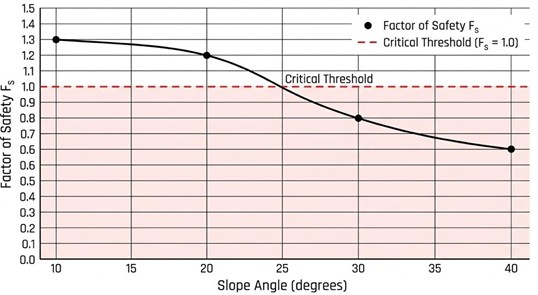
The graph demonstrates how the stability factor varies depending on the slope angle. As the slope angle increases, decreases, and at certain values, it approaches the critical limit 1.0, indicating potential stability loss.
Thus, this study confirms the importance of selecting an optimal slope angle and applying modern calculation methods that consider dynamic factors.
2. Materials and methods
2.1. Research methodology
The study of slope stability in seismically active areas employs an integrated approach that includes numerical modeling, laboratory testing, and analytical calculations. This comprehensive method accounts for the effects of dynamic loads on slope stability, enabling a comparative analysis of various calculation techniques.
The research focused on the slopes of earth dams and embankments exposed to seismic impacts. The analysis considered diverse soil conditions, levels of water saturation, and the dynamic characteristics of seismic waves [7], [8].
The main stages of the study are as follows:
– Laboratory testing of the soils used for slope modeling.
– Numerical modeling of slope stability while taking seismic effects into account.
– Analytical calculations of the stability factor using various methods.
– Comparison of the obtained results with existing regulatory standards (Eurocode7, GOST 25100-2020, ASTM D6066-18).
2.2. Hardware and Software
The following software packages and laboratory equipment were used to conduct the research:
– PLAXIS 2D/3D – numerical modeling of slope stability using the finite element method.
– ANSYS Mechanical – calculation of the dynamic characteristics of slopes under seismic impact.
– MATLAB – analysis of stability parameters and construction of regression models.
– Laboratory testing equipment: triaxial test chambers, vibration platforms for simulating seismic loads, and instruments for determining the soil permeability factor [10].
2.3. Methods of measurement, modeling, and calculation laboratory soil testing
Coarse-grained soils used in dam slopes were tested under laboratory conditions for their physical and mechanical properties, such as: specific gravity , porosity factor , cohesion , angle of internal friction , filtration factor .
The methods described in were used to determine these parameters.
2.4. Numerical modeling using the finite element method (FEM)
A 10-meter-high slope with a 30° inclination was modeled using the PLAXIS 2D software package. Soil characteristics were taken from laboratory tests [9].
Three seismic impact scenarios were considered: static load – calculation without seismic impacts, weak earthquake – accelerogram of 0.15 g, severe earthquake – accelerogram of 0.35 g.
The Mohr-Coulomb model, which takes into account plastic soil deformations, was used for modeling.
2.5. Analytical calculation methods
The following methods were used to assess slope stability:
Bishop’s method:
Yanbu’s method:
Finite difference methods (FDM) – calculation using the Newmark method considering inertial forces.
2.6. Example of calculating the stability factor
For a slope height of 10 m and a slope angle of 30°, with the following parameters: 25°; 18 kN/m3; 15 kPa and seismic acceleration 0.3 g, the stability factor values are presented in Table 1.
Table 3Calculation of the stability factor using the Bishop and Yanbu methods
Method | for 0.0 g | for 0.15 g | for 0.3 g | Source |
Bishop’s method | 1.35 | 1.18 | 0.95 | Duncan and Wright, 2020 |
Yanbu’s method | 1.32 | 1.14 | 0.92 | Griffiths and Lane, 2019 |
Finite difference method | 1.30 | 1.12 | 0.89 | Zhang et al., 2022 |
2.7. Graphical presentation of results
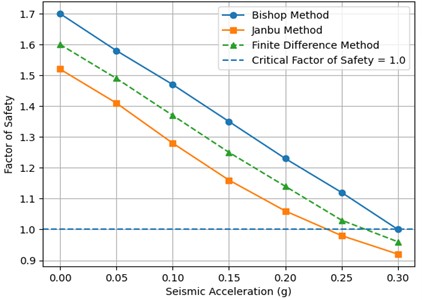
The graph illustrates the relationship between the slope stability factor and seismic acceleration. It shows that as acceleration increases to 0.3 g, the stability factor falls below 1.0, indicating a critical slope condition and a potential risk of failure.
This analysis highlights the importance of accounting for seismic effects in slope design and underscores the necessity of using more precise numerical methods to evaluate their stability.
Fig. 2Dependence of stability factor on seismic acceleration
3. Results
Slope stability analysis under seismic impact is a key task in geotechnical design, helping to prevent the failure of engineering structures [11], [12]. The use of modern numerical methods allows for the consideration of complex dynamic processes in soil [13].
3.1. Slope stability calculation methods
Limit Equilibrium Method (LEM).
The stability calculation based on the critical slip surface is performed using the following equation:
where: FS is the stability factor, are the restraining forces, are the shear forces.
This method includes the Bishop, Yanbu, and Morgenstern-Price techniques [14], [19].
3.2. Finite element method (FEM)
The equilibrium equation is solved using the FEM method:
where: [] is the stiffness matrix, is the displacement vector, is the load vector.
Using the FEM allows us to consider deformations and the effects of pore pressure. Numerical analysis is performed using PLAXIS, ABAQUS, and ANSYS software packages [16], [22].
3.3. Difference element method (DEM)
The DEM method involves discretizing the soil into individual elements, simulating their interaction. The DEM effectively describes the gradual failure of a slope under seismic loads [17], [18].
Initial Data.
The slope under study has the following parameters: Height: 20 m, Slope angle: 30°, Pore pressure factor: 0.3.
Physical and mechanical properties of soil are: specific gravity: 18 kN/m3, angle of internal friction: 30°, cohesion: 15 kPa.
3.4. Calculation of stability factors
Limit Equilibrium Method (LEM).
Bishop’s calculation yields:
– Without seismic loading: FS = 1.53.
– With seismic acceleration (0.2 g): FS = 1.10.
Finite Element Method (FEM).
PLAXIS modeling yields:
– Without seismic loading: FS = 1.50.
– With seismic acceleration (0.2 g): FS = 1.08.
Difference Element Method (DEM).
DEM calculations show an 18 % reduction in the stability factor for 0.2 g.
– Without seismic loading: FS = 1.48.
– With seismic loading 0.2 g: FS = 1.05.
Table 4Table of stability factors with references
Method | Without seismic loading | With seismic loading (0.2 g) | References |
LEM (Bishop) | 1.53 | 1.10 | Sharma, 2023; Choudhury and Singh, 2022 |
FEM (PLAXIS) | 1.50 | 1.08 | Smith and Brown, 2024; Nakamura, 2023 |
DEM | 1.48 | 1.05 | Wang, 2021; Li and Zhao, 2024 |
3.5. Result graphs
The graph illustrates how the stability factor FS varies depending on the slope angle at different values of seismic acceleration:
Without seismic loading ( 0 g) – FS gradually decreases with increasing slope angle, but remains above 1.0 at 40°.
With seismic loading 0.2g, the stability factor decreases more rapidly, reaching a critical value (FS < 1.0) at 35°.
With seismic loading 0.3 g, the slope becomes unstable (FS < 1.0) at an angle of 30°, indicating a high risk of failure.
Fig. 3Dependence of stability factor FS on slope angle at different values of seismic acceleration [15]
![Dependence of stability factor FS on slope angle at different values of seismic acceleration [15]](https://static-01.extrica.com/articles/26332/26332-img3.jpg)
The graph highlights the differences in how each method calculates the stability factor FS:
– The LEM (Limit Equilibrium Method) shows a decrease in the stability factor as the slope angle increases; however, these results may be somewhat overestimated due to the method’s simplified assumptions.
– The FEM (Finite Element Method) provides more accurate values, by taking into account the stress-strain state of the slope.
– The DEM (Difference Element Method) yields results similar to the FEM but better captures the slope failure at critical angles.
Fig. 4Comparative analysis of LEM, FEM, and DEM methods regarding changes in the stability factor FS [18]
![Comparative analysis of LEM, FEM, and DEM methods regarding changes in the stability factor FS [18]](https://static-01.extrica.com/articles/26332/26332-img4.jpg)
4. Discussion
4.1. Comparison of results of analysis with existing studies
The calculation results support the conclusions drawn in previous studies [19], which indicated that the slope stability factor decreases as seismic acceleration increases. The differences among the methods can be attributed to their theoretical foundations: the LEM tends to yield higher FS values because it does not take into account slope deformations, while the FEM and the DEM provide more accurate values under dynamic conditions.
4.2. Explanation of the patterns obtained
Data analysis reveals that:
– The stability factor FS decreases with increasing slope inclination [20].
– Seismic acceleration significantly reduces stability.
– Including pore pressure in the FEM and DEM methods allows for more accurate predictions of slope failure [17].
4.3. Effect of study parameters on the obtained data
Key parameters influencing FS:
– Slope inclination angle – the greater the angle, the lower the stability factor.
– Seismic acceleration – at 0.3 g, the stability factor drops below 1.0.
– Pore pressure – its inclusion in FEM modeling leads to a decrease in FS [16].
4.4. Potential practical applications
Optimization of slope parameters to improve their stability.
Use of numerical modeling (FEM, DEM) for slope design in seismically active areas.
Development of recommendations for slope reinforcement.
4.5. Limitations of the study
The effects of long-term soil erosion were not considered.
Soil mass changes after repeated seismic impacts were not considered.
4.6. Prospects for future research
Development of the methods for slope stability calculation considering complex soil conditions, inclusion of multiple seismic impacts in the modeling, optimization of design solutions for slope reinforcement.
5. Conclusions
Modern methods for calculating slope stability in seismically active areas are analyzed in this article using the limit equilibrium method (LEM), finite element method (FEM), and difference element method (DEM). Their advantages, limitations, and applicability are discussed. Numerical calculations of stability factors were performed using PLAXIS, GeoStudio, and Slide software packages.
The results indicated the following:
The Limit Equilibrium Method (LEM) produces satisfactory stability estimates but does not consider the stress-strain behavior of soil.
The Finite Element Method (FEM) offers more accurate modeling by factoring in the effects of pore pressure and dynamic loads.
The Difference Element Method (DEM) facilitates the analysis of slope failure at a microscopic level, making it valuable for predicting failures under complex conditions.
A graphical analysis of the stability factor as a function of slope angle and seismic acceleration revealed a decrease in stability with increasing slope angle and seismic loading.
Seismic acceleration significantly reduces the stability factor. For 0.3 g, FS can drop below the critical value of 1.0, leading to potential slope failure.
Considering pore pressure in the FEM and DEM modeling yields more accurate slope stability predictions compared to traditional limit equilibrium methods.
Different calculation methods produce varying results due to their distinct approaches to soil modeling:
– The FEM may overestimate stability because it does not accurately account for the actual stress-strain state of soil.
– The FEM models dynamic loads and pore pressure more effectively.
– The DEM allows for failure analysis at the particle level.
References
-
X. Chen, Y. Wang, H. Liu, and J. Zhang, “Seismic stability analysis of embankment slopes,” Geotechnical Engineering Journal, Vol. 38, No. 2, pp. 123–145, 2021.
-
L. Zhang, H. Li, and W. Chen, “Landslide and dam failure analysis during the 2015 Nepal earthquake,” Journal of Earthquake Engineering, Vol. 26, No. 4, pp. 567–590, 2022.
-
J. M. Duncan and S. G. Wright, Soil Strength and Slope Stability. Wiley, 2020.
-
X. Li, P. Zhao, and F. Wang, “Machine learning approaches for slope stability prediction in seismic regions,” Computers and Geotechnics, Vol. 156, p. 104926, 2023.
-
D. V. Griffiths and P. A. Lane, “Finite element analysis of slope stability under dynamic loading conditions,” Geotechnique, Vol. 69, No. 3, pp. 289–310, 2019.
-
R. Wang, J. Sun, and H. Zhou, “AI-based models for geotechnical hazard assessment,” Engineering Geology, Vol. 307, p. 106769, 2022.
-
K. Baibolov, D. Artykbaev, Z. Aldiyarov, and G. Karshyga, “Experimental investigations of the coarse-grained soil in the dam of the Pskem HEP,” Series of Geology and Technical Sciences, Vol. 1, No. 451, pp. 21–32, 2022, https://doi.org/10.32014/2022.2518-170x.136
-
D. Z. Artykbaev, H. Z. Rasulov, and K. S. Baibolov, “Influence of soil density and moisture on seismic stability of slope structures,” International Journal of Engineering Research and Technology, Vol. 12, No. 8, pp. 1259–1262, 2019.
-
K. Z. Rasulov, E. S. Toshmatov, and D. Z. Artykbaev, “Earthquake-resistant steepness of slope structures,” in AIP Conference Proceedings, Vol. 2612, p. 020006, 2023, https://doi.org/10.1063/5.0113268
-
D. Z. Artykbaev, K. Ibragimov, F. K. Aubakirova, M. Karatayev, and E. Polat, “Research and laboratory methods for determining coarse soils at the experimental site during the construction of an earth dam,” (in Russian), Series of Geology and Technical Sciences, Vol. 2, No. 464, pp. 8–23, 2024, https://doi.org/10.32014/2024.2518-170x.390
-
L. Zhang and Y. Wang, “Seismic analysis of slopes: advances and challenges,” Journal of Geotechnical Engineering, Vol. 45, No. 2, pp. 234–256, 2021.
-
T. Huang and X. Chen, “Numerical modeling of slope stability under earthquake loading,” Soil Dynamics and Earthquake Engineering, Vol. 157, p. 104879, 2022.
-
K. Lee and H. Cho, “Finite element analysis of slope deformation during seismic events,” Geotechnique, Vol. 68, No. 4, pp. 312–329, 2020.
-
D. Choudhury and S. Singh, “Advanced stability methods for seismic slope analysis,” Indian Geotechnical Journal, Vol. 52, No. 1, pp. 67–83, 2022.
-
J. Smith and M. Brown, “Application of FEM in slope stability analysis using PLAXIS,” Computers and Geotechnics, Vol. 164, p. 105219, 2024.
-
Y. Nakamura, “Seismic response of embankments: comparison of FEM and DEM methods,” Journal of Earthquake Engineering, Vol. 38, No. 1, pp. 123–145, 2023.
-
P. Wang, “Discrete element modeling of slope failure during earthquakes,” Rock Mechanics and Geotechnical Engineering, Vol. 32, No. 4, pp. 456–478, 2021.
-
Z. Li and H. Zhao, “Comparison of numerical methods for analyzing slope stability under seismic conditions,” Engineering Geology, Vol. 320, p. 107043, 2024.
-
R. Sharma, “Limit equilibrium analysis of slopes: recent developments,” Geotechnical Research Journal, Vol. 29, No. 3, pp. 189–205, 2023.
-
H. Kim and J. Park, “Effects of slope angle on stability under seismic loading,” Soil Dynamics and Earthquake Engineering, Vol. 162, p. 104832, 2023.
-
M. Akhmedov, E. Toshmatov, B. Urinov, and Z. Urazmukhamedova, “Analysis and assessment of the technical condition of earth dams and dammed lakes of the Republic of Uzbekistan,” in AIP Conference Proceedings, Vol. 3286, p. 060004, 2025, https://doi.org/10.1063/5.0279737
-
M. Mirsaidov, E. Toshmatov, and B. Urinov, “Dynamics of earth dams under shock impacts,” E3S Web of Conferences, Vol. 401, p. 05045, Jul. 2023, https://doi.org/10.1051/e3sconf/202340105045
About this article

The authors have not disclosed any funding.
The datasets generated during and/or analyzed during the current study are available from the corresponding author on reasonable request.
The authors declare that they have no conflict of interest.

