Abstract
This article investigates the influence of a new-generation high-performance superplasticizer, developed by the Arment Construction Chemicals Company, on the properties of fresh and hardened concrete. The innovative admixture is characterized by a synergistic polymix formulation of advanced polymers, combined with a proprietary binary filler system. The primary objective of the research is to evaluate the efficacy of this composite chemical in enhancing workability, mechanical strength, and durability beyond the capabilities of conventional superplasticizers. The experimental methodology involved preparing concrete mixtures with varying dosages of the new superplasticizer, which were compared against control mixes and those containing traditional water-reducers. The fresh properties assessed included slump, slump retention over time, and setting time. For the hardened state, compressive and flexural strength tests were conducted at different curing ages, alongside an analysis of durability indicators such as water permeability and resistance to chemical attack.
Highlights
- A novel PCE-based superplasticizer with a binary microfiller system was developed. It improves rheological stability and densifies the interfacial transition zone (ITZ), significantly reducing porosity and enhancing the chemical resistance of the concrete matrix.
- The superplasticizer increases early-age strength by 69–98%. Experimental results validate substantial durability improvements, achieving water resistance up to W10 and frost resistance up to F350 due to the combined action of the admixture and microfillers.
- Optimal mix design parameters have been determined, specifically 0.8% superplasticizer and 25% binary microfiller, ensuring the production of self-compacting concrete with high flowability (slump flow > 20 cm) and extended workability retention (up to 120 minutes).
1. Introduction
Previous research on high-performance concrete design has extensively investigated the influence of chemical and mineral modifiers, as well as microfillers, on the technological and physical-mechanical properties of cement systems. These studies have addressed a wide range of issues related to the mechanisms of action of these components as reported in the literature.
However, without applying a different nature the use of binary cement additives and fillers plays a key role in enhancing the contact zone between the aggregate and the cement paste, thereby increasing the density and chemical resistance of the concrete structure.
The evolution of superplasticizers is a testament to the progressive application of polymer chemistry to construction materials. The journey began with first-generation admixtures based on lignosulfonates, which offered modest water reduction but were plagued by undesirable side effects such as excessive air entrainment, severe setting retardation, and high variability in performance. The development of second-generation superplasticizers, namely sulfonated naphthalene formaldehyde (SNF) and sulfonated melamine formaldehyde (SMF) condensates, marked a revolutionary step forward. These synthetic polymers functioned primarily through electrostatic repulsion, whereby their anionic chains adsorbed onto cement particles, conferring like negative charges that caused the particles to repel each other. This mechanism enabled dramatic water reductions of up to 25-30 %, facilitating the production of high-strength concrete and flowing concrete for the first time [2-4]. Despite their transformative impact, inherent limitations became apparent. A significant drawback was the rapid loss of workability, known as “slump loss”, often requiring re-tempering with additional admixture on-site. Furthermore, their performance was highly sensitive to the specific mineralogy of the cement, particularly the sulfate and alkali content, leading to issues of incompatibility and unpredictable behavior [5-7].
The advent of third-generation superplasticizers based on polycarboxylate ether (PCE) polymers heralded a new era. Unlike their predecessors, PCEs operate primarily through a mechanism of steric hindrance. Their comb-like molecular structure features a charged backbone that adsorbs onto cement particles and long, hydrophilic polyether side chains that extend into the pore solution. These side chains create a physical barrier that prevents the cement particles from flocculating, a mechanism that is more robust and efficient than electrostatic repulsion alone [8-11]. The key advantage of PCEs lies in their tunable molecular architecture; by varying the length and density of the backbone and side chains, chemists can “design” polymers for specific performance characteristics, such as high early strength, prolonged slump retention, or reduced viscosity. This has enabled water reductions exceeding 30 % and provided much-improved control over the rheology of concrete [12].
2. Research methods
All experimental measurements were conducted in triplicate to ensure reproducibility. The relative uncertainty of the compressive strength and flowability tests did not exceed ±2.5 %.
Both standardized and non-standardized research methods were employed to conduct a comprehensive study of the physical-chemical and physical-mechanical properties of the materials. The setting time and normal consistency of the cement paste and hardened specimens were determined using the Vicat apparatus in accordance with GOST 30744-2001.
The cement stone specimens, measuring 2×2×2 cm, were stored in a curing chamber at a temperature of 20±2 °C and a relative humidity of 95-100 % to determine their properties at 28 days. The flexural and compressive strengths of the cement-sand mortar were determined using 4×4×16 cm prism samples according to GOST 30744-2001. Concrete testing was performed based on GOST 10180-2012. To evaluate the compressive strength and durability of the concrete, 10×10×10 cm cubic samples and 10×10×40 cm prism samples were prepared and tested.
The average density and water absorption of the cement stone were studied using 2×2×2 cm specimens, while the properties of the heavy concrete were evaluated using 4×4×16 cm prisms and 10 cm cubes. All samples were dried to a constant mass at a temperature of 105 °C before testing [13]-[16].
The selection and characterization of materials were paramount to ensuring the reproducibility and validity of the results. Technical parameters of POLIMIX polycarboxylate superplasticizer are listed in Table 1.
Table 1Technical specifications of POLIMIX superplasticizer
The main raw material | Polycarboxylate |
Liquid color | Dark brown liquid |
Density (at 20° C) | 1.07 ± 0.02 g/sm3 |
pH | 4.2 ±1,0 |
The amount of chlorides | < 0,1 % by mass |
The amount of alkalis | < 3,0 % by mass |
A standardized protocol was strictly followed to ensure consistency. All mixing was performed in a laboratory pan mixer with a capacity of 100 liters. The sequence was: homogenize dry aggregates for 1 minute, add 80 % of the mixing water over 1 minute, mix for 2 minutes, add the remaining water containing the dissolved superplasticizer, and then mix for a final 3 minutes. Immediately after mixing, the fresh concrete was tested for its properties [17]-[20].
3. Research results
SEMI 32.5 N Portlandcement from the “Ohangarontsement” plant was used for the preparation of heavy concrete, new Angren TPP fly ash and limestone from the Muruntov mine were used as carbonate rock to obtain a complex microfiller (chemical composition is given in Table 2).
The mineral composition of the carbonate rock is presented in Table 3.
Table 2Chemical composition of the ash spark of the new Angren ThPP
Type of microfiller | The composition of oxides, mas.% | |||||||
SiО2 | AI2O3 | Fe2Оз | СаО | MgO | МпО | Na2O | К2О | |
New Angren IES ash spark | 49.7 | 19.1 | 10.5 | 11.5 | 3.6 | – | 0.9 | 1.4 |
Table 3Mineral composition of carbonate rock
Mineralogical composition (%) | Limestone (Muruntov) |
Calcite | 98 |
Quartz | 2 |
Muscovite | – |
Montmorillonite | – |
Dolomite | – |
It is advisable to use a superplasticizer to reduce the water requirement of cement systems and to provide its required rheology. In the research work, the selection of the most optimal of the six superplasticizers most common in the building materials market of our republic was made (Table 4).
Table 4Spreading of cement paste under the influence of different superlatifiers, mm
Start time of measurements, min. | Melflux 1641 F (Germany) | Melflux 5581 F (German) | JK-02 (China) | POLIMIX (Uzbekistan) | Plv (FM) (Russia) | JK-08 (China) |
0 | 280 | 350 | 250 | 350 | 130 | 250 |
5 | 370 | 370 | 260 | 370 | 120 | 260 |
25 | 380 | 350 | 240 | 370 | 100 | 240 |
In addition to the fresh properties, the mechanical strength development and durability indicators of the concrete were evaluated. The results are summarized in Table 5.
Table 5Kinetics of concrete strength growth under normal conditions
Concrete composition | Concrete class | KCH, cm | Concrete strength, days (MPa) | Water resistance indicators of concrete, W | Frost resistance indicator, F | Elasticity modulus ×103 / Poisson's ratio MPa/– | ||||
3 | 7 | 14 | 28 | 90 | Water pressure (MPa)) | Period | ||||
Waterproofing grade of concrete | Frost resistance grade | |||||||||
Supervision | В15 | 4.0 | 6.4 | 11.6 | 15.8 | 19.8 | 26.8 | 0.4 | 173 | 23/0.18 |
32 | 58 | 79 | 99 | 134 | W-4 | 150 | ||||
В20 | 4.0 | 7.25 | 14.7 | 22 | 25 | 32.2 | 0.6 | 223 | 25/0.18 | |
29 | 59 | 88 | 100 | 129 | W-6 | 200 | ||||
В30 | 4.0 | 12.8 | 23.2 | 31.6 | 40 | 54 | 1.0 | 319 | 28/0.19 | |
32 | 58 | 79 | 100 | 135 | W-10 | 300 | ||||
Optimal | В15 | 4.0 | 7.8 | 13.8 | 18.8 | 23.8 | 29 | 0.4 | 221 | 25/0.16 |
39 | 69 | 94 | 119 | 145 | W-4 | 200 | ||||
В20 | 4.0 | 7.75 | 16.7 | 23.5 | 26.7 | 33.2 | 0.6 | 251 | 27/0.16 | |
31 | 67 | 94 | 107 | 13 | W-6 | 250 | ||||
В30 | 4.0 | 14.4 | 25.6 | 35.6 | 44 | 59.2 | 1.0 | 355 | 33/0.17 | |
36 | 64 | 89 | 110 | 148 | W-10 | 350 | ||||
Analysis of the data presented in Table 5 indicates that the addition of the new-generation superplasticizer significantly accelerates the kinetics of concrete strength development under normal curing conditions. A consistent trend was observed where the strength increased in correlation with higher binder consumption across all curing periods. For binder contents of 207, 281, and 403 kg/m3, the relative increase in compressive strength at 3, 7, and 14 days reached 69-81 %, 80-93 %, and 78-98 %, respectively. Furthermore, the incorporation of the binary microfiller (at 64-103 kg/m3 by weight of cement) resulted in modified concrete strength values 56-95 % higher than the design values at equivalent curing ages. The durability indicators, including water permeability (up to W-10) and frost resistance (up to F350 for B30 grade), demonstrate the superior performance of the optimized compositions.
Comparison of the obtained results with each other showed that it is appropriate to use the POLIMIX plasticizer based on polycarboxylate esters to achieve the highest values of cone spreading [21]-[23].
4. Discussion of research results
Studies on the effect of superplasticizer (SP) and binary microfillers on the viscosity of concrete mix. In studies, the dosage of additives is 0.4; 0.8; 1.2; 1.6 % of the mass of the binder, it was accepted as equal to.
The amount of binary microfiller is 25 % by mass of cement. The results of experimental studies are presented in Figs. 1, 2.
Fig. 1Effect of cement consumption and superplasticizer on the viscosity of the concrete mixture (the corresponding cement consumption of the 1, 2, 3-concrete mixture is 250, 290 and 410 kg/m3)
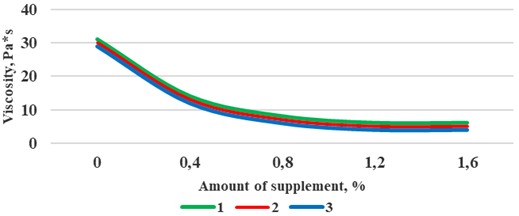
Fig. 2The effect of cement consumption, microfiller and superplasticizer on the viscosity of the concrete mixture (the corresponding consumption of cement and binary microfiller of the 1, 2, 3 – concrete mixture is 190+64, 219+74 and 309+103 kg/m3)
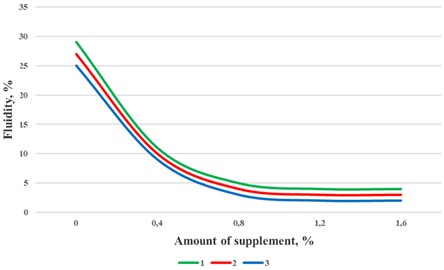
Analysis of the results showed that the viscosity of the concrete mixture naturally decreases with the increase in cement consumption and the content of the additive, especially when the dose of SP is 1.2 %.
The analysis of the obtained data shows that with an increase in the dosage of the additive, the viscosity naturally decreases and the workability of the concrete mixture increases. The introduction of a binary microfiller enhances these indicators.
Thus, it is sufficient to use 0.8 % SP to obtain a self-compacting concrete mixture with a binary mineral additive with a small viscosity value. Reducing the viscosity of the concrete mixture should help to significantly increase its flowability, which in turn requires experimental investigations [24].
One of the important properties of the concrete mixture of constructions built by the monolithic method is not only viscosity, but also fluidity and its change over time. For this reason, for the compositions listed in Tables 4-7, the change over time in the fluidity of the concrete mixture was studied (Fig. 3).
Fig. 3Changes in the fluidity of the concrete mixture over time (1 – Cement (309 kg)+binary microfiller (103 kg)+SP (0.8 %); 2 – Cement (410 kg)+SP (1.0 %)); 3 – Cement (410 kg))
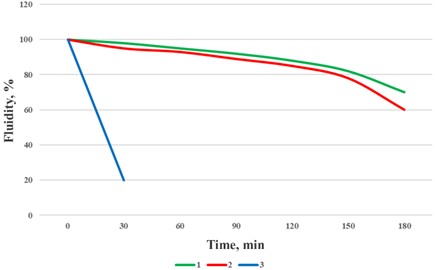
The use of binary microfiller slightly increases the duration of flowability of the concrete mixture, which is due to the additional plasticizing properties of OK, and after 2 hours, the indicator decreased by 8-20 % compared to the beginning.
5. Conclusions
The calculation program is on the basis of experimental studies and the ceo of the concrete content based on the experimental results, PC 32.5N Portland cement was selected. It was found that a combination of 0.8 % superplasticizer and 25 % binary microfiller enables the production of self-compacting concrete (slump flow >20 cm) for grades B15, B20, B30, and B60.
The combined use of the new-generation superplasticizer and binary microfiller maintains the fluidity of the concrete mixture for 100-120 minutes. This extended workability ensures effective self-compaction during the casting of monolithic concrete structures, significantly increasing the overall efficiency of the construction process.
The compositions of B15, B20, B30, and B60 concrete grades were optimized using mathematical models that account for key technological factors, including cement consumption, water-to-cement (W/C) ratio, and the dosage of the superplasticizer and binary microfiller. This optimization ensures the balanced performance of both fresh and hardened concrete properties.
In normal conditions qattiqlashuv the initial period, and the heat-moisture treatment with the solid concrete rather thenon will determine the increase. Supplement R SPchm reference to the time that accounted for up to 3-4 hours and due to the effects of the heating temperature up to 70 °C to reduce the possibility of appear.
This comprehensive investigation provides unequivocal evidence that Arment Construction Chemicals’ new-generation high-performance superplasticizer, founded on its innovative Polymix and Binary Filler technology, exerts a profoundly positive and multi-faceted influence on concrete mixtures. The synergistic action of its components delivers performance benefits that far exceed those of conventional superplasticizers, effectively addressing long-standing challenges in concrete technology.
References
-
U. Abdullaev and U. Turgunbaev, “About the properties of ash-filled concrete and JV GLENIUMSKY 504,” in E3S Web of Conferences, Vol. 264, p. 02036, Jun. 2021, https://doi.org/10.1051/e3sconf/202126402036
-
A. Adilkhodjaev, I. Kadyrov, B. Kudratov, D. Azimov, and U. Abdullayev, “Effect of binary microfiller on structure formation of cement stone,” in The 3rd International Symposium on Civil, Environmental, and Infrastructure Engineering (ISCEIE) 2024, Vol. 3317, p. 030033, Jan. 2025, https://doi.org/10.1063/5.0267410
-
N.M. Mukhammadiev and G. Malikov, “Use of basalt fiber in concrete mixture for manufacture of prefabricated concrete and reinforced concrete structures,” in The 3rd International Symposium on Civil, Environmental, and Infrastructure Engineering (ISCEIE) 2024, Vol. 3317, p. 030043, Jan. 2025, https://doi.org/10.1063/5.0266812
-
V. Tsoy, D. Abdullaeva, and N.M. Mukhammadiyev, “Influence of silica-containing additives on structure formation of composite cement binder for non-autoclaved aerated concrete,” in Problems in the Textile and Light Industry in the Context of Integration of Science and Industry and Ways to Solve Them: PTLICISIWS-2, Vol. 3045, p. 060019, Jan. 2024, https://doi.org/10.1063/5.0197488
-
I. Mukhamataliyev, N. Mukhammadiev, F. Ruzmetov, A. Khudoyorov, and S. Uzakov, “Performance properties of fiber-reinforced concrete particle-fiber-reinforced fox polfiber M12 BASF companies,” in 6th International Scientific Conference Construction Mechanics, Hydraulics and Water Resources Engineering (CONMECHYDRO 2024), Vol. 3286, p. 020003, Jan. 2025, https://doi.org/10.1063/5.0281474
-
A. Ilyasov, A. Adilkhodjaev, I. Makhamataliev, and A. Allamuratov, “Optimization of the composition of fiber foam concrete with polypropylene fiber Fox Polfiber M12 produced by basf company,” in E3S Web of Conferences, Vol. 452, p. 06011, Nov. 2023, https://doi.org/10.1051/e3sconf/202345206011
-
S. Shaumarov, K. Karakulov, S. Kandakhorov, Z. Okilov, and J. Yusupov, “Composition of aerated concrete using local raw materials,” in The 3rd International Symposium on Civil, Environmental, and Infrastructure Engineering (ISCEIE) 2024, Vol. 3317, p. 030047, Jan. 2025, https://doi.org/10.1063/5.0268040
-
U. Turgunbaev, N. Rakhimova, and T. Eshmanov, “Thermokinetic monitoring of concrete using chemical additives,” in Problems in the Textile and Light Industry in the Context of Integration of Science and Industry and Ways to Solve Them: PTLICISIWS-2, Vol. 3045, p. 060027, Jan. 2024, https://doi.org/10.1063/5.0197423
-
U. Turgunbayev and D. Sharipova, “About properties of polymer cement glue (PCA) with use of acetone-formaldehyde resin (AFR),” in The 3rd International Symposium on Civil, Environmental, and Infrastructure Engineering (ISCEIE) 2024, Vol. 3317, p. 060035, Jan. 2025, https://doi.org/10.1063/5.0267599
-
A. Arifjanov, R. Pirmatov, U. Vakhidova, A. Khaydarov, S. Arifjanov, and K. Ruziyev, “Efficient use of reservoirs in Uzbekistan,” in BIO Web of Conferences, Vol. 141, p. 03022, Nov. 2024, https://doi.org/10.1051/bioconf/202414103022
-
U. J. Turgunbayev, D. T. Sharipova, and E. I. Tykhtaboev, “The influence of technological factors on the properties of non-autoclaved aerated concrete,” in Problems in the Textile and Light Industry in the Context of Integration of Science and Industry and Ways to Solve Them: PTLICISIWS-2, Vol. 3045, p. 050025, Jan. 2024, https://doi.org/10.1063/5.0197541
-
V. Soy, “Investigation of effect of silica-containing additives on structure of composite binders,” in The 3rd International Symposium on Civil, Environmental, and Infrastructure Engineering (ISCEIE) 2024, Vol. 3317, p. 030039, Jan. 2025, https://doi.org/10.1063/5.0267635
-
I. Mukhamataliyev, F. Ruzmetov, A. Khudoyorov, and S. Uzakov, “About the strength characteristics of fiber-fiber-reinforced concrete fox polfiber M12 BASF companies,” in E3S Web of Conferences, Vol. 452, p. 06026, Nov. 2023, https://doi.org/10.1051/e3sconf/202345206026
-
C. Raupov and G. Malikov, “Creep in expanded clay concrete at different levels of stress under compression and tension,” in E3S Web of Conferences, Vol. 365, p. 02008, Jan. 2023, https://doi.org/10.1051/e3sconf/202336502008
-
S. Salikhanov and F. Zokirov, “Studying possibilities of joint operation of main beam and protective layer constructions,” in The 3rd International Symposium on Civil, Environmental, and Infrastructure Engineering (ISCEIE) 2024, Vol. 3317, p. 030029, Jan. 2025, https://doi.org/10.1063/5.0266815
-
N. B. Shaumarov, “Strength and deformation of materials and structures under the influence of seismic loads,” in Problems in the Textile and Light Industry in the Context of Integration of Science and Industry and Ways to Solve Them: PTLICISIWS-2, Vol. 3045, p. 050043, Jan. 2024, https://doi.org/10.1063/5.0197366
-
A. Adilkhodjaev, I. Kadyrov, B. Kudratov, D. Azimov, B. Xasanov, and I. Umarov, “On the structure of cement stone with fillers from metallurgical waste,” in E3S Web of Conferences, Vol. 410, p. 01020, Aug. 2023, https://doi.org/10.1051/e3sconf/202341001020
-
A. Adilkhodzhaev, I. Kadirov, B. Kudratov, B. Khasanov, M. Radjabov, and V. Kondrashenko, “Some aspects of the processes of obtaining and application of mineral powders as fillers for cement systems,” in E3S Web of Conferences, Vol. 410, p. 01021, Aug. 2023, https://doi.org/10.1051/e3sconf/202341001021
-
A. Adilkhodjaev, I. Kadyrov, and Rasulmukhamedov, “Research of porosity of a cement stone with a zeolite containing filler and a superplastic stificator,” in E3S Web of Conferences, Vol. 264, p. 02007, Jun. 2021, https://doi.org/10.1051/e3sconf/202126402007
-
A. I. Adylkhodzhaev et al., “To the question of the influence of the intensity of active centers on the surface of mineral fillers on the properties of fine-grained concrete,” International Journal of Innovative Technology and Exploring Engineering, Vol. 8, No. 9S2, pp. 219–222, Aug. 2019, https://doi.org/10.35940/ijitee.i1044.0789s219
-
E. Shchipacheva, S. Shaumarov, S. Kandakhorov, F. Mamurova, and J. Abdunazarov, “Method for assessing the degree of reducing the heat-protective properties of the external walls of buildings,” in The Third International Scientific Conference Construction Mechanics, Hydraulics and Water Resources Engineering (CONMECHYDRO 2021 AS), Vol. 2612, p. 040008, Jan. 2023, https://doi.org/10.1063/5.0115368
-
V. Tsoy, F. Karimova, N.M. Mukhammadiyev, and J. Turgayev, “Parameters of the oscillatory process of the sleeper base in the area of the rail joint when using elastic spacers,” in E3S Web of Conferences, Vol. 401, p. 05078, Jul. 2023, https://doi.org/10.1051/e3sconf/202340105078
-
C. Raupov and G. Malikov, “Comparison of microcrack formation boundaries determined by complex of physical methods with long-term strength of expanded clay concrete under different types of stress state,” in E3S Web of Conferences, Vol. 365, p. 02023, Jan. 2023, https://doi.org/10.1051/e3sconf/202336502023
-
R. Narov, J. Rashidov, and U. Turgunbayev, “Influence of type of modified fillers based on dune sand on properties of cement paste, stone, and on technological and strength properties of concrete,” in E3S Web of Conferences, Vol. 401, p. 01076, Jul. 2023, https://doi.org/10.1051/e3sconf/202340101076
About this article

The authors have not disclosed any funding.
The datasets generated during and/or analyzed during the current study are available from the corresponding author on reasonable request.
The authors declare that they have no conflict of interest.

