Abstract
This study investigates the effect of calcium naphthenate obtained from alkaline waste of oil-refinery processes on the physical, mechanical, and rheological properties of BND 60/90 road bitumen. The proposed additive is considered as a waste-derived surfactant modifier aimed at improving the structural behavior and adhesion properties of bitumen used in road construction. Bitumen samples containing 5, 10, and 20 wt.% calcium naphthenate were prepared and tested in the temperature range of 40-140 °C using rotational viscometry. The results showed that calcium naphthenate affects the flow behavior of bitumen by increasing viscosity and promoting structure formation, especially at temperatures below 100 °C. The most effective modification range was found to be 5-10 wt.%, where improved adhesion to mineral materials and enhanced rheological stability were observed without excessive loss of penetration. The findings demonstrate that calcium naphthenate obtained from refinery alkaline waste can be used as a promising functional additive for bitumen modification and waste valorization.
1. Introduction
Bitumen is one of the most widely used binders in road construction due to its waterproofing ability, adhesion to mineral aggregates, and viscoelastic behavior. However, conventional road bitumen may demonstrate insufficient thermal stability, reduced adhesion, and changes in rheological behavior under temperature and traffic loading. Therefore, the modification of bitumen using functional additives remains an important direction in pavement materials research.
The performance and durability of asphalt mixtures depend strongly on binder ageing and on the use of stabilizing and polymer-type additives [1], [3]. Locally developed modifiers, such as cellulose-based additives for asphalt concrete with mastic, have also been studied as a route to improved mixture stability [2]. More broadly, the behaviour of transport-infrastructure materials and engineering structures – including the strength and deformation of reinforced-concrete bridge elements – has been examined in numerous works [5], [6], [8]. The deformation of geotechnical and railway-infrastructure systems and the dissipation of vibration energy in such structures have likewise been investigated [4], [7]. In parallel, the processing and valorization of industrial waste in construction-related applications, including cement- and concrete-based materials, has received increasing attention [9], [10]. These studies confirm the relevance of developing locally available material-modification approaches for transport infrastructure; however, the specific use of calcium naphthenate obtained from alkaline oil-refinery waste for concentration-dependent rheological modification of BND 60/90 bitumen remains insufficiently investigated.
Recent studies have shown that the rheological behavior of bitumen is closely related to its colloidal structure, chemical composition, and the interaction between saturates, aromatics, resins, and asphaltenes [11], [12].
One promising approach is the use of surfactant-type additives obtained from industrial by-products and refinery waste. Alkaline waste generated during petroleum distillate purification contains naphthenic acid salts and other organic compounds that can be converted into calcium naphthenate. This product may act as a structuring and adhesion-improving additive for bitumen while also contributing to the utilization of refinery waste.
In recent years, increasing attention has been paid to eco-friendly, organic, and bio-based additives for asphalt binders, since such modifiers can improve rheological performance while supporting waste valorization and circular-economy principles [13-15]. Waste-derived modifiers, including recycled polymers and waste-oil-based additives, have shown comparable potential [16], [17].
Naphthenic acids are complex petroleum-derived carboxylic acids, and their salts with metal ions may form metal naphthenates with oil-soluble or oil-dispersible behavior [18], [19]. In addition, recent studies on asphalt-binder modifiers confirm that different additives can significantly affect rheological behavior and functional performance [20].
The scientific novelty of this study lies in the use of calcium naphthenate obtained from alkaline oil-refinery waste as a functional structuring additive for BND 60/90 road bitumen. Unlike conventional commercial surfactants and polymer modifiers, the proposed additive is produced from industrial waste and therefore combines bitumen modification with waste valorization. The study provides a concentration-dependent rheological assessment of calcium-naphthenate-modified bitumen in the temperature range of 40-140 °C and identifies the effective additive content of 5-10 wt.% for improving viscosity behavior, structure formation, and adhesion to mineral materials.
The aim of this study is to evaluate the influence of calcium naphthenate obtained from alkaline refinery waste on the physical, mechanical, and rheological properties of BND 60/90 bitumen and to determine the optimal additive concentration for road-construction applications.
2. Literature review
2.1. Origin and chemistry of calcium naphthenate
Calcium naphthenate is derived from the alkaline waste generated during the purification of intermediate petroleum distillates. Naphthenic acids are complex petroleum-derived carboxylic acids, and their salts with metal ions form metal naphthenates with oil-soluble or oil-dispersible behaviour [18], [19]. Besides naphthenic acid salts, such waste also contains phenols, fatty and asphaltogenic acids, resinous and sulfurous compounds, and a high fraction of unsaponifiable substances. A typical alkaline waste is a complex mixture that may contain sodium naphthenates (RCOONa) at 3-15 %, residual alkali at 0.5-1 %, carbonate impurities (Na2CO3, NaHCO3) at about 0.02 %, unsaponifiable components at 2-6 %, and water as the balance.
During alkaline treatment of fuels, naphthenic acids react with alkali to form the corresponding sodium soaps: RCOOH + NaOH → RCOONa + H2O.
where R is the hydrocarbon radical of the naphthenic acid. Insoluble naphthenates are then obtained by precipitating the alkaline waste with an aqueous solution of an alkaline-earth salt: 2RCOONa + CaCl2 → (RCOO)2Ca↓ + 2NaCl.
The reaction proceeds to completion through precipitation of the insoluble product, whose general formula is (RCOO)2Ca. Calcium naphthenate is soluble in petroleum products and in molten bitumen and, depending on its mineral-oil and unsaponifiable content, ranges from a dark-brown to a light-cream solid or viscous material. These features make it suitable for interaction with the dispersed structure of bitumen.
2.2. Bitumen modification by surfactant-type and waste-derived additives
Rheological methods are widely used to study bitumen structure and its formation, because they relate the introduction of additives and temperature variation to the resulting structural changes [11]. Bitumen is now well established to behave as a complex colloidal disperse system, in which the structure and rheology are governed by physico-chemical interactions among its constituent fractions; modern structural characterization of such binders provides the basis for understanding how surface-active additives modify their structure formation and flow behaviour [21]. One established route to modifying the structure of bitumen is the introduction of surface-active and polymer additives, which increase surface activity and significantly affect the binder structure. Because calcium naphthenate is a polar surfactant, it is expected to raise the polarity of the binder and thereby improve its adhesion to mineral aggregates; it may also exert a structuring effect that is more pronounced in binders with a less rigid asphaltene framework and weaker in binders with an already developed coagulation structure.
In recent years, eco-friendly, organic, bio-based, and waste-derived modifiers have attracted growing interest for asphalt binders, as they can improve rheological performance while supporting waste valorization and circular-economy principles [13-15]. Comparable effects have been reported for recycled-polymer, waste-oil, and other functional additives [16], [17], [20]. However, the use of calcium naphthenate obtained from alkaline oil-refinery waste has not been sufficiently studied with respect to its concentration-dependent effect on the physical, mechanical, and rheological properties of BND 60/90 road bitumen. The present study therefore evaluates calcium naphthenate as a waste-derived structuring additive and determines its effective concentration range for bitumen modification.
3. Materials and methods
BND 60/90 road bitumen, commonly used in Uzbekistan for asphalt-concrete mixtures, was used as the base binder. The initial properties of the unmodified bitumen were as follows: penetration at 25 °C – 70; ductility at 25 °C – 28 cm; softening point – 53 °C; and weak adhesion to quartz sand, the latter assessed qualitatively by the boiling-water coating-retention test. Adhesion is therefore reported throughout this work as a qualitative observation rather than a quantitative index.
Calcium naphthenate obtained from alkaline waste of oil-refinery processes was used as a modifying additive. The additive was introduced into bitumen in different concentrations in order to evaluate its effect on the physical, mechanical, and rheological properties of the binder. For the physical and mechanical tests, calcium naphthenate contents of 0, 3, 5, 10, 15, and 20 wt.% were considered. For rheological testing, the main compositions were selected as 0, 5, 10, and 20 wt.% calcium naphthenate.
The calcium naphthenate used in this study was a technical-grade product recovered from the alkaline (spent-caustic) waste of oil refining, with the general composition described in Section 2.1. It consists predominantly of calcium salts of naphthenic acids, corresponding to the general formula (RCOO)2Ca, together with minor amounts of associated hydrocarbons and residual moisture. In appearance it ranges from a dark-brown viscous mass to a lighter cream-coloured semi-solid, depending on the acid feedstock, and it is readily dispersible in petroleum media and in molten bitumen. Because naphthenic acids are a complex mixture of alicyclic carboxylic acids rather than a single compound, the additive does not possess a single defined molecular weight; for quality control it is therefore recommended that each batch be characterised by its acid value, calcium content (by complexometric titration or atomic-absorption spectroscopy) and infrared spectrum.
Modified binders were prepared by hot mechanical blending. The base bitumen was first heated to a fluid state at approximately 150±5 °C, after which the pre-weighed calcium naphthenate was added gradually in the required proportion. The mixture was then stirred with a mechanical stirrer at about 1000-1500 rpm for 30-40 min, until a visually homogeneous binder free of undissolved particles was obtained. The blending temperature was kept below the level at which appreciable thermal degradation of the bitumen would be expected.
Rheological tests were carried out using a Rheotest-2 rotational viscometer. This device allows the determination of dynamic viscosity and shear stress for Newtonian and non-Newtonian fluids. The sample was placed in the annular gap between two cylinders: an internal rotating cylinder and an external stationary cylinder. Before testing, the sample was kept in a thermostat at the required temperature for approximately one hour to ensure thermal equilibrium.
Each composition was prepared and tested in three independent replicates for the standard physical and mechanical properties reported in Table 1 (penetration at 25 °C, ring-and-ball softening point, ductility at 0 and 25 °C, and the Fraas breaking point), and the values listed are the corresponding arithmetic means. Rheological measurements were carried out at least in duplicate at each temperature. In all cases the scatter between replicates remained within the repeatability of the corresponding standard test methods – of the order of a few units for penetration, about 1 °C for the softening point and a few centimetres for ductility – so that the differences between compositions discussed below substantially exceed the experimental uncertainty.
Statistical analysis was confined to descriptive statistics appropriate to the size of the data set. Each property listed in Table 1 was determined on three independently prepared and tested specimens per composition ( 3), and each rheological data point summarised in Table 2 and Fig. 1 on no fewer than two specimens; the reported figures are the corresponding arithmetic means. The replicate scatter was evaluated against the repeatability limits prescribed by the governing standard test methods – of the order of a few units for penetration, about 1 °C for the ring-and-ball softening point and a few centimetres for ductility – and for every property the observed dispersion lay within those limits. No inferential (hypothesis-testing) statistics were applied, since the experimental design was intended to reveal the concentration- and temperature-dependent trends rather than to test formal hypotheses; the standard deviation of each individual mean is retained in the raw measurement records (available as stated under Data Availability).
The shear stress was calculated using the following equation:
where is the shear stress, Pa; is the device-scale coefficient; and is the instrument constant corresponding to the selected torque range.
The dynamic viscosity was determined as:
where is the dynamic viscosity, Pa·s; is the shear stress, Pa; and is the shear rate, s⁻1.
The rheological behavior of the studied binders was evaluated in the temperature range of 40-140 °C. The obtained rheograms were used to analyze the transition from Newtonian-like flow at high temperatures to structured non-Newtonian behavior at lower temperatures.
4. Results and discussion
The physical and mechanical properties of BND 60/90 bitumen modified with different contents of calcium naphthenate are presented in Table 1. The results show that calcium naphthenate changes the penetration, ductility, softening point, and brittleness temperature of the binder. These changes indicate that the additive affects the internal structure of bitumen and can influence its thermal stability and deformation behavior.
The addition of calcium naphthenate reduced the penetration of bitumen at several concentrations, which indicates an increase in binder stiffness. The softening point increased from 53 °C for unmodified bitumen to 58-58.1 °C for binders containing 10-20 wt.% calcium naphthenate. This confirms that the additive improves the thermal stability of the binder.
Table 1Physical and mechanical properties of BND 60/90 bitumen modified with calcium naphthenate
Bitumen content, wt.% | Calcium naphthenate content, wt.% | Penetration at 25 °C | Ductility at 25 °C, cm | Ductility at 0 °C, cm | Softening point, °C | Fraas brittleness temperature, °C |
100 | 0 | 70 | 28 | 5.0 | 53 | –11 |
97 | 3 | 59 | 16 | 4.2 | 53 | – |
95 | 5 | 55 | 13 | 3.0 | 54 | –11.5 |
90 | 10 | 60 | 15 | 4.8 | 58 | –10 |
85 | 15 | 68 | 19 | 5.0 | 58 | –11 |
80 | 20 | 50 | 7.5 | 3.0 | 58.1 | –9 |
Note: each value is the mean of three independent replicates; the scatter between replicates was within the repeatability of the corresponding standard test methods. A dash (–) indicates a value that was not determined. The standard deviation associated with each mean (mean ± SD) is to be inserted from the raw replicate records in the final typeset version | ||||||
This interpretation is consistent with previous studies showing that the rheological response of bitumen depends on its colloidal structure, SARA fractions, and interactions between polar compounds, resins, and asphaltenes [11], [12].
At the same time, the effect of calcium naphthenate is concentration-dependent. A high additive content may reduce ductility and increase stiffness excessively. Therefore, calcium naphthenate should not be considered only as a hardening additive; its effect is related to structure formation in the bitumen matrix and depends on the selected concentration.
The rheological properties of the studied systems were evaluated in the temperature range of 40-140 °C. For a clearer presentation of the main trend, Table 2 summarizes the absolute viscosity values at 70 °C, where the structuring effect of calcium naphthenate becomes especially evident.
Table 2Absolute viscosity of BND 60/90 bitumen modified with calcium naphthenate at 70 °C
Calcium naphthenate content, wt.% | Absolute viscosity, Pa·s | Change compared with pure bitumen |
0 | 190 | Reference value |
5 | 220 | Moderate increase |
10 | 360 | Significant increase |
20 | 370 | Slight additional increase |
Note: values are means of replicate measurements at 70 °C; the dependence of the rheological behaviour on temperature over the range 40-140 °C is illustrated in Fig. 1. Standard deviations (mean ± SD) for the individual values are to be inserted from the raw rheometer records in the final typeset version; where the full numerical data set is available, this table can be expanded to list the absolute viscosity at 40, 70, 90, 100, 120 and 140 °C | ||
The results presented in Table 2 show that the addition of calcium naphthenate increases the absolute viscosity of BND 60/90 bitumen at 70 °C. The viscosity of the unmodified bitumen was 190 Pa·s, whereas the addition of 5 wt.% calcium naphthenate increased the viscosity to 220 Pa·s. A more pronounced increase was observed at 10 wt.% additive content, where the viscosity reached 360 Pa·s. Further increasing the calcium naphthenate content to 20 wt.% resulted in only a slight additional increase in viscosity, up to 370 Pa·s. This indicates that the most effective concentration range is 5-10 wt.%, while a higher additive content does not provide a proportional improvement in rheological behavior.
The rheograms of unmodified and modified bitumen are presented in Fig. 1. At high temperatures, especially in the range of 120–140 °C, the binders demonstrate behavior close to Newtonian flow, which indicates partial or complete destruction of the internal structure under thermal action. When the temperature decreases to 90-80 °C and below, the modified binders demonstrate a more pronounced increase in viscosity, especially at calcium naphthenate contents above 5 wt.%.
The observed increase in viscosity may be explained by the interaction of calcium naphthenate molecules with polar components of bitumen and asphaltene structures. As a result, an additional spatial framework may be formed in the binder, which increases resistance to shear deformation. However, when the additive content exceeds 10 wt.%, the increase in viscosity becomes insignificant, indicating that further modification is not economically or technologically justified. The structural mechanism proposed above should be regarded as a working hypothesis: its direct confirmation would require spectroscopic and microstructural evidence – for example Fourier-transform infrared (FTIR) spectroscopy, fluorescence microscopy and SARA fractionation – which is beyond the scope of the present study and is identified below as a direction for future work.
Fig. 1Rheograms of BND 60/90 bitumen modified with different contents of calcium naphthenate. Curves 1-4 correspond to 0, 5, 10 and 20 wt.% calcium naphthenate, respectively. For each composition the lower, near-linear family of curves (open symbols, dashed lines) was obtained at 140 °C, where the binders exhibit near-Newtonian behaviour, and the upper family (filled symbols, solid lines) at 70 °C, where structured non-Newtonian behaviour develops
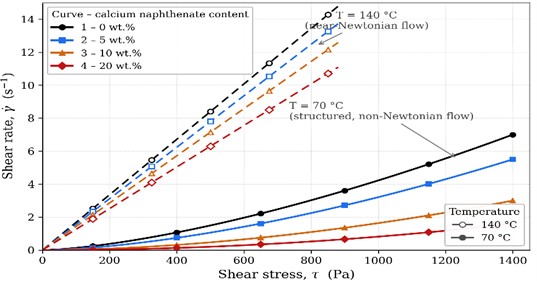
Fig. 1 confirms that calcium naphthenate changes the flow behavior of BND 60/90 bitumen in a concentration-dependent manner. At high temperatures, the difference between unmodified and modified binders is limited, while at lower temperatures the modified binders demonstrate a more pronounced increase in viscosity. This behavior indicates the formation of an additional spatial structure in the bitumen matrix. The most effective modification range is 5-10 wt.% calcium naphthenate, because further increase to 20 wt.% does not provide a proportional improvement in viscosity.
Similar concentration-dependent effects have been reported for other organic, polymer-based, bio-based, and waste-derived asphalt-binder modifiers, where excessive additive content does not always lead to proportional improvement in rheological behavior [13-15]. Comparable trends are seen for recycled-polymer and waste-oil-based modifiers [16], [17], [20]. Compared with conventional polymer modifiers such as styrene-butadiene-styrene (SBS) and ethylene-vinyl acetate (EVA), which are typically introduced at a few weight per cent and require high-shear processing to develop a polymer network [13], [14], calcium naphthenate is a low-cost, waste-derived additive that can be incorporated by simple hot mechanical blending; its effect on high-temperature stiffness is, however, more modest, so that the two classes of modifier are best regarded as complementary rather than directly equivalent.
5. Limitations and future work
Several limitations of the present study should be acknowledged. The investigation was carried out on a single grade of paving bitumen (BND 60/90) modified with calcium naphthenate obtained from a single waste source, and the additive was characterised only at a technical level rather than by full instrumental analysis. The binders were evaluated in the unaged state, so that the effects of short- and long-term ageing (for example RTFOT and PAV), moisture sensitivity and field performance were not assessed. The proposed structuring mechanism was inferred from the rheological response rather than verified spectroscopically. Future work will therefore focus on complete instrumental characterisation of the additive and of the modified binders (including FTIR, SARA fractionation and microscopy), statistically designed replicate testing with reported confidence intervals, evaluation of ageing and moisture resistance, extension to other bitumen grades, and validation at the asphalt-mixture and field scale.
6. Conclusions
This study investigated the effect of calcium naphthenate obtained from alkaline oil-refinery waste on the physical, mechanical, and rheological properties of BND 60/90 road bitumen. Based on the obtained results, the following conclusions can be drawn:
1) Calcium naphthenate can be used as a waste-derived surfactant-type additive for bitumen modification. Its chemical nature and solubility in petroleum products make it suitable for interaction with the dispersed structure of bitumen.
2) The addition of calcium naphthenate affects the physical and mechanical properties of bitumen. The modified binders demonstrated an increase in softening point and improved adhesion to mineral materials, indicating enhanced thermal stability and better interaction with aggregates.
3) Rheological testing showed that calcium naphthenate increases the viscosity of bitumen, especially at temperatures below 100 °C. At 70 °C, the viscosity increased from 190 Pa·s for unmodified bitumen to 220 Pa·s, 360 Pa·s, and 370 Pa·s for binders containing 5, 10, and 20 wt.% calcium naphthenate, respectively.
4) The most effective additive content was found to be 5-10 wt.%. In this range, calcium naphthenate promotes structure formation and improves rheological stability without causing excessive stiffening of the binder.
5) The use of calcium naphthenate obtained from alkaline refinery waste provides both technological and environmental benefits, as it improves bitumen performance while contributing to the valorization of industrial waste.
References
-
S. Sreedhar and E. Coleri, “The effect of long-term aging on fatigue cracking resistance of asphalt mixtures,” International Journal of Pavement Engineering, Vol. 23, No. 2, pp. 308–320, Jan. 2022, https://doi.org/10.1080/10298436.2020.1745206
-
K. Aripov and S. Akhmedov, “Development of an additive based on cellulose for the stabilization of asphalt concrete with mastic,” in Scientific Proceedings of the International Conference “Resource-Saving Technologies in Transport, Dec. 2022.
-
A. Mamatmuminov, S. Ibragim, and I. Xoshimov, “Technology for producing modified polymer sulfur bitumen and its properties,” Vibroengineering Procedia, Vol. 60, pp. 556–562, Dec. 2025, https://doi.org/10.21595/vp.2025.25364
-
M. Miralimov, A. Karshiboev, R. Ospanov, I. Mengliev, and D. Usmanov, “Deformation of railway track embankment with loess soil sections in Republic of Uzbekistan,” in AIP Conference Proceedings, Vol. 3317, No. 1, p. 030004, Jan. 2025, https://doi.org/10.1063/5.0266733
-
S. Akhmedov, T. Radjabov, S. Shodjalilov, A. Ergashov, and S. Safarov, “Diagrams of compression-expansion of concrete, assessment of strength and deformation of its elements,” in AIP Conference Proceedings, Vol. 3317, No. 1, p. 030009, Jan. 2025, https://doi.org/10.1063/5.0266940
-
S. Akhmedov, K. Aripov, R. Ospanov, I. Mirzaolimov, and T. Kenjayev, “Strength of reinforced concrete T-beams of bridges reinforced with external reinforcement from fabric polymeric composites,” E3S Web of Conferences, Vol. 401, p. 01068, Jul. 2023, https://doi.org/10.1051/e3sconf/202340101068
-
M. Miralimov, R. Ospanov, and I. Mengliev, “Modeling of dissipation of vibration energy in problems of structural dynamics,” E3S Web of Conferences, Vol. 401, p. 05025, Jul. 2023, https://doi.org/10.1051/e3sconf/202340105025
-
N. Saatova, S. Shozhalilov, and S. Safarov, “Methodology of techno-economic feasibility study for the reconstruction of road bridges,” in AIP Conference Proceedings, Vol. 2471, No. 1, p. 030096, Jan. 2022, https://doi.org/10.1063/5.0089536
-
E. Shipacheva, S. Shaumarov, A. Gulamov, M. M. Talipov, and S. Kandakharov, “Water structure and its influence on cement stone and concrete properties,” in ICTEA: International Conference on Thermal Engineering, Vol. 1, No. 1, 2024.
-
Z. Bagova et al., “Processing of lead-containing industrial waste in Kazakhstan,” Open Engineering, Vol. 16, No. 1, Jan. 2026, https://doi.org/10.1515/eng-2025-0156
-
D. Lesueur, “The colloidal structure of bitumen: consequences on the rheology and on the mechanisms of bitumen modification,” Advances in Colloid and Interface Science, Vol. 145, No. 1-2, pp. 42–82, Jan. 2009, https://doi.org/10.1016/j.cis.2008.08.011
-
J. Wang, T. Wang, X. Hou, and F. Xiao, “Modelling of rheological and chemical properties of asphalt binder considering SARA fraction,” Fuel, Vol. 238, pp. 320–330, Feb. 2019, https://doi.org/10.1016/j.fuel.2018.10.126
-
A. Almusawi and S. T. N. Nasraldeen, “Advanced rheological characterization of asphalt binders modified with eco-friendly and polymer-based additives under dynamic loading,” Applied Sciences, Vol. 15, No. 10, p. 5552, May 2025, https://doi.org/10.3390/app15105552
-
M. Mielczarek, S. Fornalczyk, and M. Słowik, “Evaluation of rheological properties of polymer-modified asphalt binders and mastics with organic additive-imidazoline,” Sustainability, Vol. 16, No. 4, p. 1434, Feb. 2024, https://doi.org/10.3390/su16041434
-
C. Martinez-Toledo, G. Valdes-Vidal, A. Calabi-Floody, M. E. Gonzalez, and O. Reyes-Ortiz, “Evaluation of rheological properties of asphalt binder modified with biochar from oat hulls,” Materials, Vol. 17, No. 17, p. 4312, Aug. 2024, https://doi.org/10.3390/ma17174312
-
D. Wang et al., “Rheological properties of asphalt binder modified with waste polyethylene: An interlaboratory research from the RILEM TC WMR,” Resources, Conservation and Recycling, Vol. 186, p. 106564, Nov. 2022, https://doi.org/10.1016/j.resconrec.2022.106564
-
O. de Medeiros Melo Neto et al., “Assessment of rheological properties of asphalt binder modified with babassu oil,” Case Studies in Construction Materials, Vol. 21, p. e03599, Dec. 2024, https://doi.org/10.1016/j.cscm.2024.e03599
-
R. Facanali, N. A. Porto, J. Crucello, R. M. Carvalho, B. G. Vaz, and L. W. Hantao, “Naphthenic acids: formation, role in emulsion stability, and recent advances in mass spectrometry-based analytical methods,” Journal of Analytical Methods in Chemistry, Vol. 2021, pp. 1–15, 2021, https://doi.org/10.1155/2021/6078084
-
W. I. Eke, C. Victor-Oji, and O. Akaranta, “Oilfield metal naphthenate formation and mitigation measures: a review,” Journal of Petroleum Exploration and Production Technology, Vol. 10, No. 2, pp. 805–819, Nov. 2019, https://doi.org/10.1007/s13202-019-00797-0
-
Q. Zhu, C. Liu, Y. Wang, Y. Su, and M. Li, “Effect of modifiers on self-healing and rheological properties of asphalt binder,” Materials, Vol. 17, No. 13, p. 3304, Jul. 2024, https://doi.org/10.3390/ma17133304
-
D. Shaikhah, C. Oliviero Rossi, G. Luca, R. Angelico, P. Calandra, and P. Caputo, “The use of nuclear magnetic resonance spectroscopy (NMR) to characterize bitumen used in the road pavements industry: a review,” Molecules, Vol. 29, No. 17, p. 4038, Aug. 2024, https://doi.org/10.3390/molecules29174038
About this article

The authors have not disclosed any funding.
The datasets generated during and/or analyzed during the current study are available from the corresponding author on reasonable request.
The authors declare that they have no conflict of interest.

