Abstract
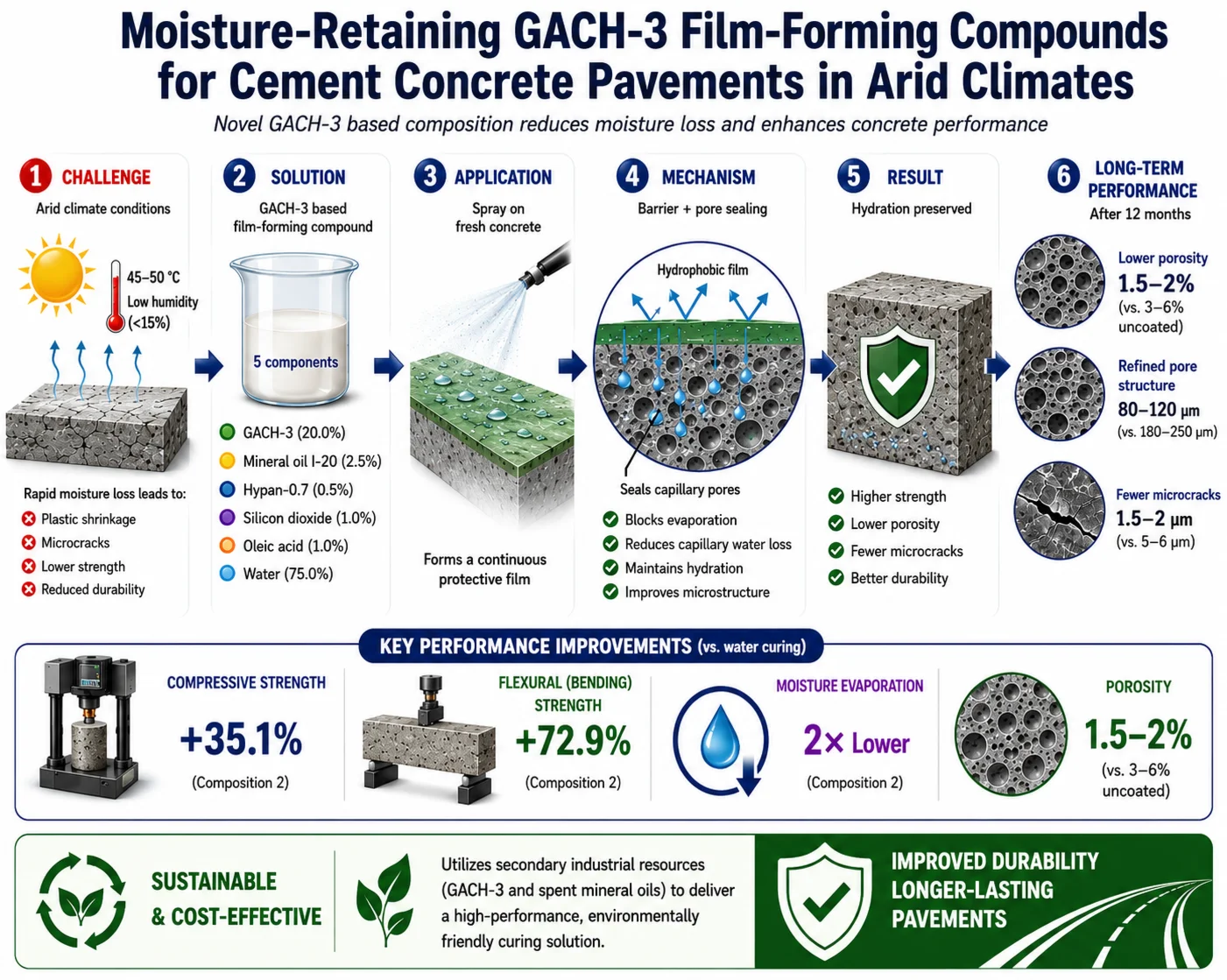
In hot and arid climates, rapid moisture loss from freshly placed cement concrete pavements disrupts hydration, leading to reduced strength and durability. This study evaluates novel film-forming compositions based on secondary industrial resources (GACH-3 and spent mineral oils). The research establishes the physicochemical mechanisms of pore colmatation achieved through the synergistic interaction of paraffin-based components and technical oleic acid. Experimental results demonstrate that the optimized composition increases compressive strength by up to 35.1 % and reduces moisture evaporation twofold. Long-term observations (12 months) confirmed significantly reduced porosity and microcrack sizes.
Highlights
- A novel GACH-3 based film-forming curing compound was developed for cement concrete pavements in hot and arid climates.
- The optimized composition reduced moisture evaporation by twofold and increased compressive strength by up to 35.1% compared with conventional curing.
- A synergistic “barrier and seal” mechanism combining hydrophobic film formation and pore colmatation improved hydration and concrete durability.
- Long-term evaluation after 12 months confirmed lower porosity (1.5-2%), smaller pore size, and significant reduction of microcracks.
- The proposed composition utilizes secondary industrial resources, providing a sustainable and cost-effective curing technology for concrete pavements.
1. Introduction
In hot and arid climates, rapid moisture loss from fresh cement concrete pavements disrupts hydration, reducing strength and durability. Film-forming curing compounds are used to limit evaporation; however, existing solutions often suffer from low efficiency, high viscosity, or high cost. This study develops and evaluates a novel film-forming composition based on locally available materials to reduce moisture loss and improve the physico-mechanical properties of concrete under severe climatic conditions.
The novelty of this research lies in the utilization of secondary industrial resources – specifically GACH-3 (a petroleum refining by-product) and spent mineral oils - to create a high-performance moisture barrier. Unlike traditional latex-based compounds, the proposed GACH-3-based system is specifically optimized for high thermal radiation (surface temperatures exceeding 50 °C) and low humidity (below 15 %) characteristic of Uzbekistan. By transforming industrial waste into a high-value engineering material, this approach not only ensures pavement reliability but also directly aligns with “circular economy” principles, significantly reducing the carbon footprint and reliance on expensive imported polymers.
2. Material and method
This section describes the development of a novel film-forming composition and the characteristics of the reference materials used for comparative analysis.
2.1. Reference curing compounds
To evaluate the effectiveness of the proposed approach, three existing formulations were analyzed:
– T1: A latex-based compound comprising styrene-butadiene (divinylstyrene) latex, solid hydrocarbons, lanolin production waste, and calcined soda. Experimental evaluation revealed its insufficient efficiency in preventing surface microcracks under extreme plastic shrinkage [10, 13].
– T2: An improved conventional compound incorporating oil dewaxing by-products and plasticizers. Despite better performance, T2 exhibits high viscosity at lower temperatures, complicating field application in spring and autumn.
– T3 (Prototype): A multi-component analogue based on latex and solid paraffin (Patent RU 2455265) [12]. While functional, its high cost and insufficient film-formation speed under arid conditions limit its practical use.
2.2. Development of the optimized GACH-3 based composition
The proposed composition was designed to eliminate the shortcomings of the prototype by utilizing secondary industrial resources. The optimized formulation, designated as Composition 2, is detailed in Table 1.
Table 1Optimized formulation of the proposed GACH-3 based curing compound
Component | Mass fraction, wt. % |
Petroleum GACH (GACH-3) | 20.0 |
Used I-20 mineral oil | 2.5 |
Hydrolyzed polyacrylonitrile (Hypan-0.7) | 0.5 |
Silicon dioxide | 1.0 |
Technical oleic acid | 1.0 |
Water | 75.0 |
The rationale for the selected components is as follows:
– GACH-3: A petroleum refining by-product used as the primary paraffin-based hydrophobic agent. It reduces film formation time and enhances reflectivity.
– Mineral oil I-20: Acts as a solvent to ensure the complete dissolution of GACH-3 and promotes penetration into the concrete matrix. Increasing the concentration above 2.5 % is avoided due to a decrease in the solubility parameter.
– Hypan-0.7: A polymer component introduced to improve the mechanical resistance and elasticity of the protective layer.
– Silicon dioxide: Regulates viscosity and stabilizes the system; contents above 1 % may lead to agglomeration.
– Technical oleic acid: Functions as an emulsifier that promotes pore colmatation and stabilizes the system.
2.3. Physicochemical interaction mechanism
The high moisture-retention capacity of the proposed system is achieved through a synergistic “barrier and seal” effect. The GACH-3 component forms a continuous hydrophobic surface film that physically blocks the evaporation path. Simultaneously, the technical oleic acid interacts with the ions in the fresh cement concrete pore solution to form insoluble calcium soaps. These soaps, acting in tandem with silicon dioxide micro-fillers, effectively colmate (seal) the capillary pores. This multi-level barrier ensures that the internal moisture remains available for continuous cement hydration [5, 6] even under extreme thermal radiation [11].
2.4. Preparation and application procedure
The preparation process involves heating the water to 60 °C, followed by the sequential addition of GACH-3, used mineral oil I-20, technical oleic acid, and Hypan-0.7 under continuous stirring. Silicon dioxide is then introduced to adjust the viscosity and stabilize the emulsion. The resulting homogeneous emulsion is applied by spraying at a recommended rate of 300-350 g/m2 [3, 4, 14]. Film formation begins within 30 minutes and is fully completed within 3 hours at (20±2) °C. The recommended application temperature range for the concrete surface is from +2°C to +45°C. All concrete specimens were cast and tested in accordance with GOST 10180-2012 [1] and GOST 12730.3-2020 [2].
3. Results and discussion
The experimental evaluation of the film-forming properties of the proposed composition was conducted on concrete specimens prepared in accordance with GOST 10180-2012 [1]. To ensure statistical reliability, all tests were performed in triplicate, and the results are presented as the arithmetic mean ± standard deviation (SD), providing a confidence interval of 95 %.
3.1. Optimization of the composition
Initially, six formulations were tested to determine the optimal component ratio. The physical and mechanical properties of the treated specimens are summarized in Table 2.
Table 2Physical and mechanical properties of concrete specimens treated with various experimental curing formulations.
Compressive strength, MPa | Water absorption, % | Bending tensile strength, MPa | Amount of evaporated water, % | |||||
1st layer | 2nd layer | 1st layer | 2nd layer | 1st layer | 2nd layer | 1st layer | 2nd layer | |
Comp. 1 | 47.9 | 42.5 | 10.9 | 10.8 | 5.7 | 5.2 | 5.0 | 4.8 |
Comp. 2 | 54.7 | 51.4 | 10.7 | 10.6 | 6.4 | 6.1 | 4.3 | 4.1 |
Comp. 3 | 45.7 | 42.3 | 11.0 | 10.9 | 5.4 | 5.2 | 5.5 | 5.3 |
Comp. 4 | 39.8 | 37.2 | 11.5 | 11.3 | 4.8 | 4.4 | 7.9 | 7.4 |
Comp. 5 | 36.1 | 35.9 | 11.5 | 11.2 | 4.1 | 3.9 | 7.9 | 7.6 |
Comp. 6 | 33.4 | 33.1 | 11.7 | 11.2 | 3.8 | 3.6 | 8.5 | 7.9 |
Analysis of Table 2 indicates that Composition 2 (20.0 % GACH-3) achieves the highest performance metrics. To address the requirement for experimental analysis, these data were visualized to establish variable correlations.
Fig. 1Correlation analysis between GACH-3 content, compressive strength, and moisture evaporation
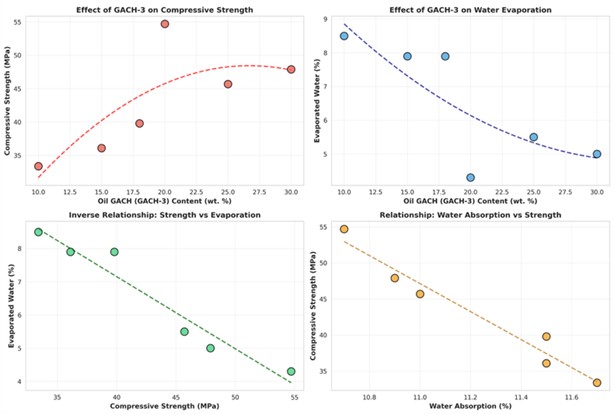
As shown in Fig. 1, a parabolic relationship exists between GACH-3 content and compressive strength, with a clear optimum at 20 wt. %. Beyond this point, the increase in hydrophobic components leads to a slowdown in strength gain. The inverse linear correlation between strength and evaporation rates confirms the “barrier and seal” hypothesis: by minimizing moisture loss (4.3 %), the composition ensures the necessary hydration degree for the cement matrix.
3.2. Comparative performance
Based on the optimization, Composition 2 was compared against water curing (control) and the T3 prototype [12].
As demonstrated in Table 3, the proposed composition increased compressive strength by 35.1 % and flexural tensile strength by 72.9 % compared to water-cured samples. Moisture evaporation was reduced twofold relative to the T3 prototype, which was developed based on the existing multi-component technology. This significant improvement is attributed to the physicochemical mechanism described in Section 2.3: the formation of insoluble calcium soaps, which effectively colmates the pores [10, 13].
Table 3Comparative performance analysis of the optimized composition versus water-cured and T3-protected benchmarks
Indicators | Test results | ||||
Water | Composition from T3 | Proposed composition | |||
1st layer | 2nd layer | 1st layer | 2nd layer | ||
Compressive strength, MPa | 40.5 | 43.2 | 44.8 | 54.7 | 51.4 |
Bending tensile strength, MPa | 3.7 | 4.9 | 5.0 | 6.4 | 6.1 |
Water absorption, % | 14.2 | 12.6 | 11.1 | 10.7 | 10.6 |
Amount of evaporated water, % | 122.0 | 87.0 | 77.0 | 43.0 | 41.0 |
3.3. Long-term durability and microstructure
To assess long-term reliability, specimens were analyzed 12 months after application [14].
The data in Table 4 show that the treatment leads to a significantly denser microstructure [5, 6]. Porosity was reduced to 1.5-2 %, and microcrack sizes were minimized to 1.5-2 μm. These results confirm that early-age moisture conservation promotes a more refined and dense C-S-H gel structure, significantly enhancing durability under arid climatic conditions [11].
Table 4Long-term microstructural parameters and porosity of concrete specimens 12 months after application of various curing treatments
Indicators | Concrete hardening under various conditions | ||
Uncovered | Coated with T3 composition | Covered with the proposed composition | |
Porosity, % | 6.0 | 3.0 | 1.5-2 |
Pore size, μm | 80-120 | 60-90 | 45-65 |
Micro-crack width, μm | 10-12 | 7-8 | 1.5-2 |
4. Conclusions
The research successfully developed and validated an innovative film-forming composition based on GACH-3 petroleum residue, specifically tailored for cement concrete curing in hot and arid climatic conditions characteristic of the Uzbekistan region. The scientific foundation of this study establishes a synergistic “barrier and seal” mechanism, where the hydrophobic paraffin film is reinforced by pore colmatation through the interaction of technical oleic acid with ions in the fresh concrete matrix.
Experimental evaluations established that Composition 2 is the optimal formulation, effectively reducing moisture evaporation twofold and enhancing compressive strength by 35.1 % and flexural tensile strength by 72.9 % relative to standard water curing. Comparative analysis with the T3 prototype confirmed the superior engineering efficiency and cost-effectiveness of the proposed GACH-3-based system.
Furthermore, long-term microstructural observations conducted 12 months after application demonstrated a significant refinement of the concrete structure. Porosity was reduced to 1.5-2 %, and microcrack sizes were minimized to 1.5-2 μm, proving that early-age moisture conservation promotes a more refined C-S-H gel structure and ensures enhanced operational durability.
From a sustainability perspective, the utilization of secondary industrial resources such as GACH-3 and spent mineral oils directly supports “circular economy” principles by reducing the carbon footprint and the dependence on expensive imported polymers. Consequently, the developed composition is highly recommended for large-scale practical application in the construction and maintenance of cement concrete road and airfield pavements in regions with severe climatic conditions.
References
-
“Concretes. methods for determining strength using control samples,” Moscow, Russia, Moscow, Russia, GOST 10180-2012, 2012.
-
“Concretes. method for determining water absorption,” Moscow, Russia, Moscow, Russia, GOST 12730.3-2020, 2020.
-
“Standard specification for liquid membrane-forming compounds for curing concrete,” ASTM International, West Conshohocken, PA, ASTM C309/C309M-23, 2023, https://doi.org/10.1520/c0309
-
“Standard test method for water retention by concrete curing materials,” ASTM International, West Conshohocken, PA, USA, ASTM C156/C156M-16, 2016.
-
A. M. Neville, “Properties of concrete,” in Cement and Concrete Chemistry, Dordrecht: Springer Netherlands, 2014, pp. 369–532, https://doi.org/10.1007/978-94-007-7945-7_6
-
P. K. Mehta and P. J. M. Monteiro, Concrete: Microstructure, Properties, and Materials. New York, USA: McGraw-Hill Education.
-
S. H. Kosmatka, B. Kerkhoff, and W. C. Panarese, Design and Control of Concrete Mixtures. Skokie, IL, USA: Portland Cement Association (PCA).
-
S. Mindess, J. F. Young, and D. Darwin, Concrete. Upper Saddle River, NJ, USA: Prentice Hall.
-
“ACI 308R-16: guide to curing concrete,” American Concrete Institute, Farmington Hills, MI, USA, 2016.
-
M. A. Sanjuán and C. Argiz, “Influence of curing conditions on the durability of concrete,” Construction and Building Materials, Vol. 172, pp. 1–11, 2018.
-
P. Zhang, K. Wang, Q. Li, J. Wang, and Y. Ling, “Effect of curing compounds on concrete properties under hot weather conditions,” Construction and Building Materials, Vol. 203, pp. 1–9, 2019, https://doi.org/10.1016/j.conbuildmat.2020.119933
-
“Composition for curing freshly placed concrete surfaces,” Patent of the Russian Federation, RU2455265C1, 2012.
-
I. V. Nevzorov and V. S. Petrov, “Film-forming materials for concrete curing,” Construction Materials, No. 6, pp. 45–50, 2017.
-
T. J. Amirov, M. B. Tukhtayev, and E. S. Sottiqulov, “New composition of film-forming materials for maintaining freshly laid cement-concrete road pavements,” 74th International Conference on Vibroengineering, Vol. 60, pp. 450–457, Nov. 2025, https://doi.org/10.21595/vp.2025.25684
About this article

The authors have not disclosed any funding.
The datasets generated during and/or analyzed during the current study are available from the corresponding author on reasonable request.
The authors declare that they have no conflict of interest.

