Abstract
In thermal power systems, coal-fired boilers contain dense flue gas with high-concentrations of particulate matter. Their acoustic attenuation characteristics directly determine the measurement accuracy of acoustic monitoring equipment. Systematic investigations on boundary layer attenuation caused by nonlinear acoustic effects under high-concentration conditions is still insufficient. This study establishes a two-dimensional numerical model of acoustic attenuation in particle-laden flue gas based on nonlinear acoustic theory and thermoviscous boundary layer mechanism. The influences of particle radius, volume fraction, particle distribution, and acoustic frequency on the attenuation coefficient are quantitatively analyzed under ambient temperature and atmospheric pressure. The simulation results in the particle-free medium are highly consistent with the Stokes-Kirchhoff theoretical solution. In particle-laden media, particle surface viscous dissipation is the main attenuation mechanism. The attenuation coefficient increases significantly with particle radius and volume fraction, increasing sharply below 1000 Hz and following the scaling law above 5000 Hz. The boundary layer overlapping effect under 1 % volume fraction further enhances energy dissipation. This model can improve the theoretical system of sound propagation in high-concentration suspensions, and provide a solid theoretical foundation for the design and optimization of acoustic monitoring devices in practical furnace environments.
1. Introduction
Coal-fired boilers are core power-generation equipment in thermal power plants. The flue gas inside the furnace carries a large number of coal-fired particles, forming a typical high-concentration particulate medium [1]. Acoustic monitoring technology has been widely used in online measurement of particle concentration, particle size distribution, and flow field parameters due to its non-intrusive, high-temperature resistant, and real-time characteristics [2]. However, sound waves propagating through particulate media experience strong attenuation caused by scattering, viscous dissipation, thermal conduction, and boundary layer effects. This seriously reduces the signal-to-noise ratio and detection accuracy of acoustic monitoring systems [3]. Therefore, clarifying the acoustic attenuation mechanism and quantitative law in boiler particle-laden flow is of great theoretical significance and engineering value for improving the performance of acoustic detection technology.
The study of acoustic attenuation in suspensions has a long history. Sewell [1] first theoretically analyzed sound extinction caused by cylindrical and spherical obstacles in viscous fluids. Urick [2] and Lamb [3] established classical models of acoustic absorption in dilute particle suspensions, focusing on geometric scattering and fluid bulk viscosity loss. With the development of acoustic detection technology, multi-mechanism coupling effects are gradually taken into account. Hamilton [4] studied acoustic attenuation in marine sediments and emphasized the contributions of particle friction and pore flow. Cao et al. [5] modified the diffraction effect and realized ultrasonic attenuation measurement for bone density models. Lei et al. [6] analyzed the influence of bubble content on ultrasonic attenuation in agar gel. Chen et al. [7] measured the dynamic attenuation coefficient of biological tissues and predicted thermal damage. Yang et al. [8] evaluated the sound attenuation performance of carbon fiber composite structures.
Although existing studies have made progress in various particulate media, they still have limitations in boiler environments. Most models are only applicable to dilute suspensions and ignore the nonlinear boundary layer dissipation under high-concentration conditions [9]. The coupling effect of particle radius, volume fraction, and acoustic frequency on attenuation is not fully revealed. The dominant attenuation mechanism in actual furnace environments is still unclear. In addition, the quantitative relationship between boundary layer thickness and attenuation coefficient lacks numerical verification [10].
To address the above deficiencies, this study establishes a two-dimensional numerical model of acoustic attenuation in particle-laden flue gas. The model fully considers viscous boundary layers, thermal boundary layers, particle scattering, and thermoviscous absorption of the gas phase [11]. The accuracy of the numerical scheme is verified by comparing with the Stokes-Kirchhoff theoretical formula. The influences of particle radius (37 μm, 50 μm), volume fraction (0.2 %, 0.6 %, 1.0 %), and acoustic frequency (0-10 kHz) on the attenuation coefficient are systematically studied. The dominant attenuation mechanism and frequency scaling law are clarified. This work provides a reliable numerical method and theoretical support for acoustic monitoring and signal correction in coal-fired boilers.
2. Simulated model
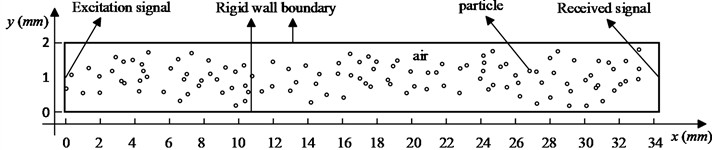
A two-dimensional computational model is established with dimensions of 34.3 mm and 2 mm. Rigid wall boundaries are set at 0 mm and 1 mm. The left inlet (Port 1) is the acoustic excitation source with an amplitude of 1 Pa, and a plane wave of phase 0. The right outlet (Port 2) is a non-reflective absorbing terminal to suppress wave reflection and measure transmitted sound pressure to calculate transmission coefficient/loss.
Coal powder particles with specific sizes and volume fractions are randomly distributed in the domain. Their boundaries use a thermal viscous impedance model to simulate boundary layer energy dissipation. The pressure acoustic module simulates sound propagation, with the fluid model set to “heat conduction and viscosity” to incorporate air’s sound absorption effect.
Fig. 1Simulated model
In numerical simulation, the volume fraction of particles in a two-dimensional domain can be expressed as:
where, is particle volume fraction; represents the area of the two-dimensional domain; is the number of particles, and is the particle radius. The geometric model is discretized using a free triangular mesh. To ensure calculation accuracy, the maximum grid size is less than 1/10 of the wavelength, and the minimum grid size is 1/10 of the particle diameter.
The actual sound attenuation coefficient is the sum of viscous absorption, heat conduction and relaxation effects in the gas medium within boiler. The corresponding sound wave attenuation formula is Stokes-Kirchhoff formula:
Thermophysical parameters of flue gas (20 °C, 1 atm) [12]: Density: 1.2043kg/m3; Shear viscosity: 1.8133×10⁻5 kg/(m·s); Bulk viscosity: 1.088×10⁻⁵ kg/(m·s); Thermal conductivity: 0.0257 W/(m·K); Specific heat: 1004.5 J/(kg·K); Specific heat ratio: 1.4. , and CV is the specific heat at constant volume. The unit of sound attenuation coefficient calculated by this formula is Np/m, and the unit of sound attenuation coefficient in the simulation results is dB/m. The conversion relationship between the two and the standard conversion formula are derived as follows:
The attenuation coefficient in the simulation is calculated by the sound power transmission loss [13]:
where is the incident sound power; is the emitted sound power, and is the distance of sound propagation. The unit of sound attenuation coefficient is dB/m.
3. Results and discussion
3.1. Sound attenuation in a particle free environment
To verify the accuracy of the model, the study first simulated the sound attenuation coefficient without particle media, and the results are shown in Fig. 2.
Fig. 2Comparison between theoretical values and simulated results
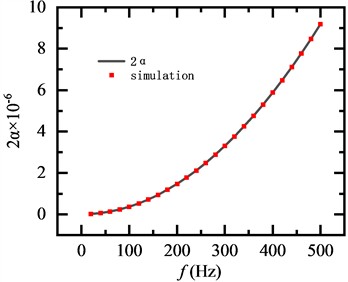
As shown in Fig. 2, under ambient temperature and atmospheric pressure, the simulation results are highly consistent with theoretical predictions, both increasing significantly with frequency and aligning with the scaling law. This validation confirms the accuracy of the “heat conduction and viscosity” fluid model and numerical scheme. The variation of attenuation coefficient after particle addition can be attributed to particle scattering and surface dissipation effects.
3.2. Sound attenuation in a particle environment
In particle-laden gases, the dissipation of particle boundary layers (divided into viscous and thermal boundary layers, generating viscous and thermal conduction attenuation respectively, Key factors affecting the attenuation coefficient are expressed as follows:
where is the viscous boundary layer thickness, and is the viscous boundary layer thickness.
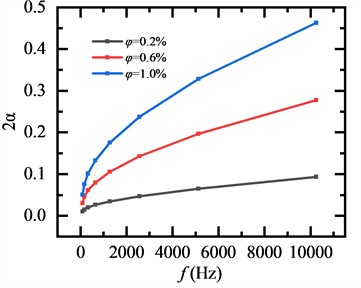
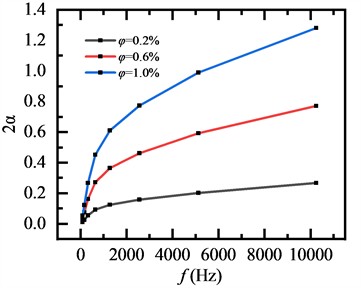
Under ambient temperature and atmospheric pressure, the particle radius () and volume fraction () effect on the acoustic attenuation coefficient in particle-laden media are shown in Fig. 3.
Fig. 3The variation of sound attenuation coefficient in different particle concentrations
a)37 μm
b)50 μm
As shown in Fig. 3, in the same radius, the attenuation coefficient increases significantly with volume fraction (0.2 % < 0.6 % < 1 %). This is higher than that of the particle-free model in the entire frequency range, especially in the low-frequency range. This confirms that particle surface viscous dissipation is the absolute dominant mechanism. In the low-frequency range (< 1000 Hz), the curves increase sharply, and the enhancement effect of volume fraction is significant. In the mid-to-high frequency range (> 5000 Hz), the slope slows down, following the law, and the synergistic effect of volume fraction and frequency strengthens attenuation.
For the same volume fraction, the attenuation coefficient of the 50 μm particle model is significantly higher than that of the 37 μm model. This is because larger particles have larger surface area, enhancing boundary layer dissipation and scattering effect, especially in the high-frequency range. Notably, under 1 % high concentration, the overlapping effect of particle boundary layers further improves attenuation efficiency. This is consistent with the actual working conditions of boilers.
4. Conclusions
1) Under ambient temperature and atmospheric pressure, the simulation results of the “heat conduction and viscosity” fluid model in the particle-free environment are consistent with theoretical predictions. This verifies the accuracy of the numerical scheme, and the variation of the attenuation coefficient after particle addition is attributed to particle scattering and surface dissipation.
2) In micron-sized dust systems, particle surface viscous dissipation is the absolute dominant mechanism of acoustic attenuation. Traditional theoretical models only considering geometric scattering or fluid-phase absorption are no longer applicable.
3) For particles with the same radius, the attenuation coefficient increases significantly with the increase of volume fraction (0.2 % < 0.6 % < 1 %). Higher volume fraction enhances energy dissipation by increasing the total surface area of particles, with a more prominent enhancement effect in the low-frequency range. The overlapping effect of boundary layers under 1 % high-concentration further improves attenuation.
4) In micron-sized particle-laden flue gas, particle surface viscous and thermal boundary layer dissipation is the dominant attenuation mechanism, which is different from the traditional viewpoint of scattering domination.
5) For particles with the same volume fraction, the attenuation coefficient of larger radius particles (50 μm) is significantly higher than that of smaller radius particles (37 μm). Larger radius enhances dissipation and scattering by expanding the single-particle surface area, with a more obvious enhancement effect in the high-frequency range.
6) The attenuation coefficient of particle-laden systems shows a consistent variation with frequency: it increases sharply in the low-frequency range (< 1000 Hz) and follows the law in the mid-to-high frequency range (> 5000 Hz). The synergistic effect of particle radius, volume fraction and frequency enhances the acoustic attenuation effect, providing a theoretical basis for acoustic monitoring technology in high-concentration boiler environments.
References
-
Sewell and C. J. T., “The extinction of sound in a viscous atmosphere by small obstacles of cylindrical and spherical form,” Proceedings of the Royal Society of London. Series A, Containing Papers of a Mathematical and Physical Character, Vol. 83, No. 566, pp. 547–548, 1910, https://doi.org/10.1098/rspa.1910.0045
-
R. J. Urick, “The absorption of sound in suspensions of irregular particles,” The Journal of the Acoustical Society of America, Vol. 20, No. 3, pp. 283–289, May 1948, https://doi.org/10.1121/1.1906373
-
H. Lamb, Hydrodynamics. Cambridge, UK: Cambridge University Press, 1932.
-
E. L. Hamilton, “Sound attenuation in marine sediments,” Geophysics, Vol. 27, pp. 620–646, 1972.
-
L. P. Cao, G. Z. Xing, M. Wang, and H. F. Zheng, “Ultrasonic attenuation measurement method of bone density mold based on modified diffraction effect,” China Measurement and Test, Vol. 50, No. 10, pp. 93–98+135, 2024.
-
C. Y. Lei, K. R. Xue, D. T. Wang, Y. Y. Zhang, C. G. Ju, and Y. Wu, “Influence of bubble content and spacing of agar gel on ultrasonic attenuation characteristics,” (in Chinese), Transducer and Microsystem Technologies, Vol. 43, No. 2, pp. 57–60, 2024, https://doi.org/10.13873/j.1000-9787(2024)02-0057-04
-
F. Chen, W. T. Shi, P. Zhao, and C. Shen, “Experimental design for measuring dynamic attenuation coefficient of biological tissues and research on thermal damage prediction,” Acta Metrologica Sinica, Vol. 45, pp. 1592–1600, 2024.
-
D. Yang, Z. Y. Tian, Q. Li, L. Zhu, Z. Liang, and Q. Li, “Research on the sound attenuation performance of carbon fiber and copolymer ellipsoidal cavities,” (in Chinese), Shanghai Plastics, Vol. 53, No. 5, pp. 19–25+30, 2025, https://doi.org/10.16777/j.cnki.issn.1009-5993.2025.05.004
-
S. Y. Huang and X. Y. Li, “Acoustic attenuation in high-concentration particle suspensions,” Acta Acustica, Vol. 44, pp. 789–796, 2019.
-
S. Temkin, Elements of Acoustics. New York, USA: John Wiley & Sons, 1981.
-
P. M. Morse, K. U. Ingard, and R. T. Beyer, Theoretical Acoustics. Princeton, USA: ASME International, 1969.
-
S. P. Parida and P. C. Jena, “Dynamic Analysis of Cracked FGM Cantilever Beam,” in Lecture Notes in Mechanical Engineering, Singapore: Springer Singapore, 2020, pp. 339–347, https://doi.org/10.1007/978-981-15-2696-1_33
-
R. L. Padhy, S. P. Parida, D. Mishra, and P. C. Jena, “Study of damage progression due to impact of solid bodies on laminated composite plates in water,” International Journal on Interactive Design and Manufacturing (IJIDeM), Vol. 19, No. 6, pp. 4487–4495, Oct. 2024, https://doi.org/10.1007/s12008-024-02128-y
About this article

This research is supported by the National Natural Science Foundation of China (No. 12574480), and Natural Science Foundation of Hebei Province (A2025502025 and A2021502001), and the Fundamental Research Funds for the Central Universities of China (2025MS184), Scientific Research Projects of Universities in Hebei Province (ZC2023058).
The datasets generated during and/or analyzed during the current study are available from the corresponding author on reasonable request.
The authors declare that they have no conflict of interest.

