Abstract
This paper presents the development of a wearable system for human motion monitoring based on an inertial measurement unit (IMU). The proposed device enables real-time acquisition of angular velocity, linear acceleration, and orientation parameters of a body segment. An experimental prototype was implemented using an IMU sensor, Arduino Nano, and a data recording module. Laboratory tests focused on dorsiflexion and plantarflexion movements of the ankle joint. The results demonstrate that the system can accurately capture motion parameters and reflect changes in the Pitch angle corresponding to these movements. The proposed approach can be applied in motion analysis and rehabilitation monitoring. Future work includes integration of EMG and force sensors to extend the system functionality.
Highlights
- A wearable multisensor system based on an IMU was developed for real-time human limb motion monitoring.
- The proposed device accurately measures angular velocity, linear acceleration, and segment orientation during ankle movements.
- Experimental validation demonstrated reliable tracking of dorsiflexion and plantarflexion through Pitch angle analysis.
- The modular architecture enables future integration of EMG and force sensors for advanced rehabilitation monitoring and biomechanical assessment.
- The modular platform allows future integration of additional wearable sensors, such as EMG, plantar pressure, force, and physiological sensors, to expand rehabilitation monitoring capabilities.
1. Introduction
In recent years, wearable sensors have been increasingly used in biomedical engineering, motion analysis, and rehabilitation. Musculoskeletal disorders and injuries often lead to reduced mobility, which creates a need for reliable methods to monitor and restore movement [1-3].
Traditional motion analysis systems, such as Motion Capture, provide high accuracy but are expensive and usually limited to laboratory use [4]. For this reason, there has been growing interest in wearable systems that can monitor human movement in real time under everyday conditions. These systems are compact, portable, and capable of continuous data collection, which makes them suitable for rehabilitation applications [5-7].
Most modern wearable systems rely on inertial measurement units (IMU), as well as EMG and force sensors. IMU sensors are widely used to estimate joint angles, movement phases, and motion dynamics, and in many cases their results are comparable to Motion Capture systems [11-14]. EMG sensors are used to assess muscle activity, while force sensors provide information about interaction with the supporting surface [15-16].
Recent work has focused on combining these sensors into multisensor systems to improve measurement accuracy and obtain more complete information about human movement [17-19]. In addition, machine learning methods are often used for processing sensor data and recognizing movement patterns [20-21]. Some studies also report compact IMU-based wearable devices capable of real-time motion monitoring [22].
In this paper, a wearable motion monitoring system based on an IMU sensor is presented. Unlike conventional single-sensor approaches, the proposed system is designed as a modular platform with the potential integration of IMU, EMG, and force sensors for comprehensive motion analysis. A compact and low-cost prototype was developed and experimentally validated, demonstrating the capability of real-time acquisition of kinematic parameters, including angular velocity, linear acceleration, and orientation. The system also provides scalability toward a full multisensor architecture, enabling simultaneous analysis of motion kinematics, muscle activity, and interaction forces, which is essential for advanced rehabilitation applications.
Fig. 1Human motion scheme: a) anatomical planes; b) lower-limb joint movements. Adapted from Leonova et al. (2026) [23]
![Human motion scheme: a) anatomical planes; b) lower-limb joint movements. Adapted from Leonova et al. (2026) [23]](https://static-01.extrica.com/articles/26453/26453-img1.jpg)
a)
![Human motion scheme: a) anatomical planes; b) lower-limb joint movements. Adapted from Leonova et al. (2026) [23]](https://static-01.extrica.com/articles/26453/26453-img2.jpg)
b)
2. Hardware platform
The developed system is a wearable multisensor hardware platform designed for monitoring human motion and analyzing biomechanical parameters. The system architecture allows the integration of multiple sensors, including an inertial measurement unit (IMU), an electromyography (EMG) sensor, and a force sensor. This configuration enables simultaneous analysis of motion kinematics, muscle activity, and interaction with the supporting surface.
At the current stage, an experimental prototype based on an IMU sensor has been developed. The IMU module includes an accelerometer and a gyroscope for measuring linear acceleration and angular velocity along three axes. The overall view of the wearable device is shown in Fig. 2, where a compact enclosure with integrated electronic components is presented.
Fig. 2Wearable device for monitoring human body movements. The photograph was taken by the corresponding author at the Department of Aerospace and Electronic Engineering, Almaty University of Power Engineering and Telecommunications, in 2025
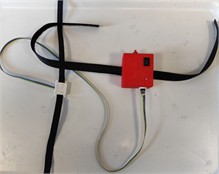
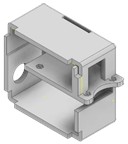
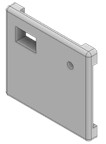
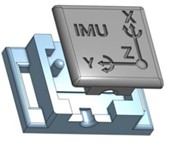
Fig. 3CAD model of the wearable device: a) main enclosure; b) cover; c) IMU module housing
a)
b)
c)
The enclosure was designed using CAD modeling. Fig. 3 presents the 3D model of the device, including the main enclosure, the cover, and a separate housing for the IMU sensor.
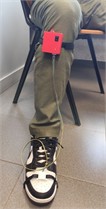
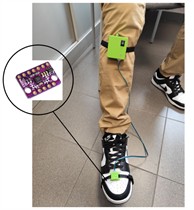
The device placement and IMU sensor positioning are illustrated in Fig. 4. The main unit is attached to the lower leg using a strap, while the IMU sensor is fixed on the foot to capture motion and orientation during the experiment.
Fig. 4Device placement and sensor positioning: a) device attached to the user’s leg; b) IMU sensor mounted on the foot. The photographs were taken by the corresponding author at the Department of Aerospace and Electronic Engineering, Almaty University of Power Engineering and Telecommunications, in 2025
a)
b)
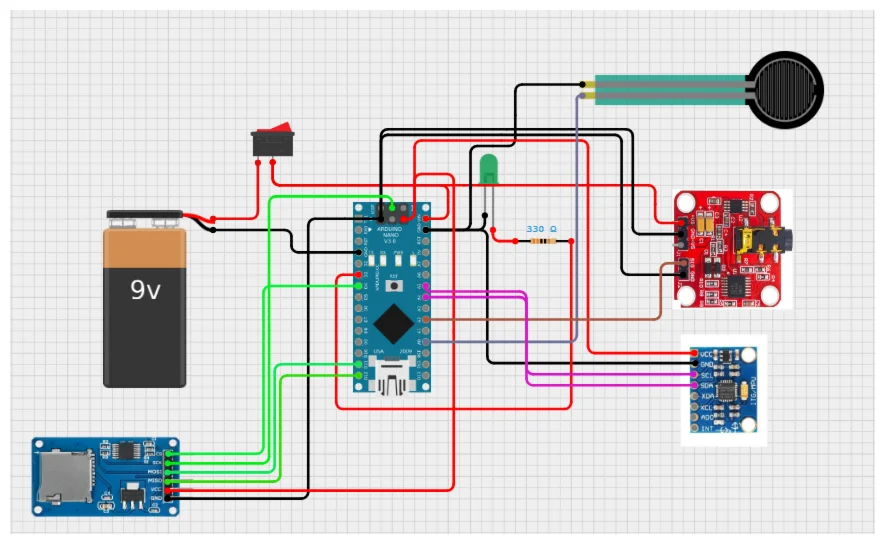
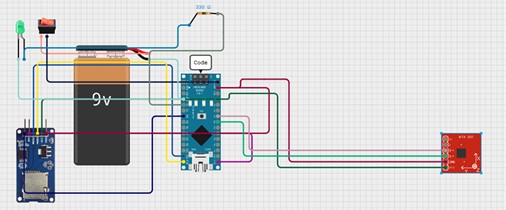
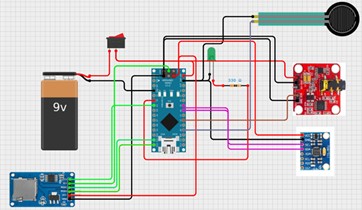
The electrical circuit of the prototype is shown in Fig. 5. The system includes an Arduino Nano microcontroller, an IMU sensor, a microSD data logging module, an indicator, and a 9 V power supply.
Fig. 5Electrical circuit diagram of the IMU-based prototype
To extend the system functionality, a multisensor architecture including IMU, EMG, and a force sensor is proposed (Fig. 6). The IMU is used for motion kinematics analysis, the EMG sensor for muscle activity monitoring, and the force sensor for measuring load and interaction with the supporting surface.
All sensors are connected to the Arduino Nano, which ensures synchronized data acquisition and recording. The proposed architecture enables real-time multisensor monitoring of human motion.
Fig. 6Multisensor hardware architecture based on IMU, EMG and Force sensors
3. Experimental setup
To evaluate the performance of the developed system, a laboratory experiment was conducted to analyze ankle joint motion using an inertial measurement unit (IMU). The objective was to record three-dimensional motion parameters of the foot, including angular velocity, linear acceleration, and segment orientation.
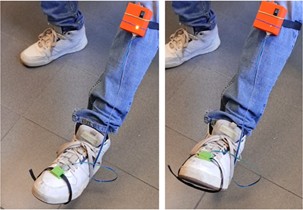
The experiment was performed using a wearable prototype attached to the user’s leg, with the IMU sensor mounted on the foot to capture motion in real time. The device placement during testing is shown in Fig. 7.
The study focused on dorsiflexion and plantarflexion movements, which are key components of ankle joint kinematics and are commonly used in rehabilitation exercises.
Fig. 7Snapshot of the experiment with the device worn by the user during dorsiflexion and plantarflexion. The photographs were taken by the corresponding author at the Department of Aerospace and Electronic Engineering, Almaty University of Power Engineering and Telecommunications, in 2025
4. Results
The experimental results show that the developed system is capable of capturing changes in the kinematic parameters of foot motion during dorsiflexion and plantarflexion.
Fig. 8 presents the angular velocity components , , and over time (0-30 s). The observed ranges are: from –40 to 40 deg/s, from –130 to 100 deg/s, and from –50 to 50 deg/s, reflecting the rotational dynamics of the foot.
Fig. 8Angular velocity components during dorsal and plantar flexion
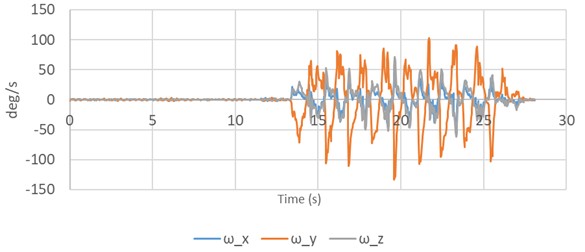
Fig. 9 shows the linear acceleration components , , , and the total acceleration The values range from –0.5 to 2 m/s2, corresponding to the variation in movement speed of the body segment.
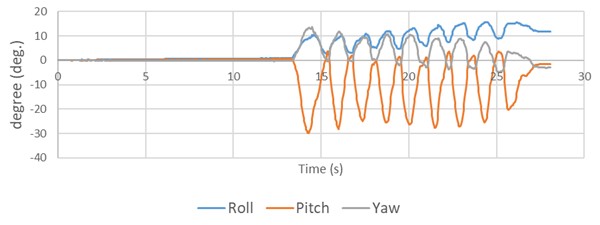
Fig. 10 illustrates the orientation angles Roll, Pitch, and Yaw. The most significant variation is observed in the Pitch angle, corresponding to dorsiflexion-plantarflexion motion, while Roll and Yaw show smaller fluctuations.
The results indicate that the IMU-based system can reliably capture key motion parameters and can be applied for kinematic analysis in rehabilitation tasks.
Fig. 9Linear acceleration during dorsal and plantar flexion movements
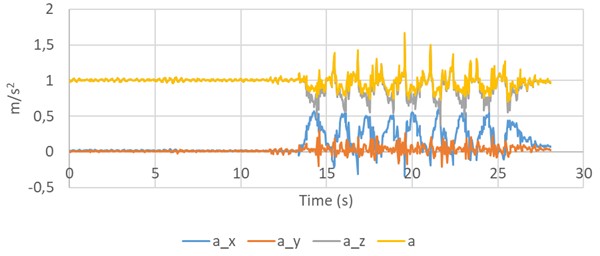
Fig. 10Orientation angles (Roll, Pitch, Yaw) during dorsal and plantar flexion movements
5. Conclusions
The conducted experimental study evaluated the capability of the developed IMU-based system to monitor foot motion during dorsiflexion and plantarflexion. The results showed that the device can reliably capture angular velocity, linear acceleration, and segment orientation.
Analysis of the recorded data demonstrated that the main variations occur along the Pitch axis, corresponding to dorsiflexion–plantarflexion movements, while Roll and Yaw components remain less significant. The measured motion range (–28° to 27°) is close to the typical ankle movement range, confirming the validity of the proposed system.
The obtained results indicate that the developed wearable device can be effectively used for motion monitoring and kinematic analysis in rehabilitation applications. A preliminary quantitative assessment of the measured parameters was also performed, demonstrating stable signal behavior and consistency with expected motion patterns.
Future work will include quantitative validation of the system using reference measurement methods (e.g., motion capture systems or goniometers), as well as statistical error analysis to further evaluate measurement accuracy. In addition, the integration of EMG and force sensors will be implemented within a synchronized multisensor architecture, enabling comprehensive analysis of motion kinematics, muscle activity, and interaction forces.
References
-
X. Wang, H. Yu, S. Kold, O. Rahbek, and S. Bai, “Wearable sensors for activity monitoring and motion control: a review,” Biomimetic Intelligence and Robotics, Vol. 3, No. 1, p. 100089, Mar. 2023, https://doi.org/10.1016/j.birob.2023.100089
-
L. M. S. D. Nascimento, L. V. Bonfati, M. L. B. Freitas, J. J. A. Mendes Junior, H. V. Siqueira, and S. L. Stevan, “Sensors and systems for physical rehabilitation and health monitoring: a review,” Sensors, Vol. 20, No. 15, p. 4063, 2020, https://doi.org/10.3390/s20154063
-
I. H. Lopez-Nava and A. Munoz-Melendez, “Wearable inertial sensors for human motion analysis: a review,” IEEE Sensors Journal, Vol. 16, No. 22, pp. 7821–7834, Nov. 2016, https://doi.org/10.1109/jsen.2016.2609392
-
Q. Wang, P. Markopoulos, B. Yu, W. Chen, and A. Timmermans, “Interactive wearable systems for upper body rehabilitation: a systematic review,” Journal of NeuroEngineering and Rehabilitation, Vol. 14, No. 1, p. 20, Mar. 2017, https://doi.org/10.1186/s12984-017-0229-y
-
I. Boukhennoufa, X. Zhai, V. Utti, J. Jackson, and K. D. Mcdonald-Maier, “Wearable sensors and machine learning in post-stroke rehabilitation assessment: a systematic review,” Biomedical Signal Processing and Control, Vol. 71, p. 103197, Jan. 2022, https://doi.org/10.1016/j.bspc.2021.103197
-
X. Wu, C. Liu, L. Wang, and M. Bilal, “Internet of things-enabled real-time health monitoring system using deep learning,” Neural Computing and Applications, Vol. 35, No. 20, pp. 14565–14576, Sep. 2021, https://doi.org/10.1007/s00521-021-06440-6
-
T. S. Qureshi, M. H. Shahid, A. A. Farhan, and S. Alamri, “A systematic literature review on human activity recognition using smart devices: advances, challenges, and future directions,” Artificial Intelligence Review, Vol. 58, No. 9, p. 276, Jun. 2025, https://doi.org/10.1007/s10462-025-11275-x
-
N. Stepanenko and A. Dubko, “Motion tracking systems in rehabilitation: a comparative analysis of sensor technologies, algorithmic methods, and clinical relevance,” International Science Journal of Engineering and Agriculture, Vol. 4, No. 6, pp. 72–100, 2025, https://doi.org/10.46299/j.isjea.20250406.06
-
M. Mardonova and Y. Choi, “Review of wearable device technology and its applications to the mining industry,” Energies, Vol. 11, No. 3, p. 547, Mar. 2018, https://doi.org/10.3390/en11030547
-
S. Patel, H. Park, P. Bonato, L. Chan, and M. Rodgers, “A review of wearable sensors and systems with application in rehabilitation,” Journal of NeuroEngineering and Rehabilitation, Vol. 9, No. 1, p. 21, Apr. 2012, https://doi.org/10.1186/1743-0003-9-21
-
R. Riener, L. Lünenburger, and G. Colombo, “Human-centered robotics applied to gait training and assessment,” The Journal of Rehabilitation Research and Development, Vol. 43, No. 5, p. 679, 2006, https://doi.org/10.1682/jrrd.2005.02.0046
-
A. M. Sabatini, “Estimating three-dimensional orientation of human body parts by inertial/magnetic sensing,” Sensors, Vol. 11, No. 2, pp. 1489–1525, Jan. 2011, https://doi.org/10.3390/s110201489
-
S. Zhang et al., “Deep learning in human activity recognition with wearable sensors: a review on advances,” Sensors, Vol. 22, No. 4, p. 1476, Feb. 2022, https://doi.org/10.3390/s22041476
-
Y. He et al., “Accuracy validation of a wearable IMU-based gait analysis in healthy female,” BMC Sports Science, Medicine and Rehabilitation, Vol. 16, No. 1, p. 2, Jan. 2024, https://doi.org/10.1186/s13102-023-00792-3
-
W. Tao, T. Liu, R. Zheng, and H. Feng, “Gait analysis using wearable sensors,” Sensors, Vol. 12, No. 2, pp. 2255–2283, Feb. 2012, https://doi.org/10.3390/s120202255
-
S. Zhao et al., “Wearable physiological monitoring system based on electrocardiography and electromyography for upper limb rehabilitation training,” Sensors, Vol. 20, No. 17, p. 4861, Aug. 2020, https://doi.org/10.3390/s20174861
-
G. Nicora et al., “Systematic review of AI/ML applications in multi-domain robotic rehabilitation: trends, gaps, and future directions,” Journal of NeuroEngineering and Rehabilitation, Vol. 22, No. 1, p. 79, Apr. 2025, https://doi.org/10.1186/s12984-025-01605-z
-
A. M. Sabatini, “Quaternion-based extended Kalman filter for determining orientation by inertial and magnetic sensing,” IEEE Transactions on Biomedical Engineering, Vol. 53, No. 7, pp. 1346–1356, Jul. 2006, https://doi.org/10.1109/tbme.2006.875664
-
N. J. Seo, K. Coupland, C. Finetto, and G. Scronce, “Wearable sensor to monitor quality of upper limb task practice for stroke survivors at home,” Sensors, Vol. 24, No. 2, p. 554, Jan. 2024, https://doi.org/10.3390/s24020554
-
A. Caña-Pino and P. Holgado-López, “Wearable-sensor and virtual reality-based interventions for gait and balance rehabilitation in stroke survivors: a systematic review,” Signals, Vol. 6, No. 3, p. 48, Sep. 2025, https://doi.org/10.3390/signals6030048
-
P. Lobo, P. Morais, P. Murray, and J. L. Vilaça, “Trends and innovations in wearable technology for motor rehabilitation, prediction, and monitoring: a comprehensive review,” Sensors, Vol. 24, No. 24, p. 7973, Dec. 2024, https://doi.org/10.3390/s24247973
-
G. Mastrangelo, B. D. M. C. Rico, M. Russo, M. Ceccarelli, and D. Cafolla, “A feasibility study for a cost-effective wearable system for real-time ankle mobility monitoring,” in Mechanisms and machine science, Cham: Springer Nature Switzerland, 2025, pp. 367–377, https://doi.org/10.1007/978-3-031-96081-9_37
-
A. Leonova, M. Russo, C. Morales-Cruz, and M. Ceccarelli, “Performance evaluation of biped unit in LARMbot HumanoidV.3,” Designs, Vol. 10, No. 2, p. 35, 2026, https://doi.org/10.3390/designs10020035
About this article

This research has been funded by the Ministry of Science and Higher Education of the Republic of Kazakhstan, Grant No. AP27508009.
The datasets generated during and/or analyzed during the current study are available from the corresponding author on reasonable request.
Dr. Nursultan Zhetenbayev, Dr. Yerkebulan Nurgizat are scientific committee members of the 77th International Conference on Vibroengineering and were not involved in the editorial review and/or the decision to publish this article.

