Abstract
To clarify the application feasibility and practical effects of waste fly ash as a filler in asphalt pavement materials, this study selected two types of waste fly ash as the primary filler. Asphalt mastics with different fly ash contents were prepared using a high-speed melt shearing method. The interaction and compatibility between the asphalt binder and waste fly ash were characterized by scanning electron microscopy. The rheological properties of the waste-fly-ash asphalt mastics were analyzed using a dynamic shear rheometer. The influence of waste fly ash content on the pavement performance of asphalt mastic was systematically examined through three major index tests. The results indicate that replacing a portion of pure mineral filler with varying amounts of waste fly ash does not reduce the adhesion of the asphalt mastic. The addition of waste fly ash not only effectively enhances the high-temperature stability of the mastic but also improves resistance to shear deformation.
Highlights
- No obvious wrinkles appear, and the surface remains relatively smooth, while a small amount of fly ash is almost completely encapsulated by asphalt.
- The enhancing effect of fly ash on the softening point of asphalt mastic is superior to that of conventional mineral filler.
- Replacing mineral filler with fly ash can effectively improve the high-temperature performance of asphalt mastic.
1. Introduction
Due to its significant advantages in volume reduction, resource recovery and harmless treatment, waste incineration technology has become a mainstream approach for solid waste management. However, the large amount of waste fly ash generated during incineration, which is rich in heavy metals and hazardous substances, poses a high environmental risk and has become a key bottleneck restricting the sustainable development of incineration technology [1]. As a solid waste with high specific surface area and abundant pore structure, waste fly ash shows potential for application in material modification, particularly attracting extensive attention as a filler in asphalt pavement materials [2]. Fillers in the asphalt mastic system not only fill the voids between aggregates but also directly influence the viscoelastic properties of the mastic, thereby exerting a profound impact on the pavement performance of asphalt pavements [3]. Compared with conventional mineral filler, the differences in physical and chemical characteristics of fly ash may lead to significant changes in key properties of asphalt mastic, such as high-temperature stability, low-temperature crack resistance and fatigue durability [4]. However, the residual heavy metals and chemical reactivity in fly ash may pose threats to the environmental safety and performance stability of pavement materials, limiting its practical application.
Based on this, this study takes waste fly ash as the research object, systematically investigating its interaction mechanism as a filler in asphalt pavement materials and its influence on pavement performance. The main research contents include the adhesion, microscopic morphology, rheological properties and pavement performance of waste fly ash-asphalt binder. This study aims to provide a scientific basis for the efficient resource utilization of waste fly ash and to open new pathways for the sustainable development of asphalt pavement materials.
2. Material and experiment
2.1. Material
2.1.1. Solid waste
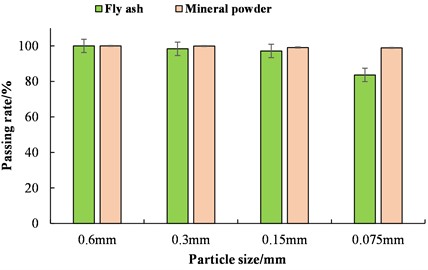
The waste incineration fly ash selected in this study was sourced from waste-to-energy plants in Guangzhou, and the mineral filler used was limestone mineral filler. Sieving tests were conducted on the waste fly ash in accordance with the Test Methods for Aggregate in Highway Engineering (JTG E42-2005), and the sieving results are shown in Fig. 1.
Fig. 1Particle size distribution of fly ash and mineral powder
2.1.2. Binder
SK70# base asphalt was selected as the binder and fly ash-asphalt mastics was prepared by melt-blending method. The key technical properties of the SK70# base asphalt are presented in Table 1. The fly ash asphalt mastic was prepared by high-speed spurring and the mixing speed was 2500 rpm for 30 min, which was performed at 160 ℃.
Table 1Technical indices of asphalt
Indices | Testing value | Requirement |
Softening point / ℃ | 47.9 | > 46 |
Penetration / 0.1 mm | 65.1 | 60~80 |
PI index | –1.25 | –1.5~+1.0 |
Ductility / cm | 21.9 | > 20 |
2.2. Method
2.2.1. Scanning electron microscopy test
A focused ion beam field-emission scanning electron microscope was used to characterize the microstructure of waste fly ash asphalt mastic, with magnification ranging from 1000× to 5000×. The accelerating voltage range is 1-5 kV and the specimen were sputtered by coating with gold.
2.2.2. Pavement performance test
According to the Test Methods of Asphalt and Asphalt Mixtures for Highway Engineering (JTG E20-2019), three major index tests (Softening point, penetration and ductility) were conducted on fly-ash asphalt mastic. For each test, three groups of specimens were used as parallel tests to ensure the accuracy of the experimental results.
2.2.3. Dynamic shear rheological test
The dynamic shear rheological test of the fly ash asphalt mastic was conducted using Anton Paar SmartPave 102 asphalt rheometers. Parallel plates of 25 mm diameter were employed, with gap settings of 2 mm. The temperature sweep ranged from 55 °C to 85 °C at a heating rate of 2 °C/min, with an oscillation frequency of 10 rad/s. The applied strain was controlled between 0.1 % and 1.0 % to remain within the linear viscoelastic range. Routine experiments included three groups of specimens.
3. Results and discussion
3.1. Micro-morphology of waste fly ash-asphalt interaction
Figs. 2 and 3 show the scanning electron microscopy characterization results of waste fly ash asphalt mastic film and mineral filler asphalt mastic, respectively. Analysis of Fig. 2 reveals that after contact between fly ash and the asphalt surface, no obvious wrinkles appear, and the surface remains relatively smooth. Increasing the magnification shows that a small number of wrinkles appear at the edges of the contact interface between some fly ash particles and asphalt, while a small amount of fly ash is almost completely encapsulated by asphalt, making full contact with the asphalt surface. From Fig. 3, it can be clearly observed that due to the relatively small and uniform overall particle size of the mineral filler, its distribution on the surface is relatively uniform. After contact with asphalt, no obvious wrinkling is observed. Under higher magnification, the asphalt surface remains smooth, with no mineral filler particles completely sinking into the asphalt interior.
Fig. 2SEM results of fly ash
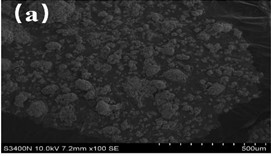
a) 500 μm
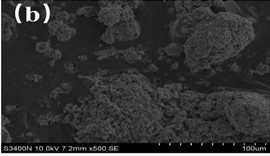
b) 100 μm
Fig. 3SEM results of mineral filler
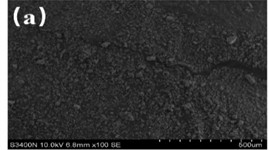
a) 500 μm
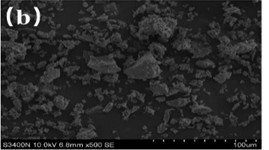
b) 100 μm
3.2. Pavement performance of waste fly ash asphalt mastic
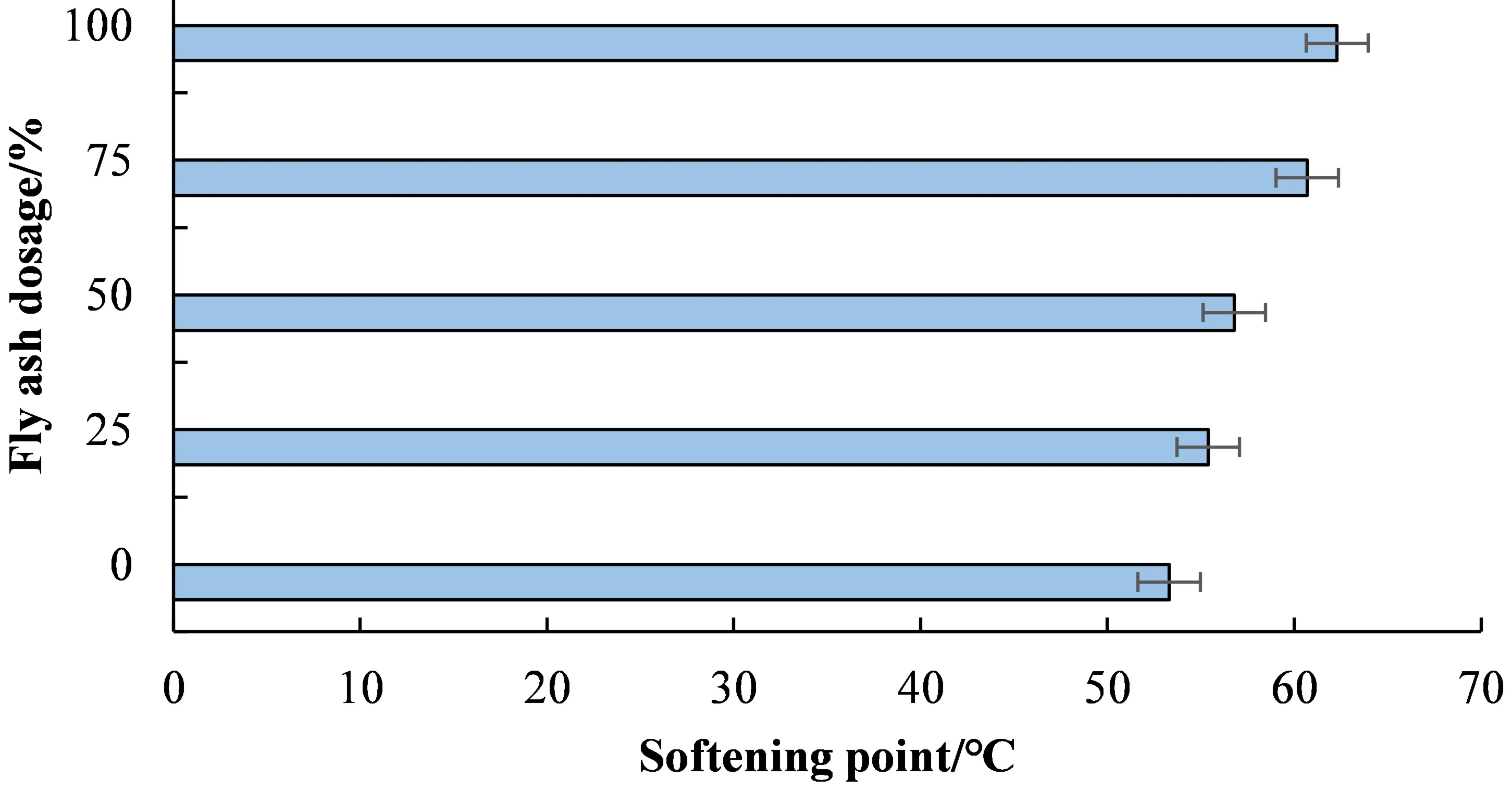
Fig. 4 presents the test results of the three major indexes of fly-ash asphalt mastic under different substitution rates. According to the analysis of Fig. 4, as the substitution rate of waste fly ash increases, the softening point of the asphalt mastic significantly increases, while the penetration and ductility obviously decrease. When fly ash dosage reached 100 %, the softening point increased by 16.9 % and the penetration decreased by 32.9 %. This indicates that the enhancing effect of fly ash on the softening point of asphalt mastic is superior to that of conventional mineral filler, and this effect strengthens with increasing fly ash proportion. Although the decrease in ductility may be detrimental to low-temperature crack resistance, through reasonable dosage design and comprehensive optimization of other properties, fly ash still has potential as a modified filler for asphalt pavement materials.
Fig. 4Pavement performance test results
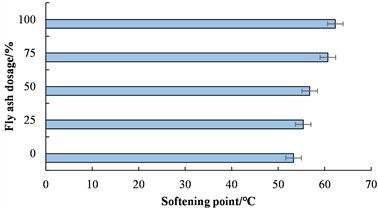
a) Softening point
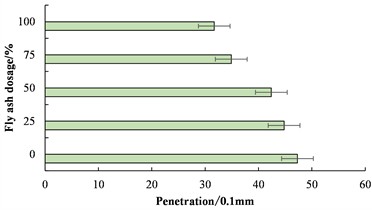
b) Penetration
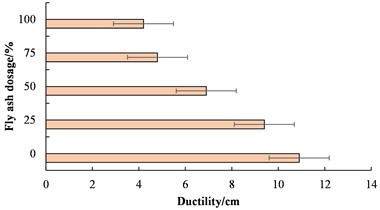
c) Ductility
3.3. Rheological performance analysis of waste fly ash asphalt mastic
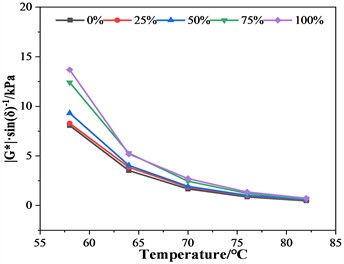
Analysis of Fig. 5 reveals that the rutting factor of waste fly ash asphalt mastic under different substitution rates decreases with increasing temperature, showing a trend of sharp decline followed by a gradual flattening. When the dosage of fly ash reached 100 %, the rutting factor increased by 76.9 %. This indicates that replacing mineral filler with fly ash can effectively improve the high-temperature performance of asphalt mastic. This may be attributed to the characteristics of waste fly ash, which has lower density and larger specific surface area, pore volume and pore diameter compared to mineral filler. The free asphalt in the asphalt mastic is adsorbed by the fly ash to form structural asphalt, which exerts an enhancing effect on the high-temperature performance of the asphalt mastic.
Fig. 5DSR test results
4. Conclusions
1) After contact between fly ash and the asphalt surface, no obvious wrinkles appear, and the surface remains relatively smooth, while a small amount of fly ash is almost completely encapsulated by asphalt.
2) When fly ash dosage reached 100 %, the softening point increased by 16.9 % and the penetration decreased by 32.9 %, which indicated that the enhancing effect of fly ash on the softening point of asphalt mastic is superior to that of conventional mineral filler.
3) Replacing mineral filler with fly ash can effectively improve the high-temperature performance of asphalt mastic. When the dosage of fly ash reached 100 %, the rutting factor increased by 76.9 %. This may be attributed to the characteristics of waste fly ash, which has lower density and larger specific surface area, pore volume and pore diameter compared to mineral filler.
References
-
F.-Y. Chang and M.-Y. Wey, “Comparison of the characteristics of bottom and fly ashes generated from various incineration processes,” Journal of Hazardous Materials, Vol. 138, No. 3, pp. 594–603, Dec. 2006, https://doi.org/10.1016/j.jhazmat.2006.05.099
-
S. S. Thipse, M. Schoenitz, and E. L. Dreizin, “Morphology and composition of the fly ash particles produced in incineration of municipal solid waste,” Fuel Processing Technology, Vol. 75, No. 3, pp. 173–184, Mar. 2002, https://doi.org/10.1016/s0378-3820(02)00007-3
-
A. Dixit and S. K. Das, “Fly ash stabilized red mud as a one-part alkali-activated sustainable material for pavement subgrade: strength, durability and life cycle assessment analysis,” Road Materials and Pavement Design, Vol. 26, No. 10, pp. 2536–2562, 2025, https://doi.org/10.1080/14680629.2025.2454027
-
Y. Zhang, Z. Ma, Z. Fang, Y. Qian, P. Zhong, and J. Yan, “Review of harmless treatment of municipal solid waste incineration fly ash,” Waste Disposal and Sustainable Energy, Vol. 2, No. 1, pp. 1–25, 2020, https://doi.org/10.1007/s42768-020-00033-0
-
X. Sun, Y. Ye, X. Qin, Z. Liu, W. Zhao, and Z. Wang, “Deterioration behavior and mechanism of heavy metal leaching inhibition efficiency of MSWI fly ash − asphalt mastic under ultraviolet irradiation,” Waste Management, Vol. 215, p. 115428, 2026, https://doi.org/10.1016/j.wasman.2026.115428
-
A. Woszuk, L. Bandura, and W. Franus, “Fly ash as low cost and environmentally friendly filler and its effect on the properties of mix asphalt,” Journal of Cleaner Production, Vol. 235, pp. 493–502, Oct. 2019, https://doi.org/10.1016/j.jclepro.2019.06.353
About this article

This paper describes research activities mainly requested and sponsored by Guangdong Provincial Highway Construction Co., Ltd.
The datasets generated during and/or analyzed during the current study are available from the corresponding author on reasonable request.
The authors declare that they have no conflict of interest.

