Abstract
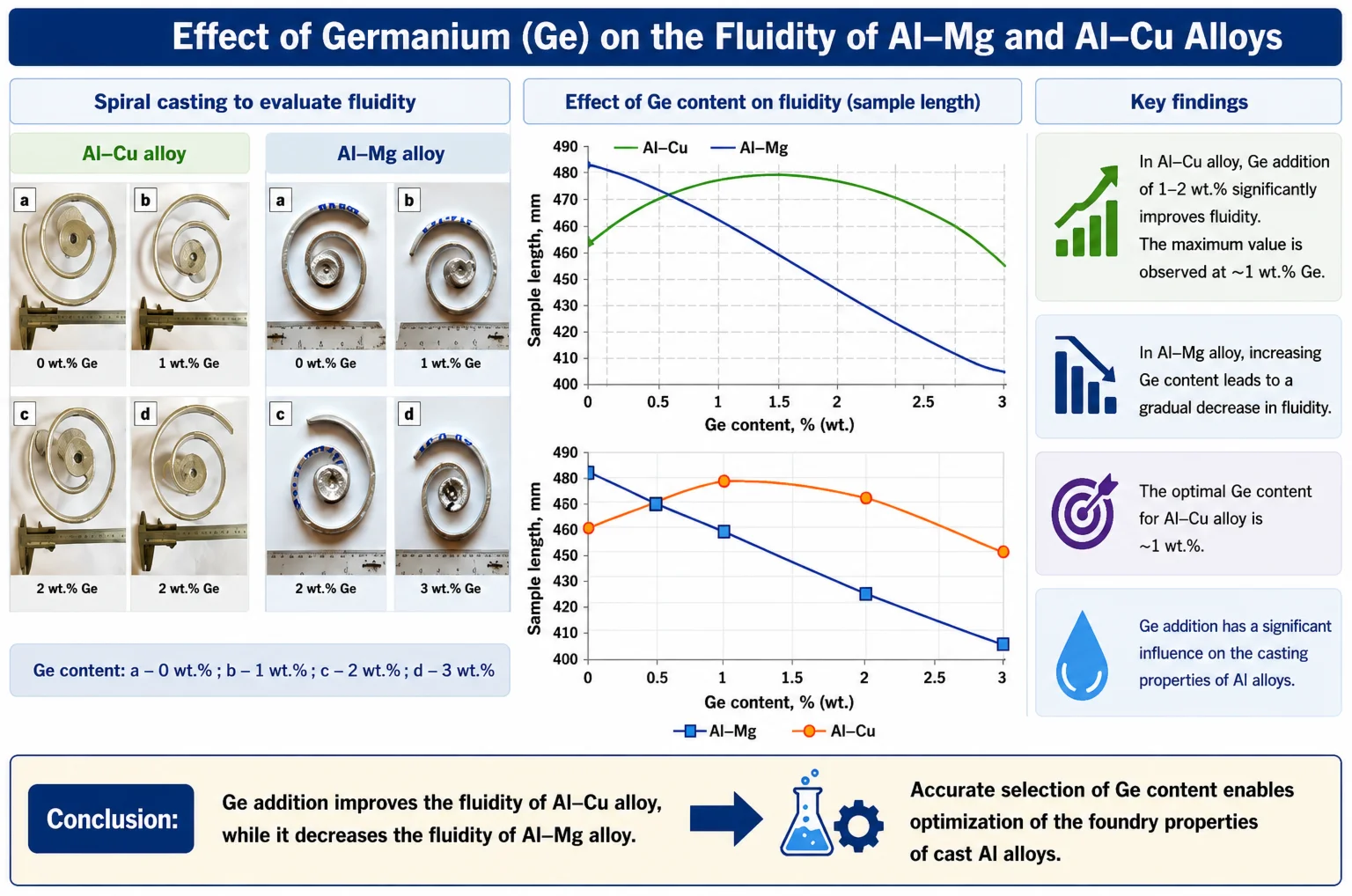
The study presents a theoretical and experimental analysis of the variation in the fluidity of aluminum alloys – one of their key casting properties – under the influence of germanium and silicon. Based on experimental investigations, aluminum-based alloys were modified with different amounts of germanium and silicon, and the optimal modification level was determined through mathematical modeling. Initially, under laboratory conditions, aluminum casting alloys were alloyed with germanium at concentrations of 1 %, 2 %, and 3 % (relative to the charge), while 5 % silicon was added to each sample. The prepared melts were cast into standard spiral molds designed to evaluate fluidity. After solidification and removal from the molds, the lengths of the samples were measured, and a relationship between germanium content and fluidity was established in the form of a graph. Based on the obtained experimental data, the effect of germanium content on alloy fluidity was mathematically modeled. The modeling process was carried out using the Lagrange interpolation method. The resulting function allows for the theoretical prediction of the influence of varying germanium concentrations on the fluidity of the alloy.
Highlights
- The results of the conducted experimental and mathematical studies showed that the fluidity of aluminum-based alloys significantly depends on the amount of germanium added to their composition.
- Based on the experimental data obtained during the study, relationship graphs between germanium content and fluidity were constructed, and mathematical models were developed on this basis.
- These cubic polynomial models adequately describe the properties of the alloys and make it possible to predict their behavior.
- This approach enables the optimization of alloy composition, the prediction of casting properties in advance, and the effective control of technological processes.
- In general, it should be emphasized that, based on the conducted research, it is advisable to introduce germanium into the alloy composition in the range of 1–2%.
1. Introduction
Currently, extensive research efforts worldwide are focused on improving the properties of light alloys (particularly aluminum) through the addition of various elements and compounds [1-5]. In particular, studies are being conducted on enhancing the mechanical properties of aluminum alloys by increasing the number of crystallization nuclei through modification with different elements, determining the temperature dependence of modification and microalloying processes, and improving the physicochemical and operational properties of light alloys – such as aluminum and magnesium alloys – by altering their composition. Furthermore, research includes the analysis of theories related to the treatment of liquid alloys both inside and outside the furnace, the evaluation of the assimilation degree of microalloying elements into the alloy, and the development of energy- and resource-efficient technologies [6-12].
In global practice, a number of scientists have made significant contributions to the development of technologies aimed at improving alloy properties through the introduction of various elements into light alloys. Among them are American researchers such as Frank Mansfeld and Y. Wang, among others. Their studies have demonstrated that it is possible to increase the pitting corrosion resistance of alloys by 15-20 % and hardness by 10-12 %, while also enabling the implementation of resource-saving technologies by eliminating the need for chromium treatment [13].
Chinese researchers, including Dong Q. et al., developed a technology for improving the properties of Al-Mg-Si alloys through heat treatment when the content of modifying elements is less than 1 %, where magnesium, iron, and silicon serve as the primary alloying elements [14].
Among the scientists who have investigated the introduction of microalloying elements into light alloys, particularly aluminum casting alloys, Valentina F. Degtyareva et al. achieved improvements in microstructure and hardness by alloying aluminum with germanium and silicon under pressure [15]. In addition, B. M. Nemenenok et al. modified AK12och grade aluminum alloy by jointly introducing germanium and tin, and further improved the microstructure by treating the molten alloy with NaCl and KCl salts to enhance modification efficiency [16].
According to the literature review, it should be noted that during the introduction of modifying (microalloying) elements into light alloys, there remains a persistent problem associated with their burn-off at high temperatures, which leads to insufficient retention and assimilation of these elements in the alloy. In this regard, despite significant scientific progress in the field of processing molten light alloys with various elements, several unresolved issues still remain. These include the insufficient mechanical and casting properties of light alloys, particularly aluminum alloys, the non-uniform distribution of microalloying elements within the alloy, and the need to develop resource-efficient microalloying technologies for introducing modifying elements and compounds into alloy compositions.
2. Materials and experimental
The fluidity of aluminum alloys is a critical property in the production of cast products, particularly for manufacturing components with complex geometries, and it has a significant impact on product quality [17]. Alloys with improved fluidity contribute to reducing defects such as misruns and incomplete filling in cast parts. In this study, binary aluminum alloys from the Al-Mg and Al-Cu systems were selected for investigation. Germanium was added to these alloys at levels of 1 %, 2 %, and 3 % relative to the charge, while 5 % silicon was introduced into each sample.
Fig. 1Samples used for the evaluation of fluidity: a- Al-Mg; b-Al-Mg-1%Ge-5%Si; c-Al-Mg-2%Ge-5%Si; d- Al-Mg-3%Ge-5%Si. Photo by S. Tursunbaev in the Metals Technologies Laboratory on January 20, 2025
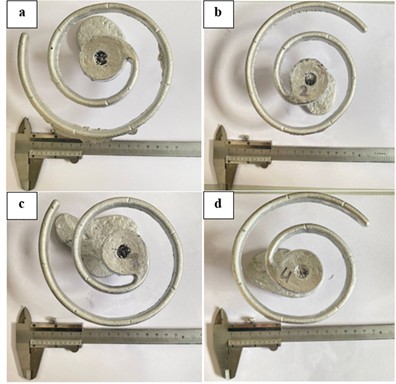
A resistance furnace was used for casting the samples. The melts were poured into molds at a temperature range of 740-750 °C. To determine fluidity, spiral test specimens (spiral molds) were prepared. The sand-clay mold mixture for the spiral specimens consisted of 85 % quartz sand, 11 % bentonite clay, and 4 % water [18]. The spiral molds were designed as two-part molds: the lower part contained the spiral cavity, while the upper part included the gating system. This configuration of the gating system was chosen to prevent the molten metal from escaping the mold during the solidification process [18].
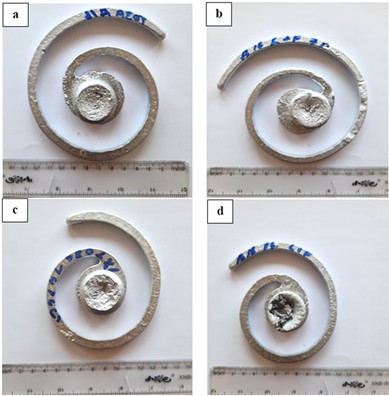
The samples were cast into molds with various compositional combinations. Initially, the base alloys were cast without any additional alloying elements. After solidification, the cast specimens were removed from the sand-clay molds (Figs. 1 and 2). The lengths of the extracted samples were then measured.
Fig. 2Samples used for the evaluation of fluidity: a- Al-Cu; b-Al-Cu-1%Ge-5%Si; c-Al-Cu-2%Ge-5%Si; d- Al-Cu-3%Ge-5%Si. Photo by S. Tursunbaev in the Metals Technologies Laboratory on January 25, 2025
3. Results and analysis
The lengths of the samples were measured, and based on the obtained results, a graph showing the relationship between germanium content and fluidity was developed (Fig. 3).
Fig. 3Relationship graphs
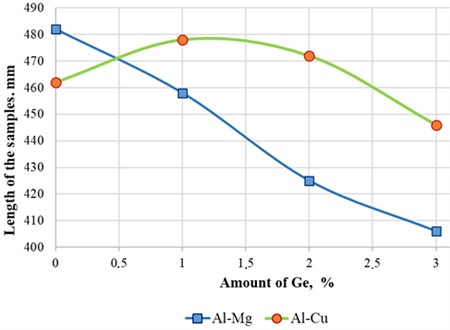
The obtained results demonstrate that the addition of germanium has a significant influence on the fluidity behavior of aluminum alloys, although the effect strongly depends on the alloying system. As shown in Fig. 3, the Al-Mg alloy exhibited a continuous decrease in fluidity with increasing germanium content. The sample length decreased from approximately 482 mm for the alloy without germanium to about 406 mm at 3 % Ge addition. This behavior can be explained by the increase in melt viscosity and the formation of oxide-related particles, which create additional resistance to liquid metal flow during mold filling. Furthermore, magnesium-containing aluminum alloys are known to possess relatively high oxidation activity, and the presence of germanium may intensify this effect, leading to earlier solidification and reduced flow distance.
In contrast, the Al-Cu alloy demonstrated a different tendency. The addition of germanium up to 1-2 % improved the fluidity, and the maximum sample length of approximately 478 mm was observed at 1 % Ge content. This improvement may be associated with structural modifications occurring in the melt, which contribute to a more stable solidification process and improved feeding ability of the liquid alloy. Copper-containing aluminum alloys generally exhibit better casting characteristics, and small additions of germanium may promote the refinement of the solidification structure, resulting in enhanced fluidity. However, when the germanium content reached 3 %, the fluidity of the Al-Cu alloy also decreased. This indicates that excessive germanium addition negatively affects the melt flow behavior, possibly due to increased viscosity and the accumulation of oxide inclusions. Therefore, the results suggest that germanium has an optimum concentration range in Al-Cu alloys, whereas in Al-Mg alloys its effect is predominantly detrimental. Overall, the experimental results confirm that the influence of germanium on fluidity is highly dependent on the chemical composition of the alloy system. The observed trends indicate that alloying interactions and solidification mechanisms play an important role in determining the casting performance of aluminum alloys.
At the next stage of the study, an optimization process was developed by mathematically modeling the effect of germanium content on the fluidity, which is a casting property of the samples. The mathematical modeling of fluidity was carried out based on the relationship graphs presented in Fig. 3. The mathematical modeling was developed using the PTC Mathcad Prime 10.0.1.0 software [19].
For four data points obtained from experimental studies, the initial form of the cubic polynomial function can be expressed as follows: , where:
1) – Lagrange basis polynomials.
2) – the -coordinates of the points.
Fig. 4Comparative graph of the samples’ fluidity properties based on mathematical modeling
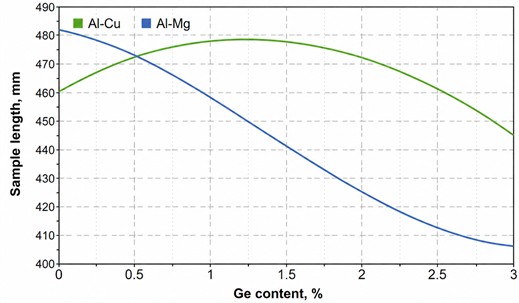
The relationship graph obtained using the software is presented in Fig. 4. Using the obtained results, the function describing the dependence of the fluidity of the investigated aluminum alloys on the percentage of germanium added to their composition can be expressed as follows:
– For the Al-Cu alloy (Ge + Si): .
– For the Al-Mg alloy (Ge + Si): .
4. Conclusions
The results of the conducted experimental and mathematical studies showed that the fluidity of aluminum-based alloys significantly depends on the amount of germanium added to their composition. In particular, it was determined that in Al-Mg system alloys, an increase in the amount of germanium leads to a decrease in fluidity, whereas in Al-Cu alloys, increasing the germanium content within the range of 1-2 % results in improved fluidity. Based on the experimental data obtained during the study, relationship graphs between germanium content and fluidity were constructed, and mathematical models were developed on this basis. These cubic polynomial models adequately describe the properties of the alloys and make it possible to predict their behavior. Specifically, separate functional relationships were established for Al-Cu and Al-Mg alloys, clearly expressing the trend of fluidity variation with respect to germanium content. The agreement between the results of mathematical modeling and experimental data confirms the validity of the selected model.
This approach enables the optimization of alloy composition, the prediction of casting properties in advance, and the effective control of technological processes. In general, it should be emphasized that, based on the conducted research, it is advisable to introduce germanium into the alloy composition in the range of 1-2 %. This amount plays an important role in improving fluidity, optimizing the casting process, and obtaining high-quality cast products.
References
-
X. Fang et al., “Simultaneous refinement of α-Al and modification of Si in Al-Si alloy achieved via the addition of Y and Zr,” Journal of Materials Research and Technology, Vol. 30, pp. 1822–1833, 2024, https://doi.org/10.1016/j.jmrt.2024.03.219
-
T. A. Jasim, “Review on the mechanisms of modification Al-Si alloys,” Journal of University of Babylon for Engineering Sciences, Vol. 27, No. 1, pp. 338–343, Feb. 2019, https://doi.org/10.29196/jubes.v27i1.2169
-
M. de Giovanni, J. A. Kaduk, and P. Srirangam, “Modification of Al-Si alloys by Ce or Ce with Sr,” JOM, Vol. 71, No. 1, pp. 426–434, Oct. 2018, https://doi.org/10.1007/s11837-018-3192-6
-
S. Tursunbaev et al., “Influence of nickel and germanium on the mechanical properties of aluminum alloys,” International Journal of Mechatronics and Applied Mechanics, Vol. I, No. 23, pp. 150–158, Mar. 2026, https://doi.org/10.17683/ijomam/issue23.14
-
Y. Lu et al., “The synergistic refinement and modification of Al-7Si alloys caused by trace Er and B,” Metals, Vol. 15, No. 4, p. 413, Apr. 2025, https://doi.org/10.3390/met15040413
-
S. Tursunbayev, N. Turakhodjayev, S. Mardanokulov, R. Zokirov, and F. Odilov, “The effect of lithium on the mechanical properties of alloys in the Al-Li system,” E3S Web of Conferences, Vol. 390, p. 05046, Jun. 2023, https://doi.org/10.1051/e3sconf/202339005046
-
S. Tursunbaev, N. Turakhodjaev, F. Odilov, S. Mardanokulov, and R. Zokirov, “Change in wear resistance of alloy when alloying aluminium alloy with germanium oxide,” E3S Web of Conferences, Vol. 401, p. 05001, Jul. 2023, https://doi.org/10.1051/e3sconf/202340105001
-
Z. Zhao et al., “Insights into the dual effects of Ti on the grain refinement and mechanical properties of hypoeutectic Al-Si alloys,” Journal of Materials Science and Technology, Vol. 189, pp. 44–59, 2024, https://doi.org/10.1016/j.jmst.2023.12.014
-
M. Mahmudzoda, B. B. Eshov, and J. H. Dzhailoev, “Anodic behavior of AK7 aluminum alloy and composite material of the Al-Al2O3 system within an NaCl electrolyte solution medium,” Metallurgist, Vol. 67, No. 9-10, pp. 1466–1472, Mar. 2024, https://doi.org/10.1007/s11015-024-01639-z
-
H. Zhang et al., “Fabrication of high-strength corrosion-resistant Al-Cu-Li alloys via high-pressure heat treatment and double aging,” Journal of Alloys and Compounds, Vol. 1050, p. 185608, Jan. 2026, https://doi.org/10.1016/j.jallcom.2025.185608
-
L. F. Gomes, C. L. Kugelmeier, A. Garcia, C. A. Della Rovere, and J. E. Spinelli, “Influences of alloying elements and dendritic spacing on the corrosion behavior of Al-Si-Ag alloys,” Journal of Materials Research and Technology, Vol. 15, pp. 5880–5893, Nov. 2021, https://doi.org/10.1016/j.jmrt.2021.11.043
-
S. Tursunbaev, N. Turakhodjaev, L. Zhang, Z. Wang, U. Mardonov, and M. Saidova, “Mechanical properties and evolution of the microstructure of Al-Cu-Mg system alloys under the influence of alloying elements (Ge and Si),” International Journal of Mechatronics and Applied Mechanics, Vol. 1, No. 18, pp. 164–169, Dec. 2024, https://doi.org/10.17683/ijomam/issue18.19
-
F. Mansfeld and Y. Wang, “Development of “stainless” aluminum alloys by surface modification,” Materials Science and Engineering: A, Vol. 198, No. 1-2, pp. 51–61, 1995, https://doi.org/10.1016/0921-5093(95)80058-3
-
Q. Dong, Y. Zhang, J. Wang, L. Huang, and H. Nagaumi, “Enhanced strength-conductivity trade-off in Al-Mg-Si alloys with optimized Mg/Si ratio,” Journal of Alloys and Compounds, Vol. 970, p. 172682, Jan. 2024, https://doi.org/10.1016/j.jallcom.2023.172682
-
V. F. Degtyareva, “Simple metals at high pressures: the Fermi sphere – Brillouin zone interaction model,” (in Russian), Uspekhi Fizicheskih Nauk, Vol. 176, No. 4, p. 383, Jan. 2006, https://doi.org/10.3367/ufnr.0176.200604c.0383
-
S. P. Korolev, S. P. Zadrutskij, B. M. Nemenenok, V. M. Mikhajlovskij, and A. G. Sheshko, “Conception of modular technologies for producing high-quality aluminum alloy castings,” Litejnoe Proizvodstvo, No. 8, 2002.
-
S. Tursunbaev, N. Turakhodjaev, S. Mardonakulov, and S. Toshmatova, “Effect of germanium oxide on the properties of aluminum casting details in agricultural machinery,” BIO Web of Conferences, Vol. 85, p. 01024, 2024, https://doi.org/10.1051/bioconf/20248501024
-
F. Scaglione, S. Arnaboldi, C. Viscardi, M. Baricco, and M. Palumbo, “Solidification calculations of precious alloys and Al-base alloys for additive manufacturing,” Metals, Vol. 12, No. 2, p. 322, 2022, https://doi.org/10.3390/met12020322
-
S. Tursunbaev et al., “Comparison of the effect of germanium (Ge) and germanium-silicon (Ge-Si) combinations on the hardness of aluminum alloy through mathematical modeling,” in Optical and Computational Technologies for Measurements and Industrial Applications (OptiComp 2025), Vol. 13803, p. 34, 2025, https://doi.org/10.1117/12.3077575
About this article

The authors have not disclosed any funding.
The datasets generated during and/or analyzed during the current study are available from the corresponding author on reasonable request.
The authors declare that they have no conflict of interest.

