Abstract
Buildings constructed above high-speed railway tunnels represent an innovative model for intensive land use. However, they face significant challenges from train-induced vibrations and subsequent structure-borne noise. To investigate the propagation characteristics of this noise, a field measurement was conducted on an 18-story shear wall residential building above a railway tunnel. Vibration and indoor noise signals on different floors were synchronously recorded during train passages. The results indicate that the building's vertical vibration attenuates with increasing floor height, with the floor slab center showing a stronger response than structural columns. The indoor structure-borne noise levels within the characteristic frequency band (20-80 Hz) exhibit a “high at both ends, low in the middle” distribution, being more significant on lower floors and upper floors compared to middle floors. Within the 20-100 Hz characteristic band, a relatively stable transfer relationship exists between the structure-borne noise sound pressure level and the floor vibration velocity level, although significant deviations occur at structural or acoustic resonance frequencies. Influenced by the indoor background noise, the overall linear correlation between vibration and noise is not strong on some floors. This study reveals the propagation patterns of vibration and structure-borne noise in overbuilding structures, providing data and theoretical references for targeted vibration and noise reduction design.
Highlights
- Propagation patterns of vibration and structure-borne noise in overbuilding structures are presented
- The indoor structure-borne noise is more significant on lower floors and upper floors
- Field measurement was conducted on an 18-story shear wall residential building above a railway tunnel
1. Introduction
High-speed rail (HSR) tunnel-integrated rooftop developments constitute an emerging urban development paradigm that advances land-use intensification and enables the integration of efficient, multi-tiered transportation systems. However, the building foundations are mechanically coupled to the underlying HSR tunnel structure – creating a continuous load path through which dynamic wheel-rail excitations propagate upward [1]. As high-speed trains traverse the tunnel, they generate broadband vibratory energy that transmits through the tunnel lining, surrounding soil mass, and foundation system into the superstructure, ultimately manifesting as low-frequency structural-borne noise within occupied spaces. This noise exhibits high transmission efficiency through building elements and minimal geometric attenuation – rendering it persistently perceptible and difficult to mitigate in sensitive indoor environments.
Chronic exposure poses dual risks: (i) cumulative fatigue effects that may compromise structural serviceability and long-term durability [2]; and (ii) non-auditory physiological and psychological impacts – including sleep disturbance, reduced cognitive performance, and diminished occupant satisfaction – that collectively degrade indoor environmental quality [3]. Consequently, vibration- and noise-induced constraints have emerged as a critical technical barrier impeding both the large-scale implementation of HSR-adjacent land redevelopment and the achievement of high-performance design standards for rooftop buildings [4-5]. Rigorous characterization of structural noise propagation mechanisms – particularly the frequency-dependent coupling between train-induced ground vibrations and interior acoustic responses – is therefore essential to support evidence-based environmental impact assessment, performance-oriented regulatory frameworks, and physics-informed mitigation strategies [6-7].
This study presents findings from a comprehensive field measurement campaign conducted on operational rooftop buildings above urban rail transit tunnels. We systematically investigate: (i) the spatial-frequency evolution of train-induced vibrations across the tunnel-foundation-superstructure interface; (ii) the modal distribution and intensity patterns of indoor structural-borne noise; and (iii) the quantitative linkage between vibration input metrics (e.g., velocity RMS, dominant frequency bands) and resulting noise descriptors (e.g., , , low-frequency weighted levels). The field-measured data provided in this study can serve as a calibration benchmark for parameter selection and effectiveness prediction of these measures.
2. Test overview and methodology
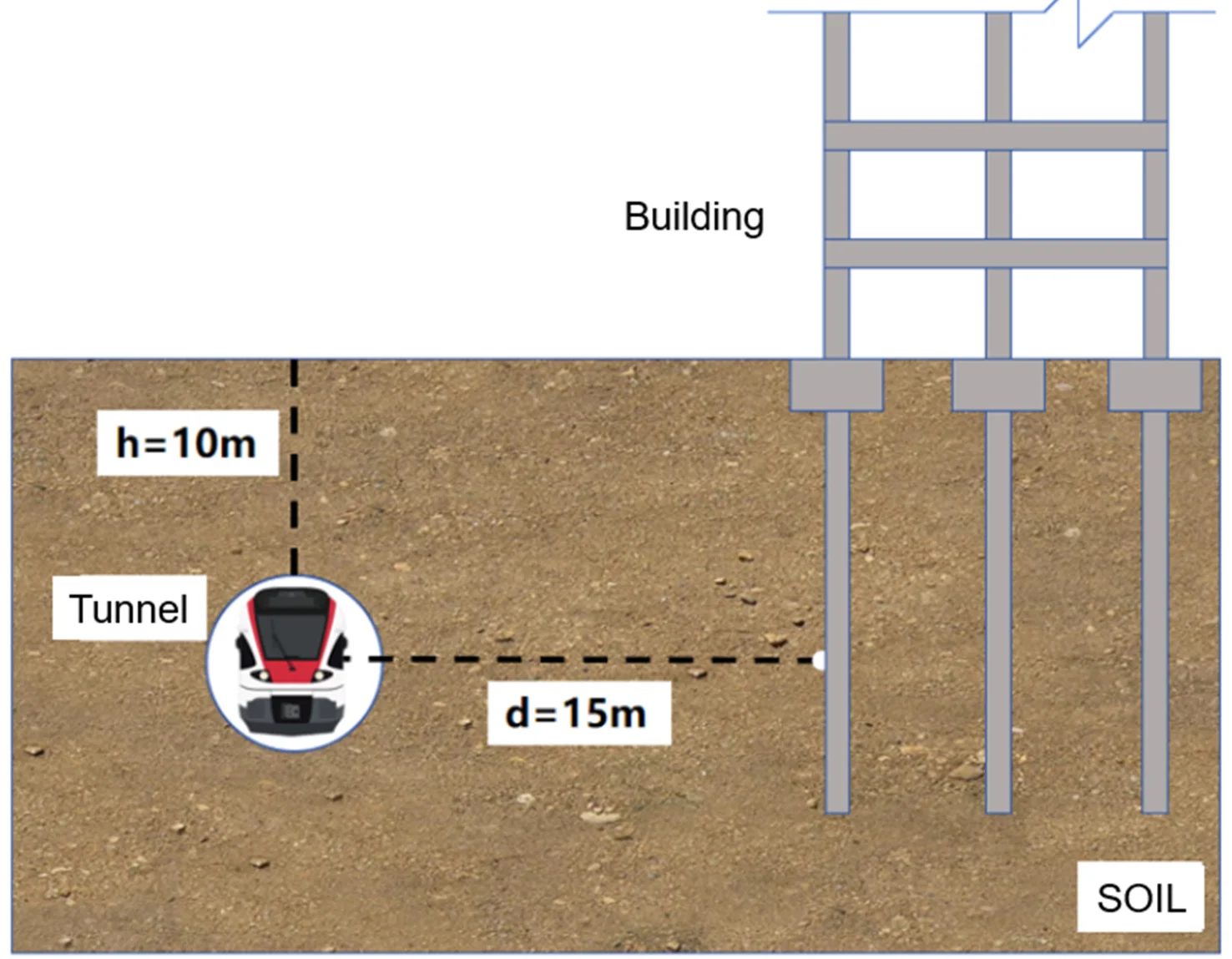
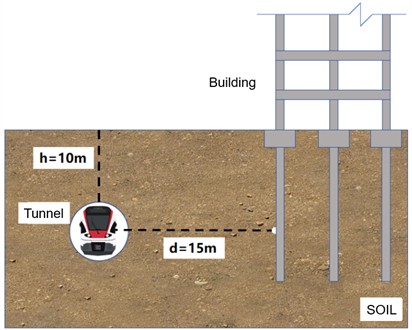
The study is based on field measurements of a building subjected to railway-induced vibrations. The test was conducted during off-peak hours on a weekday under clear weather conditions to minimize other interferences. The methodological approach focuses on the propagation within the building structure. The layout of the tunnel and the building is shown in Fig. 1.
Fig. 1Relationship of the building and tunnel
Inside the building, a total of 7 vibration measurement points and 3 noise measurement points were arranged. Vibration points were distributed at structural column locations on the 1st, 6th, 10th, 14th, and 18th floors, as well as at the center of floor slabs on the 6th and 10th floors. Noise points were located at the center of floor slabs on the 6th, 10th, and 14th floors, as shown in Fig. 2. The sampling frequency for vibration signals was 512 Hz, and for noise signals, it was 12,000 Hz.
Data processing was conducted with reference to relevant standards such as the “Standard for Limit and Measuring Method of Building Vibration and Secondary Radiation Noise Caused by Urban Rail Transit” (JGJ/T170-2009). The evaluation metrics were the vibration velocity level and the -weighted sound pressure level , calculated as follows:
The original time-history data were processed using 1/3 octave band spectrum analysis to obtain the frequency-domain characteristics of vibration and noise. To quantify the relationship between vibration and noise, the transfer difference (-) was introduced as an indicator, and linear regression analysis was performed.
Fig. 2On-site test schematic diagram. Photo by the author of Wenyong Mei during the test of May, 2025 at Guangzhou, China
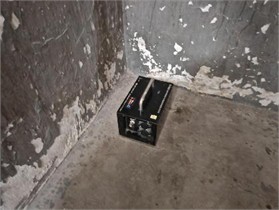
a) Instrumentation locations for column vibration monitoring across structural levels
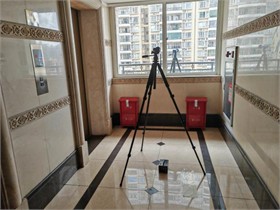
b) Instrumentation locations for concurrent vibration and noise monitoring at the geometric center of each structural floor slab
3. Results and discussion
3.1. Propagation characteristics of structural vibration
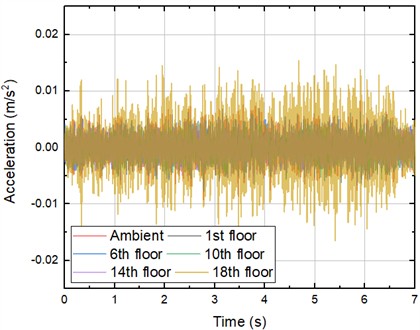
The time history of train pass by is shown in Fig. 3. The peak background vibration acceleration (approximately 0.003 m/s2) was much smaller than the vibration induced by train passages (e.g., peak at 1st-floor column was about 0.015 m/s2), and thus its influence was negligible. Vertical comparison showed that vibration decays with increasing building height. Lower floors (e.g., 1st floor) exhibited significantly greater vibration than higher floors (e.g., 6th floor), and the decay gradient decreased at higher levels. Within the same floor, vibration at the floor slab center (e.g., peak 0.036 m/s2 on the 10th floor) was markedly greater than at the structural column (e.g., peak 0.008 m/s2 at the column base on the same floor), indicating that the floor slab is the primary responding element to vertical vibration.
Fig. 3Time history of train pass by
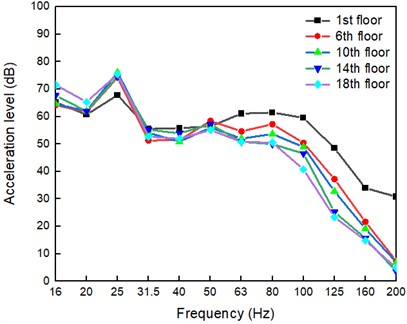
Spectral analysis further revealed vibration propagation patterns, as shown in Fig. 4. Vibration energy attenuates significantly at medium and high frequencies (above 50 Hz) as it propagates upward, while low-frequency components (e.g., below 25 Hz) show less attenuation. A distinct peak appeared near 25 Hz for structural column vibrations across floors, likely due to resonance with the building’s natural frequency.
For floors at and above the 6th floor, the vibration velocity levels of structural columns were not significantly different within the 16-50 Hz range. This suggests substantial energy dissipation after vibration propagates to the lower-middle floors, resulting in smaller differences between higher floors.
In frequency bands above 31.5 Hz, the vibration velocity level at the floor slab center was generally greater than that at structural columns on the same floor, consistent with the floor slab’s role as the primary vibration response element.
Fig. 4Spectral analysis of train pass by
3.2. Distribution characteristics of indoor structure-borne noise
The frequency-domain distribution of structure-borne noise exhibited the features, as shown in Fig. 5. In frequency bands above 31.5 Hz, the sound pressure level of structure-borne noise generally decreased with increasing floor height. However, between the 10th and 14th floors, noise in the 31.5-100 Hz band showed an increase rather than a decrease, with a pronounced peak near 80 Hz. This phenomenon is likely caused by the reflection and superposition of sound waves, excited by vibration, between the roof and walls in higher floors, combined with potential acoustic resonance near 80 Hz.
Fig. 5Frequency-domain distribution of structure-borne noise
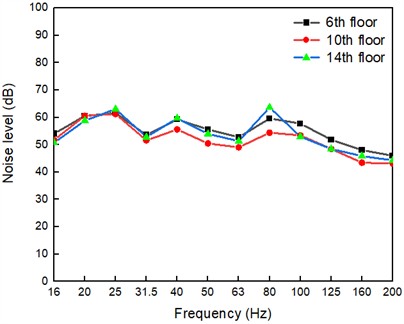
Overall, due to proximity to the vibration source on lower floors and the influence of sound reflection/superposition on higher floors, the structure-borne noise on both ends is greater than on middle floors (e.g., 10th floor), presenting a non-linear vertical distribution. The measured structure-borne noise sound pressure level was close to the indoor background noise level, indicating that background noise must be considered in the analysis.
3.3. Transfer relationship and correlation between vibration and structure-borne noise
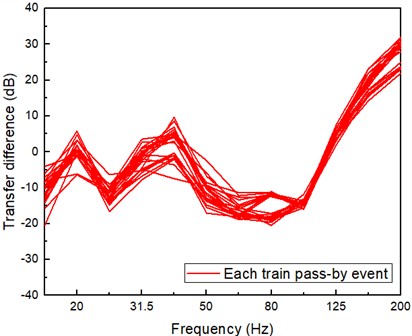
Within the characteristic frequency band of 16-200 Hz (where the main energy of both vibration and noise is concentrated), the transfer difference between the noise sound pressure level and the floor vibration velocity level was overall relatively stable, as shown in Fig. 6. It presents the transfer difference (-), which is the difference between the structure-borne noise sound pressure level () and the floor vibration velocity level () across the characteristic frequency band. Each red line represents the transfer difference spectrum calculated from the data of a single train pass-by event at a specific measurement location on 6th and 10th floor. A total of 12 train pass-by events were recorded, yielding 24 distinct curve records on 6th and 10th floor. This indicates that within this band, structural vibration and radiated noise satisfy a certain vibro-acoustic coupling relationship. However, at specific frequency points such as 20 Hz, 25 Hz, and 40 Hz, the transfer difference curve showed sharp peaks. This is likely because structural vibration or acoustic modes resonated at these frequencies, causing either vibration or noise to be amplified individually.
Fig. 6Transfer difference between the noise level and the vibration level
Linear fitting was performed between the vibration velocity level and noise sound pressure level at the floor slab center on the 6th and 10th floors, as shown in Fig. 7. Linear Fitting analyzes the statistical correlation from the perspective of overall levels. It performs linear fitting between the vibration velocity level () and the noise sound pressure level () measured at the slab center on the same floor.
Fig. 7Correlation between structural noise on each floor and the vibration at the center of the floor slab
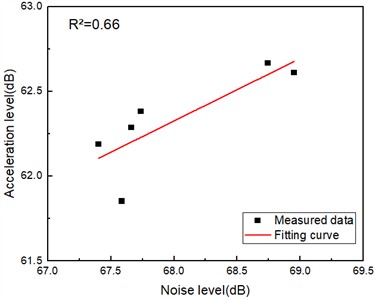
a) 6th floor
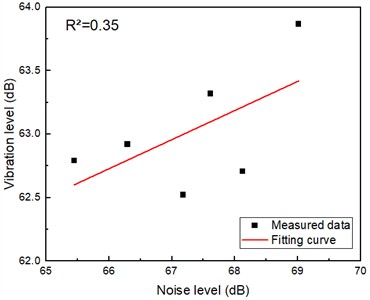
b) 10th floor
The results showed that the linear correlation coefficient for the 6th-floor data was 0.66, indicating a relatively good correlation between vibration and noise. In contrast, the for the 10th-floor data was only 0.35, showing a weak correlation. This discrepancy is primarily due to the interference of background noise. On middle floors with lower vibration levels (e.g., 10th floor), the structure-borne noise signal is more easily “masked” by background noise, reducing the statistical correlation between the measured values. This suggests that while structural vibration is a primary factor influencing structure-borne noise in the lower-middle floors of over-track buildings, the presence of background noise prevents a completely linear correlation.
4. Potential methods to minimize the vibrations and structure-borne noise
Based on the propagation characteristics identified in this study, the following structural modifications or enhancements can be considered to minimize train-induced vibrations and subsequent noise:
(1) Optimize Floor Slab Design: The floor slab is the primary vibration-responding and noise-radiating component. It is recommended to increase slab thickness, add ribs, or use composite materials to enhance its stiffness and mass, thereby reducing the vibration response. Elastic layers or isolation bearings can be installed at the connections between floor slabs and beams/columns to block vibration transmission paths.
(2) Apply Damping Materials: Apply constrained layer damping materials or viscoelastic damping coatings on large radiation surfaces such as the underside of floor slabs and walls to dissipate vibrational energy and reduce the radiation efficiency of structure-borne noise.
(3) Avoid Resonance in Design: Conduct structural dynamic analysis to ensure the building’s fundamental natural frequencies are away from the dominant frequency bands of train excitation. Adjusting structural stiffness, mass distribution, or adding Tuned Mass Dampers can be effective.
(4) Base Isolation: Implement an overall isolation layer (e.g., rubber bearings, spring isolators) between the building foundation and the tunnel structure to reduce vibration input at the source. This is the most effective but also higher-cost measure, suitable for projects with high performance requirements.
(5) Interior Acoustic Treatment: Incorporate sound-absorbing materials for ceilings and walls as part of the interior finishing, particularly targeting low-frequency noise, to reduce indoor noise levels.
The suggestions above require comprehensive design considering specific engineering conditions and cost-benefit analysis.
5. Conclusions
Based on the field measurement and analysis, the following main conclusions are drawn:
The vibration energy of the building structure attenuates as it propagates vertically, with medium and high frequencies attenuating more noticeably. The vibration response at the center of the floor slab is stronger than that at the structural columns.
The indoor structure-borne noise exhibits a non-linear vertical distribution, characterized by higher levels on lower floors (near the source) and upper floors (affected by sound reflection/superposition) and lower levels on middle floors. Attention should be paid to the risk of acoustic resonance, particularly around 80 Hz.
Within the characteristic frequency band of 16-200 Hz, a relatively stable transfer relationship exists between structure-borne noise and floor vibration. However, this relationship is disrupted at structural or acoustic resonance frequencies.
Background noise significantly affects the indoor acoustic environment, especially on middle floors of the building, where it weakens the apparent correlation between measured structure-borne noise and vibration.
References
-
P. Fiala, G. Degrande, and F. Augusztinovicz, “Numerical modelling of ground-borne noise and vibration in buildings due to surface rail traffic,” Journal of Sound and Vibration, Vol. 301, No. 3-5, pp. 718–738, Apr. 2007, https://doi.org/10.1016/j.jsv.2006.10.019
-
N. Atalla and R. J. Bernhard, “Review of numerical solutions for low-frequency structural-acoustic problems,” Applied Acoustics, Vol. 43, No. 3, pp. 271–294, Jan. 1994, https://doi.org/10.1016/0003-682x(94)90050-7
-
M. Petyt, Introduction to Finite Element Vibration Analysis. Cambridge: Cambridge University Press, 2010, https://doi.org/10.1017/cbo9780511761195
-
Y. Qiu, B. Zheng, B. Jiang, S. Jiang, and C. Zou, “Effect of non-structural components on over-track building vibrations induced by train operations on concrete floor,” International Journal of Structural Stability and Dynamics, Vol. 26, No. 21, p. 2550010, Sep. 2026, https://doi.org/10.1142/s0219455426501804
-
Y. F. Duan, S. M. Wang, R. Z. Wang, C. Y. Wang, J. Y. Shih, and C. B. Yun, “Vector Form Intrinsic Finite-Element Analysis for Train and Bridge Dynamic Interaction,” Journal of Bridge Engineering, Vol. 23, No. 1, p. 04017081, Jan. 2018, https://doi.org/10.1061/(asce)be.1943-5592.0001171
-
R. Cao, M. Ma, X. Sun, and J. Chen, “Transmission characteristics of train-induced vibration in buildings based on wave propagation analysis,” Construction and Building Materials, Vol. 378, p. 131154, May 2023, https://doi.org/10.1016/j.conbuildmat.2023.131154
-
T. Guo, Z. Cao, Z. Zhang, and A. Li, “Frequency domain-based analysis of floor vibrations using the dynamic stiffness matrix method,” Journal of Vibration and Control, Vol. 25, No. 4, pp. 763–776, Aug. 2018, https://doi.org/10.1177/1077546318795931
About this article

The authors have not disclosed any funding.
The datasets generated during and/or analyzed during the current study are available from the corresponding author on reasonable request.
The authors declare that they have no conflict of interest.

