Abstract
This paper systematically studies the characteristics of building vibration and structural noise caused by train operation in view of the vibration and noise problems specific to the railway canopy complex in the integrated development of stations and cities through field measurement. The results show that the vibration energy of the floor slab is concentrated in the medium and low frequency band of 20-80 Hz and directly leads to the main peak of indoor noise in the 40-80 Hz band, with significant coherence between the two, confirming that the “vibration-sound” coupling mechanism is the main source of noise; Interior decoration can effectively improve the acoustic environment quality by reducing the reverberation time. This study reveals the intrinsic connection between vibration and noise and demonstrates that “vibration control of sound” is the fundamental approach to addressing such problems. The research results can provide key theoretical basis and engineering guidance for the optimal design and environmental control of the superstructure.
Highlights
- Vibration energy of the floor slab is concentrated in the medium and low frequency band
- Interior decoration can effectively improve the acoustic environment quality
- Vibration reduction measures should be prioritized for the 20-80 Hz vibration band
1. Introduction
With the deepening of urbanization in China, land resources are becoming increasingly tight, and intensive land use has become a core issue in urban development. Against this backdrop, transportation-oriented development models have emerged. The TOD model, which centers on rail transit stations and involves high-density, multi-functional development of surrounding land to build above-ground complexes that integrate commercial, residential and office functions, has become an important path for promoting sustainable urban development.
Fig. 1Schematic diagram of a station-city integrated rooftop complex
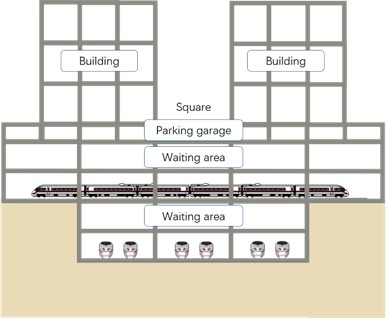
However, this innovative model of integrated station-city rooftop complexes, while enhancing land use efficiency, also faces unique vibration and noise challenges. Unlike traditional buildings, this type of structure lacks a natural vibration attenuation barrier of the soil layer beneath it, causing the vibration energy generated by train operation to be directly transmitted to the upper structure. Vibration travels along the structural components and radiates mid - and low-frequency noise, which has a significant impact on the acoustic environment quality inside the building.
The complexity of this problem is mainly reflected in the fact that the vibration propagation path involves multiple structural components such as tracks, foundations, beams, columns, and floor slabs; The noise radiation characteristics are significantly modulated by the acoustic parameters of the building space; The form of the building structure and the properties of the materials also have differentiated effects on the propagation of vibration noise. Therefore, accurately predicting and effectively controlling the vibration noise of such buildings is a complex and challenging task.
Beyond train-induced vibrations, structural vibration and acoustic challenges are prevalent in various built environments, such as those induced by wind or road traffic, highlighting the broader relevance of understanding vibration transmission and control. In the broader field of structural acoustics, research on how structural form and material configuration influence indoor acoustic responses provides valuable methodological insights. For instance, studies on cable net membrane roofs demonstrate the significant impact of geometry on acoustic performance [1, 2]. For the specific issue of rail transit noise, comprehensive reviews synthesize existing prediction models and control techniques [3], while hybrid analytical-empirical methods have been developed to correlate vibration and indoor noise in low-rise buildings [4]. Furthermore, mitigation strategies are evolving, including the use of advanced building materials designed to reduce vibration transmission [5] and detailed evaluations of mitigation measures under different structural configurations [6].
At present, prediction methods for building vibration and structural noise mainly include empirical formula methods, numerical analysis methods, analytical methods, and emerging neural network prediction methods [7, 8]. The empirical formula method has the advantage of rapid assessment in the preliminary design stage. Kurzweil et al. [9] proposed A formula for the relationship between the A-weighted sound level within a building and the distance to the metro line, providing preliminary estimates for specific situations. The empirical formula proposed by Vlahopoulos et al. [10] has been applied in the prediction of structural noise in low-rise buildings, but studies have shown that the higher the frequency, the lower the prediction accuracy. Numerical analysis methods are widely adopted because of their higher prediction accuracy. Boundary element methods, finite element methods, and hybrid models have become mainstream techniques. Sadeghi et al. [11] used the finite element method to establish acoustic vibration models of buildings and studied the influence of structural parameters on noise propagation. Gu et al. [12] combined the boundary element method with statistical energy analysis to achieve full-band noise prediction. The analytical method builds a theoretical model based on the vibration-noise propagation mechanism, which has the advantage of clear physical meaning. Luo et al. [13] studied acoustic radiation characteristics using cellular automata methods and wave superposition principles, and their models were in good agreement with analytical solutions, numerical results, and measurement data. Yang et al. [14] proposed a theoretical model of semi-infinite shell acoustic radiation using the W-H equation, which demonstrated good prediction accuracy over a wide frequency range.
With the development of artificial intelligence technology, neural network prediction methods have provided new ideas for vibration-noise prediction. Li et al. [15] proposed a deep learning method based on artificial neural networks, using parameters such as indoor vibration and room reverberation characteristics to train the model, achieving high prediction accuracy. Liang et al. [16] studied the influence characteristics of rail transit and road traffic on building noise based on deep learning, providing a new method for noise source identification.
Despite significant progress in existing research, there are still deficiencies in the study of vibration noise for the special structural form of the integrated station-city roof complex. In particular, the coupling mechanism of vibration and noise has not been fully revealed, and there is a lack of systematic field measurement data verification and engineering case support. Based on this, this study systematically explores the vibration and structural noise characteristics of the integrated station-city roof complex through field measurements, with the aim of providing data support and theoretical basis for the optimal design and environmental control of such buildings.
2. Test scheme and method
To reveal the environmental impact of train operation on the integrated station-city superstructure, this study conducted systematic field tests of vibration and structural noise on the superstructure. The test building was located above the ground line of the rail transit, and the train passed through the building at a speed of 13 to 20 km/h. To minimize interference from other noise sources such as road traffic and human activity, the measurements were chosen to be conducted at midnight to ensure the reliability and accuracy of the data.
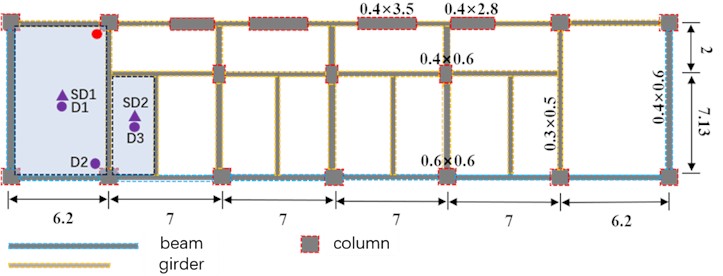
The test setup was specifically optimized for the structural characteristics of the superstructure (Fig. 2). The roof contains two different sizes of rooms (56.61 m2 and 27.81 m2), with each room type having both decorated and undecorated rooms. The measurement points are set at the center of the floor, with triangular patterns representing the microphone and circular patterns representing the vibration accelerometer. This arrangement can fully capture the vibration and acoustic responses inside the building, providing a solid data base for subsequent analysis. During the measurement process, focus on the vibration-noise characteristics at different speeds as the train passes through to reflect the environmental impact under actual operating conditions.
Fig. 2Test layout of different rooms
In terms of evaluation indicators, this study adopts the internationally recognized vibration acceleration level (VAL) and sound pressure level (SPL) as the core quantitative standards. The calculation of the vibration acceleration level follows the formula VAL = , where the reference acceleration 1×10⁻⁶m/s2, and a is derived throughrms time-domain signal processing. The sound pressure level is calculated using SPL = , with the reference sound pressure 2×10⁻⁵Pa. For an in-depth analysis of frequency characteristics, the 1/3 octave band method was used, with the vibration analysis frequency range set at 4-200 Hz and the structural noise analysis frequency range set at 16-250 Hz. These ranges were selected based on two primary considerations: 1) the frequency bands most relevant to human perception of whole-body vibration and intrusive low-frequency structure-borne noise, and 2) the characteristic dominant vibrational modes and associated acoustic radiation expected for this type of concrete slab structure, as supported by preliminary tests and related literature. This method can accurately reflect the differences in human sensitivity to different frequency bands.
The structure of the superstructure is an important link that affects the propagation of vibration and structural noise. Concrete density of the building structure (2500 kg/m3), elastic modulus (3×10¹⁰ Pa), floor thickness (0.12 m), and Poisson’s ratio (0.2). Parameters for structural columns include mass per unit length (900 kg/m), elastic modulus (3.25×10¹⁰Pa), and moment of inertia of section (1.08×10⁻²m4) The parameters for structural beams cover the mass per unit length of the crossbeam (600 kg/m), the mass per unit length of the longitudinal beam (375 kg/m), and the corresponding elastic modulus of the concrete (3×10 Pa10) and moment of inertia of the section (3.1×10⁻³ m4).
Acoustic property testing is another important component of this chapter. The room impulse response is generated by balloon explosion, and the energy decay curve is calculated using the Schroeder integral method. Specifically, the attenuation function was calculated using the formula and the reverberation time RT60 = was fitted by linear regression:
In terms of data processing, professional signal analysis techniques were used to process the collected vibration and noise data. The amplitude characteristics are obtained through time-domain analysis, and the main energy concentration bands are identified through frequency-domain analysis. The characteristics of the 20-80 Hz vibration band and the 40-80 Hz and 120-130 Hz noise bands are analyzed emphatically in view of the particularity of the upper cover. All data processing followed international standards to ensure the scientific nature and comparability of the results.
3. Analysis of vibration and structural noise characteristics of the superstructure
3.1. Vibration characteristics analysis
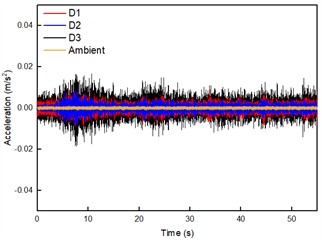
The vibration response data of the floor slab caused by the train running on the ground were obtained through field measurements (Fig. 3). The analysis showed that the amplitude of the vibration acceleration at the center of the floor was between 0.007 and 0.016 m/s2, demonstrating relatively stable vibration characteristics. In terms of time-domain characteristics, the vibration response shows typical transient characteristics and is closely related to the state of train operation. The vibration amplitude is relatively low when the train enters and exits the garage at a speed of 13 km/h, and the vibration response is significantly enhanced when the speed is increased to 20 km/h, indicating that the train speed is an important factor affecting the vibration intensity.
Fig. 3Vibration time history curve
In terms of frequency domain characteristics, the vibration energy of the building is mainly concentrated in the frequency range of 20-80 Hz, which precisely includes the main resonant frequencies of the building structure. By time-frequency analysis (Fig. 4), it can be found that the distribution of vibration energy has distinct frequency band characteristics, and vibrations of different frequency components show a regular distribution pattern on the time axis. This frequency concentration phenomenon is directly related to the structural characteristics of the building, and the thickness of the floor slab, the material parameters, and the supporting conditions jointly determine its vibration response characteristics. It is noteworthy that while vibrations in bridges supporting railway lines often exhibit dominant energy at even lower frequencies (< 20 Hz) due to global flexural modes, the floor slab in the present study shows concentration in the 20-80 Hz band, which is more characteristic of local plate/slab modes. This contrast underscores the unique ‘direct transmission' pathway in station-city integrated complexes, where vibration energy is efficiently transferred to the superstructure's local components, resulting in a mid-frequency dominated signature.
Fig. 4Vibration time-frequency curve
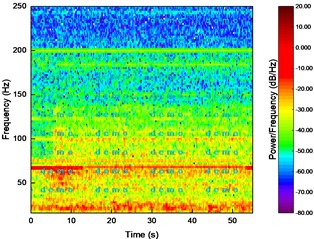
a) D1
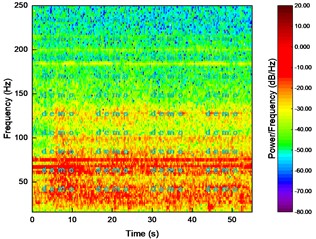
b) D3
The frequency distribution characteristics of the vibration velocity level were obtained through further 1/3 octave analysis (Fig. 5). The vibration velocity level peaks in the 31.5-80 Hz band, which is highly consistent with the aforementioned frequency band of vibration energy concentration. It is notable that the vibration velocity level is relatively low in the low-frequency region (16-25 Hz), but as the frequency increases, the vibration level gradually increases and begins to decline after reaching a maximum near 63 Hz. This trend reflects the transmission and amplification characteristics of the building structure to vibrations of different frequencies and provides an important basis for subsequent vibration control.
Fig. 51/3 octave frequency vibration velocity level
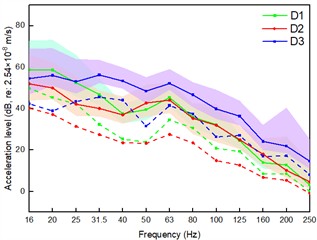
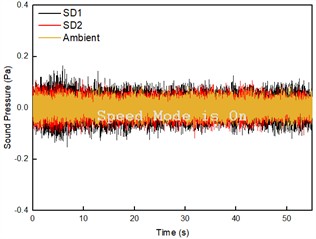
Fig. 6Time-history curve of noise sound pressure
3.2. Structural noise characteristics analysis
Corresponding to the vibration characteristics, the structural noise inside the building exhibits unique acoustic characteristics (Fig. 6). Measured data show that the amplitude of sound pressure at the center of the floor slab fluctuates between 0.085 and 0.15 Pa, a range significantly higher than the ambient noise level, confirming the significant impact of train operation on the acoustic environment inside the building. Observing the time-domain characteristics, the noise sound pressure changes in sync with the train's running state. The sound pressure level rises rapidly during the train’s passage and then gradually decays, presenting a typical pulse-like feature.
In the frequency domain analysis, the structural noise energy of the building is mainly concentrated in the two main frequency bands of 40-80 Hz and 120-130 Hz (Fig. 7). The first energy concentration band (40-80 Hz) is highly consistent with the main distribution area of the vibration energy, which fully demonstrates that the structural noise is directly radiated by the building vibration. The emergence of the second energy concentration band (120-130 Hz) requires further analysis. Through comparative studies with environmental noise, we find that the noise in this band may be affected by environmental factors, but the specific causes still need to be explored in depth.
Fig. 7Time-frequency curve of noise sound pressure
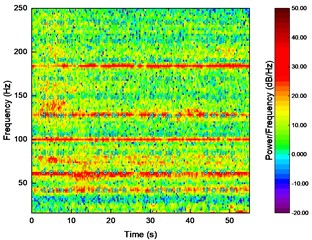
a) SD1
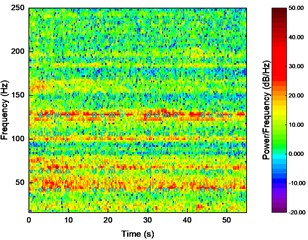
b) SD2
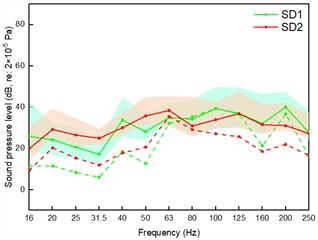
Through 1/3 octave sound pressure level analysis, the noise sound pressure level remained at a high level in the 63-100 Hz band (Fig. 8), with the maximum sound pressure level occurring near 80 Hz. The contrast analysis with the vibration velocity level showed a good correspondence between the peak frequency of the noise sound pressure level and that of the vibration velocity level, further verifying the causal relationship between vibration and noise. It is notable that in the high-frequency region above 12 5 Hz, the noise sound pressure level drops rapidly, indicating that the structure has a good isolation effect on high-frequency noise.
Fig. 8Sound pressure level of noise at 1/3 octave frequency
3.3. Analysis of acoustic characteristics
The acoustic characteristics of the building were systematically evaluated through reverberation time tests. Test results showed significant differences in reverberation times between rooms in building. The reverberation time of undecorated room SD1 was 1.88 s, that of room SD2 was 2.11 s, and that of decorated rooms SD1-1 and SD2-1 dropped to 1.10 s and 1.34 s respectively. The difference is mainly due to the variation in sound absorption caused by the decoration materials. After the decoration, the rooms added sound-absorbing elements such as furniture and wall decorations, which significantly improved the sound absorption performance of the rooms.
Analysis of the frequency characteristics of reverberation time indicates that building rooms have relatively longer reverberation times in the low frequency band (63-125 Hz), which coincides exactly with the main frequency band of structural noise and may lead to cumulative effects of noise in that frequency band. In the high-frequency region, the reverberation time is significantly shortened, which is consistent with the attenuation trend of the noise sound pressure level in the high-frequency region. This frequency-dependent reverberation characteristic has a significant impact on the acoustic environment quality within buildings and needs to be fully considered in noise control design.
By comparing the acoustic performance of rooms in different decoration states, we found that the decoration measures not only improve the visual perception of the rooms, but also significantly enhance the acoustic comfort. Shorter reverberation times in decorated rooms mean faster attenuation of sound energy, which helps to reduce the duration of noise and the degree of interference. This finding provides an important reference for the interior acoustic design of integrated station-city roof complexes, emphasizing the need to consider the optimization of acoustic performance at the architectural design stage.
3.4. Correlation analysis of vibration and noise
A combined analysis of the building's vibration and noise characteristics reveals a close causal relationship between the two. First, in the frequency domain, there is a clear correspondence between the energy distribution of vibration and noise. The 20-80 Hz band where the vibration energy of the floor slab is concentrated overlaps highly with the main peak band of 40-80 Hz in the indoor noise spectrum. This is in line with the radiation mechanism of structural noise: building components have lower vibration efficiency in the lower frequency band and emit longer wavelengths of sound waves, so the peak frequency of noise usually “drifts” to the frequency band up to tens of Hertz relative to the peak frequency of vibration. The frequency correspondence observed in this study strongly confirms that indoor noise mainly stems from the vibration radiation of the building structure, namely the “vibration-sound” coupling effect.
Secondly, the correlation was quantitatively verified from the signal source head through coherence analysis. In the main influence band of 40-80 Hz, the vibration and noise signals showed a high degree of coherence (coherence coefficient generally greater than 0.8), especially at the vibration peak frequency of 63 Hz, the coherence coefficient was close to 1. This statistically proves that the noise energy in this frequency band mainly comes from structural vibration, and there is a strong linear dependence between the two. However, for the secondary peak band (120-130 Hz) that appears in the noise spectrum, its coherence with the vibration signal is significantly reduced. This suggests that the cause of the noise in this band is more complex, possibly a mixture of contributions from multiple sources such as structural vibration radiation, environmental noise penetration, and noise from equipment inside the building, and the specific cause is a key point that needs to be clarified in subsequent studies.
Overall, the in-depth analysis of the vibration-noise correlation in this study not only clarifies the energy transmission chain of “train-track-building structure-indoor sound field”, but also provides a key entry point for the coordinated control of vibration and noise. Damping design for the core vibration band of 20-80 Hz (especially around 63 Hz) will suppress the main noise radiation from the source, which is more fundamental and economical than simply taking sound absorption and sound insulation measures indoors. This suggests that integrated mitigation strategies, combining source/path vibration control (e.g., through resilient floor layers, tuned mass dampers, or advanced materials with vibration-reducible properties) with interior acoustic treatment, would be most effective. The findings underscore the importance of considering such integrated 'vibration control of sound' strategies at the early architectural and structural design stage for similar complexes. Therefore, an integrated management strategy based on the concept of “vibration control of sound” has significant engineering guiding significance for improving the sound environment quality of the integrated station-city roof complex.
4. Conclusions
This study systematically investigated the environmental vibration and structural noise characteristics of the integrated station-city roof complex through field measurements, and the main conclusions are as follows:
1) The vibration energy of the floor slabs of the superstructure is mainly concentrated in the medium and low frequency band of 20-80 Hz; The indoor structural noise spectrum shows a bimodal feature, with the main peak at 40-80 Hz and the secondary peak at 120-130 Hz. Coherence analysis indicated that the noise in the 40-80 Hz band was strongly correlated with floor vibration, confirming that it originated from structural vibration radiation.
2) The acoustic environment inside the building, particularly the reverberation time, has a significant modulating effect on noise perception; Renovation works can effectively improve the quality of the indoor acoustic environment by increasing sound absorption and reducing reverberation time.
3) The research findings reveal that “vibration control of sound” is the fundamental approach to solving such problems. It is suggested that in engineering design, vibration reduction measures should be prioritized for the 20-80 Hz vibration band to suppress noise radiation from the source, which is more economical and effective than air sound insulation alone.
The measured data and conclusions of this study provide a verification basis for the vibration and noise prediction model of integrated station-city development, and provide theoretical guidance for the design and vibration and noise reduction of the superstructure. Future research could focus on establishing more accurate vibration-sound coupling prediction models and conducting targeted evaluation of the effects of vibration isolation technical measures. Furthermore, integrating stochastic modeling approaches to account for uncertainties in operational and material parameters will be valuable to generalize the results and support robust design and retrofitting guidelines for a wider range of building configurations.
References
-
F. Rizzo and P. Zazzini, “Improving the acoustical properties of an elliptical plan space with a cable net membrane roof,” Acoustics Australia, Vol. 44, No. 3, pp. 449–456, Nov. 2016, https://doi.org/10.1007/s40857-016-0072-5
-
F. Rizzo and P. Zazzini, “Shape dependence of acoustic performances of buildings with a hyperbolic paraboloid cable net membrane roof,” Acoustics Australia, Vol. 45, No. 2, pp. 421–443, May 2017, https://doi.org/10.1007/s40857-017-0092-9
-
J. Chen et al., “Train-induced vibration and structure-borne noise measurement and prediction of low-rise building,” Buildings, Vol. 14, No. 9, p. 2883, Sep. 2024, https://doi.org/10.3390/buildings14092883
-
Y. He, Y. Zhang, Y. Yao, Y. He, and X. Sheng, “Review on the prediction and control of structural vibration and noise in buildings caused by rail transit,” Buildings, Vol. 13, No. 9, p. 2310, Sep. 2023, https://doi.org/10.3390/buildings13092310
-
S. Wu and S. Pyo, “Effects of vibration-reducible cementitious materials on the acoustic and structural responses of buildings adjacent to urban railway systems: a numerical approach,” International Journal of Concrete Structures and Materials, Vol. 19, No. 1, Feb. 2025, https://doi.org/10.1186/s40069-024-00747-z
-
Y. Hao, H. Qi, S. Liu, V. Nian, and Z. Zhang, “Study of noise and vibration impacts to buildings due to urban rail transit and mitigation measures,” Sustainability, Vol. 14, No. 5, p. 3119, Mar. 2022, https://doi.org/10.3390/su14053119
-
J. Melke, “Noise and vibration from underground railway lines: proposals for a prediction procedure,” Journal of Sound and Vibration, Vol. 120, No. 2, pp. 391–406, Jan. 1988, https://doi.org/10.1016/0022-460x(88)90451-8
-
C. Zou, J. Hu, X. Li, J. Chen, and W. He, “Noise exposure assessment of over-track buildings induced by train operations,” Applied Acoustics, Vol. 225, p. 110170, Nov. 2024, https://doi.org/10.1016/j.apacoust.2024.110170
-
L. G. Kurzweil, “Prediction and control of noise from railway bridges and tracked transit elevated structures,” Journal of Sound and Vibration, Vol. 51, No. 3, pp. 419–439, Apr. 1977, https://doi.org/10.1016/s0022-460x(77)80085-0
-
N. Vlahopoulos, “A numerical structure-borne noise prediction scheme based on the boundary element method, with a new formulation for the singular integrals,” Computers and Structures, Vol. 50, No. 1, pp. 97–109, Mar. 1994, https://doi.org/10.1016/0045-7949(94)90441-3
-
J. Sadeghi and M. Vasheghani, “Safety of buildings against train induced structure borne noise,” Building and Environment, Vol. 197, p. 107784, Jun. 2021, https://doi.org/10.1016/j.buildenv.2021.107784
-
Y. W. Gu et al., “Experimental and numerical study on vibration and structure-borne noise of high-speed railway composite bridge,” Applied Acoustics, Vol. 192, p. 108757, 2022, https://doi.org/10.1016/j.apacoust.2022.108757
-
K. Luo, Z. Wang, and X. Lei, “The cellular automata model of sound propagations and its application in structural noise calculations,” Applied Acoustics, Vol. 182, p. 108262, 2021, https://doi.org/10.1016/j.apacoust.2021.108262
-
W. Yang, Z. Wang, and Y. Choy, “Prediction of sound radiation from an unbaffled long enclosure with the ground,” Mechanical Systems and Signal Processing, Vol. 149, p. 107232, 2021, https://doi.org/10.1016/j.ymssp.2020.107232
-
X. Li, Y. Chen, C. Zou, H. Wang, B. Zheng, and J. Chen, “Building structure-borne noise measurements and estimation due to train operations in tunnel,” Science of The Total Environment, Vol. 926, p. 172080, May 2024, https://doi.org/10.1016/j.scitotenv.2024.172080
-
R. Liang, W. Liu, W. Li, and Z. Wu, “A traffic noise source identification method for buildings adjacent to multiple transport infrastructures based on deep learning,” Building and Environment, Vol. 211, p. 108764, Mar. 2022, https://doi.org/10.1016/j.buildenv.2022.108764
About this article

The authors have not disclosed any funding.
The datasets generated during and/or analyzed during the current study are available from the corresponding author on reasonable request.
The authors declare that they have no conflict of interest.

