Abstract
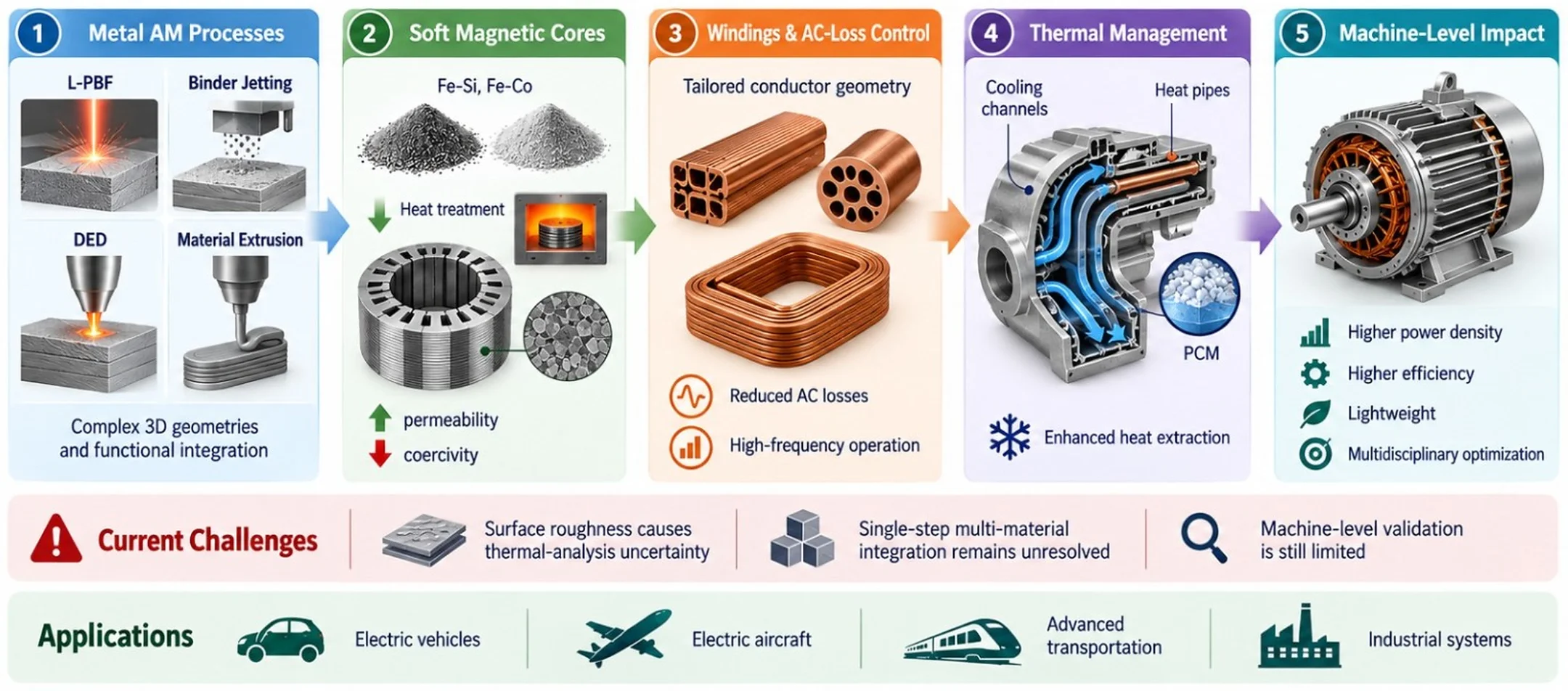
Achieving high power density and ultra-high efficiency in electrical machines requires overcoming the inherent 2D geometric constraints of conventional mass-manufacturing methods. In this context, additive manufacturing (AM) enables the fabrication of complex, highly integrated components and emerges as a transformative approach for multidisciplinary optimization of mechanical and thermal performance. This critical review synthesizes the latest advances, key limitations, and future research directions for the application of AM to core electrical-machine components. The review covers the tailored optimization of soft magnetic materials, particularly Fe-Si and Fe-Co, processed via methods such as laser powder bed fusion (L-PBF) and binder jetting (BJT), and highlights the role of post-processing heat treatment (HT) in improving magnetic permeability and overall magnetic performance. It further examines AM-enabled winding concepts, including semi-stranded coil architectures and eddy-current-suppressing features, aimed at reducing AC losses under high-frequency operation. In addition, this study discusses state-of-the-art thermal management system (TMS) solutions, including hollow conductors with integrated heat pipes (HP) and phase change material (PCM)-based approaches for enhanced heat extraction and temperature regulation. Despite these developments, two critical challenges remain: uncertainty in thermal analysis driven by the surface roughness of AM-produced channels, and the unresolved goal of single-step, multi-material integration of magnetic, conductive, and dielectric materials. The review demonstrates that AM offers a key technological pathway for developing next-generation, high-performance electrical machines demanded by many industrial fields, including electrified aviation and advanced transportation systems.
Highlights
- The review shows that AM process parameters, material choice, and post-processing directly shape the magnetic performance and practical use of soft-magnetic parts in electrical machines.
- Fe–Si and Fe–Co alloys remain central to AM electrical-machine research because their permeability, coercivity, core loss, and saturation behavior strongly affect machine performance.
- AM opens new design options for windings and conductors, including lightweight geometries, lower AC losses, and cooling features that are difficult to realize with conventional manufacturing.
- Hollow conductors, integrated heat pipes, and phase-change materials can strengthen thermal management, but wider industrial use still requires reliable machine-level validation.
1. Introduction
Recent technological advances across multiple disciplines, coupled with increasingly demanding sustainability requirements, have markedly intensified the demand for high-performance electromechanical components. Environmental pressures associated with climate change and the pursuit of global net-zero targets are accelerating electrification across industrial sectors and promoting design strategies that prioritize energy efficiency and reduced lifecycle emissions [1]. In this context, high-performance applications, including electric vehicles and emerging electric aircraft propulsion systems, are imposing progressively tighter requirements on electrical machines (EMs), particularly in terms of power density, efficiency, and mass/volume reduction [2-4].
Despite continuous progress in materials and design methodologies, the development of next-generation EMs remains strongly constrained by conventional manufacturing paradigms. Established production routes, such as laminated electrical steel stacks and subtractive machining, tend to enforce quasi-two-dimensional geometries and restrict the feasible integration of electromagnetic, thermal, and structural functions within a single architecture. These constraints limit the co-optimization of core subsystems, including the magnetic circuit, winding layout, and cooling topology, and thereby impede the realization of highly compact, lightweight, and high-efficiency machines demanded by electrified transportation [5-7].
Additive manufacturing (AM) offers a fundamentally different design-to-manufacture pathway by enabling layer-wise fabrication of complex geometries, internal features, and lattice or topology-optimized structures that are difficult or impractical to produce using traditional methods [7], [8]. The resulting design freedom is particularly attractive for EMs, where performance is governed by tightly coupled electromagnetic and thermal phenomena. AM-enabled architectures can facilitate integrated cooling channels, novel conductor/winding arrangements, and three-dimensional magnetic flux guidance features, creating new opportunities for multidisciplinary optimization and functional integration.
AM has attracted growing attention as an enabling technology for high-performance EMs, yet its adoption remains challenged by material-process-structure-property relationships, post-processing requirements, and uncertainty in performance prediction under realistic operating conditions. This paper presents a critical review of the state of the art in AM for electrical-machine applications, synthesizing recent progress in additively manufactured magnetic materials, conductor and winding topologies, and thermally integrated designs. Drawing on foundational and recent contributions from leading research groups [9-11], the review evaluates demonstrated performance benefits, identifies persistent scientific and engineering bottlenecks, and outlines research directions necessary to translate AM-enabled concepts into robust, scalable machine technologies for electrified mobility and aviation.
Although considerable progress has been reported in the use of additive manufacturing for electrical machines, the literature is still largely divided among magnetic materials, conductors and windings, AC-loss reduction, thermal management, and topology optimization. These topics are often discussed separately, which makes it difficult to determine how improvements achieved at the material or component level ultimately affect the performance of a complete electrical machine. Therefore, there is still a need for a broader assessment that considers these developments together and discusses their interactions, limitations, and practical implications.
The main contribution of this review is to bring these research directions together within a common framework for high-performance electrical machines. In addition to summarizing recent developments, the review examines the relationships between electromagnetic performance, thermal behavior, mechanical requirements, manufacturability, and the level of experimental validation reported in the literature. Particular attention is also given to whether the reported benefits have been demonstrated only through simulation or material-level testing, or whether they have progressed toward component and machine-level validation. Furthermore, the possible contribution of artificial intelligence and data-driven approaches to the design, optimization, monitoring, and future development of additively manufactured electrical machines is considered.
Based on this scope, the review is structured with a set of research questions that examine the key technical challenges associated with additive manufacturing in electrical machines. Particular attention is given to the influence of AM processes, material selection, and post-processing on the electromagnetic performance and practical applicability of magnetic materials; the benefits and limitations of additively manufactured conductors and winding architectures with respect to AC losses, thermal behavior, and power density; and the performance, integration, manufacturability, and applicability of AM-enabled thermal-management solutions. The review further evaluates the extent to which the reported benefits of AM have been validated beyond numerical simulations and material-level investigations, including component-, prototype-, and complete-machine demonstrations. In addition, the potential contribution of artificial intelligence and data-driven approaches to the design, optimization, monitoring, and development of future AM electrical machines is considered. This study provides a framework for assessing current technological capabilities, experimental maturity, practical limitations, and future research priorities in the field.
2. Review methodology
2.1. Literature search strategy and study selection
A structured literature search was conducted to identify peer-reviewed studies addressing additive manufacturing (AM) technologies and their applications in electrical machines. The search was performed using Scopus, Web of Science, and IEEE Xplore through the electronic resources available via the university library. Publications from 2020 to 2026 were prioritized to capture recent technological developments; however, earlier studies were also retained when they provided fundamental concepts, seminal findings, or essential background information.
The search strategy combined terms related to additive manufacturing, electrical machines, materials, and performance. Representative keywords included additive manufacturing of electrical machines, additive manufacturing of electric motor components, soft magnetic materials, additive manufacturing of windings, motor cooling, AC-loss reduction, and thermal management systems. These terms were used individually and in combination to improve the coverage of relevant studies.
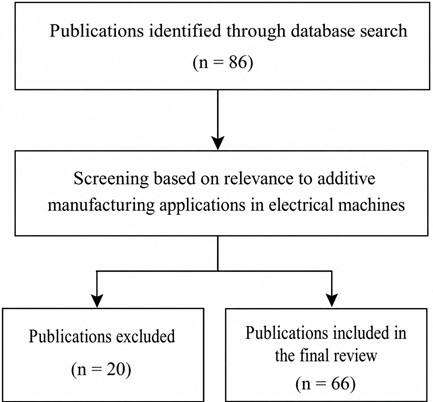
The initial search identified 86 publications. Each record was screened according to its relevance to the scope of this review. Studies were included when they addressed the design, fabrication, material properties, thermal behavior, electromagnetic performance, or machine-level integration of additively manufactured electrical-machine components. Publications were excluded when AM was only mentioned incidentally, the application was unrelated to electrical machines, or insufficient technical information was provided for meaningful evaluation.
Following screening, 20 publications were excluded and 66 studies were retained for detailed review. The selected studies were subsequently classified according to their primary contributions, including magnetic materials and cores, conductors and windings, AC-loss mitigation, thermal management, cooling structures, manufacturing constraints, and machine-level integration for practical electrical-machine implementation studies. The overall identification, screening, and study-selection process is summarized in Fig. 1.
Fig. 1Flow diagram of the literature search and study-selection process
2.2. Comparative positioning of the present review
To better define the scope and contribution of this review, a number of review and overview studies on additive manufacturing in electrical machines and related research areas were examined comparatively. The comparison focuses on the main topics addressed in these studies, including material systems, manufacturing methods, machine components, and their intended functions. As shown in Table 1, much of the existing review literature concentrates on particular materials, fabrication techniques, or individual components. In contrast, relatively few studies consider magnetic materials, conductors and windings, AC-loss reduction, thermal management, and machine-level applications within the same framework. The present review aims to bring these closely related topics together and to provide a broader view of the role of additive manufacturing in electrical machine development.
Table 1Comparison of selected review and overview studies with the scope and contribution of the present review
Study | Scope | Materials | Processes | Machine components / functions | Unresolved gaps relative to the present review |
Ghahfarokhi et al. [2] | AM-enabled thermal management of electrical machines | Materials and structures used for thermal management and cooling | FFF/FDMSLA, SLS/SLM and related AM approach | Heat sinks, heat exchangers, cooling jackets, winding cooling and related thermal structures | Provides a detailed thermal-management perspective and discusses the maturity of AM-enabled cooling concepts; however, magnetic-material behavior, winding/AC-loss mechanisms and their combined machine-level validation are outside its primary scope |
Dan et al. [4] | Thermal management of electric vehicles at component and system levels | Cooling media and thermally functional materials, including phase-change-based solutions | Air, liquid, phase-change and other thermal-man. tech. | Vehicle air-conditioning, battery thermal management and motor thermal management | Broad EV thermal-management review; AM process–material relationships and AM-specific electrical-machine design are not its central focus |
Wu and El-Refaie [5] | Opportunities and challenges of AM for electrical-machine construction | Magnetic-core, conductive, insulating, permanent-magnet and cooling-related materials | Multiple AM and multi-material man. approach | Iron cores, winding, insulation, permanent magnets and cooling systems | Broad AM overview covering most major machine subsystems; however, the evidence is not systematically classified from material/component studies through prototype and operational-machine validation |
Hussain et al. [6] | AM and topology optimization of reluctance machines | Mainly magnetic and conductive materials relevant to reluctance-machine development | AM technologies applicable to electrical machines together with topology-optimization methods | Primarily stator and rotor magnetic structures of reluctance machines | Strong focus on reluctance-machine topology and manufacturability; integration with winding, thermal-management and broader machine-level validation is less central |
Schuhmann et al. [7] | AM applications within electro-mobility | Broad range of materials relevant to AM in electromobility, with substantial attention to metallic AM | Various AM tech. including metal AM | Electric motors together with other electromobility components | Broad electromobility perspective rather than a detailed electrical-machine synthesis linking magnetic materials, windings, losses and thermal management |
Ahmad et al. [8] | Design freedom offered by AM for improving electrical-machine performance | Magnetic, conductive and other functional materials used in electrical-machine components | Multiple AM routes enabling complex machine geometry | Stator/rotor structures, winding geometries and thermal-management structures | Provides broad electrical-machine coverage; however, evidence maturity from simulation/material testing to operational-machine validation and AI/data-driven methods are not used as the principal framework for organizing the evidence |
Lamichhane et al. [9] | AM of soft magnetic materials for electrical machines | Soft magnetic materials, particularly Fe–Si, Fe–Co and related systems | Multiple AM routes, including process-selection and hybrid-printing approach | Mainly soft magnetic cores and magnetic components | Primarily material-centered; conductors/windings, integrated thermal management and multidisciplinary complete-machine assessment are outside its main scope |
Tiismus et al. [10] | State of the art and tech. maturity of AM electromagnetic materials for topology-optimized electrical machines | Soft magnetic, hard magnetic and electrically conductive materials | AM tech. applicable to electromagnetic materials | Magnetic cores, permanent magnets and conductive components | Provides an important material and technology-maturity assessment; integrated thermal management and systematic progression from component evidence to operational complete-machine validation receive less emphasis |
Ajamloo et al. [11] | AM methods and properties of soft and hard magnetic cores for electrical machines | Fe–Si and Fe–Co-based soft magnetic materials; hard magnetic materials including NdFeB, ferrite and Alnico | LPBF, binder-/sintering-based and other AM routes for magnetic materials | Soft magnetic cores and hard-magnetic/permanent-magnet components | Strongly focused on magnetic materials and cores; conductors/windings, integrated cooling and whole-machine multidisciplinary integration are outside its central scope |
Wang et al. [12] | Thermal-management technologies for electric motors used in electric cars | Cooling media and thermally functional materials | Air, liquid and other motor-cooling tech. | Electric-motor thermal systems and cooling paths | Detailed motor-cooling review, but AM processes, AM magnetic materials and AM-enabled winding/manufacturing considerations are not integrated |
Wrobel [13] | Thermal management of integrated motor drives | Thermal-management materials and working media | Passive and active cooling technologies | Electrical machine and integrated-drive thermal systems | Focuses on high-specific-output integrated-drive thermal management rather than AM material–process relationships and multidisciplinary AM machine development |
Present review | Integrated assessment of metal AM for high-performance electrical machines | Soft/hard magnetic materials, conductive materials, windings and thermally functional AM structures | Metal-AM processes, post-processing strategies and geometry-enabled design approaches relevant to electrical-machine components | Magnetic cores, conductors/windings, AC-loss-management structures, thermal-management systems and machine-level applications | Integrates electromagnetic, thermal, mechanical and manufacturing trade-offs; distinguishes evidence from simulation and material/coupon testing through component, prototype and machine-level validation; and incorporates the emerging role of AI and data-driven approaches |
3. Additively manufactured soft magnetic cores
Soft magnetic cores (SMCs) are indispensable in electrical machines due to their role in establishing and guiding magnetic flux. They are used to strengthen the magnetic field generated by winding currents; their high magnetic permeability enables rapid magnetization, increasing flux density and thereby improving machine efficiency and performance. In addition, their low coercivity supports fast response to alternating field variations while minimizing energy dissipation, making SMCs well suited for applications dominated by time-varying magnetic excitation with reduced hysteresis losses. SMCs, characterized by low magnetic reluctance along the flux path, remain fundamental building blocks of electrical machines [14]. For high-performance electrical machines, achieving high flux density while maintaining low total losses is critical [15], [16]. Traditionally, magnetic cores have been fabricated from laminated electrical steels; however, additive manufacturing (AM) now enables the production of Fe-Si and Fe-Co based soft magnetic alloys for machine components [3], [11], [17]. Compared with lamination, AM introduces new design freedoms but also elevates the risk of increased eddy-current losses under high-frequency operation. For this reason, this review emphasizes both alloy/process optimization and AM-enabled topologies that aim to suppress these losses.
3.1. Additive manufacturing processes for soft magnetic materials
For metal AM, four process families are most commonly employed: laser powder bed fusion (L-PBF), binder jetting (BJ), directed energy deposition (DED), and material extrusion (MEX). Their working principles are illustrated in Fig. 2. Both LPBF and BJ are powder-bed processes; in LPBF, powder is selectively melted by a laser, whereas BJ selectively deposits a chemical binder to join powder particles, followed by post-processing. In DED, material (powder or wire) is fed while an energy source, typically a laser, creates a melt pool, whereas in MEX a metal-polymer composite feedstock is heated and extruded layer-by-layer and subsequently debound and sintered. According to the literature, L-PBF (≈ 65 %) and BJ (≈ 15 %) are the most frequently used approaches for AM of SMCs [11], [18]. Reviews by Lamichhane et al. [9] and Ajamloo et al. [11] indicate that more than 90 % of published studies focus on Fe-Si and Fe-Co alloys: approximately 81 % investigate Fe-Si, ~14 % Fe-Co, and the remaining ~5 % explore alternatives such as Fe-Ni.
Silicon-rich electrical steels, such as Fe-6.5 wt% Si, are attractive because their higher electrical resistivity can reduce eddy-current losses [14], [19], [20], [21], [22]. In conventional sheet processing, however, increasing Si content significantly embrittles the alloy, making it difficult to roll and stamp thin laminations without cracking; therefore, the Si content in commercial laminated electrical steels is typically limited to around ~3.5 wt%. In contrast, AM can fabricate soft magnetic Fe-6.5 wt% Si cores that can exhibit improved electromagnetic properties relative to their laminated counterparts, while also enabling three-dimensional geometrical tailoring. Nevertheless, the application of AM to stator cores remains constrained by the challenge of limiting eddy-current losses in high-frequency conditions. By comparison, AM of rotor cores has advanced further, partly because the magnetic excitation in rotors can be closer to quasi-DC, resulting in more manageable eddy-current generation [11].
Fig. 2Common AM methods in the fabrication of soft and hard magnetic cores: a) L-PBF, b) BJ, c) DED, d) MEX [10]
![Common AM methods in the fabrication of soft and hard magnetic cores: a) L-PBF, b) BJ, c) DED, d) MEX [10]](https://static-01.extrica.com/articles/26758/26758-img2.jpg)
a)
![Common AM methods in the fabrication of soft and hard magnetic cores: a) L-PBF, b) BJ, c) DED, d) MEX [10]](https://static-01.extrica.com/articles/26758/26758-img3.jpg)
b)
![Common AM methods in the fabrication of soft and hard magnetic cores: a) L-PBF, b) BJ, c) DED, d) MEX [10]](https://static-01.extrica.com/articles/26758/26758-img4.jpg)
c)
![Common AM methods in the fabrication of soft and hard magnetic cores: a) L-PBF, b) BJ, c) DED, d) MEX [10]](https://static-01.extrica.com/articles/26758/26758-img5.jpg)
d)
Beyond soft magnetic steel, AM has also been applied to permanent magnet materials. For example, NdFeB magnets have been produced using polymer-bonded large-area AM and binder jetting routes. However, such approaches often yield parts containing up to ~70 vol% magnetic material, which may be insufficient to reach the density required for certain high-performance applications. Overall, additively manufactured magnetic materials remain highly promising for a wide range of applications, but further research is needed to improve densification and to tailor microstructural features to meet demanding electromagnetic performance targets [23]. As shown by Cramer et al. [23], binder jetting is particularly well suited for producing crack-free, near-net-shape components and can achieve high density after appropriate post-processing, making it a strong candidate route for SMC production [6], [11], [20], [24].
Fe-Co and Fe-Co-based amorphous alloys are among the most attractive soft magnetic materials for high-performance applications, owing to their exceptionally high saturation magnetization and Curie temperature. Significant progress has been reported in the additive manufacturing of these alloys – particularly via selective laser melting (SLM) and laser engineered net shaping (LENS) – which enables improved microstructural control and, in many cases, enhanced mechanical performance. Nevertheless, due to their high material cost and processing challenges, Fe–Co systems are still largely confined to specialized, high-value applications, most notably in aerospace and other high-efficiency systems where superior magnetic performance is required [9].
Among soft magnetic materials, Fe–Co alloys are known to exhibit the highest saturation magnetization and Curie temperature; for example, an alloy composition close to 35 % Co-65 % Fe can reach a saturation flux density of approximately 2.43 T at room temperature. As a result, Fe-Co-based alloys are frequently selected for high-performance electrical machines that demand high magnetic loading and elevated flux density [5], [9], [14]. Kustas et al. additively manufactured an Fe-Co-1.5 V alloy using the LENS process and characterized the resulting microstructures in terms of atomic ordering, grain morphology, and crystallographic texture [25]. In related work, Goll et al. demonstrated the feasibility of producing SLM components from Fe-Co, Fe-Ni, and Fe-Si alloys and examined how the resulting component properties depend on key process parameters [26].
3.2. Post-processing: heat treatment (HT) for property enhancement
The rapid thermal cycling intrinsic to laser powder bed fusion (L-PBF) can introduce significant residual stresses and local distortions in printed metallic components. These effects are particularly pronounced in larger Fe-Si parts, where they may degrade dimensional accuracy and compromise microstructural integrity [27]. As a consequence, as-built components typically exhibit reduced magnetic permeability and elevated coercivity when no post-processing is applied [11], [28].
Post-processing heat treatment is therefore critical to mitigate process-induced defects and to restore magnetic performance to target levels [9], [11], [29], [30]. In the L-PBF processing of Fe-Si alloys, the high cooling rates promote fine grain structures, which generally yield inferior magnetic properties compared with coarse-grained cast or rolled counterparts. High-temperature heat treatment not only relieves internal stresses but also promotes grain growth, leading to substantial improvements in the magnetic response of soft magnetic cores (SMCs).
Fig. 3Optical and scanning electron microscope (SEM) images of the surface and cross-sections of as-printed annealed Fe-6.5 wt%Si sheets [29]
![Optical and scanning electron microscope (SEM) images of the surface and cross-sections of as-printed annealed Fe-6.5 wt%Si sheets [29]](https://static-01.extrica.com/articles/26758/26758-img6.jpg)
a) As-printed
![Optical and scanning electron microscope (SEM) images of the surface and cross-sections of as-printed annealed Fe-6.5 wt%Si sheets [29]](https://static-01.extrica.com/articles/26758/26758-img7.jpg)
b) 1200 °C
The influence of heat treatment on the microstructure and magnetic properties of Fe-6.5 wt% Si plates is illustrated in Fig. 3. As shown in Fig. 3(a) and (b), the surface becomes noticeably smoother after heat treatment, and millimeter-scale macroscopic grains can be observed. In addition, the cross-sectional surface roughness improves from approximately 5.5 μm to 3.8 μm [29]. In contrast, the as-built condition typically exhibits “semi-soft” magnetic behavior, characterized by low permeability and high coercivity. This is commonly attributed to high residual stress generated by rapid cooling, small grain size, and microstructural heterogeneity introduced during printing. Heat treatment reduces residual stresses, increases grain size, and homogenizes the microstructure through recrystallization, thereby playing a decisive role in enhancing magnetic properties [11]. Consistent with these mechanisms, Garibaldi et al. and others have reported that heat treatment decreases internal stress and increases magnetic permeability through grain growth, resulting in marked improvements in soft magnetic performance [2], [9], [11], [17], [27], [29], [31]. Table 2 summarizes the changes in maximum relative permeability and coercivity reported for different additively manufactured soft-magnetic alloys before and after heat treatment. The processing route, specimen condition, heat-treatment parameters, and magnetic characterization conditions are also included to provide the necessary context for each result. Since these conditions differ from one study to another, the numerical values should not be compared directly across studies. Instead, they are more appropriately interpreted by comparing the as-fabricated and heat-treated states within each individual study. Overall, the reported results show a consistent tendency toward higher permeability and lower coercivity after suitable heat treatment, although the extent of improvement depends strongly on the alloy composition, processing history, specimen geometry, and treatment conditions.
Table 2Structured evidence summary of heat-treatment effects on additively manufactured soft-magnetic alloys under source-specific processing and characterization conditions
Alloy / Study | AM process / specimen condition | Heat-treatment condition | Magnetic characterization / reference condition | Maximum relative permeability, μmax (AF → HT) | Coercivity, Hc (A/m) (AF → HT) |
FeSi2.9, Quercio et al. [32] | L-PBF; magnetic specimens with geometry selected according to the characterization method | Annealed condition; source-specific treatment | Magnetic properties evaluated using dedicated specimen geometries | 748 → 3224 | NR |
Fe-Si, Shen et al. [33] | L-PBF; Fe–Si material developed for three-dimensional magnetic-flux motor application | Annealed condition | Magnetic characterization performed in the context of 3D-flux motor application | NR | 357 → 317 |
Fe-6.5 wt%Si, Koo et al. [29] | Shell-shaping SLM; structurally layered Fe–Si specimens | High-temperature treatment in the 1000-1200 °C range | Magnetic properties evaluated after HT; core-loss behavior also studied under high-frequency excitation | 797 → 7393 | 165 → 34.6 |
Fe-Si, Tiismus et al. [34] | L-PBF; toroidal specimens; optimized printing condition | 1200-1350 °C, 1 h in vacuum; 1200 °C identified as optimum | Quasi-static magnetic characterization; 50 Hz loss performance also evaluated | 1400 → 8900 | 203 → 52 |
Fe-3.7 wt%Si, Tiismus et al. [35] | SLM; solid and partitioned toroidal specimens | As-built, 800 °C and 1200 °C conditions | DC magnetic characterization; AC losses evaluated at 50 Hz over several flux-density levels | 3220 → 28,900 | 205 → 41 |
FeSi6.7, Goll et al. [26] | L-PBF; soft-magnetic Fe–Si material/component route | Thermal post-processing applied; treatment conditions are source-specific | Magnetic characterization including hysteresis-loss evaluation at 1 T and 50 Hz | 2150 → 31,000 | 144.5 → 16.2 |
Fe-Co-1.5V, Kustas et al. [25] | LENS; bulk Fe-Co-1.5V specimens | Annealed condition | Magnetic properties assessed before and after thermal post-processing | 518 → 1615 | 995 → 401 |
Equiatomic Fe-Co, Li et al. [36] | LPBF; dense bulk equiatomic Fe-Co | Post-LPBF annealing | Soft-magnetic properties evaluated after structural ordering and stress-relief treatment | 503 → 5008 | 1417 → 450 |
Equiatomic Co-Fe, Liogas et al. [37] | LPBF; ring specimens | 1300 K for 2 h + 1123 K for 4 h, followed by controlled slow cooling | Quasi-static magnetic characterization in a closed magnetic circuit | 315 → 8197 | 1394 → 112 |
Fe-49Co-2V, Riipinen et al. [38] | L-PBF; bar specimen for the values reported here | HT2: 700 °C for 2 h + 820 °C for 10 h, Ar–4%H₂ atmosphere | Quasi-static DC measurement; separate ring specimens were also evaluated at 10 and 50 Hz | 307 → 17,000 | 1344 → 52 |
Note: AF denotes the as-fabricated condition, HT denotes the heat-treated condition, and NR denotes not reported. The values should be interpreted within the specific processing and test conditions of each study | |||||
A comparison of the reported heat-treatment routes shows that the magnetic response cannot be explained by residual-stress relief and grain growth alone. Garibaldi et al. [31] showed that annealing Fe–6.9Si at 1150 °C for 1 h produced a recrystallized, predominantly equiaxed microstructure while retaining the favourable <001> texture along the build direction, resulting in a maximum relative permeability of 24,000 and a coercivity of 16 A/m. Tiismus et al. [35] similarly demonstrated a strong temperature dependence in Fe-3.7Si: increasing the annealing temperature from 800 to 1200 °C reduced coercivity from 132 to 41 A/m and increased the maximum relative permeability from 7460 to 28,900. Over the same temperature range, however, electrical resistivity decreased from 59.2 to 56.9 µΩ·cm, illustrating that heat treatment involves a balance between improved hysteresis behaviour and the resistivity required to suppress classical eddy currents. Heat-treatment sequence is equally important. For equiatomic Co-Fe, Liogas et al. [37] employed a multi-stage route consisting of normalization at 1300 K for 2 h, subsequent treatment at 1123 K for 4 h, and controlled slow cooling. This treatment promoted both recrystallization and B2 ordering, yielding a maximum relative permeability above 8000, a coercivity of 112 A/m, and a magnetic saturation polarization of 2.39 T. A pronounced route dependence was also reported for Fe-49Co-2V by Riipinen et al. [38]. A 700 °C pre-anneal followed by treatment at 820 °C produced a coercivity of 52 A/m and a maximum relative permeability of 17,000, whereas normalization at 950 °C before the same primary annealing temperature resulted in 527 A/m and 1421, respectively. The latter response was associated with partial grain growth and grain-boundary pinning by second-phase particles. These comparisons indicate that the optimum post-processing strategy is alloy- and process-specific and depends on the combined evolution of residual stress, grain morphology, crystallographic texture, structural ordering, secondary phases, and electrical resistivity rather than annealing temperature alone.
These findings also have direct implications for material-specific heat-treatment optimization. Garibaldi et al. [31] showed that annealing Fe-6.9 wt%Si at 1150 °C for 1 h produced a recrystallized microstructure with a maximum relative permeability of 24,000 and a coercivity of 16 A/m. Liogas et al. [37] identified a two-step treatment consisting of normalization at 1300 K for 2 h followed by 1123 K for 4 h and slow cooling as the optimum route among the investigated profiles for equiatomic Co-Fe. Riipinen et al. [38] further reported that the optimum heat-treatment procedure depends on alloy composition and initial microstructure; in their Fe-49Co-2V study, one treatment cycle produced magnetic properties comparable to commercial Fe-Co-V, whereas the other investigated treatments resulted in abnormal grain growth and poorer magnetic performance.
From a machine-level perspective, improvements in soft-magnetic properties obtained after heat treatment are important insofar as they enable greater magnetic-flux utilisation without excessive AC loss. Koo et al. [29], for example, reported a permeability of 7393, a coercivity of 34.6 A/m, and a saturation magnetization of 1.68 T for heat-treated Fe-6.5Si, together with a core loss of 52.5 W/kg at 1 kHz and 1 T. These values illustrate how improved permeability and reduced coercivity, when accompanied by adequate saturation behaviour and loss control, can support the use of AM soft-magnetic cores under elevated-frequency excitation. At the machine level, Shen et al. [33] showed that an LPBF Fe-3.5Si core produced 19.1 % higher rotary torque than a soft magnetic composite counterpart in a 3D-flux machine under ferrite excitation at 50 Hz. However, the AM alloy exhibited higher total iron loss at stronger magnetic fields and higher frequencies, highlighting an important performance trade-off. Similarly, Goodall et al. [21] reported that an AM Fe-6.5Si Hilbert stator exhibited losses comparable to 0.35-mm electrical-steel laminations below 500 Hz. Although the lower magnetic-material volume resulted in an approximately 20 % reduction in torque, the reduced stator mass provided a 13 % improvement in torque density. These results demonstrate that permeability, coercivity, saturation behaviour, and AC loss should be evaluated together when assessing the machine-level benefits of AM soft-magnetic materials, particularly as operating frequency increases.
3.3. Topological and functional strategies for eddy-current loss mitigation
AM creates substantial opportunities to enhance electromagnetic performance and reduce power losses by enabling geometrically complex core architectures that are impractical to fabricate using conventional processes. This capability becomes particularly valuable under high-frequency operating conditions, where eddy-current losses can dominate total core loss [3], [8], [16], [19]. In conventional electrical machines, magnetic cores are typically built from stacked laminations to increase electrical resistance across the flux path and thereby suppress eddy currents. However, lamination-based manufacturing can be difficult or even infeasible for non-traditional and geometrically complex machines, such as axial-flux and transverse-flux topologies, spherical motors, claw-pole machines, and other asymmetric electrical machines, where core geometries are inherently three-dimensional and do not conform to standard stamping and stacking routes.
AM can realize such unconventional magnetic-core geometries while simultaneously embedding eddy-current-suppressing features directly into the core. Reported AM-enabled eddy-current mitigation concepts include segmented or parallel-plate structures, Hilbert-curve inspired patterns, and clock-spring–type topologies. Compared with fully solid AM cores, cores incorporating these loss-mitigation geometries exhibit reduced eddy-current formation. Moreover, relative to simple parallel-plate segmentation, Hilbert-type and clock-spring designs have been shown to provide more effective suppression of eddy-current losses [8].
An additional advantage is that, unlike many conventional manufacturing routes, AM part-production costs do not necessarily scale strongly with geometric complexity (see Fig. 4). Since material is deposited only where required, AM can also reduce material waste, which is beneficial for both cost and sustainability considerations [39].
Fig. 4Comparative analysis of additive manufacturing and conventional manufacturing in terms of part complexity and production cost [39]
![Comparative analysis of additive manufacturing and conventional manufacturing in terms of part complexity and production cost [39]](https://static-01.extrica.com/articles/26758/26758-img8.jpg)
These AM-enabled topologies for electrical machines can deliver a range of system-level benefits, including reduced mass, improved heat-removal effectiveness, smoother torque production, lower noise and vibration, and even the emergence of entirely new machine architectures that are not feasible with conventional manufacturing routes [19].
In solid and laminated magnetic cores, eddy currents are induced as a function of magnetic flux density and the flux variation frequency . Accordingly, eddy-current losses increase approximately with and . The magnitude of these losses also depends on the material’s electrical resistivity and, for laminated stacks, the lamination thickness. A straightforward approach to reducing eddy-current losses would be to lower and ; however, this directly penalizes power density and thus conflicts with high-performance design objectives. In practice, the most effective strategies are to (i) increase the effective electrical resistivity of the core material and/or (ii) segment the core into electrically insulated thin sections (laminations) to interrupt circulating current paths. From a materials perspective, high-silicon electrical steels can increase resistivity and thereby reduce losses. In AM, additional loss-mitigation pathways are possible, such as intentionally introducing microscale voids during printing to disrupt eddy-current loops. Furthermore, emerging approaches propose increasing core resistivity through the incorporation of layers/materials such as FeAl16, FeGA3, and Al2O3 [19].
For additively manufactured soft magnetic cores, integrating slits, micro air gaps, or thin-walled topologically optimized structures into the core is widely recognized as an effective design approach for restricting eddy-current pathways and reducing eddy-current losses [3], [5], [19], [26]. Goodall et al. reported improved eddy-current-loss performance in the stator of an axial-flux electrical machine by employing a Hilbert cross-sectional geometry that enables a three-dimensional magnetic-flux path [21], [30]. Similarly, Goll et al. demonstrated reductions in eddy-current-related losses through AM-informed design and processing choices [26].
Fig. 5 illustrate additive-manufacturing (AM)-enabled material and topological strategies for reducing eddy-current losses. Fig. 5(a) presents a reference multilayer structure without slits, where insufficient interlayer insulation results in high eddy-current density. Fig. 5(b) introduces an improved concept with alternating Fe-6.7%Si and FeAl16 layers and integrated slits, which interrupt current paths and enhance insulation. Fig. 5(c) shows finite-element (FE) results for this design, confirming a significant reduction in eddy-current density. The additively manufactured prototype demonstrates feasibility, with losses reduced by up to 28 % compared to the layered structure and 7 % relative to the baseline.
Functionally graded structures enhance the magnetic and thermal performance of electrical-machine (EM) cores by introducing a controlled, gradual variation of material properties within the component. By employing alternating layers of soft magnetic and insulating materials, these designs can constrain magnetic flux paths and suppress the formation of eddy currents. As demonstrated in graded-gyroid TPMS (triply periodic minimal surface) architectures, this approach can maintain an efficient magnetic-flux distribution while achieving lower total iron loss [3].
Fig. 5a) Finite-element (FE) simulation of eddy-current distribution in a toroidal multilayer reference structure composed of idealized materials [26]; b) schematic illustration of the layered, slotted structure and the prototype fabricated using the layered manufacturing method [26]; c) Finite element (FE) simulation of the slotted multilayer structure [26]
![a) Finite-element (FE) simulation of eddy-current distribution in a toroidal multilayer reference structure composed of idealized materials [26]; b) schematic illustration of the layered, slotted structure and the prototype fabricated using the layered manufacturing method [26]; c) Finite element (FE) simulation of the slotted multilayer structure [26]](https://static-01.extrica.com/articles/26758/26758-img9.jpg)
a)
![a) Finite-element (FE) simulation of eddy-current distribution in a toroidal multilayer reference structure composed of idealized materials [26]; b) schematic illustration of the layered, slotted structure and the prototype fabricated using the layered manufacturing method [26]; c) Finite element (FE) simulation of the slotted multilayer structure [26]](https://static-01.extrica.com/articles/26758/26758-img10.jpg)
b)
![a) Finite-element (FE) simulation of eddy-current distribution in a toroidal multilayer reference structure composed of idealized materials [26]; b) schematic illustration of the layered, slotted structure and the prototype fabricated using the layered manufacturing method [26]; c) Finite element (FE) simulation of the slotted multilayer structure [26]](https://static-01.extrica.com/articles/26758/26758-img11.jpg)
c)
Based on their review, Tiismus et al. anticipate a substantial increase in AM-based prototyping of topology-optimized EM components, including windings, heat exchangers, and synchronous rotors [10]. The geometric freedom offered by AM has enabled TPMS-based lattice architecture to be incorporated into the fundamental design of electrical machines. When combined with functional grading strategies, such structures offer important advantages for guiding magnetic flux and mitigating eddy-current losses [3], [16].
Although geometric segmentation can effectively restrict eddy-current paths, its practical benefit depends on a balance between electromagnetic performance, mechanical integrity, and manufacturability. Broumand and Hong [16] compared solid, parallel non-continuous, parallel continuous, and Hilbert thin-wall structures and showed that reducing the conductive path length substantially suppresses eddy-current formation. However, the geometry itself introduces important design constraints. A wall thickness of 400 µm with a solid volume fraction of approximately 50 % was adopted as a compromise between manufacturability and eddy-current suppression, whereas reducing the wall thickness to 200 µm was considered difficult to realize using existing metal AM technologies. The resulting magnetic behaviour is also strongly direction-dependent: the relative permeability of the parallel continuous-wall structure decreased to 45.7 % of its reference value for transverse magnetization, while the third-order Hilbert structure retained 67.7 %, corresponding to an approximately 33 % reduction. This structural magnetic anisotropy can be advantageous in reluctance-based machine designs, but it also demonstrates that interrupting conductive paths inevitably modifies the available magnetic-flux paths. Mechanical requirements further constrain the topology; despite the greater magnetic anisotropy of the parallel-wall structure, the Hilbert geometry was selected for the conceptual rotor because of mechanical-integrity considerations under high-speed operation. Manufacturing details can also compromise the intended electromagnetic benefit, since connecting struts required to join adjacent walls may form closed conductive loops and reintroduce eddy-current losses. Consequently, Hilbert, slit, and layered architectures should not be evaluated solely in terms of loss reduction; their suitability depends on the simultaneous control of flux-path continuity, structural integrity, minimum printable feature size, and unintended conductive bridges created during fabrication [16].
The available evidence in this area is mainly based on numerical simulations and component-level demonstrations; therefore, the reported benefits should not yet be interpreted as fully validated machine-level performance.
4. Conductors, windings, and AC loss management
Additive manufacturing (AM) enables the fabrication of windings and coils with virtually arbitrary cross-sectional profiles and integrated functionalities. This capability not only expands the design space for improving electrical-machine (EM) performance but also facilitates the development of thermally controlled machines through the integration of advanced thermal-management features directly into the winding structure. While higher rotational speed can increase power density, the associated AC losses in the windings can become a dominant limitation, particularly at elevated electrical frequencies [8], [22], [40], [41].
Mitigating these effects requires careful electromagnetic and thermal co-design. In contrast to conventional manufacturing, AM provides substantial geometric freedom in conductor shaping, offering new pathways to reduce AC loss mechanisms and improve heat extraction.
In parallel, the growing global commitment to net-zero targets, reinforced by climate-policy frameworks such as the Paris Agreement, has intensified the push toward EM designs targeting substantially higher power densities (on the order of 9-25 kW/kg) and efficiencies exceeding 96 %, while also minimizing dependence on rare-earth materials. Meeting these objectives demands significant reductions in winding losses and improved dissipation of heat generated by high-current conductors, challenges that are difficult to fully address using conventional manufacturing. AM offers a compelling route by enabling complex coil geometries and functional grading of materials within a single component. This flexibility allows engineers to integrate multiple functions, such as embedded cooling channels, terminals, and sensors, directly into the winding architecture, thereby supporting the development of next-generation, lightweight, high-efficiency Ems [42].
Despite these advantages, manufacturing high-conductivity metals, especially copper, remains technically challenging for powder bed fusion processes. Copper is difficult to process because achieving and sustaining localized heating under the laser spot is more complex than for many other metals. In modern EMs, copper remains the dominant winding material, with limited exceptions such as the aluminum squirrel-cage rotors used in certain low-power/low-voltage induction machines [43], [44]. Copper combines very high thermal conductivity, which promotes rapid heat dissipation from the melt pool, and high optical reflectivity at common laser wavelengths, which reduces energy absorption during processing [45]. Consequently, fabricating dense parts from pure copper via AM is non-trivial: the high thermal conductivity can lead to premature cooling during the build, and freshly produced copper parts also tend to oxidize rapidly if environmental control is insufficient [43], [46].
In AM applications, aluminum is often preferred over copper. One key reason is that aluminum can be processed to achieve finer feature resolution, which can enable the fabrication of a higher number of turns within a given winding volume [45], [47], [48]. In a study by Wu and El-Refaie, additively manufactured AlSi10Mg windings, despite having lower electrical conductivity than copper, were implemented in stator windings and shown to significantly reduce AC losses. In this context, the use of low-density AlSi10Mg can increase the machine’s specific power (power-to-mass ratio) [49], [50]. Similarly, Yamada et al. experimentally demonstrated that their aluminum winding configuration achieved lower losses and higher efficiency than a comparable copper winding. Notably, this improvement was obtained while maintaining the same overall motor mass, indicating a meaningful efficiency gain without a weight penalty [41].
Fig. 6An innovative semi-stranded winding design with transposed wire position [51]
![An innovative semi-stranded winding design with transposed wire position [51]](https://static-01.extrica.com/articles/26758/26758-img12.jpg)
To further reduce AC losses, Ref. [51] proposed a semi-stranded winding concept (Fig. 6) that combines semi-solid conductors with stranded segments. The individual strands are intentionally transposed to mitigate undesirable high-frequency current redistribution and associated eddy-current effects. By balancing DC and AC losses, the design achieves a high fill factor within a transposed, multi-strand architecture. The proposed winding was prototyped using 3D printing in an ultra-light aluminum alloy, demonstrating the manufacturability of advanced, AC-loss-aware conductor topologies via AM.
Slot (tooth-slot) geometry-tailored coils produced via additive manufacturing can enable higher efficiency and specific power by increasing slot fill factor and allowing tight integration with thermal management systems [52]. In addition, Ref. [49] reports that the electrical conductivity of additively manufactured conductors can be intentionally tuned by modifying the build orientation (vertical, horizontal, or inclined) and post-processing parameters. This controllability creates a valuable design lever for reducing AC winding losses in machines that employ solid conductors. For example, employing lower conductivity in conductors located near the slot opening can suppress AC loss mechanisms, whereas using higher conductivity near the slot bottom can reduce DC losses.
Despite the design freedom offered by AM, the practical feasibility of unconventional windings is constrained by conductor properties, electrical insulation, joining, and long-term reliability. Aluminum is attractive for weight-sensitive electrical machines, but its lower electrical conductivity than copper increases winding loss unless sufficient conductor cross-sectional area and slot utilization are provided. Yamada et al. [41] showed that this trade-off can be mitigated through a high-slot-fill aluminum winding design, demonstrating the close coupling between conductor material, available slot area, and electrical loss. AM provides additional freedom to tailor conductor cross-sections and winding paths; Wragge-Morley et al. [42] further noted that the electrical conductivity achieved in AM copper can approach that of conventionally drawn Cu wire. Nevertheless, conductivity remains strongly dependent on manufacturing quality. Jiang et al. [46] showed that porosity, impurities, relative density, and build-related defects can substantially influence the electrical performance of additively manufactured pure copper. Manufacturing feasibility also extends beyond printing the conductor itself. Ghahfarokhi et al. [47] emphasized the importance of winding manufacturing procedures and proper conductor connections in advanced hairpin configurations. For AM windings, these considerations are accompanied by the need for reliable insulation coverage of complex conductor surfaces and validation under repeated electrical, thermal, and mechanical loading. At present, such long-term machine-level validation remains limited. Therefore, AM-enabled windings should be assessed in terms of conductivity, slot utilisation, connection quality, insulation integrity, thermal behaviour, and durability rather than geometric freedom or mass reduction alone [41], [42], [46], [47].
Overall, the evidence for AM windings ranges from numerical design studies to experimentally manufactured components, while complete-machine and long-term operational validation remains limited.
4.1. Integration of advanced thermal management systems
While recent advances in additive manufacturing (AM) create major opportunities for next-generation electrical machines (EMs), thermal management has increasingly become a primary constraint in achieving high performance [30]. For instance, in electric vehicles, motor thermal management is critical as designs push toward higher torque, higher speed, and greater power density to improve competitiveness. Inadequate thermal management can lead to irreversible demagnetization of permanent magnets, accelerated aging of insulation materials, reduced efficiency, shortened service life, and, in severe cases, catastrophic motor failure [12].
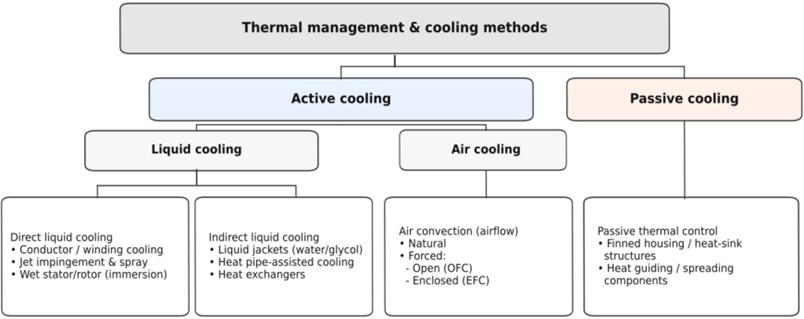
Ghahfarokhi et al. provide a comprehensive assessment of AM-enabled thermal management system (TMS) solutions for EMs, highlighting both the contributions of AM and the key challenges that remain [2]. As illustrated in Fig. 7, two overarching thermal management approaches are commonly distinguished in electrical machines-passive and active cooling-each with several sub-categories. Passive cooling typically offers simpler, more reliable, and lower-cost solutions, whereas active cooling can provide substantially higher cooling capacity and improved heat extraction under demanding operating conditions [2]. Sarap et al. have further advanced this area by contributing to the development and evaluation of such thermal management concepts for electrical machines [53].
Fig. 7Thermal management and cooling methods for electric machines
4.2. Directly integrated cooling solutions
Owing to its functional-integration capability, additive manufacturing (AM) enables thermal management system (TMS) concepts that extract heat directly from the windings and the magnetic core. This provides a level of design freedom that is difficult to achieve with conventional manufacturing and can significantly reduce the overall thermal resistance between heat sources and the ultimate heat sink.
In the aerospace sector, conventional turbofan/turbojet propulsion systems contribute substantially to emissions. To support emissions-reduction targets, advances in electrification have positioned permanent-magnet electrical machines as a promising alternative for future aircraft propulsion. Within this context, the ARPA-E ASCEND program has motivated research into aviation-class, synergistically cooled electric motors targeting specific power levels of 20 kW/kg and beyond. Reported gains in specific power have been enabled, in part, by integrating additively manufactured heat pipes into the propulsion-machine architecture [8], [54], [55]. AM facilitates the fabrication of hollow conductors with integrated cooling channels extending along the axial length of the windings. Such conductors are attractive for increasing specific power because they can be lightweight and, when appropriately designed, can also help mitigate AC losses at high operating frequencies through tailored electrical conductivity. In addition, they offer the potential for tight, simplified integration with power-electronics subsystems. For these reasons, aluminum alloys, most notably AlSi10Mg, are frequently employed and manufactured via direct metal laser sintering (DMLS) for hollow-conductor concepts [22], [56]. Heat pipes can be embedded into the winding assembly using AM-fabricated hollow conductors, enabling direct cooling and effectively increasing the allowable electrical loading of the machine [22].
Wu et al. investigated the use of copper–water heat pipes embedded within additively manufactured aluminum windings for a high-power-density electrical machine. In their concept, the heat-pipe assembly serves as the primary cooling mechanism. Despite several challenges related to electrical, thermal, and mechanical compatibility, experimental results indicated that the system may remove heat effectively. Compared with direct liquid cooling, which enabled a current density of approximately 14 A/mm2, the heat-pipe approach supported a higher current density (≈20 A/mm2), indicating increased thermal headroom for higher electromagnetic loading. Because heat pipes can transport heat efficiently from geometrically complex regions, heat-pipe-based cooling continues to attract strong interest for advanced EM thermal management [13], [57], [58].
Sixel et al. proposed ceramic additively manufactured direct-winding heat exchangers (3D-DWHX) to significantly enhance winding cooling in electrical machines, particularly under high-temperature operation, by leveraging the unique geometries achievable via 3D printing. Their comparative analysis reported that the 3D-DWHX concept can deliver a heat-transfer coefficient approximately 2.5× higher than conventional direct oil cooling. Moreover, the reference electrical machine achieved a specific power of 12.1 kW/kg. A 3D-DWHX integrated into a radial-flux, double-layer, concentrated-winding stator is built in Ref [59].
Wrobel, Scholes, Law, and co-workers developed and experimentally evaluated an integrated heat exchanger fabricated via metal additive manufacturing (MAM) to cool part of the electric propulsion system of a high-altitude, solar-powered aircraft. Their results demonstrated that MAM can enable the design and manufacture of an extremely compact and lightweight air-cooled heat exchanger capable of meeting the cooling requirements of a specific solar-powered aircraft electric motor, highlighting the value of AM for tightly constrained aerospace thermal-management applications [60].
These results provide encouraging component-level evidence for directly integrated cooling, although further validation in complete machines under representative operating conditions is still required.
5. Integration of phase change materials (PCMs)
Among recent advances in thermal management, the integration of phase change materials (PCMs) has attracted increasing attention as a means to enhance heat absorption and redistribution in electrical machines. One emerging approach places PCM directly within magnetic cores so that heat generated in the windings can be absorbed efficiently and redistributed through latent-heat buffering. In this concept, the magnetic cores are configured as thin-walled structures, and the internal voids are filled with PCM to maximize thermal buffering capacity (see Fig. 8). When complemented by an active cooling system, this strategy can support high-torque operation while improving thermal stability under demanding conditions [13], [28], [30], [61].
In Ref. [61] PCM was employed to prevent degradation of NdFeB permanent-magnet performance at elevated operating temperatures; the results indicated that the magnets’ magnetic properties were effectively preserved. Ref. [13] further showed that PCMs can provide an innovative thermal-management pathway for integrated motor drives (IMDs), particularly for windings subjected to overload conditions. In that study, PCMs (specifically paraffin) were integrated into additively manufactured conductors to enhance thermal performance, achieving an approximately 60 % reduction in winding temperature rise compared with a conventional alternative. Fig. 9 illustrates the structure of an AM-fabricated coil featuring integrated cooling channels. To provide a clearer comparison of the reported PCM results, the main findings are summarized in Table 3 together with the corresponding operating and evaluation conditions.
Fig. 8Conceptual stator segment structures in which the voids of thin-walled structures, including magnetic cores, liners, and windings are filled with PMCs. From left to right: Bulk, Parallel and Hilbert structures [30]
![Conceptual stator segment structures in which the voids of thin-walled structures, including magnetic cores, liners, and windings are filled with PMCs. From left to right: Bulk, Parallel and Hilbert structures [30]](https://static-01.extrica.com/articles/26758/26758-img14.jpg)
Fig. 9Additively manufactured coil with integrated channels [62]
![Additively manufactured coil with integrated channels [62]](https://static-01.extrica.com/articles/26758/26758-img15.jpg)
Table 3PCM-based thermal-management studies and corresponding evaluation conditions
Study | Application / component | PCM configuration | Evaluation / operating condition | Reference condition | Reported thermal outcome |
Broumand et al. [30] | Winding thermal management using thin-walled AM magnetic-core structures | PCM placed within internal voids of the AM core | Transient thermal evaluation under high-load operation; active-cooling influence also considered | Corresponding configuration without PCM | 74 % increase in allowable operating duration without active cooling; 104 % delay in early-stage temperature rise with active cooling |
Lamarre et al. [61] | Thermal protection of NdFeB permanent magnets | PCM incorporated into permanent-magnet structures | Elevated temperature/ transient thermal operation; numerical and experimental evaluation | Magnet configuration without PCM | Up to 232 % increase in allowable transient duration before the specified temperature limit; > 31 °C reduction in average magnet temperature in the simulated EV operating case |
The reported cooling approaches address different thermal requirements and operating conditions. Sarap et al. [53] reported that air cooling is often sufficient for less power-dense electrical machines, whereas liquid cooling is used for more demanding applications; they also noted that direct liquid cooling can improve thermal performance by bringing the coolant closer to the heat source and identified additively manufactured hollow windings as a direct-conductor-cooling solution. For a high-specific-power aircraft-propulsion electric machine, Chowdhury et al. [54] developed additively manufactured hollow conductors integrated with heat pipes with the aim of increasing machine specific power. Their study further showed that the thermal-management-system performance and specific power are sensitive to coolant temperature, while the maximum heat-transfer capability of the heat pipes depends on condenser coolant temperature and configuration; fin-based surface-area enhancement was also required at some convective boundaries to achieve the target thermal performance. In contrast, Broumand et al. [30] evaluated PCM-filled thin-wall AM magnetic cores under transient high-load conditions and reported a 74 % increase in allowable operating duration without active cooling and a 104 % delay in temperature rise when active cooling was present. Thus, Sarap et al. [53] distinguish air- and liquid-cooling applicability according to thermal demand, Chowdhury et al. [54] demonstrate an AM hollow conductor/heat-pipe system for a high-specific-power aircraft machine, and Broumand et al. [30] demonstrate PCM-based thermal buffering under transient high-load operation. The available PCM evidence ranges from numerical machine-level assessment to experimental component testing, while full operational-machine validation remains limited.
6. Discussion and future outlook
Additive manufacturing (AM) offers an exceptional opportunity to enhance the performance of electrical-machine (EM) components by effectively overcoming key constraints of conventional manufacturing. In particular, AM enables the realization of complex three-dimensional geometries, the incorporation of integrated cooling channels, and the implementation of structures optimized via advanced topological design methods. Despite this unique design freedom, broad commercial deployment and widespread industrial adoption remain hindered by several critical, unresolved challenges that span both academic research and practical engineering. The performance of AM-fabricated components depends strongly on process parameters, resulting microstructure, and post-processing routes [11]. Whether the target is electrical or magnetic functionality, the “as-built” condition often compromises the properties required for high-performance operation. For example, Fe-Si cores produced by powder bed fusion techniques such as LPBF are prone to processing-induced defects, notably porosity and microcracking. These structural imperfections can significantly degrade both magnetic performance and thermal conductivity. Recent work by Michieletto et al. [1] highlights the growing necessity of advanced non-destructive evaluation methods, such as X-ray computed tomography (CT), to reliably detect subsurface anomalies and ensure build-quality validation. AM also introduces major challenges for thermal management, particularly in the fabrication of internal cooling channels. Due to the layer-wise build process, AM channels typically exhibit high surface roughness, which can strongly affect pressure drop and convective heat transfer. Favero et al. [63] showed that conventional computational fluid dynamics (CFD) tools are often insufficient for accurately predicting the pressure losses and heat-transfer coefficients in such channels, largely because the effective roughness state is not known as a priori. This limitation creates substantial uncertainty in the modeling of AM-optimized thermal solutions and underscores the critical need for experimental calibration and validated correlations tailored to AM surfaces.
Beyond channel roughness, accurate thermal modeling requires reliable identification of key parameters that are difficult to measure directly. Wang et al. [12], for instance, emphasized the importance of determining the effective thermal conductivity of winding insulation and the contact thermal resistance at material interfaces. These parameters are particularly consequential in AM systems because performance is strongly influenced by process-dependent microstructures and thermal anisotropy. Moreover, thermal models must account for the complex internal geometries and heterogeneous material distributions enabled by AM. To rigorously validate such models and extract reliable parameter values, inverse approaches are increasingly advocated as a practical route for identifying otherwise inaccessible thermal properties from measurable system-level data.
For high specific-power applications such as electromobility and aviation propulsion, a central ambition of AM is the realization of a fully functional, monolithic electrical machine. Achieving this vision requires integrating all key functional components, most critically the magnetic core, conductive winding, and electrical insulation, within a single, unified manufacturing step. Reaching true single-step multi-material AM is widely viewed as a paradigm shift that could fundamentally eliminate critical thermal contact resistances, enable ambitious specific power-density targets, and reduce assembly complexity [30], [43]. However, as argued by Lamichhane et al. [9], multi-material integration remains the principal barrier preventing AM from reaching its full potential in EMs. Overcoming this barrier would substantially reduce production time and manufacturing cost by minimizing or eliminating assembly operations. The core difficulty lies in thermal and process incompatibility across materials: metallic alloys often require processing temperatures exceeding ~1000 °C, whereas dielectric materials, such as polymers and many ceramics, may require stability below ~300 °C, creating severe constraints on physical compatibility, interface quality, and defect control. In addition, Wu and El-Refaie [5] emphasize that reliable insulation of additively manufactured conductors remains a major unresolved challenge; they suggest that high-temperature ceramic insulation, compared with conventional polymers, may provide a more robust long-term pathway.
Among the challenges discussed above, multi-material integration emerges as the principal barrier to the realization of fully additively manufactured electrical machines. Lamichhane et al. [9] explicitly identified multi-material integration as a principal obstacle preventing AM from reaching its full potential in electrical machines, particularly because different functional materials require substantially different processing conditions. Wu and El-Refaie [5] further noted that only a limited number of fully additively manufactured electrical machines have been investigated and that reliable insulation of additively manufactured conductors remains an unresolved challenge. A further critical barrier concerns predictive thermal design. Favero et al. [63] experimentally showed that AM-induced surface roughness can cause significant discrepancies between numerical predictions and measured pressure losses and heat-transfer behaviour in internal channels, requiring experimental calibration of numerical models. Accordingly, the cited literature identifies multi-material/process compatibility as the primary barrier, followed by reliable insulation and experimentally validated thermal modelling as critical requirements for progressing from individual AM components toward complete electrical machines [5], [9], [63].
The potential impact of AM is not limited to the manufacturing of discrete motor components. It also opens new opportunities for optimizing entire complex systems, such as integrated motor drives (IMDs). Wrobel [13] has emphasized the critical role of thermal management in IMDs and argued that AM can unlock design routes that were previously unattainable for such high specific-output systems.
Finally, a strong synergy exists between topology optimization (TO) and AM when the goal is to minimize both mass and energy losses in EMs. Lizarribar et al. [64], for example, demonstrated that TO can yield substantial rotor weight reductions. More broadly, these results underscore a central point: the highly complex geometries generated by TO are often infeasible to manufacture using conventional methods, whereas AM provides the practical means to realize them and translate computationally optimized designs into functional hardware.
The multidisciplinary design potential of AM becomes evident when material, topology, structural, and thermal choices are considered together rather than as independent developments. Sarap et al. [53] explicitly noted that AM enables electrical-machine designs with optimized mechanical, electromagnetic, and thermal parameters. At the magnetic-core and topology level, Broumand and Hong [16] showed that Hilbert thin-wall structures modify directional magnetic permeability and selected the Hilbert topology for their conceptual rotor partly because of mechanical-integrity considerations under high-speed operation. Goodall et al. [21] further demonstrated the machine-level consequence of this geometric freedom: their AM Hilbert stator was 33% lighter than the laminated reference and achieved a 13 % improvement in torque density, although the reduced magnetic-material volume resulted in an approximately 20 % reduction in torque. At the winding and thermal-management level, Chowdhury et al. [54] developed additively manufactured hollow conductors integrated with heat pipes for an aircraft-propulsion electric machine specifically aimed at increasing machine specific power. In addition, Shen et al. [33] reported that an annealed LPBF Fe-3.5 wt%Si core produced 19.1 % higher rotary torque than the soft-magnetic-composite counterpart under the investigated 50-Hz ferrite-excitation condition, while higher total iron loss occurred at stronger magnetic fields and higher frequencies. Taken together, these reported results directly connect magnetic-material selection, topology, structural requirements, winding cooling, and electromagnetic performance at the electrical-machine level [16], [21], [33], [53], [54].
Artificial intelligence represents an increasingly important enabling layer for extending additive manufacturing from geometry and material innovation toward data-driven design, manufacturing, and lifecycle management of electrical machines. Within this framework, AI-enabled process optimisation can support the identification of suitable combinations of manufacturing parameters, whereas in situ monitoring can provide a data-driven basis for recognising abnormal process signatures and potential defects during fabrication. Surrogate models can further reduce the computational burden associated with repeated high-fidelity electromagnetic, thermal, and mechanical simulations, thereby accelerating multi-objective design exploration and topology optimisation of complex AM-enabled components. These capabilities are particularly relevant to electrical machines, in which the design space may simultaneously involve electromagnetic performance, thermal dissipation, structural integrity, manufacturability, and material constraints. When combined within a digital thread, such approaches provide a pathway from AI-assisted design and manufacturing to continuously updated digital-twin representations of the manufactured machine or component.
The operational dimension of this framework is supported by recent developments in machine-learning-based condition monitoring and prognostics of rotating systems. Rezazadeh et al. [65] investigated supervised and unsupervised machine-learning approaches for the classification of unbalanced, misaligned, and cracked rotor-bearing systems using features extracted from the time, frequency, and time-frequency domains. Their supervised classifiers achieved testing accuracies of up to 97 %, while -means clustering correctly grouped 87 % of the samples, highlighting the potential of data-driven methods for condition monitoring, particularly when the damage state is not fully known a priori. More recently, Rezazadeh et al. [66] developed an interpretable CNN-BiLSTM framework for degradation-mode identification and remaining useful life prediction under variable operating conditions. Their approach combined operating-regime identification, condition-specific normalisation, degradation-aware feature engineering, and post-hoc explainability; engineered degradation features accounted for 82.1 % of the model’s predictive importance, and distinct degradation-mode clusters were identified within the monitored fleet. These developments are highly relevant to additively manufactured electrical machines because they indicate how manufacturing and design data can ultimately be coupled with operational measurements such as temperature, vibration, current, and rotational speed. In a future digital-twin architecture, physics-based electromagnetic, thermal, and structural models could therefore be complemented by AI-based condition assessment and remaining-life prediction, allowing the performance and health state of AM-enabled machine components to be evaluated throughout their service life rather than only at the design or fabrication stage.
7. Conclusions
Additive manufacturing (AM) has introduced a fundamentally new design paradigm for electrical machines (EMs) and has enabled tangible scientific and experimental progress toward overcoming long-standing bottlenecks, particularly in magnetic-loss reduction and thermal management. Although the use of processes such as LPBF and binder jetting (BJT) for Fe-Si and Fe-Co alloys has alleviated several limitations associated with conventional manufacturing, achieving high magnetic performance still typically requires post-processing heat treatment to relieve residual stresses and optimize the microstructure.
On the electromagnetic side, geometric and topology-driven concepts demonstrate how AM can deliver intelligent loss-mitigation solutions through three-dimensional architecture. On the thermal side, advanced integration approaches, including hollow conductors with embedded heat pipes, as well as phase-change-material (PCM)-based winding cooling, have reduced critical thermal resistances and thereby increased achievable continuous power density.
Despite these significant advances, realizing a full industrial transformation will ultimately depend on developing robust multi-material AM capabilities that can integrate magnetic, conductive, and dielectric materials in a single manufacturing step. Overcoming this barrier would enable assembly-free, lightweight, and ultra-efficient electrical machines with unprecedented functional integration. In parallel, future work should prioritize controlling surface roughness and improving process repeatability in AM components to reduce uncertainty and enhance the reliability of computational fluid dynamics (CFD) and thermal analysis models used in machine design and validation.
References
-
D. Michieletto, L. Alberti, F. Zanini, and S. Carmignato, “Electromagnetic characterization of silicon-iron additively manufactured cores for electric machines,” Energies, Vol. 17, No. 3, p. 650, Jan. 2024, https://doi.org/10.3390/en17030650
-
P. S. Ghahfarokhi et al., “Opportunities and challenges of utilizing additive manufacturing approaches in thermal management of electrical machines,” IEEE Access, Vol. 9, pp. 36368–36381, Feb. 2021, https://doi.org/10.1109/access.2021.3062618
-
M. Broumand and Z. Hong, “Design of electric machines based on additively manufactured lattice structures,” in AIAA SCITECH 2024 Forum, Jan. 2024, https://doi.org/10.2514/6.2024-1535
-
D. Dan, Y. Zhao, M. Wei, and X. Wang, “Review of thermal management technology for electric vehicles,” Energies, Vol. 16, No. 12, p. 4693, Jun. 2023, https://doi.org/10.3390/en16124693
-
F. Wu and A. M. El-Refaie, “Toward additively manufactured electrical machines: opportunities and challenges,” IEEE Transactions on Industry Applications, Vol. 56, No. 2, pp. 1306–1320, Mar. 2019, https://doi.org/10.1109/tia.2019.2960250
-
S. Hussain, A. Kallaste, and T. Vaimann, “Recent trends in additive manufacturing and topology optimization of reluctance machines,” Energies, Vol. 16, No. 9, p. 3840, Apr. 2023, https://doi.org/10.3390/en16093840
-
D. Schuhmann, C. Rockinger, M. Merkel, and D. K. Harrison, “A study on additive manufacturing for electromobility,” World Electric Vehicle Journal, Vol. 13, No. 8, p. 154, Aug. 2022, https://doi.org/10.3390/wevj13080154
-
Z. Ahmad, A. Kallaste, T. Vaimann, M. U. Naseer, S. Hussain, and A. Rassõlkin, “Review of design freedom offered by additive manufacturing for performance enhancement of electrical machine,” IEEE Open Journal of the Industrial Electronics Society, Vol. 5, pp. 1300–1323, 2024, https://doi.org/10.1109/ojies.2024.3509547
-
T. N. Lamichhane, L. Sethuraman, A. Dalagan, H. Wang, J. Keller, and M. P. Paranthaman, “Additive manufacturing of soft magnets for electrical machines-a review,” Materials Today Physics, Vol. 15, p. 100255, Dec. 2020, https://doi.org/10.1016/j.mtphys.2020.100255
-
H. Tiismus, A. Kallaste, T. Vaimann, and A. Rassõlkin, “State of the art of additively manufactured electromagnetic materials for topology optimized electrical machines,” Additive Manufacturing, Vol. 55, No. February, p. 102778, Jul. 2022, https://doi.org/10.1016/j.addma.2022.102778
-
A. M. Ajamloo, M. N. Ibrahim, and P. Sergeant, “Properties of additively manufactured soft and hard magnetic cores for electrical machines: methods and materials – a review,” IEEE Transactions on Industry Applications, Vol. 61, No. 6, pp. 9033–9048, Nov. 2025, https://doi.org/10.1109/tia.2025.3571861
-
X. Wang et al., “A critical review on thermal management technologies for motors in electric cars,” Applied Thermal Engineering, Vol. 201, p. 117758, Jan. 2021, https://doi.org/10.1016/j.applthermaleng.2021.117758
-
R. Wrobel, “A technology overview of thermal management of integrated motor drives – electrical machines,” Thermal Science and Engineering Progress, Vol. 29, p. 101222, Mar. 2022, https://doi.org/10.1016/j.tsep.2022.101222
-
B. Podmiljšak et al., “The future of permanent-magnet-based electric motors: how will rare earths affect electrification,” Materials, Vol. 17, No. 4, p. 848, Feb. 2024, https://doi.org/10.3390/ma17040848
-
T. Pham, P. Kwon, and S. Foster, “Additive manufacturing and topology optimization of magnetic materials for electrical machines-a review,” Energies, Vol. 14, No. 2, p. 283, Jan. 2021, https://doi.org/10.3390/en14020283
-
M. Broumand and Z. Hong, “Design of PM/Reluctance synchronous machines based on additively manufactured Hilbert structures,” in AIAA AVIATION 2023 Forum, Jun. 2023, https://doi.org/10.2514/6.2023-4431
-
A. M. Ajamloo, M. N. Ibrahim, and P. Sergeant, “A review on properties of 3D printed magnetic cores for electrical machines: additive manufacturing methods and materials,” in 2024 International Conference on Electrical Machines (ICEM), pp. 01–7, Sep. 2024, https://doi.org/10.1109/icem60801.2024.10700338
-
A. Selema, M. N. Ibrahim, and P. Sergeant, “Metal additive manufacturing for electrical machines: technology review and latest advancements,” Energies, Vol. 15, No. 3, p. 1076, Jan. 2022, https://doi.org/10.3390/en15031076
-
H. Tiismus, A. Kallaste, T. Vaimann, and A. Rassolkin, “Eddy current loss reduction prospects in laser additively manufactured soft magnetic cores,” in 2022 International Conference on Electrical Machines (ICEM), pp. 1511–1516, Sep. 2022, https://doi.org/10.1109/icem51905.2022.9910679
-
D. Gandhi, M. Mukherjee, B. Rajak, and K. S. Arora, “Directed energy deposition (DED) of Fe-6.5wt%Si electrical steel,” Progress in Additive Manufacturing, Vol. 10, No. 10, pp. 8041–8051, Oct. 2025, https://doi.org/10.1007/s40964-025-01091-8
-
A. D. Goodall, N. Gadiyar, E. L. Severson, and I. Todd, “Loss performance of an additively manufactured axial flux machine stator with an eddy-current limiting structure,” Materials Today Communications, Vol. 35, p. 105978, Jun. 2023, https://doi.org/10.1016/j.mtcomm.2023.105978
-
A. Selema, M. N. Ibrahim, and P. Sergeant, “Additively manufactured ultralight shaped-profile windings for HF electrical machines and weight-sensitive applications,” IEEE Transactions on Transportation Electrification, Vol. 8, No. 4, pp. 4313–4324, Dec. 2022, https://doi.org/10.1109/tte.2022.3173126
-
C. L. Cramer et al., “Binder jet additive manufacturing method to fabricate near net shape crack-free highly dense Fe-6.5 wt.% Si soft magnets,” Heliyon, Vol. 5, No. 11, p. e02804, Nov. 2019, https://doi.org/10.1016/j.heliyon.2019.e02804
-
T. N. Lamichhane et al., “An additively manufactured Fe-3Si stator for a high-performance electrical motor,” Applied Sciences, Vol. 15, No. 4, p. 1706, Feb. 2025, https://doi.org/10.3390/app15041706
-
A. B. Kustas et al., “Characterization of the Fe-Co-1.5V soft ferromagnetic alloy processed by Laser Engineered Net Shaping (LENS),” Additive Manufacturing, Vol. 21, pp. 41–52, May 2018, https://doi.org/10.1016/j.addma.2018.02.006
-
D. Goll et al., “Additive manufacturing of soft magnetic materials and components,” Additive Manufacturing, Vol. 27, pp. 428–439, May 2019, https://doi.org/10.1016/j.addma.2019.02.021
-
H. Tiismus, A. Kallaste, M. U. Naseer, T. Vaimann, and A. Rassolkin, “Design and performance of laser additively manufactured core induction motor,” IEEE Access, Vol. 10, pp. 50137–50152, May 2022, https://doi.org/10.1109/access.2022.3173317
-
S. Ul Hassan, M. Hussain Shah, L. Pešek, and M. Chomát, “Material characterization and strategies for optimization of additively manufactured electric machines-A review,” Electronics, Vol. 14, No. 4, p. 729, Feb. 2025, https://doi.org/10.3390/electronics14040729
-
B. Koo et al., “Structurally-layered soft magnetic Fe-Si components with surface insulation prepared by shell-shaping selective laser melting,” Applied Surface Science, Vol. 553, p. 149510, Jul. 2021, https://doi.org/10.1016/j.apsusc.2021.149510
-
M. Broumand, S. Yun, and Z. Hong, “A novel phase change material-based thermal management of electric machine windings enabled by additive manufacturing,” Applied Thermal Engineering, Vol. 244, p. 122802, May 2024, https://doi.org/10.1016/j.applthermaleng.2024.122802
-
M. Garibaldi, I. Ashcroft, J. N. Lemke, M. Simonelli, and R. Hague, “Effect of annealing on the microstructure and magnetic properties of soft magnetic Fe-Si produced via laser additive manufacturing,” Scripta Materialia, Vol. 142, No. January 2020, pp. 121–125, Jan. 2017, https://doi.org/10.1016/j.scriptamat.2017.08.042
-
M. Quercio et al., “Functional characterization of L-PBF produced FeSi2.9 soft magnetic material,” in 2022 International Conference on Electrical Machines (ICEM), pp. 531–537, Sep. 2022, https://doi.org/10.1109/icem51905.2022.9910684
-
X. Shen et al., “Evaluation of microstructure, mechanical and magnetic properties of laser powder bed fused Fe-Si alloy for 3D magnetic flux motor application,” Materials and Design, Vol. 234, No. September, p. 112343, 2023, https://doi.org/10.1016/j.matdes.2023.112343
-
H. Tiismus et al., “Laser additively manufactured magnetic core design and process for electrical machine applications,” Energies, Vol. 15, No. 10, p. 3665, May 2022, https://doi.org/10.3390/en15103665
-
H. Tiismus et al., “AC magnetic loss reduction of SLM processed Fe-Si for additive manufacturing of electrical machines,” Energies, Vol. 14, No. 5, p. 1241, Feb. 2021, https://doi.org/10.3390/en14051241
-
S. Li et al., “3D printing of ductile equiatomic Fe-Co alloy for soft magnetic applications,” Additive Manufacturing, Vol. 47, No. August, p. 102291, 2021, https://doi.org/10.1016/j.addma.2021.102291
-
K. A. Liogas et al., “Effect of heat treatment on the microstructure and magnetic properties of laser powder bed fusion processed equiatomic Co-Fe,” Additive Manufacturing, Vol. 67, No. March, p. 103499, 2023, https://doi.org/10.1016/j.addma.2023.103499
-
T. Riipinen, S. Metsä-Kortelainen, T. Lindroos, J. S. Keränen, A. Manninen, and J. Pippuri-Mäkeläinen, “Properties of soft magnetic Fe-Co-V alloy produced by laser powder bed fusion,” Rapid Prototyping Journal, Vol. 25, No. 4, pp. 699–707, May 2019, https://doi.org/10.1108/rpj-06-2018-0136
-
S. Modi and A. Vadhavkar, “Advancing additive manufacturing into the mobility industry business case: mobility consortium for additive manufacturing (MCAM),” , 2019.
-
J. Zhang, H. Jiang, Z. Zhang, L. Yu, and X. Zhu, “AC loss analytic method and optimization of litz winding for high-speed electrical machines,” IEEE Transactions on Industrial Electronics, Vol. 71, No. 4, pp. 3330–3341, 2023, https://doi.org/10.1109/tie.2023.3277127
-
Y. Yamada, H. Sugimoto, and K. Imae, “Design of high slot fill aluminum winding in a permanent magnet synchronous machine with reduced winding loss,” IEEE Transactions on Industry Applications, Vol. 59, No. 2, pp. 1437–1445, Mar. 2023, https://doi.org/10.1109/tia.2023.3240991
-
R. Wragge-Morley, N. Simpson, P. Munagala, and H. Felton, “Additive manufacturing of next generation electrical machine windings: opportunities in fusion engineering,” IEEE Transactions on Plasma Science, Vol. 52, No. 9, pp. 4090–4095, Sep. 2024, https://doi.org/10.1109/tps.2024.3359709
-
L. Szabó and D. Fodor, “The key role of 3D printing technologies in the further development of electrical machines,” Machines, Vol. 10, No. 5, p. 330, May 2022, https://doi.org/10.3390/machines10050330
-
A. Marfoli, M. Dinardo, M. Degano, C. Gerada, and W. Jara, “Squirrel cage induction motor: a design-based comparison between aluminium and copper cages,” IEEE Open Journal of Industry Applications, Vol. 2, No. April, pp. 110–120, 2021, https://doi.org/10.1109/ojia.2021.3073820
-
A. Thabuis, X. Ren, and Y. Perriard, “Enhanced electric motors using multi-functional 3D printed winding with integrated heat sinks,” IEEE Transactions on Energy Conversion, Vol. 38, No. 2, pp. 849–858, Jun. 2022, https://doi.org/10.1109/tec.2022.3221189
-
Q. Jiang et al., “A review on additive manufacturing of pure copper,” Coatings, Vol. 11, No. 6, p. 740, Jun. 2021, https://doi.org/10.3390/coatings11060740
-
P. S. Ghahfarokhi, A. Podgornovs, A. J. Marques Cardoso, A. Kallaste, A. Belahcen, and T. Vaimann, “Hairpin windings manufacturing, design, and AC losses analysis approaches for electric vehicle motors,” in 2021 11th International Electric Drives Production Conference (EDPC), No. 1, pp. 1–7, Dec. 2021, https://doi.org/10.1109/edpc53547.2021.9684208
-
T. Vaimann, A. Kallaste, V. Bolgov, and A. Belahcen, “Environmental considerations in lifecycle based optimization of electrical machines,” in 16th International Scientific Conference on Electric Power Engineering (EPE), pp. 209–214, May 2015, https://doi.org/10.1109/epe.2015.7161057
-
F. Wu and A. M. El-Refaie, “Minimization of winding AC losses using inhomogeneous electrical conductivity enabled by additive manufacturing,” in IEEE Energy Conversion Congress and Exposition (ECCE), pp. 3607–3614, Oct. 2020, https://doi.org/10.1109/ecce44975.2020.9235598
-
A. Al-Qarni, A. El-Refaie, and F. Wu, “Impact of machine parameters on the design of high specific power permanent magnet machines for aerospace applications,” in 2021 IEEE International Electric Machines and Drives Conference (IEMDC), pp. 1–8, May 2021, https://doi.org/10.1109/iemdc47953.2021.9449592
-
A. Selema, M. N. Ibrahim, and P. Sergeant, “Development of novel semi-stranded windings for high speed electrical machines enabled by additive manufacturing,” Applied Sciences, Vol. 13, No. 3, p. 1653, Jan. 2023, https://doi.org/10.3390/app13031653
-
S. Koushan, S. Vahid, and A. El-Refaie, “Study of the current ripple effect of a modular machine drive on torque ripple and losses foran SPM machine with additively manufactured hollow conductor coils,” in International Conference on Electrical Machines (ICEM), pp. 1948–1954, 2022, https://doi.org/10.1109/icem51905.2022.9910925
-
M. Sarap, A. Kallaste, P. Shams Ghahfarokhi, H. Tiismus, and T. Vaimann, “Utilization of additive manufacturing in the thermal design of electrical machines: a review,” Machines, Vol. 10, No. 4, p. 251, Mar. 2022, https://doi.org/10.3390/machines10040251
-
T. Chowdhury et al., “Thermal management system for an electric machine with additively manufactured hollow conductors with integrated heat pipes,” IEEE Transactions on Industry Applications, Vol. 60, No. 3, pp. 3763–3772, May 2024, https://doi.org/10.1109/tia.2024.3353720
-
A. Usman and A. Saxena, “Technical roadmaps of electric motor technology for next generation electric vehicles,” Machines, Vol. 13, No. 2, p. 156, Feb. 2025, https://doi.org/10.3390/machines13020156
-
A. Al-Qarni and A. El-Refaie, “Additively manufactured fractional slot concentrated windings with integrated heat pipes: single-layer vs. double-layer,” in International Conference on Electrical Machines (ICEM), pp. 1484–1490, 2022, https://doi.org/10.1109/icem51905.2022.9910759
-
F. Wu, A. El-Refaie, and A. Al-Qarni, “Additively manufactured hollow conductors integrated with heat pipes: design tradeoffs and hardware demonstration,” IEEE Transactions on Industry Applications, Vol. 57, No. 4, pp. 3632–3642, Jul. 2021, https://doi.org/10.1109/tia.2021.3076423
-
F. Wu and A. M. El-Refaie, “Additively manufactured hollow conductors with integrated cooling for high specific power electrical machines,” in 2020 International Conference on Electrical Machines (ICEM), pp. 1497–1503, 2020, https://doi.org/10.1109/icem49940.2020.9270871
-
W. Sixel, M. Liu, G. Nellis, and B. Sarlioglu, “Ceramic 3-D printed direct winding heat exchangers for thermal management of concentrated winding electric machines,” IEEE Transactions on Industry Applications, Vol. 57, No. 6, pp. 5829–5840, Nov. 2021, https://doi.org/10.1109/tia.2021.3104273
-
R. Wrobel, B. Scholes, A. Hussein, R. Law, A. Mustaffar, and D. Reay, “A metal additively manufactured (MAM) heat exchanger for electric motor thermal control on a high-altitude solar aircraft – experimental characterisation,” Thermal Science and Engineering Progress, Vol. 19, p. 100629, Oct. 2020, https://doi.org/10.1016/j.tsep.2020.100629
-
J.-M. Lamarre, M. Ibrahim, R. Pelletier, H. Vatandoost, and F. Bernier, “Permanent magnets with embedded phase changing material for electric motor thermal management,” Journal of Applied Physics, Vol. 136, No. 17, Nov. 2024, https://doi.org/10.1063/5.0219982
-
C. Wohlers, P. Juris, S. Kabelac, and B. Ponick, “Design and direct liquid cooling of tooth-coil windings,” Electrical Engineering, Vol. 100, No. 4, pp. 2299–2308, 2018, https://doi.org/10.1007/s00202-018-0704-x
-
G. Favero, M. Bonesso, P. Rebesan, R. Dima, A. Pepato, and S. Mancin, “Additive manufacturing for thermal management applications: from experimental results to numerical modeling,” International Journal of Thermofluids, Vol. 10, p. 100091, May 2021, https://doi.org/10.1016/j.ijft.2021.100091
-
B. Lizarribar, B. Prieto, M. Martinez-Iturralde, and G. Artetxe, “Novel topology optimization method for weight reduction in electrical machines,” IEEE Access, Vol. 10, No. May, pp. 67521–67531, Jun. 2022, https://doi.org/10.1109/access.2022.3185741
-
N. Rezazadeh, A. Felaco, S. Fallahy, and G. Lamanna, “Application of supervised and unsupervised machine learning to the classification of damaged rotor-bearing systems,” Macromolecular Symposia, Vol. 411, No. 1, pp. 1–4, 2023, https://doi.org/10.1002/masy.202200219
-
N. Rezazadeh, G. Lamanna, F. Caputo, M. de Oliveira, and A. de Luca, “Degradation mode identification and remaining useful life prediction via an interpretable CNN-BiLSTM framework,” Nondestructive Testing and Evaluation, pp. 1–27, 2026, https://doi.org/10.1080/10589759.2026.2660753
About this article

The authors have not disclosed any funding.
The datasets generated during and/or analyzed during the current study are available from the corresponding author on reasonable request.
Ali Yalçın: conceptualization, literature review, investigation, writing-original draft preparation, visualization. Zafer Doğan: conceptualization, supervision, validation, project administration, writing-review and editing. Savas Dilibal: conceptualization, methodology, supervision, validation, writing-review and editing.
The authors declare that they have no conflict of interest.

