Abstract
The aim of the study is to experimentally establish the influence of the radius of the rotating drum chamber on the value of the bifurcation rotation speed during self-excitation of auto-oscillations of a single-grain intra-chamber filling. The criterion modeling method based on visualization of the filling behavior was applied. Eight variable drums with a chamber radius 18.75-212 mm were used. To represent the desired dependence in the criterion form, a bifurcation diagram was used in the axes of the dynamic criteria for the similarity of the flow on the cylindrical surface of the rotating drum chamber. An analogue of the Reynolds number was used based on the identified analogue of the granular kinematic viscosity of the liquefied granular filling. The influence of onwas estimated by the position of the bifurcation line on the diagram. The scientific novelty of the work lies in establishing the increase in the bifurcation value of the Froude number with increasing . It was also found that decreases with increasing the degree of filling of the chamber. The results obtained allow us to predict the parameters of the implementation of innovative energy-efficient auto-oscillating processes for processing granular materials with a variation of the drum radius.
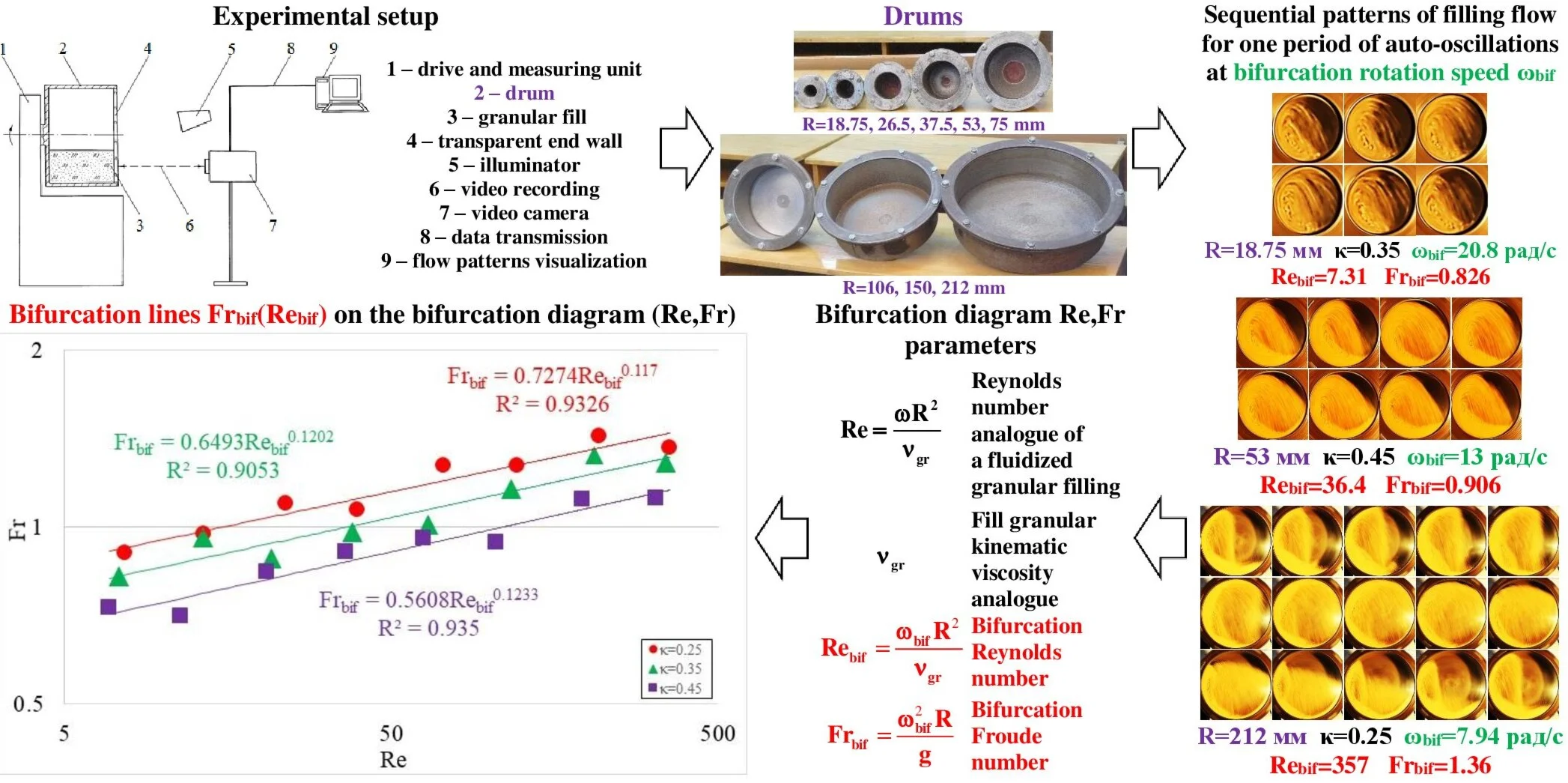
Highlights
- By visualization through the transparent wall of the drum, the effect of the chamber radius R on the bifurcation value of the rotation speed during self-excitation of auto-oscillations of a single-grain filling was studied.
- The position of the bifurcation lines of the diagram (Re,Fr) of the similarity criteria of the granular flow on the cylindrical surface of the rotating chamber was determined.
- An analogue of the Reynolds number was used based on the discovered analogue of the granular kinematic viscosity of the liquefied granular filling.
- The bifurcation value of the Froude number Frbif increases with increasing R.
- Frbif decreases with increasing chamber filling degree.
1. Introduction
Every year, more than 100 billion tons of various granular materials are processed in the world in the chemical, mining, metallurgical, building materials, energy, mechanical engineering, biological and a number of other industries. The processing of such materials is carried out by drum machines by granulation, reaction, mixing, grinding, washing, size classification, tumbling, drying and heat treatment. The cross-industry class of drum-type technological machines has gained wide application due to a number of operational advantages. However, the problem of these machines is the high energy intensity of the processes [1]. This is due to the passivity of a significant part of the internal chamber filling. Self-excitation of auto-oscillations of granular filling of the rotating drum chamber allows to activate filling and increase the technological efficiency of drum machines. The first video recording of auto-oscillations of granular filling of the rotating drum was carried out in [2]. In [3], the mechanism of occurrence of oscillations of filling of self-grinding mills is revealed. Attempts to create models of self-excitation and the manifestation of instability in the motion of granular filling of a rotating drum were made in [4-9]. In [10], the conditions for the stability of the motion of the oscillatory system of a drum machine are established. The manifestation of instability in the motion of a two-fraction granular filling of a rotating drum was elucidated in [11]. In [12], a model of the oscillatory stability of the motion of a two-fraction filling is constructed.
The defining parameter of the implementation of self-excitation of the auto-oscillating motion of the granular filling of the chamber is the lower bifurcation value of the drum rotation speed, which is recorded during a smooth increase in the angular velocity from the rest state. This value characterizes the transition from a continuous circulating to a periodic auto-oscillating mode of the filling motion. With an increase in the rotation speed, the instability of the continuous circulating mode of motion develops, which leads to the establishment of periodic self-oscillations. The task of predicting the influence of the chamber radius on the bifurcation value of the drum rotation speed seems to be quite relevant. Instead, in [11, 12] the lower bifurcation value of the rotation speed was established only for one value of the drum chamber radius at a filling degree of 0.25-0.5. The aim of the work is to establish the influence of the chamber radius on the bifurcation value of the drum rotation speed. This will allow predicting the effectiveness of the implementation of auto-oscillating processes for processing granular materials when the radius of the drum chamber varies. To achieve the aim, the following tasks were set: to perform experimental modeling of the lower bifurcation value of the rotation speed for different radii and degrees of filling of the drum chamber with mono-grained material; to assess the qualitative influence of the chamber radius on the bifurcation value of the rotation speed.
2. Materials and methods
The bifurcation values of the auto-oscillation parameters were determined by the criterion modeling method based on the visualization of the behavior of the granular filling of the chamber. Eight interchangeable drums with transparent end walls were used (Fig. 1). The radii of the drum chambers were 18.75, 26.5, 37.5, 53, 75, 106, 150 and 212 mm.
Fig. 1Drums: a) R = 18.75, 26.5, 37.5, 53 and 75 mm; b) R = 106, 150 and 212 mm
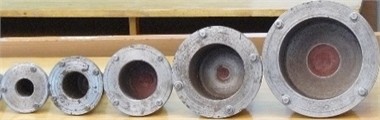
a)
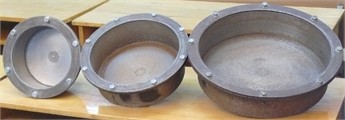
b)
As a mono-granular working material for filling the drum chamber, a non-cohesive granular material with particles of close to spherical shape with a size of = 2.2 mm was used. The content of the drum chamber with working material was estimated by the volumetric degree of filling of the chamber , where is the volume of a portion of granular filling at rest, is the length of the drum chamber. The discrete values of were 0.25, 0.35, and 0.45.
The experimental conditions are given in Table 1.
A 240 W collector electric motor was used to drive the filled drum, the rotation speed of which was changed by adjusting the supply voltage. The bifurcation value of the rotation speed was determined during a smooth increase in the angular rotation speed until reaching the minimum value at which self-excitation of auto-oscillations of the granular filling of the rotating drum chamber occurred. In this case, the value of angular acceleration did not exceed 0.1 1/s2.
To represent the dependence of the bifurcation value of the rotation speed on the chamber radius in the criterion form, a bifurcation diagram of dynamic flow similarity criteria on the cylindrical surface of the rotating drum chamber was used. The Reynolds number analogue for fluidized granular filling and the Froude number were used as the coordinate axes of the diagram , , where ≈10-3 m2/s is an analogue of the granular kinematic viscosity of the fill [13], is the gravitational acceleration. The expressions for the coordinates of the points and of the bifurcation line on the bifurcation diagram have the form , .
Table 1Experiment conditions
Parameters | Designation | Units | Value | |
Main groups | Component elements | |||
Drum | Chamber radius | mm | 18.75, 26.5, 37.5, 53, 75, 106, 150 and 212 | |
Chamber length | mm | 100 | ||
Angular speed of rotation | rad/s | 0-25 | ||
Granular filling of the drum chamber | Average particle size | mm | 2.2 | |
Particle shape | – | – | close to spherical | |
Bulk density of filling | kg/m3 | 900 | ||
Analogue of granular kinematic viscosity of granular fill | m2/s | ≈ 10-3 | ||
Degree of filling of the drum chamber with granular material | – | 0.25, 0.35 and 0.45 | ||
Video recording of auto-oscillations | Video capture frame rate | – | FPS | 24 |
Auto-oscillation frequency | Hz | 1.4-6 | ||
3. Results
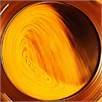
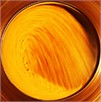
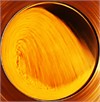
Sequential pictures of video recording of the movement of granular filling upon reaching the bifurcation value of the rotation speed and self-excitation of auto-oscillations for one oscillation period, which were obtained at different values of and , are shown in Fig. 2-4. (All photos taken by K. Deineka at the Drum-Type Machines Laboratory, National University of Water and Environmental Engineering, Rivne, Ukraine, on January 2026).
Fig. 2Pictures of auto-oscillations at R = 18.75 mm, κ = 0.35, ωbif = 20.8 rad/s, Rebif = 7.31 and Frbif=0.826


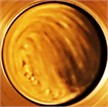



Fig. 3Pictures of auto-oscillations at R = 53 mm, κ = 0.45, ωbif = 13 rad/s, Rebif = 36.4 and Frbif = 0.906





The results of the experimentally obtained bifurcation values of the auto-oscillation parameters are given in Table 2.
The data obtained in Table 2 allow us to construct the points of the bifurcation lines on the bifurcation diagram .
Fig. 4Pictures of auto-oscillations at R = 212 mm, κ = 0.25, ωbif = 7.94 rad/s, Rebif = 357 and Frbif = 1.36
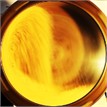
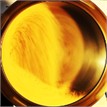
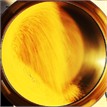
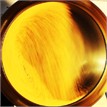
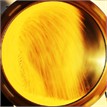
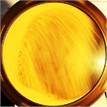
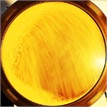
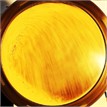
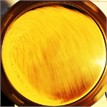
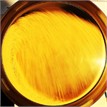
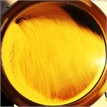
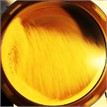
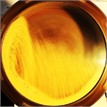
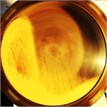
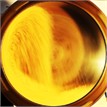
Table 2Experimentally obtained bifurcation values of auto-oscillation parameters
Parameters | Designation | Measurement range | Value | |
Bifurcation value of the drum rotation angular velocity | (mm) | 18.75 | 19.5-21.8 | |
26.5 | 16.1-19 | |||
37.5 | 14.8-17 | |||
53 | 12.9-14.1 | |||
75 | 11.1-12.9 | |||
106 | 9.3-10.9 | |||
150 | 8.5-9.7 | |||
212 | 7.1-8 | |||
0.25 | 7.9-21.8 | |||
0.35 | 7.7-20.8 | |||
0.45 | 7.1-19.6 | |||
Coordinates of the points of the bifurcation lines on the bifurcation diagram | ; | (mm) | 18.75 | 6.8; 0.72-7.7; 0.91 |
26.5 | 11.3; 0.7-13.4; 0.98 | |||
37.5 | 20.8; 0.83-23.9; 1.1 | |||
53 | 36.3; 0.9-39.6; 1.08 | |||
75 | 62.9 ;0.95-72.6; 1.27 | |||
106 | 104.8; 0.94-121.8; 1.27 | |||
150 | 192.2; 1.11-217.4; 1.43 | |||
212 | 323.1; 1.11-356.9; 1.37 | |||
0.25 | 7.6; 0.9-356.9; 1.37 | |||
0.35 | 7.3; 0.82-346.5; 1.29 | |||
0.45 | 6.8; 0.72-323.1; 1.12 | |||
The graphs of the obtained bifurcation lines on the bifurcation diagram are shown in Fig. 5.
The positions of the bifurcation lines on the bifurcation diagram determine the dependence of the bifurcation value of the rotation speed on the radius of the drum chamber and the degree of filling of the chamber .
4. Discussion
The obtained results of experimental visualization of the behavior of granular filling of the rotating drum chamber allowed us to qualitatively and quantitatively assess the influence of the chamber radius on the bifurcation value of the rotation speed .
Visual qualitative analysis of the motion patterns in Fig. 2-4 clearly demonstrates the stable nature of the manifestation of self-excitation of auto-oscillations of granular filling when the values of the radius of the rotating drum chamber vary. The number of patterns is inversely proportional to the bifurcation velocity .
The established quantitative dependencies are determined by the position of the bifurcation lines on the bifurcation diagram (Fig. 5) and (Table 2). The dependencies of the detected bifurcation lines can be approximately approximated by step functions (Fig. 5).
Fig. 5Bifurcation lines FrbifRebif on the diagram Re,Fr for R = 18.75-212 mm and κ = 0.25-0.35
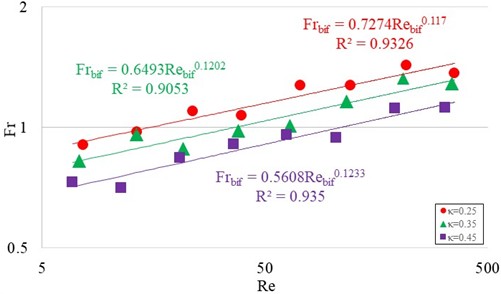
It is found that with an increase in from 18.75 to 212 mm, and a corresponding increase in the bifurcation value of the Reynolds number from 6.86 to 357, the bifurcation value of the Froude number increases from 0.704 to 1.43. This indicates an increase in the stability of the filling movement due to the influence of , which is manifested in the corresponding increase in . This is due to the manifestation of the dynamic effect of weakening the dilatancy of the granular filling in the chamber of the rotating drum with increasing [11, 12]. Such an increase in . The influence of the degree of filling of the chamber on the bifurcation velocity was also revealed (Fig. 5) and (Table 2). It was established that with an increase in from 0.25 to 0.45, the bifurcation value of the Froude number decreases from 0.903 to 0.728 at = 18.75 mm, and also from 1.36 to 1.12 at = 212 mm. This indicates a decrease in the stability of the filling motion due to the influence of , which is manifested in the corresponding decrease in . This is due to the manifestation of the dynamic effect of weakening the filling dilatancy with increasing , which was first established in [11]. This decrease in is caused by the limitation of the space for possible free radial circulation of the filling in the chamber and increases with increasing . The revealed influence of the degree of filling on the bifurcation value of the Froude number complements and expands similar results of works [11, 12].
5. Conclusions
The influence of the chamber radius on the lower bifurcation value of the drum rotation speed consists in the increase in the bifurcation value of the Froude number of the diagram with increasing . The influence of the degree of filling of the chamber with a granular medium on consists in the decrease in the bifurcation value of the Froude number with increasing . An increase in the radius increases the stability of the oscillatory motion of the granular filling in the chamber of the rotating drum, and an increase in the degree of filling reduces this stability.
For the size of a spherical particle of a single-grain filling = 2.2 mm, with an increase in the radius from 18.75 to 212 mm, the bifurcation value of the Froude number increases from 0.704 to 1.43 at a filling degree = 0.25-0.45. On the other hand, with an increase in from 0.25 to 0.45, the bifurcation value of the Froude number decreases from 0.903 to 0.728 at = 18.75 mm, and also from 1.36 to 1.12 at = 212 mm.
In the future, it is planned to determine the influence of the granulometric composition of the granular intra-chamber filling on the lower bifurcation value of the drum rotation speed when varying the radius and the degree of filling .
References
-
M. Góralczyk, P. Krot, R. Zimroz, and S. Ogonowski, “Increasing energy efficiency and productivity of the comminution process in tumbling mills by indirect measurements of internal dynamics-an overview,” Energies, Vol. 13, No. 24, p. 6735, Dec. 2020, https://doi.org/10.3390/en13246735
-
H.-U. Both, “Motions of grinding elements in a ball mill,” (in German), IWF, Göttingen, 1966, https://doi.org/10.3203/iwf/c-921
-
I. V. Novytskyi and Y. O. Shevchenko, “Justification of the criterion for optimal control of the self-grinding process of ores in drum mills,” Naukovyi Visnyk Natsionalnoho Hirnychoho Universytetu, No. 4, pp. 61–66, Aug. 2024, https://doi.org/10.33271/nvngu/2024-4/061
-
F. Zimber, J. E. Kollmer, and T. Pöschel, “Polydirectional stability of granular matter,” Physical Review Letters, Vol. 111, No. 16, p. 168003, Oct. 2013, https://doi.org/10.1103/physrevlett.111.168003
-
Z. Wang and J. Zhang, “Fluctuations of particle motion in granular avalanches – from the microscopic to the macroscopic scales,” Soft Matter, Vol. 11, No. 27, pp. 5408–5416, Apr. 2015, https://doi.org/10.1039/c5sm00643k
-
Z. Wang and J. Zhang, “Spatiotemporal chaotic unjamming and jamming in granular avalanches,” Scientific Reports, Vol. 5, No. 1, p. 8128, Jan. 2015, https://doi.org/10.1038/srep08128
-
H. Maghsoodi and E. Luijten, “Chaotic dynamics in a slowly rotating drum,” Revista Cubana De Fisica, Vol. 33, No. 1, pp. 50–54, Jul. 2016.
-
J. A. F. Balista, “Axial segregation of granular mixtures as the rotational stabilization of the radial core,” Granular Matter, Vol. 19, No. 2, p. 39, Apr. 2017, https://doi.org/10.1007/s10035-017-0721-x
-
V. Salinas, C. Quiñinao, S. González, and G. Castillo, “Triggering avalanches by transverse perturbations in a rotating drum,” Scientific Reports, Vol. 11, No. 1, p. 13936, Jul. 2021, https://doi.org/10.1038/s41598-021-93422-2
-
K. Y. Deineka and Y. V. Naumenko, “The tumbling mill rotation stability,” Scientific Bulletin of National Mining University, Vol. 1, No. 1 (163), pp. 60–68, Feb. 2018, https://doi.org/10.29202/nvngu/2018-1/10
-
K. Deineka and Y. Naumenko, “Revealing the mechanism of stability loss of a two-fraction granular flow in a rotating drum,” Eastern-European Journal of Enterprise Technologies, Vol. 4, No. 1 (118), pp. 34–46, Aug. 2022, https://doi.org/10.15587/1729-4061.2022.263097
-
K. Deineka and Y. Naumenko, “Mathematical modeling of the rotating drum granular fill flow oscillatory stability,” Vibroengineering Procedia, Vol. 59, pp. 70–81, Sep. 2025, https://doi.org/10.21595/vp.2025.25248
-
Y. Naumenko, K. Deineka, and T. Myronenko, “Establishing the conditions for the formation of a near-wall layer of solid granular fill of a rotating drum,” Eastern-European Journal of Enterprise Technologies, Vol. 5, No. 1(113), pp. 51–61, Oct. 2021, https://doi.org/10.15587/1729-4061.2021.240194
About this article

The authors have not disclosed any funding.
The datasets generated during and/or analyzed during the current study are available from the corresponding author on reasonable request.
The authors declare that they have no conflict of interest.

