Abstract
The long-term operation of industrial buildings housing technological equipment that generates dynamic loads requires the application of modern approaches to assessing the technical condition of load-bearing structures. Continuous exposure to vibration loads may lead to the gradual accumulation of damage, a reduction in the operational reliability of structures, and increased maintenance costs. In this context, vibration monitoring is increasingly regarded as one of the key tools of modern Structural Health Monitoring (SHM) systems, which enable the technical condition of engineering structures to be monitored throughout their service life.
Highlights
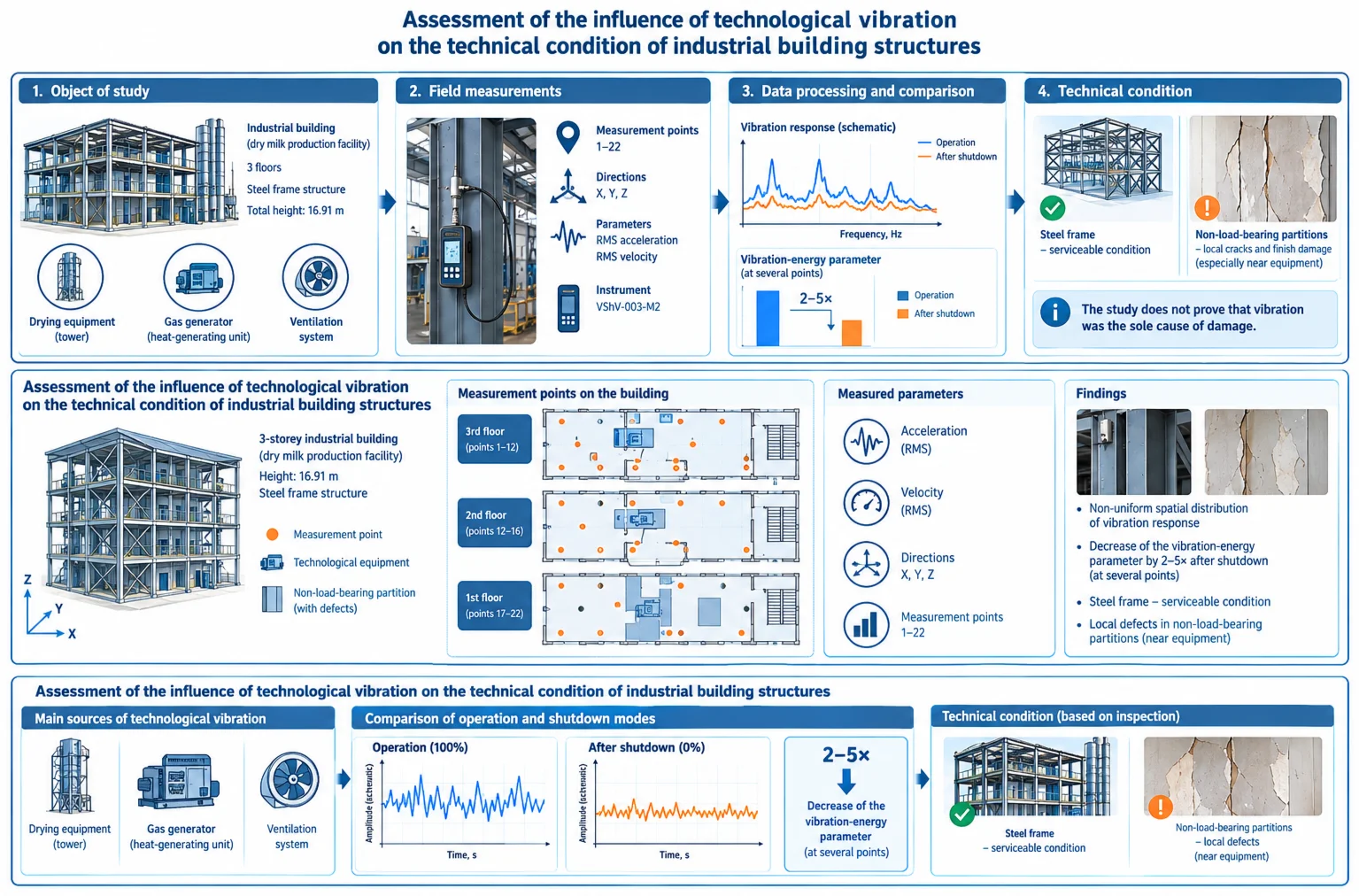
- Field vibration measurements were combined with technical inspection to assess an operating industrial steel-frame building.
- Vibration levels were generally higher near technological equipment, with local maxima also influenced by structural configuration and stiffness.
- Switching off the gas generator and drying tower reduced the calculated vibration-energy parameter by approximately 2–5 times at several measurement points.
- Local defects in non-load-bearing partitions were spatially associated with areas of increased vibration activity, although causation was not established.
1. Introduction
Industrial buildings are among the most critical elements of production infrastructure, as their safe operation directly affects the reliability of technological processes, the economic efficiency of enterprises, and personnel safety. A significant proportion of such structures in Ukraine were constructed several decades ago and are currently operated under conditions that differ substantially from those assumed in their original design.
Modernization of production lines, installation of more powerful equipment, increased operating intensity of technological units, and the natural ageing of structures result in changes in the actual stress–strain state of buildings. Under these conditions, timely assessment of their technical condition using modern instrumental methods becomes particularly important. One of the most informative sources of information on the performance of a structural system is its dynamic response to operational loads. In current international practice, the analysis of vibration parameters is regarded as an important component of the Structural Health Monitoring (SHM) concept, which involves continuous or periodic monitoring of the technical condition of structures based on the detection of changes in their dynamic characteristics. Fundamental studies [1-5] and those of other researchers have demonstrated that changes in natural frequencies, mode shapes, vibration acceleration levels, and other parameters can serve as sensitive indicators of damage development, structural degradation, or changes in operating conditions.
At the same time, most published studies have focused on bridges, high-rise structures, transportation infrastructure, or specially designed laboratory models. A separate area of research concerns the assessment of the dynamic behaviour of industrial buildings in which technological equipment acts as a source of dynamic excitation. Field studies of such structures make it possible to assess the actual response of the structural system under real operating conditions and to identify the specific features of the interaction between technological loads and the dynamic characteristics of the building [6, 7]. Therefore, the patterns of vibration propagation in such structural systems have their own specific features and require dedicated field investigations. Experimental studies conducted directly at operating industrial facilities are of particular value. Such investigations make it possible to assess the actual dynamic behaviour of structures under real operating conditions while accounting for the simultaneous effects of technological processes, the structural configuration of the building, the physical condition of materials, and the mechanisms of dynamic load transmission.
2. Main text
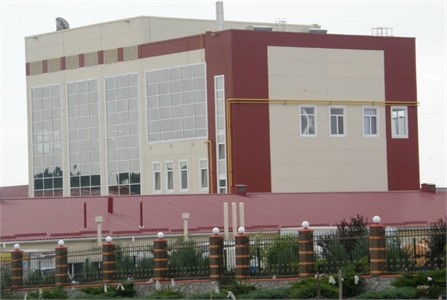
The experimental investigations were conducted on a production building of a dry milk production facility (Fig. 1) operated by the private enterprise Bilotserkivska Agro-Industrial Group (Poltava Region, Ukraine). The building operates under a continuous technological process involving the permanent operation of drying equipment, pumping units, ventilation systems, and transport mechanisms, which constitute the main sources of dynamic loads.
The structural system of the building consists of a steel frame formed by rolled-section columns and beams with reinforced concrete floor slabs. The spatial stiffness of the building is provided by the combined action of the frame, horizontal floor diaphragms, and a system of vertical bracing members. The main production building has three storeys and a plan dimension of 18×12 m, with a single-storey production section measuring 18×18 m attached to it. The total height of the structure is 16.91 m.
Fig. 1General view of the dry milk production workshop. “Bilotserkivska Agroindustrial Group”, located in the village of Bilotserkivka, Velykobahachanskyi District, Poltava Region, Ukraine. Photo was taken by Serhii Mykytenko in 2020
Before the instrumental investigations, a technical inspection of the building was carried out, including an analysis of the design documentation, a visual inspection of the load-bearing and enclosing structures, and documentation of the identified defects. The inspection showed that the load-bearing steel frame was in satisfactory technical condition, whereas local cracks and damage to the finishing layer were detected in the non-load-bearing partitions, predominantly in production areas located near the technological equipment.
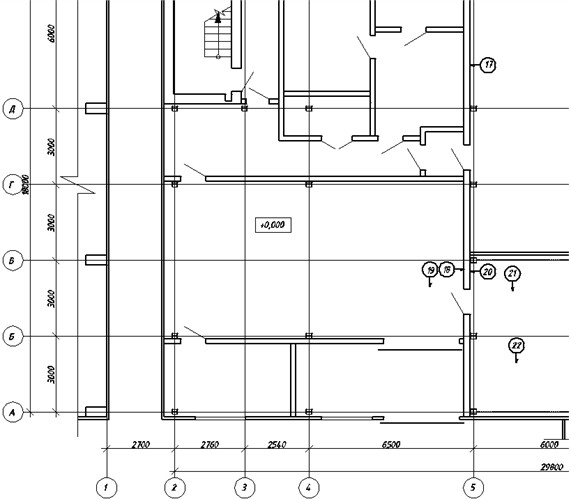
The experimental part of the study was aimed at determining the actual vibration parameters of the building structures under normal operating conditions and identifying a possible relationship between the level of dynamic loads and the technical condition of the structural elements. Measurements were performed without interrupting the technological process after the production equipment had reached a steady-state operating mode. This approach made it possible to obtain parameters characterizing the actual operating conditions of the building without the influence of transient regimes associated with the start-up or shutdown of machinery. The measurement points were located on the main structural elements of the building, including equipment foundations, steel columns, beams, floor slabs, and partitions. Their selection was based on the structural configuration of the building, the location of the technological equipment, and the results of the preliminary technical inspection (Fig. 2-4). During the study, the root-mean-square (RMS) values of vibration acceleration and vibration velocity were determined at each measurement point. The provisions of ISO 20816-1 and ISO 20816-3 [8, 9] were taken into account to characterize the intensity of mechanical vibration generated by the technological equipment. To improve the reliability of the results, repeated measurements were performed at each point, after which the mean values of the monitored parameters were determined.
Fig. 2Vibration measurement layout at points 1-12 on the third floor of the production building of a dry milk production facility
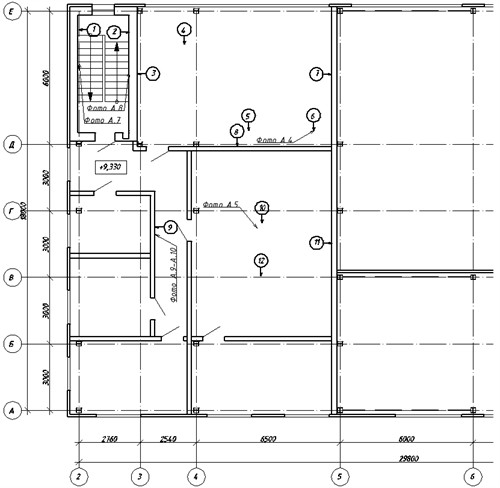
Fig. 3Vibration measurement layout for points 12-16 on the second floor of the production building of a dry milk production facility
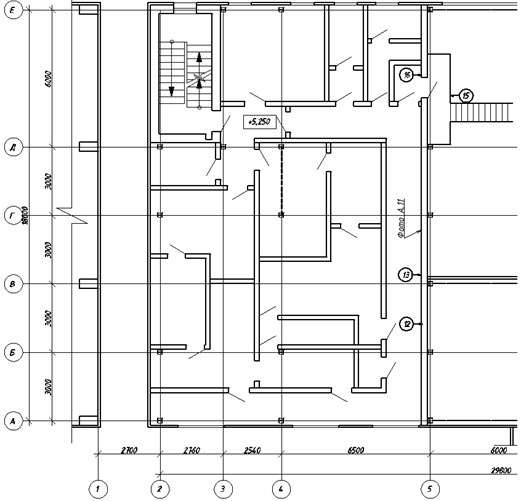
Fig. 4Vibration measurement layout for points 17-22 on the ground floor of the production building of a dry milk production facility
The dynamic behaviour of the structural system was described by the equation of motion:
where is the reduced mass of the investigated structural subsystem, is the damping coefficient, is the effective stiffness, and is the external dynamic load generated by the technological equipment.
In the present study, Eq. (1) was used as a reduced-order representation of the dynamic behaviour of the investigated steel-frame building subjected to technological excitation. The reduced mass used for the vibration-energy calculations was 2 kg. This value represents an adopted reduced mass for the comparative assessment of the measured vibration response and should not be interpreted as the total physical mass of the building.
The stiffness and damping coefficient c were not independently identified from the field measurements. The investigation was focused on the actual vibration response of the operating building and did not include dedicated free-decay or forced-response tests required for reliable experimental identification of damping. Similarly, separate identification of the effective mass and stiffness would require a calibrated structural model with an explicitly defined mass distribution and stiffness characteristics.
The vibration condition of the structures was assessed using the root-mean-square (RMS) values of vibration acceleration and vibration velocity:
where 10 s is the duration of each measurement interval.
For harmonic vibration, the measured acceleration and velocity are related by:
where is the vibration frequency. Thus:
The relationship was directly applied to the experimental data. For example, at measurement point 1 under the 100 % operating condition, the measured RMS acceleration was 0.135 m/s2 and the RMS vibration velocity was 4.5 mm/s, giving 4.775 Hz, which corresponds to the value presented in Table 1.
In addition, the natural-frequency relationship for a single-degree-of-freedom representation:
was used to interpret the measured vibration response in terms of the effective stiffness-to-mass characteristics of the corresponding structural subsystem.
The vibration-energy parameter was evaluated as:
where is the total vibration-energy parameter, is the adopted reduced mass, is the measured vibration frequency, and is the vibration displacement amplitude.
The calculated parameters were used for comparative assessment of the vibration state of the investigated structural elements under different operating conditions.
The obtained experimental data were systematized, statistically processed, and used for further analysis of the spatial distribution of vibration parameters and their comparison with the results of the technical inspection of the building.
3. Results
The comprehensive technical inspection of the production building was carried out prior to the instrumental measurements and was aimed at determining the actual technical condition of the structural system and identifying possible damage associated with long-term operation. The inspection results showed that the load-bearing steel frame of the building was in a serviceable technical condition. No signs of loss of load-bearing capacity, local instability, or plastic deformation that could indicate a critical reduction in the operational reliability of the structure were detected in the columns, beams, roof elements, or their connections. At the same time, several local defects were identified in the non-load-bearing structures, including vertical and inclined cracks in partitions, local damage to the plaster layer, partial deterioration of finishing materials, and loss of tightness at interfaces between partitions and load-bearing structures.
The non-uniform spatial distribution of defects was also observed. The highest concentration of defects was recorded in areas adjacent to technological equipment, whereas the intensity of damage was lower in more distant parts of the building. These observations provided the basis for subsequent instrumental measurements aimed at quantifying the dynamic effects acting on the structures.
Building vibrations were measured in the vertical direction and in two mutually perpendicular horizontal directions, and , corresponding to the principal axes of the building. The X-axis was oriented as close as possible to the direction toward the vibration source.
A VShV-003-M2 noise and vibration meter was used for the measurements; the device is designed to determine the root-mean-square values of vibration acceleration and vibration velocity. Measurements were performed both during operation of the principal technological equipment and after its shutdown. The 100 % vibration-exposure condition corresponded to normal continuous operation of the principal technological vibration sources, while the 0 % condition corresponded to measurements after their shutdown. The measurements were performed after the equipment had reached a stable production regime, excluding transient start-up and shutdown effects. The principal sources of technological excitation identified during the investigation were the gas generator/heat-generating equipment, the drying tower and associated ventilation equipment. The original field records did not include independent measurements of equipment rotational speed or direct measurements of the dynamic force amplitudes generated by individual machines. Therefore, specific RPM and force-amplitude values were not introduced into the analysis. Instead, the excitation characteristics were evaluated from the measured structural response in terms of RMS acceleration, RMS velocity, vibration amplitude and frequency.
The vibration transmission paths were also affected by the structural connections of the technological equipment. The gas generator and ventilation devices were installed directly on the floor structure above the second storey without intermediate vibration-isolation elements. In addition, the working platform of the drying tower was rigidly connected to the adjacent masonry wall through steel stairs. These connections provided direct mechanical paths for the transmission of dynamic excitation to the building structures.
The analysis of the obtained data indicates that the distribution of vibration parameters has a pronounced spatial character. Elevated values of RMS vibration acceleration and vibration velocity were generally recorded in structural elements located near the drying equipment and other technological units, which constituted the principal sources of dynamic excitation. Comparison of measurements performed during operation and after shutdown of the principal technological vibration sources demonstrated a substantial reduction in the vibration response at the corresponding measurement points. In the original measurement series, the calculated vibration-energy parameter decreased by approximately 2-5 times at several measurement points after the gas generator and drying tower were switched off. This result provides direct experimental evidence that the technological equipment constituted a major source of the dynamic excitation recorded in the building.
At the same time, several local increases in vibration parameters were observed at control points that cannot be explained solely by the distance from the excitation source. This indicates that the transmission of dynamic loads was also affected by the structural configuration of the building, the spatial distribution of stiffness, the interaction between structural and non-structural elements, and the specific mechanical connections between the technological equipment and the building structures.
Comparison of the results of the technical inspection and field measurements revealed that local defects in non-load-bearing structures were spatially associated with areas characterized by elevated vibration activity. Despite the absence of indications of reduced load-bearing capacity in the steel frame, prolonged cyclic dynamic loading may contribute to the development or acceleration of serviceability-related damage in secondary structural elements. The present field investigation therefore demonstrates the usefulness of vibration measurements as a complementary tool for technical assessment of operating industrial buildings.
The obtained results are consistent with current approaches to using vibration parameters as indicators of the technical condition of structures. Previous studies [1, 3, 5] have shown that the dynamic response of a structure can serve as a sensitive indicator of changes in its technical condition. Verboven et al. [3] and Rainieri, Fabbrocino [4] have also demonstrated the applicability of vibration-based approaches for structural identification and diagnostics.
At the same time, the studies presented in [6, 7] demonstrate the importance of conducting field measurements under actual operating conditions, when technological and other operational loads act simultaneously on the structures. The identified local maxima of vibration acceleration, which are not directly related to the distance from the vibration source, are also consistent with the findings of [5], which emphasize the significant influence of the spatial non-uniformity of structural stiffness on the transmission of dynamic energy. A similar pattern can be observed in the investigated production building, where the structural characteristics of individual elements influence the formation of local zones of increased vibration activity.
The results of the experimental measurements are presented in Table 1.
Table 1Processing of the measurement results
Measurement point | Direction | Vibration exposure level, % | RMS acceleration , m/s2 | RMS velocity , mm/s | Amplitude , mm | Frequency , Hz | Vibration-energy parameter |
1 | X | 100 | 0.135 | 4.5 | 0.15 | 4.775 | 0.513 |
1 | X | 0 | 0.034 | 3.3 | 0.32 | 1.640 | 0.276 |
1 | X | 0 | 0.034 | 3.3 | 0.32 | 1.640 | 0.276 |
2 | X | 100 | 0.234 | 14 | 0.838 | 2.660 | 4.965 |
2 | X | 100 | 0.085 | 2.2 | 0.057 | 6.149 | 0.123 |
2 | X | 0 | 0.102 | 1.1 | 0.012 | 14.758 | 0.031 |
3 | X | 100 | 0.126 | 3.45 | 0.094 | 5.813 | 0.301 |
3 | X | 0 | 0.0231 | 2 | 0.173 | 1.838 | 0.101 |
4 | X | 100 | 1.68 | 14 | 0.117 | 19.099 | 4.965 |
4 | X | 100 | 0.082 | 5.4 | 0.356 | 2.417 | 0.739 |
4 | Y | 100 | 0.092 | 3.6 | 0.141 | 4.067 | 0.328 |
5 | Z | 100 | 0.52 | 11 | 0.233 | 7.524 | 3.065 |
5 | Z | 0 | 0.082 | 4.8 | 0.281 | 2.719 | 0.584 |
6 | X | 100 | 0.096 | 5.85 | 0.356 | 2.612 | 0.867 |
6 | Y | 100 | 0.126 | 6.6 | 0.346 | 3.038 | 1.103 |
7 | X | 100 | 0.059 | 2.8 | 0.133 | 3.354 | 0.199 |
7 | X | 0 | 0.038 | 1.2 | 0.038 | 5.040 | 0.036 |
8 | Y | 100 | 0.066 | 2.3 | 0.08 | 4.567 | 0.134 |
8 | X | 0 | 0.0201 | 1.2 | 0.072 | 2.666 | 0.036 |
9 | X | 100 | 0.096 | 5.1 | 0.271 | 2.996 | 0.659 |
10 | X | 100 | 0.19 | 6.15 | 0.199 | 4.917 | 0.958 |
10 | Z | 100 | 0.087 | 3 | 0.103 | 4.615 | 0.228 |
11 | X | 100 | 0.065 | 2.4 | 0.089 | 4.310 | 0.146 |
12 | Z | 100 | 0.088 | 3.9 | 0.173 | 3.591 | 0.385 |
13 | X | 100 | 0.084 | 3.75 | 0.167 | 3.565 | 0.356 |
14 | X | 100 | 0.129 | 7.05 | 0.385 | 2.912 | 1.259 |
15 | X | 100 | 0.029 | 2 | 0.138 | 2.308 | 0.101 |
16 | X | 100 | 0.048 | 3 | 0.188 | 2.546 | 0.228 |
17 | X | 100 | 0.035 | 1.3 | 0.048 | 4.285 | 0.043 |
17 | X | 75 | 0.027 | 1.15 | 0.049 | 3.737 | 0.033 |
17 | X | 0 | 0.042 | 1.6 | 0.061 | 4.178 | 0.065 |
18 | X | 100 | 0.162 | 4.8 | 0.142 | 5.371 | 0.584 |
19 | X | 100 | 0.079 | 4.8 | 0.292 | 2.619 | 0.584 |
20 | X | 100 | 0.068 | 1.8 | 0.048 | 6.013 | 0.082 |
21 | Z | 100 | 0.048 | 2 | 0.083 | 3.820 | 0.101 |
21 | Y | 100 | 0.114 | 3.3 | 0.096 | 5.498 | 0.276 |
21 | X | 100 | 0.102 | 3 | 0.088 | 5.411 | 0.228 |
22 | Z | 100 | 0.093 | 4.35 | 0.203 | 3.403 | 0.479 |
22 | X | 100 | 1.02 | 4.35 | 0.019 | 37.319 | 0.479 |
22 | Y | 100 | 0.96 | 3.6 | 0.014 | 42.441 | 0.328 |
4. Conclusions
The technical inspection showed that the load-bearing steel frame of the investigated production building remains in a serviceable condition. No signs of loss of load-bearing capacity, local instability, or critical deformation were found. At the same time, cracks and other local defects were observed in non-load-bearing partitions and finishing elements, mainly in areas close to the technological equipment. Their location does not allow the effect of long-term dynamic loading to be excluded, although the present study does not provide sufficient grounds to consider vibration the only cause of the observed damage. The vibration measurements gave a more detailed picture of the actual behaviour of the building during operation. The vibration response was clearly non-uniform: higher values of acceleration and velocity were generally observed close to the drying equipment and other technological units, but some local maxima occurred at points where the distance from the source alone could not explain the measured response. The results therefore suggest that vibration transmission is strongly influenced by the stiffness and spatial configuration of the structural system, as well as by the connections between the technological equipment and the building structures.
A particularly informative result was obtained by comparing measurements with the main technological sources operating and switched off. At several measurement points, the calculated vibration-energy parameter decreased by approximately 2-5 times after the gas generator and drying tower were stopped. This comparison provides direct experimental evidence of the significant contribution of the technological equipment to the dynamic response of the building. The measured acceleration and velocity values were also used to determine the corresponding vibration frequencies and to relate the experimental observations to the dynamic characteristics of the structural system. In this form, the analytical relationships used in the study are not considered separately from the experiment, but serve to interpret the measured response of the actual structure.
The novelty of the presented approach lies in the combined use of field vibration measurements and technical inspection results to assess the dynamic behaviour of an operating industrial steel-frame building under actual technological loads. In contrast to considering vibration parameters only as isolated measurements, the proposed approach relates their spatial distribution and characteristic dynamic parameters to the structural configuration and observed serviceability-related damage. This provides an additional basis for identifying local zones of increased dynamic activity and for improving the assessment of the operational condition of industrial building structures.
Taken together, the results show that vibration measurements can complement conventional technical inspection when assessing industrial buildings operating under continuous technological loads. They make it possible to identify areas with increased dynamic activity and to distinguish between the general condition of the structural system and local serviceability problems. For the investigated building, the results also indicate the need to consider measures aimed at reducing vibration transmission from the technological equipment, particularly at locations where rigid mechanical connections provide a direct path for dynamic loads.
References
-
J. M. W. Brownjohn, A. de Stefano, Y.-L. Xu, H. Wenzel, and A. E. Aktan, “Vibration-based monitoring of civil infrastructure: challenges and successes,” Journal of Civil Structural Health Monitoring, Vol. 1, No. 3-4, pp. 79–95, Sep. 2011, https://doi.org/10.1007/s13349-011-0009-5
-
Brownjohn and J. M. W., “Structural health monitoring of civil infrastructure,” Philosophical Transactions of the Royal Society A: Mathematical, Physical and Engineering Sciences, Vol. 365, No. 1851, pp. 589–622, Feb. 2007, https://doi.org/10.1098/rsta.2006.1925
-
P. Verboven, E. Parloo, P. Guillaume, and M. van Overmeire, “Autonomous structural health monitoring-part I: modal parameter estimation and tracking,” Mechanical Systems and Signal Processing, Vol. 16, No. 4, pp. 637–657, 2002, https://doi.org/10.1006/mssp.2002.1492
-
C. Rainieri and G. Fabbrocino, Operational Modal Analysis of Civil Engineering Structures: an Introduction and Guide for Applications. New York, NY: Springer New York, 2014, https://doi.org/10.1007/978-1-4939-0767-0
-
F. Stochino, A. Attoli, M. Serra, A. Napoli, D. Meloni, and F. Mistretta, “Structural identification from operational modal analysis: the case of steel structures,” Buildings, Vol. 13, No. 2, p. 548, Feb. 2023, https://doi.org/10.3390/buildings13020548
-
J. M. W. Brownjohn, T.-C. Pan, C. Middleton, S. C. Tan, and G. Yang, “Floor vibration serviceability in a multistory factory building,” Journal of Performance of Constructed Facilities, Vol. 30, No. 1, p. 04014203, Dec. 2014, https://doi.org/10.1061/(asce)cf.1943-5509.0000688
-
L. B. Saint Martin, L. L. Gusmão, T. H. Machado, E. P. Okabe, and K. L. Cavalca, “Operational modal analysis application to support structure identification under rotating machinery unbalance,” Engineering Structures, Vol. 249, p. 113344, Oct. 2021, https://doi.org/10.1016/j.engstruct.2021.113344
-
“Mechanical vibration-measurement and evaluation of machine vibration-part 1: general guidelines,” ISO 20816-1, 2016, https://doi.org/10.3403/30337264
-
Mechanical vibration-measurement and evaluation of machine vibration-part 3: industrial machinery with a power rating above 15 kW and operating speeds between 120 r/min and 30,000 r/min,” ISO 20816-3, 2022.
About this article

The authors have not disclosed any funding.
The datasets generated during and/or analyzed during the current study are available from the corresponding author on reasonable request.
The authors declare that they have no conflict of interest.

