Abstract
A parametric study of the free axisymmetric vibrations of a circular plate on a continuous Winkler elastic foundation is carried out. The foundation is assumed to be radially inhomogeneous, with the foundation modulus varying according to a power-law function of the dimensionless radial coordinate. Fundamental solutions of the differential equation governing the vibrations are presented in closed form as absolutely and uniformly convergent double power series. Analytical relationships between the vibration frequencies and the foundation inhomogeneity parameter, as well as the generalized parameter of the mechanical system, are obtained over a wide range of their values. The results obtained can be used in the analysis, design, and optimization of plate structures interacting with a nonhomogeneous elastic foundation.
1. Introduction
The dynamic behavior of structural elements is an important consideration in the analysis and design of engineering structures. Among such elements, circular plates supported by a continuous elastic foundation are widely used in various engineering applications, particularly in steel, reinforced concrete, and composite structures [1]. Modal analysis of circular plates interacting with a nonhomogeneous foundation is particularly relevant to vibration control. The computational model of a plate on an elastic foundation is applicable to the design and dynamic assessment of machine and turbine components, manhole covers of storage tanks, as well as column support assemblies, water towers, and wind turbines. Accurate prediction of natural frequencies and mode shapes makes it possible to avoid resonance, enhance structural safety, and promote the efficient use of materials.
One of the most widely used approaches to modeling the interaction between structures and soil foundations is based on the Winkler model. Within this model, the soil foundation is characterized by the subgrade modulus, a generalized parameter that represents its stiffness. In the simplest formulation, the foundation is assumed to be homogeneous, with a constant subgrade modulus throughout the domain. This assumption substantially simplifies the mathematical formulation and facilitates the derivation of analytical solutions. In practice, however, this idealization has limited applicability because it deviates from the actual properties of soil foundations. To improve the accuracy of calculations, it is therefore appropriate to account for foundation inhomogeneity, in which the subgrade modulus depends on the spatial coordinates [2].
Classical monographs [3]-[5] comprehensively present the theory of circular plates. However, analytical solutions for circular plates resting on variable Winkler foundations remain relatively scarce in the scientific literature. An analytical solution for the free vibrations of circular plates with elastically restrained edges resting on a Winkler foundation was obtained in [6]. Parametric analysis focuses on the effects of foundation stiffness, edge-restraint stiffness, and boundary conditions on the natural frequencies. It was shown that an increase in the Winkler foundation stiffness consistently increases the natural frequencies, whereas a decrease in the support stiffness substantially reduces the frequencies of the lower vibration modes. Article [7] investigates plates of variable thickness resting on Winkler and Pasternak foundations using analytical approximations. The parametric analysis considers the effects of the thickness variation parameter, the shear stiffness of the foundation (Pasternak parameter), and the boundary conditions. It was established that both foundation parameters increase the stiffness of the system, with the Pasternak shear layer having a more pronounced effect on the higher modes. A power-series solution for the free vibration analysis of Mindlin circular plates with variable thickness and inhomogeneous material properties resting on an elastic foundation was proposed by the authors of [8]. Parametric analysis encompasses thickness gradients, material inhomogeneity coefficients, and foundation stiffness. It was found that both the material gradient and foundation parameters have a significant effect on the natural frequencies. In [9], the free vibrations of polar-orthotropic circular plates with quadratically varying thickness resting on an elastic foundation were investigated. Parametric analysis considers orthotropic coefficients, thickness-variation parameters, and Winkler foundation stiffness. It was shown that orthotropy significantly alters the mode shapes, while thickness variation enhances the influence of the foundation, particularly for the higher modes.
In article [10], the case where the subgrade modulus is a power function of the coordinate along the beam’s midline is considered. However, an analytical solution is obtained only for the case where the power exponent is equal to one. For other positive values of the exponent, a numerical solution method is developed. Publication [11], similarly to article [10], also considers the case where the subgrade modulus is defined as a power function of the coordinate along the beam’s midline. The author likewise states that it is impossible to obtain an analytical solution to the corresponding differential equation for a power exponent other than one. Therefore, it is argued that reliable and efficient numerical methods should be employed in this case.
Thus, an analysis of the current scientific literature indicates that most studies of vibrations of plates on variable elastic foundations are based on advanced numerical methods. Moreover, parametric analyses generally assume a constant foundation stiffness, which considerably simplifies the mathematical model. Studies employing the general solution of the governing differential equation remain extremely limited in the literature.
Therefore, the available literature indicates that systematic parametric studies of the free vibrations of circular plates on nonhomogeneous elastic foundations based on exact analytical solutions remain limited. Further development of analytical approaches to this class of problems thus remains an important research direction. A similar conclusion was reached in [2] based on a comprehensive review of the relevant literature. To address this gap, the present study performs a parametric analysis of the vibrations of a plate whose subgrade modulus varies according to a power law.
2. Research methodology and results
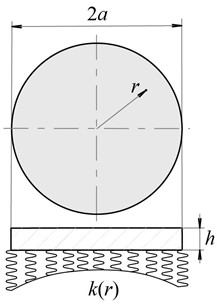
The axisymmetric vibrations of a circular plate with constant flexural rigidity , resting on a continuous nonhomogeneous Winkler elastic foundation, are considered (Figs. 1 and 2).
In the amplitude domain, the governing differential equation of free vibration takes the form [3], [4]:
where is the material density, is the the plate thickness, is the natural frequency of the plate, is the amplitude function of the transverse deflection, depending only on the radial coordinate , is the variable subgrade modulus characterizing the foundation inhomogeneity.
The exact solution of the differential Eq. (1) for the case of the arbitrary continuous function is given in [12]-[14]:
where is the dimensionless deflection function, are the dimensionless integration constants determined from the prescribed boundary conditions, , are the equation fundamental functions, moreover:
where are the auxiliary functions.
Fig. 1Annular plate
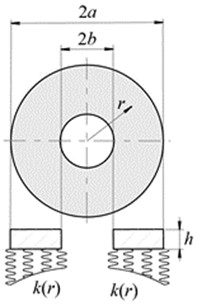
Fig. 2Solid circular plate
For the case of a power-law varying foundation:
the formulas from [12]-[14], which define the solutions , are transformed into the following form:
Parameters appearing in Eq. (6), (14) are determined by the following relations: is the known generalized dimensionless parameter of the mechanical system under consideration, is the unknown dimensionless natural frequency.
The analytical relations given by Eqs. (2)-(20) enable the investigation of free axisymmetric vibrations of solid and annular plates resting on a nonhomogeneous elastic foundation characterized by a power-law variation of the foundation modulus, as well as the parametric analysis of their natural frequencies.
3. Parametric analysis of vibrations of a solid plate
Consider a solid plate with a clamped edge. Using Eqs. (6)-(13), vibration frequencies related to the first three axisymmetric modes were calculated for various parameter values within the ranges and . The ranges of the parameters and were selected to encompass the most characteristic physical and mechanical properties of the system under consideration.
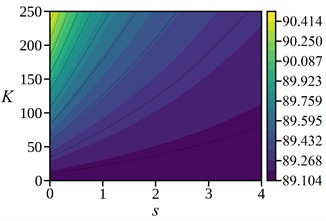
The results obtained using the authors’ method (AM) for are presented in numerical form in Table 1 and graphically in Fig. 3. It should be noted separately that, in the limiting case = 0, when the elastic foundation is absent, the dimensionless frequencies are as follows: = 10.216, = 39.771, = 89.104.
It should be noted that the method allows the computational accuracy to be controlled by selecting an appropriate number of terms in the series. In the examples considered, the calculations were performed to an accuracy of six decimal places. For the natural frequencies, this level of accuracy was achieved by retaining the first terms of the series.
Considering the vibration frequencies as functions of the independent variables , over the specified intervals , respectively, and having a set of values of these functions (see Table 1), we approximate them by third-degree polynomials. As a result, the following analytical relationships are obtained:
where the values of the coefficients and the corresponding coefficients of determination are given in Table 2.
Fig. 32D contour maps of Ωi(s,K)(i=1,2,3) within the ranges 0≤s≤4 and 0≤K≤250 for a solid circular plate with a rigidly fixed edge
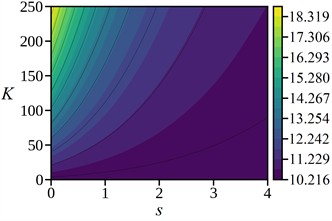
a)
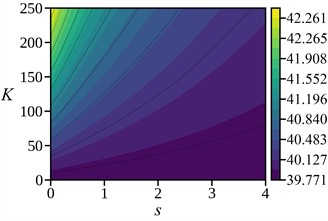
b)
c)
Table 1Obtained results for a solid circular plate with a rigidly fixed edge
0 | 25 | 11.374 | 40.084 | 89.244 | 50 | 12.424 | 40.395 | 89.384 |
0.5 | 10.900 | 39.973 | 89.196 | 11.542 | 40.174 | 89.288 | ||
1 | 10.643 | 39.916 | 89.172 | 11.053 | 40.061 | 89.239 | ||
1.5 | 10.495 | 39.881 | 89.157 | 10.766 | 39.992 | 89.210 | ||
2 | 10.405 | 39.858 | 89.147 | 10.590 | 39.945 | 89.190 | ||
2.5 | 10.348 | 39.841 | 89.140 | 10.478 | 39.911 | 89.176 | ||
3 | 10.311 | 39.828 | 89.134 | 10.404 | 39.886 | 89.165 | ||
3.5 | 10.285 | 39.818 | 89.130 | 10.354 | 39.866 | 89.156 | ||
4 | 10.268 | 39.810 | 89.127 | 10.319 | 39.850 | 89.149 | ||
0 | 100 | 14.296 | 41.009 | 89.664 | 250 | 18.825 | 42.799 | 90.496 |
0.5 | 12.728 | 40.574 | 89.471 | 15.747 | 41.754 | 90.020 | ||
1 | 11.826 | 40.349 | 89.374 | 13.871 | 41.206 | 89.779 | ||
1.5 | 11.285 | 40.212 | 89.316 | 12.699 | 40.868 | 89.633 | ||
2 | 10.949 | 40.119 | 89.276 | 11.946 | 40.638 | 89.534 | ||
2.5 | 10.732 | 40.051 | 89.247 | 11.449 | 40.470 | 89.462 | ||
3 | 10.588 | 40.000 | 89.225 | 11.113 | 40.342 | 89.407 | ||
3.5 | 10.489 | 39.960 | 89.208 | 10.880 | 40.242 | 89.363 | ||
4 | 10.421 | 39.928 | 89.194 | 10.716 | 40.162 | 89.328 |
Table 2Values of coefficients j and coefficients of determination R2 of polynomial Eq. (21)
1 | 2 | 3 | |
10.50027179 | 39.83156638 | 89.13047354 | |
–0.955635044 | –0.250874395 | –0.112560553 | |
0.039080697 | 0.011489895 | 0.005186142 | |
0.567380122 | 0.16376255 | 0.074375256 | |
–0.020344857 | –0.005756973 | –0.002536747 | |
–3.36495404×10⁻⁵ | –9.85126327×10⁻⁷ | –9.40213900×10⁻⁸ | |
–0.088232175 | –0.027036405 | –0.012370640 | |
0.002771291 | 0.000845861 | 0.000380271 | |
8.43927745×10⁻⁶ | 3.14368802×10⁻⁷ | 3.11956490×10⁻⁸ | |
2.14851471×10⁻⁸ | 6.86461832×10⁻¹¹ | 6.59113159×10⁻¹² | |
0.993 | 0.993 | 0.992 |
4. Illustrative example
To verify the analytical formulas (AF) Eq. (21) consider a mechanical system with the following characteristics: elasticity modulus 200 GPa; Poisson’s ratio 0,3; 7800 kg/m3; 1.5 m; 0.02 m; 5.5×10³ kN/m3, 2.15.
Table 3 presents the results obtained using the authors’ method (AM), analytical formulas (AF), and the finite element method (FEM) implemented in the LIRA-FEM software package. The finite element model comprised 360 triangular elements in the central region of the plate and 6,840 rectangular elements in the remaining region. The relative errors between the FEM and AF results are also provided.
Table 3Obtained results
Mode No. | Vibration frequencies , rad/s | Relative error, % | ||
AM | AF | FEM | ||
1 | 49.696656 | 49.270169 | 47.298965 | 4.17 |
2 | 175.670108 | 175.478453 | 167.076340 | 5.03 |
3 | 388.904688 | 388.812123 | 369.630524 | 5.19 |
5. Conclusions
Parametric analysis was performed to investigate the free axisymmetric vibrations of a circular plate resting on a nonhomogeneous Winkler elastic foundation characterized by a power-law variation of the foundation modulus. Dependences of the natural frequencies on the foundation inhomogeneity exponent and the generalized dimensionless parameter of the mechanical system were established. The resulting polynomial relationships provide a high approximation accuracy and make it possible to determine the natural frequencies without performing repeated numerical calculations. Comparison with the finite element method confirmed the validity and practical applicability of the proposed approach.
References
-
F. E. Ahad, D. Shi, and A. Ur Rehman, “Analytical approaches to vibration analysis of circular, annular and sectorial plates subjected to classical and arbitrary boundary conditions – a literature survey,” Journal of Vibroengineering, Vol. 18, No. 2, pp. 731–743, Mar. 2016, https://doi.org/10.21595/jve.2015.16382
-
M. A. Foyouzat, M. Mofid, and J. E. Akin, “Free vibration of thin circular plates resting on an elastic foundation with a variable modulus,” Journal of Engineering Mechanics, Vol. 142, No. 4, Jan. 2016, https://doi.org/10.1061/(asce)em.1943-7889.0001050
-
S. Timoshenko and S. Woinowsky-Krieger, Theory of Plates and Shells. New York, USA: McGraw-Hill, 1959.
-
S. Timoshenko, Vibration Problems in Engineering. New York, USA: Van Nostrand, 1955.
-
D. V. Vainberh and Y. D. Vainberh, Calculation of Plates. (in Ukrainian), Kyiv, Ukraine: Budivelnyk, 1970.
-
L. Rao and K. C. Chellapilla, “Free vibration of circular plates with elastic edge support and resting on an elastic foundation,” International Journal of Acoustics and Vibrations, Vol. 17, pp. 204–207, 2012.
-
S. Salawu, G. Sobamowo, and O. Sadiq, “Investigation of the dynamic behaviour of non-uniform thickness circular plates resting on Winkler and Pasternak foundations,” Acta Polytechnica, Vol. 60, No. 2, pp. 127–144, Apr. 2020, https://doi.org/10.14311/ap.2020.60.0127
-
M. Shariyat and M. M. Alipour, “A power series solution for free vibration of variable thickness Mindlin circular plates with two-directional material heterogeneity and elastic foundations,” Journal of Solid Mechanics, Vol. 3, No. 2, pp. 183–197, 2011, https://doi.org/10.1016/j.apm.2012.07.037
-
A. P. Gupta and N. Bhardwaj, “Free vibration of polar orthotropic circular plates of quadratically varying thickness resting on elastic foundation,” Applied Mathematical Modelling, Vol. 29, No. 2, pp. 137–157, Oct. 2004, https://doi.org/10.1016/j.apm.2004.07.010
-
J. N. Franklin and R. F. Scott, “Beam equation with variable foundation coefficient,” Journal of the Engineering Mechanics Division, Vol. 105, No. 5, pp. 811–827, Feb. 2021, https://doi.org/10.1061/jmcea3.0002525
-
M. Lentini, “Numerical solution of the beam equation with nonuniform foundation coefficient,” Journal of Applied Mechanics, Vol. 46, No. 4, pp. 901–904, Dec. 1979, https://doi.org/10.1115/1.3424675
-
Y. S. Krutii, A. O. Perperi, and D. V. Velychko, “Calculation of axisymmetric vibrations of circular plates resting on a power-law variable Winkler elastic foundation,” (in Ukrainian), Modern Construction and Architecture, No. 12, pp. 51–64, 2025.
-
Y. Krutii, A. Perperi, S. Nikipchuk, I. Butrynskyi, and D. Velychko, “Modal analysis of circular plates resting on an inhomogeneous elastic Winkler foundation,” Vibroengineering Procedia, Vol. 59, pp. 133–138, Sep. 2025, https://doi.org/10.21595/vp.2025.25282
-
Y. Krutii, A. Perperi, R. Kachmar, R. Predko, and D. Velychko, “Analytical method for studying free vibrations of round plates on a non-homogeneous elastic foundation,” Mathematical Models in Engineering, Vol. 12, No. 2, pp. 202–219, Jun. 2026, https://doi.org/10.21595/mme.2026.26028
About this article

The authors have not disclosed any funding.
The datasets generated during and/or analyzed during the current study are available from the corresponding author on reasonable request.
The authors declare that they have no conflict of interest.

