Abstract
The article presents the justification for the design of a vibrating unbalance mill with an independent drive. To implement this task, a schematic diagram of the mill was developed, a nonlinear mathematical model of the mill was created, and elements of its dynamics were investigated. Based on the obtained mathematical equations, graphical dependencies were constructed that describe the influence of the parameters of a vibrating unbalance mill with an independent drive on the amplitude of oscillations of its working chamber and the nature of its movement. This makes it possible to regulate the efficiency of the vibrating mill and optimize its geometric parameters even at the design stage. Based on the obtained mathematical model, it is possible to construct the trajectories of movement of any point of the mill during its operation. The determined indicators are of great importance in studying the dynamics of the mill with the aim of its constructive improvement to ensure reliability and long service life.
Highlights
- The optimal way to increase the efficiency and productivity of vibrating mill is to create new designs that implement complex trajectories of the working chamber.
- The mathematical model of the motion of a vibration unbalance mill with an independent drive, developed using the aforementioned methodology, is a system of expressions that describe the motion of individual points of the mill and include all its parameters.
- The amplitude of oscillations of the working chamber of the mill is a factor that is subject to regulation and directly affects the productivity and efficiency of the mill.
- It is clear that an increase in the distance between the mill suspension supports leads to a nonlinear increase in the vertical amplitude of the chamber vibrations.
- To increase the efficiency of the vibration unbalance mill with an independent drive, at the design stage it is necessary to ensure the minimum distance between the unbalance shafts and the maximum distance between the elastic suspension supports.
1. Introduction
Vibrating mills are widely used for grinding bulk materials in various industries. The increase in the scope and volume of their use leads to the need to create new models, optimize and modernize existing types of vibrating mills. This requires additional research into the influence of various external and internal factors on their operation.
The key parameters that determine the productivity of a vibrating mill are the amplitude and frequency of oscillations of its working chamber. During oscillatory motion, the chamber receives energy from the machine drive, which is spent on performing the intended technological operation – grinding, crushing, transportation, etc. At the same time, an unlimited increase in the frequency and amplitude of oscillations is impossible, as this leads to a significant increase in the loads on the supporting units of the machine, which causes accelerated wear, increased metal consumption, energy consumption and the cost of performing operations.
The optimal way to increase the efficiency and productivity of vibrating machines, in particular mills, is to create new designs that implement complex trajectories of the working chambers. Therefore, the purpose of this study is to investigate the influence of the geometric parameters of a vibrating ball mill with an independent drive on the amplitude and characteristics of the movement of its working chamber. To achieve this goal, a nonlinear mathematical model was developed that describes the movement of the center of mass of the mill, and the influence of the main geometric parameters on the vibration characteristics was analyzed. The results obtained provide a basis for optimizing the geometry of the mill at the design stage and increasing its operational efficiency, reliability and service life.
2. Referencing
A review of recent publications has shown that the operation of vibrating mills is considered based on various methods and models. In [1], the internal dynamic processes in the mill and the influence of the load on the energy efficiency of the grinding process are studied. Vibration and acoustic signals are used to assess the operating modes of the mill. It is the analysis of their spectrum that determines the degree of loading and the efficiency of the mill. The use of acoustic sensors to monitor the grinding process is also described in [2, 3]. Such studies show the prospects for the use of acoustic methods for studying the dynamic state of a vibrating mill.
In [4], the influence of the diameter of the grinding bodies on the intensity of the work of a vibrating ball mill is studied. In particular, it was found that the size of the balls significantly affects the intensity and productivity of the grinding process. In [5], by modeling a vibrating ball mill using the discrete element method, the trajectories of the grinding body motion, the forces of interaction between particles, and the distribution of energy during grinding were analyzed.
In [6], a new model of a vibration mill with vibration-impact disturbance of the working chamber is proposed. A mathematical model of the mill is built and the influence of the technological environment on the amplitude, speed, acceleration and dynamic loads of the simulated multi-mass system is investigated. Also, in [7-9], mathematical and experimental studies of the dynamic, kinematic and energy parameters of vibration-impact systems are carried out, the results of which allow optimizing the grinding processes.
In [10], a complex model of the mill is proposed, combining an electromechanical drive system, multi-body dynamics and the discrete element method, which together allows investigating the influence of the diameter and filling of the working chamber of the mill on its energy efficiency and the productivity of the grinding process.
In [11, 12], the influence of disturbance and trajectory of the working chamber on the grinding process of bulk material is investigated. In [13-15] the movement of bulk material in the chamber of a vibrating mill was tracked by conducting DEM and FEM modeling.
The analysis of literature sources shows that the study of vibrating mills is carried out using mathematical modeling and modern numerical methods. Despite the significant amount of work on this topic, the issue of optimizing various models of vibrating mills remains relevant and requires further research. In particular, this concerns the influence of geometric parameters of vibrating mills and physical and mechanical characteristics of bulk materials on the efficiency of the grinding process.
3. Main material
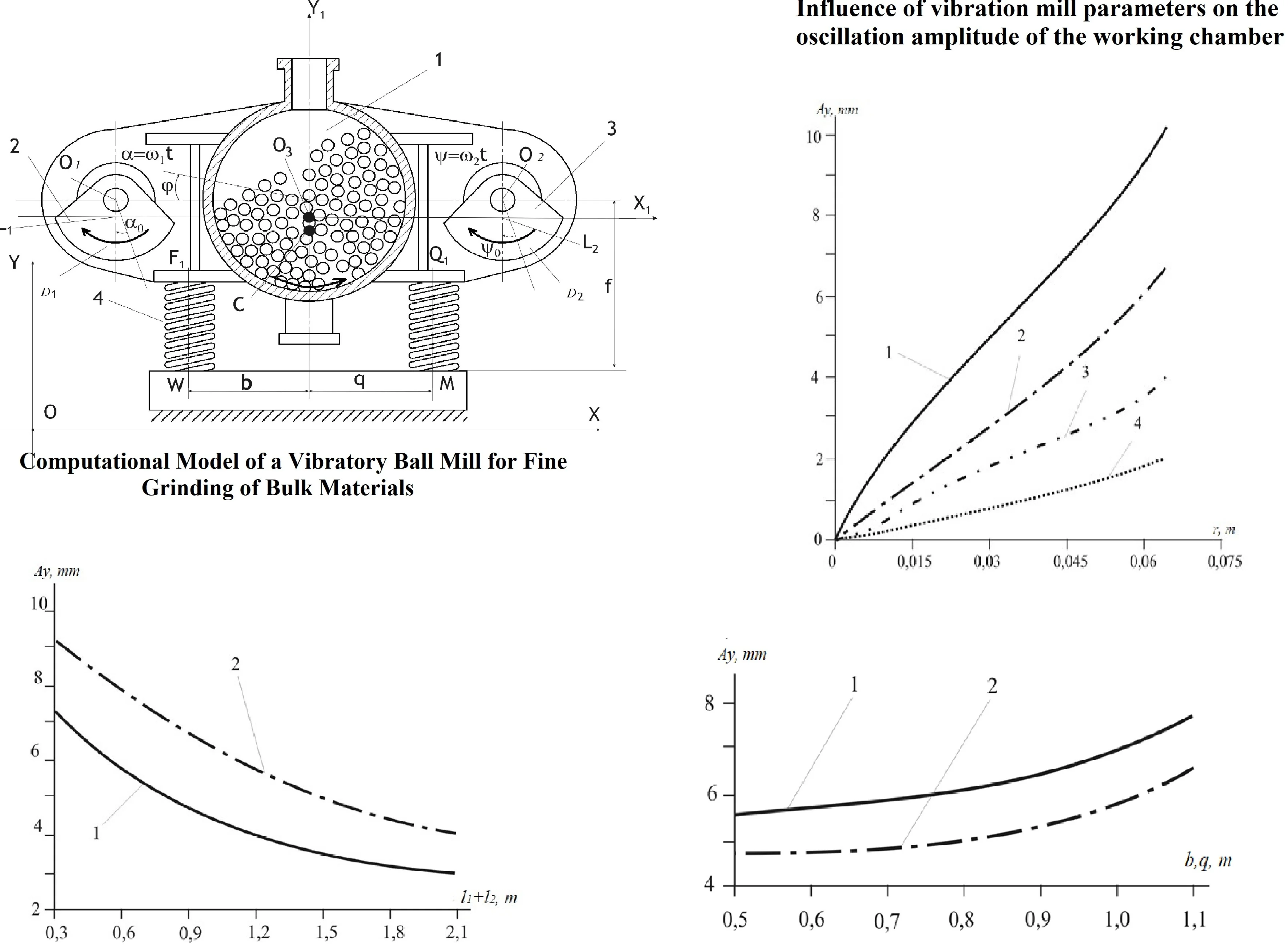
The design diagram of a vibrating unbalance mill with an independent drive is presented in the form shown in Fig. 1.
In Fig. 1, denoted: 1 – working chamber of the mill with a total mass . The moment of inertia of these masses relative to the longitudinal axis of the mill chamber is will be .
Let us denote 2 and 3 blocks of imbalances (two blocks on the left and two on the right) with the corresponding masses and . Eccentricity of imbalances within the block, respectively – and . Let’s set the coordinate systems: a) – stationary; b) – movable, attached to the working chamber of the mill, oscillating with it. Let be the possible angle of rotation of the mill chamber during oscillatory motion in the planes of rotational motion of the unbalanced blocks. The center of mass of the camera is around point . Let and be the coordinates of the center of rotation of the left unbalance blocks, and , respectively, of the right ones. The left unbalance blocks have an angular velocity of , the right blocks – . Let and be the initial phases of the unbalance blocks, and – the angles of rotation of the unbalance blocks for a certain time of operation of the mill. Let 4 be the elastic suspension of the mill. It consists of 4 compression springs, twisted, cylindrical. is the total stiffness of the suspension of the left part of the mill, is the right part of the mill. When the mill is at rest, the length of the springs will be and , denoted by . When the mill is operating, the length of the suspension springs at any time is and . Let and be the distances from the axes of the springs to the axis of the chamber in the plane of rotational motion of the unbalance blocks.
Fig. 1Computational model of a vibratory ball mill for fine grinding of bulk materials
The mathematical model of the motion of a vibration unbalance mill with an independent drive, developed using the aforementioned methodology, is a system of expressions that describe the motion of individual points of the mill and include all its parameters (kinematic, geometric and dynamic, including force) in the form of symbolic notations. The model is built on the basis of the Lagrange equation with the subsequent application of asymptotic methods of nonlinear mechanics.
Based on the formed system of expressions [16-17], it is possible to construct the equation of motion of any point of the selected section of the mill:
where ; ;
Eq. (3) is the presented mathematical model of the analysis of the motion of a vibration unbalance mill with an independent drive. From a mathematical point of view, it describes the motion of the center of mass of the working chamber of the mill. These equations allow to reconstruct the trajectories of the motion of points and determine the amplitudes of their oscillations. In the future, knowing the amplitude and frequency of oscillations of a specific point, it becomes possible to assess the efficiency of the material grinding process in this zone of the mill, which allows to determine the productivity and quality of grinding for individual sections of the working chamber.
The amplitude of oscillations of the working chamber of the mill is a factor that is subject to regulation and directly affects the productivity and efficiency of the mill. The amplitude of oscillations cannot be increased indefinitely, but within wide limits it can be corrected by changing the kinematic, geometric and inertial characteristics of the mill. It is thanks to the optimal selection of these parameters that maximum efficiency of the mill for fine grinding of bulk material of a certain type is achieved, when a given portion of material is crushed to the required size of the final fraction in the minimum time with the expenditure of the minimum amount of energy resources.
The results of the research on the influence of the parameters of a vibration unbalance mill with an independent drive on the amplitude of oscillations of its working chamber and the nature of its movement (in other words, the dynamics of the mill) were a number of graphical relationships illustrating this influence. As an example, below is an analysis of the influence of the eccentricity of the masses of the unbalance blocks on the amplitude of the oscillatory movement of the mill chamber at different values of the masses of these blocks (Fig. 2).
Fig. 2The influence of the eccentricity of the mass of the unbalance blocks on the amplitude of the oscillatory motion of the mill chamber for different masses of the unbalance blocks: 1 – MD = 12 kg; 2 – MD = 9 kg; 3 – MD= 6 kg; 4 – MD= 3 kg
Fig. 3 and 4 present the results of studies of the influence of the geometric parameters of a vibrating unbalance mill with an independent drive on the vertical amplitude of oscillations of its chamber. In particular, Fig. 3 shows the influence of the location of the axes of the unbalance shafts, while Fig. 4 illustrates the influence of the position of the mill suspension springs.
Fig. 3The influence of the location of the axes of the unbalance shafts on the vertical amplitude of the camera vibrations when: 1 – MK = 1200 kg; 2 – MK = 850 kg.
Fig. 4The effect of the placement of the mill suspension spring on the vertical amplitude of the chamber oscillations for: 1 – MK = 1000 kg; 2 – MK = 1500 kg
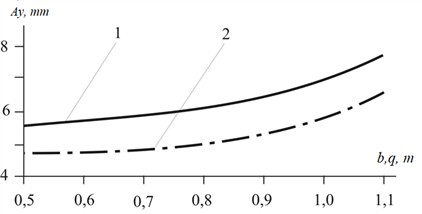
The graphical dependences (Figs. 2-4) show that reducing the mass of the working chamber from 1.200 to 850 kg, while maintaining a constant distance between the unbalance weights, results in an increase in amplitude to 9.1 mm. Furthermore, when the weight of the unbalance weights is increased to 12 kg and the distance from the chamber axis to the suspension supports is increased to 1 m, the vertical amplitude reaches its maximum value of 7.8 mm.
Based on the study’s graphical relationships and obtained results, it has been determined that maximizing the oscillation amplitude of the mill’s working chamber requires minimizing the distance between the unbalance shafts while maximizing the distance between the suspension supports. This operating mode significantly alters the kinematics of the grinding media, shifting them from a low-efficiency rolling motion to a high-energy state characterized by impact and circulation. Consequently, this enables a substantial increase in the speed and quality of material grinding while minimizing time and energy consumption.
4. Conclusions
Based on the constructed mathematical model and graphical dependencies (Fig. 2-3), it was established that an increase in the distance between individual independently driven unbalance shafts (to the axis of the mill chamber) leads to a nonlinear decrease in the vertical amplitude of the chamber vibrations. And from the graphical dependency (Fig. 4), it is clear that an increase in the distance between the mill suspension supports leads to a nonlinear increase in the vertical amplitude of the chamber vibrations. In general, the analysis of graphs 3 and 4 shows that to increase the efficiency of the vibration unbalance mill with an independent drive, at the design stage it is necessary to ensure the minimum distance between the unbalance shafts and the maximum distance between the elastic suspension supports.
Similar studies can be conducted for any point of the mill under study using Eq. (1) and (2). The used methodology can be applied to other types of mills.
References
-
M. Góralczyk, P. Krot, R. Zimroz, and S. Ogonowski, “Increasing energy efficiency and productivity of the comminution process in tumbling mills by indirect measurements of internal dynamics – an overview,” Energies, Vol. 13, No. 24, p. 6735, 2020, https://doi.org/10.3390/en13246735
-
K. B. Owusu, W. Skinner, and R. Asamoah, “Acoustic sensor frequencies and mill feed properties – a brief review,” in Chemeca. Advance, Disrupt and Sustain. Engineers Australia, Vol. 1, No. 1, pp. 187–121, 2021.
-
O. M. Stankevych, “Methods of artificial intelligence for acoustic emission diagnostics of fracture stages (a review). Part 1: Algorithms of unsupervised and supervised machine learning,” Physicochemical Mechanics of Materials, Vol. 60, No. 3, pp. 5–14, 2024, https://doi.org/10.15407/pcmm2024.03.005
-
P. Tomach, “The influence of the grinding media diameter on grinding efficiency in a vibratory ball mill,” Materials, Vol. 17, No. 12, p. 2924, Jun. 2024, https://doi.org/10.3390/ma17122924
-
M. Thouret et al., “Discrete elements modeling of a vibratory ball mill,” in Proceedings of the 13th Colloque Sciences Et Technologies Des Poudres (STP 2024), p. 2024, Jun. 2024.
-
H. Shevchenko and V. Shevchenko, “Analytical researches of a vibrating mill with vibroimpact excitation of a crushing chamber,” IOP Conference Series: Earth and Environmental Science, Vol. 1348, No. 1, p. 012050, 2024, https://doi.org/10.1088/1755-1315/1348/1/012050
-
V. Gursky, I. Kuzio, and V. Korendiy, “Optimal synthesis and implementation of resonant vibratory systems,” Universal Journal of Mechanical Engineering, Vol. 6, No. 2, pp. 38–46, Aug. 2018, https://doi.org/10.13189/ujme.2018.060202
-
V. Gurskyi, V. Korendiy, P. Krot, R. Zimroz, O. Kachur, and N. Maherus, “On the dynamics of an enhanced coaxial inertial exciter for vibratory machines,” Machines, Vol. 11, No. 1, p. 97, Jan. 2023, https://doi.org/10.3390/machines11010097
-
V. Korendiy, V. Zakharov, V. Gurey, P. Dmyterko, I. Novitskyi, and O. Havrylchenko, “Modelling the operation of vibratory machine for single-sided lapping of flat surfaces,” Vibroengineering Procedia, Vol. 38, pp. 1–6, Jun. 2021, https://doi.org/10.21595/vp.2021.22001
-
Z. Liu et al., “Electromechanical coupling characteristics analysis of vertical stirred mill based on ECS-MBD-DEM,” Powder Technology, Vol. 433, p. 119245, Dec. 2023, https://doi.org/10.1016/j.powtec.2023.119245
-
D. Wang et al., “Multi-harmonic vibration finishing dynamics: system response and granular media behavior,” Powder Technology, Vol. 469, No. 2, p. 121791, Oct. 2025, https://doi.org/10.1016/j.powtec.2025.121791
-
W. Fu, D. Li, and X. Zhang, “Structure optimization of vibratory mills based on container wall trajectory characteristics,” Advanced Powder Technology, Vol. 37, No. 6, p. 105264, Apr. 2026, https://doi.org/10.1016/j.apt.2026.105264
-
D. Rhymer, A. Ingram, K. Sadler, and C. R. K. Windows-Yule, “Segregation in binary and polydisperse stirred media mills and its role on grinding effectiveness,” Powder Technology, Vol. 443, p. 119921, May 2024, https://doi.org/10.1016/j.powtec.2024.119921
-
S. Bremner, A.C. Brandt, D. Ssebunnya, A. Kwade, S. Neethling, and A. Mainza, “Comparison of media dynamics in a stirred mill using particle tracking techniques and DEM simulations,” Chemical Engineering and Technology, Vol. 49, No. 5, p. e70231, May 2026, https://doi.org/10.1002/ceat.70231
-
T. M. Lenkovskiy et al., “An effective crack tip region finite element sub-model for fracture mechanics analysis,” Archives of Materials Science and Engineering, Vol. 2, No. 87, pp. 56–65, 2017, https://doi.org/10.5604/01.3001.0010.7446
-
V. Topilnytskyy et al., “Modeling the dynamics of vibratory separator of the drum type with concentric arrangement of sieves,” Eastern-European Journal of Enterprise Technologies, Vol. 2, No. 7 (86), pp. 26–35, Apr. 2017, https://doi.org/10.15587/1729-4061.2017.95615
-
V. Topilnytskyy and V. Vyshatytskyy, “Developing a mathematical model for describing the motion of a vibratory type separator with sequential screens,” Ukrainian Journal of Mechanical Engineering and Materials Science, Vol. 10, No. 1, pp. 70–76, May 2024, https://doi.org/10.23939/ujmems2024.01.070
About this article

The authors have not disclosed any funding.
The datasets generated during and/or analyzed during the current study are available from the corresponding author on reasonable request.
The authors declare that they have no conflict of interest.

