Abstract
The article addresses the problems associated with the mathematical modeling of nonlinear electromagnetic vibrators. The presented paper demonstrates the reason that, for decades, has caused certain difficulties in providing a mathematically correct description of the excitation force generated by the half-wave-rectified alternating current resulting from the operation of a diode connected in series in the power supply circuit of electromagnetic vibrators. The paper also shows that for correct mathematical modeling, in the case of an electromagnetic vibrator powered by alternating current (without a diode), it is necessary to take into account the phase of /2, i.e., instead of , should be used . Mathematical analysis of the equations describing the oscillations of a mechanical system and the driving force has also shown that a single equation can be successfully used instead of a system of two equations. Practical experience demonstrates that to accurately describe the dynamics of vibrating machines during various technological operations, it is necessary to model them as two-mass systems (rather than systems reduced to a single mass), while the technological process itself should be treated as a three-mass system.
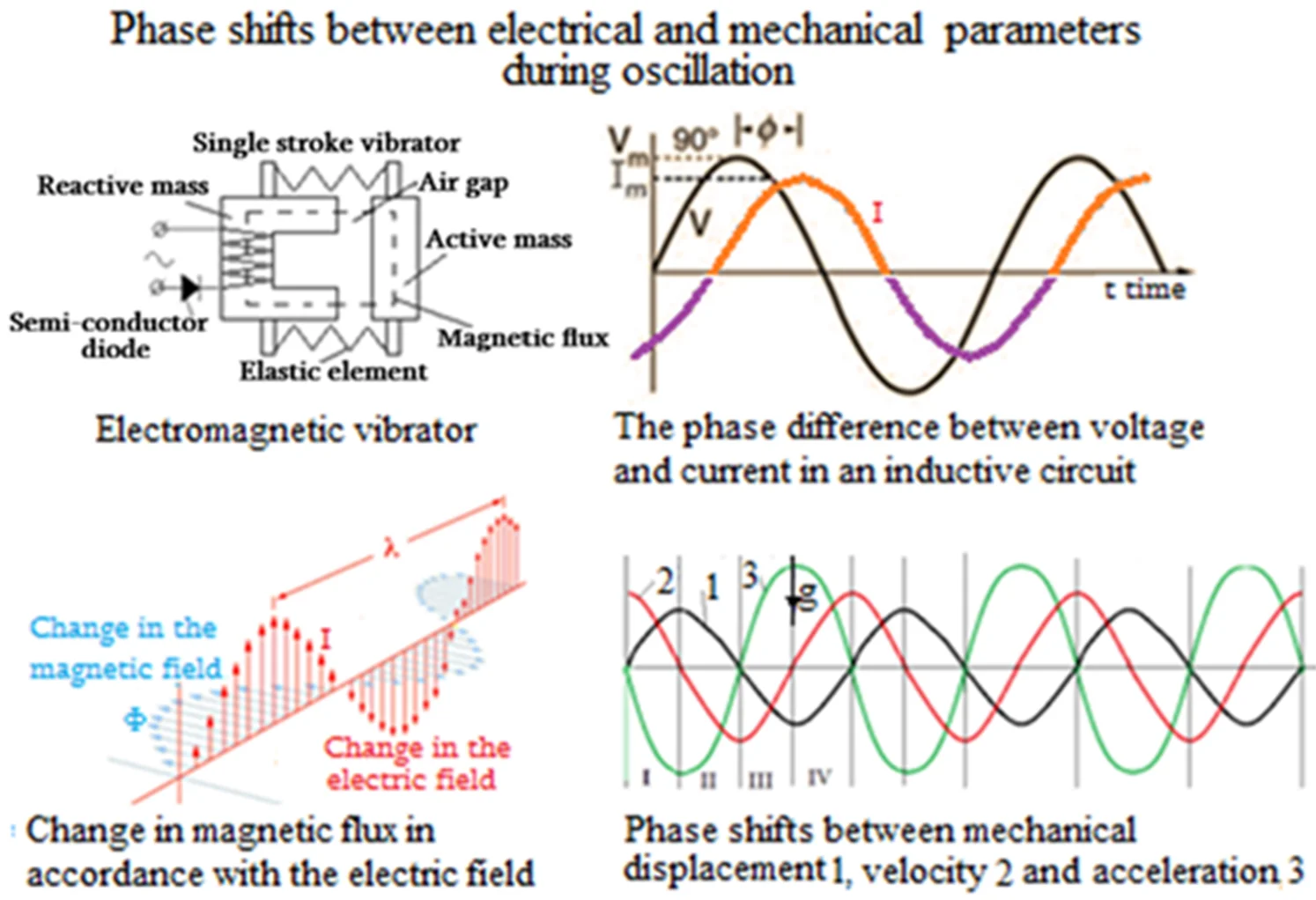
Highlights
- For the first time, the operation of a semiconductor diode connected in series in a variable-inductance electrical circuit, intended to halve the excitation frequency of the electromagnet in a vibratory machine, was described mathematically.
- It was established that the half-cycle of alternating current interrupted by the diode must not be equated to setting the voltage term associated with the diode to zero in the electromagnetic excitation equation.
- In the absence of the voltage term, the excitation equation is transformed into an equation describing the decay of a radioactive substance [I. S. Piskunov, Differential and Integral Calculus. Moscow, 1970, 576 pp.].
- It was established that, owing to inductive reactance, at frequencies above 15–20 Hz, the amplitudes of mechanical oscillations have a negligible effect on the formation of the excitation force.
- A simplified single-equation nonlinear differential equation and an exact single-equation nonlinear differential equation describing single-acting electromagnetic vibratory machines were obtained.
1. Introduction
Electromagnetic vibrating machines are widely used in engineering [1-4]. Despite the structural simplicity, the operation and stability processes of vibrating machines, in particular electromagnetic vibrators, involve fundamental issues of vibration theory [3]-[10]. The aim of this work is to develop a mathematical model for electromagnetic vibration machines that enables the determination of the future machine's operational characteristics and dynamic stability with maximum accuracy during the early stages of design. The methodology of the current study was based on the continuous comparison and analysis of theoretical and experimental results. Closely related research findings appearing in the scientific literature were also systematically reviewed and analyzed [6].
2. Mathematical modeling of electromagnetic vibrators with semi-rectified current (electromagnetic force)
Unlike non-electromagnetic vibrators, electromagnetic vibrators are mathematically described by two equations: (1) the first equation describes the mechanical oscillatory process driven by an excitation force with a quadratic dependence, while (2) the second equation describes the generation of electromagnetic flux () [7]:
where 2, , , are the coefficients of proportionality, respectively, of dissipative forces, perturbation force, electrical intensity, magnetic permeability, is the natural circular frequency of the vibrator, is the initial air gap, is the magnetic flux, is the vibration amplitude of the mechanical system.
To ensure an excitation frequency of 50 Hz in high-power electromagnetic vibrators powered directly from the industrial mains, a semiconductor diode is connected in series with the vibrator’s power circuit.
For a number of years, developing a mathematical description of the excitation force while accounting for the cyclic interruption of the current by the semiconductor diode posed a significant challenge. For example, the periodic zeroing of the input signal (the second term, , in Eq. (2)) resulted in an unbounded increase in the magnetic flux and the deflection of the mechanical system shown in Fig. 1.
Fig. 1Increase in magnetic flux and bending when zeroing bsin(ωt) in Eq. (1)
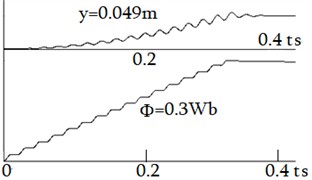
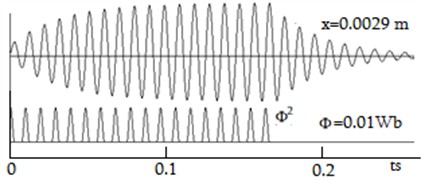
Fig. 2The resonant obtained using Eq. (4) by cyclically setting cos(ωt) to zero
To address this problem, some researchers periodically interrupted the magnetic flux in Eq. (1) while leaving the process described by Eq. (2) unchanged, thereby obtaining good results. Others artificially varied the coefficients and in Eq. (2) over unrealistically large ranges.
To investigate this problem, a comprehensive mathematical and physical analysis of Eq. (2) was carried out. An analytical solution of Eq. (2) was obtained under the assumption that the air gap is sufficiently small and can therefore be neglected [11]:
Further analysis showed that, from the perspective of electromagnetic induction, the current and magnetic flux within the system do not vanish instantaneously when the current is interrupted by the diode. Therefore, during the intervals when the diode blocks the current, the equations governing electromagnetic flux decay must be used instead of Eq. (2) [11].
To simplify calculations (while accepting a small, permissible error regarding the negative half-periods) mathematical modeling allows to be set to zero without equating to zero in Eq. (2) [11], [12].
3. Mathematical modeling of electromagnetic vibrators oscillations with one equation
By expanding Eq. (3) (which describes the magnetic flux into a power series in terms of , selecting the first term, squaring it, and substituting the result into Eq. (1), we derive a single equation describing the oscillatory process of the electromagnetic vibration exciter:
where .
Fig. 2 shows the resonant mode obtained using Eq. (4) with half-wave rectified 50 Hz current excitation. The resonant mode presented here is in good agreement with results obtained on an actual vibration test stand. It is worth noting that an analogous result is obtained by cyclically replacing Eq. (1) with the magnetic flux decay equation, or by interrupting the magnetic flux itself during the half-periods.
4. Influence of a phase shift on a forming of electromagnetic exciting force
When mathematically modeling electromagnetic vibrators, the phase shift in Eq. (2) must also be taken into account; excitation by , without the appropriate phase adjustment, yields the oscillatory process shown in Fig. 3, which is unrealistic, whereas a phase shift of /2, i.e. using results in the resonant mode shown in Fig. 4, which fully corresponds to reality.
Fig. 3The resonant obtained using sin(ωt) in Eq. (1)
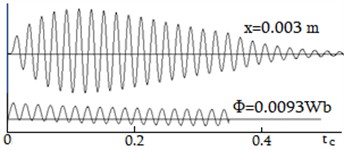
Fig. 4The resonant obtained using cos(ωt) in Eq. (1)
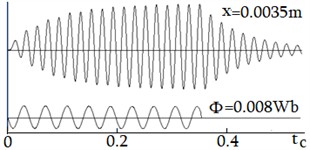
Analyses of Eq. (2) shows that the magnetic flux is formed based on the integration of . Thus, the integration of over a segment - with a zero initial value of the argument is a function , which is shifted from the zero axis and when the argument changes, the sign does not change.
When integrating over a segment - to obtain the function, which is unbiased relative to the zero axis and changes sign, it is necessary to use shifted by /2.
5. Consideration of vibration machines as a two-mass freedom systems
Fig. 5 shows the computational scheme of a two-mass vibratory machine. To simplify the calculations, existing methods consider vibratory machines as a single-mass system with a reduced mass . as shown in Fig. 6 [2], [11].
Fig. 5Two-mass system
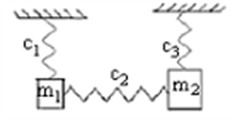
Fig. 6Single-mass system
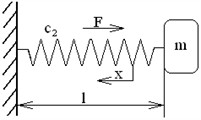
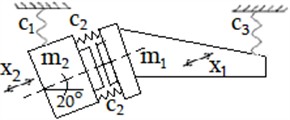
Fig. 7Two-mass vibrator
Practical experience shows that, in order to adequately describe a wide range of technological operations, it is necessary to consider the vibratory machine in mathematical modeling not as a system reduced to a single isolated mass, described by Eq. (1) or (4) [11], but rather as a two-mass system (Fig. 5).
In the context of modern digital technologies, and to address the aforementioned drawback under changing technological loads, it is appropriate to represent the mathematical model of vibromachines as a two-mass oscillatory system (Fig. 7), with two degrees of freedom and suspension stiffnesses and .
The calculation formulas of the mathematical model of a single-cycle two-mass electromagnetic vibrator taking into account excitation force of Eq. (4) (Fig. 5 and Fig. 7) has the following form [11], [12]:
During the execution of technological operations, the reactive and active masses are subjected to different loads. Moreover, the magnitude of the active mass varies depending on the oscillation period.
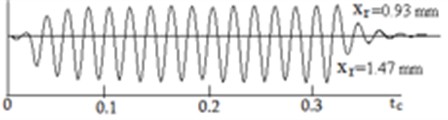
The stiffnesses and are much less than the main stiffness Fig. 8 shows the amplitudes of resonant oscillations obtained using a two-mass computational model for the case where the active mass is 1.25 and the reactive mass is 0.75, while Fig. 9 presents the amplitudes obtained using an equivalent single-mass model.
Fig. 8Resonance of two-mass system
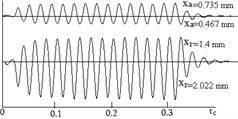
Fig. 9Resonance of single-mass system
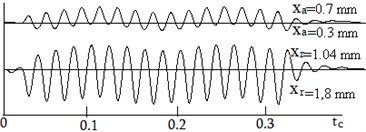
It should be noted that when mathematically modeling two-mass systems, the suspension stiffnesses and must be taken into account; otherwise, under the influence of an external force, the vibrator, isolated from the environment, would exhibit unrealistic spatial motion (Fig. 9). Fig. 10 shows the resonant regime established under the influence of suspension stiffness, in which a low-frequency oscillatory component is evident.
Fig. 10Oscillatory process of an isolated two-mass system without c1 or c2
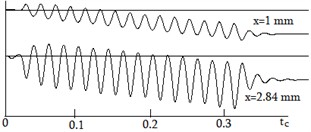
Fig. 11Oscillatory process of a two-mass system, taking into account c1 or c2
Technological loading significantly influences the dynamics of vibrating machines, resulting in a redistribution of the machine’s active and reactive masses. Consequently, both the total mass of the vibrating machine and its natural frequency of oscillation change. Technological loading also affects the magnitude and nature of the dissipative forces acting on the vibrator. Since the performance of certain technological operations requires precise knowledge of the oscillation amplitudes, it is necessary to develop a mathematical model of a two-mass vibrating machine with two degrees of freedom. Experimental studies were conducted on various types of actual vibrating machines, utilizing a special vibration test rig equipped with a frequency converter. Electrical and vibration parameters were measured using modern digital instruments. C++ Builder and the Runge-Kutta method were employed for mathematical programming.
6. Conclusions
It has been established that, in some (certain) cases, the system of equations describing the oscillation of electromagnetic vibrators can be successfully replaced by a single equation.
Mathematical modeling has shown that when the electromagnetic vibrator is powered by alternating current (without a diode), a phase shift of /2 must be taken into account in Eq. (2) – that is, should be used instead of .
It has been established that, in the mathematical modeling of material transport and compaction processes, it is appropriate to treat two-mass vibrating machines as two-mass systems rather than as systems reduced to a single mass, whereas the transport or compaction process itself should be treated as a three-mass system.
References
-
I. I. Blekhman, Vibrational Mechanics: Nonlinear Dynamic Effects. Singapore: World Scientific, 2000, p. 509.
-
P. Czubak and M. Klemiato, “Analysis of the transport capabilities of an energy-efficient resonant vibratory conveyor of classical construction,” Energies, Vol. 18, No. 10, p. 2500, 2025, https://doi.org/10.3390/en18102500
-
I. I. Blekhman, Series on Stability, Vibration and Control of Systems, Series A. Singapore: World Scientific, 2004, p. 410, https://doi.org/10.1142/5013
-
S. K. Dwivedi and M. Al-Ajmi, “Dynamic analysis of vibratory feeder and their effect on feed particle acceleration,” Measurement, Vol. 101, pp. 145–156, 2017, https://doi.org/10.1016/j.measurement.2017.01.031
-
J. J. Thomsen, Vibrations and Stability: Advanced Theory, Analysis, and Tools. Berlin; Heidelberg: Springer, 2003.
-
V. Despotović, M. Lečić, M. R. Jović, and A. Djurić, “Vibration control of resonant vibratory feeders with electromagnetic excitation,” FME Transactions, Vol. 42, No. 4, pp. 281–289, 2014, https://doi.org/10.5937/fmet1404281d
-
V. Korendiy, O. Kachur, I. Hurey, R. Predko, R. Palash, and O. Havrylchenko, “Modelling and experimental investigation of the vibratory conveyor operating conditions,” Vibroengineering Procedia, Vol. 47, pp. 1–7, Dec. 2022, https://doi.org/10.21595/vp.2022.23057
-
M. Chelidze, V. Zviadauri, and T. Natriashvili, “Some problems with the mathematical modeling of electromagnetic vibrators used for transporting bulk materials,” Transport Problems, Vol. 17, No. 4, pp. 57–68, Dec. 2022, https://doi.org/10.20858/tp.2022.17.4.05
-
M. Chelidze, V. Zviadauri, T. Natriashvili, A. Didebulidze, G. Javakhishvili, and T. Kuntchulia, “Vibrational transport of materials considering the physical and mechanical characteristics of the material-working element system,” Transport Problems, Vol. 20, No. 4, pp. 181–193, 2025, https://doi.org/10.20858/tp.2025.20.4.15
About this article

This work was supported by Shota Rustaveli National Science Foundation of Georgia (SRNSFG) [FR-24-1448], “Comprehensive research of the vibratory transport-technological processes and development of the designs of new, highly efficient device”.
The datasets generated during and/or analyzed during the current study are available from the corresponding author on reasonable request.
The authors declare that they have no conflict of interest.

