Abstract
In arid regions of southwestern Uzbekistan, protecting the railway subgrade from wind-blown sand is a priority engineering task. This paper presents a systems approach to selecting and applying geomaterials for the Bukhara–Misken railway: climatic-geotechnical zoning, assessment of sand-drift intensity, a decision matrix based on wind loading, and a techno-economic evaluation. The proposed measures (geogrids, geotextiles, geomats, aerodynamic barriers, and biopolymer stabilizers) enhance subgrade stability, reduce maintenance costs, and extend maintenance intervals. The approach is transferable to transport infrastructure in desert zones of Central Asia.
Highlights
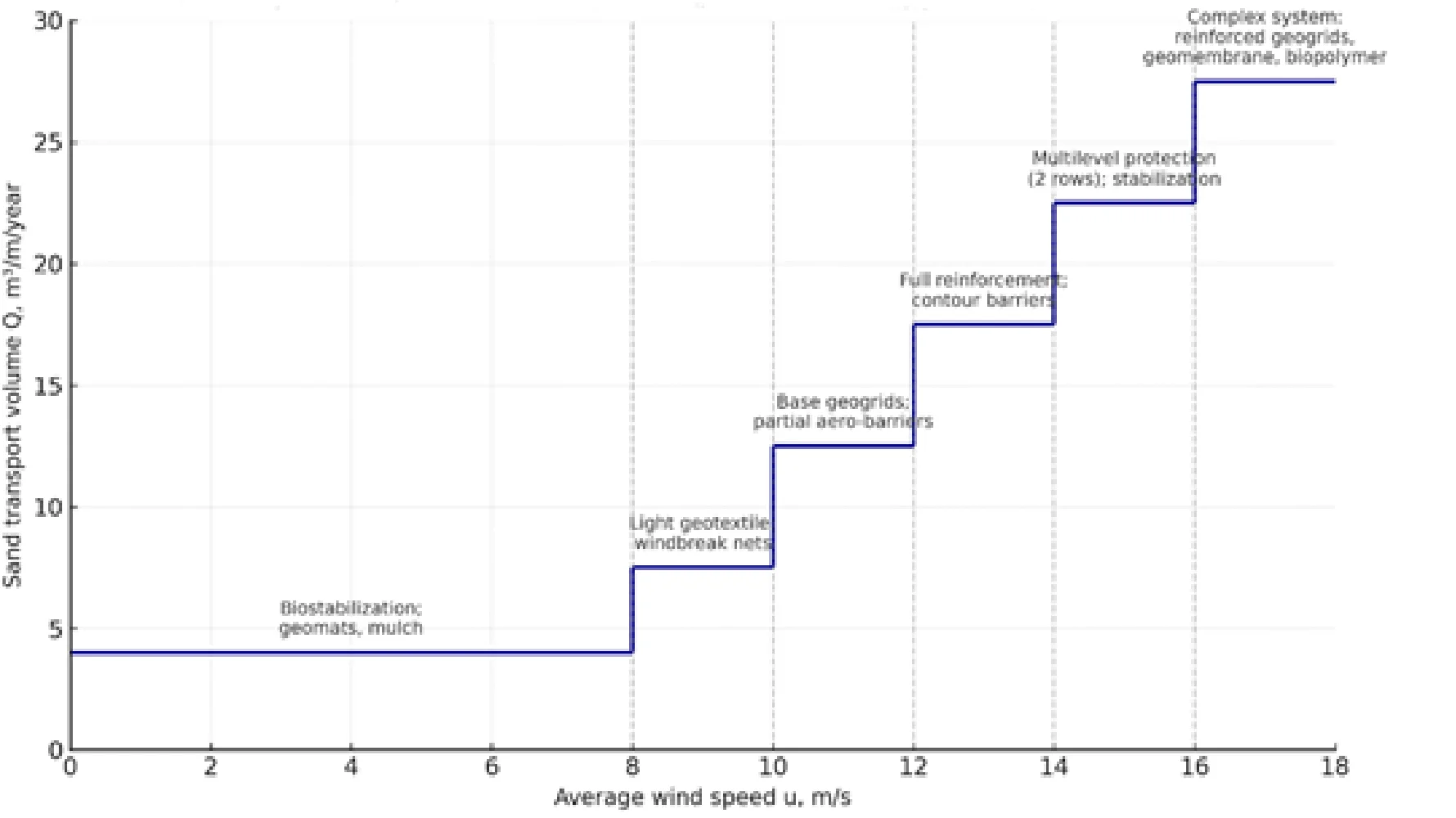
- Stepwise diagram of wind speed vs protection levels.
- Scheme of protection types along Bukhara–Misken line.
- Matrix for selecting optimal design and technological solutions depending on wind speed and sand transport volume.
1. Introduction
Railway construction and operation in arid regions are strongly influenced by aeolian processes such as deflation, wind erosion, and sand accumulation [1-3]. In areas with loose sand and sparse vegetation – such as Iran, China, and Central Asia – sand drifts cause slope instability and higher maintenance costs [2, 4, 5].
In southwestern Uzbekistan, particularly along the Bukhara-Misken line, sand encroachment up to 1 m in height occurs frequently. This requires durable engineering and technological solutions. Geosynthetics can redistribute stresses, limit deformations, and reduce sand transport [5-8].
International practice (China, Saudi Arabia) shows that the most effective protection combines base reinforcement, aerodynamic barriers, and biopolymer surface stabilization [4, 9, 10]. The choice of geomaterial type must consider local geotechnical and climatic conditions [7, 11-13].
The aim of this study is to develop an adaptive engineering protection system for the railway subgrade using geomaterials, tailored to wind load and sand-drift intensity on the Bukhara-Misken railway.
The main objectives are:
1) To perform climatic-geotechnical zoning of the railway section.
2) To determine sand-drift intensity [4, 5, 12].
3) To develop a decision matrix linking wind speed and sand-drift volume.
4) To evaluate the technical and economic effectiveness of geomaterials and aerodynamic barriers [11, 14, 15].
The scientific novelty lies in integrating climatic zoning, a cubic sand-drift model, and a matrix-based algorithm for selecting protective measures, which increases subgrade stability and reduces maintenance costs [7, 8, 10].
2. Materials and methods
2.1. Climate and geotechnical zoning
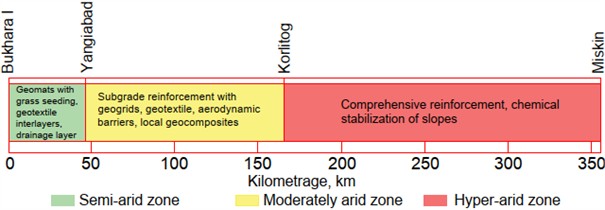
For the Bukhara–Miskin railway line (≈ 356 km), zoning was carried out according to the degree of aridity based on data from Uzgidromet (1990-2020) [16, 17]. As a result, the following climatic zones were identified:
– Slightly arid zone (0-39 km) – characterised by relatively moderate climatic conditions: average annual precipitation is 120-150 mm, and average wind speed is 2-3 m/s. Sand drifts are less pronounced here, but are possible in conditions of local soil blowing.
– The mid-arid zone (40-166 km) has a drier climate, with precipitation ranging from 80 to 100 mm/year. The main feature is a steady wind regime with an average speed of 4-6 m/s, which contributes to the movement of sand masses, especially near areas with disturbed vegetation cover.
– The highly arid zone (167-356 km) has the most extreme climatic conditions. Precipitation does not exceed 70 mm/year, and wind activity increases significantly: the average wind speed exceeds 7 m/s, with gusts of up to 12-15 m/s regularly recorded. This zone experiences the greatest manifestations of aeolian activity, including the formation of dunes and massive sand drifts, especially near areas with low anthropogenic protection.
An engineering-geological characterisation (granulometry, filtration, vegetation cover, deflation) has been carried out for each zone [5, 12, 13].
2.2. Sand transport model and parameter sensitivity
The intensity of sand transport was determined using the formula [4, 5, 12]:
where – sand transport volume, m3/m/year; – empirical coefficient (accepted within the range of 0.1–0.25 depending on the type of sand); – sand density (1600 kg/m3); – average annual wind speed, m/s; – acceleration due to gravity (9.81 m/s2).
Table 1Matrix for selecting optimal design and technological solutions depending on wind speed and sand transport volume
Average annual wind speed , m/s | Sand transport volume , m3/m/year | Recommended solution | Type of material used |
Up to 8 | < 5 | Biological stabilisation of slopes, minimal reinforcement | Geomats, biomaterials, mulching covers |
8-10 | 5-10 | Light reinforcement; local wind protection nets | Non-woven geotextiles, mesh barriers |
10-12 | 10-15 | Reinforcement of the embankment base with geogrids, partial aerodynamic barriers | Biaxial geogrids, aerodynamic screens |
12-14 | 15-20 | Comprehensive reinforcement of the base and slopes, installation of barriers along the contour of the embankment | High-strength geogrids, dense geotextiles, barrier structures |
14-16 | 20-25 | Multi-level protection: reinforcement, two rows of aerodynamic barriers, surface stabilisation | Reinforcing geocomposites, geomaterials, shielding barriers |
More than 16 | > 25 | Comprehensive system: base reinforcement, anti-erosion slope systems, chemical soil stabilisation | Reinforced geogrids, geomembranes, biopolymer stabilisers |
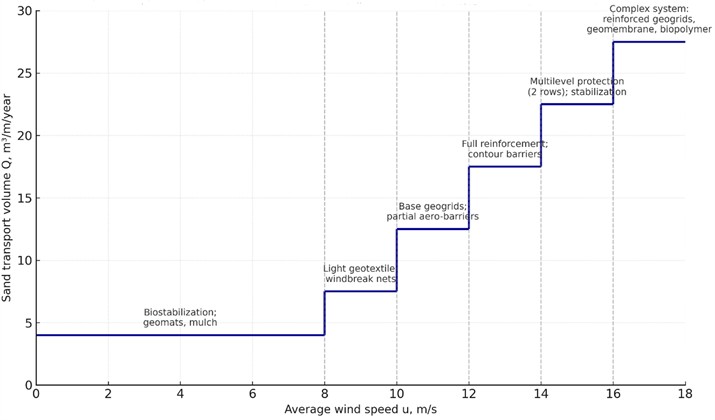
Since , the intensity of sand transport is proportional to the cube of wind speed . In engineering calculations, discretisation was used for wind speed intervals and corresponding ranges of sand transport volume, as shown in Table 1 [8, 10].
Parameter () has a scaling effect: when it increases from 0.10 to 0.25, the value () increases approximately 2.5 times, which was taken into account when validating the calculated data based on field observations [15, 18, 19].
2.3. Decision matrix
The matrix defines the transition from biostabilisation (low , low ) to multi-level systems with reinforcement and aerodynamic barriers [1, 6, 8, 10].
It is used to design local risk segments [15, 19, 20].
2.4. Performance criteria
The effectiveness assessment included: (i) reduction in sand transport volume (, %); (ii) increase in slope stability coefficient ; (iii) increase in inter-repair period (years); (iv) reduction in annual operating costs (, %).
3. Results and discussion
Zoning revealed heterogeneous conditions: 0-39 km – low impact ( 2.5-4.0), 40-166 km – moderate ( 10-15), 167-356 km – high ( 25-30) [12, 13, 16].
The application of the matrix reduced by 60-80 %, increased to ≥ 1.5, increased by 3-5 years, and reduced OPEX by 15-18 % [15, 18, 21].
For clarity, a ‘step-by-step’ schedule of correspondence between u ranges and measures has been developed (Fig. 1) [8, 10, 18, 22].
Fig. 1Stepwise diagram of wind speed vs protection levels
The diagram (Fig. 2) illustrates the distribution of types of measures along the route: in the slightly arid zone – biological methods; in the moderately arid zone – reinforcement and barriers; in highly arid zones – integrated systems with biopolymers [22, 23].
This cascading approach ensures a balance between technical and economic efficiency and confirms the versatility of the method for the desert regions of Central Asia [5, 7, 8, 15, 24].
Fig. 2Scheme of protection types along Bukhara-Misken line
4. Conclusions
An adaptive algorithm for the engineering protection of railway subgrades in arid regions has been developed, based on climatic zoning and a cubic model of sand transport.
The matrix of design and technological solutions provides a differentiated selection of protective measures: from biostabilisation of slopes to multi-level reinforcement systems and aerodynamic barriers. The use of geogrids, geotextiles, geomats and biopolymer stabilisers reduces sand transport by 60-80 %, increases the slope stability coefficient to 1.5 and reduces operating costs by 15-20 %.
The proposed methodology can be used in the design, modernisation and operation of railways in desert areas of Central Asia and similar climatic conditions. Further research is aimed at assessing the durability of geomaterials and refining the empirical parameters of the sand transport model.
References
-
M. Fathali, M. M. K. Nasrabad, H. R. Abbasi, A. Amrollahi, and M. Soleymani, “Aeolian sand challenges in desert rail infrastructures, overview of Iran’s experience and advancement,” Construction and Building Materials, Vol. 438, p. 136953, Aug. 2024, https://doi.org/10.1016/j.conbuildmat.2024.136953
-
B. Ma et al., “Characteristics and hazards of an aeolian sand environment along railways in the southeastern fringe of the Taklimakan desert and sand control measures,” Applied Sciences, Vol. 12, No. 18, p. 9186, Sep. 2022, https://doi.org/10.3390/app12189186
-
J. Liu, L. Wang, and M. Chen, “Engineering practices for aeolian sand hazard mitigation in desert regions: A case study from China,” Journal of Arid Land, Vol. 12, No. 3, pp. 398–408, 2020.
-
F. Li, W. Zheng, L. Zhang, H. Wang, and Z. Wang, “Optimization study on the design parameters of sand barriers along the hami-lop nor railway line,” Sustainability, Vol. 15, No. 6, p. 5297, Mar. 2023, https://doi.org/10.3390/su15065297
-
A. Gupta, G. Singh, and A. Mishra, “Application of geosynthetics in control of sand migration along transportation corridors: A review,” Geotextiles and Geomembranes, Vol. 49, pp. 237–249, 2021.
-
M. Amiri Tasuji, P. Ghadir, A. Hosseini, A. A. Javadi, A. Habibnejad Korayem, and N. Ranjbar, “Experimental investigation of sandy soil stabilization using chitosan biopolymer,” Transportation Geotechnics, Vol. 46, p. 101266, May 2024, https://doi.org/10.1016/j.trgeo.2024.101266
-
K. Lesov, “Effectiveness management of construction production programs with changes in the facilities saturation with means of mechanization,” in 3rd International Scientific Conference Construction Mechanics, Hydraulics and Water Resources Engineering (CONMECHYDRO 2021 AS), Vol. 2612, p. 040022, Jan. 2023, https://doi.org/10.1063/5.0114462
-
K. Lesov, A. O. ’Ralov, M. Kenjaliyev, N. Begmatov, and U.B. Ergashev, “Calculation of slope stability against erosion deformations,” in E3S Web of Conferences, Vol. 583, p. 01006, Oct. 2024, https://doi.org/10.1051/e3sconf/202458301006
-
E. Deng, H. Yue, X.-Y. Liu, and Y.-Q. Ni, “Aerodynamic impact of wind-sand flow on moving trains in tunnel-embankment transition section: from field testing to CFD modeling,” Engineering Applications of Computational Fluid Mechanics, Vol. 17, No. 1, Dec. 2023, https://doi.org/10.1080/19942060.2023.2279993
-
A. Abdujabarov, P. Begmatov, F. Eshonov, M. Mekhmonov, and M. Khamidov, “Determination of state of avalanche protection gallery during seismic impact and avalanches,” in E3S Web of Conferences, Vol. 401, p. 02042, Jul. 2023, https://doi.org/10.1051/e3sconf/202340102042
-
K. S. Lesov, Z. Z. Ergashev, M. K. Kenjaliyev, and S. A. Tadjibaev, “Quantitative characteristics of construction and reconstruction of railway sections in Uzbekistan,” in E3S Web of Conferences, Vol. 401, p. 03024, Jul. 2023, https://doi.org/10.1051/e3sconf/202340103024
-
Z. C. Zhou, Z. P. Shangguan, and D. Zhao, “Modeling vegetation coverage and soil erosion in China’s Loess Plateau,” Environmental Earth Sciences, Vol. 68, No. 8, pp. 2305–2312, 2013.
-
M. Qadir, A. D. Noble, S. Schubert, R. J. Thomas, and A. Arslan, “Sodicity‐induced land degradation and its sustainable management: problems and prospects,” Land Degradation and Development, Vol. 17, No. 6, pp. 661–676, May 2006, https://doi.org/10.1002/ldr.751
-
K. S. Lesov, M. M. Rasulmukhamedov, A. K. Mavlanov, and M. K. Kenjaliyev, “Tension of ground pressure on the foundations of railway catenary supports,” in E3S Web of Conferences, Vol. 401, p. 03035, Jul. 2023, https://doi.org/10.1051/e3sconf/202340103035
-
N. Begmatov, U. Ergashev, K. Lesov, and S. Shayakhmetov, “Bearing capacity of the subgrade for high-speed train traffic,” in E3S Web of Conferences, Vol. 531, p. 02006, Jun. 2024, https://doi.org/10.1051/e3sconf/202453102006
-
M. Muzaffarova, “Dilatation of the method of the fixation of moveable sands,” Transport Problems, Vol. 17, No. 4, pp. 79–89, Dec. 2022, https://doi.org/10.20858/tp.2022.17.4.07
-
M. Muzaffarova and M. Mirkhanova, “Investigations of damage to the under-rail base on the main routes JSC “Uzbekistan Temir Yullari”,” in E3S Web of Conferences, Vol. 401, p. 05034, Jul. 2023, https://doi.org/10.1051/e3sconf/202340105034
-
M. Mekhmonov, S. Makhamadjonov, and A. Uralov, “Stabilization of embankments and coastal bridges with reinforced concrete piles,” in E3S Web of Conferences, Vol. 508, p. 08018, Apr. 2024, https://doi.org/10.1051/e3sconf/202450808018
-
S. B. Shayakhmetov, S. B. Kystaubayev, K. S. Lesov, and K. K. Umarov, “Seismic stress state of Earth bed – foundation system,” in E3S Web of Conferences, Vol. 401, p. 01083, Jul. 2023, https://doi.org/10.1051/e3sconf/202340101083
-
S. B. Shayakhmetov, Z. D. Kalpenova, K. S. Lesov, and K. K. Umarov, “Rayleigh and love surface waves with regard to seismic stress state of earth bed,” in E3S Web of Conferences, Vol. 401, p. 01077, Jul. 2023, https://doi.org/10.1051/e3sconf/202340101077
-
U. Ergashev and N. Begmatov, “Ensuring safety of track-laying works while long-welded rails replacement,” Discover Applied Sciences, Vol. 7, No. 5, p. 470, May 2025, https://doi.org/10.1007/s42452-025-07049-3
-
K. Lesov, A. Abdujabarov, M. Kenjaliyev, and O. Mirzakhidova, “Techno-economic evaluation of geotextile application as a separation layer and its contribution,” in E3S Web of Conferences, Vol. 583, p. 01008, Oct. 2024, https://doi.org/10.1051/e3sconf/202458301008
-
A. Abdujabarov, P. Begmatov, M. Mekhmonov, and F. Eshonov, “Earthquake resistance of culverts of railways of Uzbekistan,” in E3S Web of Conferences, Vol. 401, p. 03003, Jul. 2023, https://doi.org/10.1051/e3sconf/202340103003
-
A. Kuandykova et al., “Production of composite cement clinker based on industrial waste,” Journal of Composites Science, Vol. 8, No. 7, p. 257, Jul. 2024, https://doi.org/10.3390/jcs8070257
About this article

The authors have not disclosed any funding.
The datasets generated during and/or analyzed during the current study are available from the corresponding author on reasonable request.
The authors declare that they have no conflict of interest.

