Abstract
This study presents a technical and ecological evaluation of a diatomite-based filter strip designed to purify polluted surface runoff from a railway embankment. A pilot-scale three-layer structure (1.0 m width, 0.70 m height, slope 1:1.5) was constructed parallel to the embankment. The upper gravel layer dissipates flow and retains coarse solids, the diatomite layer (0.8-2.0 mm) serves as the main sorption–filtration medium for petroleum hydrocarbons (PHCs) and fine suspended solids, and the bottom drainage layer provides filtrate collection and sampling. Field observations during rainfall and snowmelt events showed removal efficiencies of 97.5 % for petroleum hydrocarbons and 96.7 % for suspended solids, ensuring compliance with regulatory limits for fishery water bodies. The system operates passively, without external energy, and maintains stable filtration parameters. The results confirm the engineering feasibility and ecological efficiency of diatomite-based filter strips for mitigating hydrocarbon pollution in railway drainage systems.
1. Introduction
The intensive use of hydrocarbons and their derivatives in industry and transport significantly increases the risk of their entry into natural water bodies through insufficiently treated wastewater. For most production and transport facilities, including railway enterprises, the problem of preventing pollution of industrial areas by petroleum products and their removal from surface runoff remains an urgent environmental task [1-3].
Surface runoff from railway embankments often contains suspended solids and petroleum hydrocarbons (PHCs) originating from fuel leaks, lubricants, and technical fluids. During the long cold period of the year, pollutants accumulate on site, and within a short snowmelt period (10-15 days) are diffusively washed away either over the terrain or directly into water bodies [4, 5]. Such diffusive runoff is difficult to localize and treat using traditional centralized facilities. Consequently, there is a need for linear, low-cost, and passive purification systems that can be deployed along embankments to intercept and treat runoff before it reaches natural receivers.
Natural sorbents, particularly diatomite, have shown high efficiency in removing petroleum hydrocarbons and heavy metals due to their high porosity, adsorption capacity, and environmental safety [6-8]. The use of diatomite as a filter-sorption medium in linear water-protection structures enables the deep treatment of surface runoff from both suspended and dissolved contaminants. This makes diatomite promising for constructing ecological barriers that protect aquatic ecosystems from pollution caused by railway transport facilities.
Based on this, the authors proposed and experimentally studied a three-layer filter strip structure consisting of a crushed-stone layer, a diatomite layer, and a drainage layer arranged parallel to a railway embankment [2, 9, 10]. The proposed system combines mechanical filtration, sorption of dissolved petroleum products, and partial self-purification through the rhizosphere of perennial grasses seeded on the surface layer.
The novelty of this study lies in the integrated technical and ecological evaluation of the diatomite-based filter strip under real field conditions. The research provides a reproducible description of the structure and operation of the filter strip, experimentally assesses its effectiveness in removing petroleum hydrocarbons and suspended solids from railway runoff, and assesses its environmental protection performance under real field conditions.
The objective of this study is to evaluate the ecological efficiency of a diatomite-based filter strip for cleaning polluted diffusive runoff from a railway embankment and to determine its practical applicability for protecting water bodies from hydrocarbon contamination.
2. Methods and materials
To achieve the objectives of this research, a combination of analytical, experimental, and computational methods was employed. The study included field observations, laboratory analyses, and an ecological assessment of the efficiency of a diatomite-based filter strip designed for the purification of polluted surface runoff from a railway embankment.
2.1. Study area and conditions
The experiments were conducted on a pilot section of a railway embankment where diffuse surface runoff occurs during rainfall and snowmelt periods. This runoff typically contains suspended solids and petroleum hydrocarbons (PHCs) originating from ballast contamination, lubricants, and fuel residues. During long cold seasons, pollutants accumulate on the embankment surface and are washed away during the short (10-15 day) snowmelt period, resulting in a concentrated discharge that is difficult to intercept using traditional centralized treatment systems [1-5].
These features make it necessary to develop linear, low-cost, passive purification systems that can be installed directly along embankments to intercept and treat runoff before it reaches natural water bodies.
2.2. Design of the filter strip
A pilot filter strip, 10 meters in length, was constructed parallel to the railway embankment. The diatomite fraction (0.8–2 mm) was selected to provide an optimal balance between high sorption capacity and sufficient hydraulic conductivity for passive filtration.
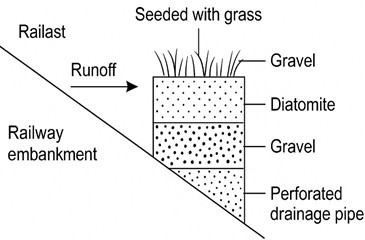
A three-layer ribbon-type filter strip was constructed parallel to the railway embankment. The structure had a total width of 1.0 m, height of 0.70 m, and side slope of 1:1.5, corresponding to the embankment geometry (Fig. 1). It consisted of the following functional layers:
1) Top layer: gravel (2-10 mm, 150 mm thick). This layer dissipates flow energy, retains coarse suspended particles, and provides uniform distribution of runoff. The surface was seeded with perennial grasses (≈ 40 g·m-2), which promote self-purification by developing oil-degrading rhizosphere microflora.
2) Middle (main) layer: diatomite (fraction 0.8-2 mm, 700 mm thick). This is the primary sorption–filtration medium that captures fine suspended solids and dissolved petroleum hydrocarbons due to its high porosity and silica skeleton structure [6-9].
3 Bottom layer: gravel (2-10 mm, 150 mm thick) with a perforated drainage pipe to collect and sample the filtrate.
The design filtration rate through the diatomite layer was 0.4–1.0 m·h-1, which ensured a minimum contact time of 30 minutes between the polluted water and the diatomite bed. These parameters allow deep purification of runoff to meet the regulatory limits (PHCs ≤ 0.05 mg·dm-3, TSS ≤ 2 mg·dm-3).
Fig. 1Schematic of the three-layer diatomite-based filter strip for treating runoff from a railway embankment
2.3. Hydraulic operation and cleaning process
Polluted runoff from the railway embankment enters the gravel layer, where flow velocity decreases and coarse particles settle. Then the water percolates through the diatomite layer, where filtration and sorption of dissolved hydrocarbons and fine particles occur. The purified filtrate drains through the lower gravel layer into a collection sump equipped with a perforated sampling pipe. The system operates passively-without external energy input-relying solely on gravity flow.
2.4. Sampling and analytical methods
Sampling was carried out during natural rainfall and snowmelt events. Composite samples of influent (before filtration) and effluent (after filtration) were collected at equal time intervals (every 10-15 min). Each event included 3-5 grab samples combined into a representative event-mean sample for analysis. The procedure followed national standards for environmental monitoring [10, 11].
Laboratory analyses included:
1) Petroleum hydrocarbons (PHCs): determined by infrared spectrophotometry after extraction with n-hexane; detection limit ≤ 0.02 mg·dm-3.
2) Total suspended solids (TSS): measured gravimetrically after filtration through pre-weighed glass-fiber filters and drying at 103-105 °C.
3) Physicochemical parameters (pH, electrical conductivity, temperature): measured in situ using calibrated portable meters.
The removal efficiency for each pollutant was determined by the standard equation:
where – pollutant concentration in influent, mg·dm-3; – pollutant concentration in effluent, mg·dm-3.
At least 10 % of samples were duplicates or field blanks to ensure analytical quality.
2.5. Data processing and pollutant load calculation
The annual pollutant load L (kg·year-1) entering the filter system was calculated as:
where – annual runoff volume (m3·year-1); – average pollutant concentration in influent, mg·dm-3.
2.6. Quality assurance and photographic documentation
All instruments were calibrated before each measurement campaign. Surrogate recoveries ranged from 70 % to 130 %, and the relative percent difference (RPD) between duplicates did not exceed 20 % for PHCs and 15 % for TSS.
High-resolution photographs (≥ 300 dpi) documented:
1) The filter-strip layout and construction stages.
2) Sampling and laboratory analysis.
3) Runoff conditions during field experiments.
Each photograph was annotated with the author’s name, location, and date to ensure data traceability and reproducibility.
3. Results and discussion
3.1. Treatment efficiency of the filter strip
The developed three-layer diatomite-based filter strip provided deep purification of surface runoff from the railway embankment. The influent and effluent concentrations of pollutants were determined during natural precipitation and snowmelt events.
The results demonstrate a significant reduction in both total suspended solids (TSS) and petroleum hydrocarbons (PHCs), achieving values that meet environmental standards for fishery water bodies (TSS ≤ 2 mg·dm-3; PHCs ≤ 0.05 mg·dm-3).
Table 1Average pollutant concentrations before and after filtration through the diatomite strip
Parameter | Influent concentration, mg·dm-3 | Effluent concentration, mg·dm-3 | Normative value, mg·dm-3 | Removal efficiency, % |
Petroleum hydrocarbons (PHCs) | 2.0 ± 0.5 | 0.05 ± 0.02 | ≤ 0.05 | 97.5 |
Total suspended solids (TSS) | 60.0 ± 15.0 | 2.0 ± 0.8 | ≤ 2.0 | 96.7 |
Note: Values represent mean ± standard deviation | ||||
A key practical consideration is the service life of the diatomite filter media. Based on the obtained data on the sorption capacity of diatomite and the annual mass of pollutants, a preliminary estimate indicates that media replacement or regeneration would be required no sooner than after 5-7 years of operation. This factor significantly increases the engineering practicality and operational sustainability of the technology by reducing maintenance frequency and ensuring stable long-term operation. A detailed study of saturation kinetics and diatomite regeneration methods is a subject for future research.
The removal efficiency was calculated according to Eq. (1).
The high removal efficiency (96-98 %) is due to the unique micro-porous structure of diatomite, which combines mechanical filtration, adsorption, and sorption processes.
The upper gravel layer slows the inflow and traps coarse suspended solids, while the diatomite layer captures fine particles and dissolved petroleum compounds through adsorption on the silica skeleton surface.
The bottom gravel layer with a drainage pipe maintains permeability and ensures stable outflow of purified water.
3.2. Determination of annual pollutant load
The annual volume of surface runoff from the studied embankment section was calculated as:
Based on this, the total annual pollutant load (kg·year-1) entering the filter system was calculated using Eq. (2).
Substituting the measured average concentrations yields:
– For petroleum hydrocarbons (PHCs): 9340.7×2.0×10−3= 18.7 kg/year-1.
– For total suspended solids (TSS): 9340.7×60.0×10−3= 560.4 kg/year-1.
3.3. Evaluation of filtration performance and environmental effect
Based on the calculated pollutant loads and measured efficiencies, the overall filtration performance of the system was analyzed as follows.
The developed three-layer diatomite-based filter strip demonstrated high stability and effectiveness in reducing both suspended and dissolved pollutants in surface runoff from the railway embankment. The system provided deep purification during natural rainfall and snowmelt events, achieving concentrations of petroleum hydrocarbons (PHCs) and total suspended solids (TSS) that met environmental standards for fishery water bodies (PHCs ≤ 0.05 mg·dm-3, TSS ≤ 2 mg·dm-3).
The obtained results confirm that the high treatment efficiency – 97.5 % for PHCs and 96.7 % for TSS – is mainly due to the optimal combination of hydraulic and sorption processes within the multilayer structure. The upper gravel layer dissipates hydraulic energy and removes coarse particles, while the diatomite layer provides fine filtration and adsorption of dissolved hydrocarbons due to its highly porous silica structure. The bottom drainage layer maintains permeability and enables consistent filtrate collection.
Field observations showed no clogging or surface erosion throughout the monitoring period, indicating stable hydraulic operation of the system. The filtration rate remained within the design range of 0.4-1.0 m·h-1, ensuring a sufficient contact time of at least 30 minutes between polluted water and the diatomite bed. These parameters guarantee uniform flow distribution and reliable retention of contaminants even under variable runoff conditions.
The ecological efficiency of the system is expressed in the significant reduction of pollutant load discharged into nearby water bodies, thereby minimizing risks of hydrocarbon accumulation and secondary contamination. The combination of passive operation, use of natural sorbents, and absence of energy demand highlights the sustainability and engineering reliability of the proposed solution.
Overall, the results validate that diatomite-based filter strips can serve as an effective linear treatment technology for railway drainage systems, providing long-term environmental protection with minimal maintenance requirements.
4. Discussion
The obtained results confirm that the diatomite-based filter strip effectively reduces both suspended and dissolved pollutants in railway runoff, achieving treatment to near-normative levels.
Such performance is attributed to the combined filtration-sorption-biological action of the multilayer structure.
The top gravel layer ensures hydraulic stability, while diatomite adsorbs petroleum hydrocarbons and facilitates biofilm growth that enhances degradation.
Similar removal efficiencies have been reported in earlier studies on diatomite and natural sorbents used in decentralized runoff treatment systems.
Thus, the diatomite-based filter strip represents a reliable and sustainable engineering measure for protecting water bodies from hydrocarbon-contaminated railway runoff.
5. Conclusions
The conducted study confirmed the high technical and ecological efficiency of using a diatomite-based filter strip for the purification of polluted surface runoff from railway embankments.
The developed three-layer system – consisting of gravel, diatomite, and drainage layers – provides deep purification of runoff, achieving 97.5 % removal of petroleum hydrocarbons and 96.7 % removal of suspended solids.
The filter operates passively under gravity flow, requires minimal maintenance, and ensures compliance with environmental standards for fishery water bodies.
The use of natural materials such as diatomite and gravel makes the system environmentally sustainable and technically reliable.
The results demonstrate the potential of diatomite-based filters for large-scale application in transport infrastructure to protect natural water bodies from hydrocarbon pollution.
References
-
O. R. Ilyasov, “Protection of water bodies from pollution by surface runoff of residential areas using biosorption method,” Ekaterinburg, Russia, 2002.
-
O. R. Ilyasov, “Bioprotection of water sources in agricultural catchments from pollution by effluents of poultry enterprises,” Ural State Agricultural Academy, Ekaterinburg, Russia, 2004.
-
V. I. Shishkin, “Monitoring researches of oiled soil of the railway bed,” Ural State University of Agriculture, Ekaterinburg, 2010.
-
A. Gülay, K. Tatari, S. Musovic, R. V. Mateiu, H.-J. Albrechtsen, and B. F. Smets, “Internal porosity of mineral coating supports microbial activity in rapid sand filters for groundwater treatment,” Applied and Environmental Microbiology, Vol. 80, No. 22, pp. 7010–7020, Nov. 2014, https://doi.org/10.1128/aem.01959-14
-
V. L. Draginsky, “Methodological recommendations for ensuring compliance with the requirements of sanitary rules and regulations SanPiN 2.1.4.559-96,” Moscow, Russia, 2000.
-
Y. A. Ubaskina, I. V. Arsentyev, E. G. Fetyukhina, Y. A. Korosteleva, and T. V. Adaev, “Study of the mineralogical composition of diatomite for its safe extraction and use in industry,” Bulletin of the Belgorod State Technological University named after V. G. Shukhov, No. 1, pp. 128–135, 2016.
-
A. S. Kopylov, V. M. Lavygin, and V. F. Ochkov, Water Treatment in the Energy Sector. Moscow, Russia: MPEI Publishing, 2003.
-
O. R. Ilyasov, S. N. Koshelev, V. S. Khomyakova, and O. A. Sherstyuchenko, “Improvement of biotechnology for treating wastewater from livestock and poultry enterprises,” Glavnyj Zootekhnik, No. 9, pp. 13–19, 2020.
-
M. M. Talipov, O. Aliev, O. R. Ilyasov, and O. Kovaleva, “Modern method for purifying wastewater from railway embarking using diatomite in a filter band,” in International Conference on Thermal Engineering, 2024.
-
S. Sulaymanov, M. M. Talipov, R. Razikov, O. R. Ilyasov, and O. Kovaleva, “Protection of the environment from pollution by wastewater from railway transport using natural sorbents,” in International Conference on Thermal Engineering, 2024.
-
M. Talipov, “Computational modeling and analysis of mechanical power consumption in train assemblers’ work,” in International Conference on Applied Innovations in IT (ICAIIT), Jun. 2025, https://doi.org/10.25673/120513
Cited by
About this article

The authors have not disclosed any funding.
The datasets generated during and/or analyzed during the current study are available from the corresponding author on reasonable request.
The authors declare that they have no conflict of interest.

