Abstract
This article study investigates the magnetic and magnetocaloric properties of MnAs(P) pnictide compounds using first-principles calculations. In the MnAs0.97P0.03 solid solution, a significant decrease in magnetization was observed, corresponding to a transition from ferromagnetic to paramagnetic ordering. The magnetostructural phase transition responsible for this behavior induces a noticeable magnetocaloric effect near the critical temperature. To analyze these phenomena, the local density approximation with gradient corrections (LDA+GGA) was employed. The interatomic exchange integrals were evaluated by differentiating the total energy functional with respect to spin-pair deviations from equilibrium. The results reveal that increasing phosphorus concentration enhances the magnetic anisotropy within structural blocks, necessitating stronger external magnetic fields to achieve complete ferromagnetic alignment. These findings contribute to a deeper understanding of tunable magnetocaloric materials for solid-state refrigeration and magnetic energy conversion app.
Highlights
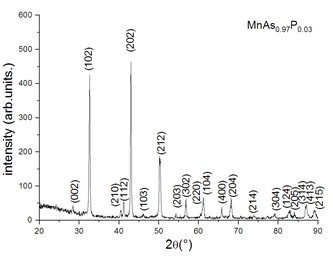
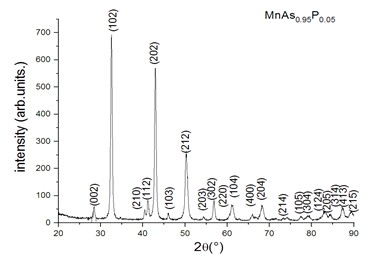
- X-ray diffraction patterns of MnAs₀.₉₇P₀.₀₃ and MnAs₀.₉₅P₀.₀₅ pnictides.
- Electronic density of states of MnAs₀.₉₇P₀.₀₃ and MnAs₀.₉₅P₀.₀₅ pnictides. The Fermi level position is indicated by a vertical line.
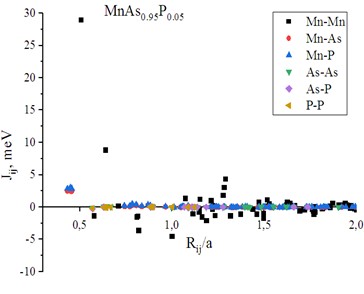
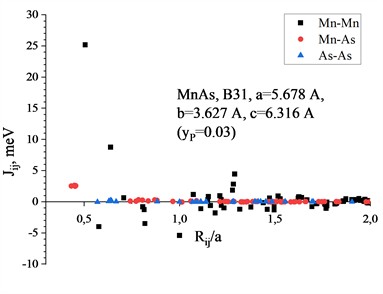
- Dependence of interatomic exchange integrals on distance in MnAs₀.₉₅P₀.₀₅ and in pure MnAs with the lattice parameters of MnAs₀.₉₅P₀.₀₅.
1. Introduction
The development of compact, environmentally sustainable, and energy-efficient refrigeration systems operating near room temperature has become increasingly significant in recent years. This growing interest is primarily driven by global concerns about greenhouse gas emissions, the environmental impact of conventional vapor-compression refrigerants, and the need for alternative solid-state cooling technologies. Among the most promising approaches is magnetic refrigeration, which is based on the magnetocaloric effect (MCE) – a reversible change in temperature of magnetic materials under the influence of an applied magnetic field [1-2].
The MCE reaches its maximum near the region of magnetic phase transitions, particularly in materials exhibiting strong coupling between magnetic and structural degrees of freedom. Such magnetostructural transitions are characteristic of certain transition-metal-based alloys, notably those containing elements from groups 5-7 of the periodic table [3-6]. These materials are of special interest because their first-order magnetostructural transformations can yield large entropy changes and high adiabatic temperature variations, which are desirable for high-performance magnetic refrigeration applications.
Despite significant progress, a comprehensive understanding of how minor chemical substitutions affect the magnetocaloric and magnetic properties of these compounds remains incomplete. In particular, elucidating the correlation between electronic structure, magnetic anisotropy, and phase transition behavior is essential for the rational design of tunable magnetocaloric materials. Therefore, this study focuses on analyzing the influence of phosphorus substitution in MnAs-based pnictides, aiming to clarify the mechanisms that govern their magnetic and magnetocaloric characteristics using first-principles calculations.
In this context, the investigation of the structural and magnetic properties of manganese-based pnictides, as well as their evolution with temperature and chemical substitution, remains of significant scientific interest. These compounds serve as model systems for studying the fundamental mechanisms of magnetostructural phase transitions, as they exhibit a wide variety of both first- and second-order transformations.
Previous studies have primarily focused on understanding the magnetocaloric effect in MnAs-based pnictides with partial substitution of manganese by transition metals [7-12]. Such investigations provided valuable insights into how electronic and magnetic interactions influence the entropy change and magnetization behavior near the critical temperature.
Building upon these earlier findings, the present work aims to analyze the influence of limited phosphorus substitution in the arsenic sublattice on the structural and magnetic phase transition characteristics of MnAs-based pnictide compounds. The goal is to elucidate how minor anionic substitutions modify the magnetostructural coupling and magnetic anisotropy, thereby affecting the overall magnetocaloric response of the system [36].
2. Materials and methods
Recently, perovskite manganites have been the subject of intensive research since they allow variation of the phase transition temperature over a wide range, thereby enabling a broader operational temperature interval for the magnetocaloric effect (MCE). In addition, these materials are economically viable and technologically accessible [1, 3]. Polycrystalline powders of solid solutions in the MnAs1-ᵧPᵧ system were synthesized using the solid-state reaction method by melting the initial components in vacuum-sealed quartz ampoules within a single-zone resistance furnace [5, 9]. Specifically, MnAs0.97P0.03 and MnAs0.95P0.05 samples were synthesized. The synthesis procedure followed established techniques for preparing manganese pnictides [9, 12]. Finely dispersed powders of manganese, phosphorus, and arsenic were mixed in stoichiometric ratios and sealed in evacuated quartz ampoules for the reaction.
The phase composition and unit cell parameters at room temperature were determined by X-ray diffraction (XRD) analysis using CuKα radiation. The isothermal entropy change associated with the phase transition was determined from magnetization measurements carried out in static magnetic fields up to 14 T [4], employing a vibrating sample magnetometer (Cryogenic Limited). Magnetocaloric properties were subsequently calculated indirectly using the Maxwell thermodynamic relation [10].
3. Results and discussion
Previous studies [15, 16] based on measurements of structural parameters, magnetic susceptibility, elastic, and other physical properties of equiatomic MnAs have demonstrated that a first-order magnetostructural phase transition occurs upon heating above 316 K. At this temperature, manganese arsenide undergoes a transformation from a ferromagnetic phase with a hexagonal crystal structure of the B81 type to a paramagnetic phase with an orthorhombic crystal structure of the B31 type.
According to X-ray diffraction (XRD) analysis, MnAs1-ᵧPᵧ compounds with phosphorus concentrations below 0.05 crystallize as single-phase materials adopting the orthorhombic B31 structure. The calculated lattice parameters , the axial ratio (), and the unit cell volume () for these solid solutions are summarized in Table 1
Table 1Parameters a, b, and c, and unit cell volume V of the MnAs1-ᵧPᵧ solid solutions
, nm | , nm | , nm | , 10–2 nm3 | |
0,03 | 0,5678 | 0,3627 | 0,6316 | 7,791 |
Calculations of the electronic structure and interatomic exchange integrals were performed using the fully relativistic Korringa-Kohn-Rostoker (KKR) method implemented in the SPR-KKR package (version 8.6) [10]. The simulations were conducted within the framework of the Coherent Potential Approximation (KKR-CPA) to properly account for the effects of chemical disorder in the alloys. The Atomic Sphere Approximation (ASA) was employed to describe the crystal potential.
For the exchange-correlation energy, the Local Density Approximation (LDA) with gradient corrections was adopted, as it provides the best correspondence between the calculated magnetic moments and the available experimental data [10, 22]. The interatomic exchange integrals were determined using the formalism described in [10, 23], which evaluates the variation of the total energy functional with respect to small deviations of specific spin pairs from their equilibrium orientations.
Fig. 1X-ray diffraction patterns of MnAs0.97P0.03 and MnAs0.95P0.05 pnictides
The interatomic exchange interactions and the corresponding electronic structure were evaluated using the fully relativistic Korringa-Kohn-Rostoker (KKR) approach, as implemented in the SPR-KKR package (v8.6) [10, 18]. The computations were performed within the Coherent Potential Approximation (KKR-CPA) to accurately describe the effects of compositional disorder in the alloy system, while the crystal potential was modeled using the Atomic Sphere Approximation (ASA). For the exchange-correlation energy, the Local Density Approximation (LDA) with gradient corrections [10, 20] was applied, as it provided the best consistency between the calculated magnetic moments and experimental results. The interatomic exchange parameters were subsequently determined according to the methodology proposed in [10, 22], which evaluates the variation of the total energy functional in response to infinitesimal deviations of specific spin pairs from their equilibrium orientations.
The calculated electronic density of states (DOS) for MnAs0.97P0.03 and MnAs0.95P0.05 is presented in Fig. 2. The spin-resolved DOS spectra display a pronounced multi-peak structure, which is typical for pnictide compounds containing 3 d transition metals [10]. The observed features reflect the hybridization between the Mn 3 d and As(P) p states, indicating strong spin-dependent interactions that govern the magnetic behavior of the solid solution.
The substitution of arsenic atoms with phosphorus, while maintaining constant crystal lattice parameters, results in a slight upward shift of the Fermi level. Despite this modification, the local magnetic moment of manganese atoms remains practically unchanged at 3.3 μB. Similarly, the interatomic exchange integrals exhibit only minor sensitivity to the As→P substitution, indicating that phosphorus incorporation does not significantly alter the overall exchange coupling mechanism (Fig. 3).
Fig. 2Electronic density of states of MnAs0.97P0.03 and MnAs0.95P0.05 pnictides. The Fermi level position is indicated by a vertical line
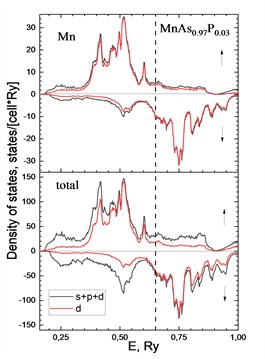
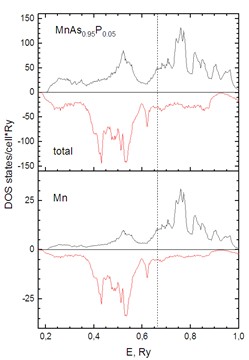
Fig. 3Dependence of interatomic exchange integrals on distance in MnAs0.95P0.05 and in pure MnAs with the lattice parameters of MnAs0.95P0.05
4. Conclusions
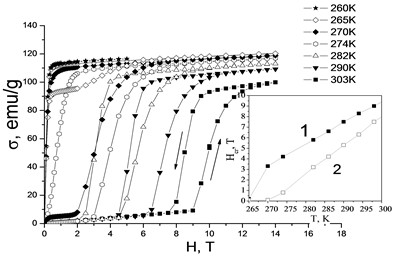
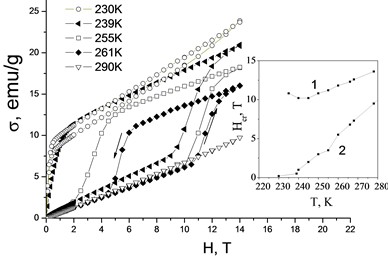
The results of field-dependent magnetization measurements for the MnAs0.95P0.05 sample, conducted in magnetic fields up to 14 T, are shown in Fig. 4. The data reveal a partial restoration of the ferromagnetic phase within the temperature range of approximately 240-320 K, occurring when the applied magnetic field exceeds a critical value (). Notably, this critical field increases substantially beyond 14 T, indicating the stabilization of ferromagnetic ordering under strong external magnetic fields.
The calculated temperature dependence of the magnetic entropy change () for the MnAs0.97P0.03 composition revealed a maximum value of approximately 61 J·kg⁻¹·K⁻¹ near 260 K, corresponding to a magnetic field variation from 0 to 14 T [10]. This pronounced peak in indicates a strong magnetocaloric response in the vicinity of the magnetostructural phase transition, confirming the significant coupling between magnetic and structural degrees of freedom in the system.
It was established that increasing the phosphorus concentration leads to a linear decrease in the lattice parameters. The observed reductions in the a, b, and c parameters can be attributed to the difference in the ionic radii of arsenic and phosphorus atoms. At temperatures above 280 K, the application of a magnetic field of 14 T results in the re-establishment of the ordered ferromagnetic state, which occurs through the reorientation of crystallite magnetization vectors parallel to the external field [14]. As a consequence, the hexagonal B81 phase re-emerges, displaying its characteristic ferromagnetic ordering. The partial substitution of phosphorus enhances the magnetic anisotropy of individual structural blocks, thereby requiring stronger external magnetic fields to stabilize the ferromagnetic phase compared to equiatomic MnAs [14].
Fig. 4a) Field-dependent magnetization curves of the MnAs0.97P0.03 sample recorded during heating and cooling in the vicinity of the phase transition temperature. Inset: temperature dependence of the critical magnetic field Hk, corresponding to the transition from the ferromagnetic ordered state to the disordered state (curve 1) and to the reverse transition (curve 2), b) field dependencies of the magnetization of MnAs0.95P0.05 pnictide near the phase transition temperature. Inset: temperature dependence of the critical magnetic field Hk for the transition from a partially ordered ferromagnetic state to a disordered one – curve 1, and for the reverse transition – curve 2
a)
b)
References
-
V. Franco, J. S. Blázquez, J. J. Ipus, J. Y. Law, L. M. Moreno-Ramírez, and A. Conde, “Magnetocaloric effect: From materials research to refrigeration devices,” Progress in Materials Science, Vol. 93, pp. 112–232, Apr. 2018, https://doi.org/10.1016/j.pmatsci.2017.10.005
-
K. A. Gschneidner, “The magnetocaloric effect, magnetic refrigeration and ductile intermetallic compounds,” Acta Materialia, Vol. 57, No. 1, pp. 18–28, Jan. 2009, https://doi.org/10.1016/j.actamat.2008.08.048
-
V. I. Val’Kov, I. F. Gribanov, B. M. Todris, A. V. Golovchan, and V. I. Mitsiuk, “Features of formation of the magnetocaloric phenomena in Mn1-tTitAs and Mn1-xCrxNiGe Systems,” Physics of the Solid State, Vol. 60, pp. 1125–1133, 2018.
-
V. I. Mitsiuk et al., “Magnetic-field-induced transitions and the inverse magnetocaloric effect at liquid helium temperatures in the Mn1-xCoxNiGe system (0.15 ≤ x < 0.80),” Journal of Magnetism and Magnetic Materials, Vol. 588, p. 171355, Dec. 2023, https://doi.org/10.1016/j.jmmm.2023.171355
-
V. I. Mityuk, G. S. Rimskii, V. I. Val’Kov, A. V. Golovchan, A. V. Mashirov, and V. V. Koledov, “Low temperature features of the magnetic and magnetocaloric properties of the Mn1-xCoxNiGe system (0.05≤x≤0.4),” Physics of Metals and Metallography, Vol. 123, pp. 386–391, 2022.
-
V. I. Valkov et al., “Baric transformation of the nature of magnetic ordering and magnetocaloric properties in the Mn1-xCrxNiGe System,” (in Russian), Physics of Metals and Metallography, Vol. 124, No. 11, pp. 1044–1050, 2023.
-
V. I. Mitsiuk, N. Y. Pankratov, G. A. Govor, S. A. Nikitin, and A. I. Smarzhevskaya, “Magnetostructural phase transitions in manganese arsenide single crystals,” Physics of the Solid State, Vol. 54, No. 10, pp. 1988–1995, Oct. 2012, https://doi.org/10.1134/s1063783412100241
-
V. I. Val’Kov et al., “Magnetic and magnetocaloric effects in systems with reverse first-order transitions,” Physics of the Solid State, Vol. 63, No. 12, pp. 1889–1899, Mar. 2022, https://doi.org/10.1134/s1063783421050188
-
V. I. Mitsiuk et al., “Magnetocaloric effect of Zn-containing manganese pnyctides,” Physics of Metals and Metallography, Vol. 125, No. 14, pp. 1838–1844, Mar. 2025, https://doi.org/10.1134/s0031918x24602336
-
V. I. Mitsiuk et al., “Magnetic and magnetocaloric characteristics of the Mn1.9Cu0.1Sb Alloy,” Journal of Communications Technology and Electronics, Vol. 68, No. 4, pp. 372–377, Apr. 2023, https://doi.org/10.31857/s0033849423040095
-
V. I. Mitsiuk, G. A. Govor, and M. Budzyński, “Reversible phase transitions and magnetocaloric effect in MnAs, MnAs0.99P0.01, and MnAs0.98P0.02 single crystals,” Inorganic Materials, Vol. 49, pp. 14–17, 2013.
-
N. Y. Pankratov, V. I. Mitsiuk, V. M. Ryzhkovskii, and S. A. Nikitin, “Direct measurement of the magnetocaloric effect in MnZnSb intermetalic compound,” Journal of Magnetism and Magnetic Materials, Vol. 470, pp. 46–49, Jan. 2019, https://doi.org/10.1016/j.jmmm.2018.06.035
-
G. A. Govor, A. O. Larin, V. I. Mitsiuk, G. S. Rimskiy, and T. M. Tkachenkа, “Magnetocaloric properties of the single crystal Mn0.99Fe0.01As,” Proceedings of the National Academy of Sciences of Belarus. Physics and Mathematics Series, Vol. 55, No. 1, pp. 118–124, Mar. 2019, https://doi.org/10.29235/1561-2430-2019-55-1-118-124
-
G. A. Govor, V. I. Mitsiuk, S. A. Nikitin, N. Y. Pankratov, and A. I. Smarzhevskaya, “Magnetostructural phase transitions and magnetocaloric effect in Mn(As,P) compounds and their composites,” Journal of Alloys and Compounds, Vol. 801, pp. 428–437, Sep. 2019, https://doi.org/10.1016/j.jallcom.2019.05.345
-
U. Berdiyev, U. Berdiyorov, and M. Toshpulatova, “Problems and tasks of creating energy-saving electric machines,” in Asia-Pacific Conference on Applied Mathematics and Statistics, Vol. 2471, p. 020002, Jan. 2022, https://doi.org/10.1063/5.0089682
-
U. Berdiyev, O. Demedenko, M. Ashurov, F. F. Hasanov, and U. B. Sulaymonov, “Optimization of the method of oxide coating of metallic iron powder particles,” in E3S Web of Conferences, Vol. 383, p. 04039, Apr. 2023, https://doi.org/10.1051/e3sconf/202338304039
-
G. E. Bacon and R. Street, “Magnetic structure of manganese arsenide,” Nature, Vol. 175, No. 4455, pp. 518–518, Mar. 1955, https://doi.org/10.1038/175518a0
-
N. N. Sirota, E. A. Vasilev, and G. A. Govor, “Neutron diffraction study of magnetic and crystallographic phase transformation in manganese arsenide as a function of temperature and pressure,” Le Journal de Physique Colloques, Vol. 32, No. C1, pp. C1–987-C1-989, Feb. 1971, https://doi.org/10.1051/jphyscol:19711351
-
H. Ebert, D. Ködderitzsch, and J. Minár, “Calculating condensed matter properties using the KKR-Green’s function method-recent developments and applications,” Reports on Progress in Physics, Vol. 74, No. 9, p. 096501, Sep. 2011, https://doi.org/10.1088/0034-4885/74/9/096501
-
U. Sulaymonov, A. Jelutkevich, M. Nabiyevna, O. Sayfullayev, and U.B. Berdiyorov, “Research of energy-saving composite materials for electric motors,” in E3S Web of Conferences, Vol. 461, p. 01054, Dec. 2023, https://doi.org/10.1051/e3sconf/202346101054
-
S. H. Vosko and L. Wilk, “Influence of an improved local-spin-density correlation-energy functional on the cohesive energy of alkali metals,” Physical Review B, Vol. 22, No. 8, pp. 3812–3815, Oct. 1980, https://doi.org/10.1103/physrevb.22.3812
-
A. I. Liechtenstein, M. I. Katsnelson, V. P. Antropov, and V. A. Gubanov, “Local spin density functional approach to the theory of exchange interactions in ferromagnetic metals and alloys,” Journal of Magnetism and Magnetic Materials, Vol. 67, No. 1, pp. 65–74, May 1987, https://doi.org/10.1016/0304-8853(87)90721-9
-
U. Berdiyev, U. Sulaymonov, and Z. Mirakhmedova, “Use of composite alloys for two stator-valve electric motors,” in E3S Web of Conferences, Vol. 461, p. 01081, Dec. 2023, https://doi.org/10.1051/e3sconf/202346101081
-
N. Pirmatov, S. Mahamadjonov, M. Matqosimov, and H. Haydarov, “Characteristics of the static and dynamic operating modes of the asynchronous generator in renewable energy sources and the production of electric energy control through a frequency converter,” in E3S Web of Conferences, Vol. 480, p. 01007, Jan. 2024, https://doi.org/10.1051/e3sconf/202448001007
-
N. Pirmatov, M. Matqosimov, S. Mahamadjonov, and S. Sayitov, “Analysis of various operating modes of the microhpp asynchronous generator using the Matlab Simulink program,” in E3S Web of Conferences, Vol. 508, p. 02012, Apr. 2024, https://doi.org/10.1051/e3sconf/202450802012
-
N. Pirmatov, M. Matqosimov, S. Mahamadjonov, and E. Xolmatov, “Investigation of transients in asynchronous generators used in microhydroelectric power plants,” in E3S Web of Conferences, Vol. 508, p. 02007, Apr. 2024, https://doi.org/10.1051/e3sconf/202450802007
-
M. Makhsudov and D. Karimjonov, “Research algorithm and dynamic characteristics of three-phase electromagnetic current transducers in filter-compensation devices,” in E3S Web of Conferences, Vol. 461, p. 01056, Dec. 2023, https://doi.org/10.1051/e3sconf/202346101056
-
M. Makhsudov, D. Karimjonov, A. Abdumalikov, A. Jalilov, and M. Yigitaliyev, “Method of determination current and power factor based on the output signal,” in International Scientific Conference on Modern Problems of Applied Science and Engineering: MPASE2024, Vol. 3244, p. 060009, Jan. 2024, https://doi.org/10.1063/5.0241566
-
J. A. Nizamov, “Device for measuring the magnetic field of scattering of the winding of a short-circuited rotor of an asynchronous motor for general industrial applications,” International Journal of Advanced Research in Science, Engineering and Technology, Vol. 10, No. 4, pp. 20517–20519, 2023.
-
N. B. Pirmatov, J. A. Nizamov, S. O. Ergashov, and D. I. Kurbanbaeva, “Calculation and measurement of the stray magnetic field in the elbow part of the rotor winding of an asynchronous motor,” (in Uzbek), Journal of Problems of Informatics and Energy, No. 6, pp. 58–66, 2023.
-
N. B. Pirmatov and J. A. Nizamov, “Study of a device for measuring the stray magnetic field in the elbow section of the squirrel-cage induction motor winding,” (in Uzbek), Development of Science and Technology, No. 6, pp. 177–181, 2023.
-
J. A. Nizamov, S. O. Ergashov, O. N. Berdiyorov, and U. N. Berdiyorov, “Device for measuring the resulting magnetic field of the stator winding of asynchronous motor for general industrial application,” in 3rd International Scientific and Technical Conference “Actual Issues of Power Supply Systems” (ICAIPSS2023), Vol. 3152, p. 050013, Jan. 2024, https://doi.org/10.1063/5.0218809
-
N. B. Pirmatov, J. A. Nizamov, and Sh. O. Ergashev, “Magnetic field in the air gap of an induction motor general inspection information applications,” The American Journal of Engineering and Technology, Vol. 5, No. 11, pp. 139–143, Nov. 2023, https://doi.org/10.37547/tajet/volume05issue11-20
-
N. B. Pirmatov, J. A. Nizamov, and S. O. Ergashev, “Experiments with asynchronous motors external magnetic fields,” International Bulletin of Applied Science and Technology, Vol. 3, No. 11, pp. 205–210, 2023.
-
J. A. Nizamov, “Experiments conducted on induction motors,” in Proceedings of the Republic Scientific-Technical Conference Electrical Engineering, Electromechanics, Electrotechnologies, and Electrotechnical Materials, Vol. 2, No. 1, pp. 681–686, 2023.
-
I. A. Ovchenkova et al., “The influence of substitutions in 3d sublattice on the exchange interactions in compounds based on NdMnGe,” IEEE Transactions on Magnetics, Vol. 52, No. 5, pp. 2500304–2500304, 2016, https://doi.org/2500304
About this article

The work was carried out with the support of the international joint project “Uzbekistan-Belarus” as part of state programs for scientific activities (BRFBR No. T25UZB-053 and FL-882406332).
The datasets generated during and/or analyzed during the current study are available from the corresponding author on reasonable request.
The authors declare that they have no conflict of interest.

