Abstract
The invention relates to the development and application of a polymer additive for asphalt concrete mixtures aimed at enhancing the mechanical and durability properties of road pavements. The study introduces a composite additive consisting of polyurethane-coated modified basalt fiber (38.0–42.0 wt.%) and recycled polyethylene (rPE) (58.0-62.0 wt.%). The additive can be incorporated into dense-graded or stone-mastic asphalt concrete at controlled dosages, ensuring uniform distribution throughout the mixture. Laboratory tests have demonstrated that asphalt concrete containing the polymer additive exhibits higher stability, improved tensile strength, and reduced water susceptibility compared to conventional mixtures. The additive also contributes to the environmental sustainability of road construction by enabling the partial use of recycled asphalt pavement (RAP) materials without compromising performance. The method of preparation involves precise heating, blending, and homogenization steps to maintain the optimal physical properties of the polymer, ensuring compatibility with the bitumen matrix. This innovation is particularly suitable for regions experiencing extreme temperature fluctuations and heavy traffic loads, providing longer pavement service life and reducing maintenance costs. The polymer additive can be adapted for various asphalt mix designs and construction technologies, offering flexibility for both new road construction and rehabilitation projects. Overall, the use of this polymer additive in asphalt concrete mixtures represents a significant advancement in pavement engineering, combining improved structural performance, economic efficiency, and environmental benefits. The additive is compatible with existing asphalt production facilities and can be easily integrated into standard asphalt mixing processes, promoting widespread adoption in modern road construction practices.
Highlights
- A novel polymer additive combining polyurethane-coated basalt fibers and recycled polyethylene creates a 3D reinforcement skeleton, significantly enhancing the interfacial adhesion between the mineral aggregate and the bitumen matrix.
- The optimized composite additive achieves a remarkable 3.7-fold reduction in average rut depth (from 10.06 mm to 2.01 mm), offering superior resistance to permanent plastic deformation under heavy traffic and extreme climate conditions.
- Incorporating the modified basalt fiber modifier increases the asphalt's shear adhesion by 30–35% and boosts its compressive strength at high temperatures (50 °C) by up to 60% compared to conventional mixtures.
1. Introduction
Currently, comprehensive measures aimed at designing and constructing high-quality automobile roads are being implemented, resulting in significant achievements. Following the National Strategy defined in Resolution No. PR-307, the Resolution of the President of the Republic of Uzbekistan No. PR-307 dated July 6, 2022, “On organizational measures for the implementation of the Innovation Development Strategy of the Republic of Uzbekistan for 2022-2026”, defines important tasks related to the production of stone mastic asphalt mixtures and the construction of experimental test road sections [1].
The implementation of these tasks requires the development of new types of products and innovative technologies in the road sector, aimed at increasing the service life of road pavements and producing modern composite materials for construction purposes.
This research is related to construction materials and is intended for the preparation of mixtures used in the construction of polymer asphalt concrete pavements for highways, airfields, and urban streets.
Currently, various polymer additives are used in the Republic to ensure the heat resistance and crack resistance of polymer asphalt concrete mixtures, including PKM (Ukraine), RW Elast (France), Butanol 5126 (Germany), PR Plast (France), and others [GOST 9128-2013: Asphalt concrete and polymer asphalt concrete mixtures for roads and airfields. Technical specifications] [2].
However, the disadvantage of these polymer additives is their insufficient resistance to shear deformation under high temperatures and heavy traffic loads when applied in the road and climatic conditions of Uzbekistan. As a result, rutting occurs in polymer asphalt concrete pavements.
A polymer stabilizing additive containing polyethylene polyamine, BND 60/90 paving-grade petroleum bitumen, polyamide fiber, polymer-dispersed additives, and surface-active agents is known (RU 2272795, IPC C04V 26/26) [3].
The closest analogue in terms of technical essence and achieved effect is a material with the following composition, wt.%: crushed plastic household waste – polyethylene (PET) and polypropylene (PP) 20-60; reclaimed asphalt pavement (RAP) 40–80 (RU 2737926 C1) [4].
The disadvantages of the known material include incomplete adaptation of the raw materials to the road and climatic conditions of Uzbekistan, as well as increased plastic deformation under dry and hot climatic conditions, which reduces shear resistance. In addition, the material is not produced domestically, resulting in high costs and logistical difficulties due to importation.
The objective of this study is to develop an asphalt concrete mixture containing a polymer additive based on polyurethane-coated modified basalt fiber, which ensures improved heat resistance of the mixture and increased shear resistance of the pavement due to reduced plastic deformation.
The scientific novelty of this research lies in the dual-phase modification mechanism: where polyurethane-coated basalt fibers provide a 3D reinforcing skeleton, while recycled polyethylene (rPE) serves as a visco-elastic filler. This synergy significantly improves the interfacial adhesion between the mineral aggregate and the bitumen matrix, achieving a 3.7-fold improvement in rutting resistance–a performance metric previously unattained with single-modifier systems in the extreme climatic conditions of Central Asia.
2. Materials and methods
2.1. Polymer additive composition and preparation
To achieve this objective, a polymer additive consisting of polyurethane-coated modified basalt fiber and recycled polyethylene (rPE) was developed with the following component ratio, wt.%:
– Polyurethane-coated modified basalt fiber: 38.0-42.0.
– Recycled polyethylene (rPE): 58.0-62.0.
To obtain the polymer additive, the polyurethane-coated modified basalt fiber and recycled polyethylene (rPE) were heated to 140-150 °C, mixed thoroughly, and granulated.
The choice of polyurethane as a coating for basalt fibers is strategic. Polyurethane acts as an 'interfacial bridge' (molecular bridge) between the inorganic basalt surface and the organic bitumen matrix. Its polar functional groups create strong chemical bonds with the silicate structure of the fiber, while its elastomeric nature ensures compatibility with the bitumen. This synergy significantly enhances the interfacial shear strength, preventing fiber pull-out and improving the overall stability of the asphalt matrix.
2.2. Materials and methods
The following materials were used for the preparation of the polymer additive.
Modified basalt fiber, produced in accordance with O‘zMSt ASTM D8448/D8448M:2024 [5]. The fiber is obtained by treating basalt filaments with polymers, organic binders, lubricants, and other viscous materials. Possible polymer coatings include epoxy resin, polypropylene, polyurethane, polyester, vinyl ester, and others.
The chemical composition of basalt fiber includes SiO2 (45-57 %), CaO (5-11 %), MgO (3-7 %), Al2O3 (10-19 %), Fe2O3 + FeO (8-16 %), TiO2 (0.5-4.0 %). The fiber density is 2,80 g/cm3, filament diameter is 13-20 μm, and fiber length ranges from 3 to 30 mm.
The tensile strength of the modified basalt fiber is 3500 MPa, which exceeds that of polypropylene, glass, and steel fibers. The working temperature range is from −260 to +700 °C, with short-term resistance up to 900 °C. The melting point is 1450 °C. The fiber exhibits high resistance to acids and alkalis and provides excellent adhesion within asphalt mixtures.
The polyurethane-coated basalt fiber contains 98 wt.% basalt fiber and 2 wt.% polyurethane. In this study, 6 mm long polyurethane-modified basalt fiber was used. Polyurethane is a high-molecular-weight elastomer characterized by flexibility and elasticity, which significantly enhances the mechanical and performance properties of asphalt concrete mixtures. Its operating temperature range is from −60 °C to +80 °C, and viscosity at 25 °C is 2550 MPa·s.
Recycled polyethylene (rPE), a recycled polyethylene material obtained from plastic waste. It is widely used in the production of new products such as pipes, films, and containers, contributing to resource conservation and environmental protection. Its density ranges from 0.91 to 0.96 g/cm3, melting temperature is approximately 105-130 °C, and it exhibits high resistance to water, acids, alkalis, and many chemical substances.
Table 1Physical and mechanical properties of the recycled polyethylene (rPE)
Property | Unit | Value | Test Method |
Density | g/cm3 | 0.92 – 0.95 | ISO 1183 |
Melt Flow Index (MFI) | g/10 min | 2.0 – 4.5 | ISO 1133 |
Melting Temperature | °C | 125 – 135 | DSC Analysis |
Tensile Strength | MPa | 18 – 24 | ISO 527 |
2.3. Preparation process
To obtain the composite additive, the components were processed using a specialized thermo-mechanical method. The preparation involved thermo-mechanical homogenization in a W-70 twin-screw extruder. The processing temperature was maintained at 140-150 °C to ensure the recycled polyethylene (rPE) reached a sufficiently low viscosity to fully encapsulate the pre-treated basalt fibers. The resulting composite was extruded and immediately granulated to maintain a uniform distribution of fibers within the polymer carrier.
2.4. Experimental design and testing
Numerous experimental compositions were prepared using different component ratios (Table 2). The mixtures were produced using dedicated equipment, and based on test results, the optimal composition of the polymer additive was determined.
Table 2Compositions of the polymer additive, wt.%
Composition | Comp.1 | Comp.2 | Comp.3 | Comp.4 | Comp.5 |
Modified basalt fiber | 38 | 35 | 32 | 30 | 28 |
recycled polyethylene (rPE) | 62 | 65 | 68 | 70 | 72 |
To prepare 1000 g of polymer additive:
– 380-420 g of polyurethane-coated modified basalt fiber.
– 580-620 g of recycled polyethylene (rPE) were mixed in a W-70 extruder under heated conditions. The resulting mass was immediately granulated before cooling. The technical properties of the obtained material are presented in Table 2.
Table 3Technical characteristics of the obtained composition
Indicator name | Parameter values, % | |||||
Specified value, % | Proposed value, % | |||||
No. 1 | No. 2 | No. 3 | No. 4 | No. 5 | ||
Moisture content, by weight | Up to 8.0 | 0.0 | 0.0 | 0.0 | 0.0 | 0.0 |
Heat resistance determined by mass change when heated at 220 °C | Up to 8.0 | 4.0 | 6.3 | 8.0 | 9.5 | 10.3 |
Fibers with a length from 0.1 mm to 2.0 mm | Not less than 80 | 90 | 80 | 65 | 60 | 50 |
To evaluate the physical, mechanical, and performance properties of asphalt concrete mixtures containing the proposed polymer additive, the following materials were used:
– Gabbro-diabase crushed stone (5-10 mm and 10-20 mm) in accordance with GOST 8267-93 [6].
– Crushed gabbro-diabase sand (0-5 mm) in accordance with GOST 31424-2010 [7].
– Non-activated limestone mineral filler grade MP-1 in accordance with GOST 16557-2005 [8].
– Paving-grade petroleum bitumen BND 60/90 in accordance with GOST 22245-90 [9].
– Polymer additive based on basalt fiber.
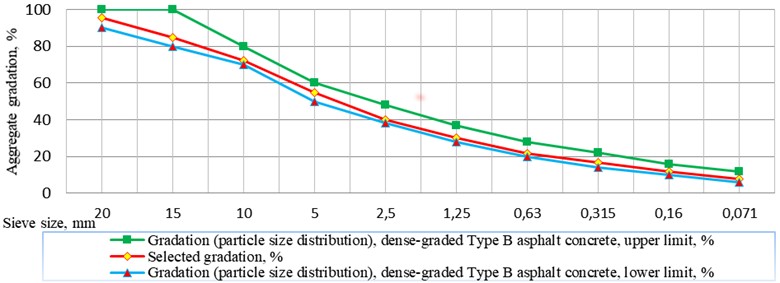
The asphalt concrete mixture containing the new polymer additive was prepared according to standard production technology (Table 4 and Fig. 1). The suitability of the polymer additive and the optimal mixture composition were determined based on the physical and mechanical properties of the asphalt concrete mixture in accordance with GOST 9128-2013 requirements.
Table 4Asphalt concrete mixture composition, %
Material name | Material | Content, % |
Gabbro-diabase crushed stone, 10-20 mm fraction | Coarse aggregate | 29.63 |
Gabbro-diabase crushed stone, 5-10 mm fraction | Medium aggregate | 15.25 |
Gabbro-diabase crushed sand, 0-5 mm fraction | Crushed sand | 42.53 |
Limestone mineral filler | Mineral filler | 7.00 |
Road viscous petroleum bitumen, grade BND 60/90 | Binder | 5.40 |
Polymer additive | Modifier | 0.19 |
Fig. 1Nomogram of the selected mix design for dense-graded type B asphalt concrete
3. Results
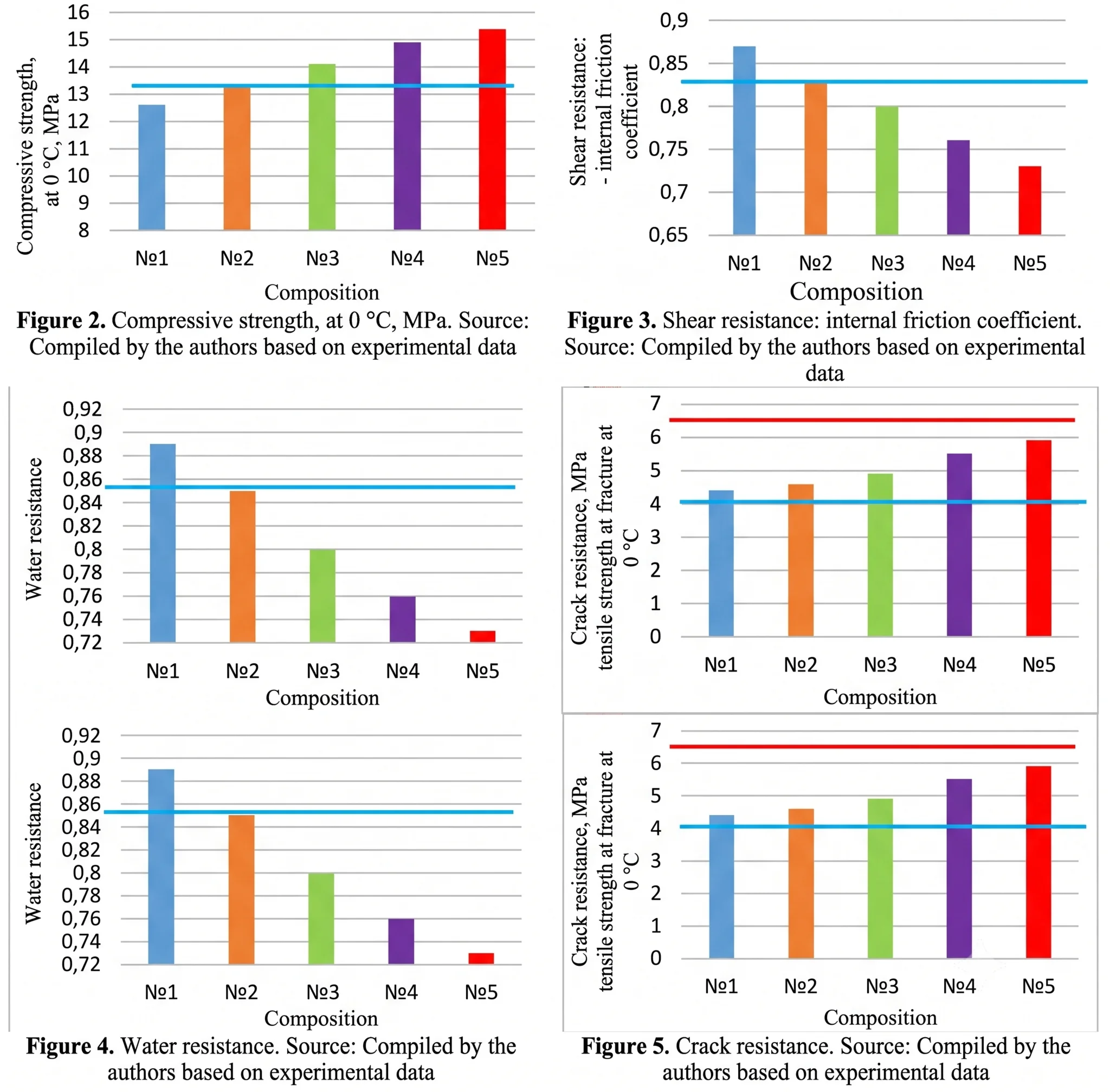
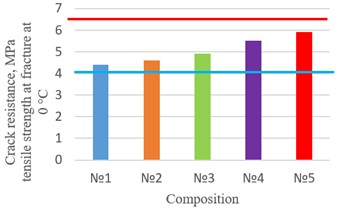
Test specimens were prepared and tested in accordance with GOST 12801-98 [10] and O‘zDSt 3610:2022 [11]. Five asphalt concrete mixtures with identical aggregate gradation but varying polymer additive compositions were produced. The test results are summarized in Table 5 and Fig. 2-5.
The results demonstrate that increasing the content of polyurethane-coated modified basalt fiber improves compressive strength at 20 °C and 50 °C, shear adhesion, crack resistance, and rutting resistance. The average rut depth was reduced from 10.06 mm in the control mixture to 2.01 mm in the optimized composition.
Table 5Physical and mechanical properties of hot dense fine-grained asphalt concrete mixture, type B, grade I
Indicator name | Parameter values, % | |||||
Specified value | Proposed value, % | |||||
No. 1 | No. 2 | No. 3 | No. 4 | No. 5 | ||
Air voids in the mineral aggregate (VMA), % | 14-19 | 16.5 | 16.4 | 16.3 | 16.2 | 16.0 |
Residual air voids (air void content), % | 2,5-5.0 | 3.0 | 2.7 | 2.5 | 2.2 | 1.9 |
Water absorption, % – of laboratory-compacted specimens – of cut sections and core samples of the finished pavement, not more than | 4.5 1.0-4.0 | 2.7 2.5 | 2.6 2.2 | 2.0 2.4 | 1.6 1.9 | 1.2 1.6 |
Compressive strength, MPa – at 20 °C, not less than 20 °C – at 50 °C, not less than 50 °C – at 0 °C, not more than 0 °C | 2.5 1.3 13.0 | 7.0 2.5 12.6 | 7.6 2.7 13.3 | 8.2 3.3 14.1 | 8.6 3.5 14.9 | 9.1 3.7 15.4 |
Shear resistance: – internal friction coefficient, not less than – shear adhesion at 50 °C, MPa, not less than | 0.83 0.38 | 0.87 0.52 | 0.83 0.67 | 0.80 0.75 | 0.76 0.86 | 0.73 0.92 |
Crack resistance, MPa tensile strength at fracture at 0 °C | 4.0-6.5 | 4.4 | 4.6 | 4.9 | 5.5 | 5.9 |
Water resistance under prolonged water saturation, not less than | 0.75 | 0.80 | 0.75 | 0.71 | 0.68 | 0.63 |
Water resistance, not less than | 0.85 | 0.89 | 0.85 | 0.80 | 0.76 | 0.73 |
Average rut depth, mm | 10.06 | 2.73 | 2.60 | 2.43 | 2.25 | 2.01 |
Fig. 2Compressive strength, at 0 °C, MPa
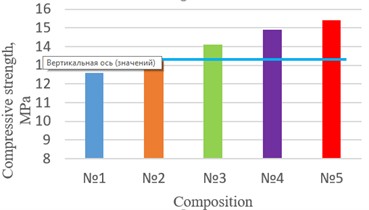
Fig. 3Shear resistance: internal friction coefficient
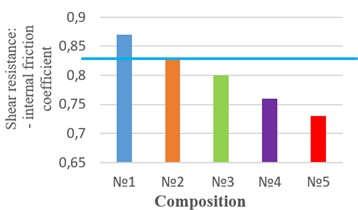
Fig. 4Water resistance
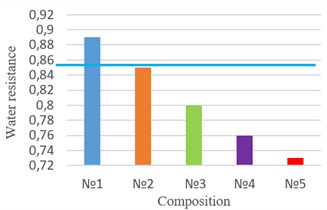
Fig. 5Crack resistance
4. Conclusions
The study concludes that the developed polymer additive, based on a 40:60 ratio of polyurethane-coated basalt fiber and recycled polyethylene, provides a superior modification effect for asphalt mixtures.
1) Mechanical synergy: The interaction between the high-tensile basalt fibers and the elastic polyurethane coating creates a reinforcement network that increases shear adhesion by 30-35 % and compressive strength at high temperatures (50 °C) by up to 60 %.
2) Deformation resistance: A critical finding of this research is the 3.7-fold reduction in average rut depth, decreasing from 10.06 mm in conventional mixtures to 2.01 mm in the optimized composition. This is attributed to the 3D reinforcement network created by the polyurethane-coated basalt fibers within the bitumen matrix, which provides superior resistance to plastic deformation under heavy traffic loads and high ambient temperatures.
3) Sustainability: The use of recycled polyethylene demonstrates a viable pathway for “Green Construction”, reducing the carbon footprint of road projects without compromising structural integrity.
4) Practical implication: The additive is fully compatible with standard asphalt mixing plants, requiring no additional infrastructure, which facilitates its rapid adoption in BRT and highway projects.
References
-
“Resolution of the President of the Republic of Uzbekistan No. PR-307 dated July 6, 2022, on organizational measures for the implementation of the Innovation Development Strategy of the Republic of Uzbekistan for 2022-2026,” Republic of Uzbekistan, Jul. 2022.
-
“Asphalt concrete mixtures, polymer asphalt concrete mixtures, asphalt concrete and polymer asphalt concrete for highways and airfields. Technical specifications,” Standartinform, Moscow, GOST 9128-2013, 2014.
-
S. K. Iliopov, I. V. Mardirosova, K. A. Dyakov, and A. K. Shcheglov, “Polymer-reinforcing granulated stabilizer for crushed stone-mastic asphalt concrete,” Patent No. 2272795, IPC C04B 26/26, 2006.
-
T. V. Andrukhova and A. A. Krutskikh, “Method for producing a polymer asphalt concrete mixture,” Patent No. RU 2737926 C1, 2020.
-
“Standard Classification of Basalt Fiber Yarns,” O'zMSt ASTM, D8448/D8448M:2024, 2024.
-
“Crushed stone and gravel from dense rocks for construction works. Technical specifications,” Standartinform, Moscow, GOST 8267-93, 2018.
-
“Non-metallic construction materials obtained from crushing dense rock during crushed stone production. Technical specifications,” Standartinform, Moscow, GOST 31424-2010, 2011.
-
“Mineral filler for asphalt concrete mixtures. Technical specifications,” Standartinform, Moscow, GOST 16557-2005, 2006.
-
“Viscous petroleum road bitumens, technical specifications,” GOST 22245-90, 1990.
-
“Materials based on organic binders for road and airfield construction. Test methods,” Standartinform, Moscow, GOST 12801-98, 2005.
-
“Stone mastic polymer asphalt concrete mixtures and stone mastic polymer asphalt concrete for roads and airfields,” Tashkent, UzDSt 3610:2022, 2022.
-
C. Zhang, “Effect of basalt fiber on properties of asphalt and asphalt mixture,” Highlights in Science, Engineering and Technology, Vol. 28, pp. 367–373, 2022, https://doi.org/10.54097/hset.v28i.4203
-
C. Li, W. Zhang, G. Sun, Y. Li, and Y. Zhang, “Research on damping properties and microscopic mechanism of polyurethane cement-based composites,” Construction and Building Materials, Vol. 365, p. 130137, 2023, https://doi.org/10.1016/j.conbuildmat.2022.130137
-
C. Raupov and G. Malikov, “Comparison of microcrack formation boundaries determined by complex of physical methods with long-term strength of expanded clay concrete under different types of stress state,” E3S Web of Conferences, Vol. 365, p. 02023, Jan. 2023, https://doi.org/10.1051/e3sconf/202336502023
-
C. Raupov and G. Malikov, “Creep in expanded clay concrete at different levels of stress under compression and tension,” E3S Web of Conferences, Vol. 365, p. 02008, Jan. 2023, https://doi.org/10.1051/e3sconf/202336502008
-
N.M. Mukhammadiev and G. Malikov, “Use of basalt fiber in concrete mixture for manufacture of prefabricated concrete and reinforced concrete structures,” in AIP Conference Proceedings, Vol. 3317, No. 1, p. 030043, Jan. 2025, https://doi.org/10.1063/5.0266812
-
V. Tsoy, D. Abdullaeva, and N.M. Mukhammadiyev, “Influence of silica-containing additives on structure formation of composite cement binder for non-autoclaved aerated concrete,” in AIP Conference Proceedings, Vol. 3045, No. 1, p. 060019, Jan. 2024, https://doi.org/10.1063/5.0197488
About this article

The authors have not disclosed any funding.
The datasets generated during and/or analyzed during the current study are available from the corresponding author on reasonable request.
The authors declare that they have no conflict of interest.

